
Lexical Pragmatics Meets Embodied Cognition Two Case Studies
Lexical Pragmatics Meets Embodied Cognition: Two Case Studies Reinhard Blutner department of philosophy Uv. A 2005 9/16/2005 Workshop on ‘Word Meaning, Concepts and Communication’ 1
0 Introduction Three reasons why lexical pragmatics should be based on an embodied view of cognition –neural embodiment –phenomenological embodiment –cultural embodiment 9/16/2005 Workshop on ‘Word Meaning, Concepts and Communication’
The Phenomenon ¨ Lexical Narrowing – all doctors drink – please smoke inside ¨ Approximation – this laptop cost 1000 dollars – this man runs round the block (barrier, corner) * ¨ Metaphorical Extension – I see the tree – I see what you’re getting at – I smell what you’re getting at ** * Zwarts 2003 ** Sweetser 1990 9/16/2005 Workshop on ‘Word Meaning, Concepts and Communication’ 3

Embodied Cognition • Cambrian Intelligence by Rodney Brooks (1999) • Philosophy in the Flesh by George Lakoff and Mark Johnson (1999) • Where the Action Is by Paul Dourish (2001) Heidegger 9/16/2005 Merleau-Ponty Workshop on ‘Word Meaning, Concepts and Communication’ 4
Embodied Cognition Manifesto ¨ Reductionst aspect: The system must be realised in a coherent, integral physical/biological structure. ¨ Grounding aspect: – Basic concepts and words derive their meaning from embodied experience. – Abstract and theoretical concepts derive their meaning from metaphorical maps to more basic embodied concepts. ¨ Evolutionary aspect: The explanation of the behaviour must include reference to cultural evolution. – This derives from the observation that intelligence lies less in he individual brain and more in the dynamic interaction of brains with the wider world including especially the social and cultural worlds 9/16/2005 Workshop on ‘Word Meaning, Concepts and Communication’ 5
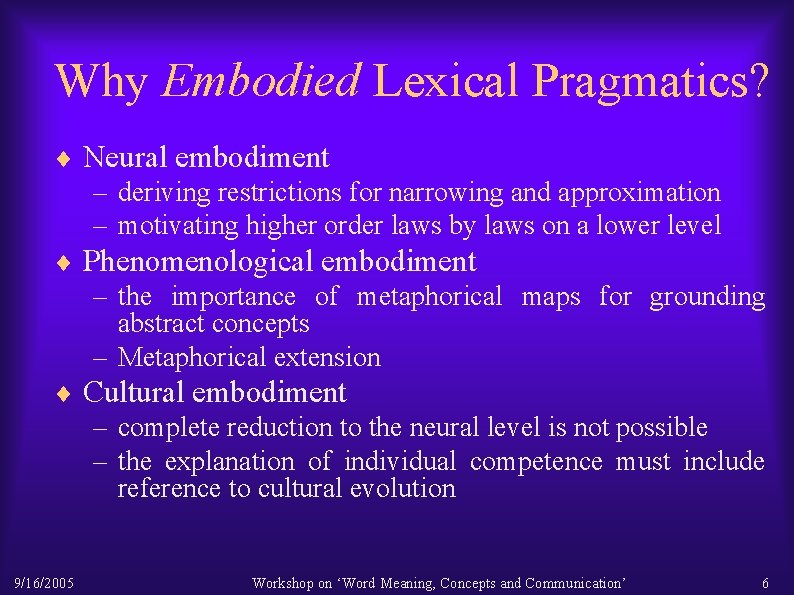
Why Embodied Lexical Pragmatics? ¨ Neural embodiment – deriving restrictions for narrowing and approximation – motivating higher order laws by laws on a lower level ¨ Phenomenological embodiment – the importance of metaphorical maps for grounding abstract concepts – Metaphorical extension ¨ Cultural embodiment – complete reduction to the neural level is not possible – the explanation of individual competence must include reference to cultural evolution 9/16/2005 Workshop on ‘Word Meaning, Concepts and Communication’ 6
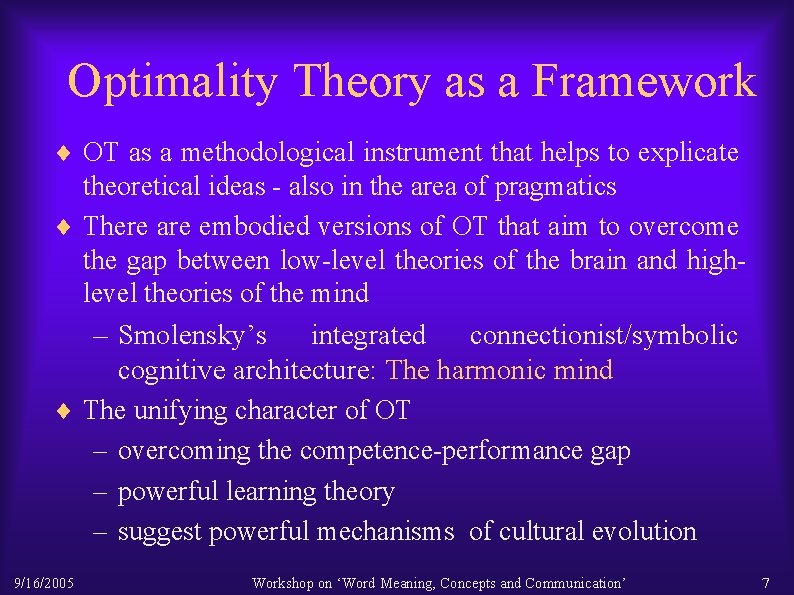
Optimality Theory as a Framework ¨ OT as a methodological instrument that helps to explicate theoretical ideas - also in the area of pragmatics ¨ There are embodied versions of OT that aim to overcome the gap between low-level theories of the brain and highlevel theories of the mind – Smolensky’s integrated connectionist/symbolic cognitive architecture: The harmonic mind ¨ The unifying character of OT – overcoming the competence-performance gap – powerful learning theory – suggest powerful mechanisms of cultural evolution 9/16/2005 Workshop on ‘Word Meaning, Concepts and Communication’ 7
Outline 1. 2. 3. 4. 5. 9/16/2005 Pragmatics in OT Pragmatics of adjectives and the phenomenon of blending The interplay between broadening and narrowing Iconicity and the need for cultural embodiment Conclusions Workshop on ‘Word Meaning, Concepts and Communication’ 8
1 Pragmatics in OT Ø Ø 9/16/2005 Radical pragmatics Optimality theory Bidirectional OT and conversational implicatures Strong and weak bidirection Workshop on ‘Word Meaning, Concepts and Communication’

Radical Pragmatics Radical pragmatics is the hypothesis that many linguistic phenomena which had previously been viewed as belonging to the semantic subsystem, in fact belong to the pragmatic subsystem. Preface to Radical Pragmatics (Peter Cole, ed. , Academic Press ¨ Division of labor between semantics and pragmatics 1981) – Discriminating meaning and interpretation – The idea of underspecification (e. g. Carston 2002) ¨ Gricean mechanism of interpretation – Neo-Gricean account (Atlas & Levinson 1981, Horn 1985, . . . ) – Relevance Theory (Sperber & Wilson 1986, Carston 1998, . . . ) 9/16/2005 Workshop on ‘Word Meaning, Concepts and Communication’ 10
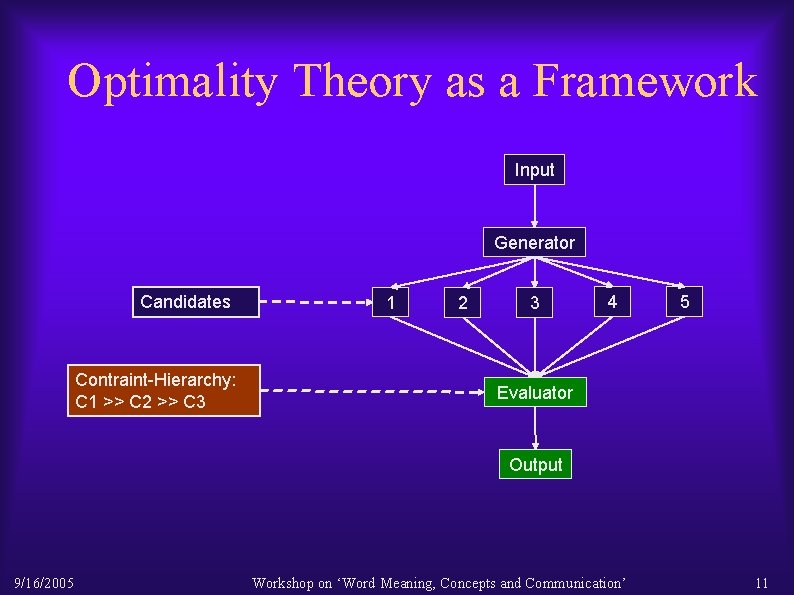
Optimality Theory as a Framework Input Generator Candidates Contraint-Hierarchy: C 1 >> C 2 >> C 3 1 2 3 4 5 Evaluator Output 9/16/2005 Workshop on ‘Word Meaning, Concepts and Communication’ 11
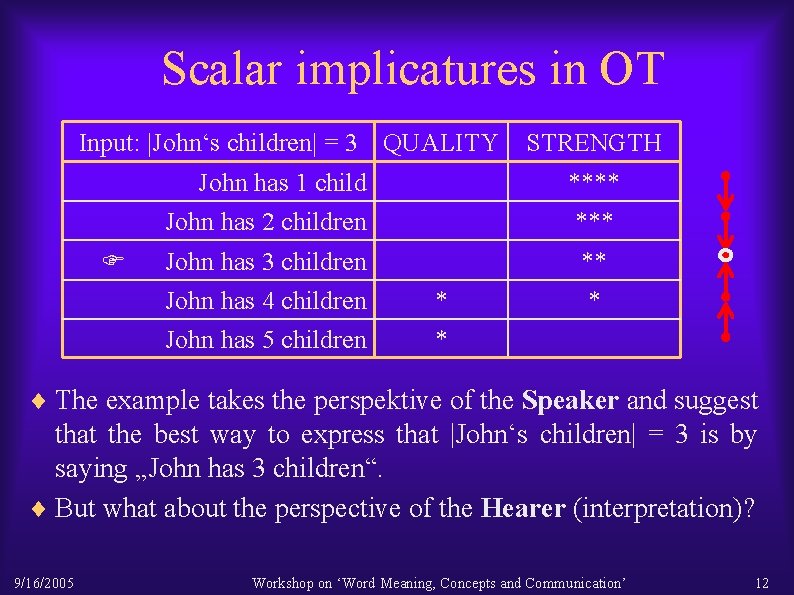
Scalar implicatures in OT Input: |John‘s children| = 3 QUALITY STRENGTH John has 1 child **** John has 2 children *** John has 3 children ** John has 4 children John has 5 children * * * ¨ The example takes the perspektive of the Speaker and suggest that the best way to express that |John‘s children| = 3 is by saying „John has 3 children“. ¨ But what about the perspective of the Hearer (interpretation)? 9/16/2005 Workshop on ‘Word Meaning, Concepts and Communication’ 12
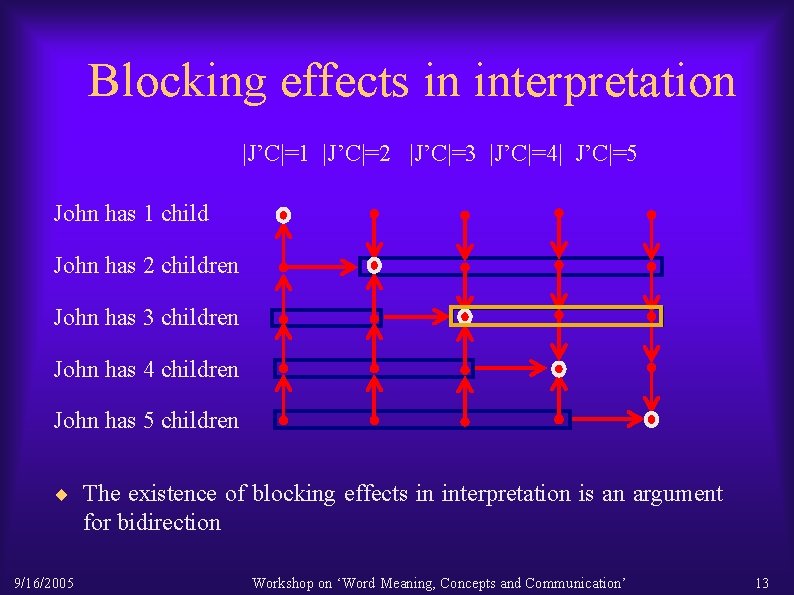
Blocking effects in interpretation |J’C|=1 |J’C|=2 |J’C|=3 |J’C|=4| J’C|=5 John has 1 child John has 2 children John has 3 children John has 4 children John has 5 children ¨ The existence of blocking effects in interpretation is an argument for bidirection 9/16/2005 Workshop on ‘Word Meaning, Concepts and Communication’ 13
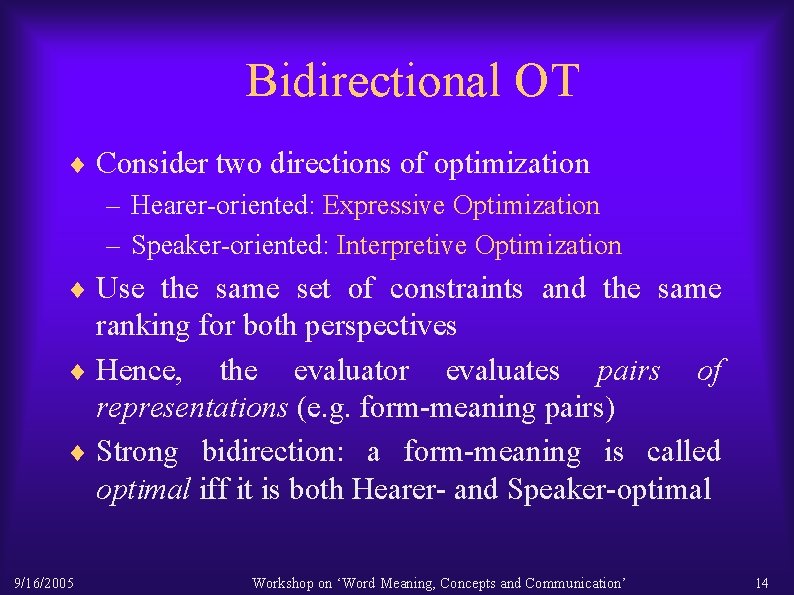
Bidirectional OT ¨ Consider two directions of optimization – Hearer-oriented: Expressive Optimization – Speaker-oriented: Interpretive Optimization ¨ Use the same set of constraints and the same ranking for both perspectives ¨ Hence, the evaluator evaluates pairs of representations (e. g. form-meaning pairs) ¨ Strong bidirection: a form-meaning is called optimal iff it is both Hearer- and Speaker-optimal 9/16/2005 Workshop on ‘Word Meaning, Concepts and Communication’ 14
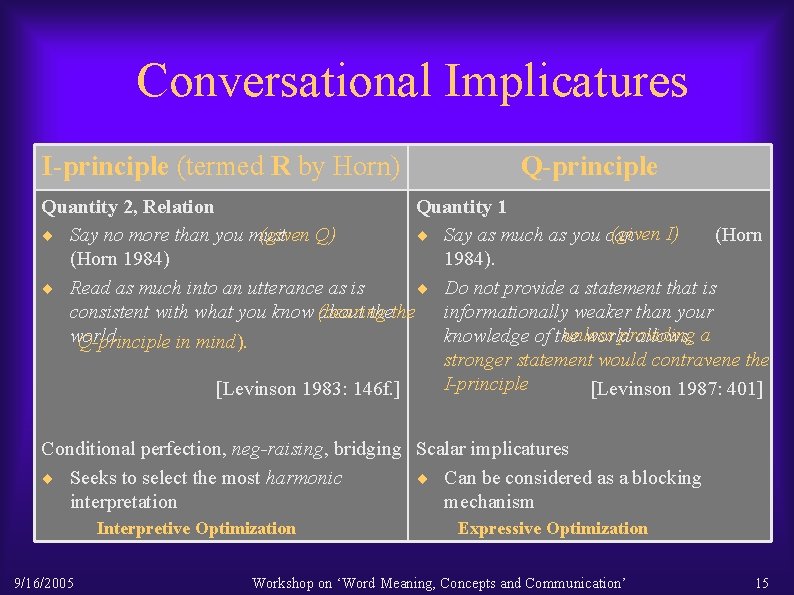
Conversational Implicatures I-principle (termed R by Horn) Q-principle Quantity 2, Relation Quantity 1 (given I) (given Q) ¨ Say no more than you must ¨ Say as much as you can (Horn 1984). ¨ Read as much into an utterance as is ¨ Do not provide a statement that is consistent with what you know (bearing about thethe informationally weaker than your unless providing world knowledge of the world allows, a Q-principle in mind). stronger statement would contravene the I-principle [Levinson 1983: 146 f. ] [Levinson 1987: 401] Conditional perfection, neg-raising, bridging Scalar implicatures ¨ Seeks to select the most harmonic ¨ Can be considered as a blocking interpretation mechanism Interpretive Optimization 9/16/2005 Expressive Optimization Workshop on ‘Word Meaning, Concepts and Communication’ 15
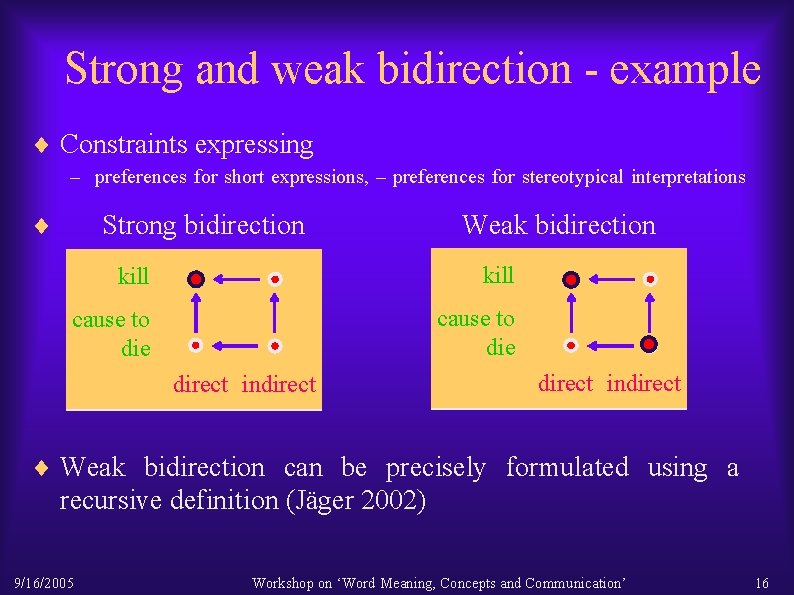
Strong and weak bidirection - example ¨ Constraints expressing – preferences for short expressions, – preferences for stereotypical interpretations ¨ Strong bidirection Weak bidirection kill cause to die direct indirect ¨ Weak bidirection can be precisely formulated using a recursive definition (Jäger 2002) 9/16/2005 Workshop on ‘Word Meaning, Concepts and Communication’ 16
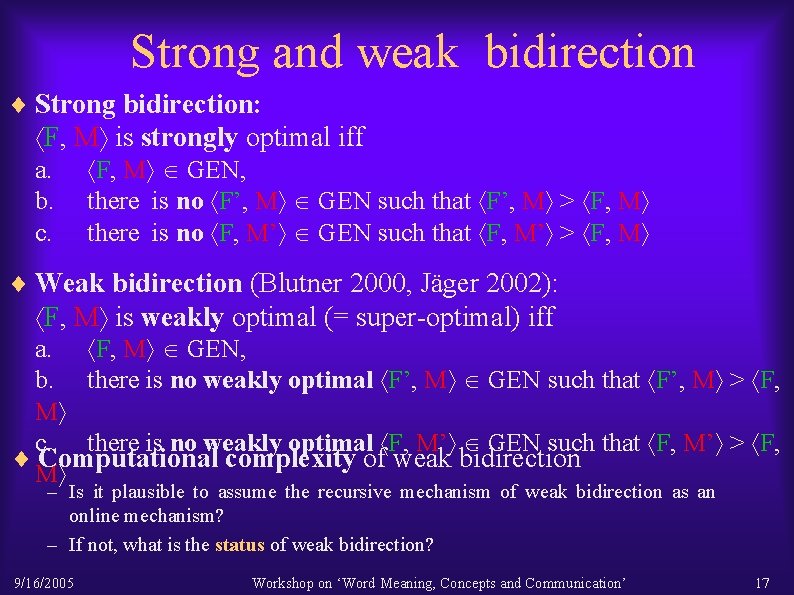
Strong and weak bidirection ¨ Strong bidirection: F, M is strongly optimal iff a. b. c. F, M GEN, there is no F’, M GEN such that F’, M > F, M there is no F, M’ GEN such that F, M’ > F, M ¨ Weak bidirection (Blutner 2000, Jäger 2002): F, M is weakly optimal (= super-optimal) iff a. F, M GEN, b. there is no weakly optimal F’, M GEN such that F’, M > F, M c. there is no weakly optimal F, M’ GEN such that F, M’ > F, ¨ Computational complexity of weak bidirection M – Is it plausible to assume the recursive mechanism of weak bidirection as an online mechanism? – If not, what is the status of weak bidirection? 9/16/2005 Workshop on ‘Word Meaning, Concepts and Communication’ 17
2 The Pragmatics of Adjectives Ø Ø Ø 9/16/2005 Three types of adjectives White triangles and red apples The underspecification view Contextual enrichment and entropy The view of neural embodiment Workshop on ‘Word Meaning, Concepts and Communication’
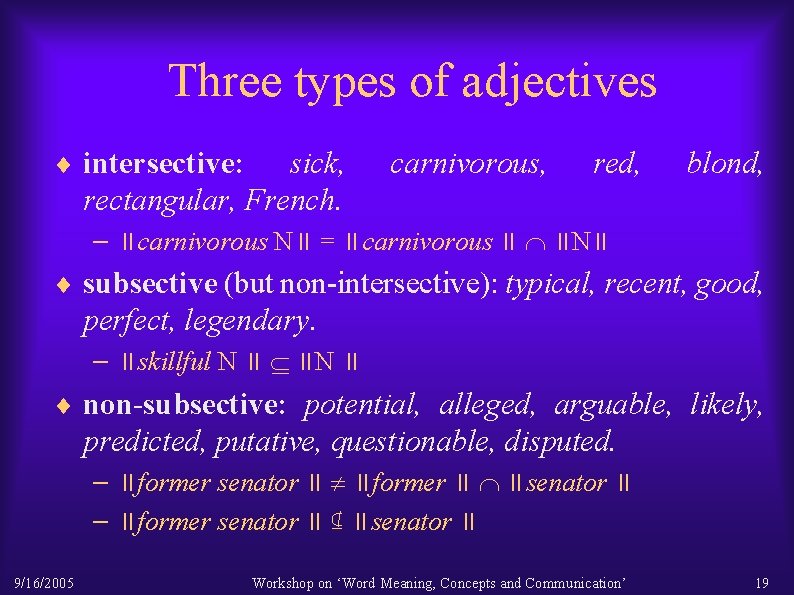
Three types of adjectives ¨ intersective: sick, rectangular, French. carnivorous, red, blond, – ∥carnivorous N∥ = ∥carnivorous ∥ ∥N∥ ¨ subsective (but non-intersective): typical, recent, good, perfect, legendary. – ∥skillful N ∥ ∥N ∥ ¨ non-subsective: potential, alleged, arguable, likely, predicted, putative, questionable, disputed. – ∥former senator ∥ ∥former ∥ ∥senator ∥ – ∥former senator ∥ ⊈ ∥senator ∥ 9/16/2005 Workshop on ‘Word Meaning, Concepts and Communication’ 19
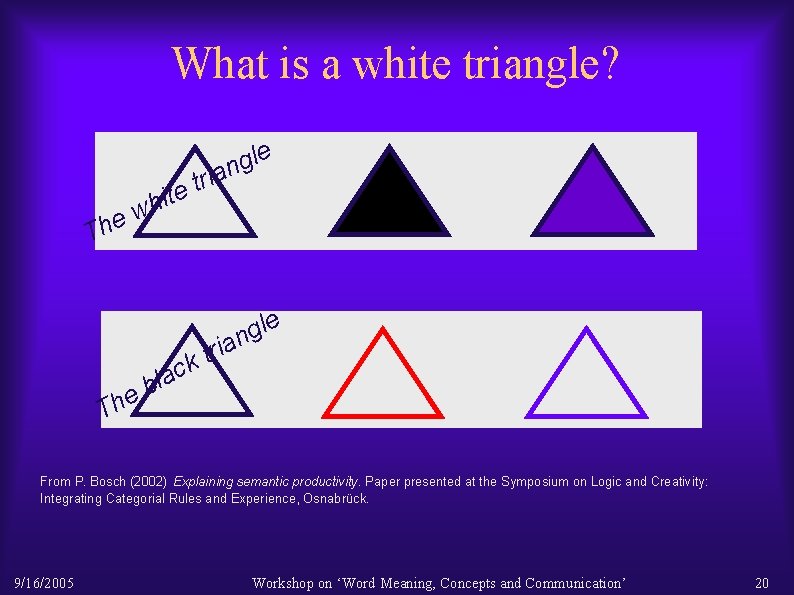
What is a white triangle? The i r t te i h w e l g an le g n ia r t k e h T c a l b From P. Bosch (2002) Explaining semantic productivity. Paper presented at the Symposium on Logic and Creativity: Integrating Categorial Rules and Experience, Osnabrück. 9/16/2005 Workshop on ‘Word Meaning, Concepts and Communication’ 20
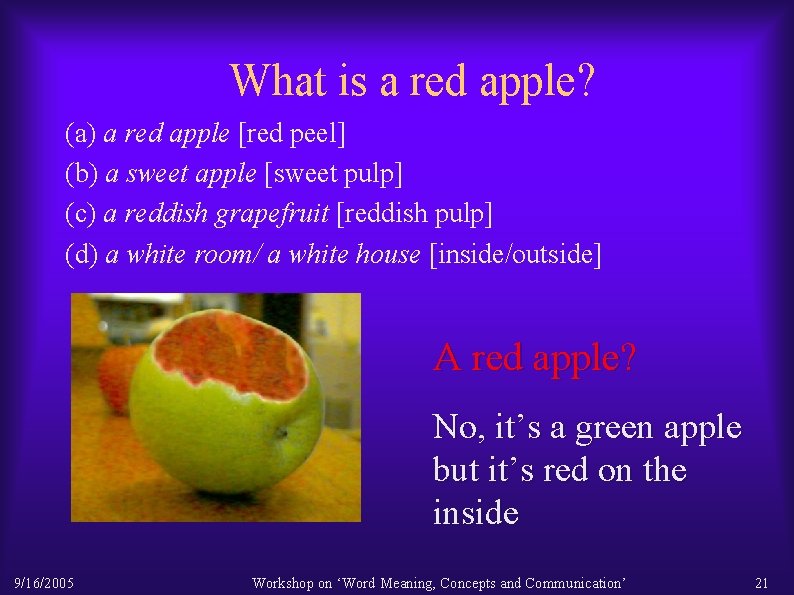
What is a red apple? (a) a red apple [red peel] (b) a sweet apple [sweet pulp] (c) a reddish grapefruit [reddish pulp] (d) a white room/ a white house [inside/outside] A red apple? No, it’s a green apple but it’s red on the inside 9/16/2005 Workshop on ‘Word Meaning, Concepts and Communication’ 21
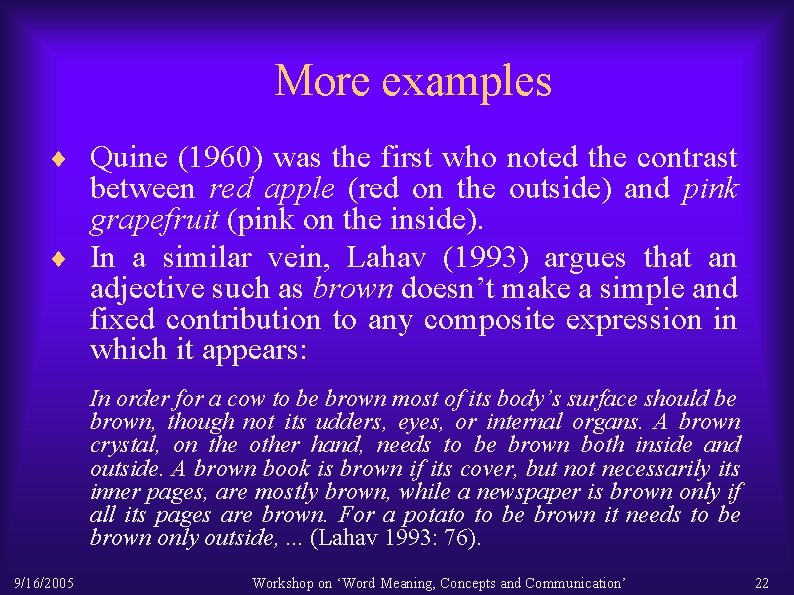
More examples ¨ Quine (1960) was the first who noted the contrast between red apple (red on the outside) and pink grapefruit (pink on the inside). ¨ In a similar vein, Lahav (1993) argues that an adjective such as brown doesn’t make a simple and fixed contribution to any composite expression in which it appears: In order for a cow to be brown most of its body’s surface should be brown, though not its udders, eyes, or internal organs. A brown crystal, on the other hand, needs to be brown both inside and outside. A brown book is brown if its cover, but not necessarily its inner pages, are mostly brown, while a newspaper is brown only if all its pages are brown. For a potato to be brown it needs to be brown only outside, . . . (Lahav 1993: 76). 9/16/2005 Workshop on ‘Word Meaning, Concepts and Communication’ 22
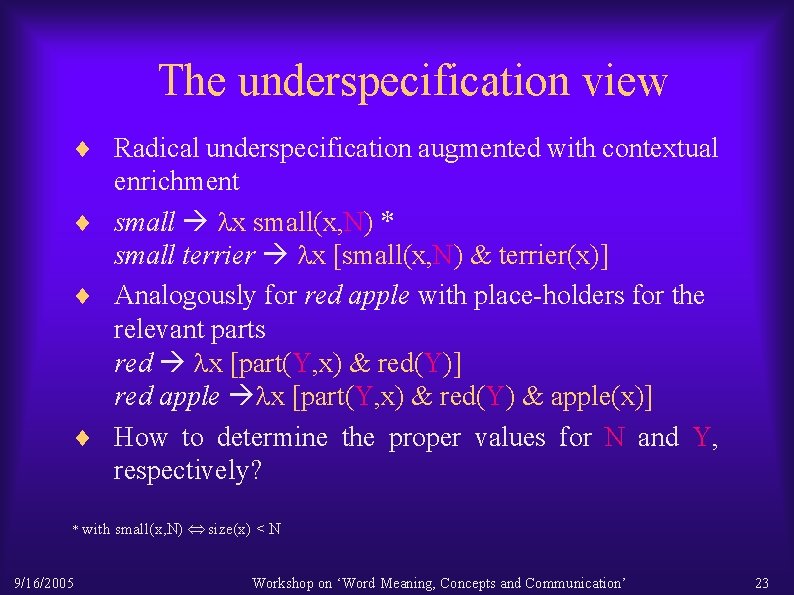
The underspecification view ¨ Radical underspecification augmented with contextual enrichment ¨ small x small(x, N) * small terrier x [small(x, N) & terrier(x)] ¨ Analogously for red apple with place-holders for the relevant parts red x [part(Y, x) & red(Y)] red apple x [part(Y, x) & red(Y) & apple(x)] ¨ How to determine the proper values for N and Y, respectively? * with 9/16/2005 small(x, N) size(x) < N Workshop on ‘Word Meaning, Concepts and Communication’ 23
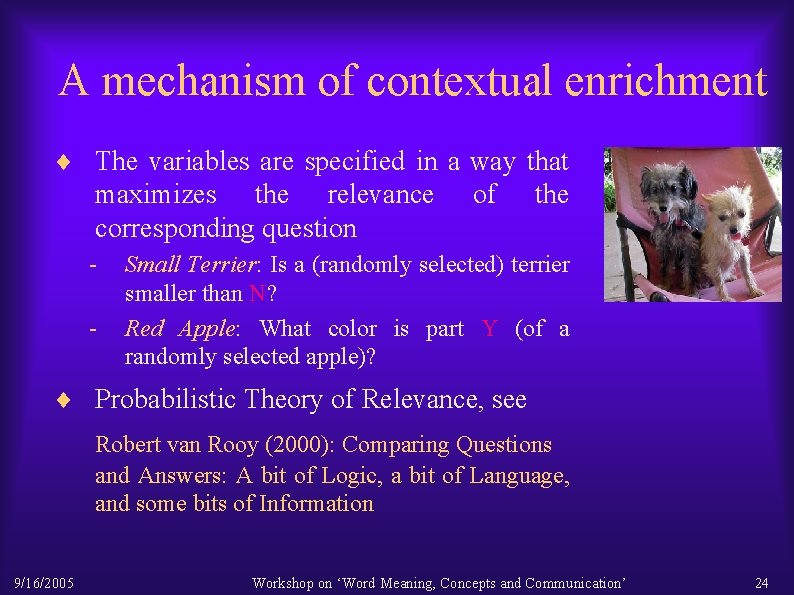
A mechanism of contextual enrichment ¨ The variables are specified in a way that maximizes the relevance corresponding question - of the Small Terrier: Is a (randomly selected) terrier smaller than N? Red Apple: What color is part Y (of a randomly selected apple)? ¨ Probabilistic Theory of Relevance, see Robert van Rooy (2000): Comparing Questions and Answers: A bit of Logic, a bit of Language, and some bits of Information 9/16/2005 Workshop on ‘Word Meaning, Concepts and Communication’ 24
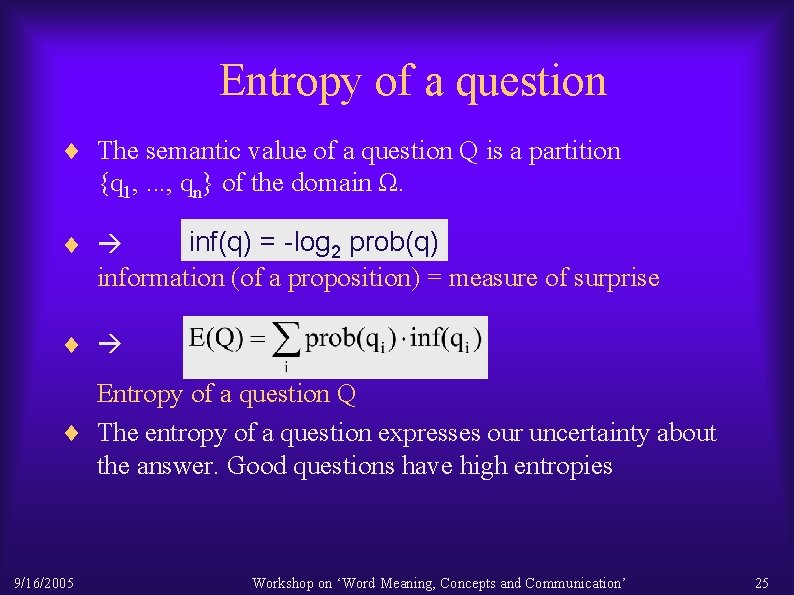
Entropy of a question ¨ The semantic value of a question Q is a partition {q 1, . . . , qn} of the domain Ω. inf(q) = -log 2 prob(q) ¨ information (of a proposition) = measure of surprise ¨ Entropy of a question Q ¨ The entropy of a question expresses our uncertainty about the answer. Good questions have high entropies 9/16/2005 Workshop on ‘Word Meaning, Concepts and Communication’ 25
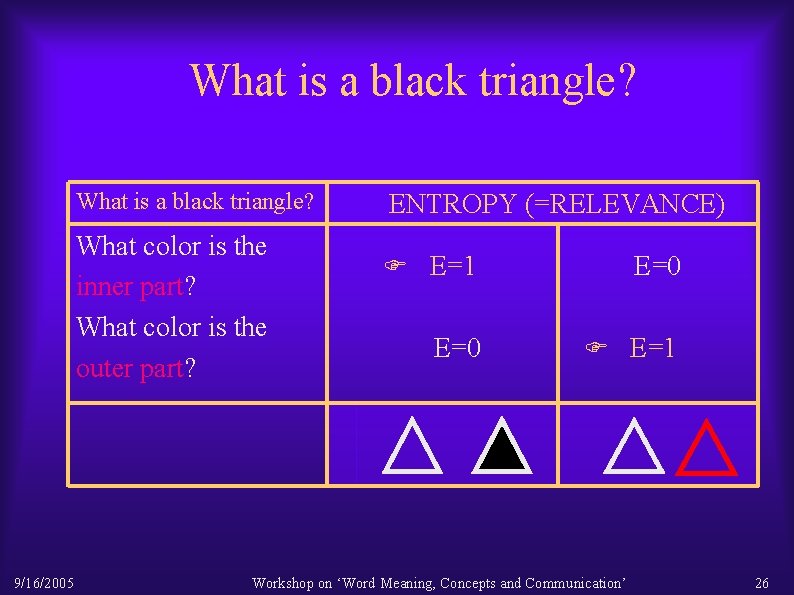
What is a black triangle? What color is the inner part? What color is the outer part? 9/16/2005 ENTROPY (=RELEVANCE) E=1 E=0 E=1 Workshop on ‘Word Meaning, Concepts and Communication’ 26
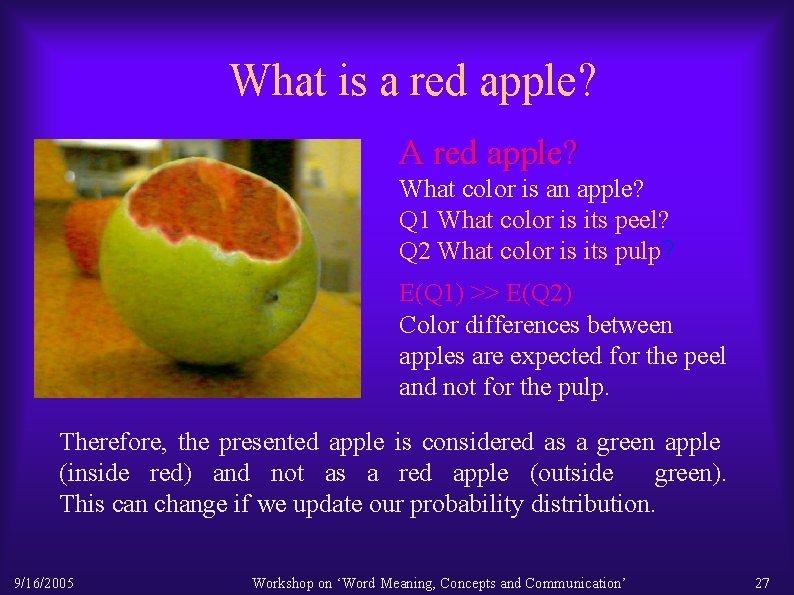
What is a red apple? A red apple? What color is an apple? Q 1 What color is its peel? Q 2 What color is its pulp? E(Q 1) >> E(Q 2) Color differences between apples are expected for the peel and not for the pulp. Therefore, the presented apple is considered as a green apple (inside red) and not as a red apple (outside green). This can change if we update our probability distribution. 9/16/2005 Workshop on ‘Word Meaning, Concepts and Communication’ 27
The view of neural embodiment ¨ The constraint of entropy maximization is crucial part of a connectionist architecture (e. g. Smolensky ). Hence, it can be seen as an embodied constraint ¨ This constraint helps to explain the systematicity of natural language comprehension – When an agent understands the expressions brown triangle and black square, she understands the expressions brown square and black triangle as well. – Compositionality is not enough to explain systematicity! (Blutner, Hendriks, de Hoop, Schwartz 2004) ¨ A disembodied cognitive architecture (e. g. Fodor & Pylyhyn 1988) fails to explain systematicity because they derive it from intersectivity in the case under discussion. But intersectivity is empirically wrong. 9/16/2005 Workshop on ‘Word Meaning, Concepts and Communication’ 28
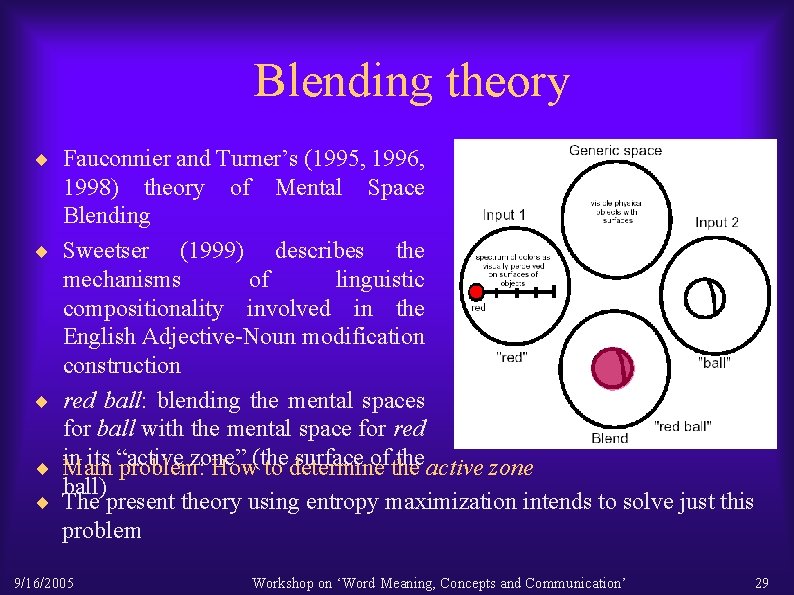
Blending theory ¨ Fauconnier and Turner’s (1995, 1996, ¨ ¨ 1998) theory of Mental Space Blending Sweetser (1999) describes the mechanisms of linguistic compositionality involved in the English Adjective-Noun modification construction red ball: blending the mental spaces for ball with the mental space for red in its “active zone” surface of the active zone Main problem: How(the to determine ball) The present theory using entropy maximization intends to solve just this problem 9/16/2005 Workshop on ‘Word Meaning, Concepts and Communication’ 29
3 The interplay between broadening and narrowing Ø Jost Zwarts: round Ø The strongest meaning hypothesis Ø Narrowing and broadening: om and rond in Dutch Ø A problem for iconicity and the view of cultural embodiment 9/16/2005 Workshop on ‘Word Meaning, Concepts and Communication’
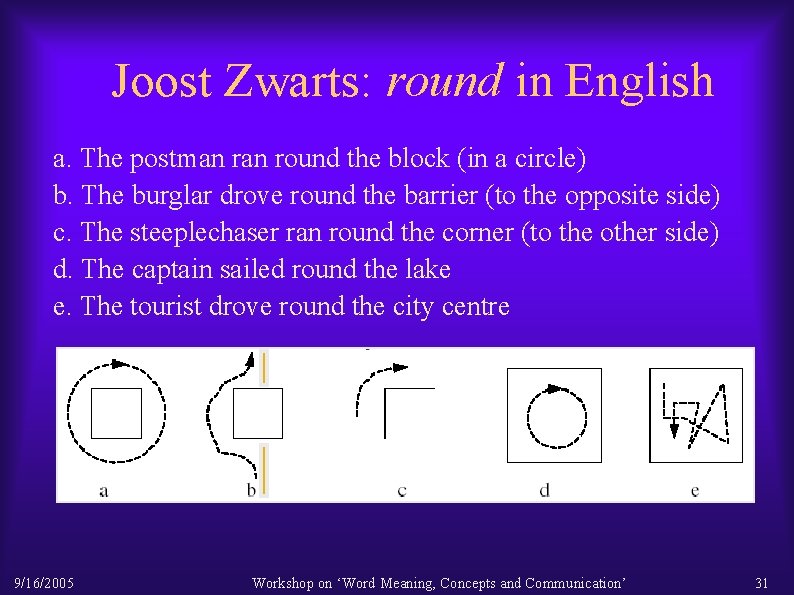
Joost Zwarts: round in English a. The postman round the block (in a circle) b. The burglar drove round the barrier (to the opposite side) c. The steeplechaser ran round the corner (to the other side) d. The captain sailed round the lake e. The tourist drove round the city centre 9/16/2005 Workshop on ‘Word Meaning, Concepts and Communication’ 31
The strongest meaning hypothesis ¨ Dalrymple, M. Kanazawa, S. Mchombo & S. Peters (1994). What do reciprocals mean? Proceedings of SALT 4. ¨ SMH: A reciprocal sentence is interpreted as expressing the logically strongest candidate truth conditions which are not contradicted by known properties of the relation expressed by the reciprocal scope when restricted to the group argument. – The girls know each other ≃ Every girl knows every other girl. – The girls are standing on each other ≄ #Every girl is standing on every other girl. ¨ Zwarts applies this idea to the expression round. 9/16/2005 Workshop on ‘Word Meaning, Concepts and Communication’ 32
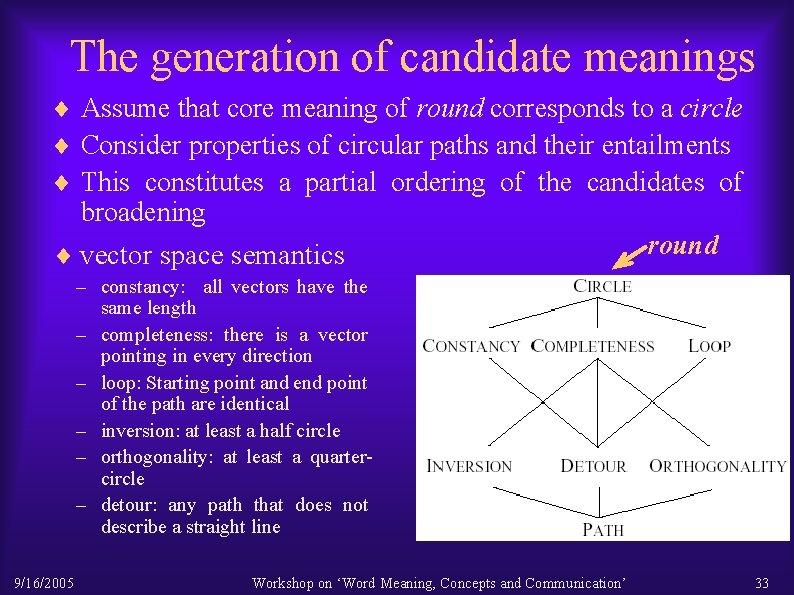
The generation of candidate meanings ¨ Assume that core meaning of round corresponds to a circle ¨ Consider properties of circular paths and their entailments ¨ This constitutes a partial ordering of the candidates of broadening ¨ vector space semantics round – constancy: all vectors have the same length – completeness: there is a vector pointing in every direction – loop: Starting point and end point of the path are identical – inversion: at least a half circle – orthogonality: at least a quartercircle – detour: any path that does not describe a straight line 9/16/2005 Workshop on ‘Word Meaning, Concepts and Communication’ 33
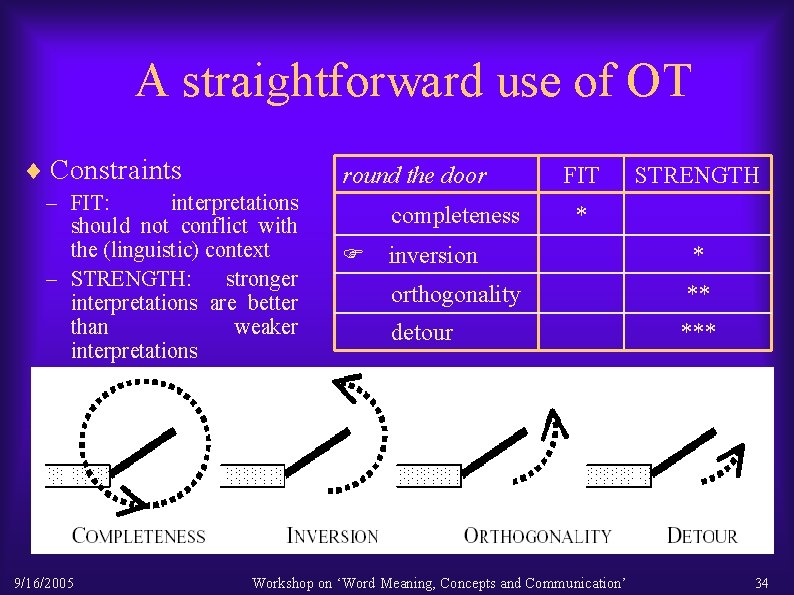
A straightforward use of OT ¨ Constraints round the door – FIT: interpretations should not conflict with the (linguistic) context – STRENGTH: stronger interpretations are better than weaker interpretations 9/16/2005 completeness FIT STRENGTH * inversion * orthogonality ** detour *** Workshop on ‘Word Meaning, Concepts and Communication’ 34
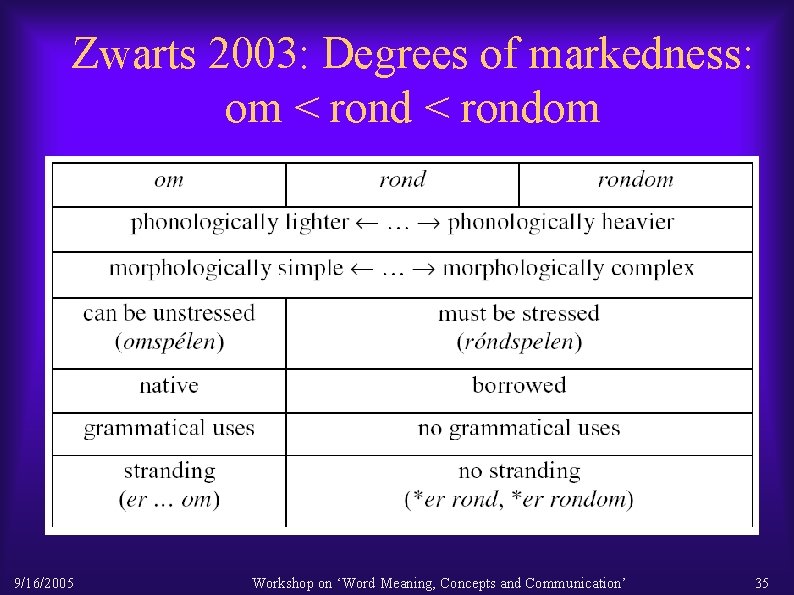
Zwarts 2003: Degrees of markedness: om < rondom 9/16/2005 Workshop on ‘Word Meaning, Concepts and Communication’ 35
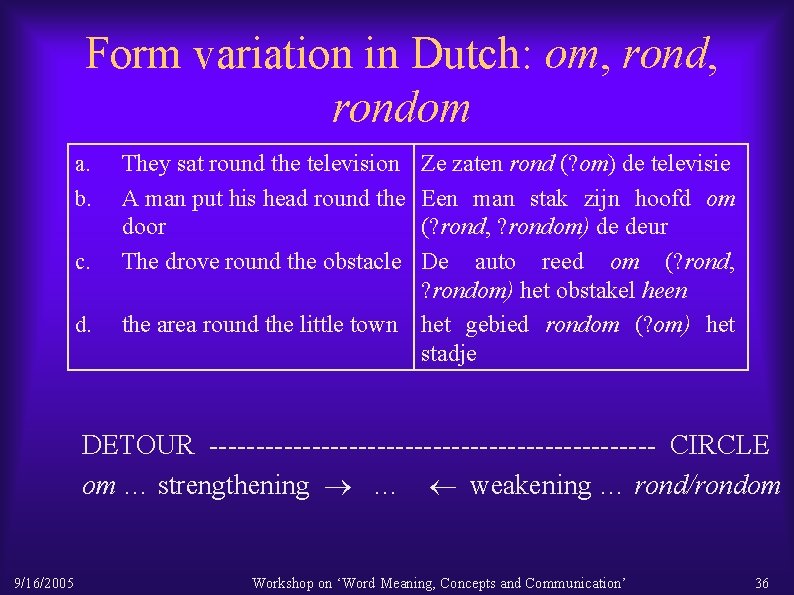
Form variation in Dutch: om, rondom a. b. c. d. They sat round the television A man put his head round the door The drove round the obstacle Ze zaten rond (? om) de televisie Een man stak zijn hoofd om (? rond, ? rondom) de deur De auto reed om (? rond, ? rondom) het obstakel heen the area round the little town het gebied rondom (? om) het stadje DETOUR ------------------------ CIRCLE om … strengthening … weakening … rond/rondom 9/16/2005 Workshop on ‘Word Meaning, Concepts and Communication’ 36
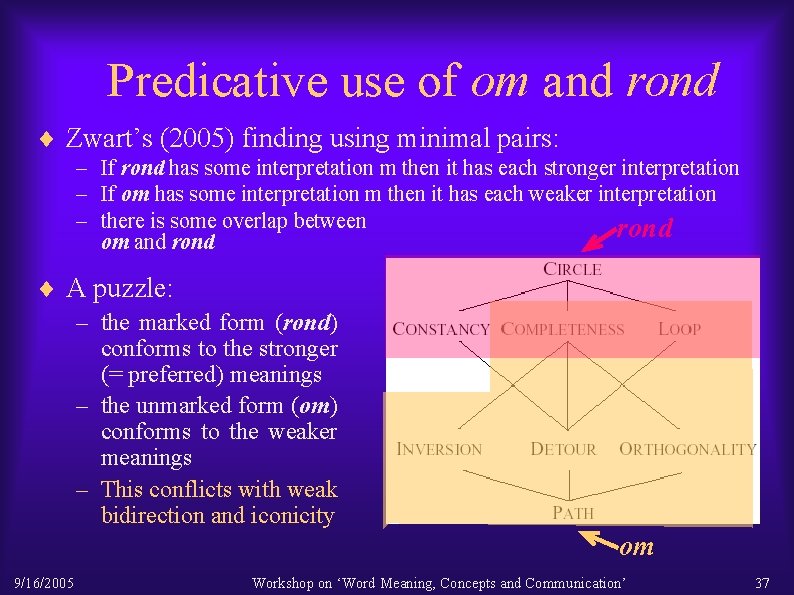
Predicative use of om and rond ¨ Zwart’s (2005) finding using minimal pairs: – If rond has some interpretation m then it has each stronger interpretation – If om has some interpretation m then it has each weaker interpretation – there is some overlap between rond om and rond ¨ A puzzle: – the marked form (rond) conforms to the stronger (= preferred) meanings – the unmarked form (om) conforms to the weaker meanings – This conflicts with weak bidirection and iconicity om 9/16/2005 Workshop on ‘Word Meaning, Concepts and Communication’ 37
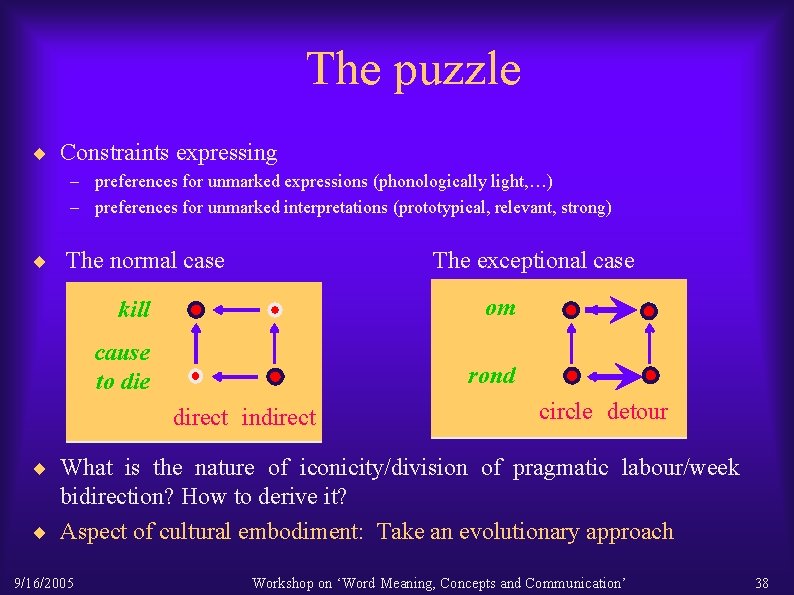
The puzzle ¨ Constraints expressing – preferences for unmarked expressions (phonologically light, …) – preferences for unmarked interpretations (prototypical, relevant, strong) ¨ The normal case The exceptional case kill om cause to die rond direct indirect circle detour ¨ What is the nature of iconicity/division of pragmatic labour/week bidirection? How to derive it? ¨ Aspect of cultural embodiment: Take an evolutionary approach 9/16/2005 Workshop on ‘Word Meaning, Concepts and Communication’ 38
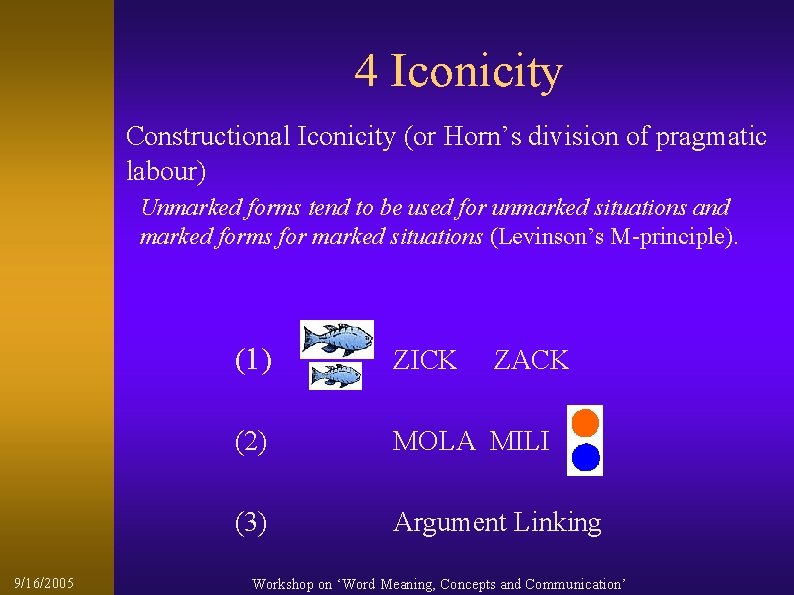
4 Iconicity Constructional Iconicity (or Horn’s division of pragmatic labour) Unmarked forms tend to be used for unmarked situations and marked forms for marked situations (Levinson’s M-principle). 9/16/2005 (1) ZICK (2) MOLA MILI (3) Argument Linking ZACK Workshop on ‘Word Meaning, Concepts and Communication’
Zipf ¨ Human Behavior and the Principle of Least Effort. Addison- Wesley. Cambridge 1949. ¨ Two basic and competing forces – Speaker’s economy: Force of unification – Hearer’s economy: Force of diversification ¨ The two opposing economies are evolutionary forces, i. e. they are balanced during language evolution. – Languages are evolving via cultural rather than biological transmission on a historical rather than genetic timescale ¨ What is the underlying mechanism of cultural evolution? 9/16/2005 Workshop on ‘Word Meaning, Concepts and Communication’ 40
¨ Iterated Two approaches to cultural development Learning (Keller, Kirby, Hurford, Brighton, Tomasello, Jäger …) – After members of one generation learn a language, their production becomes the input to learning in the next generation. Certain linguistic structure will survive transmission, while other forms may disappear. ¨ Evolutionary language games and memic selection (Lewis [signalling games], Steels, Edelman, van Rooy, …) – The idea of memic selection is an instance of the “universal Darwinist” claim (Dawkins 1983, Dennett 1995) that the methodology of evolutionary theory is applicable whenever any dynamical system exhibits (random) variation, selection amongs variants, and thus differential inheritance. ¨ Frequencies are essential in both approaches – Zipf (1936) formulated a law of abbreviation: “The length of a word tends to bear an inverse relationship to its relative frequency”. 9/16/2005 Workshop on ‘Word Meaning, Concepts and Communication’ 41
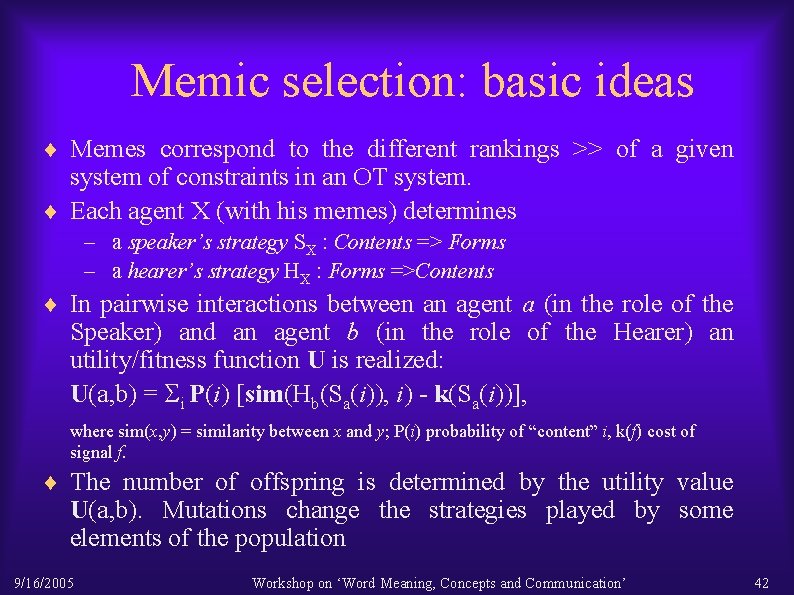
Memic selection: basic ideas ¨ Memes correspond to the different rankings >> of a given system of constraints in an OT system. ¨ Each agent X (with his memes) determines – a speaker’s strategy SX : Contents => Forms – a hearer’s strategy HX : Forms =>Contents ¨ In pairwise interactions between an agent a (in the role of the Speaker) and an agent b (in the role of the Hearer) an utility/fitness function U is realized: U(a, b) = i P(i) [sim(Hb(Sa(i)), i) - k(Sa(i))], where sim(x, y) = similarity between x and y; P(i) probability of “content” i, k(f) cost of signal f. ¨ The number of offspring is determined by the utility value U(a, b). Mutations change the strategies played by some elements of the population 9/16/2005 Workshop on ‘Word Meaning, Concepts and Communication’ 42
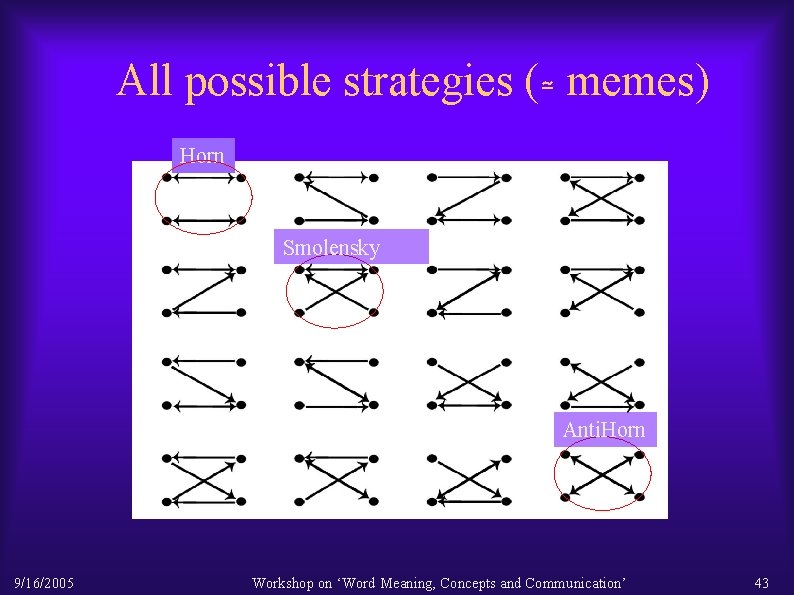
All possible strategies (≃ memes) Horn Smolensky Anti. Horn 9/16/2005 Workshop on ‘Word Meaning, Concepts and Communication’ 43

Population an pairwise interaction 9/16/2005 Workshop on ‘Word Meaning, Concepts and Communication’ 44
Results ¨ Horn and Anti-Horn are the only strategies (OT- systems) that are evolutionary stable ¨ Starting with a uniform Smolensky population will always result in a pure Horn population supposed P(M) > P(M’) and k(F) < k(F’) ¨ Mixed populations develop into pure Horn populations supposed P(M) > P(M’) and k(F) < k(F’ ) 9/16/2005 Workshop on ‘Word Meaning, Concepts and Communication’ 45
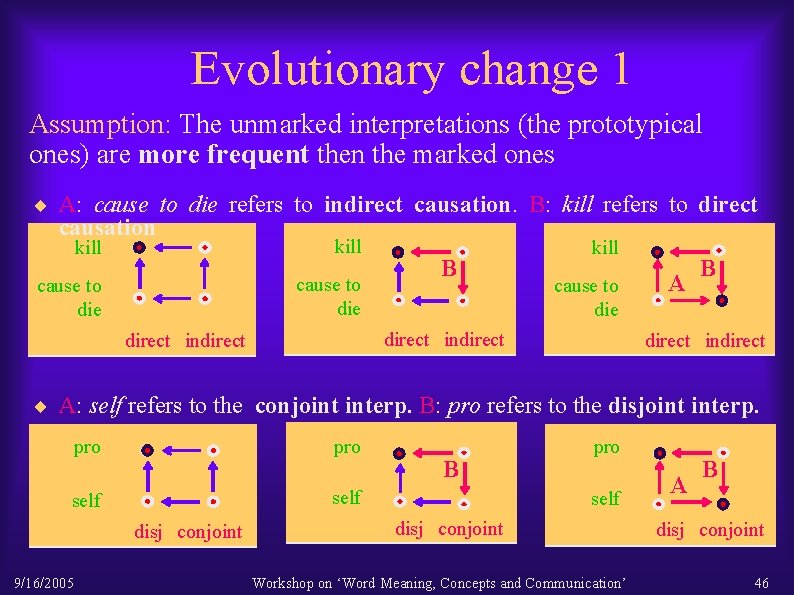
Evolutionary change 1 Assumption: The unmarked interpretations (the prototypical ones) are more frequent then the marked ones ¨ A: cause to die refers to indirect causation. B: kill refers to direct causation kill cause to die B kill cause to die direct indirect A B direct indirect ¨ A: self refers to the conjoint interp. B: pro refers to the disjoint interp. pro self disj conjoint 9/16/2005 B pro self disj conjoint Workshop on ‘Word Meaning, Concepts and Communication’ A B disj conjoint 46
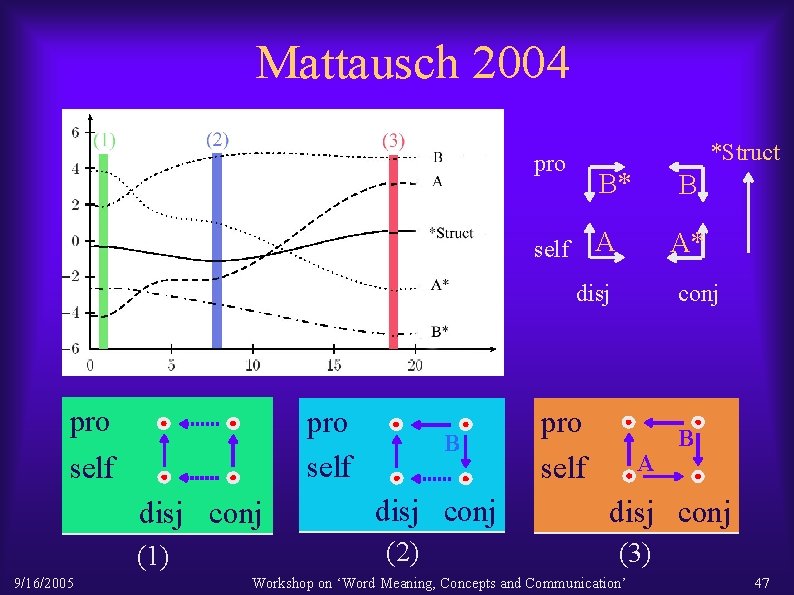
Mattausch 2004 *Struct pro B* B A self A* disj pro self disj conj (1) 9/16/2005 B disj conj (2) conj pro self A B disj conj (3) Workshop on ‘Word Meaning, Concepts and Communication’ 47
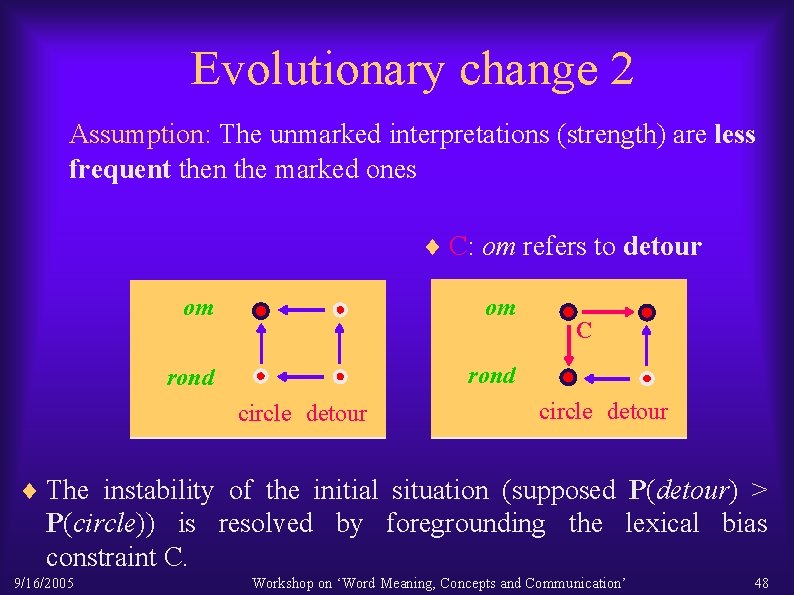
Evolutionary change 2 Assumption: The unmarked interpretations (strength) are less frequent then the marked ones ¨ C: om refers to detour om om rond circle detour C circle detour ¨ The instability of the initial situation (supposed P(detour) > P(circle)) is resolved by foregrounding the lexical bias constraint C. 9/16/2005 Workshop on ‘Word Meaning, Concepts and Communication’ 48
Discussion ¨ A theory of evolutionary stability can explain the general pattern of iconicity in cases where unmarked situations (strength!) are more frequent than marked ones ¨ A different prediction is made when the marked situations are the more frequent ones. This explains the broadening effect for rond and the narrowing effect for om. ¨ As an evolutionary model, this approach explains how coversational implicatures become conventionalized (cf. Mattausch 2004; reconstructing Levinson’s account to the binding phenomena) ¨ Another case of broadening: imprecise interpretations (cf. Krifka 2004) 9/16/2005 Workshop on ‘Word Meaning, Concepts and Communication’ 49
5 Conclusions Ø As a cognitive approach, OT pragmatics aims to explain the phenomena under consideration. Ø Neuronal embodiment helps to understand certain constraints that are crucially involved in - modelling adjectival modification and - modelling broadening. Ø Neural embodiment is not enough. The view of cultural em-bodiment becomes important when it comes to understand - modelling the nature of iconicity - the interplay between broadening and narrowing, - the conventionalization of conversational implicatures, . Ø Phenomenological embodiment becomes important for 9/16/2005 metaphorical extension (not discussed here). Workshop on ‘Word Meaning, Concepts and Communication’
- Slides: 50