
Lexical Analysis Part II Constructing a Scanner from
- Slides: 19
Lexical Analysis — Part II: Constructing a Scanner from Regular Expressions Copyright 2003, Keith D. Cooper, Kennedy & Linda Torczon, all rights reserved. Students enrolled in Comp 412 at Rice University have explicit permission to make copies of these materials for their personal use.
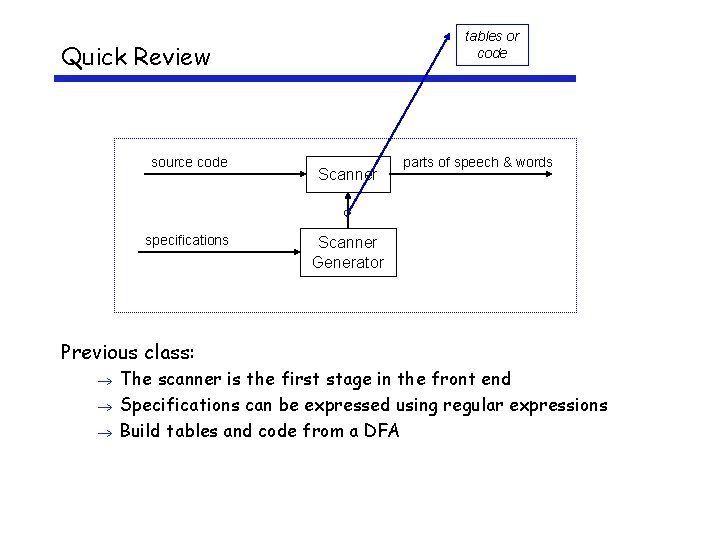
tables or code Quick Review source code specifications Scanner parts of speech & words Scanner Generator Previous class: The scanner is the first stage in the front end Specifications can be expressed using regular expressions Build tables and code from a DFA
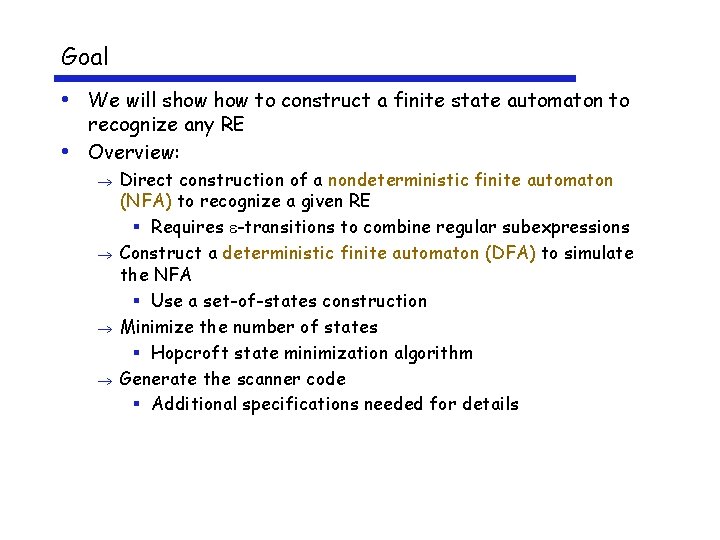
Goal • We will show to construct a finite state automaton to • recognize any RE Overview: Direct construction of a nondeterministic finite automaton (NFA) to recognize a given RE § Requires -transitions to combine regular subexpressions Construct a deterministic finite automaton (DFA) to simulate the NFA § Use a set-of-states construction Minimize the number of states § Hopcroft state minimization algorithm Generate the scanner code § Additional specifications needed for details
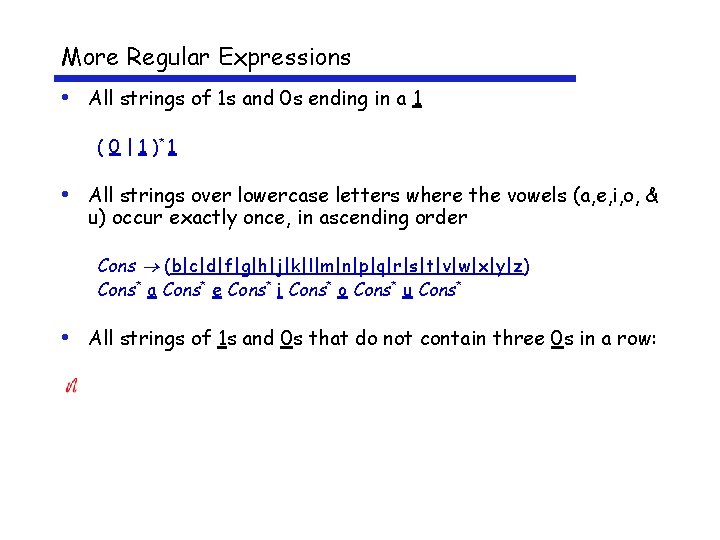
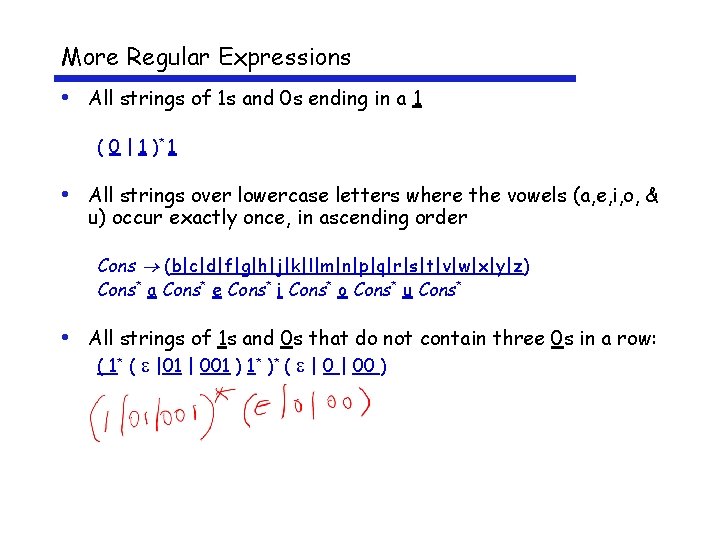
More Regular Expressions • All strings of 1 s and 0 s ending in a 1 ( 0 | 1 )* 1 • All strings over lowercase letters where the vowels (a, e, i, o, & u) occur exactly once, in ascending order Cons (b|c|d|f|g|h|j|k|l|m|n|p|q|r|s|t|v|w|x|y|z) Cons* a Cons* e Cons* i Cons* o Cons* u Cons* • All strings of 1 s and 0 s that do not contain three 0 s in a row:
More Regular Expressions • All strings of 1 s and 0 s ending in a 1 ( 0 | 1 )* 1 • All strings over lowercase letters where the vowels (a, e, i, o, & u) occur exactly once, in ascending order Cons (b|c|d|f|g|h|j|k|l|m|n|p|q|r|s|t|v|w|x|y|z) Cons* a Cons* e Cons* i Cons* o Cons* u Cons* • All strings of 1 s and 0 s that do not contain three 0 s in a row: ( 1* ( |01 | 001 ) 1* )* ( | 00 )
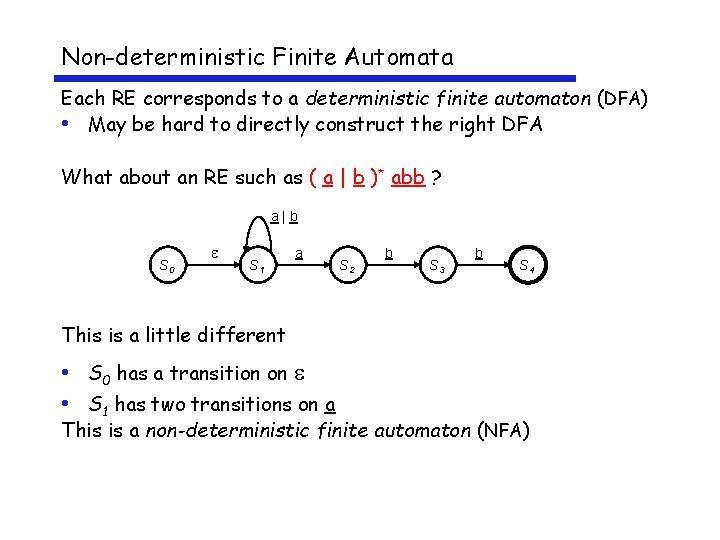
Non-deterministic Finite Automata Each RE corresponds to a deterministic finite automaton (DFA) • May be hard to directly construct the right DFA What about an RE such as ( a | b )* abb ? a|b S 0 S 1 a S 2 b S 3 b S 4 This is a little different • S 0 has a transition on • S 1 has two transitions on a This is a non-deterministic finite automaton (NFA)
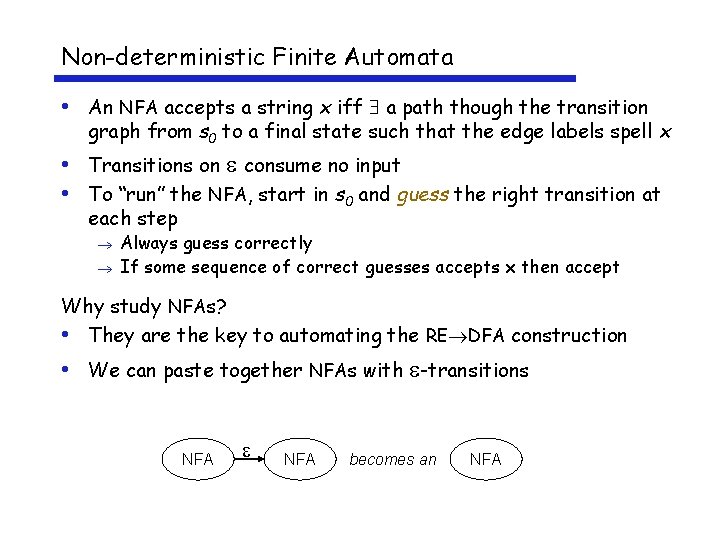
Non-deterministic Finite Automata • An NFA accepts a string x iff a path though the transition graph from s 0 to a final state such that the edge labels spell x • Transitions on consume no input • To “run” the NFA, start in s 0 and guess the right transition at each step Always guess correctly If some sequence of correct guesses accepts x then accept Why study NFAs? • They are the key to automating the RE DFA construction • We can paste together NFAs with -transitions NFA becomes an NFA
Relationship between NFAs and DFAs DFA is a special case of an NFA • DFA has no transitions • DFA’s transition function is single-valued • Same rules will work DFA can be simulated with an NFA Obviously NFA can be simulated with a DFA (less obvious) • Simulate sets of possible states • Possible exponential blowup in the state space • Still, one state per character in the input stream
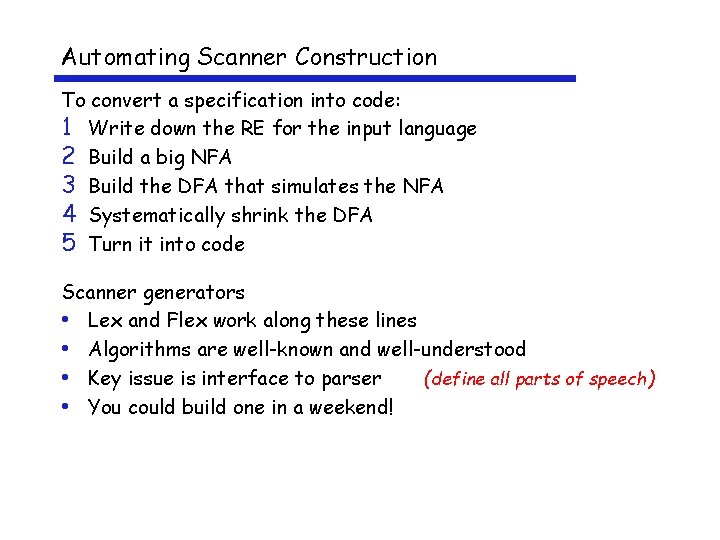
Automating Scanner Construction To convert a specification into code: 1 Write down the RE for the input language 2 Build a big NFA 3 Build the DFA that simulates the NFA 4 Systematically shrink the DFA 5 Turn it into code Scanner generators • Lex and Flex work along these lines • Algorithms are well-known and well-understood • Key issue is interface to parser (define all parts of speech) • You could build one in a weekend!
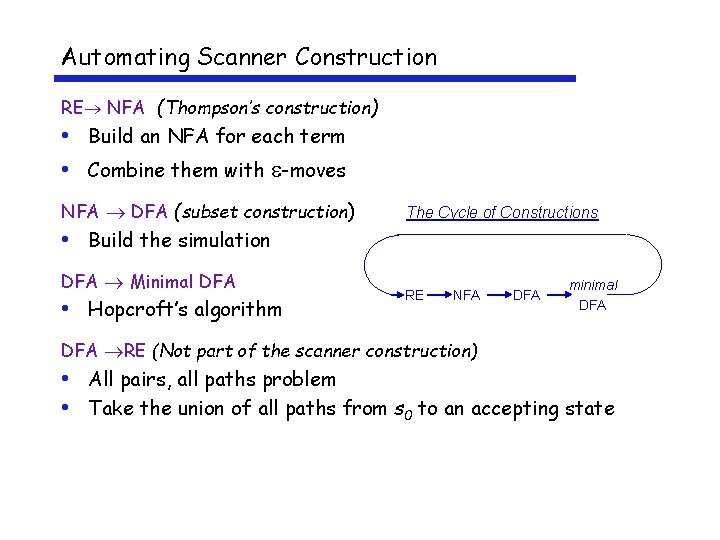
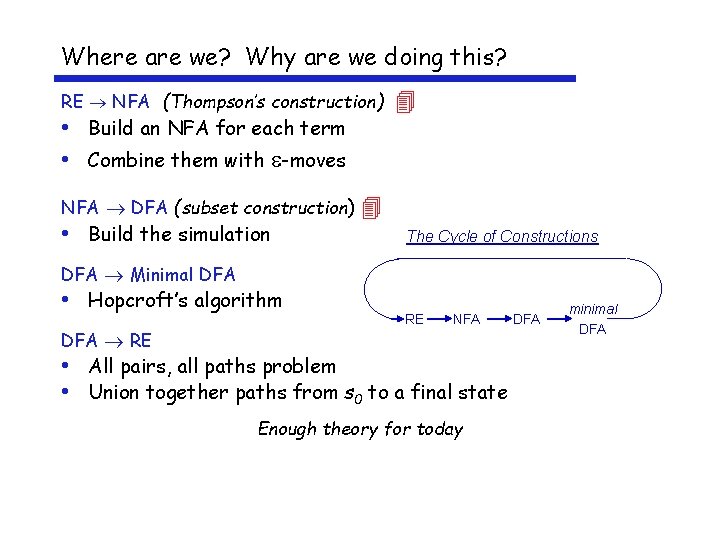
Automating Scanner Construction RE NFA (Thompson’s construction) • Build an NFA for each term • Combine them with -moves NFA DFA (subset construction) The Cycle of Constructions • Build the simulation DFA Minimal DFA • Hopcroft’s algorithm RE NFA DFA minimal DFA RE (Not part of the scanner construction) • All pairs, all paths problem • Take the union of all paths from s 0 to an accepting state
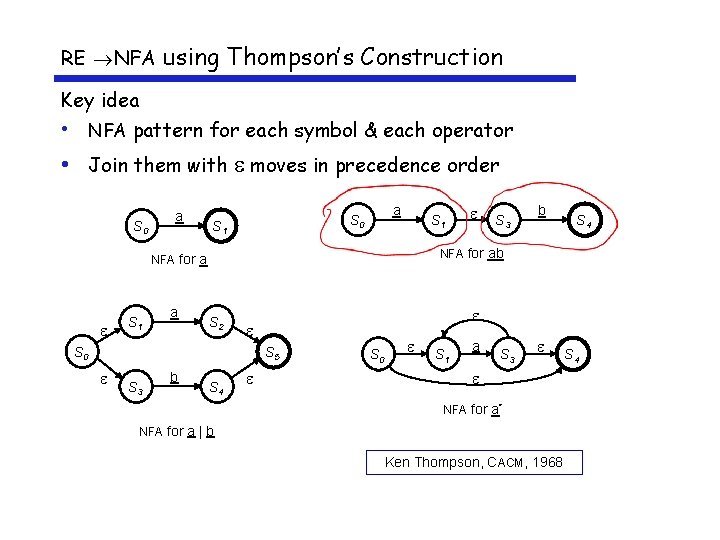
RE NFA using Thompson’s Construction Key idea • NFA pattern for each symbol & each operator • Join them with moves in precedence order S 0 a a S 0 S 1 a S 2 S 5 S 3 b b S 4 S 0 S 3 NFA for ab NFA for a S 1 S 4 S 0 S 1 a S 3 NFA for a* NFA for a | b Ken Thompson, CACM, 1968 S 4
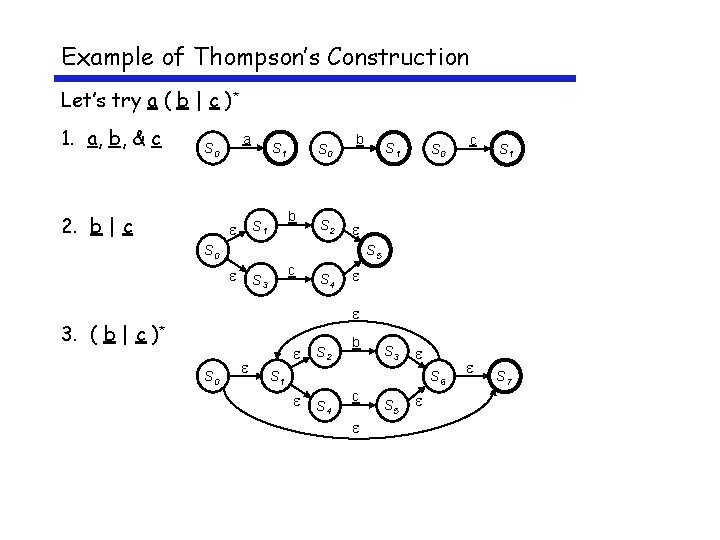
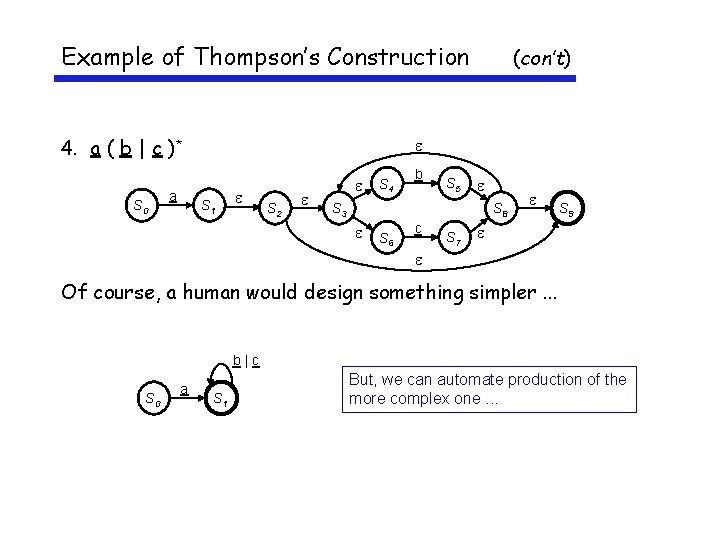
Example of Thompson’s Construction Let’s try a ( b | c )* 1. a, b, & c a S 0 2. b | c S 1 b S 1 S 0 S 2 b S 1 S 0 c S 1 S 0 S 5 c S 3 S 4 3. ( b | c )* S 0 S 2 b S 3 S 1 S 6 S 4 c S 5 S 7
Example of Thompson’s Construction 4. a ( b | c )* S 0 a (con’t) S 1 S 2 S 4 b S 5 S 3 S 8 S 6 c S 7 S 9 Of course, a human would design something simpler. . . b|c S 0 a S 1 But, we can automate production of the more complex one. . .
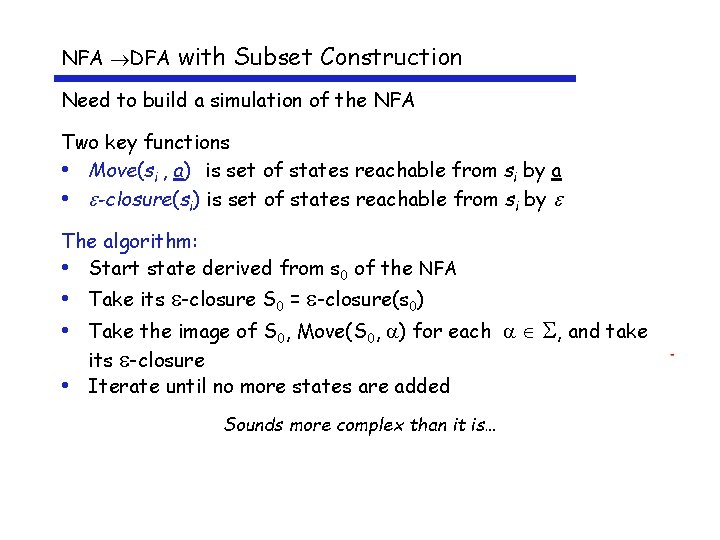
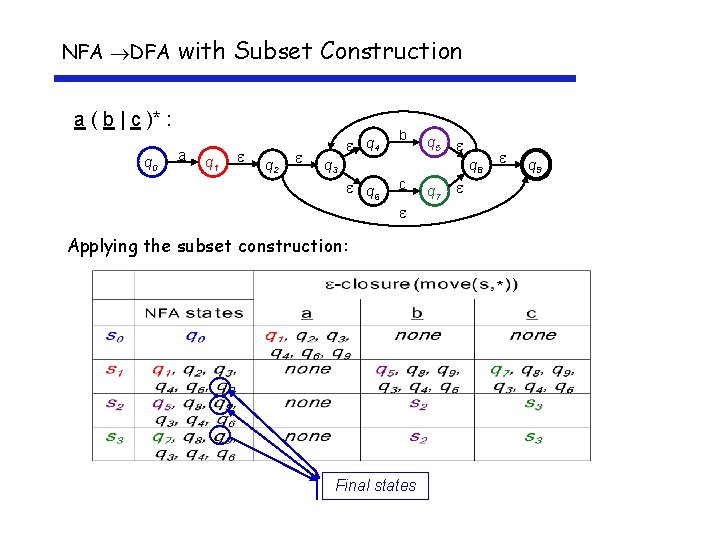
NFA DFA with Subset Construction Need to build a simulation of the NFA Two key functions • Move(si , a) is set of states reachable from si by a • -closure(si) is set of states reachable from si by The algorithm: • Start state derived from s 0 of the NFA • Take its -closure S 0 = -closure(s 0) • Take the image of S 0, Move(S 0, ) for each , and take its -closure • Iterate until no more states are added Sounds more complex than it is…
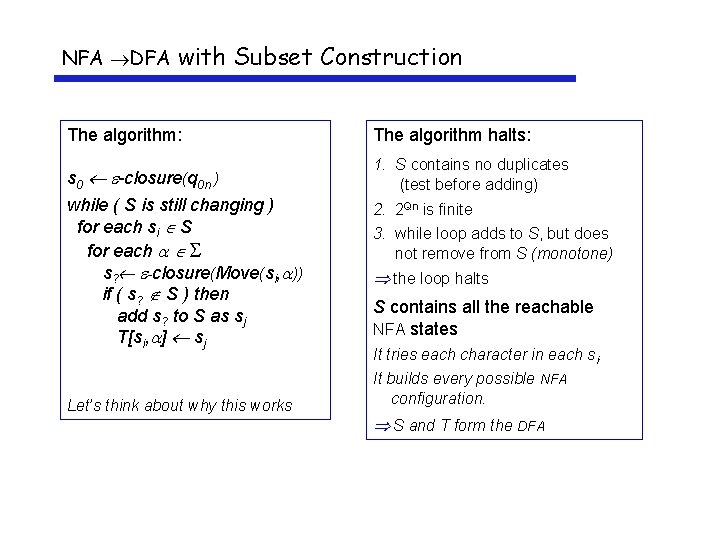
NFA DFA with Subset Construction The algorithm: The algorithm halts: s 0 -closure(q 0 n ) 1. S contains no duplicates (test before adding) while ( S is still changing ) for each si S for each s? -closure(Move(si, )) if ( s? S ) then add s? to S as sj T[si, ] sj Let’s think about why this works 2. 2 Qn is finite 3. while loop adds to S, but does not remove from S (monotone) the loop halts S contains all the reachable NFA states It tries each character in each si. It builds every possible NFA configuration. S and T form the DFA
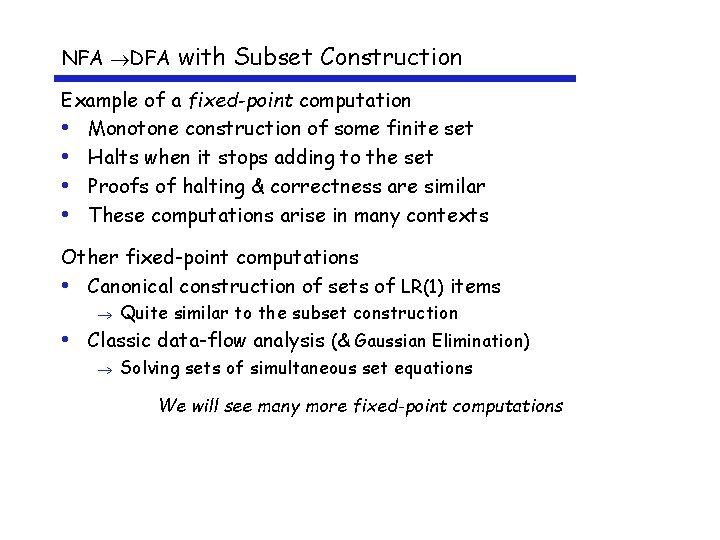
NFA DFA with Subset Construction Example of a fixed-point computation • Monotone construction of some finite set • Halts when it stops adding to the set • Proofs of halting & correctness are similar • These computations arise in many contexts Other fixed-point computations • Canonical construction of sets of LR(1) items Quite similar to the subset construction • Classic data-flow analysis (& Gaussian Elimination) Solving sets of simultaneous set equations We will see many more fixed-point computations
NFA DFA with Subset Construction a ( b | c )* : q 0 a q 1 q 2 q 4 b q 5 q 3 q 8 q 6 c Applying the subset construction: Final states q 7 q 9
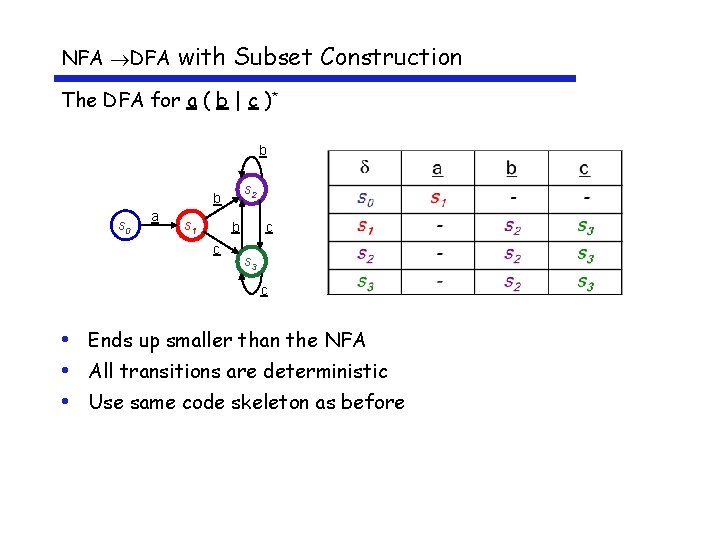
NFA DFA with Subset Construction The DFA for a ( b | c )* b s 2 b s 0 a s 1 b c c s 3 c • Ends up smaller than the NFA • All transitions are deterministic • Use same code skeleton as before
Where are we? Why are we doing this? RE NFA (Thompson’s construction) • Build an NFA for each term • Combine them with -moves NFA DFA (subset construction) • Build the simulation The Cycle of Constructions DFA Minimal DFA • Hopcroft’s algorithm DFA RE RE NFA • All pairs, all paths problem • Union together paths from s 0 to a final state Enough theory for today DFA minimal DFA