
Lewis Structures of Organic Molecules Dr C Yau






- Slides: 13
Lewis Structures of Organic Molecules Dr. C. Yau Fall 2014 11
Organic Molecules Organic chemistry is a study of compounds containing carbon. In addition, they contain mostly H, O and some N, S and P, and other elements. Those containing metals are said to be “organometallic. ” Hydrocarbons are compounds containing only H and C. They are nonpolar because they contain only C-C and C-H bonds, which are nonpolar. 2
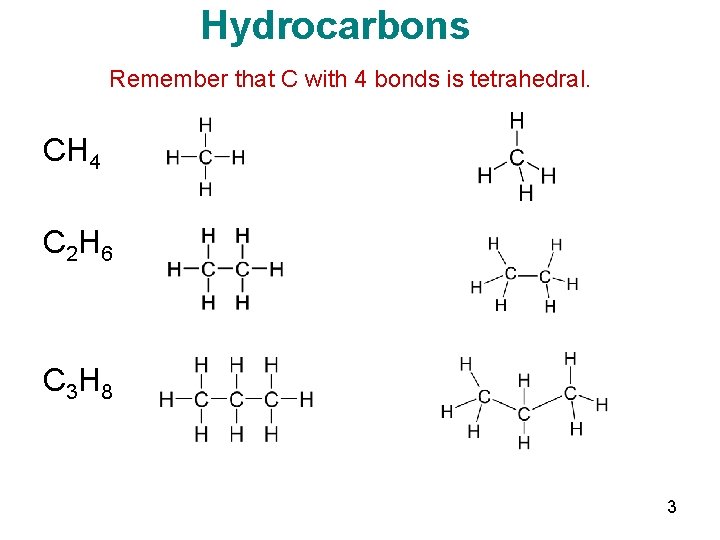
Hydrocarbons Remember that C with 4 bonds is tetrahedral. CH 4 C 2 H 6 C 3 H 8 3
Various Representations of Organic Molecules Abbreviated Line Drawings 4
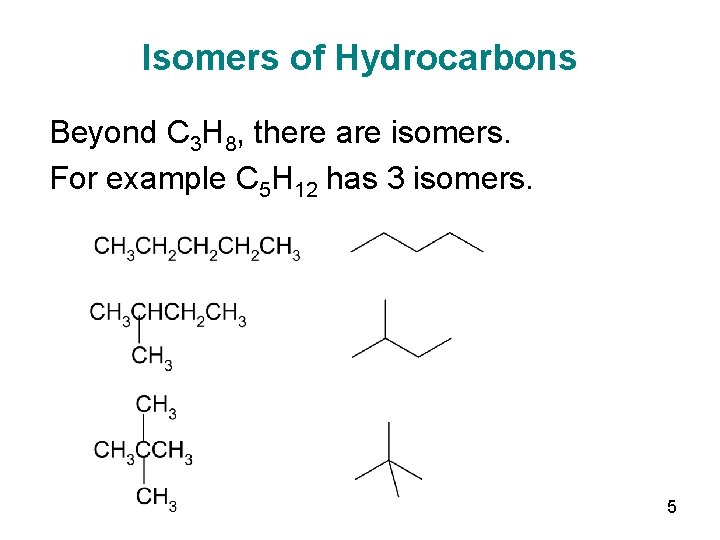
Isomers of Hydrocarbons Beyond C 3 H 8, there are isomers. For example C 5 H 12 has 3 isomers. 5
Classification of Organic Compounds Organic compounds are classified by the “functional group” that replaces one or more of the H atoms in a hydrocarbon. Substitution of a H with –OH transforms it into an alcohol. For example, replacing one H with –OH in methane makes it methyl alcohol (or methanol). 6
Alcohols 7
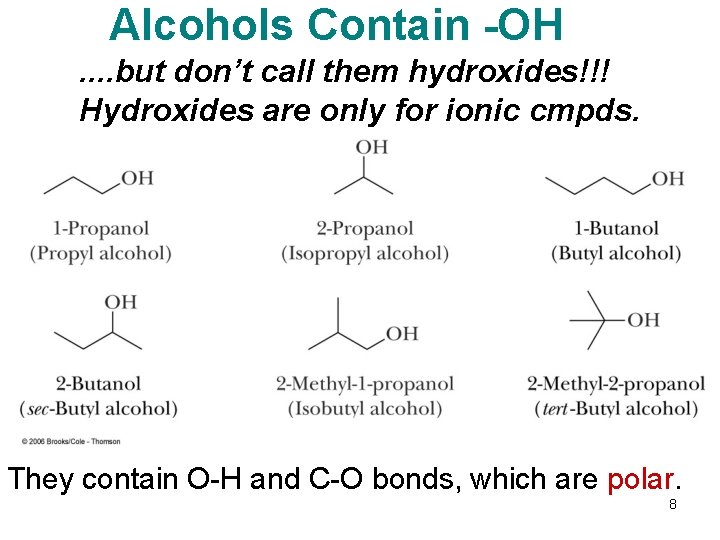
Alcohols Contain -OH. . but don’t call them hydroxides!!! Hydroxides are only for ionic cmpds. They contain O-H and C-O bonds, which are polar. 8
Carboxylic Acids These contain –COOH group or –CO 2 H Learn this structure: Formic acid HCOOH or HCO 2 H 9
MEMORIZE THIS! Acetic acid CH 3 COOH or CH 3 CO 2 H Is it polar? 10
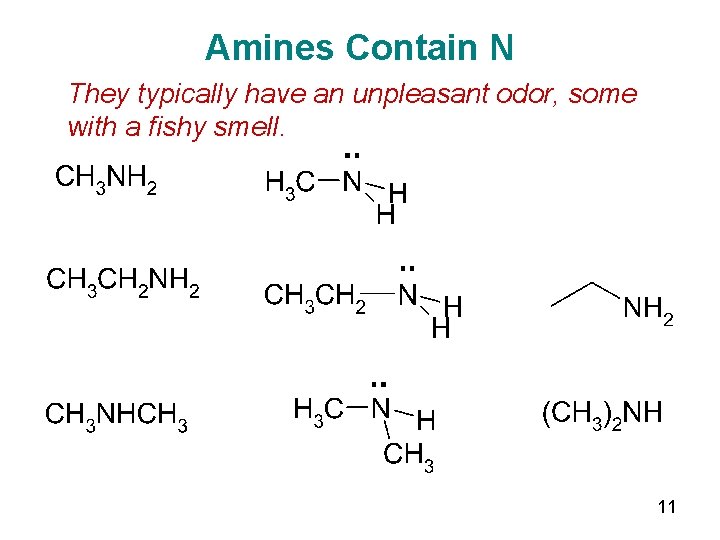
Amines Contain N They typically have an unpleasant odor, some with a fishy smell. 11
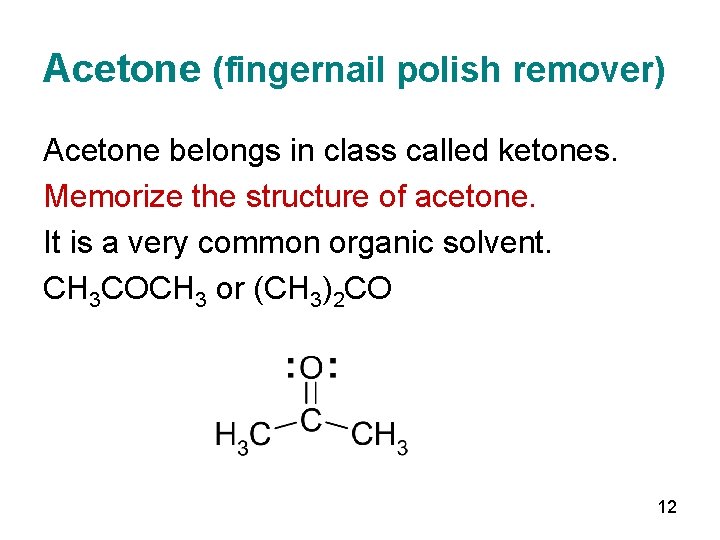
Acetone (fingernail polish remover) Acetone belongs in class called ketones. Memorize the structure of acetone. It is a very common organic solvent. CH 3 COCH 3 or (CH 3)2 CO 12
Benzene is another very common organic solvent. What is its molecular formula? 13