
Lewis model explains lots of biology Human hemoglobin
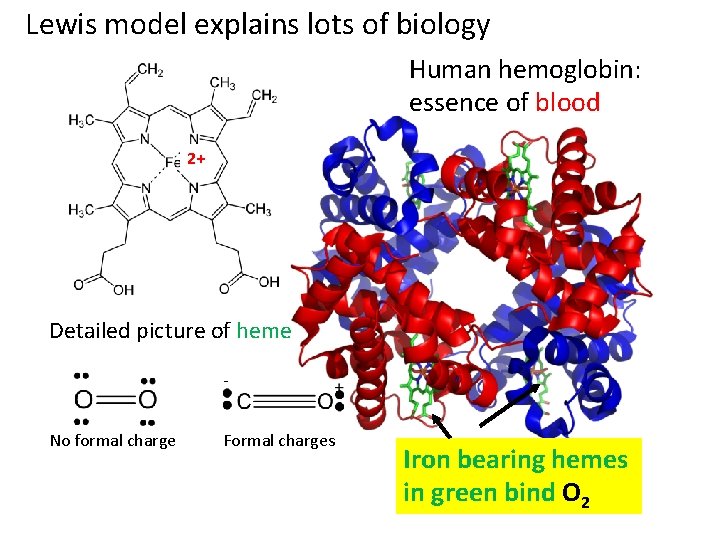
Lewis model explains lots of biology Human hemoglobin: essence of blood 2+ Detailed picture of heme No formal charge Formal charges Iron bearing hemes in green bind O 2
Normal respiration (grossly simplified): Heme + O 2 Heme-O 2 (in lungs) Heme-O 2 Heme +O 2 (throughout body) O 2 + sugar (glucose) energy for cells
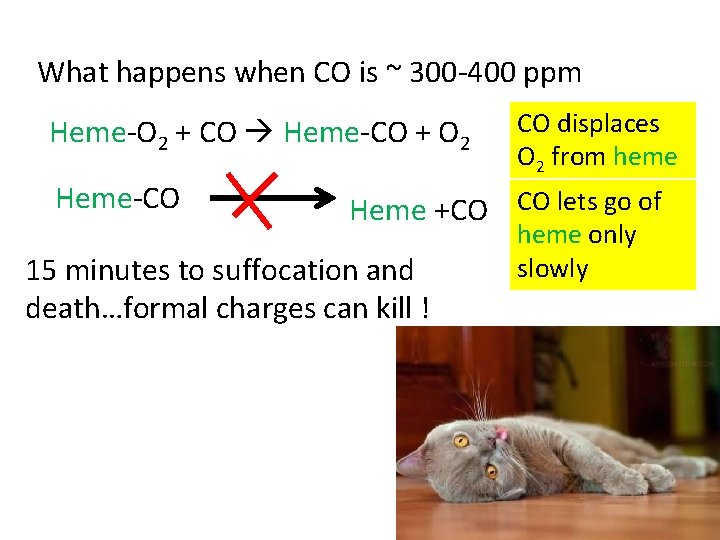
What happens when CO is ~ 300 -400 ppm Heme-O 2 + CO Heme-CO + O 2 Heme-CO CO displaces O 2 from heme Heme +CO CO lets go of 15 minutes to suffocation and death…formal charges can kill ! heme only slowly
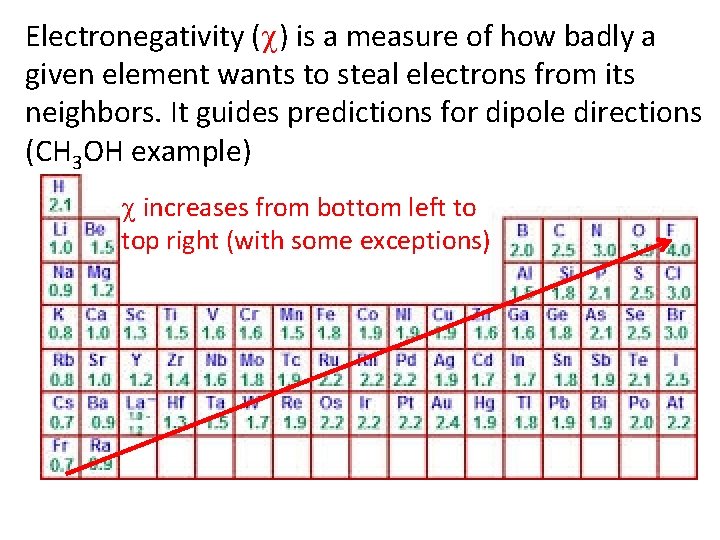
Electronegativity ( ) is a measure of how badly a given element wants to steal electrons from its neighbors. It guides predictions for dipole directions (CH 3 OH example) increases from bottom left to top right (with some exceptions)
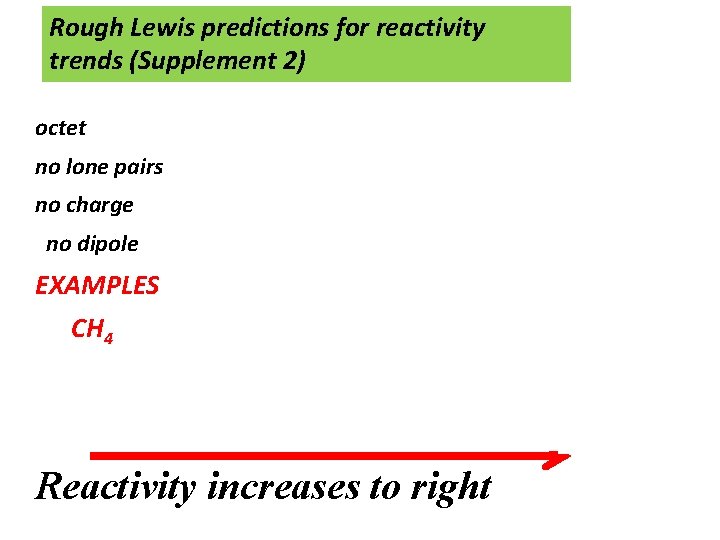
Rough Lewis predictions for reactivity trends (Supplement 2) octet no lone pairs no charge dipole no charge no octet EXAMPLES CH 4 CH 3 -CH-CH 3 : NH 3 HC C: - HOO* Br* CH 3* Reactivity increases to right
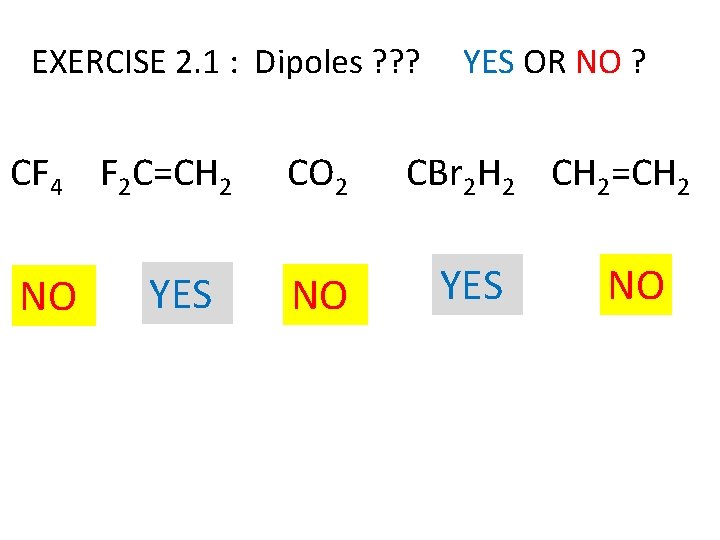
EXERCISE 2. 1 : Dipoles ? ? ? CF 4 F 2 C=CH 2 NO YES CO 2 NO YES OR NO ? CBr 2 H 2 CH 2=CH 2 YES NO
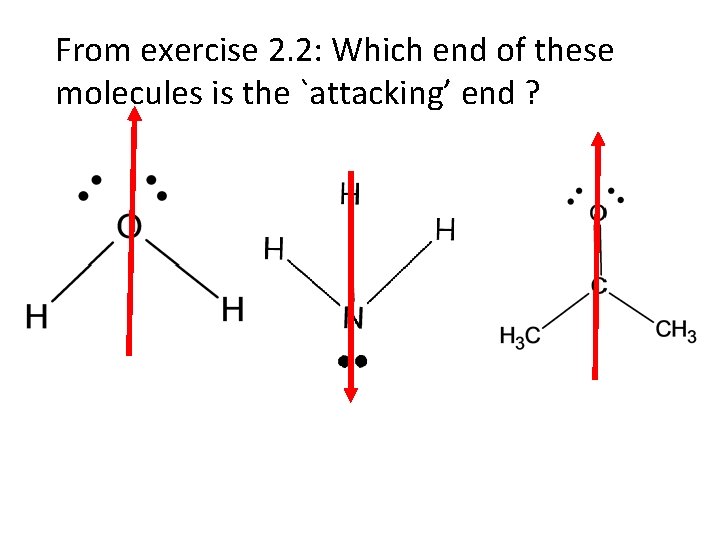
From exercise 2. 2: Which end of these molecules is the `attacking’ end ?
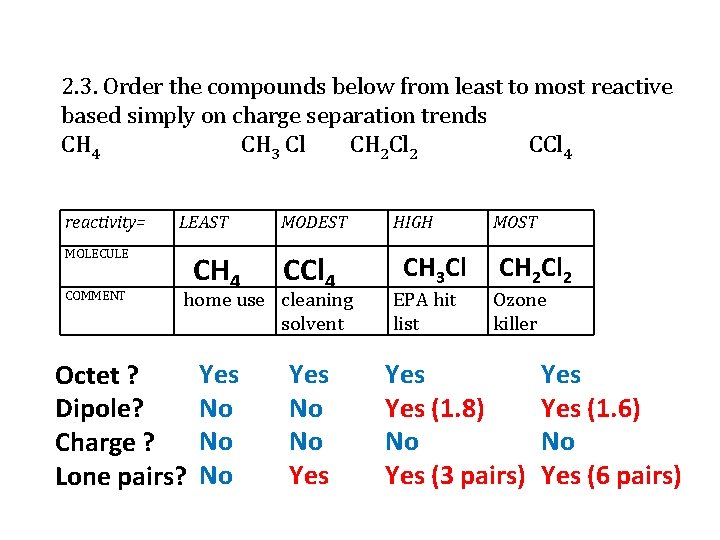
2. 3. Order the compounds below from least to most reactive based simply on charge separation trends CH 4 CH 3 Cl CH 2 Cl 2 CCl 4 reactivity= LEAST MOLECULE COMMENT MODEST CH 4 CCl 4 Yes No No No Yes home use cleaning solvent Octet ? Dipole? Charge ? Lone pairs? HIGH CH 3 Cl EPA hit list MOST CH 2 Cl 2 Ozone killer Yes (1. 8) No Yes (3 pairs) Yes (1. 6) No Yes (6 pairs)
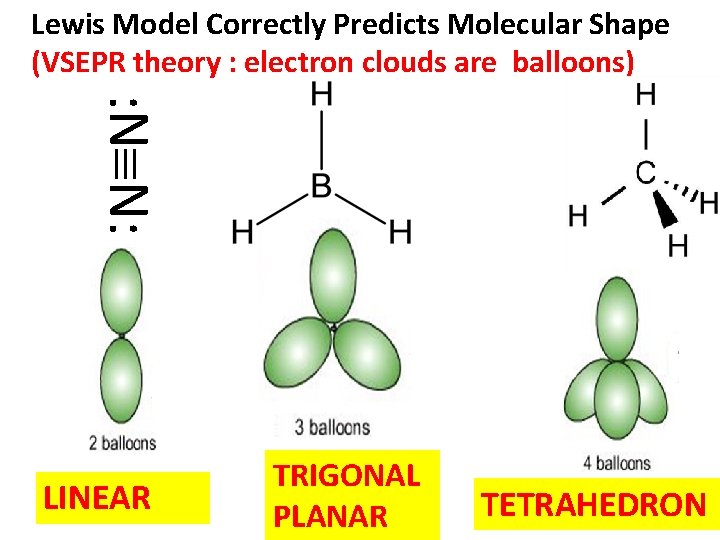
Lewis Model Correctly Predicts Molecular Shape (VSEPR theory : electron clouds are balloons) : N N: LINEAR TRIGONAL PLANAR TETRAHEDRON
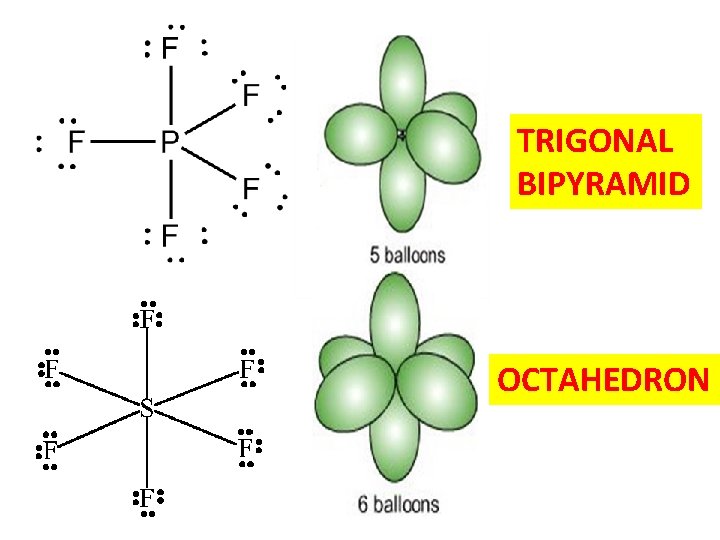
TRIGONAL BIPYRAMID OCTAHEDRON
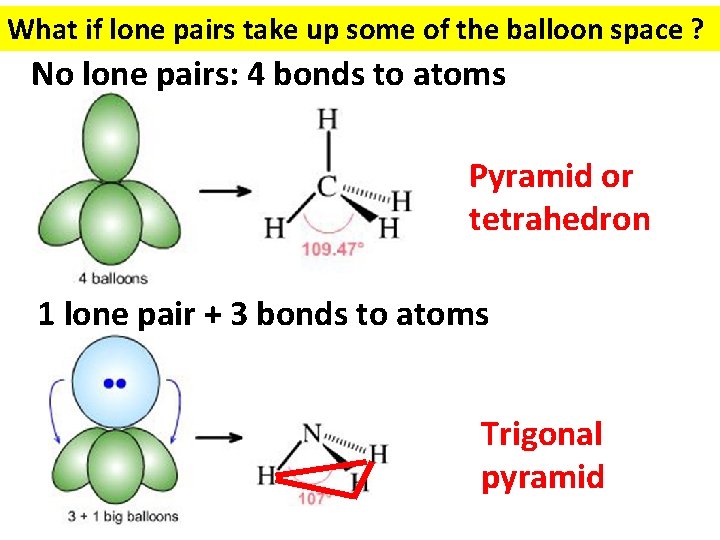
What if lone pairs take up some of the balloon space ? No lone pairs: 4 bonds to atoms Pyramid or tetrahedron 1 lone pair + 3 bonds to atoms Trigonal pyramid
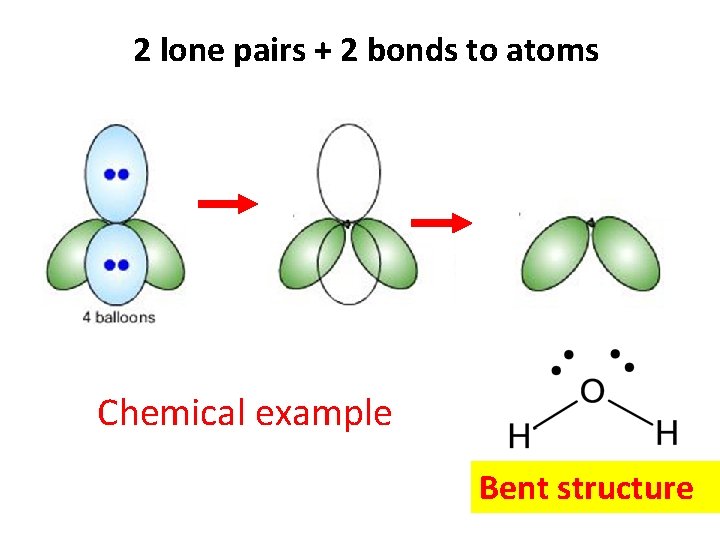
2 lone pairs + 2 bonds to atoms Chemical example Bent structure
Summary of Lewis Model successes 1. Provides simple process leading to sensible predictions of electronic distributions in most (but not all) compounds in both ground and excited states (Lewis rules)
Summary of Lewis Model successes 2) Lewis structures lead to simple and accurate predictions of molecular shapes (VSEPR)
Summary of Lewis Model successes 3) Lewis predictions of electronic distributions provide simple way to predict chemical interaction and relative stabilities, and provides basis for general acid-base model of reactivity. (Supplement 2)
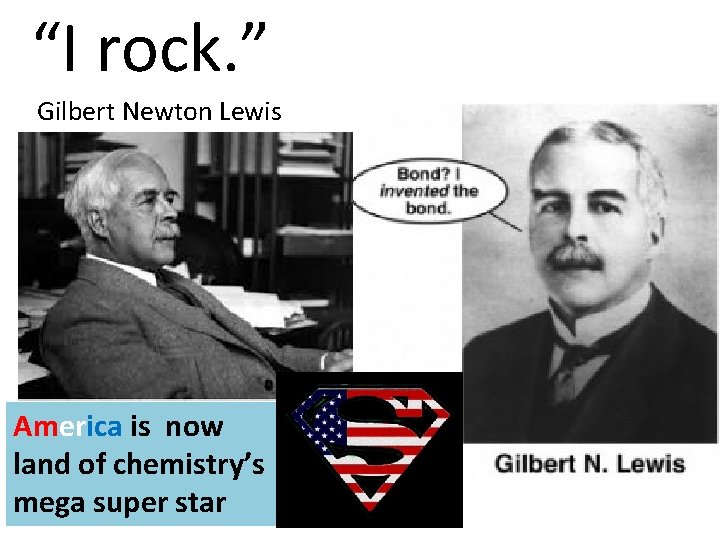
“I rock. ” Gilbert Newton Lewis America is now land of chemistry’s mega super star
ISSUES WITH THE LEWIS OCTET MODEL (the nitpicking starts…) 1. How come the bond shapes in molecules look so little like the original atomic orbitals ? ? 2. How does octet model account for the observed reactivity trend of ethane vs. ethene vs ethyne with halogens and ozone ? 3. How can you get all those electrons between carbons in double and triple bonds ? Don’t they repel ?
LEWIS MODEL HAS INCONSISTENCIES WHICH HE DOESN’T BOTHER TO ADDRESS Oh fudge off…
SO NOW WHAT ?
Eventually, another All- American “Superer Duperer” Chemistry Star swoops in and fixes everything (for a while)
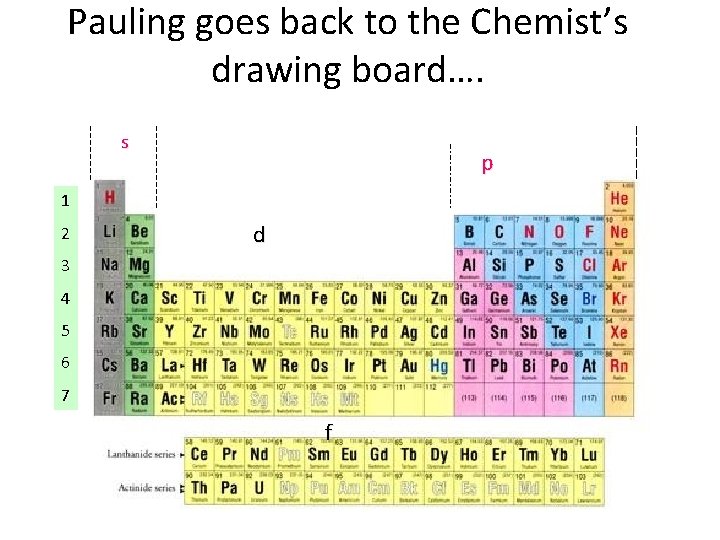
Pauling goes back to the Chemist’s drawing board…. s p 1 2 d 3 4 5 6 7 f

Pauling’s `Localized’ Valence Bond Hybridization Model PAULING’S INSIGHTS Lewis isn’t `wrong’…. he just hasn’t : a) considered the role of the valence s, p, d… orbitals play b) realized that all bonds are not the same.
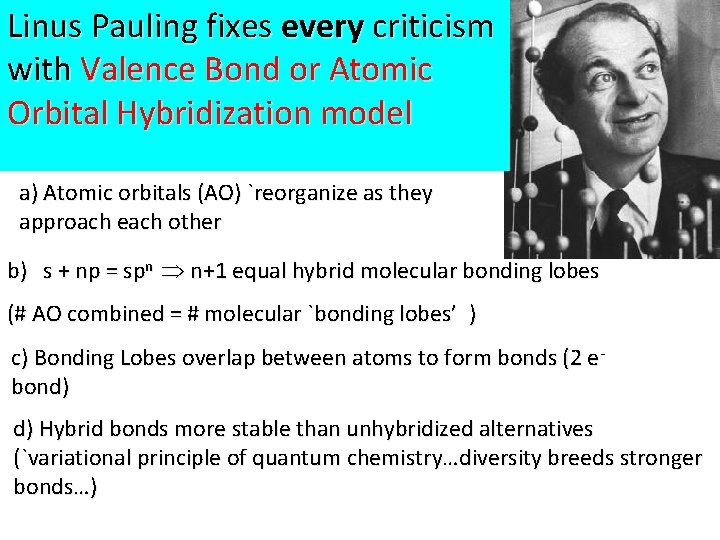
Linus Pauling fixes every criticism with Valence Bond or Atomic Orbital Hybridization model a) Atomic orbitals (AO) `reorganize as they approach each other b) s + np = spn n+1 equal hybrid molecular bonding lobes (# AO combined = # molecular `bonding lobes’ ) c) Bonding Lobes overlap between atoms to form bonds (2 ebond) d) Hybrid bonds more stable than unhybridized alternatives (`variational principle of quantum chemistry…diversity breeds stronger bonds…)
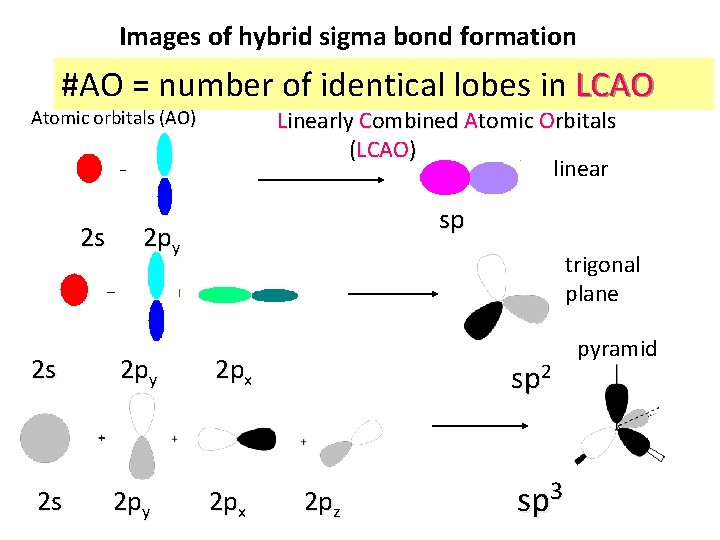
Images of hybrid sigma bond formation #AO = number of identical lobes in LCAO Linearly Combined Atomic Orbitals (LCAO) linear Atomic orbitals (AO) 2 s sp 2 py trigonal plane 2 s 2 py 2 px sp 2 2 pz sp 3 pyramid
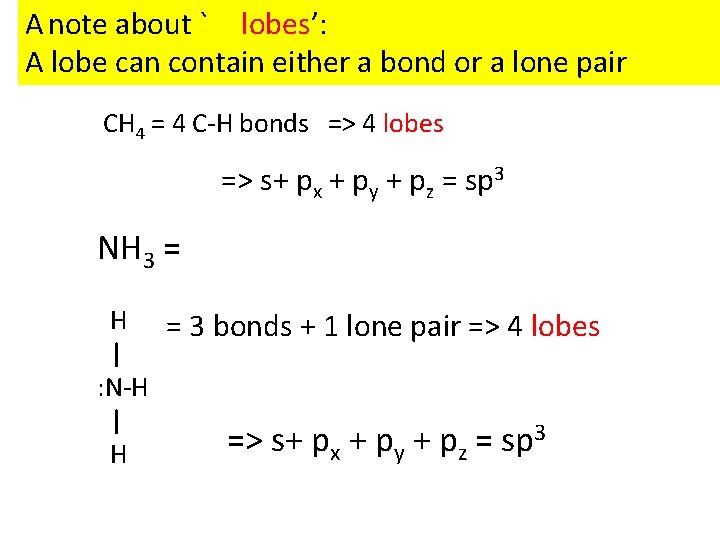
A note about ` lobes’: A lobe can contain either a bond or a lone pair CH 4 = 4 C-H bonds => 4 lobes => s+ px + py + pz = sp 3 NH 3 = H = 3 bonds + 1 lone pair => 4 lobes | : N-H | 3 => s+ p + p = sp x y z H
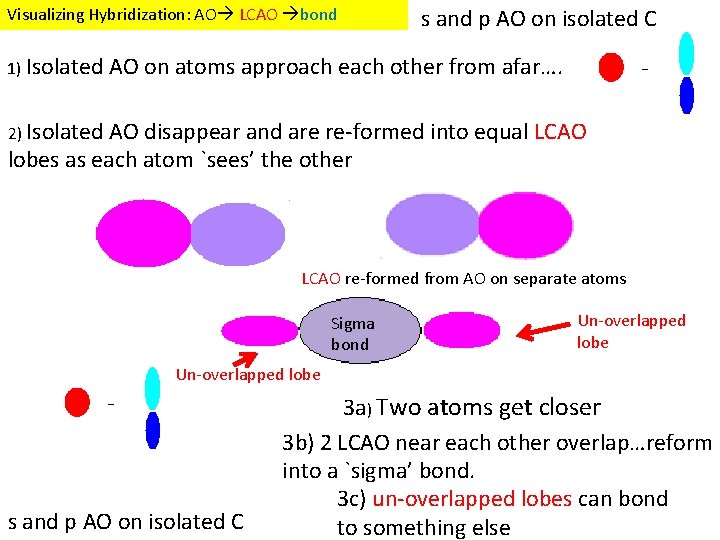
Visualizing Hybridization: AO LCAO bond 1) Isolated s and p AO on isolated C AO on atoms approach each other from afar…. 2) Isolated AO disappear and are re-formed into equal LCAO lobes as each atom `sees’ the other LCAO re-formed from AO on separate atoms Sigma bond Un-overlapped lobe s and p AO on isolated C 3 a) Two atoms get closer 3 b) 2 LCAO near each other overlap…reform into a `sigma’ bond. 3 c) un-overlapped lobes can bond to something else
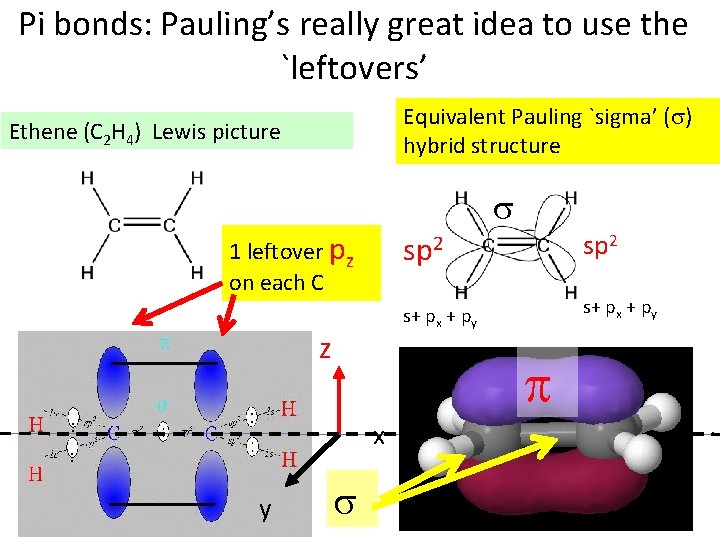
Pi bonds: Pauling’s really great idea to use the `leftovers’ Equivalent Pauling `sigma’ ( ) hybrid structure Ethene (C 2 H 4) Lewis picture 1 leftover pz on each C z sp 2 s+ px + py x y sp 2
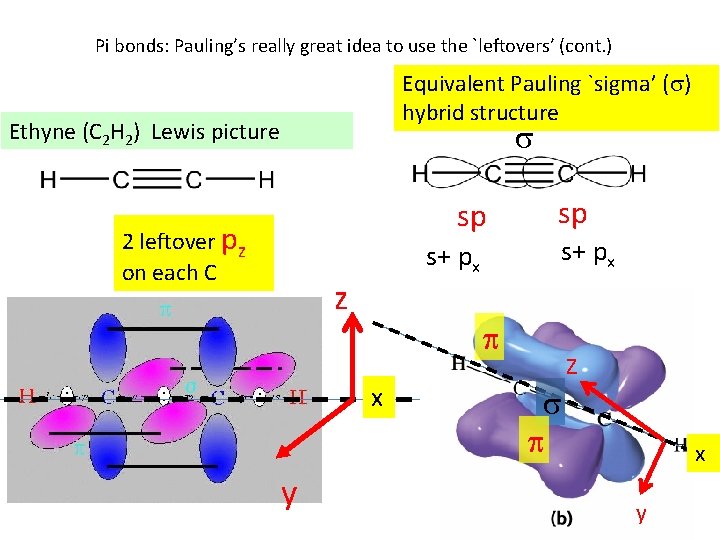
Pi bonds: Pauling’s really great idea to use the `leftovers’ (cont. ) Equivalent Pauling `sigma’ ( ) hybrid structure Ethyne (C 2 H 2) Lewis picture sp 2 leftover pz on each C s+ px z s+ px x y sp Z x y

How Pauling’s model `fixes’ the problems with Lewis model Atomic orbitals (AO) `reorganize’ (hybridize) when individual atoms approach each other such that the number of `links’ predicted by the Lewis model = the number of s, p (and d and f) orbitals combined in the reorganization. The `hybrid’ combinations are called Linear Combinations of Atomic Orbitals (LCAO). The `lobes’ in LCAO on individual atoms overlap and share two electrons between the atoms in a `sigma’ bond (often called a `valence’ or structural linkage bond. )
How Pauling’s model `fixes’ the problems with Lewis model (continued) 2. How does octet model account for the observed reactivity trend of ethane vs ethene vs ethyne with halogens and ozone ? `pi’ bonds are far less stable and far more reactive than sigma bonds. (Further out, softer, not between atoms but above and below) Ethane is held together by just `sigma bonds and is thus not very reactive. Both ethylene and acetylene have pi bonds which are easily reacted. That acetylene is more reactive thane ethylene results because it has two pi bonds while ethylene has only 1 pi bond
How Pauling’s model `fixes’ the problems with Lewis model (continued) 3. How come ethene sticks to Pt, Rh and Ni in catalysis, but ethane doesn’t ? ? ? The large and loose electronic clouds above the metals are `soft’ and easily `blended’ (overlapped’ with like electronic distributions (e. g. soft and fluid). Pi bonds are soft and fluid; sigma bonds aren’t. Moreover, the pi bonds are far away from the central core of the molecule, thus reducing nuclear repulsions.
How Pauling’s model `fixes’ the problems with Lewis model (continued) The pi bonds occupy space above and below the sigma bond and thus do not crowd them. The two pi bonds are also on different and perpendicularly aligned planes to minimize pi-pi crowding.
- Slides: 34