
Lewis Dot Structures Gateway to Understanding Molecular Structure

- Slides: 21
Lewis Dot Structures Gateway to Understanding Molecular Structure
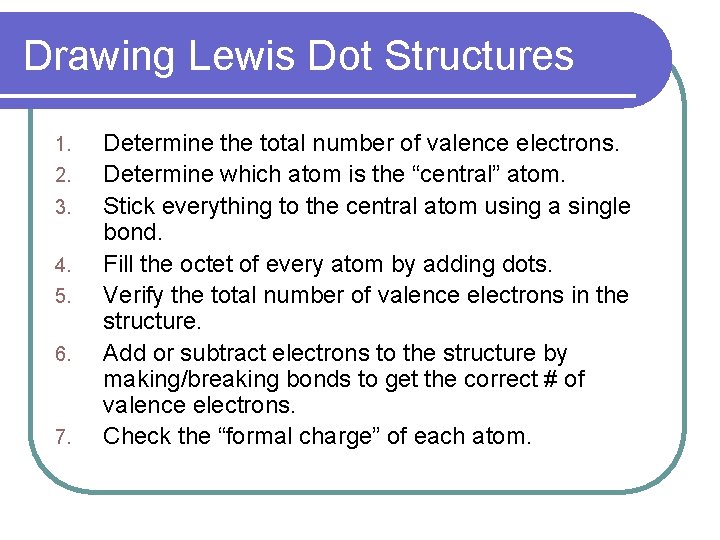
Drawing Lewis Dot Structures 1. 2. 3. 4. 5. 6. 7. Determine the total number of valence electrons. Determine which atom is the “central” atom. Stick everything to the central atom using a single bond. Fill the octet of every atom by adding dots. Verify the total number of valence electrons in the structure. Add or subtract electrons to the structure by making/breaking bonds to get the correct # of valence electrons. Check the “formal charge” of each atom.
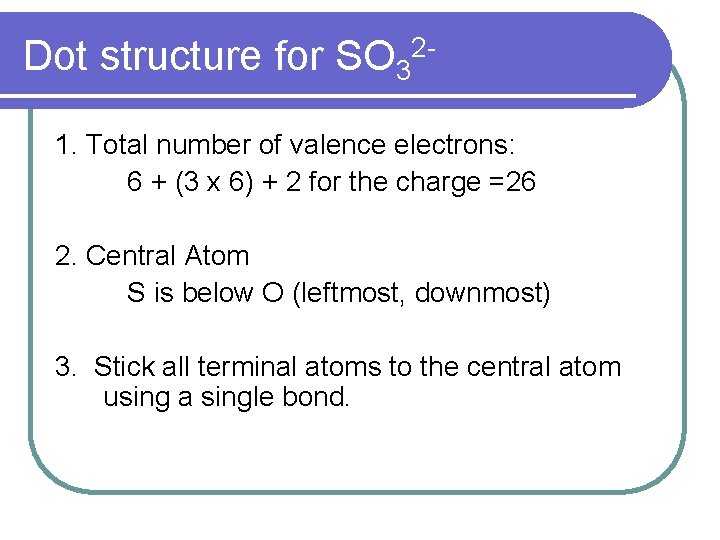
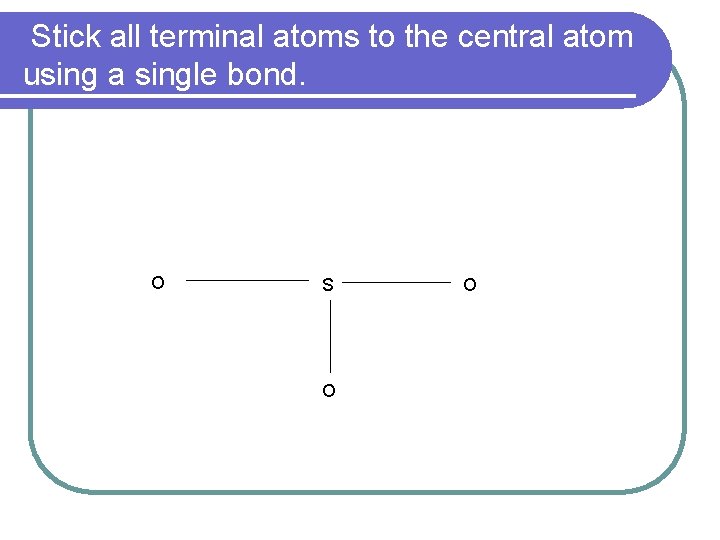
Dot structure for SO 321. Total number of valence electrons: 6 + (3 x 6) + 2 for the charge =26 2. Central Atom S is below O (leftmost, downmost) 3. Stick all terminal atoms to the central atom using a single bond.
Stick all terminal atoms to the central atom using a single bond. O S O O
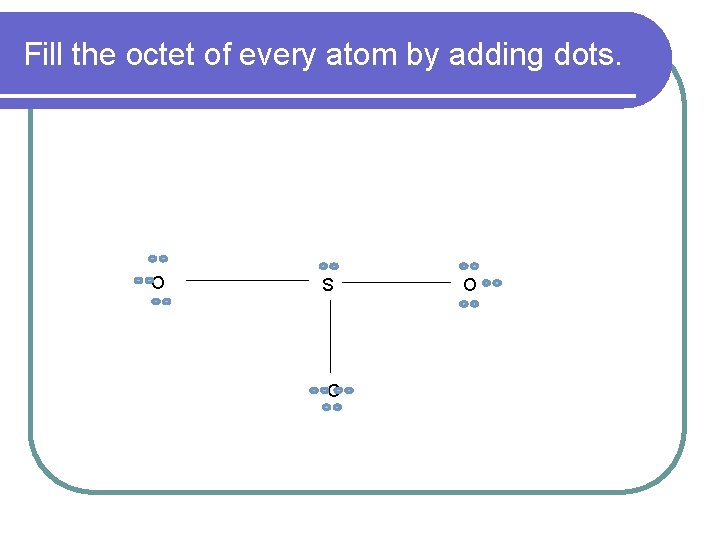
Fill the octet of every atom by adding dots. O S O O
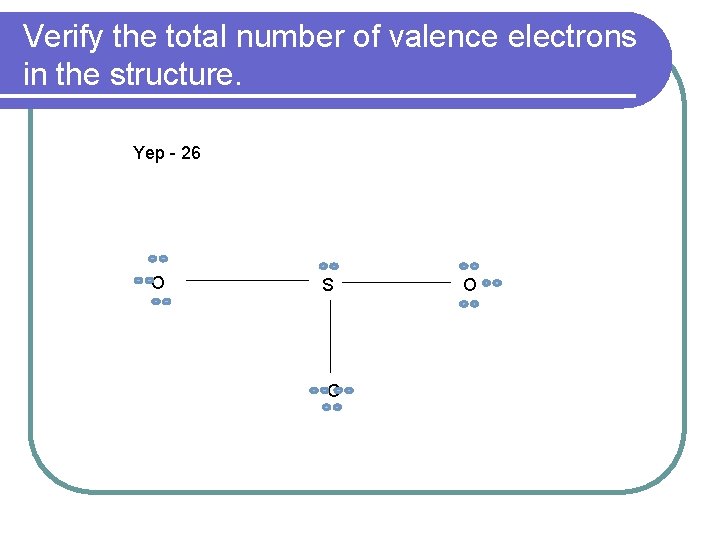
Verify the total number of valence electrons in the structure. Yep - 26 O S O O
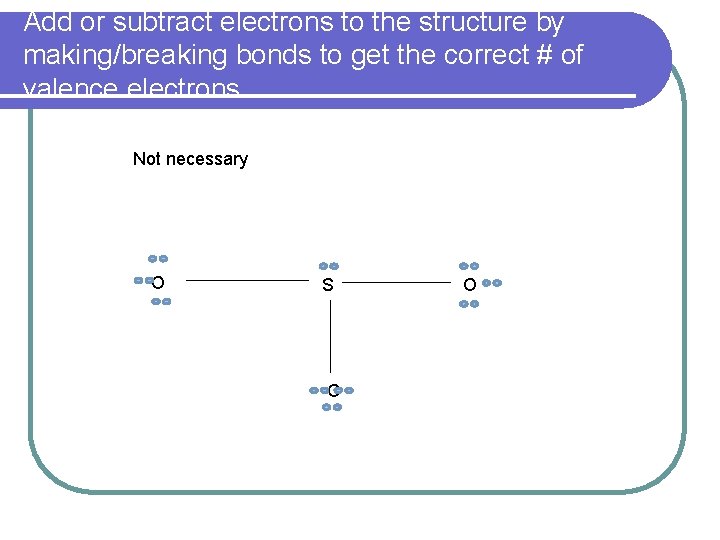
Add or subtract electrons to the structure by making/breaking bonds to get the correct # of valence electrons. Not necessary O S O O
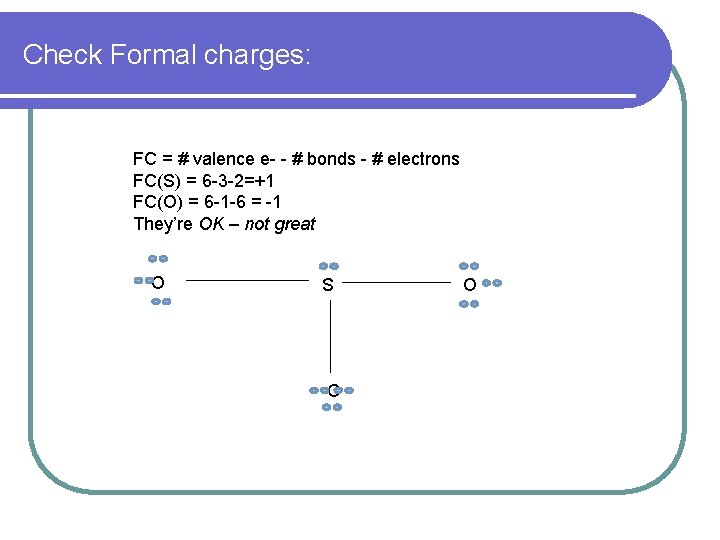
Check Formal charges: FC = # valence e- - # bonds - # electrons FC(S) = 6 -3 -2=+1 FC(O) = 6 -1 -6 = -1 They’re OK – not great O S O O
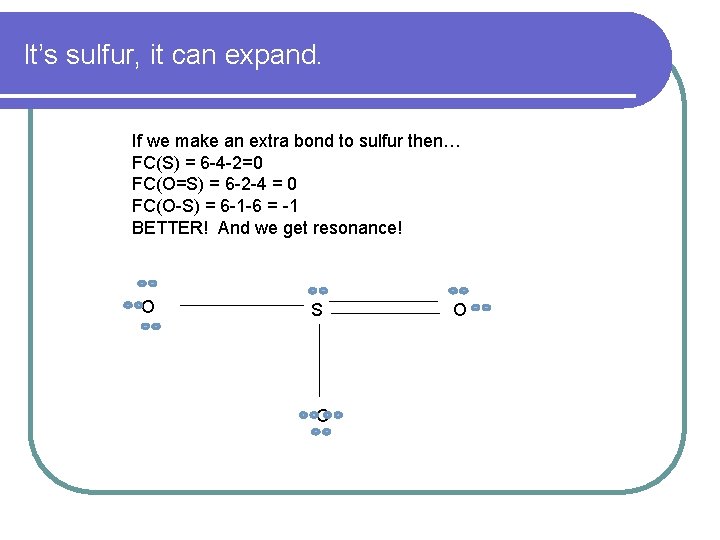
It’s sulfur, it can expand. If we make an extra bond to sulfur then… FC(S) = 6 -4 -2=0 FC(O=S) = 6 -2 -4 = 0 FC(O-S) = 6 -1 -6 = -1 BETTER! And we get resonance! O S O O
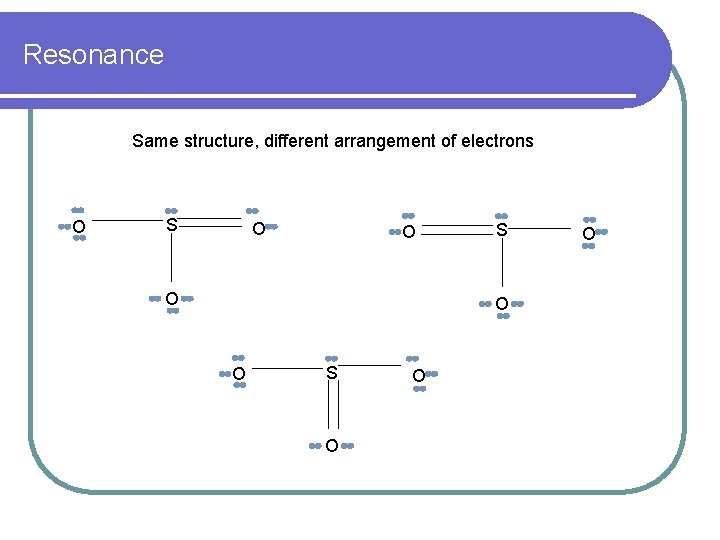
Resonance Same structure, different arrangement of electrons O S O O O
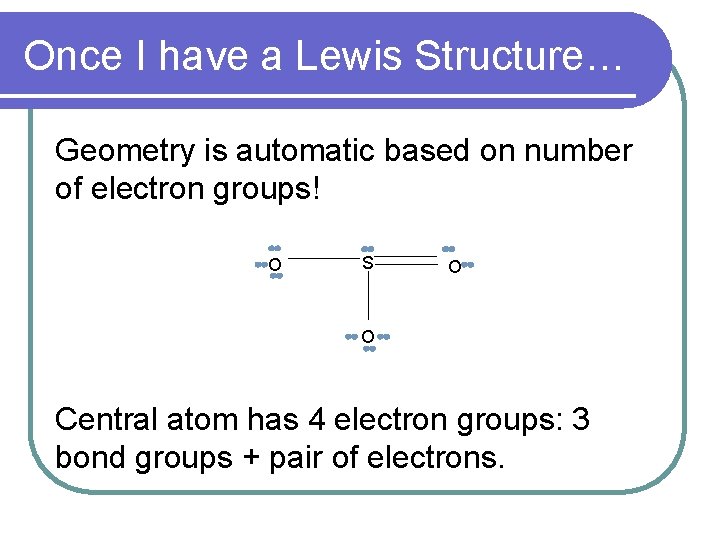
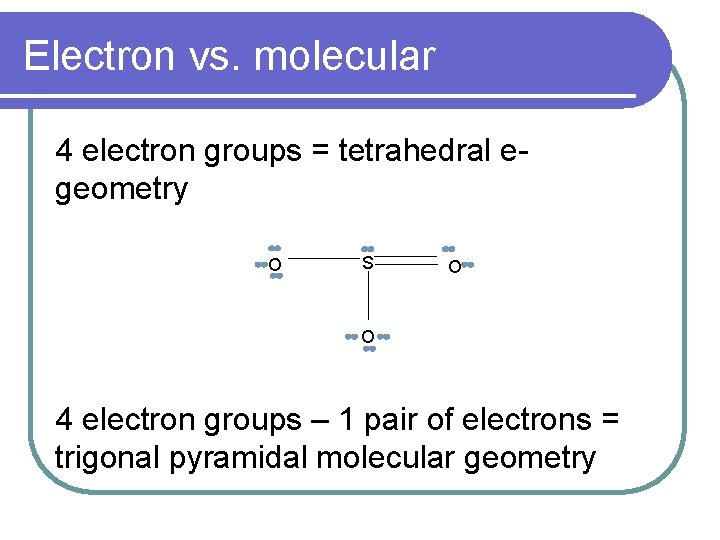
Once I have a Lewis Structure… Geometry is automatic based on number of electron groups! O S O O Central atom has 4 electron groups: 3 bond groups + pair of electrons.
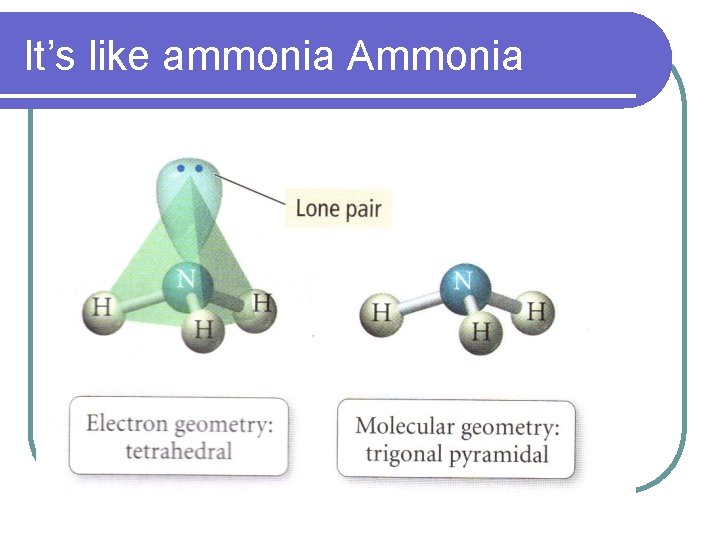
Electron vs. molecular 4 electron groups = tetrahedral egeometry O S O O 4 electron groups – 1 pair of electrons = trigonal pyramidal molecular geometry
Shape is half the issue… Shape determines how the molecules can approach each other. (Remember trying to hug someone with a leg sticking out of their chest. ) Charge is the other half. Opposites attract. Polarity is velcro.
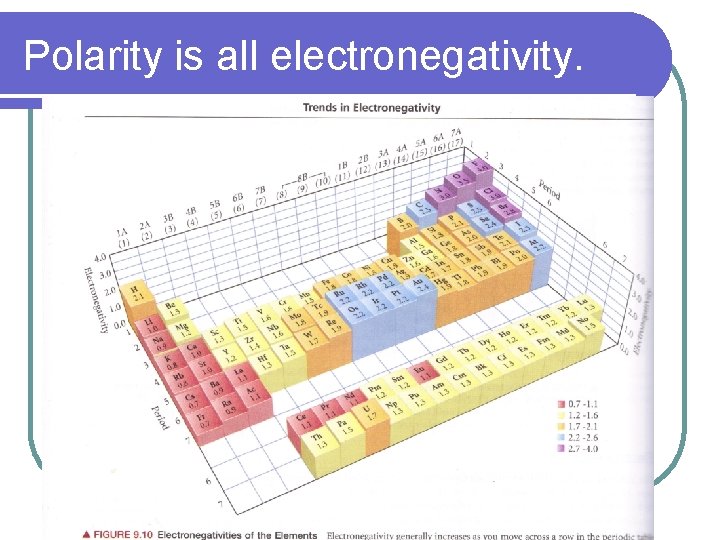
Polarity is all electronegativity.
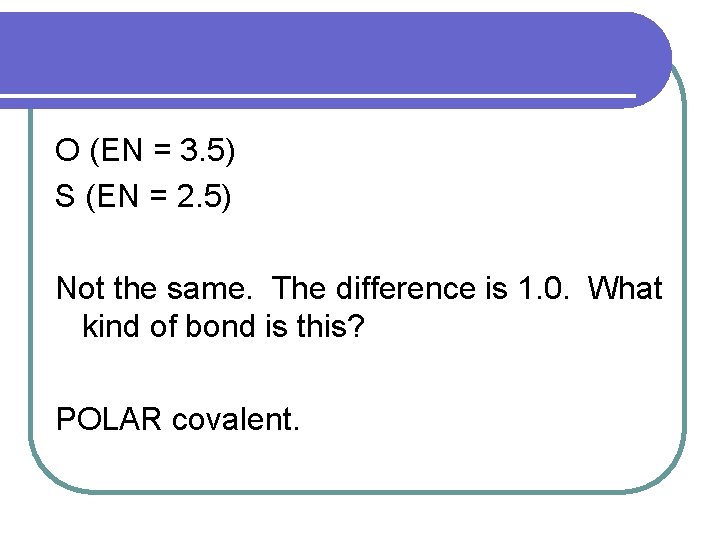
O (EN = 3. 5) S (EN = 2. 5) Not the same. The difference is 1. 0. What kind of bond is this? POLAR covalent.
Each bond is polar… What about the molecule? We need to consider shape and whether the polarities cancel. It’s trigonal pyramidal!
It’s like ammonia Ammonia
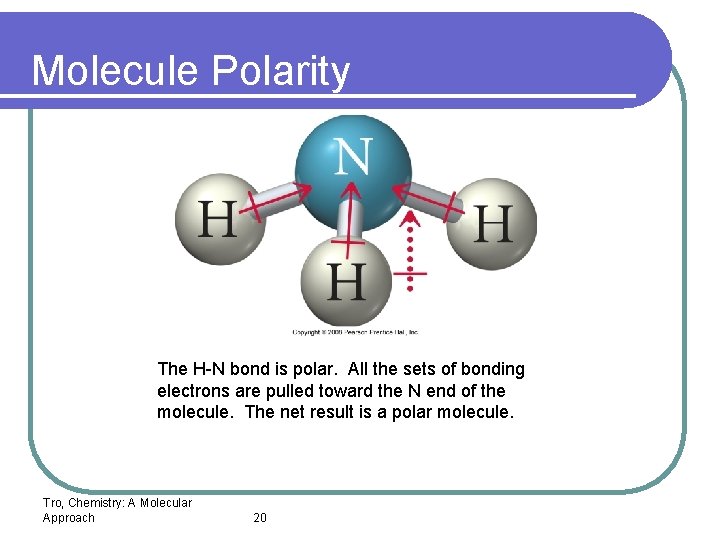
Molecule Polarity The H-N bond is polar. All the sets of bonding electrons are pulled toward the N end of the molecule. The net result is a polar molecule. Tro, Chemistry: A Molecular Approach 20
SO 3 is a polar molecular with a trigonal pyramidal shape 2 - That shape and polarity will determine how sulfite interacts with other molecules and ions. Form = Function Form + charges = Function