
Lewis Diagrams Lewis diagrams illustrate chemical bonding by
Lewis Diagrams • Lewis diagrams illustrate chemical bonding by showing only an atom’s valence electrons and the chemical symbol. See page 178 (c) Mc. Graw Hill Ryerson 2007
Lewis Diagrams • Lewis diagrams illustrate chemical bonding by showing only an atom’s valence electrons and the chemical symbol. w Dots representing electrons are placed around the element symbols at the points of the compass (north, east, south, and west). See page 178 (c) Mc. Graw Hill Ryerson 2007

Lewis Diagrams • Lewis diagrams illustrate chemical bonding by showing only an atom’s valence electrons and the chemical symbol. w Dots representing electrons are placed around the element symbols at the points of the compass (north, east, south, and west). w Electron dots are placed singly until the fifth electron is reached then they are paired. See page 178 (c) Mc. Graw Hill Ryerson 2007

Lewis Diagrams • Lewis diagrams illustrate chemical bonding by showing only an atom’s valence electrons and the chemical symbol. w Dots representing electrons are placed around the element symbols at the points of the compass (north, east, south, and west). w Electron dots are placed singly until the fifth electron is reached then they are paired. See page 178 (c) Mc. Graw Hill Ryerson 2007

Forming Compounds (continued) • Covalent bonds are formed between two or more nonmetals. w Electrons are shared between atoms. See pages 176 - 177 (c) Mc. Graw Hill Ryerson 2007
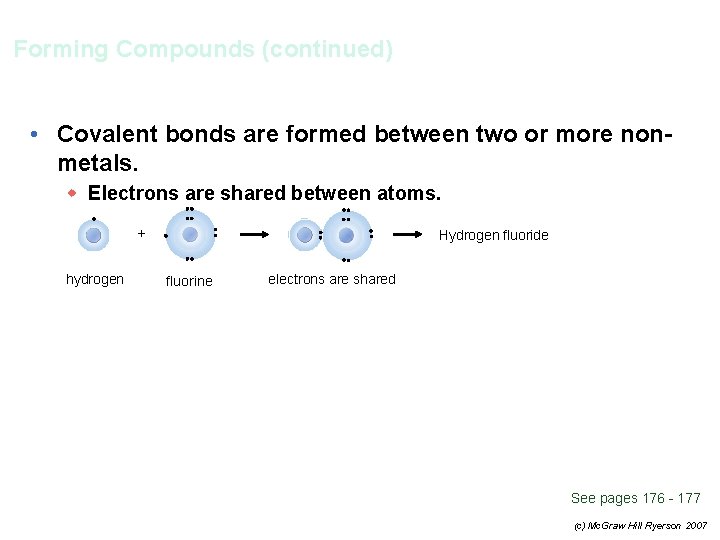
Forming Compounds (continued) • Covalent bonds are formed between two or more nonmetals. w Electrons are shared between atoms. + hydrogen Hydrogen fluoride fluorine electrons are shared See pages 176 - 177 (c) Mc. Graw Hill Ryerson 2007
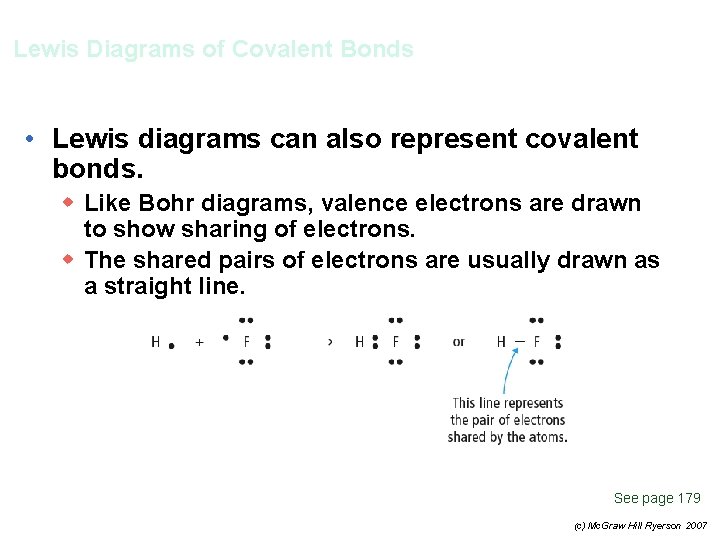
Lewis Diagrams of Covalent Bonds • Lewis diagrams can also represent covalent bonds. w Like Bohr diagrams, valence electrons are drawn to show sharing of electrons. w The shared pairs of electrons are usually drawn as a straight line. See page 179 (c) Mc. Graw Hill Ryerson 2007

Lewis Diagrams of Diatomic Molecules • Diatomic molecules, like O 2, are also easy to draw as Lewis diagrams. • • • • O • • Several non-metals join to form diatomic molecules. • • O • • • • O • • Valence electrons are shared, here in two pairs. • • O • • • • O • • • • This is drawn as a double bond. See page 180 (c) Mc. Graw Hill Ryerson 2007
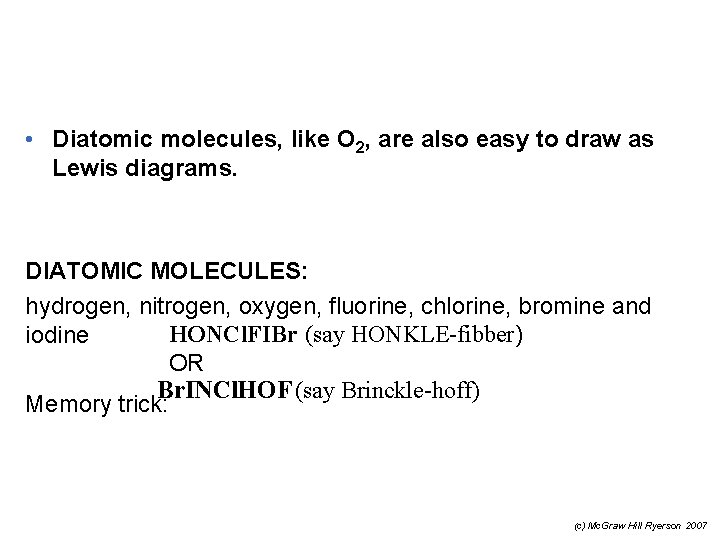
• Diatomic molecules, like O 2, are also easy to draw as Lewis diagrams. DIATOMIC MOLECULES: hydrogen, nitrogen, oxygen, fluorine, chlorine, bromine and HONCl. FIBr (say HONKLE-fibber) iodine OR Br. INCl. HOF (say Brinckle-hoff) Memory trick: (c) Mc. Graw Hill Ryerson 2007

Lewis Diagram for Ionic Compounds – metal and nonmetal (c) Mc. Graw Hill Ryerson 2007
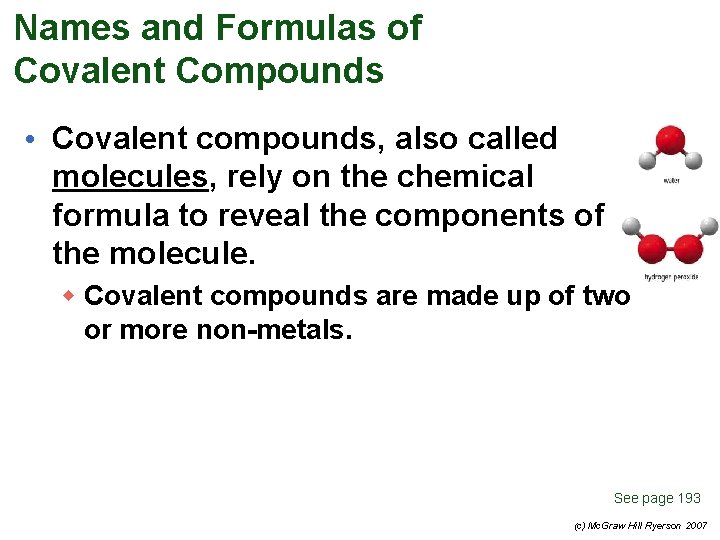
Names and Formulas of Covalent Compounds • Covalent compounds, also called molecules, rely on the chemical formula to reveal the components of the molecule. w Covalent compounds are made up of two or more non-metals. See page 193 (c) Mc. Graw Hill Ryerson 2007
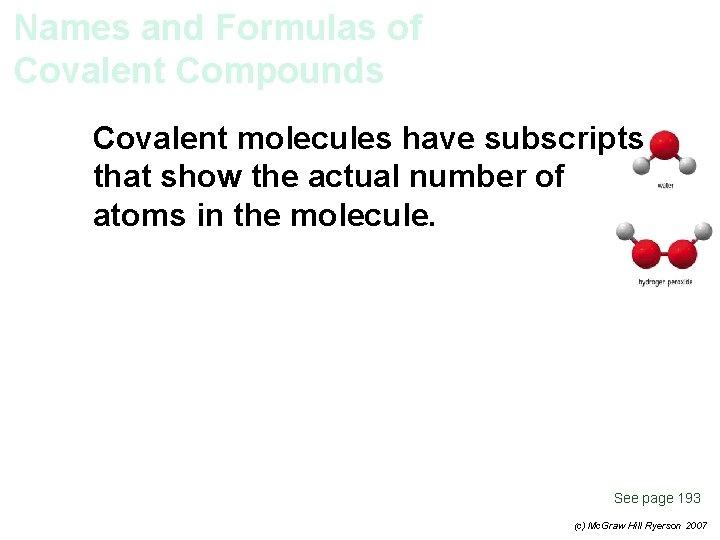
Names and Formulas of Covalent Compounds Covalent molecules have subscripts that show the actual number of atoms in the molecule. See page 193 (c) Mc. Graw Hill Ryerson 2007
Naming Binary Covalent Compounds • Binary covalent compounds (two non-metal atoms) use a system of prefixes. w Covalent compounds may have many or few atoms sharing electrons. See pages 194 - 195 (c) Mc. Graw Hill Ryerson 2007
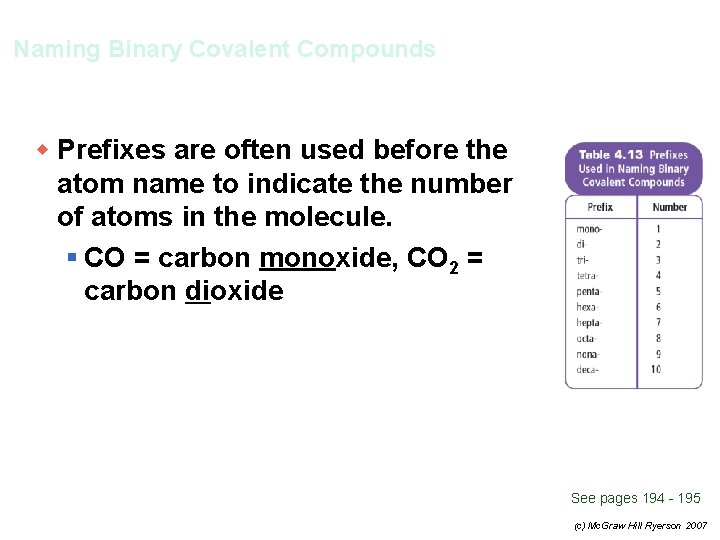
Naming Binary Covalent Compounds w Prefixes are often used before the atom name to indicate the number of atoms in the molecule. § CO = carbon monoxide, CO 2 = carbon dioxide See pages 194 - 195 (c) Mc. Graw Hill Ryerson 2007
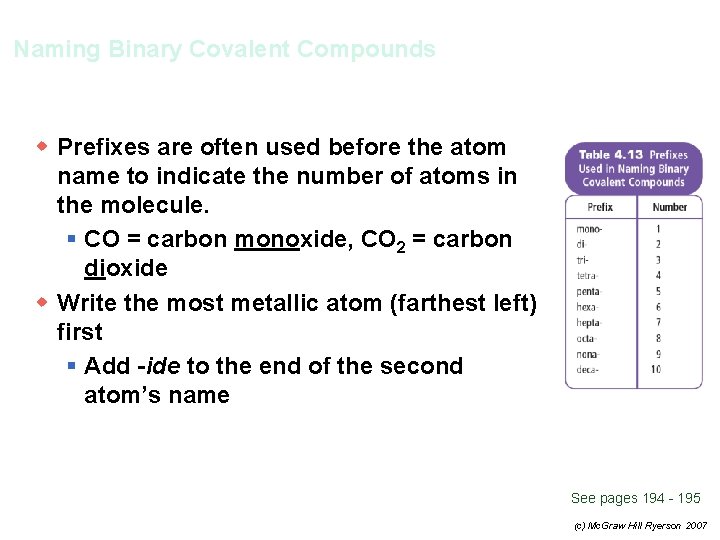
Naming Binary Covalent Compounds w Prefixes are often used before the atom name to indicate the number of atoms in the molecule. § CO = carbon monoxide, CO 2 = carbon dioxide w Write the most metallic atom (farthest left) first § Add -ide to the end of the second atom’s name See pages 194 - 195 (c) Mc. Graw Hill Ryerson 2007

Naming Binary Covalent Compounds w What is the chemical formula for the molecule trinitrogen tetrachloride? See pages 194 - 195 (c) Mc. Graw Hill Ryerson 2007
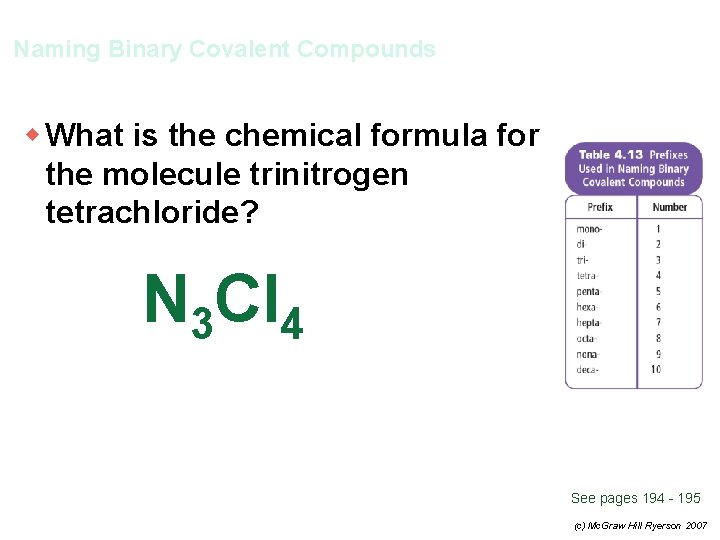
Naming Binary Covalent Compounds w What is the chemical formula for the molecule trinitrogen tetrachloride? N 3 Cl 4 See pages 194 - 195 (c) Mc. Graw Hill Ryerson 2007
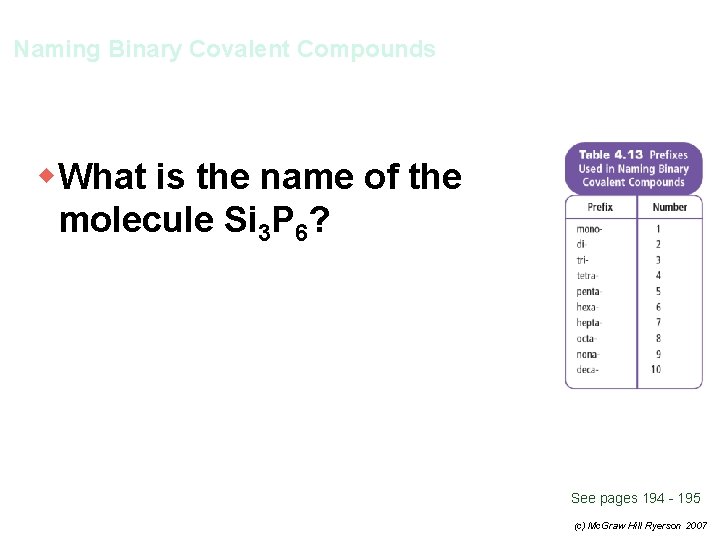
Naming Binary Covalent Compounds w What is the name of the molecule Si 3 P 6? See pages 194 - 195 (c) Mc. Graw Hill Ryerson 2007
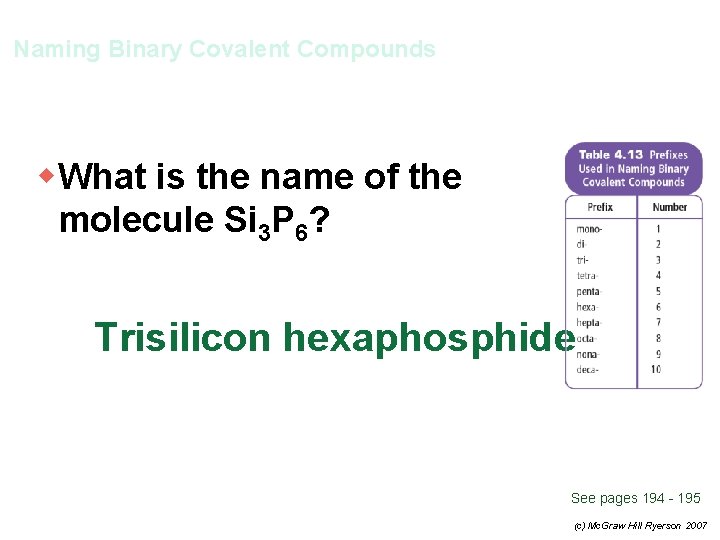
Naming Binary Covalent Compounds w What is the name of the molecule Si 3 P 6? Trisilicon hexaphosphide See pages 194 - 195 (c) Mc. Graw Hill Ryerson 2007
- Slides: 19