
Levonorgestrel Intrauterine Devices LNGIUDs Session III Providing LNGIUDs
- Slides: 20
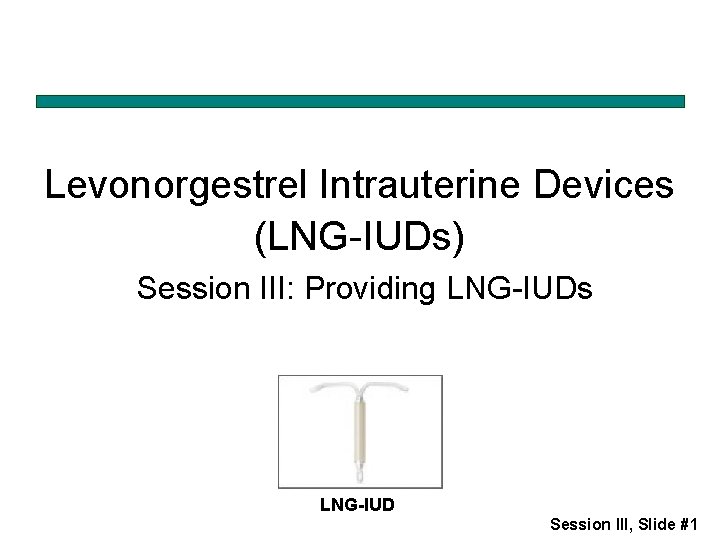
Levonorgestrel Intrauterine Devices (LNG-IUDs) Session III: Providing LNG-IUDs LNG-IUD Session III, Slide #1
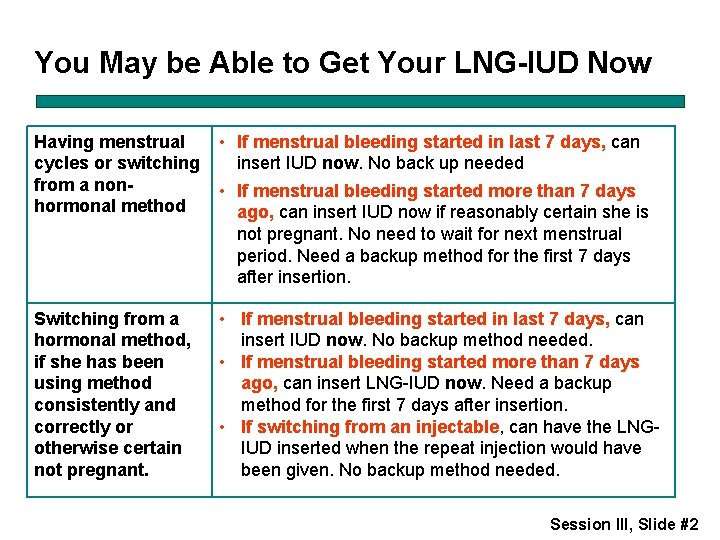
You May be Able to Get Your LNG-IUD Now Having menstrual cycles or switching from a nonhormonal method • If menstrual bleeding started in last 7 days, can insert IUD now. No back up needed Switching from a hormonal method, if she has been using method consistently and correctly or otherwise certain not pregnant. • If menstrual bleeding started in last 7 days, can insert IUD now. No backup method needed. • If menstrual bleeding started more than 7 days ago, can insert LNG-IUD now. Need a backup method for the first 7 days after insertion. • If switching from an injectable, can have the LNGIUD inserted when the repeat injection would have been given. No backup method needed. • If menstrual bleeding started more than 7 days ago, can insert IUD now if reasonably certain she is not pregnant. No need to wait for next menstrual period. Need a backup method for the first 7 days after insertion. Session III, Slide #2
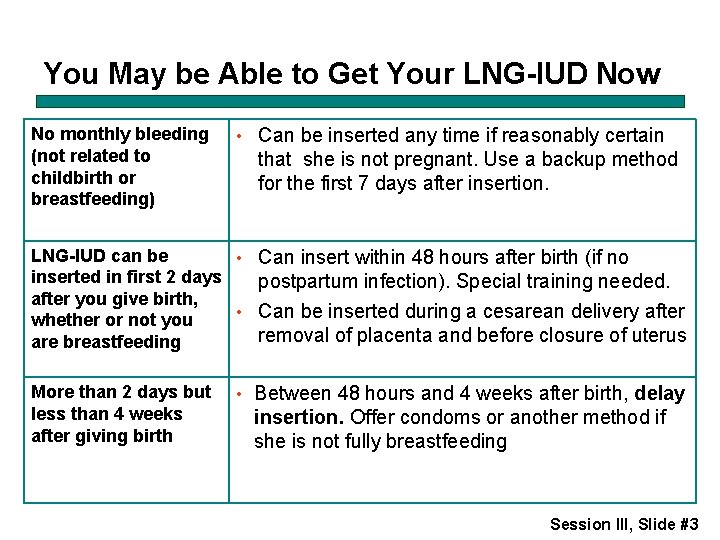
You May be Able to Get Your LNG-IUD Now No monthly bleeding (not related to childbirth or breastfeeding) • Can be inserted any time if reasonably certain that she is not pregnant. Use a backup method for the first 7 days after insertion. LNG-IUD can be • Can insert within 48 hours after birth (if no inserted in first 2 days postpartum infection). Special training needed. after you give birth, • Can be inserted during a cesarean delivery after whether or not you removal of placenta and before closure of uterus are breastfeeding More than 2 days but less than 4 weeks after giving birth • Between 48 hours and 4 weeks after birth, delay insertion. Offer condoms or another method if she is not fully breastfeeding Session III, Slide #3
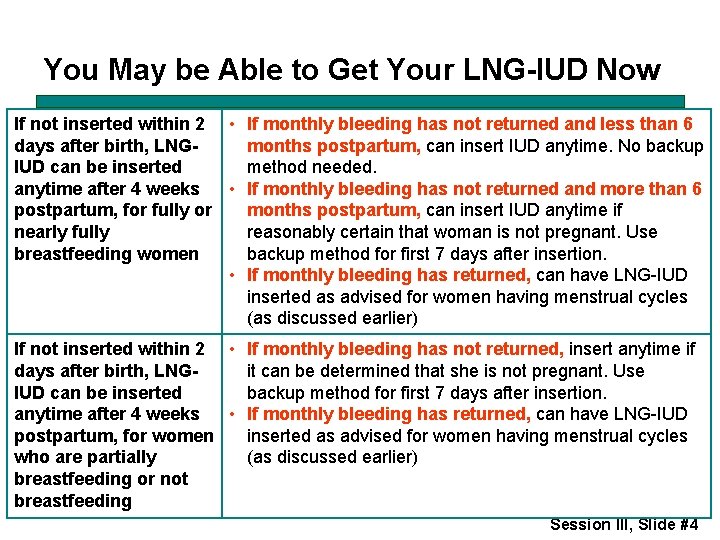
You May be Able to Get Your LNG-IUD Now If not inserted within 2 • If monthly bleeding has not returned and less than 6 days after birth, LNGmonths postpartum, can insert IUD anytime. No backup IUD can be inserted method needed. anytime after 4 weeks • If monthly bleeding has not returned and more than 6 postpartum, for fully or months postpartum, can insert IUD anytime if nearly fully reasonably certain that woman is not pregnant. Use breastfeeding women backup method for first 7 days after insertion. • If monthly bleeding has returned, can have LNG-IUD inserted as advised for women having menstrual cycles (as discussed earlier) If not inserted within 2 • If monthly bleeding has not returned, insert anytime if days after birth, LNGit can be determined that she is not pregnant. Use IUD can be inserted backup method for first 7 days after insertion. anytime after 4 weeks • If monthly bleeding has returned, can have LNG-IUD postpartum, for women inserted as advised for women having menstrual cycles who are partially (as discussed earlier) breastfeeding or not breastfeeding Session III, Slide #4
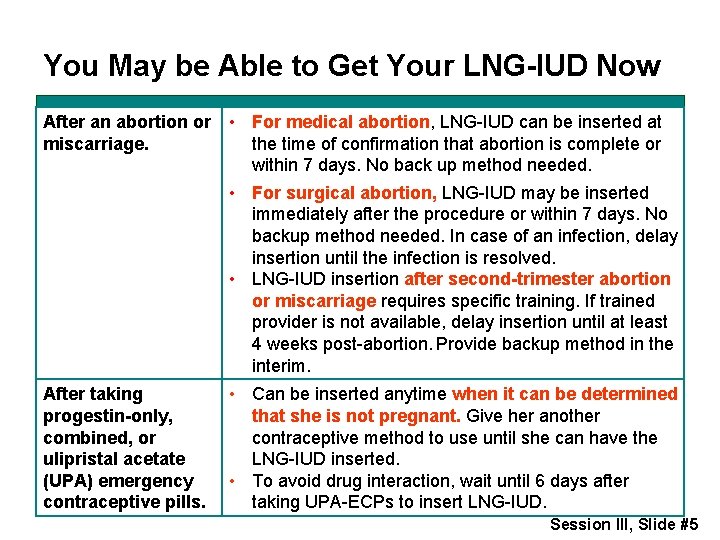
You May be Able to Get Your LNG-IUD Now After an abortion or miscarriage. • For medical abortion, LNG-IUD can be inserted at the time of confirmation that abortion is complete or within 7 days. No back up method needed. • For surgical abortion, LNG-IUD may be inserted immediately after the procedure or within 7 days. No backup method needed. In case of an infection, delay insertion until the infection is resolved. • LNG-IUD insertion after second-trimester abortion or miscarriage requires specific training. If trained provider is not available, delay insertion until at least 4 weeks post-abortion. Provide backup method in the interim. After taking progestin-only, combined, or ulipristal acetate (UPA) emergency contraceptive pills. • Can be inserted anytime when it can be determined that she is not pregnant. Give her another contraceptive method to use until she can have the LNG-IUD inserted. • To avoid drug interaction, wait until 6 days after taking UPA-ECPs to insert LNG-IUD. Session III, Slide #5
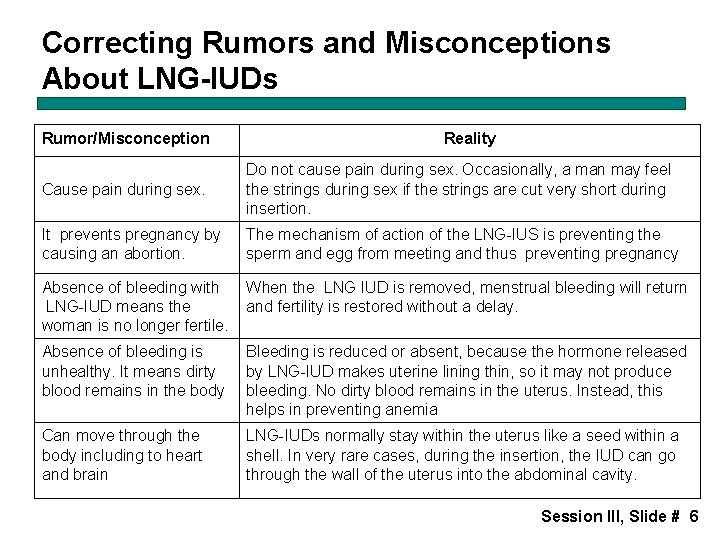
Correcting Rumors and Misconceptions About LNG-IUDs Rumor/Misconception Reality Cause pain during sex. Do not cause pain during sex. Occasionally, a man may feel the strings during sex if the strings are cut very short during insertion. It prevents pregnancy by causing an abortion. The mechanism of action of the LNG-IUS is preventing the sperm and egg from meeting and thus preventing pregnancy Absence of bleeding with LNG-IUD means the woman is no longer fertile. When the LNG IUD is removed, menstrual bleeding will return and fertility is restored without a delay. Absence of bleeding is unhealthy. It means dirty blood remains in the body Bleeding is reduced or absent, because the hormone released by LNG-IUD makes uterine lining thin, so it may not produce bleeding. No dirty blood remains in the uterus. Instead, this helps in preventing anemia Can move through the body including to heart and brain LNG-IUDs normally stay within the uterus like a seed within a shell. In very rare cases, during the insertion, the IUD can go through the wall of the uterus into the abdominal cavity. Session III, Slide # 6
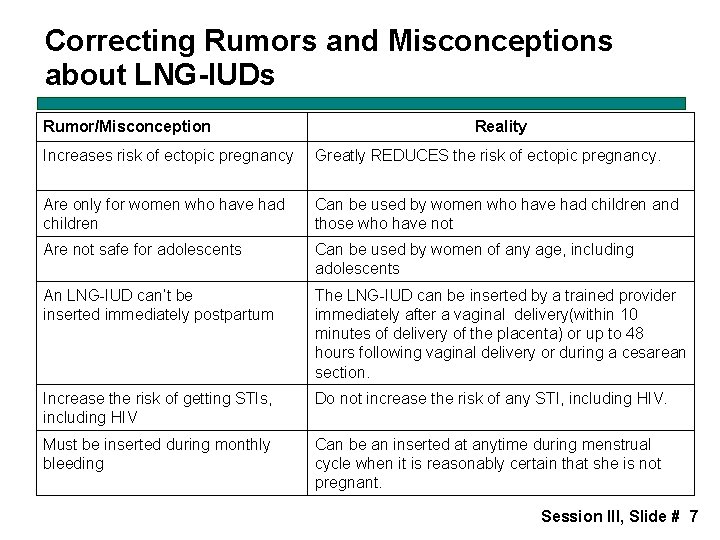
Correcting Rumors and Misconceptions about LNG-IUDs Rumor/Misconception Reality Increases risk of ectopic pregnancy Greatly REDUCES the risk of ectopic pregnancy. Are only for women who have had children Can be used by women who have had children and those who have not Are not safe for adolescents Can be used by women of any age, including adolescents An LNG-IUD can’t be inserted immediately postpartum The LNG-IUD can be inserted by a trained provider immediately after a vaginal delivery(within 10 minutes of delivery of the placenta) or up to 48 hours following vaginal delivery or during a cesarean section. Increase the risk of getting STIs, including HIV Do not increase the risk of any STI, including HIV. Must be inserted during monthly bleeding Can be an inserted at anytime during menstrual cycle when it is reasonably certain that she is not pregnant. Session III, Slide # 7
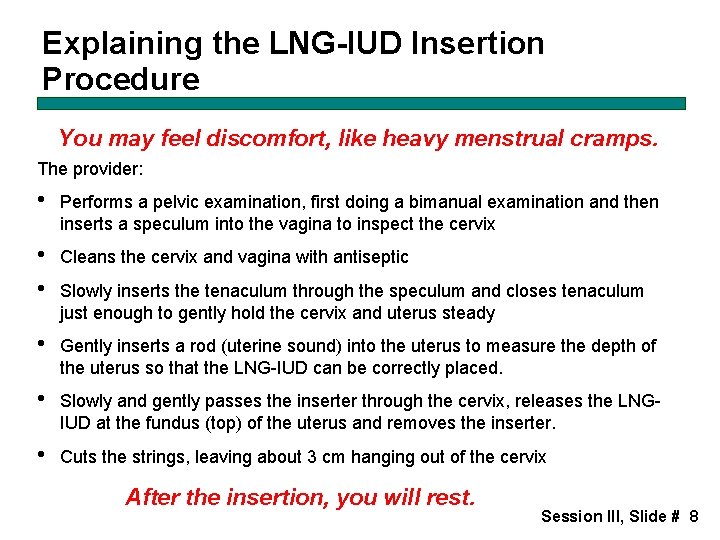
Explaining the LNG-IUD Insertion Procedure You may feel discomfort, like heavy menstrual cramps. The provider: • Performs a pelvic examination, first doing a bimanual examination and then inserts a speculum into the vagina to inspect the cervix • • Cleans the cervix and vagina with antiseptic • Gently inserts a rod (uterine sound) into the uterus to measure the depth of the uterus so that the LNG-IUD can be correctly placed. • Slowly and gently passes the inserter through the cervix, releases the LNGIUD at the fundus (top) of the uterus and removes the inserter. • Cuts the strings, leaving about 3 cm hanging out of the cervix Slowly inserts the tenaculum through the speculum and closes tenaculum just enough to gently hold the cervix and uterus steady After the insertion, you will rest. Session III, Slide # 8
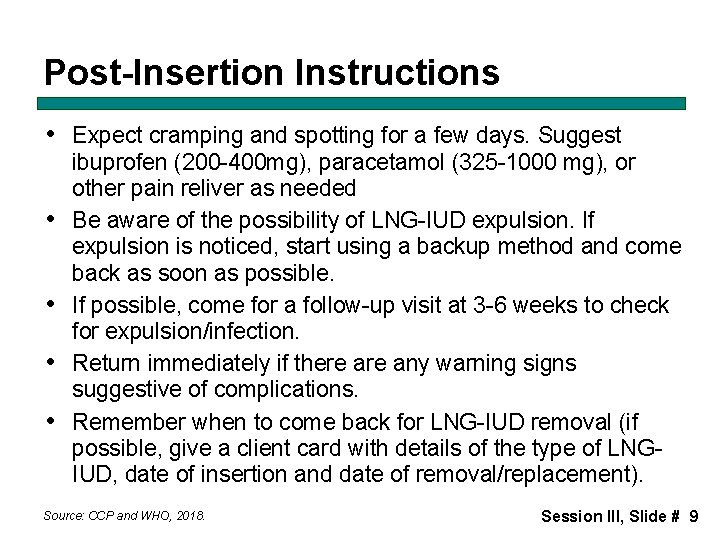
Post-Insertion Instructions • Expect cramping and spotting for a few days. Suggest • • ibuprofen (200 -400 mg), paracetamol (325 -1000 mg), or other pain reliver as needed Be aware of the possibility of LNG-IUD expulsion. If expulsion is noticed, start using a backup method and come back as soon as possible. If possible, come for a follow-up visit at 3 -6 weeks to check for expulsion/infection. Return immediately if there any warning signs suggestive of complications. Remember when to come back for LNG-IUD removal (if possible, give a client card with details of the type of LNGIUD, date of insertion and date of removal/replacement). Source: CCP and WHO, 2018. Session III, Slide # 9
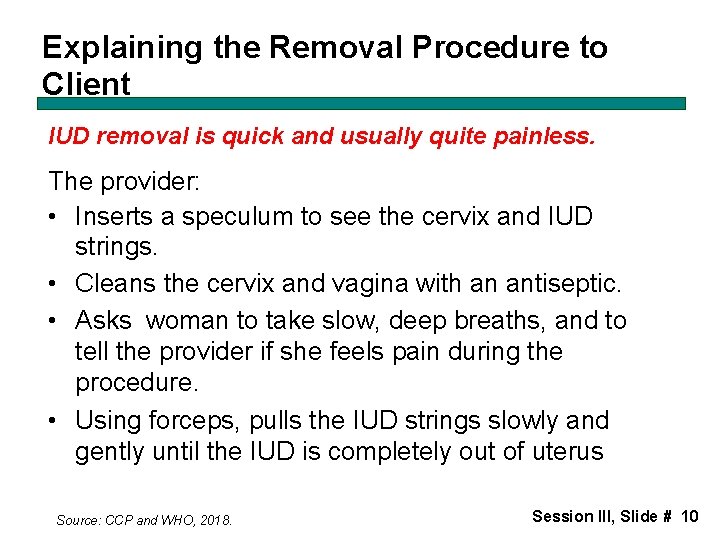
Explaining the Removal Procedure to Client IUD removal is quick and usually quite painless. The provider: • Inserts a speculum to see the cervix and IUD strings. • Cleans the cervix and vagina with an antiseptic. • Asks woman to take slow, deep breaths, and to tell the provider if she feels pain during the procedure. • Using forceps, pulls the IUD strings slowly and gently until the IUD is completely out of uterus Source: CCP and WHO, 2018. Session III, Slide # 10
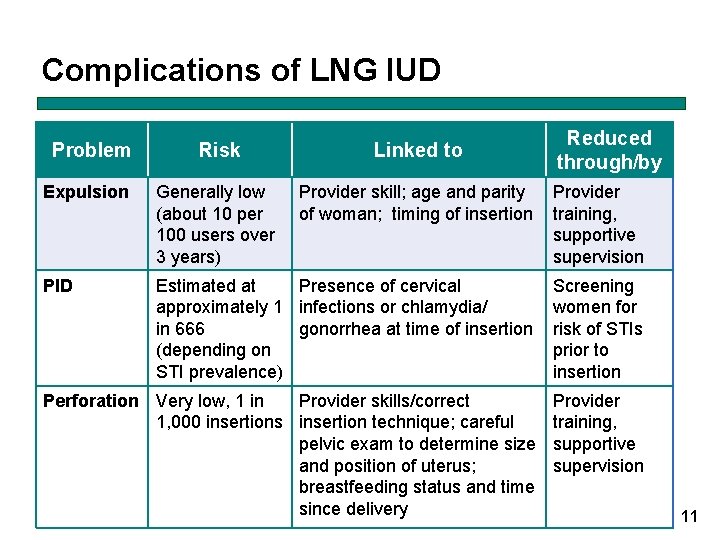
Complications of LNG IUD Problem Reduced through/by Risk Linked to Expulsion Generally low (about 10 per 100 users over 3 years) Provider skill; age and parity of woman; timing of insertion Provider training, supportive supervision PID Estimated at Presence of cervical approximately 1 infections or chlamydia/ in 666 gonorrhea at time of insertion (depending on STI prevalence) Screening women for risk of STIs prior to insertion Perforation Very low, 1 in Provider skills/correct Provider 1, 000 insertions insertion technique; careful training, pelvic exam to determine size supportive and position of uterus; supervision breastfeeding status and time since delivery Session III, Slide # 11 Source: CCP and WHO, 2018.
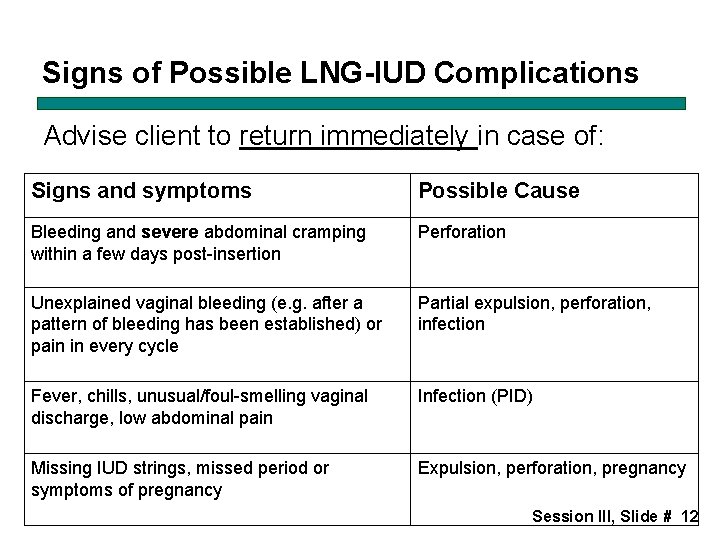
Signs of Possible LNG-IUD Complications Advise client to return immediately in case of: Signs and symptoms Possible Cause Bleeding and severe abdominal cramping within a few days post-insertion Perforation Unexplained vaginal bleeding (e. g. after a pattern of bleeding has been established) or pain in every cycle Partial expulsion, perforation, infection Fever, chills, unusual/foul-smelling vaginal discharge, low abdominal pain Infection (PID) Missing IUD strings, missed period or symptoms of pregnancy Expulsion, perforation, pregnancy Session III, Slide # 12
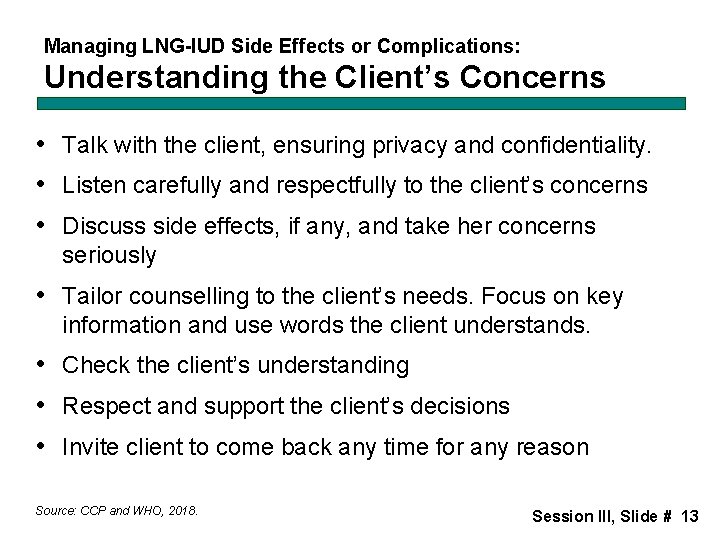
Managing LNG-IUD Side Effects or Complications: Understanding the Client’s Concerns • Talk with the client, ensuring privacy and confidentiality. • Listen carefully and respectfully to the client’s concerns • Discuss side effects, if any, and take her concerns seriously • Tailor counselling to the client’s needs. Focus on key information and use words the client understands. • Check the client’s understanding • Respect and support the client’s decisions • Invite client to come back any time for any reason Source: CCP and WHO, 2018. Session III, Slide # 13
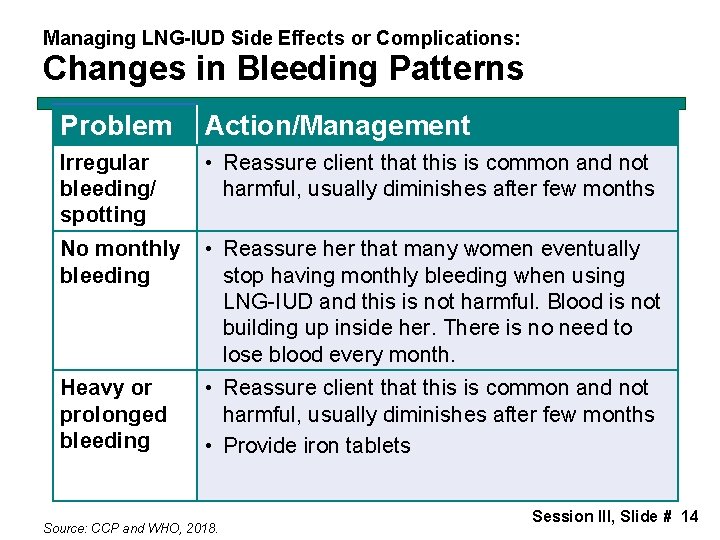
Managing LNG-IUD Side Effects or Complications: Changes in Bleeding Patterns Problem Action/Management Counseling and reassurance are key Irregular bleeding/ spotting • Reassure client that this is common and not harmful, usually diminishes after few months No monthly bleeding • Reassure her that many women eventually stop having monthly bleeding when using LNG-IUD and this is not harmful. Blood is not building up inside her. There is no need to lose blood every month. Heavy or prolonged bleeding • Reassure client that this is common and not harmful, usually diminishes after few months • Provide iron tablets Source: CCP and WHO, 2018. Session III, Slide # 14
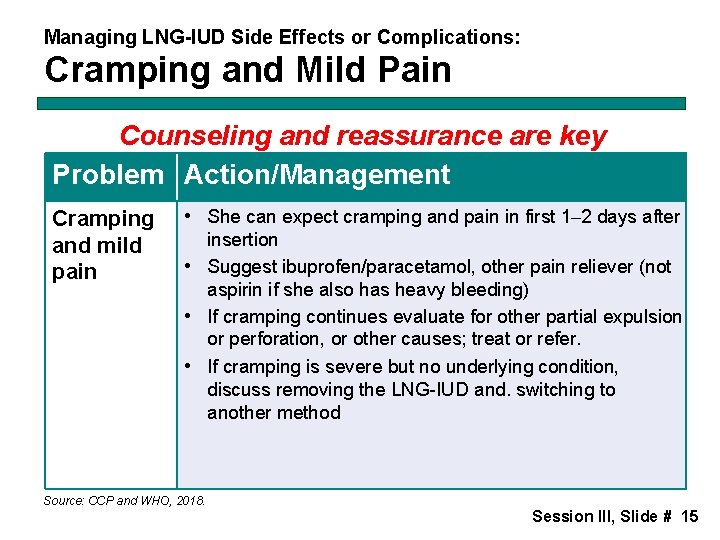
Managing LNG-IUD Side Effects or Complications: Cramping and Mild Pain Counseling and reassurance are key Problem Action/Management Cramping and mild pain • She can expect cramping and pain in first 1– 2 days after insertion • Suggest ibuprofen/paracetamol, other pain reliever (not aspirin if she also has heavy bleeding) • If cramping continues evaluate for other partial expulsion or perforation, or other causes; treat or refer. • If cramping is severe but no underlying condition, discuss removing the LNG-IUD and. switching to another method Source: CCP and WHO, 2018. Session III, Slide # 15
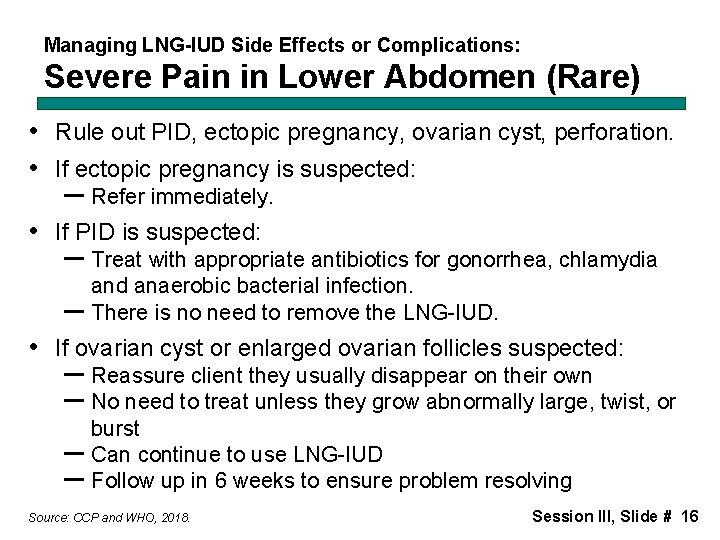
Managing LNG-IUD Side Effects or Complications: Severe Pain in Lower Abdomen (Rare) • Rule out PID, ectopic pregnancy, ovarian cyst, perforation. • If ectopic pregnancy is suspected: ─ Refer immediately. • If PID is suspected: ─ Treat with appropriate antibiotics for gonorrhea, chlamydia ─ and anaerobic bacterial infection. There is no need to remove the LNG-IUD. • If ovarian cyst or enlarged ovarian follicles suspected: ─ Reassure client they usually disappear on their own ─ No need to treat unless they grow abnormally large, twist, or ─ ─ burst Can continue to use LNG-IUD Follow up in 6 weeks to ensure problem resolving Source: CCP and WHO, 2018. Session III, Slide # 16
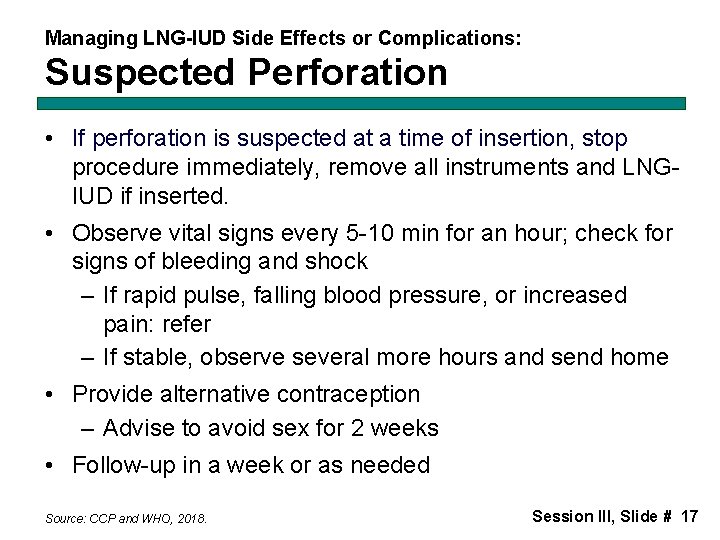
Managing LNG-IUD Side Effects or Complications: Suspected Perforation • If perforation is suspected at a time of insertion, stop procedure immediately, remove all instruments and LNGIUD if inserted. • Observe vital signs every 5 -10 min for an hour; check for signs of bleeding and shock – If rapid pulse, falling blood pressure, or increased pain: refer – If stable, observe several more hours and send home • Provide alternative contraception – Advise to avoid sex for 2 weeks • Follow-up in a week or as needed Source: CCP and WHO, 2018. Session III, Slide # 17
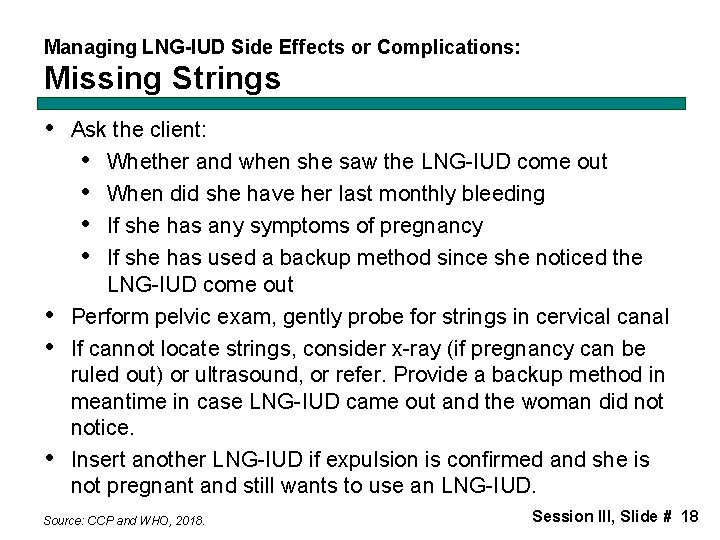
Managing LNG-IUD Side Effects or Complications: Missing Strings • • Ask the client: • Whether and when she saw the LNG-IUD come out • When did she have her last monthly bleeding • If she has any symptoms of pregnancy • If she has used a backup method since she noticed the LNG-IUD come out Perform pelvic exam, gently probe for strings in cervical canal If cannot locate strings, consider x-ray (if pregnancy can be ruled out) or ultrasound, or refer. Provide a backup method in meantime in case LNG-IUD came out and the woman did notice. Insert another LNG-IUD if expulsion is confirmed and she is not pregnant and still wants to use an LNG-IUD. Source: CCP and WHO, 2018. Session III, Slide # 18
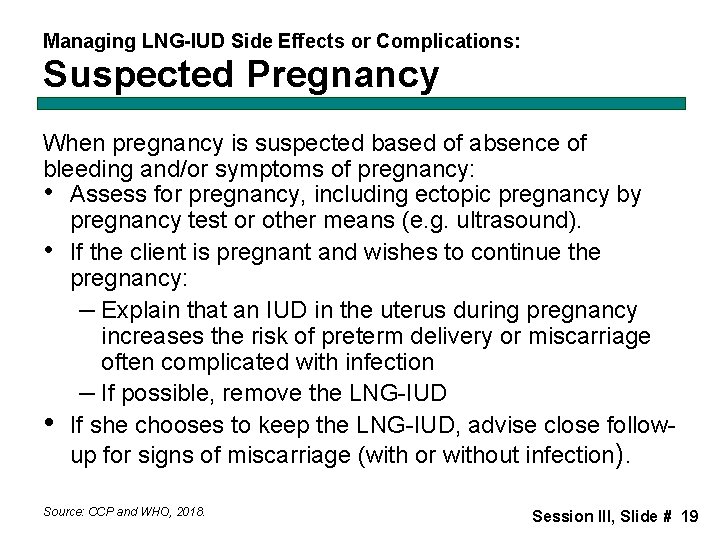
Managing LNG-IUD Side Effects or Complications: Suspected Pregnancy When pregnancy is suspected based of absence of bleeding and/or symptoms of pregnancy: • Assess for pregnancy, including ectopic pregnancy by pregnancy test or other means (e. g. ultrasound). • If the client is pregnant and wishes to continue the pregnancy: – Explain that an IUD in the uterus during pregnancy increases the risk of preterm delivery or miscarriage often complicated with infection – If possible, remove the LNG-IUD • If she chooses to keep the LNG-IUD, advise close followup for signs of miscarriage (with or without infection). Source: CCP and WHO, 2018. Session III, Slide # 19
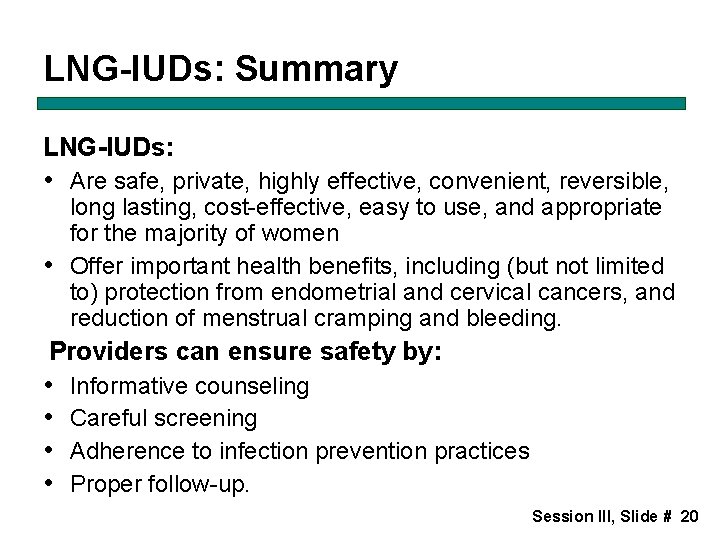
LNG-IUDs: Summary LNG-IUDs: • Are safe, private, highly effective, convenient, reversible, long lasting, cost-effective, easy to use, and appropriate for the majority of women • Offer important health benefits, including (but not limited to) protection from endometrial and cervical cancers, and reduction of menstrual cramping and bleeding. Providers can ensure safety by: • • Informative counseling Careful screening Adherence to infection prevention practices Proper follow-up. Session III, Slide # 20