
Leveraging Stereopsis for Saliency Analysis CVPR 2012 Speaker


- Slides: 35
Leveraging Stereopsis for Saliency Analysis, CVPR 2012 Speaker: Chi-Yu Hsu Advisor: Prof. Jian-Jung Ding
Outline �Abstract �Introduction �Stereo Saliency �Experiments �Conclusion
Abstract
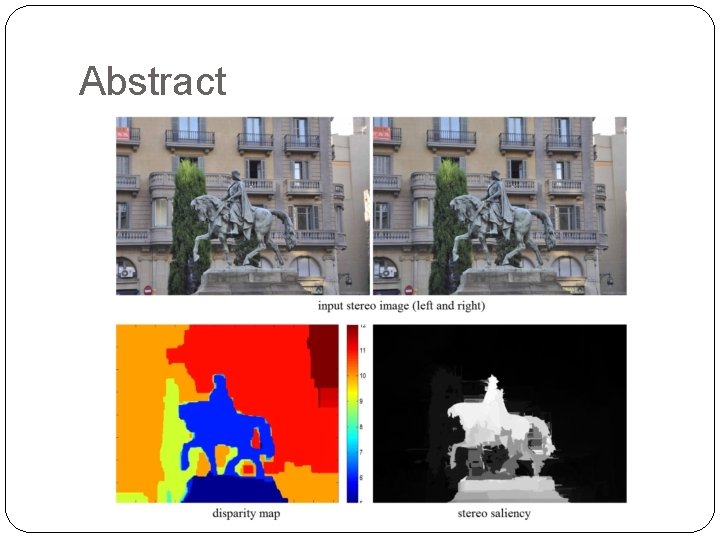
Introduction �Stereopsis provides an additional depth cue and plays an important role in the human vision system. �Two approaches: - computes stereo saliency based on the global disparity contrast in the input image. - leverages domain knowledge in stereoscopic photography. � Build a stereo saliency analysis benchmark dataset that contains 1000 stereoscopic images with salient object masks.
Stereopsis �Stereopsis is a process in visual perception leading to the perception of depth from retinal disparities. �Created by projecting two slightly different images onto the retinas of the two eyes. �Stereoscopic depth often enables people to identify objects from the background with similar visual attributes.
Stereo Saliency �Compute stereo saliency from the disparity map between the left and right view of a stereoscopic image. � Low-level disparity contrast � Unique domain knowledge
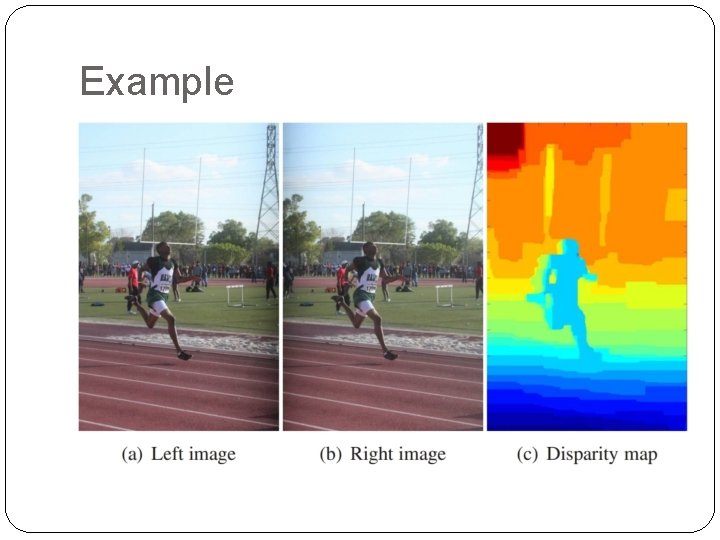
Disparity Map �Estimates a disparity map from the left and right view of a stereoscopic image. �Dense disparity map is obtained from stereo matching. �Apply the SIFT flow method to disparity estimation for its robustness.
Example
Stereo Saliency from Disparity Contrast �When taking a photo, people tend to place an important object at a different depth level than the others. �Extend a recent color contrast-based saliency detection method from Cheng et al (RC). �Consider both color and disparity during segmentation by treating the disparity value as a fourth channel.
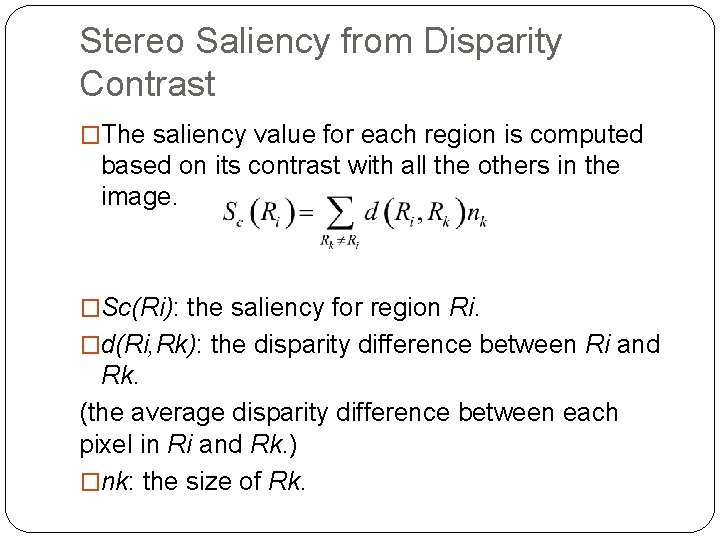
Stereo Saliency from Disparity Contrast �The saliency value for each region is computed based on its contrast with all the others in the image. �Sc(Ri): the saliency for region Ri. �d(Ri, Rk): the disparity difference between Ri and Rk. (the average disparity difference between each pixel in Ri and Rk. ) �nk: the size of Rk.
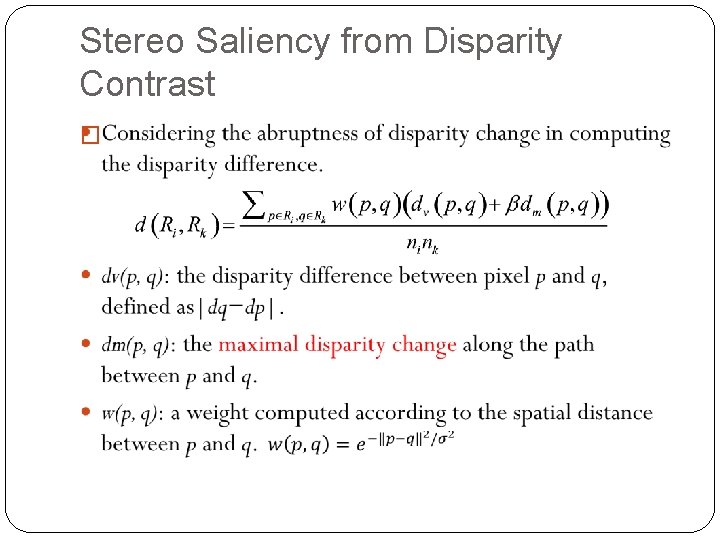
Stereo Saliency from Disparity Contrast �
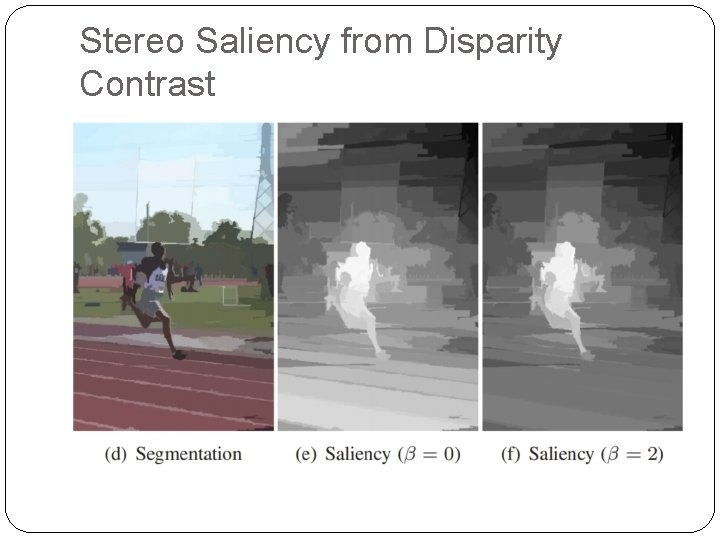
Stereo Saliency from Disparity Contrast
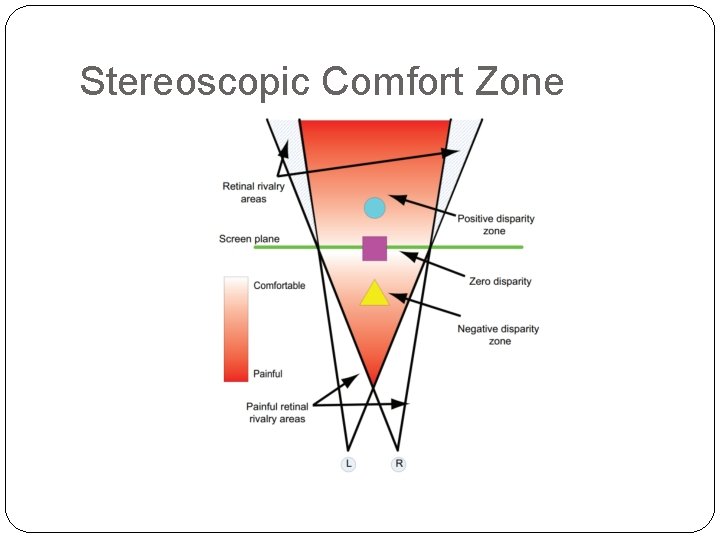
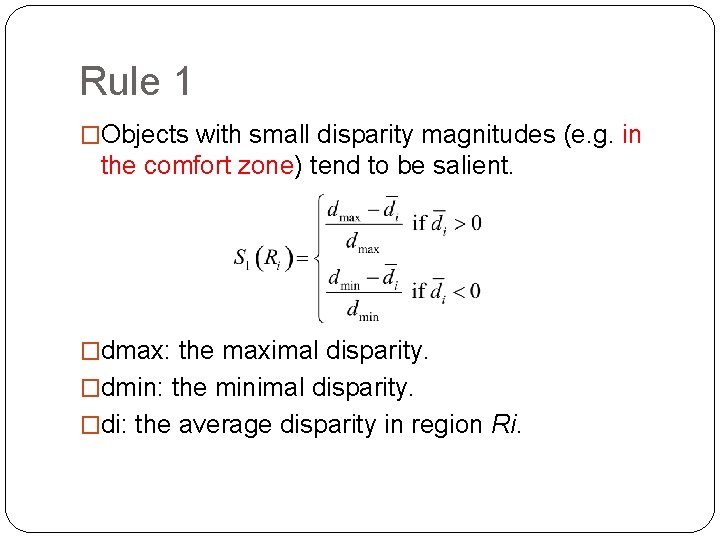
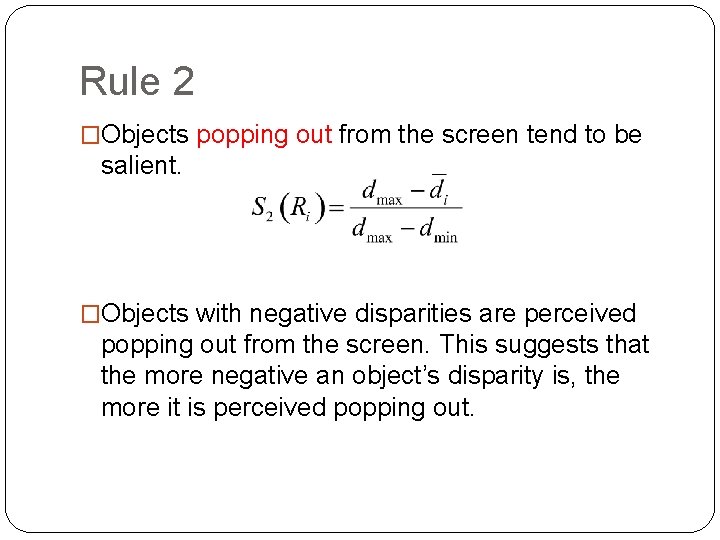
Domain Knowledge Assisted Saliency Analysis �A zone close to the screen is called the comfort zone. �In practice, content of interest is often given small or zero disparities to minimize the vergenceaccommodation conflict. �Two rules to compute knowledge-based stereo saliency. 1. Objects with small disparity magnitudes (e. g. in the comfort zone) tend to be salient. 2. Objects popping out from the screen tend to be
Stereoscopic Comfort Zone
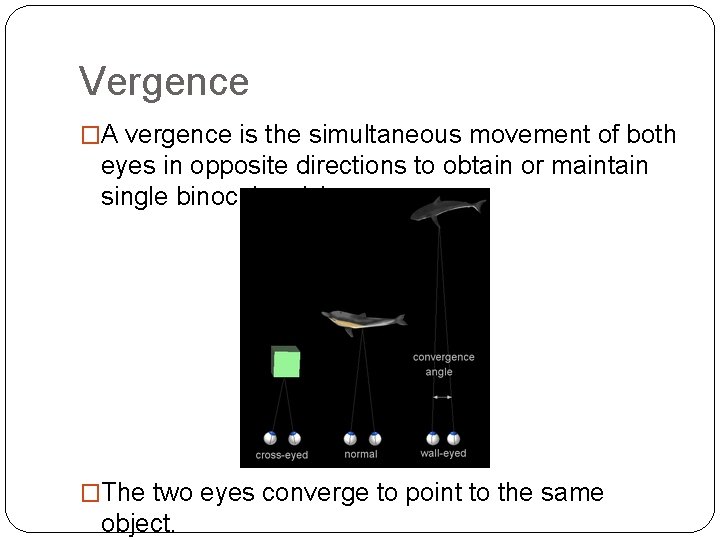
Vergence �A vergence is the simultaneous movement of both eyes in opposite directions to obtain or maintain single binocular vision. �The two eyes converge to point to the same object.
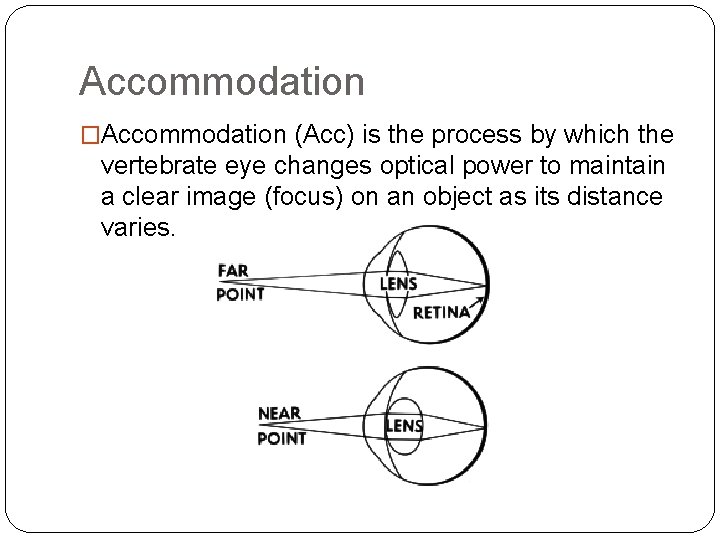
Accommodation �Accommodation (Acc) is the process by which the vertebrate eye changes optical power to maintain a clear image (focus) on an object as its distance varies.
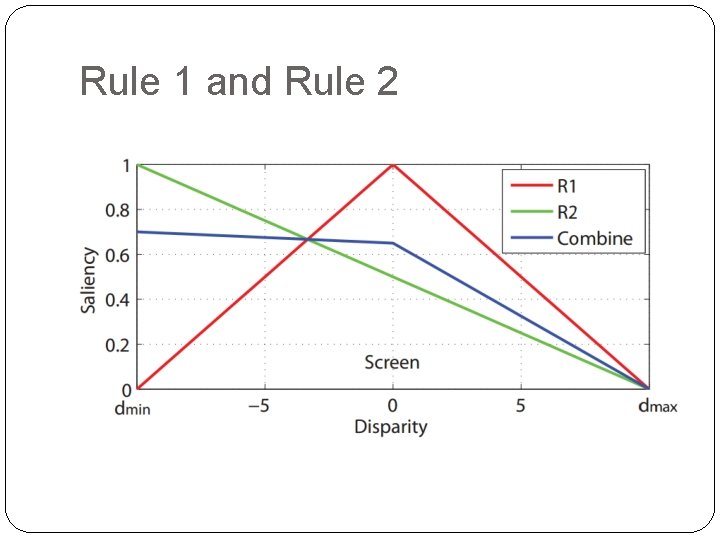
Rule 1 �Objects with small disparity magnitudes (e. g. in the comfort zone) tend to be salient. �dmax: the maximal disparity. �dmin: the minimal disparity. �di: the average disparity in region Ri.
Rule 2 �Objects popping out from the screen tend to be salient. �Objects with negative disparities are perceived popping out from the screen. This suggests that the more negative an object’s disparity is, the more it is perceived popping out.
Rule 1 and Rule 2
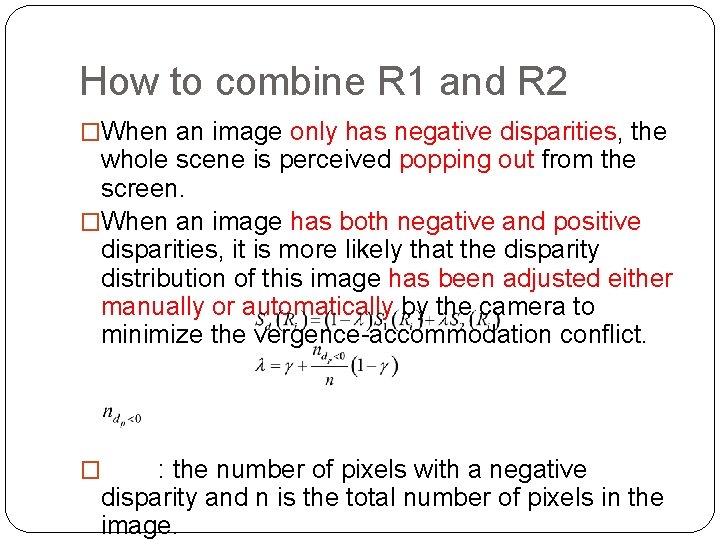
How to combine R 1 and R 2 �When an image only has negative disparities, the whole scene is perceived popping out from the screen. �When an image has both negative and positive disparities, it is more likely that the disparity distribution of this image has been adjusted either manually or automatically by the camera to minimize the vergence-accommodation conflict. : the number of pixels with a negative disparity and n is the total number of pixels in the image. �
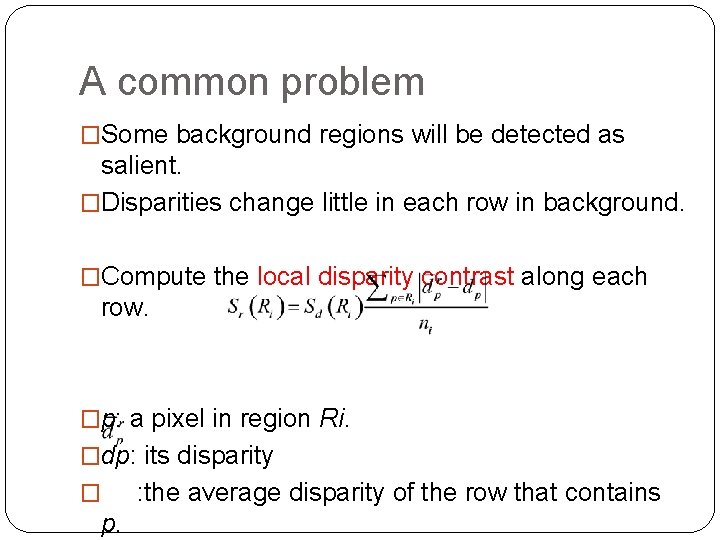
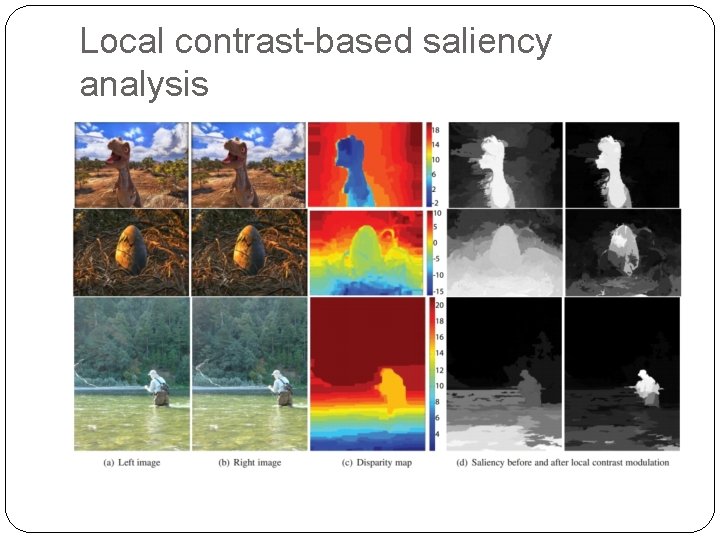
A common problem �Some background regions will be detected as salient. �Disparities change little in each row in background. �Compute the local disparity contrast along each row. �p: a pixel in region Ri. �dp: its disparity � p. : the average disparity of the row that contains
Local contrast-based saliency analysis
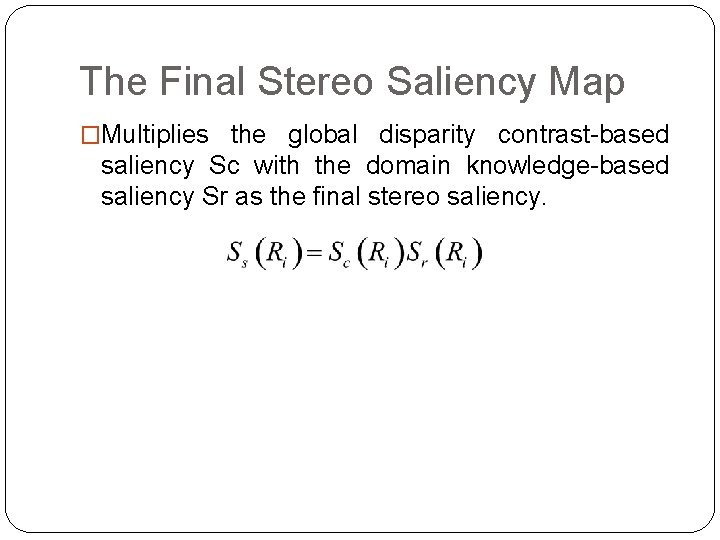
The Final Stereo Saliency Map �Multiplies the global disparity contrast-based saliency Sc with the domain knowledge-based saliency Sr as the final stereo saliency.
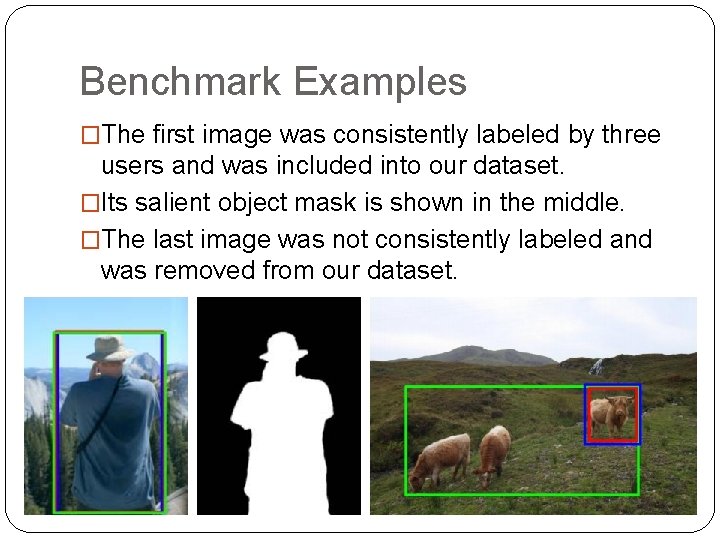
Experiments Database �There is no publicly available stereoscopic image database for saliency analysis. � 1250 stereoscopic images from Flickr, Stereoscopic Image Gallery, and NVIDIA 3 D Vision Live. �Three users are asked to enclose the most salient object in each image with a rectangle. �Remove the images with the least consistent labels. �Ask a user to manually segment the salient object. � 1000 stereoscopic images with human-labeled mask.
Benchmark Examples �The first image was consistently labeled by three users and was included into our dataset. �Its salient object mask is shown in the middle. �The last image was not consistently labeled and was removed from our dataset.
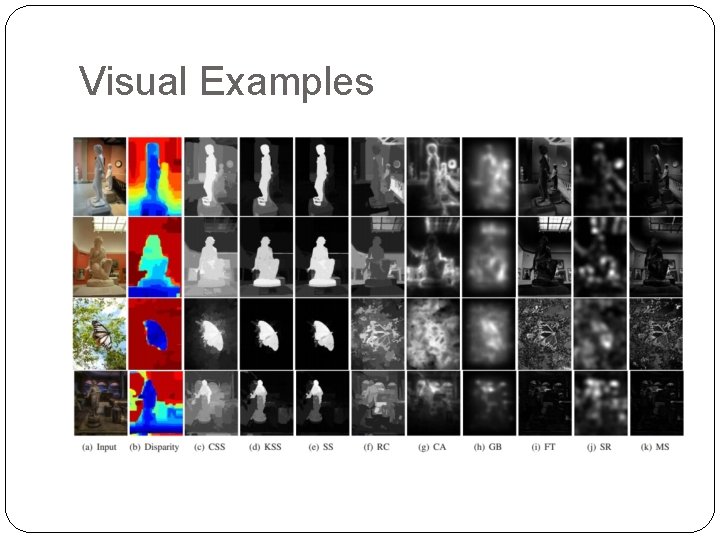
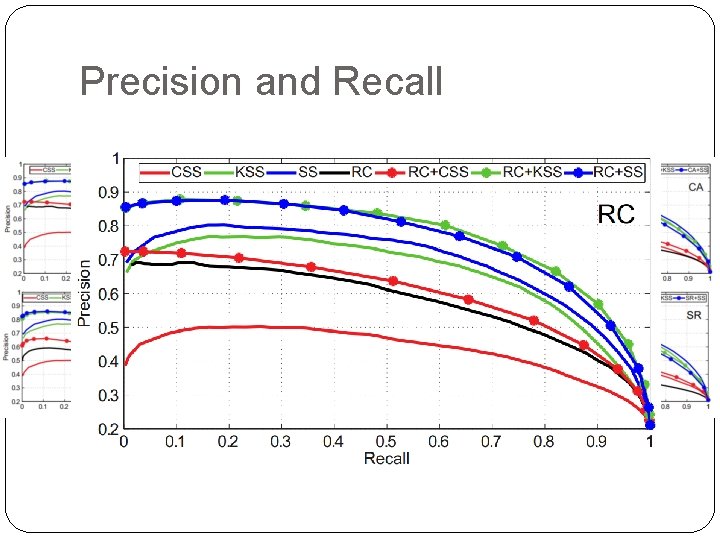
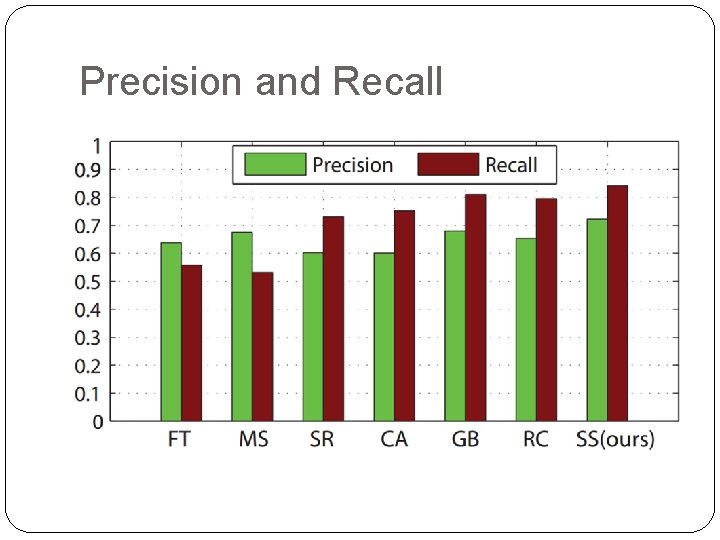
Performance Evaluation �Evaluate three saliency maps from our methods, namely global disparity contrast-based stereo saliency (CSS), knowledge-assisted stereo saliency (KSS), and their combination (SS). �Selected six state-of-the-art saliency detection methods, including RC, CA GB, FT, SR, and MS.
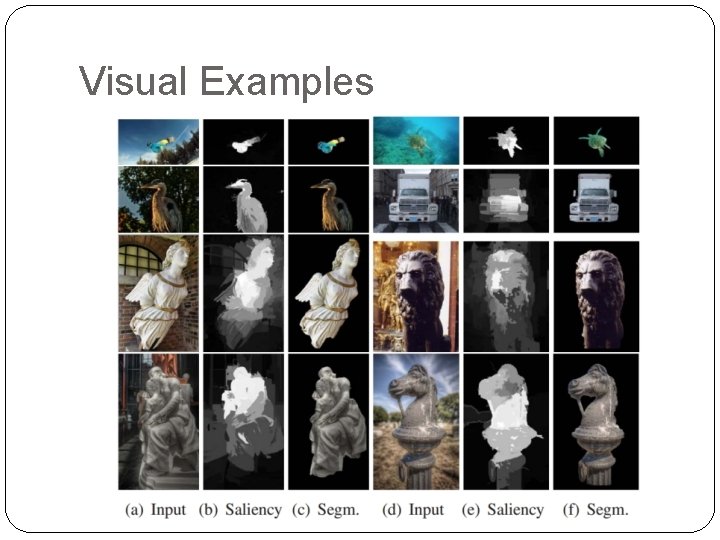
Visual Examples
Precision and Recall
Automatic Salient Object Segmentation �Initializes the segmentation with a binarized saliency map. �The threshold which gives 95% recall rate in the previous experiment �The Grab-Cut method is extended to take the binarized saliency map as input and is iteratively applied to segmentation. �Use both color and disparity to compute the difference between two pixels in the Grab-Cut framework.
Precision and Recall
Visual Examples
Limitations �Performance of the methods depend on the quality of disparity maps. �Stereo saliency is useful only if a salient object stays at a different depth than its surroundings. This is the same as saliency analysis w. r. t other visual features. �If an object cannot be separated from the background w. r. t one feature, the saliency analysis based on that feature fails.
Conclusion �Two methods for stereo saliency detection. �The first method computes stereo saliency based on global disparity contrast. �The second method makes use of the stereoscopic rules for saliency estimation. �Experiments showed that stereo saliency is a useful complement to existing visual saliency analysis and the methods are able to achieve high-quality stereo saliency detection results.
Q&A
Reference �Yuzhen Niu, Yujie Geng, Xueqing Li, and Feng Liu. Leveraging Stereopsis for Saliency Analysis. IEEE CVPR 2012.