
Leveraging Read Rates of Passive RFID Tags for

- Slides: 38
Leveraging Read Rates of Passive RFID Tags for Real-Time Indoor Location Tracking Da Yan, Zhou Zhao and Wilfred Ng The Hong Kong University of Science and Technology
Outline Motivation Pass. Track System Overview Reader Detection Model Location Inference Model Experiments Conclusion 1
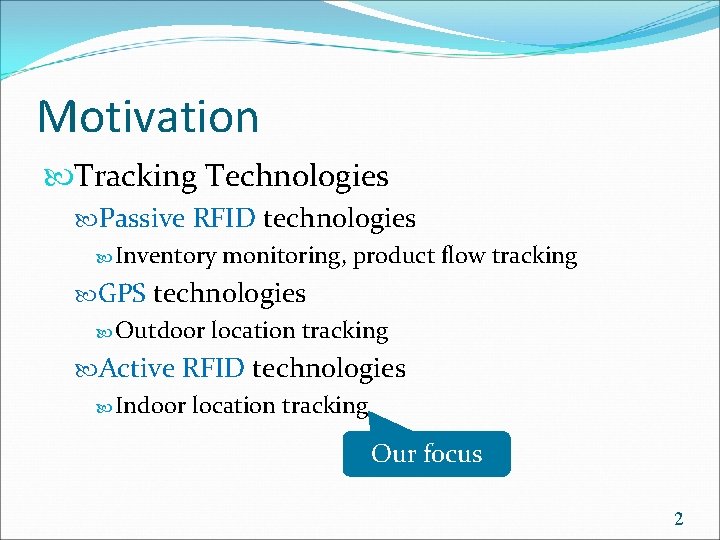
Motivation Tracking Technologies Passive RFID technologies Inventory monitoring, product flow tracking GPS technologies Outdoor location tracking Active RFID technologies Indoor location tracking Our focus 2
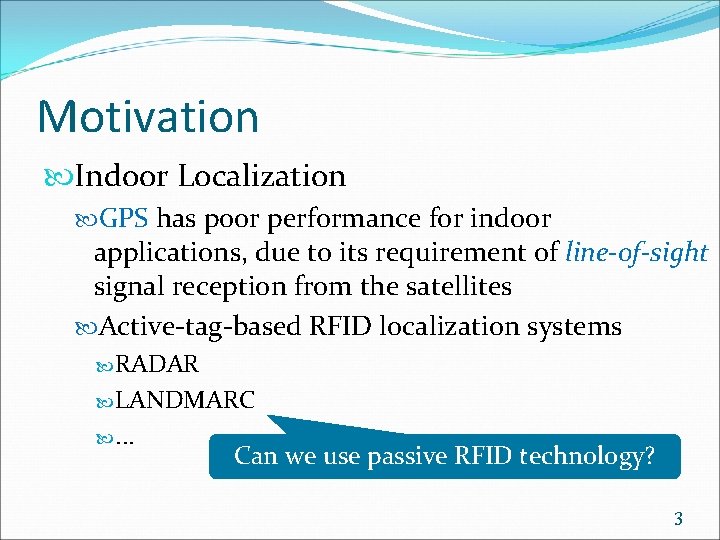
Motivation Indoor Localization GPS has poor performance for indoor applications, due to its requirement of line-of-sight signal reception from the satellites Active-tag-based RFID localization systems RADAR LANDMARC . . . Can we use passive RFID technology? 3
Motivation Passive RFID tags are more attractive than active ones Lower tag cost Can be used in a one-off manner Easier maintenance No maintenance overhead such as battery replacement Smaller error Active-tag-based systems usually incur meters of error 4
Outline Motivation Pass. Track System Overview Reader Detection Model Location Inference Model Experiments Conclusion 5
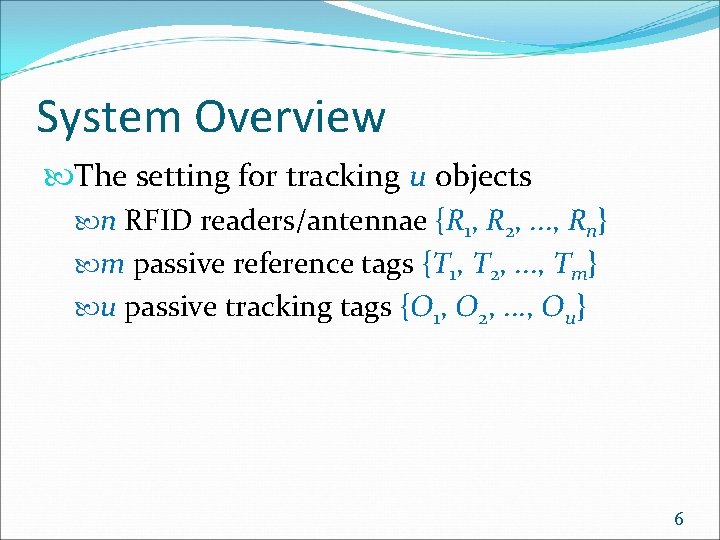
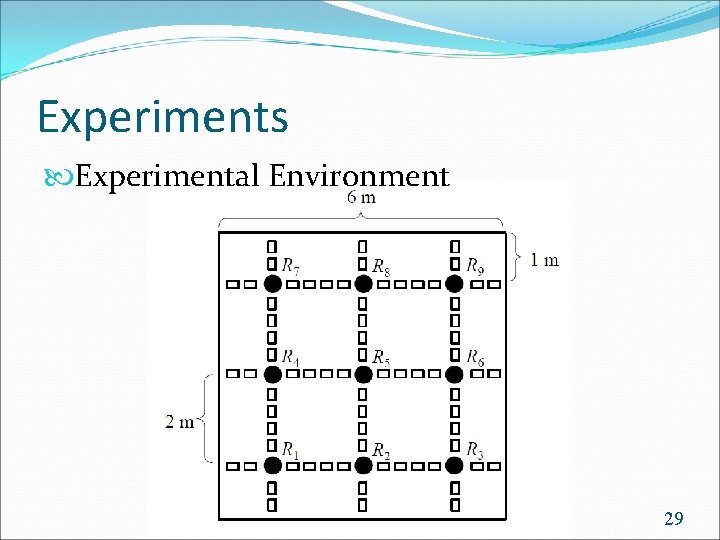
System Overview The setting for tracking u objects n RFID readers/antennae {R 1, R 2, . . . , Rn} m passive reference tags {T 1, T 2, . . . , Tm} u passive tracking tags {O 1, O 2, . . . , Ou} 6
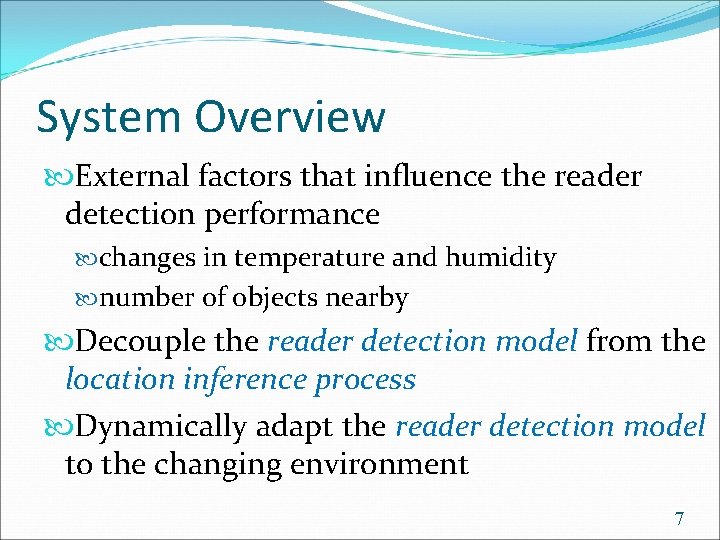
System Overview External factors that influence the reader detection performance changes in temperature and humidity number of objects nearby Decouple the reader detection model from the location inference process Dynamically adapt the reader detection model to the changing environment 7
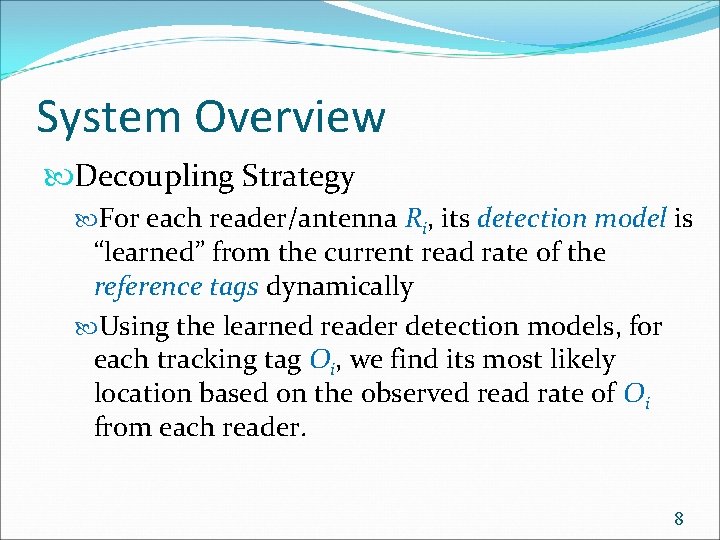
System Overview Decoupling Strategy For each reader/antenna Ri, its detection model is “learned” from the current read rate of the reference tags dynamically Using the learned reader detection models, for each tracking tag Oi, we find its most likely location based on the observed read rate of Oi from each reader. 8
Outline Motivation Pass. Track System Overview Reader Detection Model Location Inference Model Experiments Conclusion 9
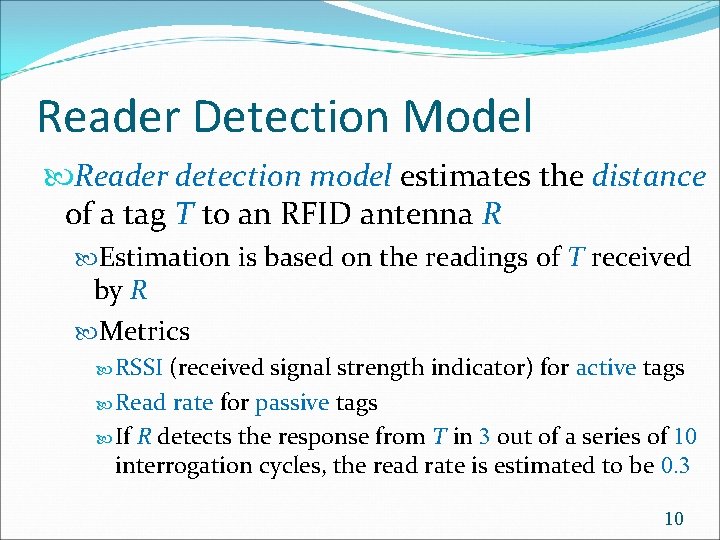
Reader Detection Model Reader detection model estimates the distance of a tag T to an RFID antenna R Estimation is based on the readings of T received by R Metrics RSSI (received signal strength indicator) for active tags Read rate for passive tags If R detects the response from T in 3 out of a series of 10 interrogation cycles, the read rate is estimated to be 0. 3 10
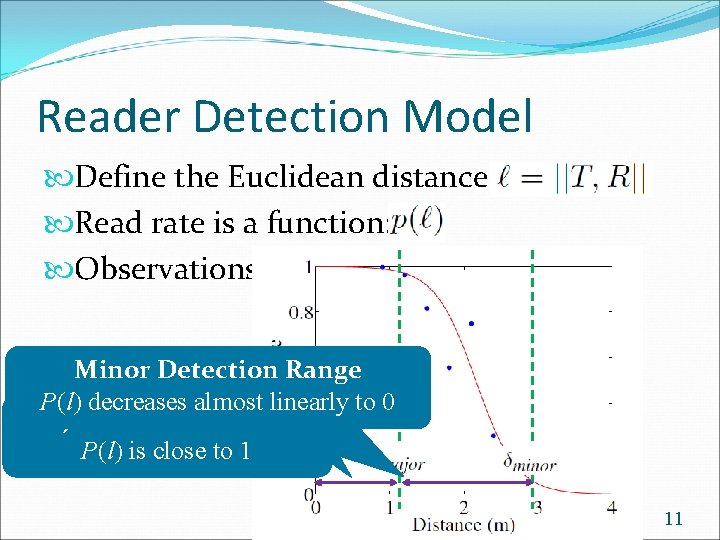
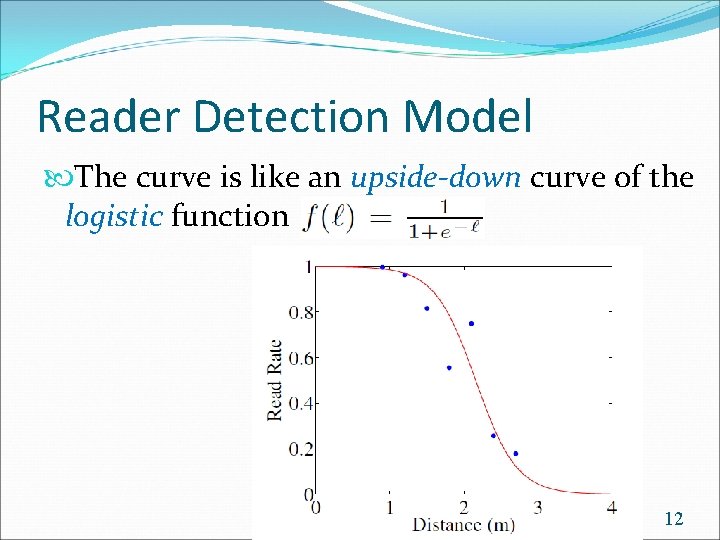
Reader Detection Model Define the Euclidean distance: Read rate is a function: Observations Minor Detection Range P(l) decreases almost linearly to 0 Major Detection Range P(l) is close to 1 11
Reader Detection Model The curve is like an upside-down curve of the logistic function 12
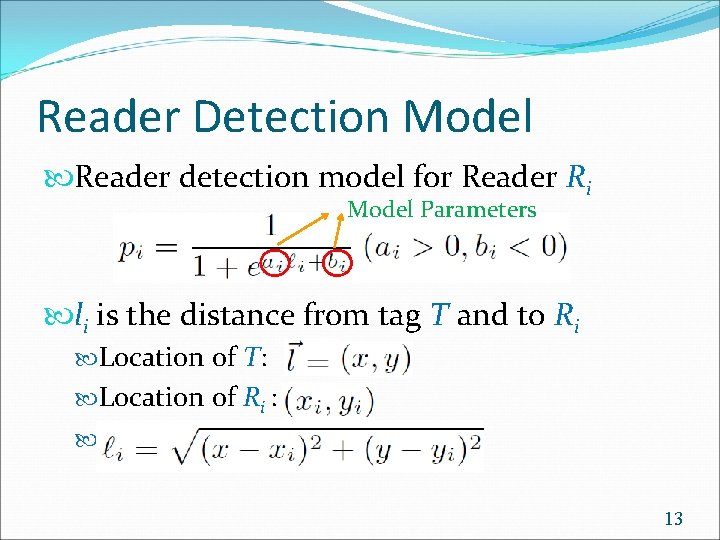
Reader Detection Model Reader detection model for Reader Ri Model Parameters li is the distance from tag T and to Ri Location of T: Location of Ri : 13
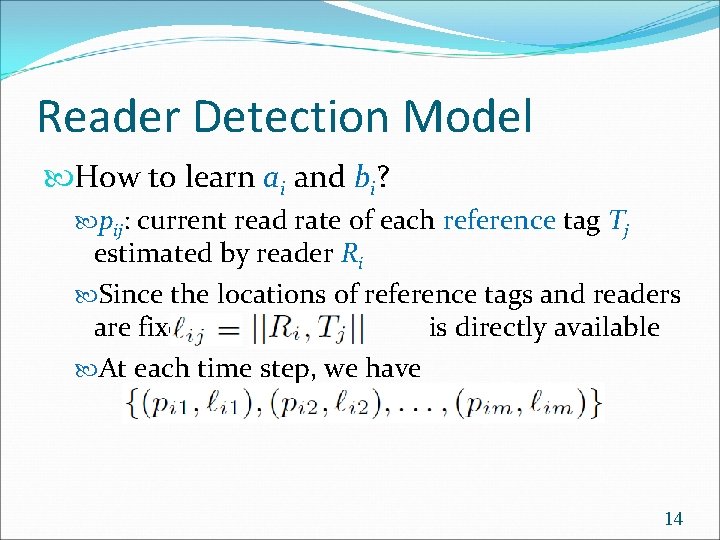
Reader Detection Model How to learn ai and bi? pij: current read rate of each reference tag Tj estimated by reader Ri Since the locations of reference tags and readers are fixed, is directly available At each time step, we have 14
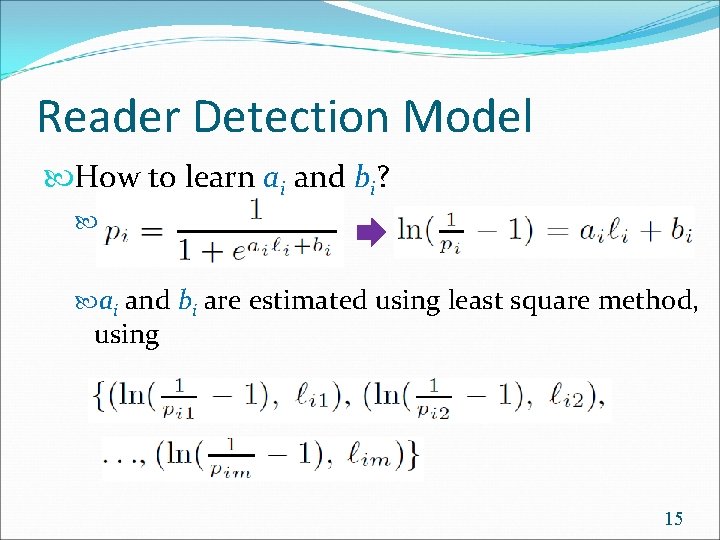
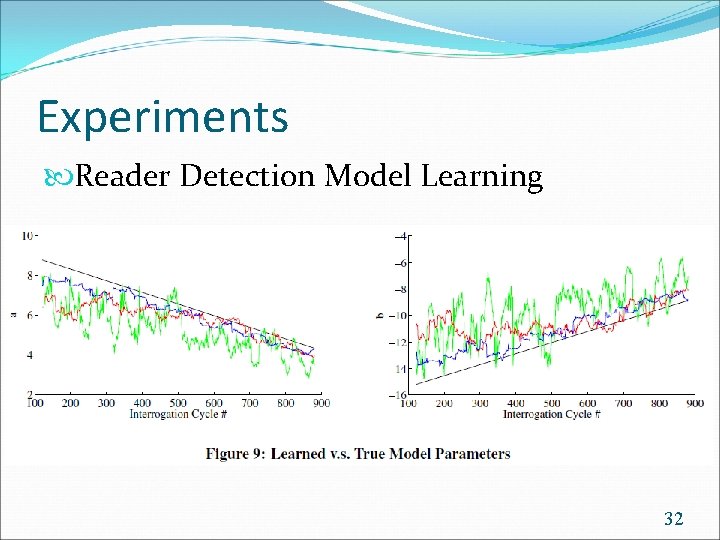
Reader Detection Model How to learn ai and bi? ai and bi are estimated using least square method, using 15
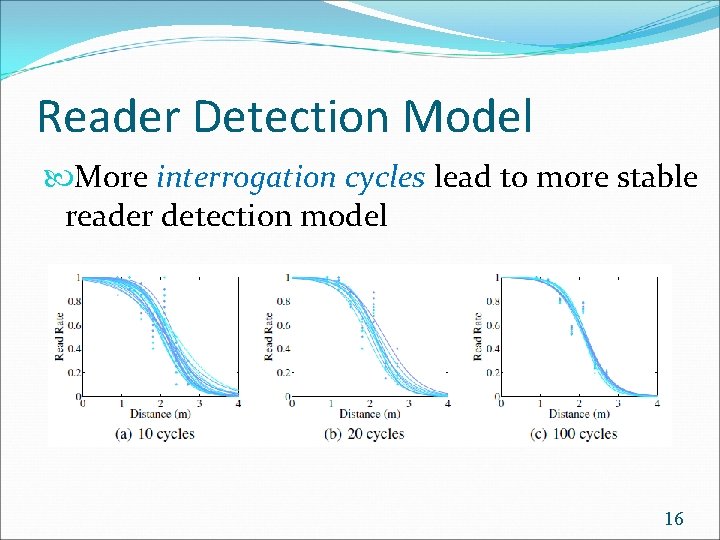
Reader Detection Model More interrogation cycles lead to more stable reader detection model 16
Outline Motivation Pass. Track System Overview Reader Detection Model Location Inference Model Experiments Conclusion 17
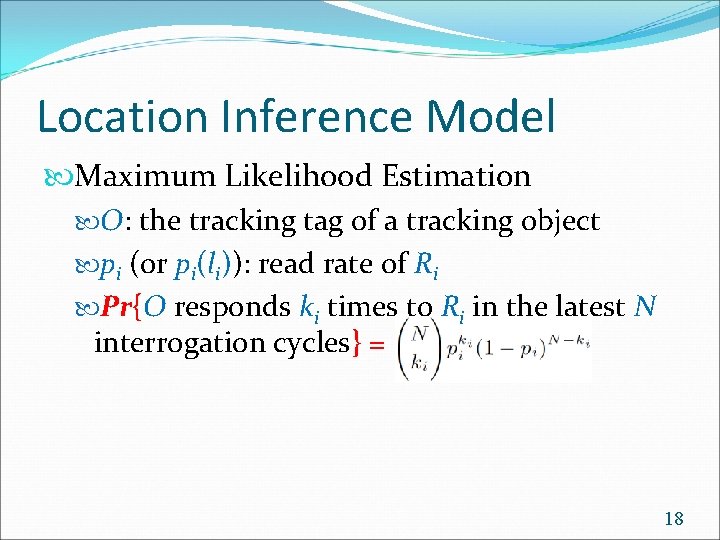
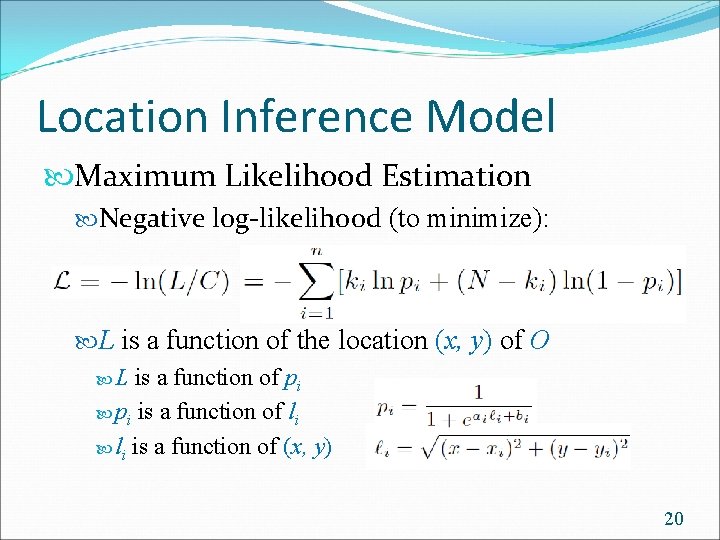
Location Inference Model Maximum Likelihood Estimation O: the tracking tag of a tracking object pi (or pi(li)): read rate of Ri Pr{O responds ki times to Ri in the latest N interrogation cycles} = 18
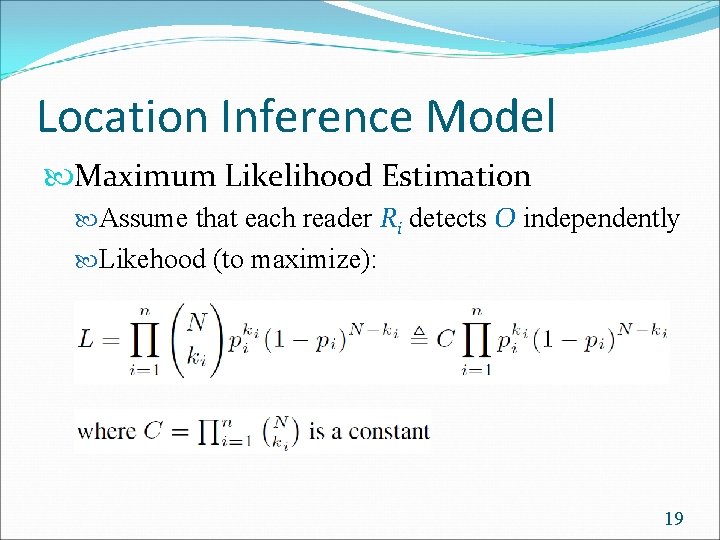
Location Inference Model Maximum Likelihood Estimation Assume that each reader Ri detects O independently Likehood (to maximize): 19
Location Inference Model Maximum Likelihood Estimation Negative log-likelihood (to minimize): L is a function of the location (x, y) of O L is a function of pi is a function of li is a function of (x, y) 20
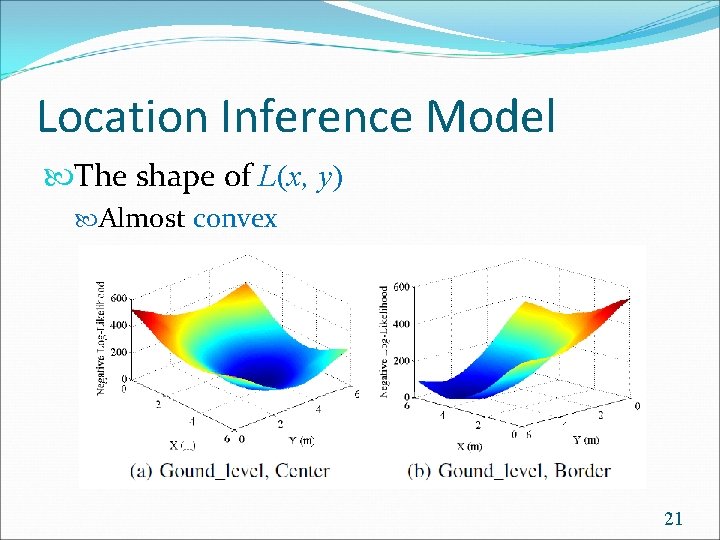
Location Inference Model The shape of L(x, y) Almost convex 21
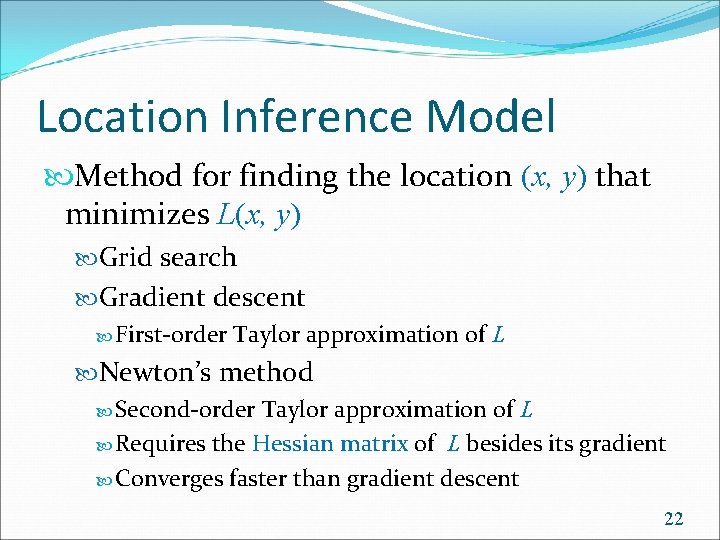
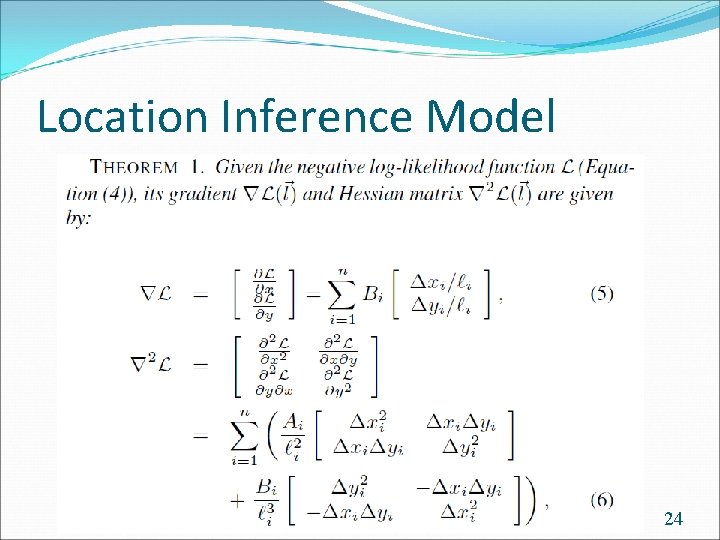
Location Inference Model Method for finding the location (x, y) that minimizes L(x, y) Grid search Gradient descent First-order Taylor approximation of L Newton’s method Second-order Taylor approximation of L Requires the Hessian matrix of L besides its gradient Converges faster than gradient descent 22
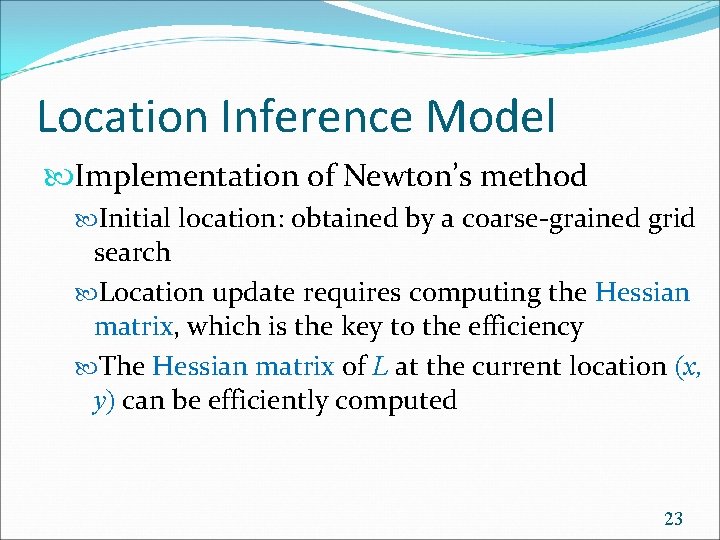
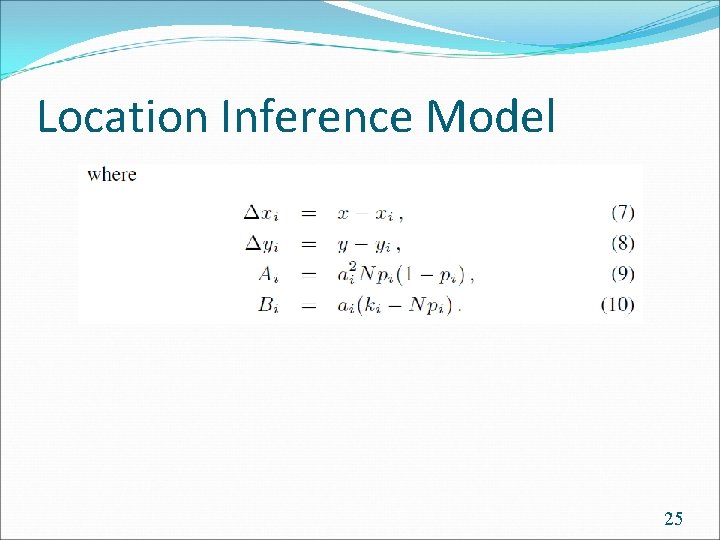
Location Inference Model Implementation of Newton’s method Initial location: obtained by a coarse-grained grid search Location update requires computing the Hessian matrix, which is the key to the efficiency The Hessian matrix of L at the current location (x, y) can be efficiently computed 23
Location Inference Model 24
Location Inference Model 25
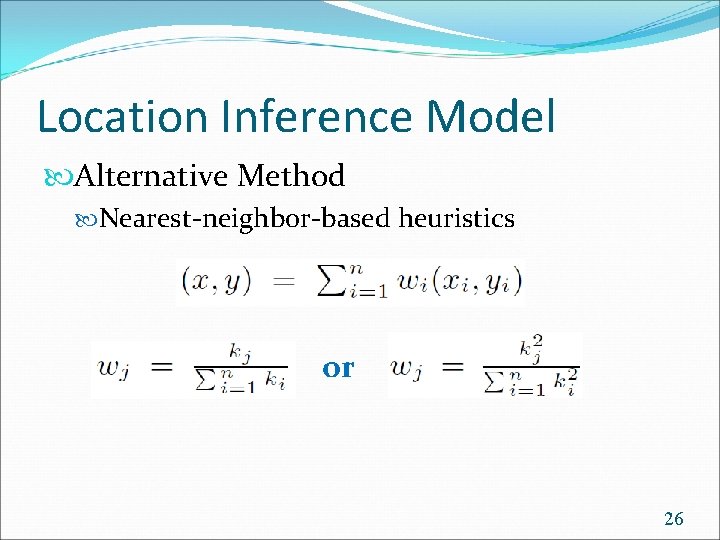
Location Inference Model Alternative Method Nearest-neighbor-based heuristics or 26
Outline Motivation Pass. Track System Overview Reader Detection Model Location Inference Model Experiments Conclusion 27
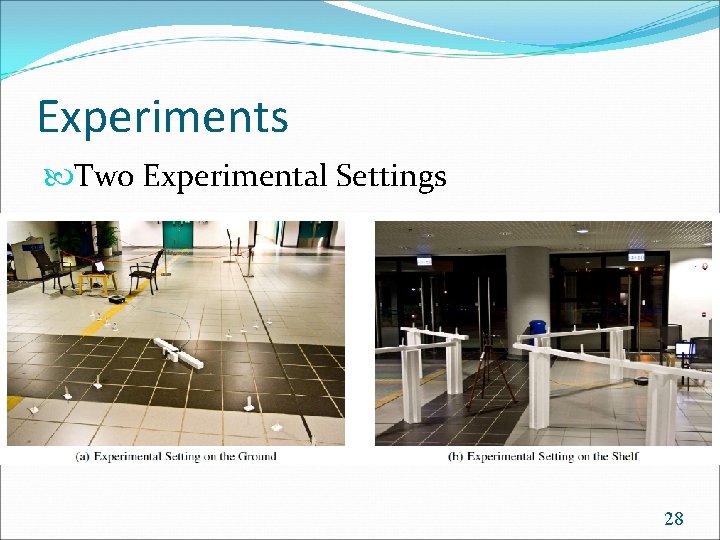
Experiments Two Experimental Settings 28
Experiments Experimental Environment 29
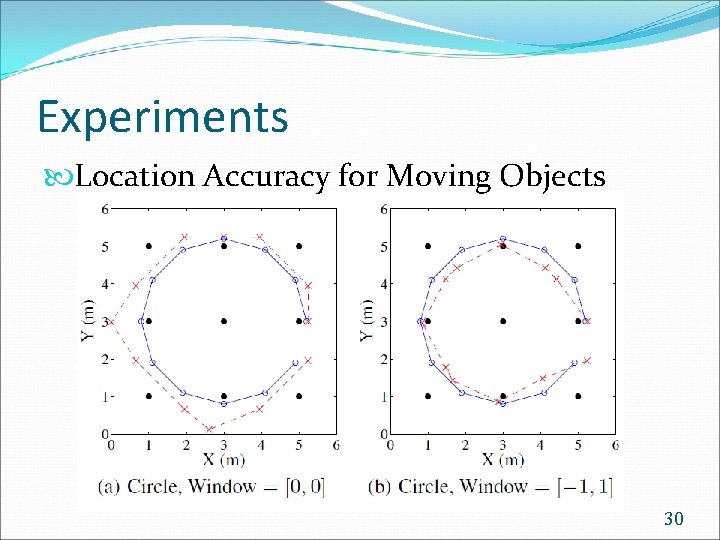
Experiments Location Accuracy for Moving Objects 30
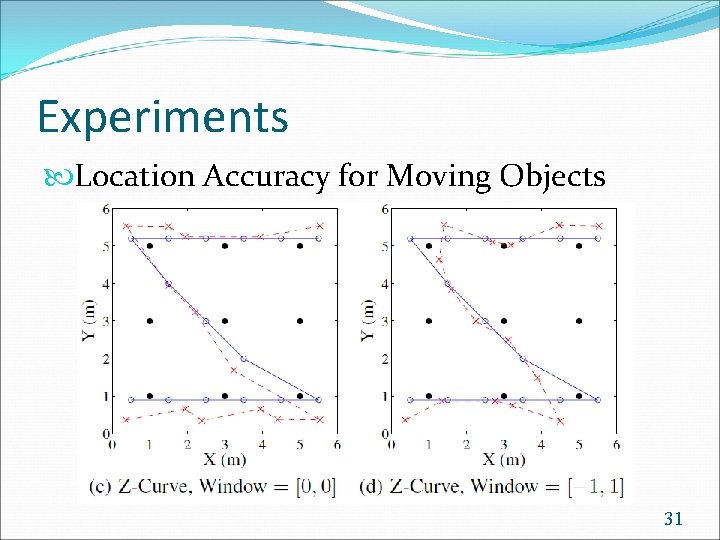
Experiments Location Accuracy for Moving Objects 31
Experiments Reader Detection Model Learning 32
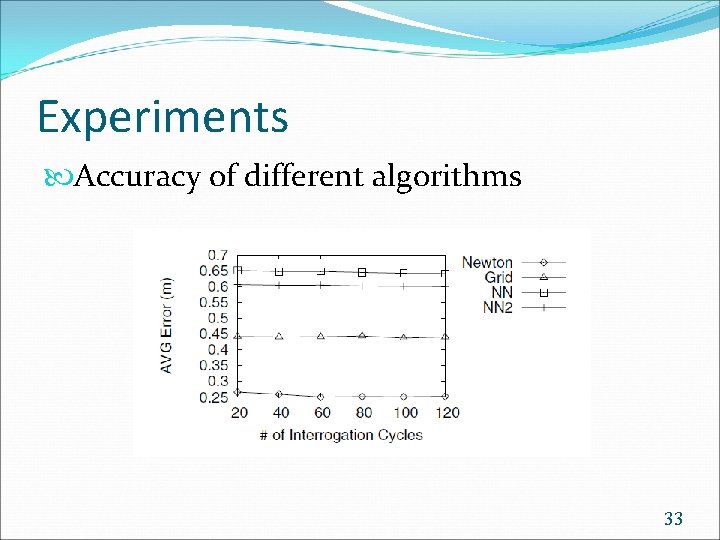
Experiments Accuracy of different algorithms 33
Outline Motivation Pass. Track System Overview Reader Detection Model Location Inference Model Experiments Conclusion 34
Conclusion Contribution of Pass. Track Sigmoid-like reader detection model that dynamically adapts to the changing environment A sound probabilistic inference model 35
Conclusion Contribution of Pass. Track estimates the location of a constantly moving object (or a static object) with an average error of around 30 cm (or below 20 cm) The most accurate algorithm (Newton’s Method) is able to perform over 7500 location estimations per second on an ordinary computer 36
Thank you! 37