
Leveraging ordinal regression with soft labels for 3

Leveraging ordinal regression with soft labels for 3 D head pose estimation from point sets Xupeng Wang School of Information and Software Engineering University of Electronic Science and Technology of China xupeng. wang@uestc. edu. cn
1 Background 2 Motivation 3 Our work 4 Conclusion
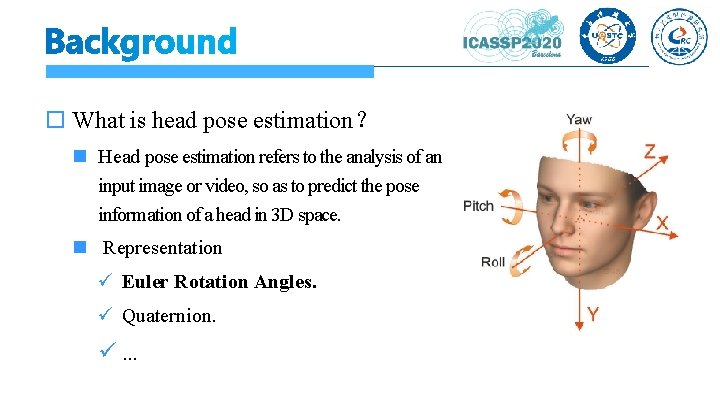
What is head pose estimation? Head pose estimation refers to the analysis of an input image or video, so as to predict the pose information of a head in 3 D space. Representation Euler Rotation Angles. Quaternion. . . .
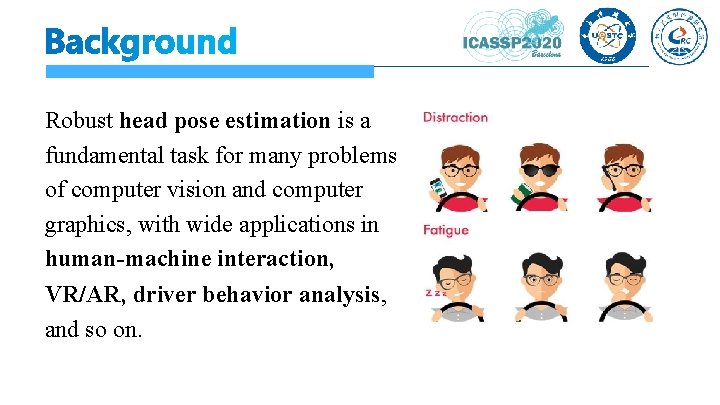
Robust head pose estimation is a fundamental task for many problems of computer vision and computer graphics, with wide applications in human-machine interaction, VR/AR, driver behavior analysis, and so on.
1 Background 2 Motivation 3 Our work 4 Conclusion
Deep learning of point cloud becames more and more popular. Popular models: Point. Net, Point. Net++, Point. CNN, PU-Net, etc. What is the advantage of point cloud data? Three dimensional geometry information of target can be obtained. There is no projection transformation from 3 D space to 2 D imaging plane. Less affected by the change of external light and imaging distance. What is the challenge of point cloud for deep learning? A point cloud is an unordered set of vectors. Geometric transformations, such as rigid transformation. Non-uniformity density in different areas.
Our solutions First, we present a convolutional neural network for 3 D head pose estimation in an end-to-end manner. Second, to the best of our knowledge, this is the first work to estimate head pose angles from point sets. Third, ordinal regression with soft labels is applied to 3 D head pose estimation for the first time.
1 Background 2 Motivation 3 Our work 4 Conclusion

The network is composed of three modules: Feature Learning Net Ranking Net Prediction Net Feature Learning Net The feature learning net exploits the Point. Net++ architecture to extract features from a point cloud. Input data:point cloud data (only 3 D coordinate information) Output data:feature vector
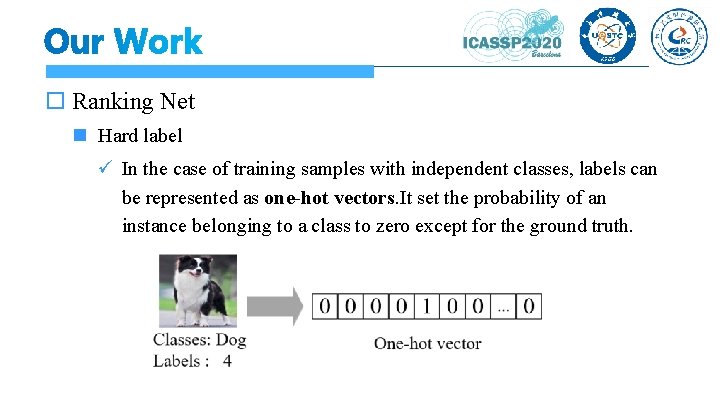
Ranking Net Hard label In the case of training samples with independent classes, labels can be represented as one-hot vectors. It set the probability of an instance belonging to a class to zero except for the ground truth.
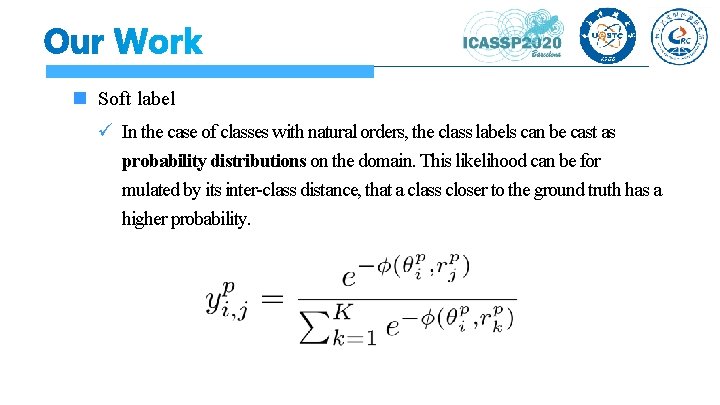
Soft label In the case of classes with natural orders, the class labels can be cast as probability distributions on the domain. This likelihood can be for mulated by its inter-class distance, that a class closer to the ground truth has a higher probability.
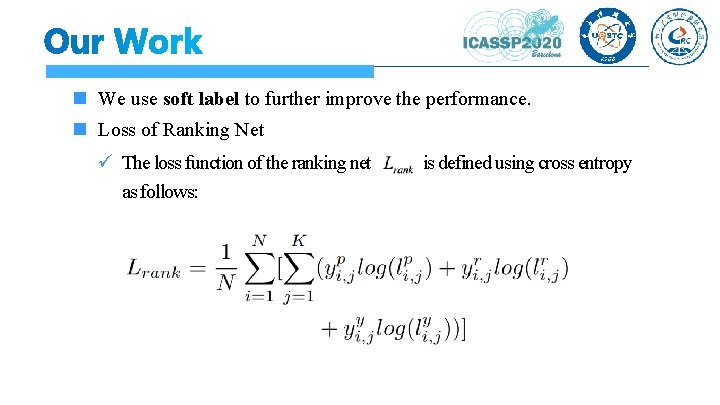
We use soft label to further improve the performance. Loss of Ranking Net The loss function of the ranking net as follows: is defined using cross entropy
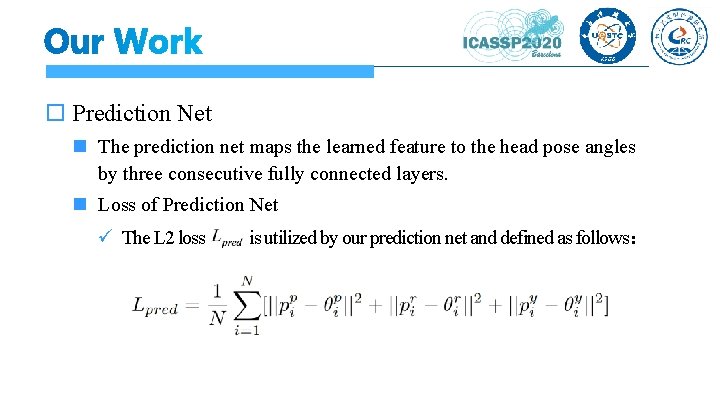
Prediction Net The prediction net maps the learned feature to the head pose angles by three consecutive fully connected layers. Loss of Prediction Net The L 2 loss is utilized by our prediction net and defined as follows:
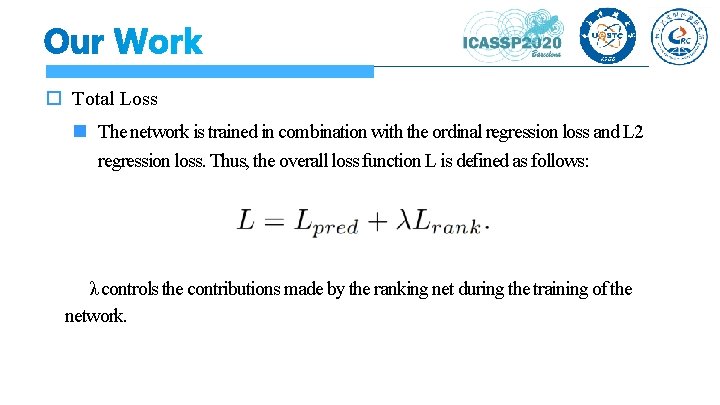
Total Loss The network is trained in combination with the ordinal regression loss and L 2 regression loss. Thus, the overall loss function L is defined as follows: λ controls the contributions made by the ranking net during the training of the network.
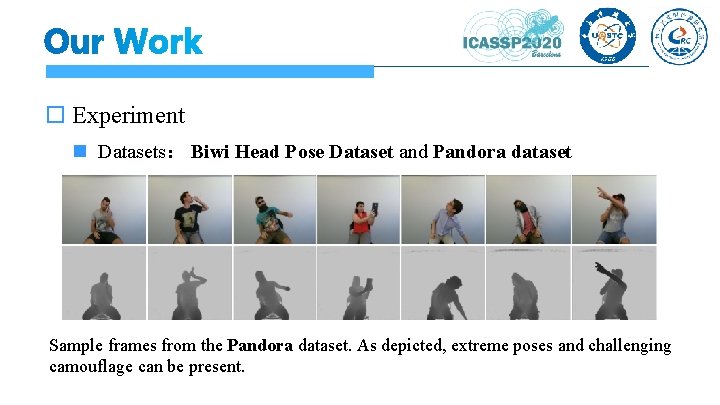
Experiment Datasets: Biwi Head Pose Dataset and Pandora dataset Sample frames from the Pandora dataset. As depicted, extreme poses and challenging camouflage can be present.
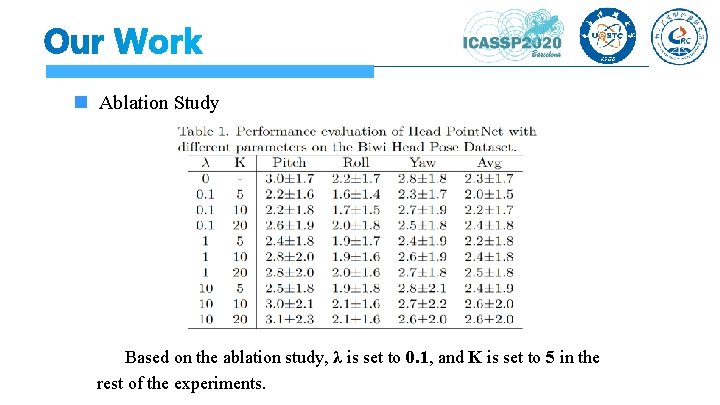
Ablation Study Based on the ablation study, λ is set to 0. 1, and K is set to 5 in the rest of the experiments.
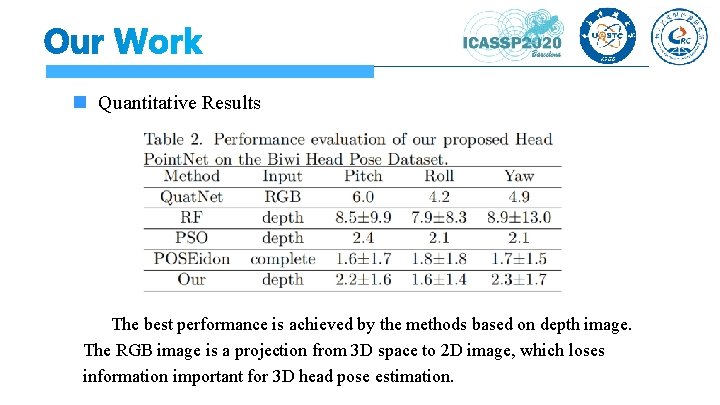
Quantitative Results The best performance is achieved by the methods based on depth image. The RGB image is a projection from 3 D space to 2 D image, which loses information important for 3 D head pose estimation.
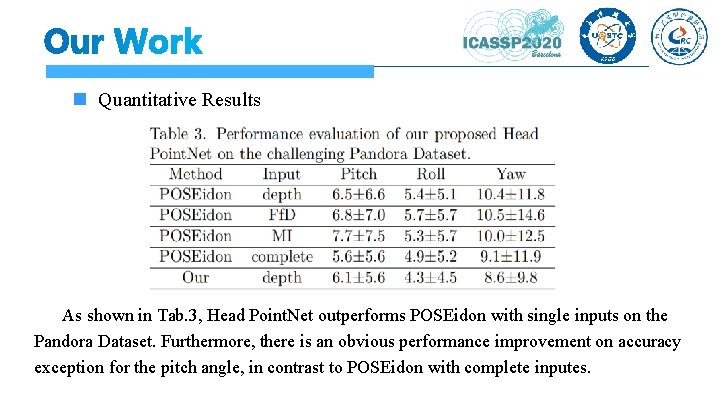
Quantitative Results As shown in Tab. 3, Head Point. Net outperforms POSEidon with single inputs on the Pandora Dataset. Furthermore, there is an obvious performance improvement on accuracy exception for the pitch angle, in contrast to POSEidon with complete inputes.
1 Background 2 Motivation 3 Our Work 4 Conclusion
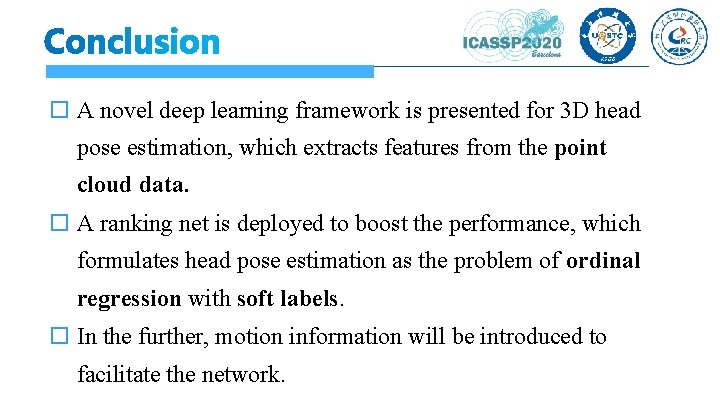
A novel deep learning framework is presented for 3 D head pose estimation, which extracts features from the point cloud data. A ranking net is deployed to boost the performance, which formulates head pose estimation as the problem of ordinal regression with soft labels. In the further, motion information will be introduced to facilitate the network.

- Slides: 22