
Leveraging Examples in eLearning Chapter 11 Ken Koedinger


- Slides: 34
Leveraging Examples in e-Learning (Chapter 11) Ken Koedinger 1
Chapter 11 Objectives § Identify types of worked examples § Design a faded worked example § Extending worked examples § Add self-explanation questions § Apply multimedia principles § Use variation & comparison to design for far transfer learning www. Clarktraining. com
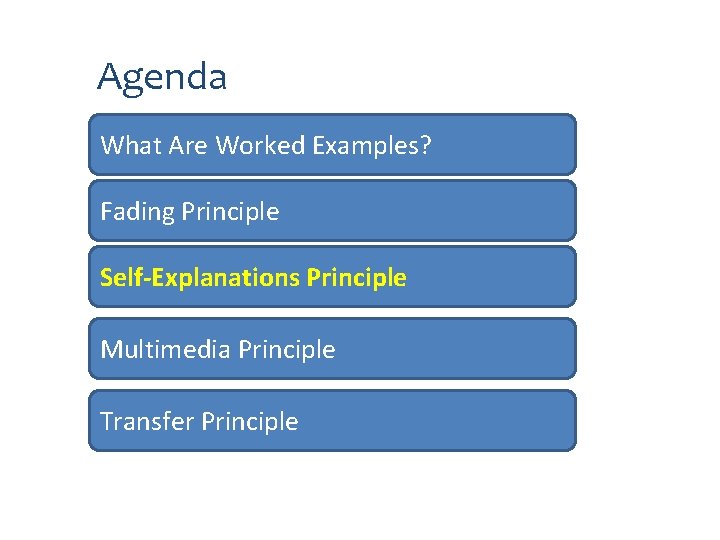
Agenda What Are Worked Examples? Fading Principle Self-Explanations Principle Multimedia Principle Transfer Principle
What is a worked example? • A step-by-step demonstration of how to perform a task or solve a problem
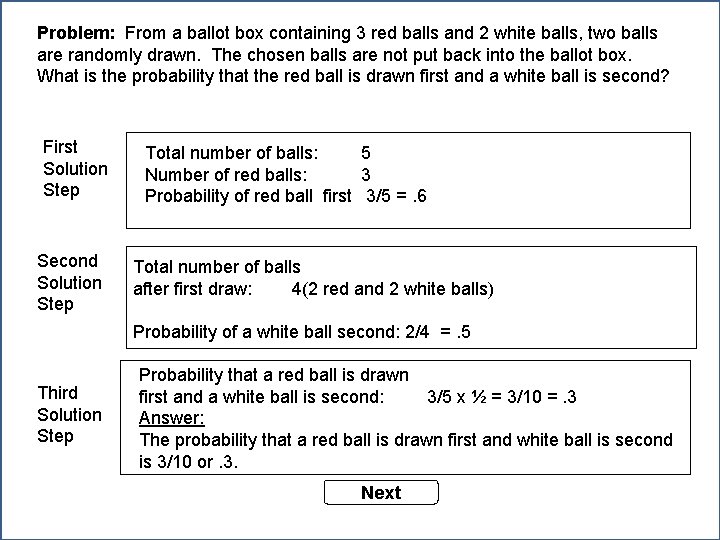
Problem: From a ballot box containing 3 red balls and 2 white balls, two balls are randomly drawn. The chosen balls are not put back into the ballot box. What is the probability that the red ball is drawn first and a white ball is second? First Solution Step Second Solution Step Total number of balls: 5 Number of red balls: 3 Probability of red ball first 3/5 =. 6 Total number of balls after first draw: 4(2 red and 2 white balls) Probability of a white ball second: 2/4 =. 5 Third Solution Step Probability that a red ball is drawn first and a white ball is second: 3/5 x ½ = 3/10 =. 3 Answer: The probability that a red ball is drawn first and white ball is second is 3/10 or. 3. Next
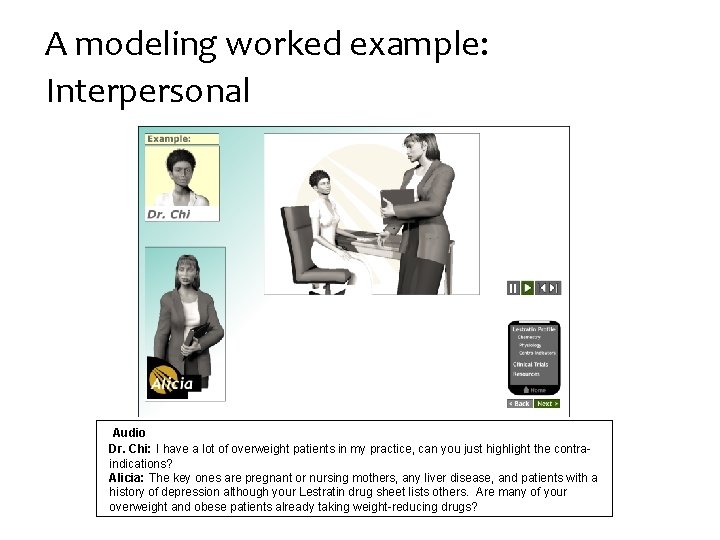
A modeling worked example: Interpersonal Audio Dr. Chi: I have a lot of overweight patients in my practice, can you just highlight the contraindications? Alicia: The key ones are pregnant or nursing mothers, any liver disease, and patients with a history of depression although your Lestratin drug sheet lists others. Are many of your overweight and obese patients already taking weight-reducing drugs?
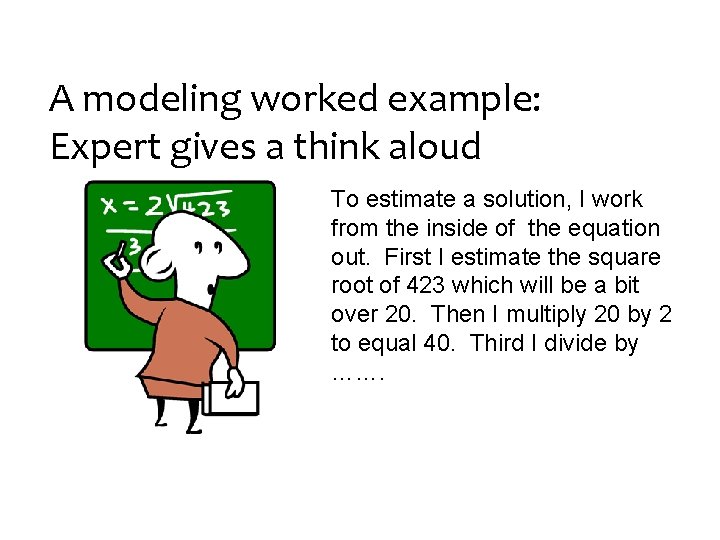
A modeling worked example: Expert gives a think aloud To estimate a solution, I work from the inside of the equation out. First I estimate the square root of 423 which will be a bit over 20. Then I multiply 20 by 2 to equal 40. Third I divide by …….
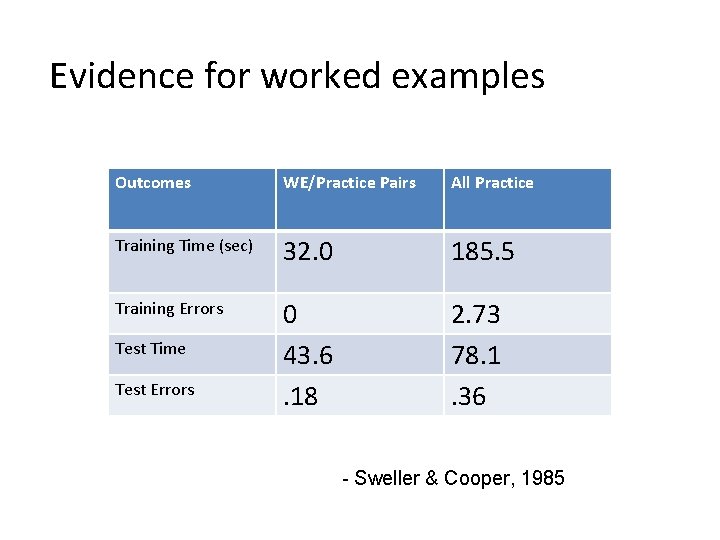
Evidence for worked examples Outcomes WE/Practice Pairs All Practice Training Time (sec) 32. 0 185. 5 Training Errors 0 43. 6. 18 2. 73 78. 1. 36 Test Time Test Errors - Sweller & Cooper, 1985
What is the rationale for worked examples? 9
Agenda What Are Worked Examples? Fading Principle Self-Explanations Principle Multimedia Principle Transfer Principle
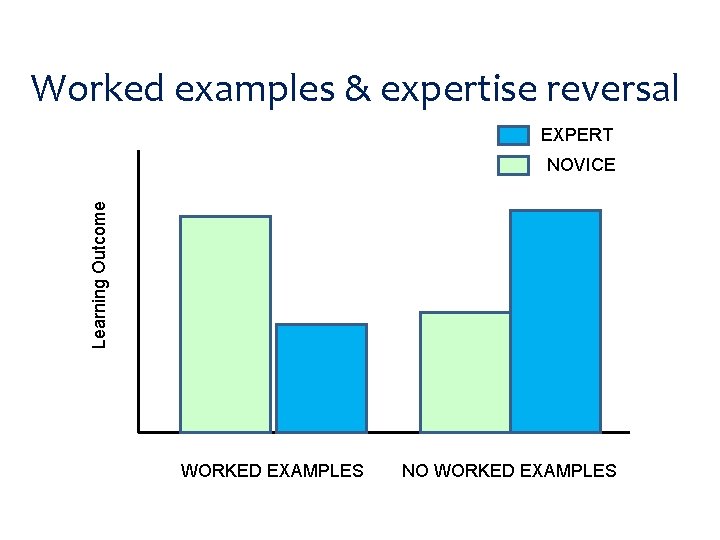
Worked examples & expertise reversal EXPERT Learning Outcome NOVICE WORKED EXAMPLES NO WORKED EXAMPLES
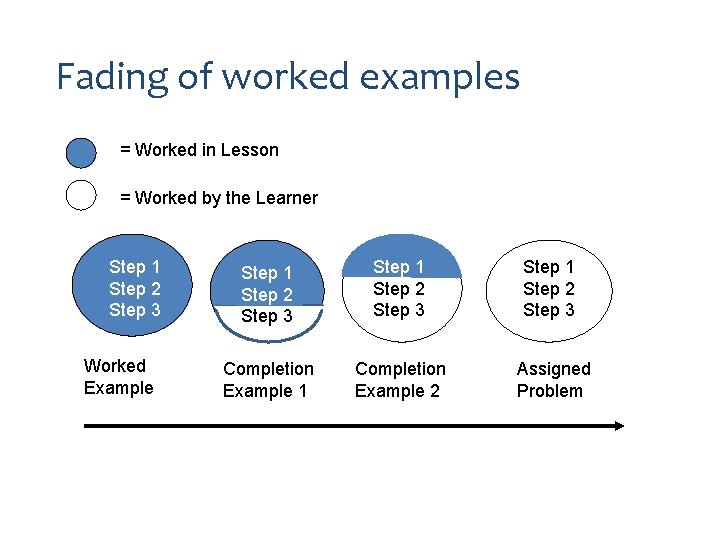
Fading of worked examples = Worked in Lesson = Worked by the Learner Step 1 Step 2 Step 3 Worked Example Step 1 Step 2 Step 3 Completion Example 1 Completion Example 2 Assigned Problem
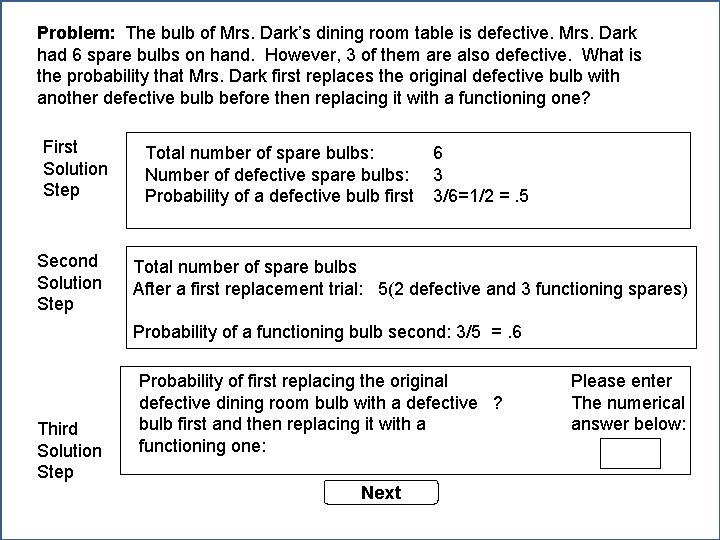
Problem: The bulb of Mrs. Dark’s dining room table is defective. Mrs. Dark had 6 spare bulbs on hand. However, 3 of them are also defective. What is the probability that Mrs. Dark first replaces the original defective bulb with another defective bulb before then replacing it with a functioning one? First Solution Step Second Solution Step Total number of spare bulbs: Number of defective spare bulbs: Probability of a defective bulb first 6 3 3/6=1/2 =. 5 Total number of spare bulbs After a first replacement trial: 5(2 defective and 3 functioning spares) Probability of a functioning bulb second: 3/5 =. 6 Third Solution Step Probability of first replacing the original defective dining room bulb with a defective ? bulb first and then replacing it with a functioning one: Next Please enter The numerical answer below:
Agenda What Are Worked Examples? Fading Principle Self-Explanations Principle Multimedia Principle Transfer Principle
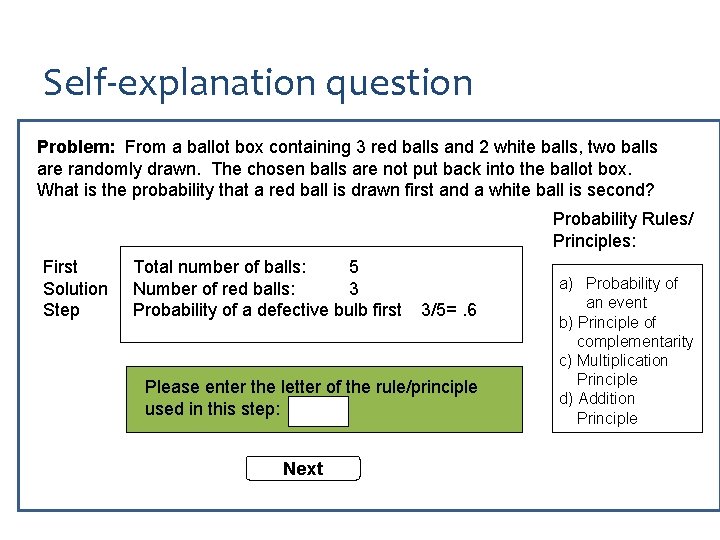
Self-explanation question Problem: From a ballot box containing 3 red balls and 2 white balls, two balls are randomly drawn. The chosen balls are not put back into the ballot box. What is the probability that a red ball is drawn first and a white ball is second? Probability Rules/ Principles: First Solution Step Total number of balls: 5 Number of red balls: 3 Probability of a defective bulb first 3/5=. 6 Please enter the letter of the rule/principle used in this step: Next a) Probability of an event b) Principle of complementarity c) Multiplication Principle d) Addition Principle
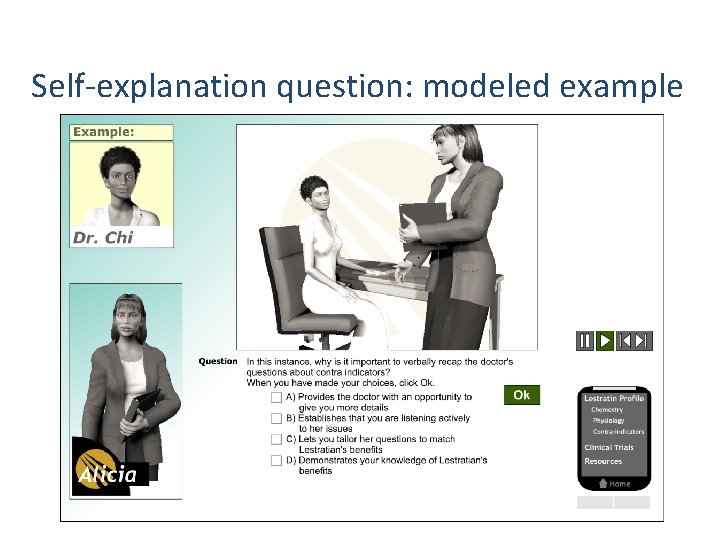
Self-explanation question: modeled example
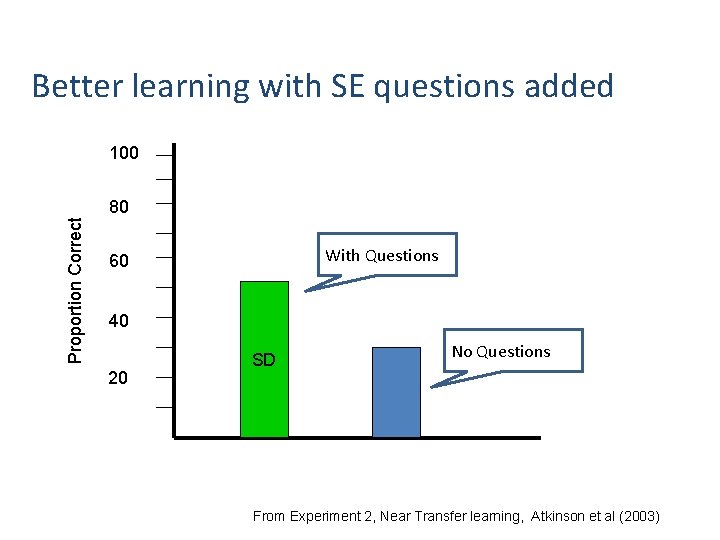
Better learning with SE questions added 100 Proportion Correct 80 With Questions 60 40 20 SD No Questions From Experiment 2, Near Transfer learning, Atkinson et al (2003)
Self-Explanation in Geometry Cognitive Tutor
Agenda What Are Worked Examples? Fading Principle Self-Explanations Principle Multimedia Principle Transfer Principle
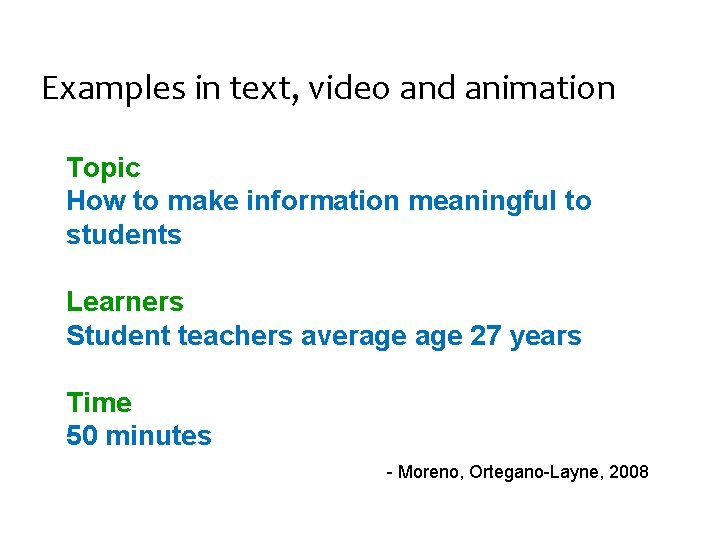
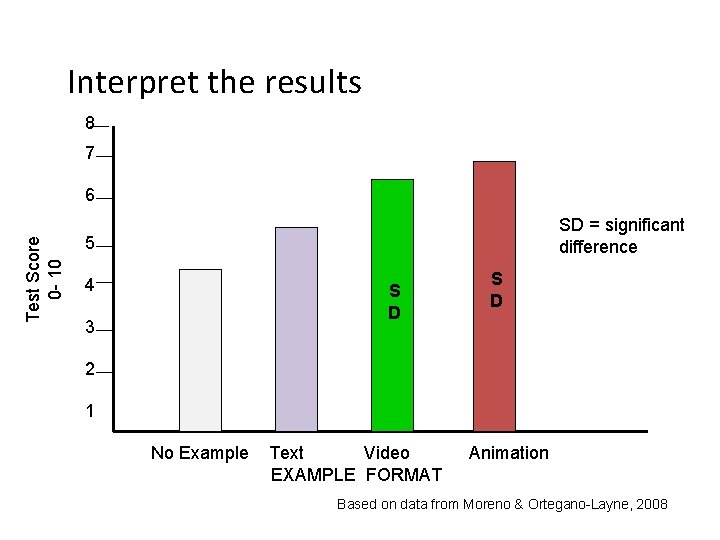
Examples in text, video and animation Topic How to make information meaningful to students Learners Student teachers average 27 years Time 50 minutes - Moreno, Ortegano-Layne, 2008
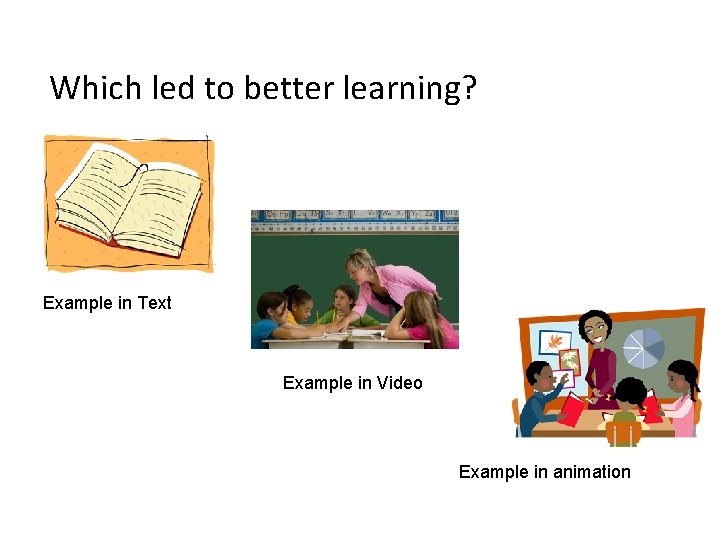
Which led to better learning? Example in Text Example in Video Example in animation
Interpret the results 8 7 Test Score 0 - 10 6 SD = significant difference 5 4 S D 3 S D 2 1 No Example Text Video EXAMPLE FORMAT Animation Based on data from Moreno & Ortegano-Layne, 2008
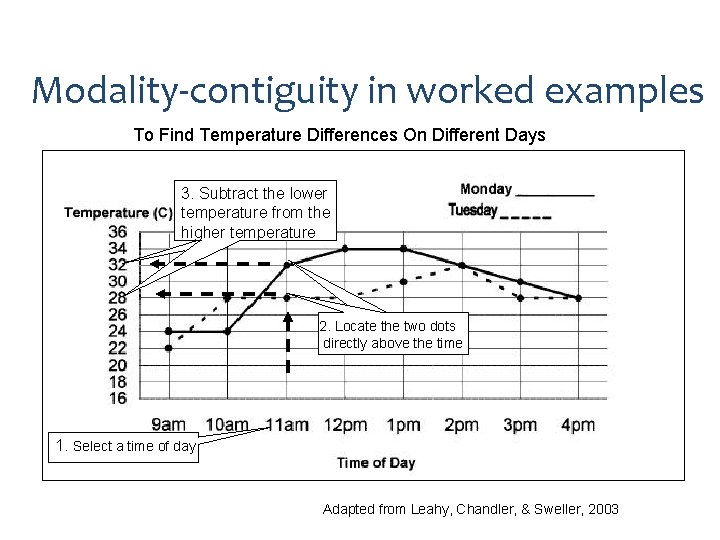
Modality-contiguity in worked examples To Find Temperature Differences On Different Days 3. Subtract the lower temperature from the higher temperature 1. Select a time 2. Locate the two dots directly above the time of day 1. Select a time of day Adapted from Leahy, Chandler, & Sweller, 2003
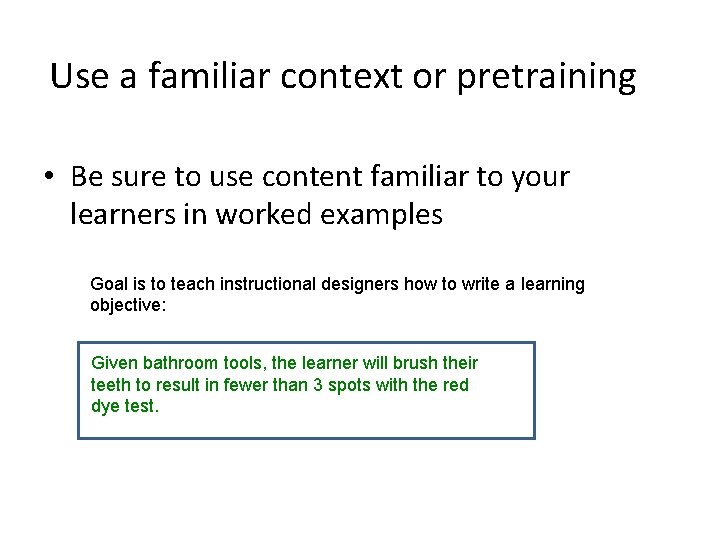
Use a familiar context or pretraining • Be sure to use content familiar to your learners in worked examples Goal is to teach instructional designers how to write a learning objective: Given bathroom tools, the learner will brush their teeth to result in fewer than 3 spots with the red dye test.
Agenda What Are Worked Examples? Fading Principle Self-Explanations Principle Multimedia Principle Transfer Principle
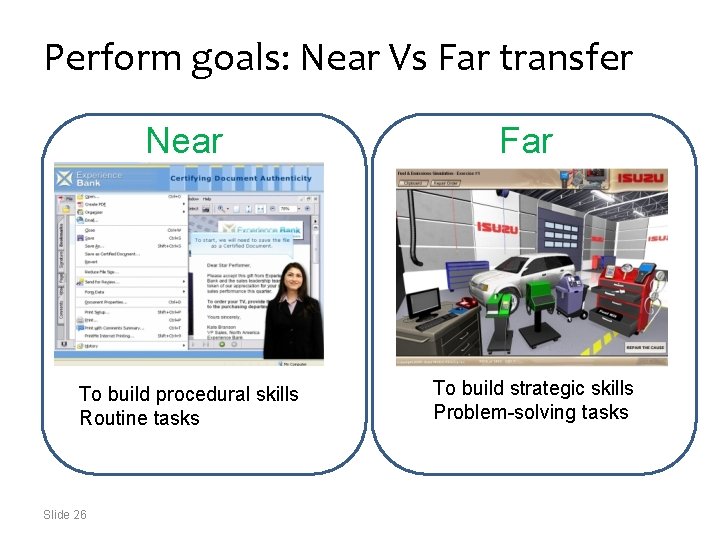
Perform goals: Near Vs Far transfer Near To build procedural skills Routine tasks Slide 26 Far To build strategic skills Problem-solving tasks
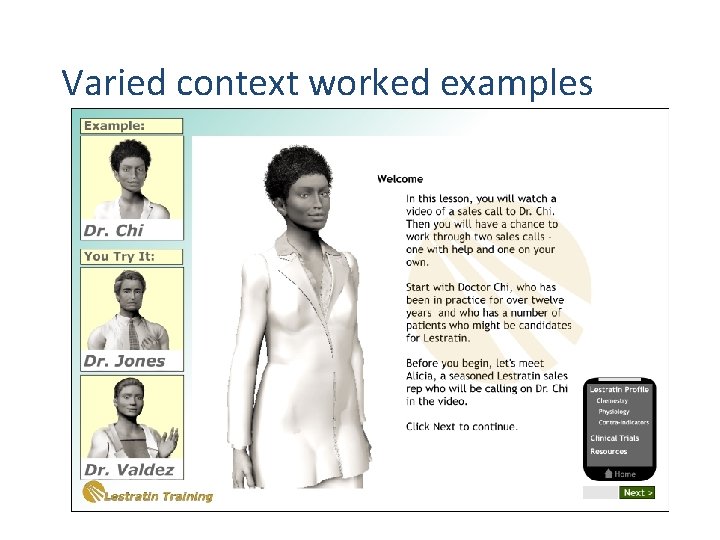
Varied context worked examples
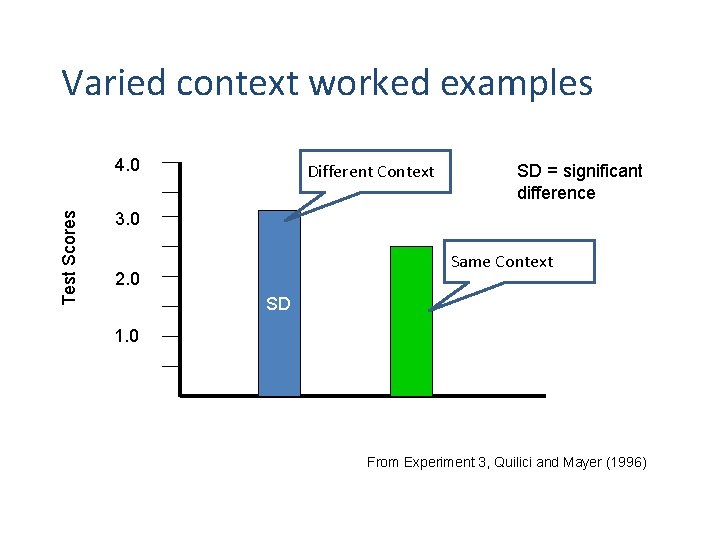
Varied context worked examples Test Scores 4. 0 Different Context SD = significant difference 3. 0 Same Context 2. 0 SD 1. 0 From Experiment 3, Quilici and Mayer (1996)
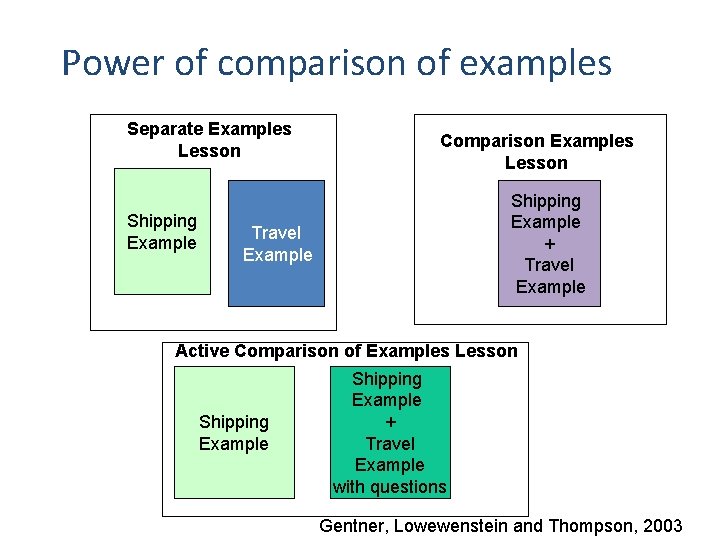
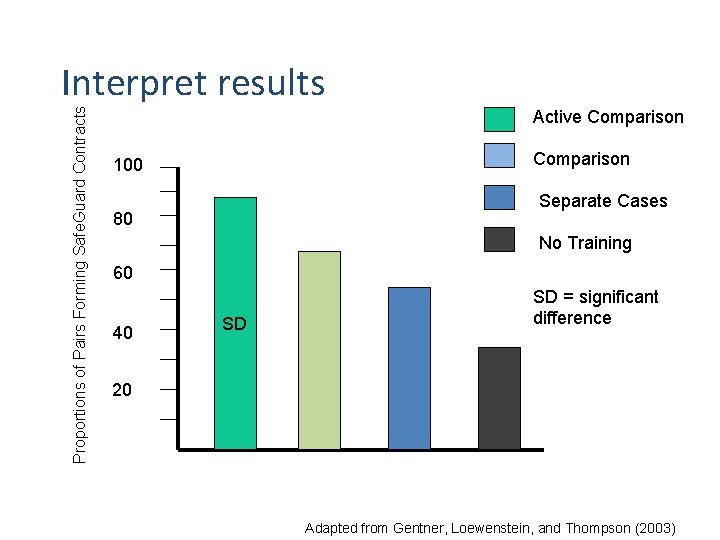
Power of comparison of examples Separate Examples Lesson Shipping Example Comparison Examples Lesson Shipping Example + Travel Example Active Comparison of Examples Lesson Shipping Example + Travel Example with questions Gentner, Lowewenstein and Thompson, 2003
Proportions of Pairs Forming Safe. Guard Contracts Interpret results Active Comparison 100 Separate Cases 80 No Training 60 40 SD SD = significant difference 20 Adapted from Gentner, Loewenstein, and Thompson (2003)
If time, can discuss other related work • Worked examples experiments in cognitive tutors – Less time, with equal or better learning • Geometry self-explanation result – Takes longer problem but better transfer – Contrast: self-explanation for English articles • Result? • Battleship Numberline example – designing based on knowledge components 31
Extras 32
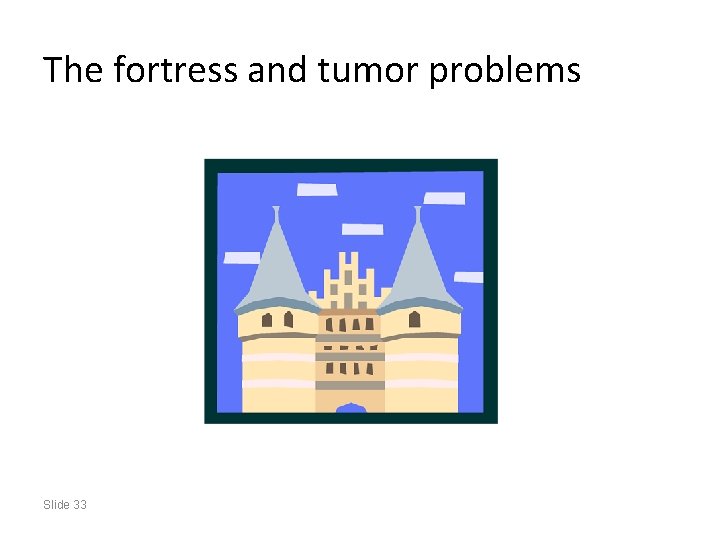
The fortress and tumor problems Slide 33
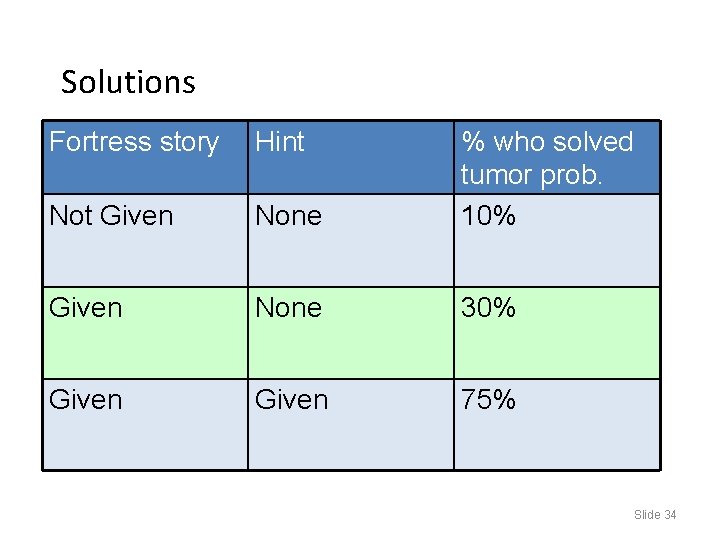
Solutions Fortress story Hint Not Given None % who solved tumor prob. 10% Given None 30% Given 75% Slide 34