
Leverage Agile Goal Setting for Improved Employee Engagement
- Slides: 12
Leverage Agile Goal Setting for Improved Employee Engagement & Performance Dodge the micromanaging foul, and score with agile short-term goal setting. Mc. Lean & Company is a research and advisory firm that provides practical solutions to human resources challenges with executable research, tools, and advice that will have a Mc. Lean & Company is a research and advisory firm providing practical solutions to human resources challenges©via executable research, tools and advice that clear and measurable impact on your business. 1997 -2013 Mc. Lean & Company. have a clear and measurable impact on your business. © 1997 - 2013 Mclean & Company. Mc. Lean & Company is a division of Info-Tech Group Mc. Lean & Company is a division of Info-Tech Research Group Research Inc. Mc. Lean & Company 1
Introduction Agile, short-term goal setting is the best way to achieve results and keep managers and employees on the same page. It’s a challenge to convert high-level organizational strategy into tangible results. In order to get things done effectively and efficiently every day, managers need to create a goal-oriented environment. Use this research to gain a better understanding of how you can flexibly manage goal setting with your employees on a daily and weekly basis. This solid understanding will help you get better performance out of your employees. This Research Is Designed For: This Research Will Give You: üHuman Resources professionals in charge of üBest practices to keep employees engaged in training managers. goal setting and achieving in the short-term. üExecutives and managers. Mc. Lean & Company 2
Executive Summary • Employee productivity losses add up to billions of dollars every year. Effective agile short-term goal setting can improve employee performance success by 17%. • Effective performance management occurs throughout the year – on a daily and weekly basis – not just at annual performance review time. Managers must embrace this reality and get into the habit of setting agile short-term goals to drive productivity. • Applying agile principles to goal setting helps organizations be more responsive, and makes daily or weekly goal setting a reality without the cumbersome paperwork associated with annual goal setting. • Short-term agile goal setting is not about micromanaging. Instead, it is about empowering employees to set their own goals based on information and support from their managers. • Employee empowerment and manager-employee relationships are major drivers for both productivity and employee retention. Using agile, short-term goal setting to build these critical components benefits the organization, manager, and employee. • The agile, short-term process includes goal sourcing, goal setting, goal achieving, and goal measuring, which can all be carried out every day or every week. • Managers that do a poor job of their own goal setting are cited as the biggest barrier to employees’ understanding of productivity expectations. Managers must walk the walk and effectively set their own goals if employees are to reap the benefits of the agile goal setting process. • Communicating the expectations within a goal setting environment and arming staff to set mutually beneficial goals are a manager’s keys to success in an agile environment. Mc. Lean & Company 3
The Case for Agile Goal Setting What’s in this Section: Sections: • Effective short-term goal setting can improve employee performance success by 17%. • Incorporating agile principles into a goal-setting process creates the grounding in reality and responsiveness to change required in today’s organizations. • Agile goal setting increases an employee’s sense of empowerment, which is a major factor in improved employee engagement. • Self-assess goal-setting effectiveness against Mc. Lean & Company’s diagnostic checklist. The Case for Agile Goal Setting Goal Sourcing: Prepare the Field for Goal Scoring Goal Setting: Get Goaling with your Employees Goal Achieving: Keep It Goaling for the Long Term Goal Measuring: Evaluate Your Goal Keeping Mc. Lean & Company 4
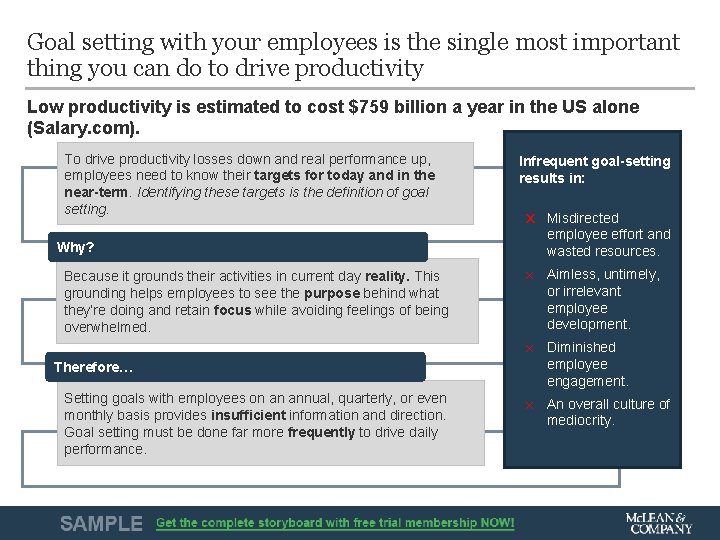
Goal setting with your employees is the single most important thing you can do to drive productivity Low productivity is estimated to cost $759 billion a year in the US alone (Salary. com). To drive productivity losses down and real performance up, employees need to know their targets for today and in the near-term. Identifying these targets is the definition of goal setting. Why? Because it grounds their activities in current day reality. This grounding helps employees to see the purpose behind what they’re doing and retain focus while avoiding feelings of being overwhelmed. Therefore… Setting goals with employees on an annual, quarterly, or even monthly basis provides insufficient information and direction. Goal setting must be done far more frequently to drive daily performance. Infrequent goal-setting results in: x Misdirected employee effort and wasted resources. x Aimless, untimely, or irrelevant employee development. x Diminished employee engagement. x An overall culture of mediocrity. Mc. Lean & Company 5
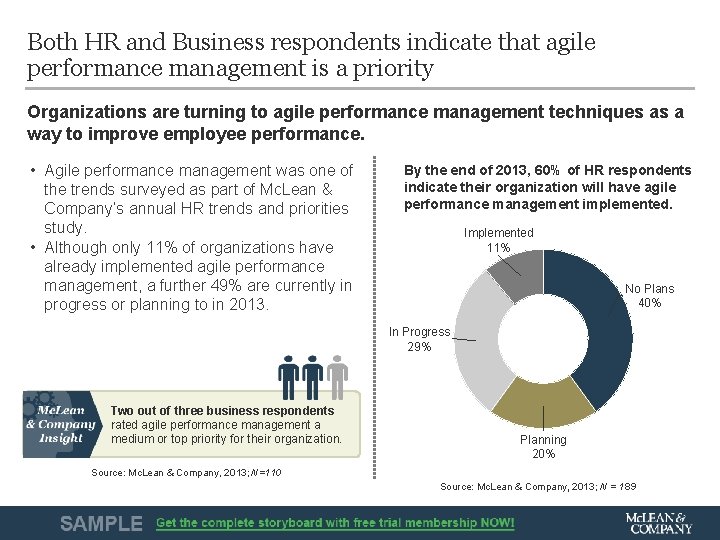
Both HR and Business respondents indicate that agile performance management is a priority Organizations are turning to agile performance management techniques as a way to improve employee performance. • Agile performance management was one of the trends surveyed as part of Mc. Lean & Company’s annual HR trends and priorities study. • Although only 11% of organizations have already implemented agile performance management, a further 49% are currently in progress or planning to in 2013. By the end of 2013, 60% of HR respondents indicate their organization will have agile performance management implemented. Implemented 11% No Plans 40% In Progress 29% Two out of three business respondents rated agile performance management a medium or top priority for their organization. Planning 20% Source: Mc. Lean & Company, 2013; N=110 Source: Mc. Lean & Company, 2013; N = 189 Mc. Lean & Company 6
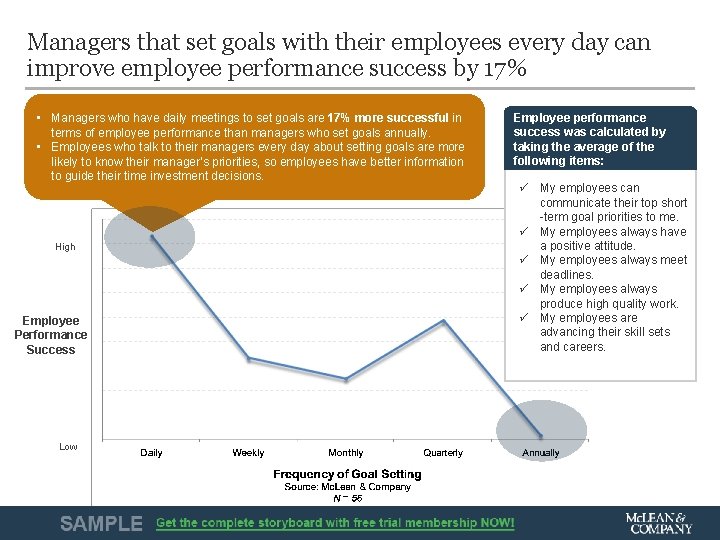
Managers that set goals with their employees every day can improve employee performance success by 17% • Managers who have daily meetings to set goals are 17% more successful in terms of employee performance than managers who set goals annually. • Employees who talk to their managers every day about setting goals are more likely to know their manager’s priorities, so employees have better information to guide their time investment decisions. High Employee Performance Success Employee performance success was calculated by taking the average of the following items: ü My employees can communicate their top short -term goal priorities to me. ü My employees always have a positive attitude. ü My employees always meet deadlines. ü My employees always produce high quality work. ü My employees are advancing their skill sets and careers. Low Mc. Lean & Company 7
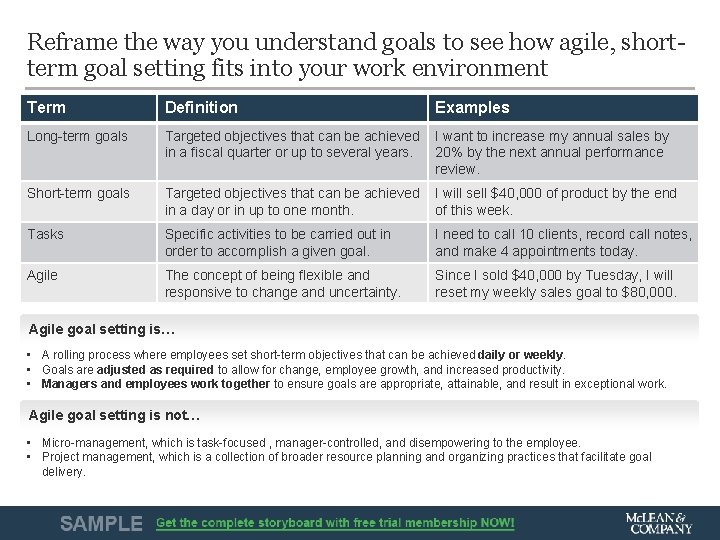
Reframe the way you understand goals to see how agile, shortterm goal setting fits into your work environment Term Definition Examples Long-term goals Targeted objectives that can be achieved in a fiscal quarter or up to several years. I want to increase my annual sales by 20% by the next annual performance review. Short-term goals Targeted objectives that can be achieved in a day or in up to one month. I will sell $40, 000 of product by the end of this week. Tasks Specific activities to be carried out in order to accomplish a given goal. I need to call 10 clients, record call notes, and make 4 appointments today. Agile The concept of being flexible and responsive to change and uncertainty. Since I sold $40, 000 by Tuesday, I will reset my weekly sales goal to $80, 000. Agile goal setting is… • A rolling process where employees set short-term objectives that can be achieved daily or weekly. • Goals are adjusted as required to allow for change, employee growth, and increased productivity. • Managers and employees work together to ensure goals are appropriate, attainable, and result in exceptional work. Agile goal setting is not… • Micro-management, which is task-focused , manager-controlled, and disempowering to the employee. • Project management, which is a collection of broader resource planning and organizing practices that facilitate goal delivery. Mc. Lean & Company 8
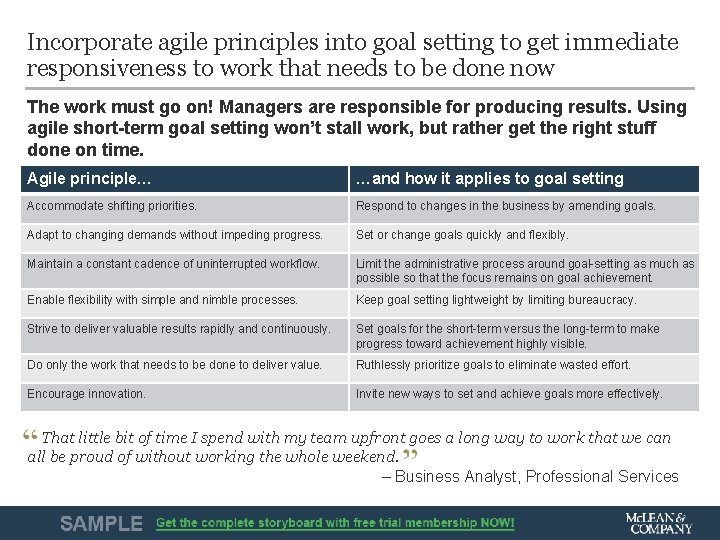
Incorporate agile principles into goal setting to get immediate responsiveness to work that needs to be done now The work must go on! Managers are responsible for producing results. Using agile short-term goal setting won’t stall work, but rather get the right stuff done on time. Agile principle… …and how it applies to goal setting Accommodate shifting priorities. Respond to changes in the business by amending goals. Adapt to changing demands without impeding progress. Set or change goals quickly and flexibly. Maintain a constant cadence of uninterrupted workflow. Limit the administrative process around goal-setting as much as possible so that the focus remains on goal achievement. Enable flexibility with simple and nimble processes. Keep goal setting lightweight by limiting bureaucracy. Strive to deliver valuable results rapidly and continuously. Set goals for the short-term versus the long-term to make progress toward achievement highly visible. Do only the work that needs to be done to deliver value. Ruthlessly prioritize goals to eliminate wasted effort. Encourage innovation. Invite new ways to set and achieve goals more effectively. That little bit of time I spend with my team upfront goes a long way to work that we can all be proud of without working the whole weekend. – Business Analyst, Professional Services Mc. Lean & Company 9
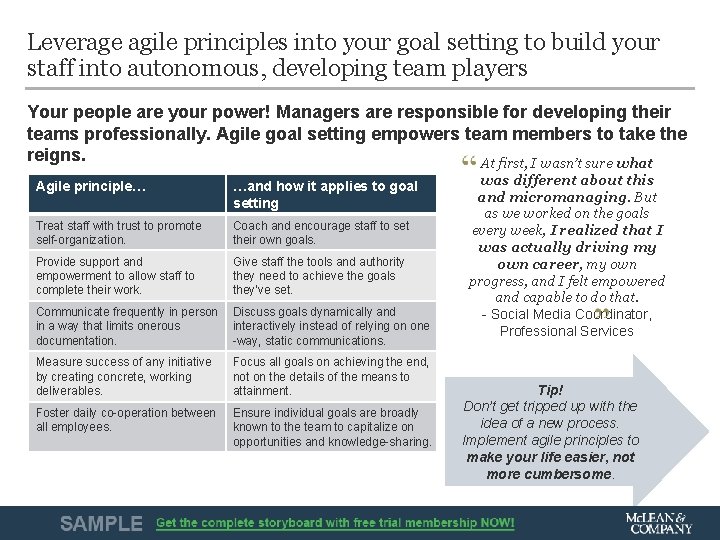
Leverage agile principles into your goal setting to build your staff into autonomous, developing team players Your people are your power! Managers are responsible for developing their teams professionally. Agile goal setting empowers team members to take the reigns. At first, I wasn’t sure what Agile principle… …and how it applies to goal setting Treat staff with trust to promote self-organization. Coach and encourage staff to set their own goals. Provide support and empowerment to allow staff to complete their work. Give staff the tools and authority they need to achieve the goals they’ve set. Communicate frequently in person in a way that limits onerous documentation. Discuss goals dynamically and interactively instead of relying on one -way, static communications. Measure success of any initiative by creating concrete, working deliverables. Focus all goals on achieving the end, not on the details of the means to attainment. Foster daily co-operation between all employees. Ensure individual goals are broadly known to the team to capitalize on opportunities and knowledge-sharing. was different about this and micromanaging. But as we worked on the goals every week, I realized that I was actually driving my own career, my own progress, and I felt empowered and capable to do that. - Social Media Coordinator, Professional Services Tip! Don’t get tripped up with the idea of a new process. Implement agile principles to make your life easier, not more cumbersome. Mc. Lean & Company 10
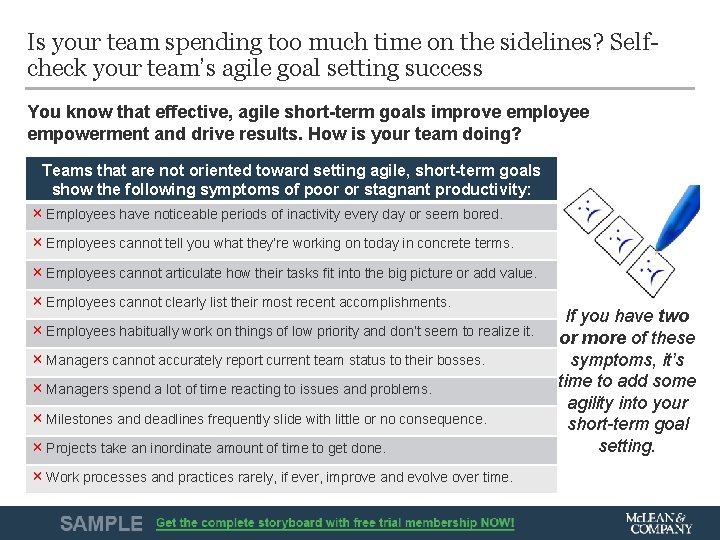
Is your team spending too much time on the sidelines? Selfcheck your team’s agile goal setting success You know that effective, agile short-term goals improve employee empowerment and drive results. How is your team doing? Teams that are not oriented toward setting agile, short-term goals show the following symptoms of poor or stagnant productivity: × Employees have noticeable periods of inactivity every day or seem bored. × Employees cannot tell you what they’re working on today in concrete terms. × Employees cannot articulate how their tasks fit into the big picture or add value. × Employees cannot clearly list their most recent accomplishments. × Employees habitually work on things of low priority and don’t seem to realize it. × Managers cannot accurately report current team status to their bosses. × Managers spend a lot of time reacting to issues and problems. × Milestones and deadlines frequently slide with little or no consequence. × Projects take an inordinate amount of time to get done. If you have two or more of these symptoms, it’s time to add some agility into your short-term goal setting. × Work processes and practices rarely, if ever, improve and evolve over time. Mc. Lean & Company 11
Mc. Lean & Company Helps HR Professionals To: ü Empower management to applyü HR best practices ü Develop effective talent acquisition & retention strategies ü Build a high performance culture Maintain a progressive set of HR policies & procedures ü Demonstrate the business impact of HR ü Stay abreast of HR trends & technologies Sign up for free trial membership to get practical solutions for your HR challenges "Mc. Lean & Company provides practical research, tools and advice covering the entire spectrum of HR & Leadership issues to ensure you experience measurable, positive results. " • - Rob Garmaise, VP of Customer Experience Toll Free: 1 -877 -281 -0480 hr. mcleanco. com Mc. Lean & Company 12