
Levelset based fluidstructure interaction modeling with the e
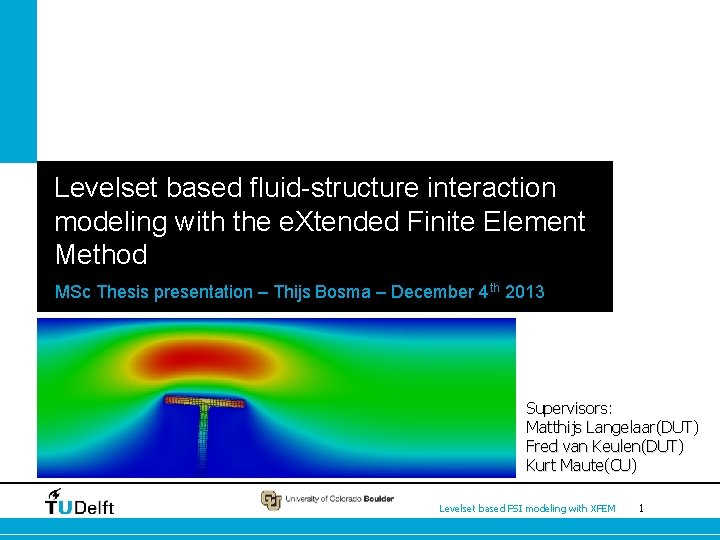
Levelset based fluid-structure interaction modeling with the e. Xtended Finite Element Method MSc Thesis presentation – Thijs Bosma – December 4 th 2013 Supervisors: Matthijs Langelaar(DUT) Fred van Keulen(DUT) Kurt Maute(CU) Levelset based FSI modeling with XFEM 1
Introduction to Fluid-Structure Interaction (FSI) Levelset based FSI modeling with XFEM 2
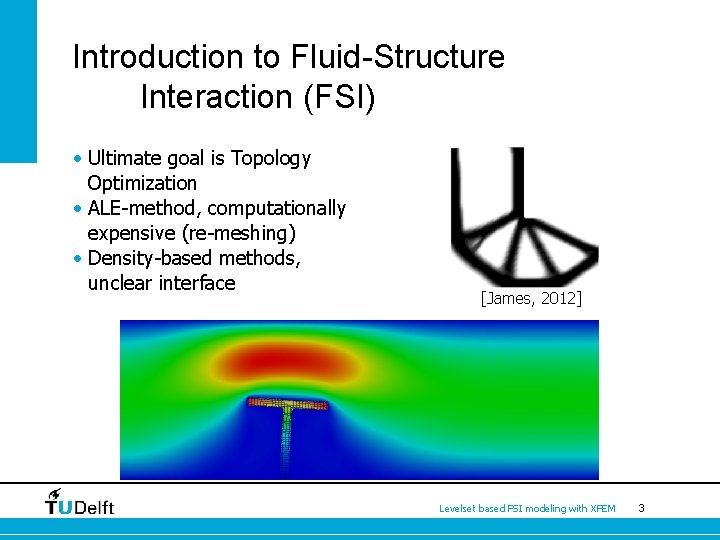
Introduction to Fluid-Structure Interaction (FSI) • Ultimate goal is Topology Optimization • ALE-method, computationally expensive (re-meshing) • Density-based methods, unclear interface [James, 2012] Levelset based FSI modeling with XFEM 3
Introduction to my work Goals of the research Model: Levelset based geometry description for fluidstructure interaction (FSI) problems with e. Xtended Finite Element Method (XFEM) approximation Goal: Develop an efficient solver scheme that finds the steady state solution of the FSI problem (simultaneously for fluid and structure), such that it can be used in an optimization framework Levelset based FSI modeling with XFEM 4
Introduction to my work Goals of the research Model: Levelset based geometry description for fluidstructure interaction (FSI) problems with e. Xtended Finite Element Method (XFEM) approximation Goal: Develop an efficient solver scheme that finds the steady state solution of the FSI problem (simultaneously for fluid and structure), such that it can be used in an optimization framework Levelset based FSI modeling with XFEM 5
Introduction to my work Goals of the research Model: Levelset based geometry description for fluid-structure interaction (FSI) problems with e. Xtended Finite Element Method (XFEM) approximation Goal: Develop an efficient solver scheme that finds the steady state solution of the FSI problem (simultaneously for fluid and structure), such that it can be used in an optimization framework 1. Does the approximated solution describe the physics of the system? 2. How can the problem be solved efficiently? 3. What makes this approach suitable for optimization? Levelset based FSI modeling with XFEM 6
Content • The model • The solvers • Monolithic and staggered solver • Results staggered • 1) Does the approximated solution describe the physics of the system? • Results monolithic • 2) How can the problem be solved efficiently? • Outlook • 3) What makes this approach suitable for optimization? • Conclusions/Recommendations Levelset based FSI modeling with XFEM 7
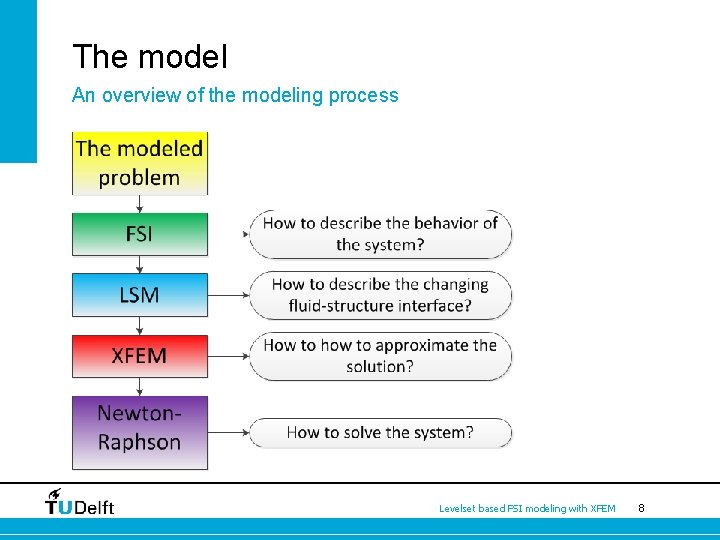
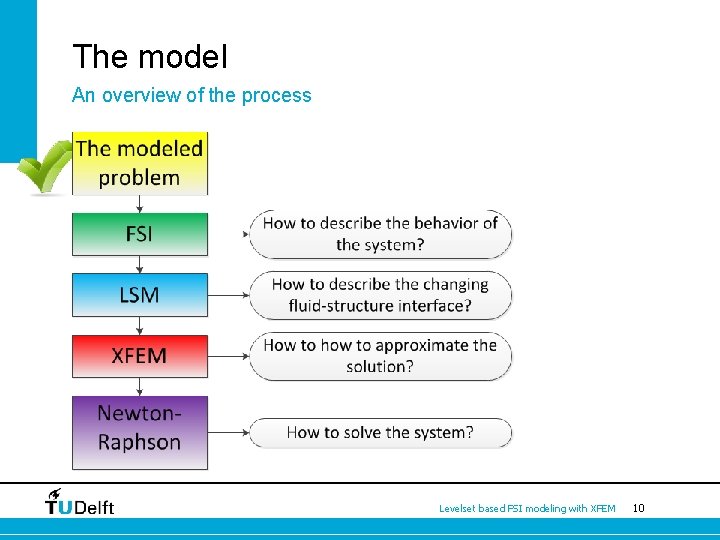
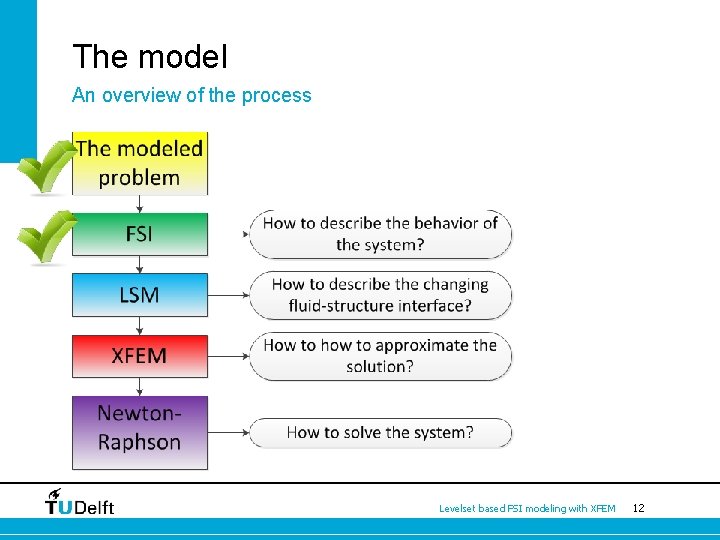
The model An overview of the modeling process Levelset based FSI modeling with XFEM 8
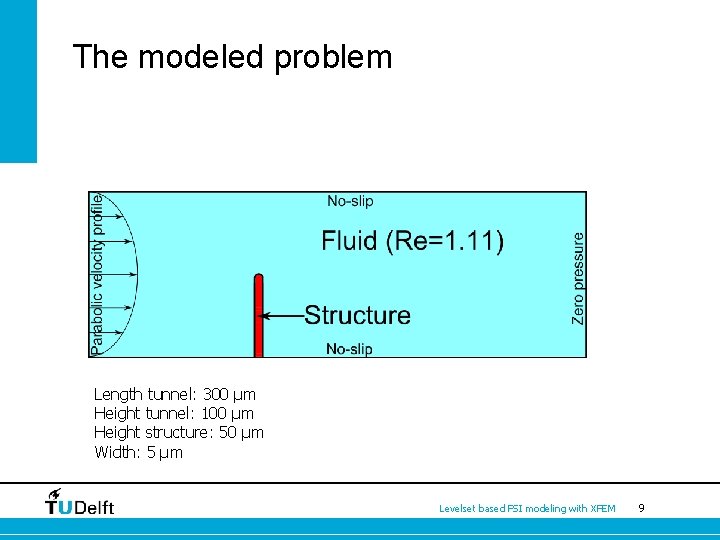
The modeled problem Length tunnel: 300 μm Height tunnel: 100 μm Height structure: 50 μm Width: 5 μm Levelset based FSI modeling with XFEM 9
The model An overview of the process Levelset based FSI modeling with XFEM 10
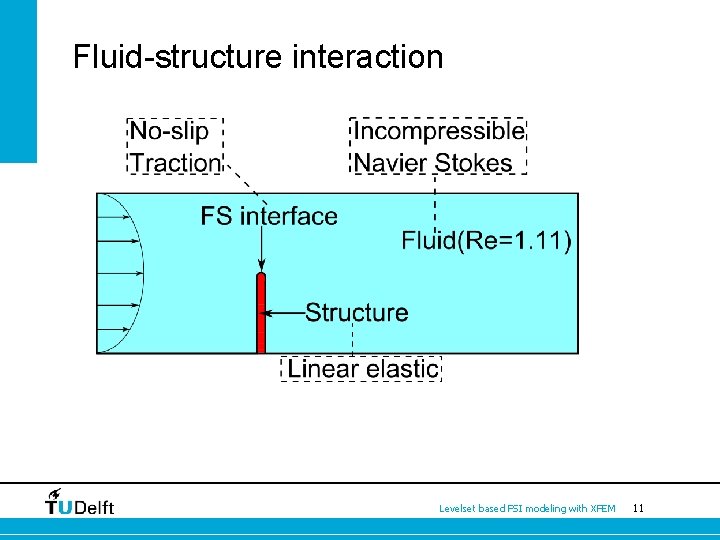
Fluid-structure interaction Levelset based FSI modeling with XFEM 11
The model An overview of the process Levelset based FSI modeling with XFEM 12
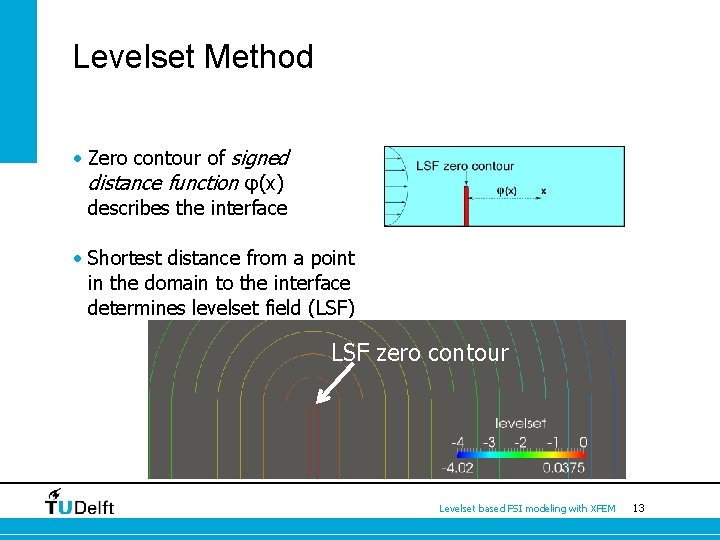
Levelset Method • Zero contour of signed distance function φ(x) describes the interface • Shortest distance from a point in the domain to the interface determines levelset field (LSF) LSF zero contour Levelset based FSI modeling with XFEM 13
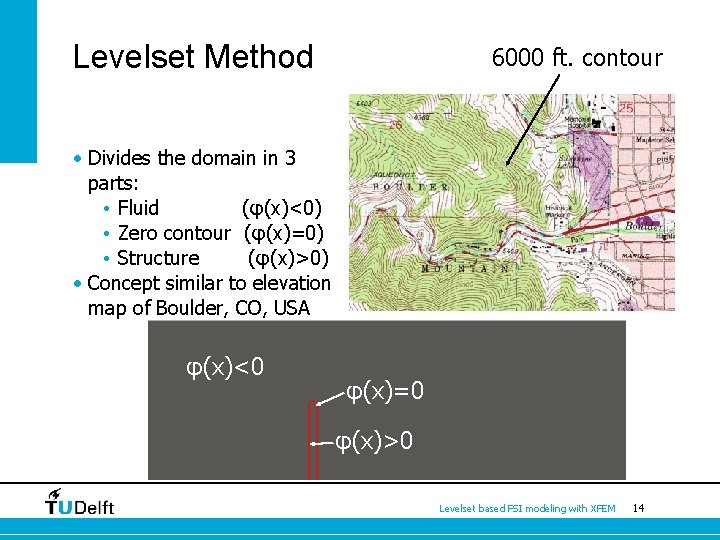
Levelset Method 6000 ft. contour • Divides the domain in 3 parts: • Fluid (φ(x)<0) • Zero contour (φ(x)=0) • Structure (φ(x)>0) • Concept similar to elevation map of Boulder, CO, USA φ(x)<0 φ(x)=0 φ(x)>0 Levelset based FSI modeling with XFEM 14
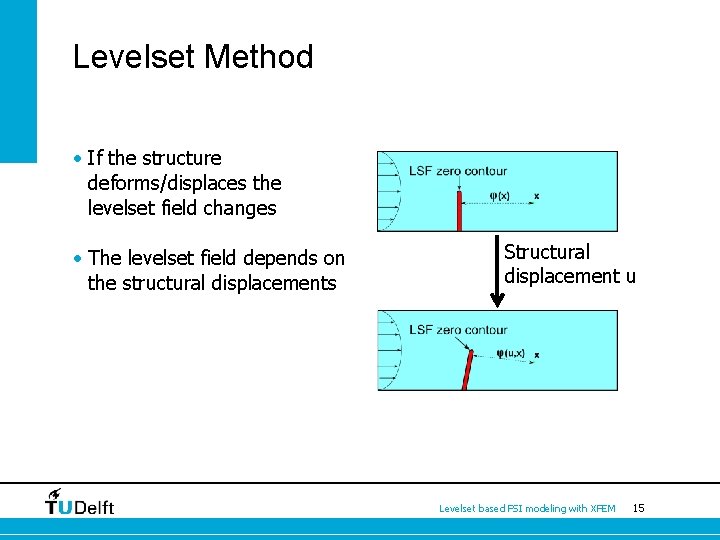
Levelset Method • If the structure deforms/displaces the levelset field changes • The levelset field depends on the structural displacements Structural displacement u Levelset based FSI modeling with XFEM 15
The model An overview of the process Levelset based FSI modeling with XFEM 16
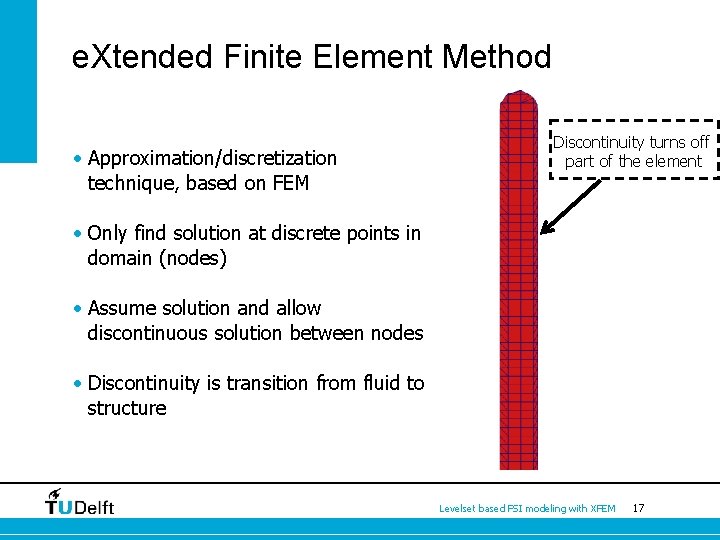
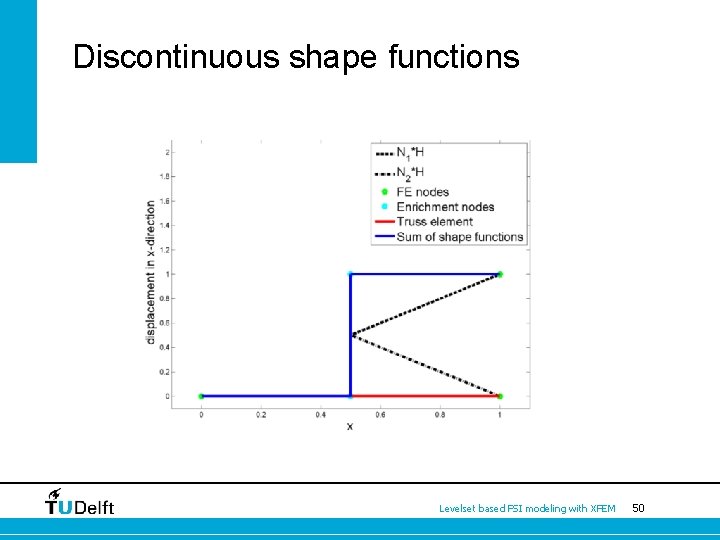
e. Xtended Finite Element Method • Approximation/discretization technique, based on FEM Discontinuity turns off part of the element • Only find solution at discrete points in domain (nodes) • Assume solution and allow discontinuous solution between nodes • Discontinuity is transition from fluid to structure Levelset based FSI modeling with XFEM 17
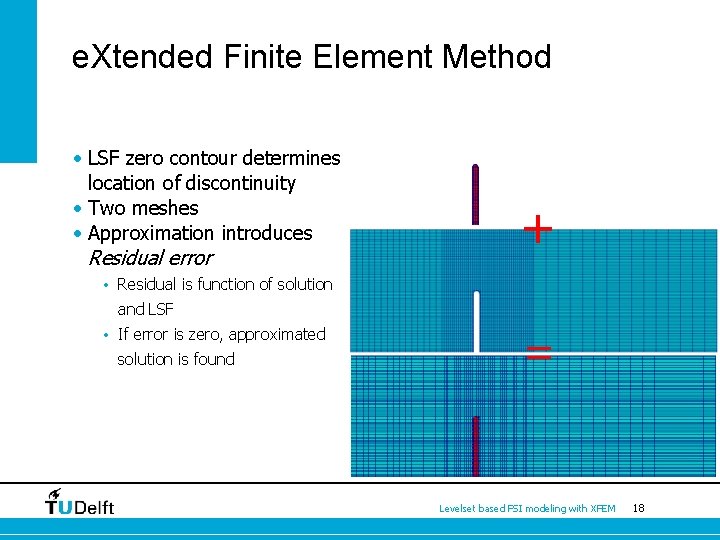
e. Xtended Finite Element Method • LSF zero contour determines location of discontinuity • Two meshes • Approximation introduces Residual error + • Residual is function of solution and LSF • If error is zero, approximated solution is found = Levelset based FSI modeling with XFEM 18
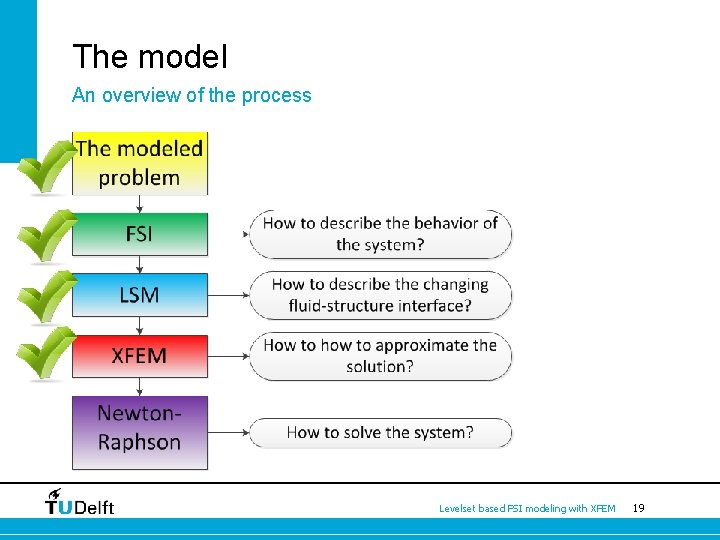
The model An overview of the process Levelset based FSI modeling with XFEM 19
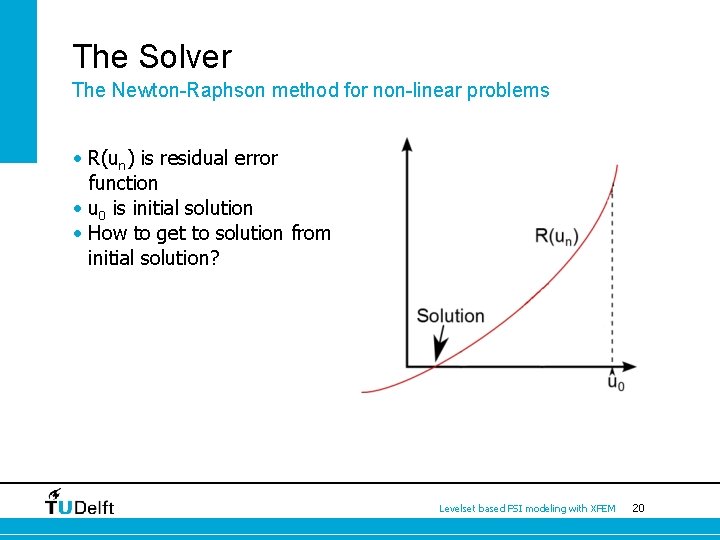
The Solver The Newton-Raphson method for non-linear problems • R(un) is residual error function • u 0 is initial solution • How to get to solution from initial solution? Levelset based FSI modeling with XFEM 20
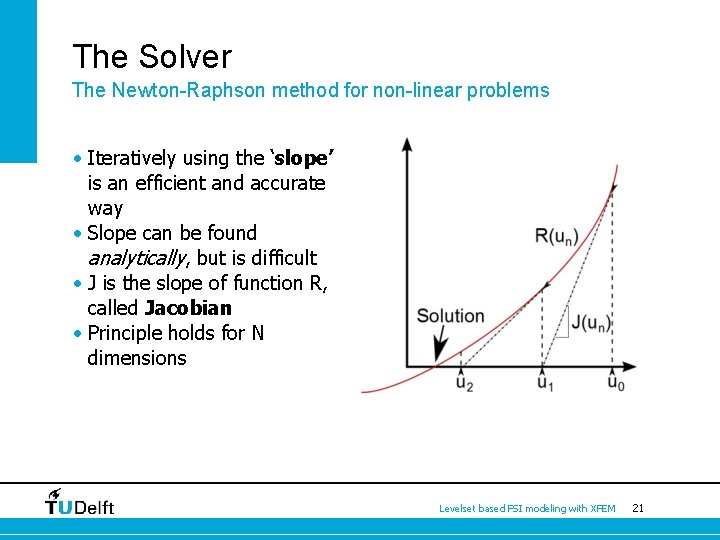
The Solver The Newton-Raphson method for non-linear problems • Iteratively using the ‘slope’ is an efficient and accurate way • Slope can be found analytically, but is difficult • J is the slope of function R, called Jacobian • Principle holds for N dimensions Levelset based FSI modeling with XFEM 21
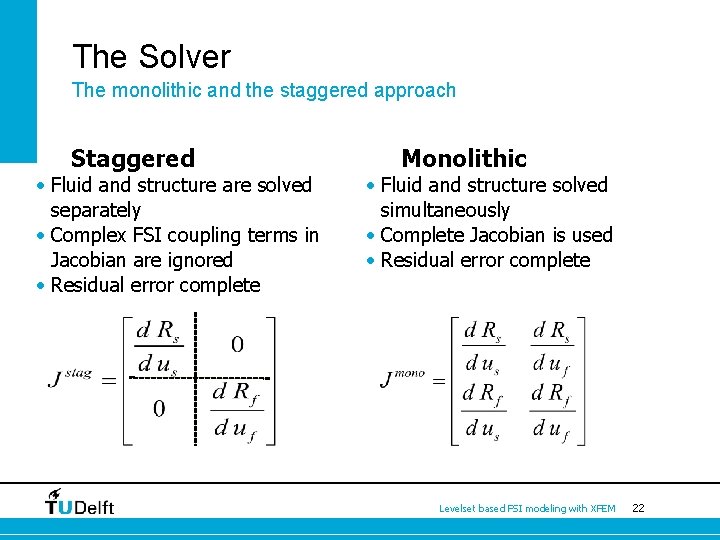
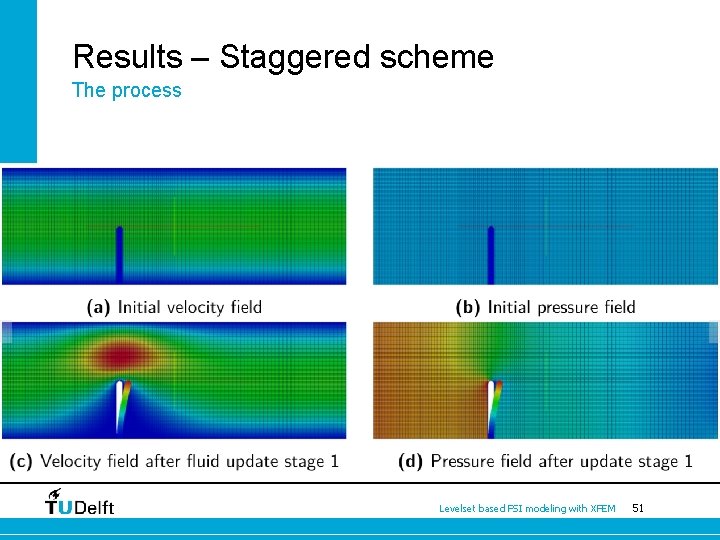
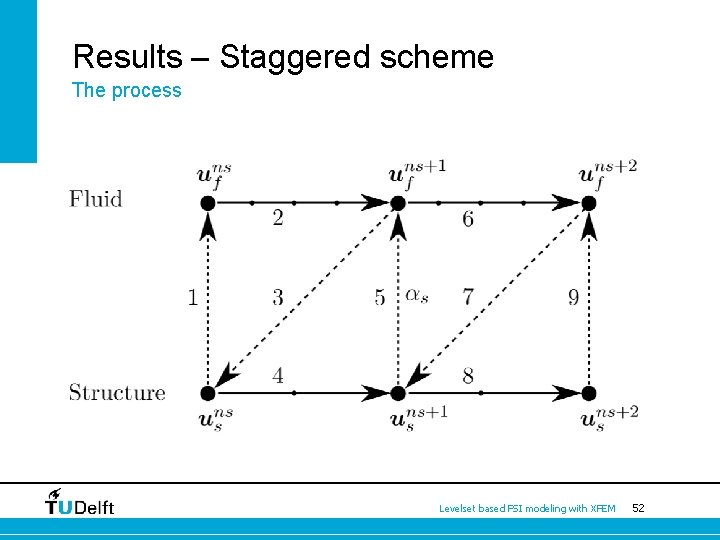
The Solver The monolithic and the staggered approach Staggered • Fluid and structure are solved separately • Complex FSI coupling terms in Jacobian are ignored • Residual error complete Monolithic • Fluid and structure solved simultaneously • Complete Jacobian is used • Residual error complete Levelset based FSI modeling with XFEM 22
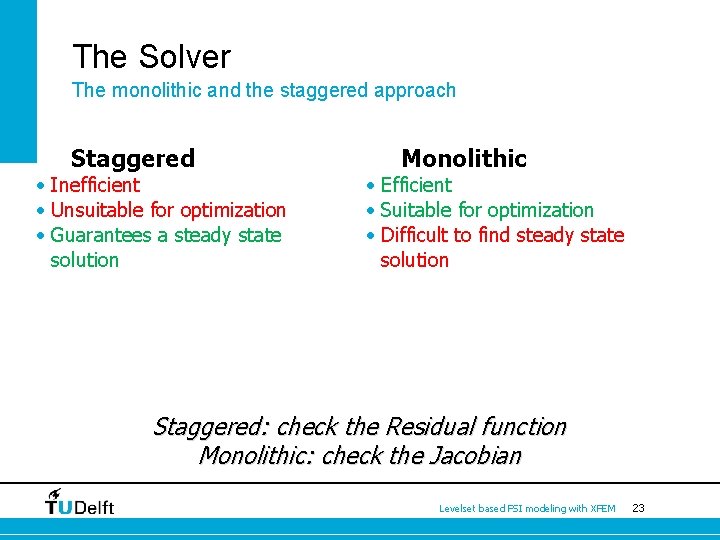
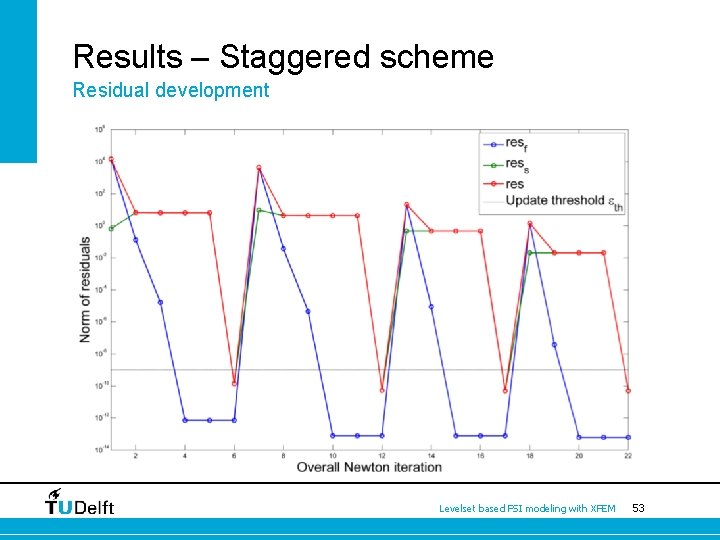
The Solver The monolithic and the staggered approach Staggered • Inefficient • Unsuitable for optimization • Guarantees a steady state solution Monolithic • Efficient • Suitable for optimization • Difficult to find steady state solution Staggered: check the Residual function Monolithic: check the Jacobian Levelset based FSI modeling with XFEM 23
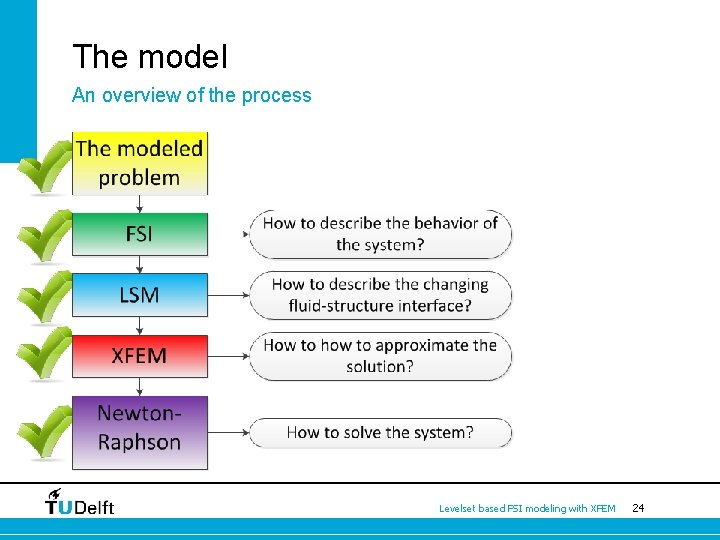
The model An overview of the process Levelset based FSI modeling with XFEM 24
![Results – Staggered scheme Velocity and displacement field – Steady state XFEM-staggered: [-] COMSOL-ALE:](http://slidetodoc.com/presentation_image/48cc0e0120fb54d3c6f97b3120bcdcb7/image-25.jpg "Results – Staggered scheme Velocity and displacement field – Steady state XFEM-staggered: [-] COMSOL-ALE:")
Results – Staggered scheme Velocity and displacement field – Steady state XFEM-staggered: [-] COMSOL-ALE: [m/s] [μm] Levelset based FSI modeling with XFEM 25
![Results – Staggered scheme Velocity and displacement field – Steady state XFEM-staggered: [-] ≈](http://slidetodoc.com/presentation_image/48cc0e0120fb54d3c6f97b3120bcdcb7/image-26.jpg "Results – Staggered scheme Velocity and displacement field – Steady state XFEM-staggered: [-] ≈")
Results – Staggered scheme Velocity and displacement field – Steady state XFEM-staggered: [-] ≈ [-] COMSOL-ALE: [m/s] [μm] Levelset based FSI modeling with XFEM 26
![Results – Staggered scheme Velocity and displacement field – Steady state XFEM-staggered: [-] ≈≈](http://slidetodoc.com/presentation_image/48cc0e0120fb54d3c6f97b3120bcdcb7/image-27.jpg "Results – Staggered scheme Velocity and displacement field – Steady state XFEM-staggered: [-] ≈≈")
Results – Staggered scheme Velocity and displacement field – Steady state XFEM-staggered: [-] ≈≈ [-] COMSOL-ALE: Staggered: Residual function is ok Levelset based FSI modeling with XFEM [m/s] [μm] 27
Goal: Develop an efficient solver scheme that finds the steady state solution of the FSI problem (simultaneously for fluid and structure), such that it can be used in an optimization framework 1. Does the approximated solution describe the physics of the system? Yes, based on qualitative check! 2. How can we efficiently solve the system? 3. What makes this approach suitable for optimization? Levelset based FSI modeling with XFEM 28
![Results – Monolithic scheme Velocity and displacement field – Exploded XFEM: [-] ≠ [-]](http://slidetodoc.com/presentation_image/48cc0e0120fb54d3c6f97b3120bcdcb7/image-29.jpg "Results – Monolithic scheme Velocity and displacement field – Exploded XFEM: [-] ≠ [-]")
Results – Monolithic scheme Velocity and displacement field – Exploded XFEM: [-] ≠ [-] COMSOL: Monolithic: Jacobian is not ok Levelset based FSI modeling with XFEM [m/s] [μm] 29
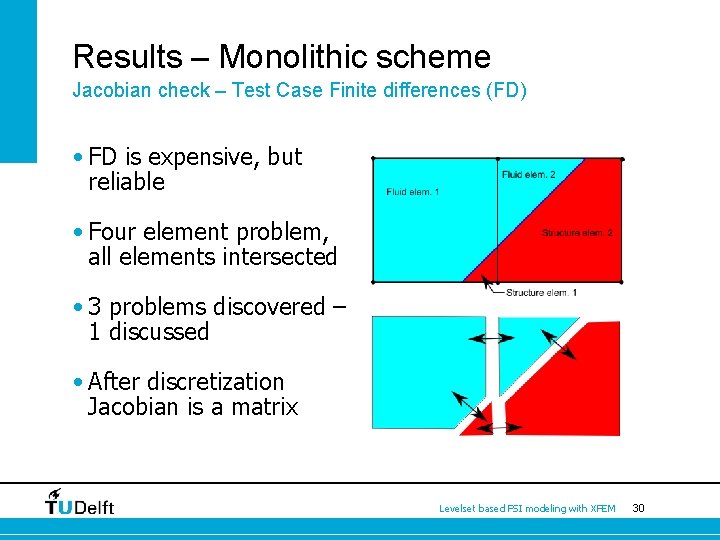
Results – Monolithic scheme Jacobian check – Test Case Finite differences (FD) • FD is expensive, but reliable • Four element problem, all elements intersected • 3 problems discovered – 1 discussed • After discretization Jacobian is a matrix Levelset based FSI modeling with XFEM 30
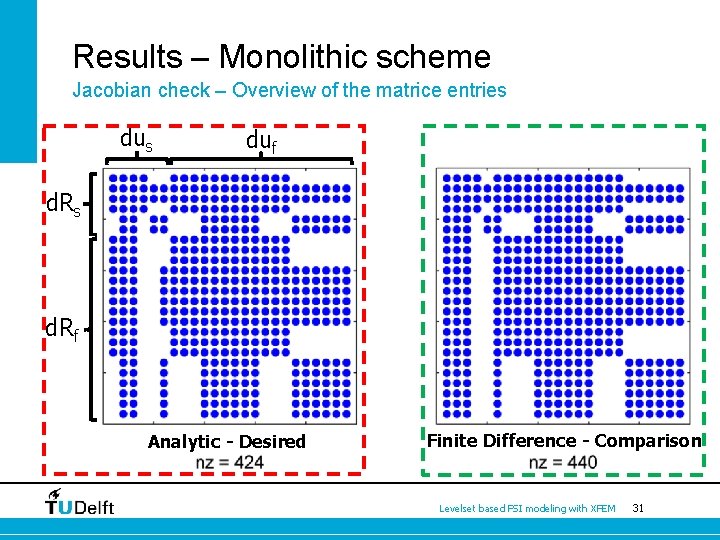
Results – Monolithic scheme Jacobian check – Overview of the matrice entries duf d. Rs d. Rf Analytic - Desired Finite Difference - Comparison Levelset based FSI modeling with XFEM 31
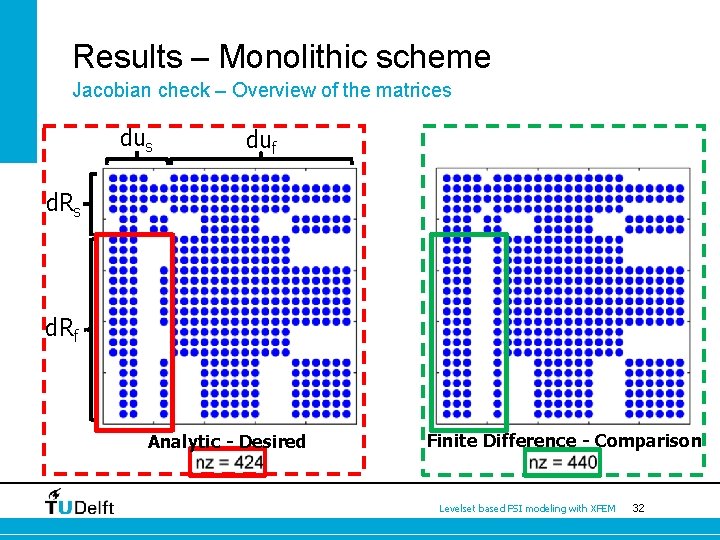
Results – Monolithic scheme Jacobian check – Overview of the matrices duf d. Rs d. Rf Analytic - Desired Finite Difference - Comparison Levelset based FSI modeling with XFEM 32
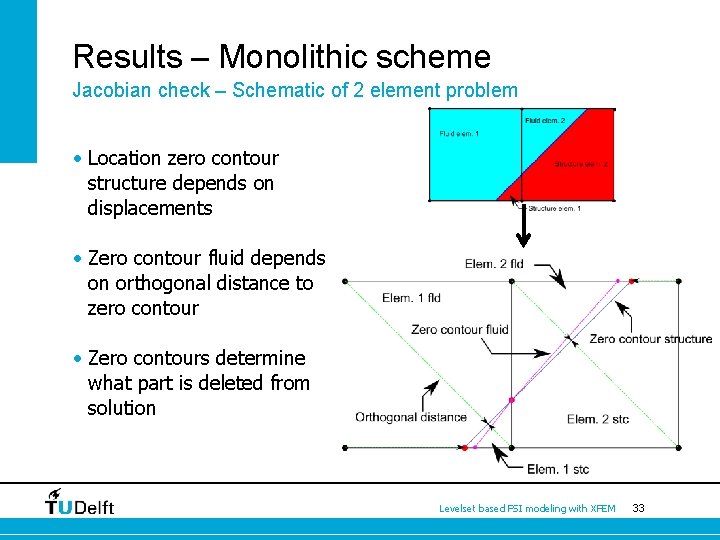
Results – Monolithic scheme Jacobian check – Schematic of 2 element problem • Location zero contour structure depends on displacements • Zero contour fluid depends on orthogonal distance to zero contour • Zero contours determine what part is deleted from solution Levelset based FSI modeling with XFEM 33
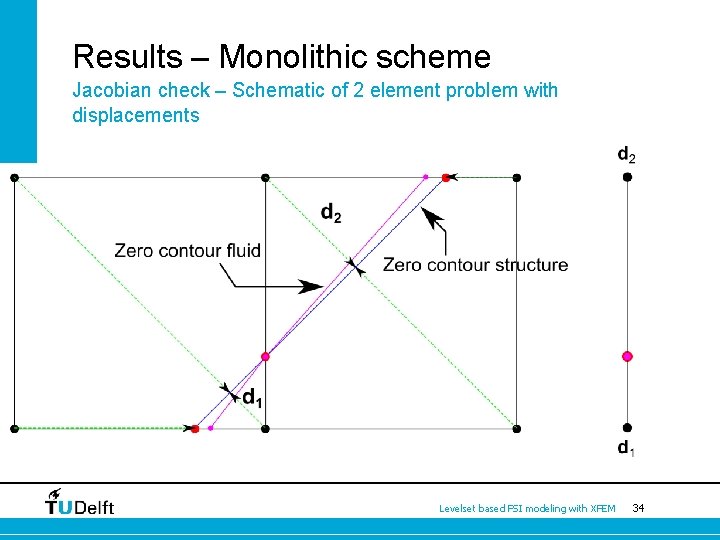
Results – Monolithic scheme Jacobian check – Schematic of 2 element problem with displacements Levelset based FSI modeling with XFEM 34
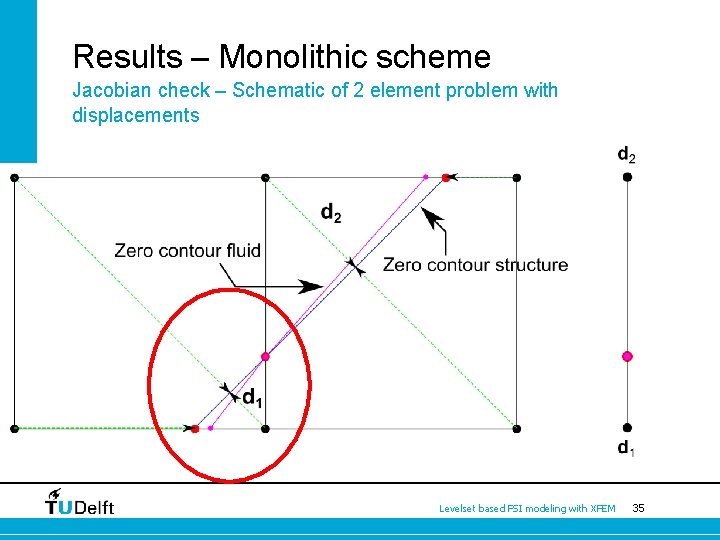
Results – Monolithic scheme Jacobian check – Schematic of 2 element problem with displacements Levelset based FSI modeling with XFEM 35
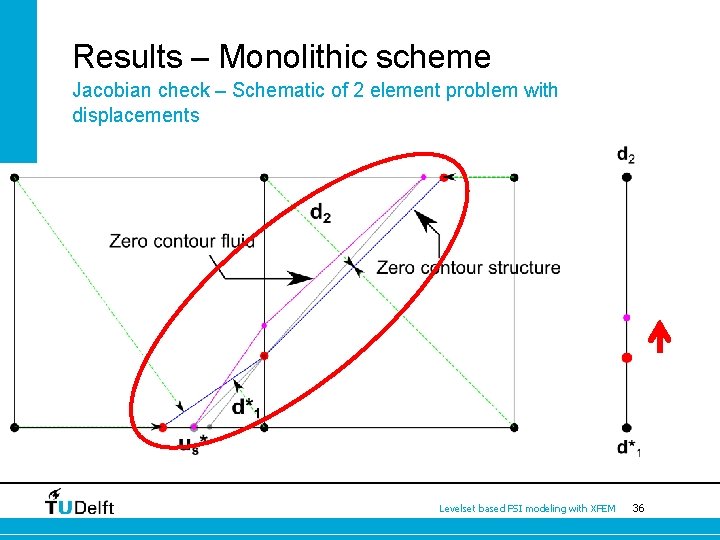
Results – Monolithic scheme Jacobian check – Schematic of 2 element problem with displacements Levelset based FSI modeling with XFEM 36
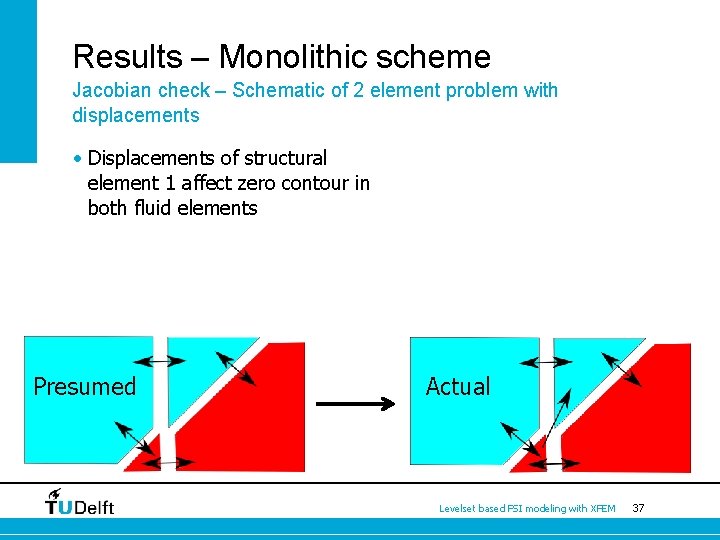
Results – Monolithic scheme Jacobian check – Schematic of 2 element problem with displacements • Displacements of structural element 1 affect zero contour in both fluid elements Presumed Actual Levelset based FSI modeling with XFEM 37
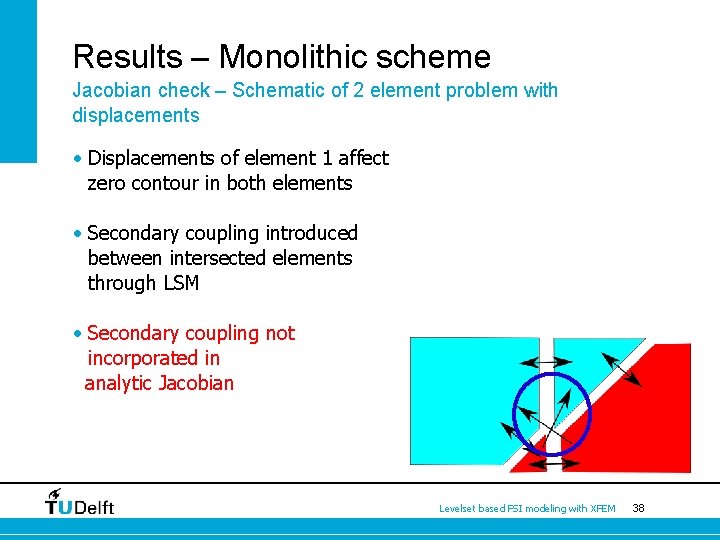
Results – Monolithic scheme Jacobian check – Schematic of 2 element problem with displacements • Displacements of element 1 affect zero contour in both elements • Secondary coupling introduced between intersected elements through LSM • Secondary coupling not incorporated in analytic Jacobian Levelset based FSI modeling with XFEM 38
Goal: Develop an efficient solver scheme that finds the steady state solution of the FSI problem (simultaneously for fluid and structure), such that it can be used in an optimization framework 1. Does the approximated solution describe the physics of the system? Yes, based on qualitative check! 2. How can we efficiently solve the system? Monolithically, but analytic Jacobian is not numerically consistent 3. What makes this approach suitable for optimization? Levelset based FSI modeling with XFEM 39
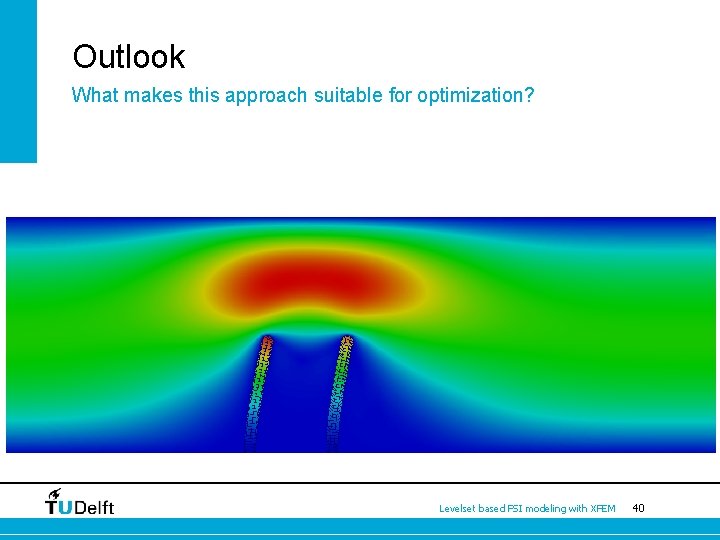
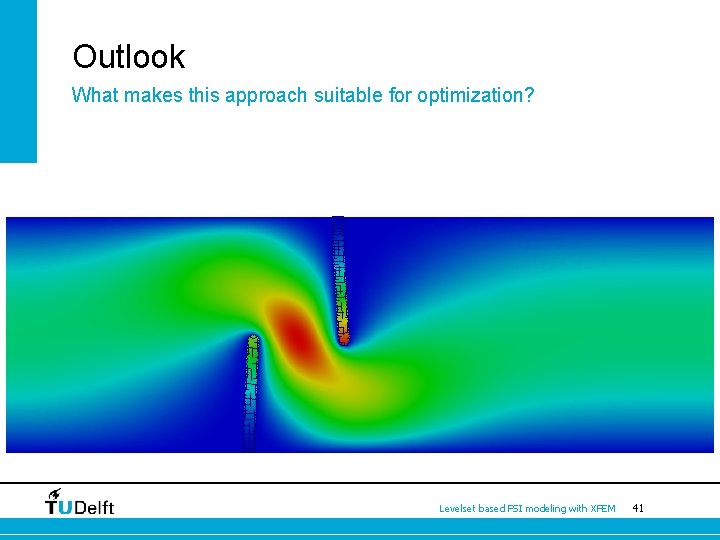
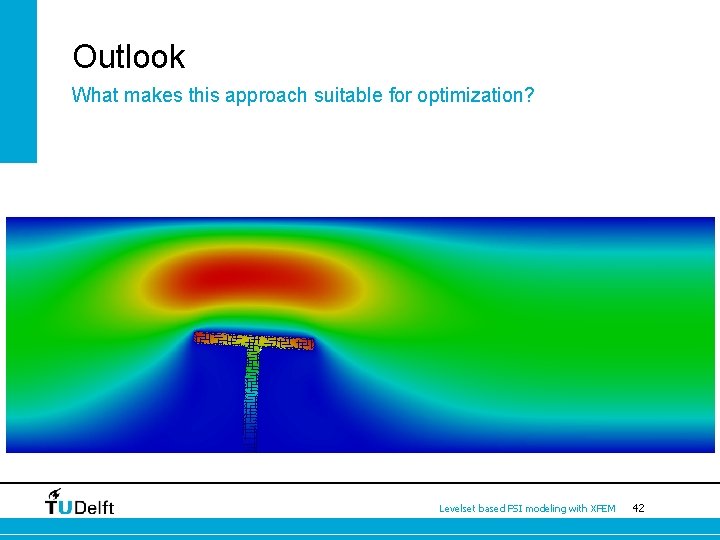
Outlook What makes this approach suitable for optimization? Levelset based FSI modeling with XFEM 40
Outlook What makes this approach suitable for optimization? Levelset based FSI modeling with XFEM 41
Outlook What makes this approach suitable for optimization? Levelset based FSI modeling with XFEM 42
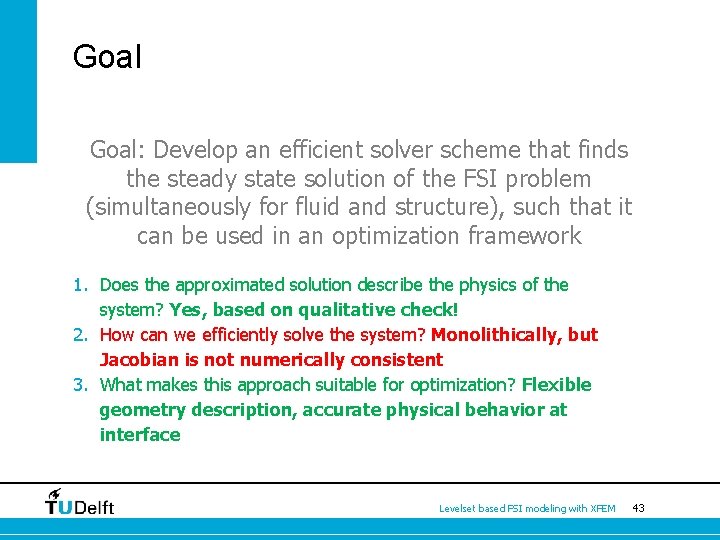
Goal: Develop an efficient solver scheme that finds the steady state solution of the FSI problem (simultaneously for fluid and structure), such that it can be used in an optimization framework 1. Does the approximated solution describe the physics of the system? Yes, based on qualitative check! 2. How can we efficiently solve the system? Monolithically, but Jacobian is not numerically consistent 3. What makes this approach suitable for optimization? Flexible geometry description, accurate physical behavior at interface Levelset based FSI modeling with XFEM 43
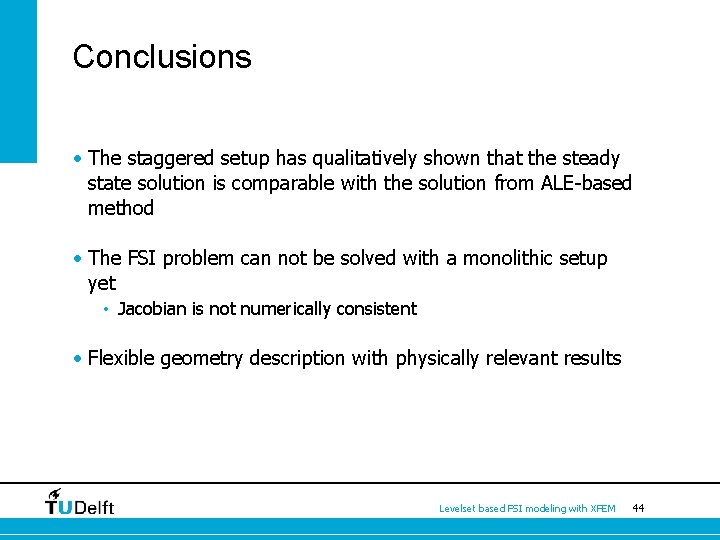
Conclusions • The staggered setup has qualitatively shown that the steady state solution is comparable with the solution from ALE-based method • The FSI problem can not be solved with a monolithic setup yet • Jacobian is not numerically consistent • Flexible geometry description with physically relevant results Levelset based FSI modeling with XFEM 44
Recommendations • More elaborate and quantitative validation of the results should performed • The analytic Jacobian needs to be improved • Secondary coupling • Two other issues • Topology Optimization Levelset based FSI modeling with XFEM 45

‘The primary product of science is failure, but failure teaches us where not to go in the future’ – Vincent Icke, physics professor University of Leiden in DWDD 27/11/2013* Thanks for the attention! * Loosely translated by Thijs Bosma Levelset based FSI modeling with XFEM 46
References • James, K. A. and Martins, J. R. (2012). An isoparametric approach to level set topology optimization using a body fitted finite element mesh. Computers & Structures, 90 -91: 97 -106 Levelset based FSI modeling with XFEM 47
Backup slides Levelset based FSI modeling with XFEM 48
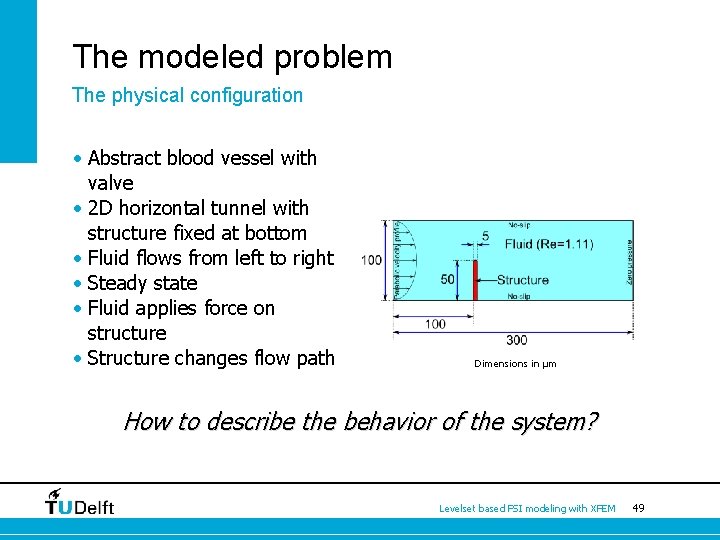
The modeled problem The physical configuration • Abstract blood vessel with valve • 2 D horizontal tunnel with structure fixed at bottom • Fluid flows from left to right • Steady state • Fluid applies force on structure • Structure changes flow path Dimensions in μm How to describe the behavior of the system? Levelset based FSI modeling with XFEM 49
Discontinuous shape functions Levelset based FSI modeling with XFEM 50
Results – Staggered scheme The process Levelset based FSI modeling with XFEM 51
Results – Staggered scheme The process Levelset based FSI modeling with XFEM 52
Results – Staggered scheme Residual development Levelset based FSI modeling with XFEM 53
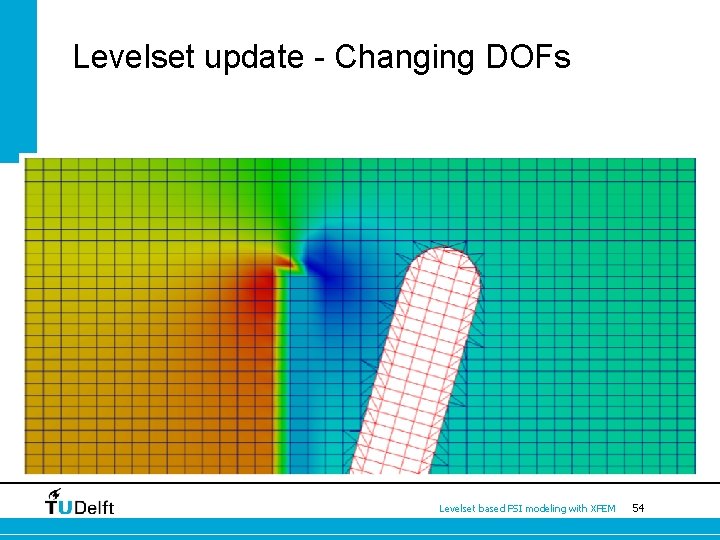
Levelset update - Changing DOFs Levelset based FSI modeling with XFEM 54
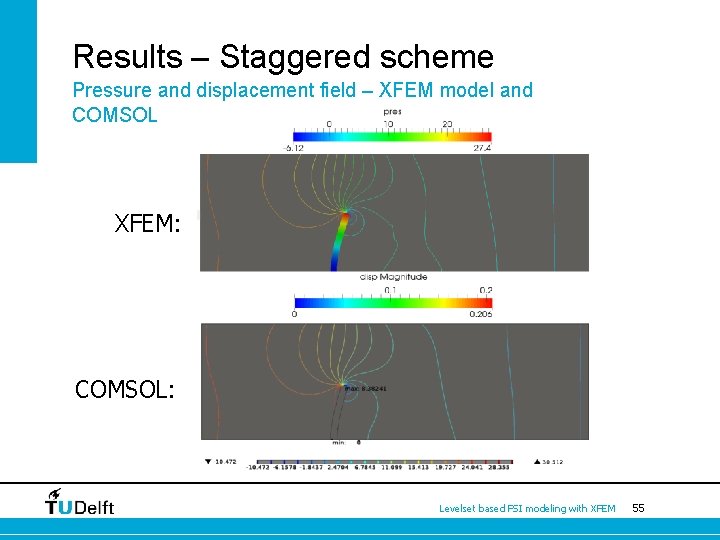
Results – Staggered scheme Pressure and displacement field – XFEM model and COMSOL XFEM: COMSOL: Levelset based FSI modeling with XFEM 55
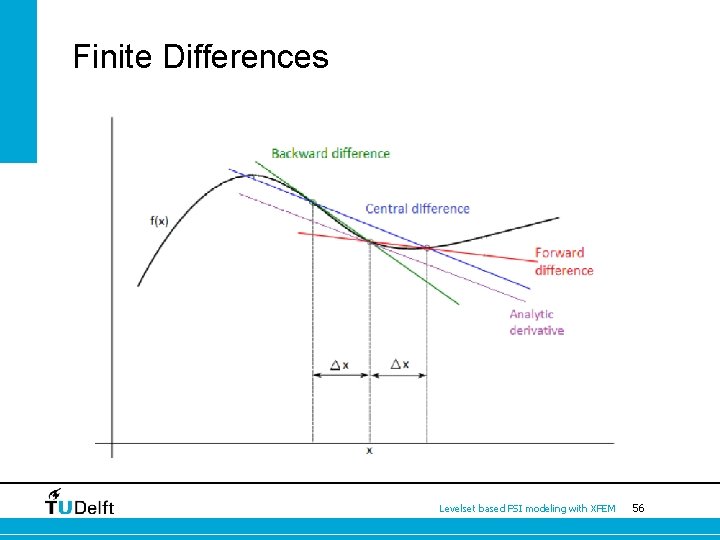
Finite Differences Levelset based FSI modeling with XFEM 56
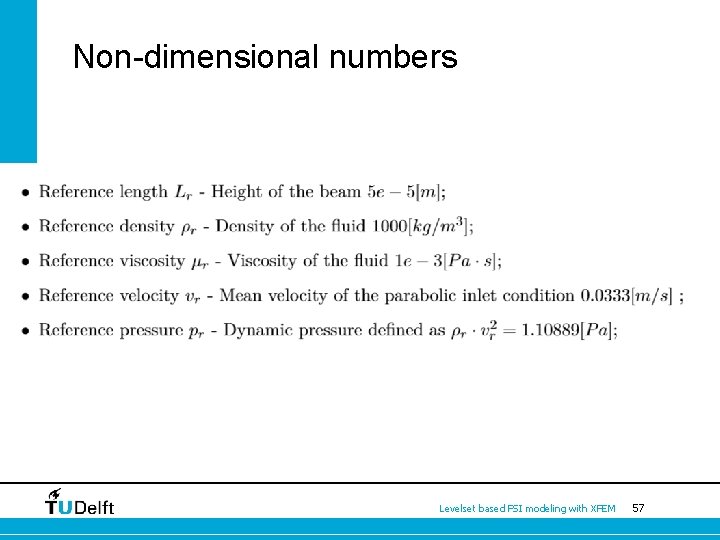
Non-dimensional numbers Levelset based FSI modeling with XFEM 57
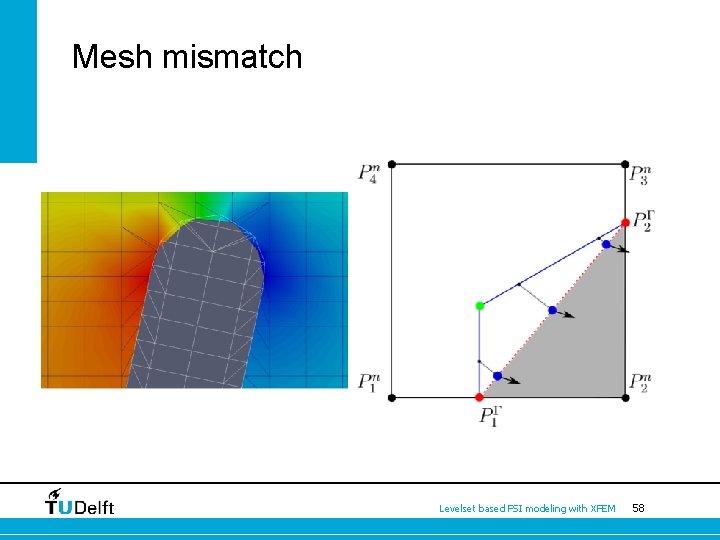
Mesh mismatch Levelset based FSI modeling with XFEM 58
Residual equations Levelset based FSI modeling with XFEM 59
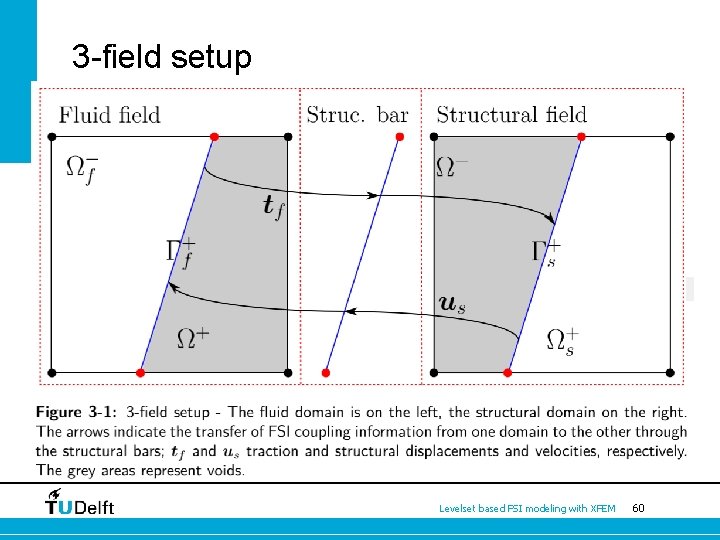
3 -field setup Levelset based FSI modeling with XFEM 60
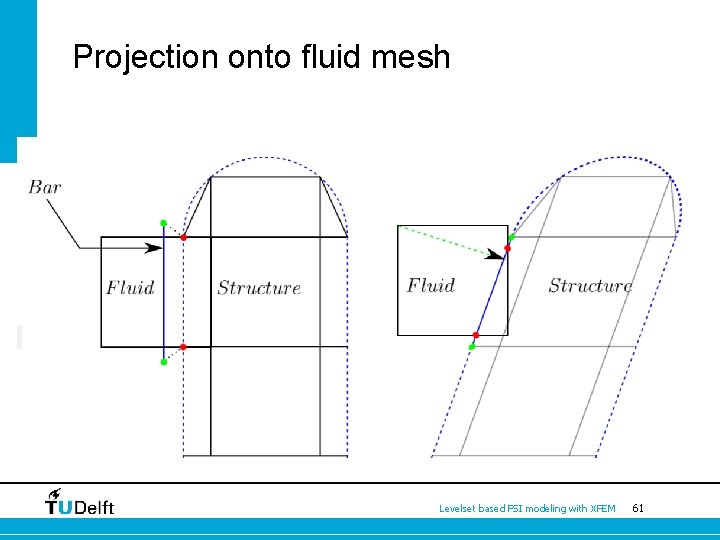
Projection onto fluid mesh Levelset based FSI modeling with XFEM 61
- Slides: 61