
Levels of Verification A 13 Testing 1 The
- Slides: 19
Levels of Verification A 13. Testing 1 The Unreachable Goal: Correctness Computer Science Dept Va Tech Aug. , 2001 Intro Data Structures & SE © 1995 -2001 Barnette ND, Mc. Quain WD
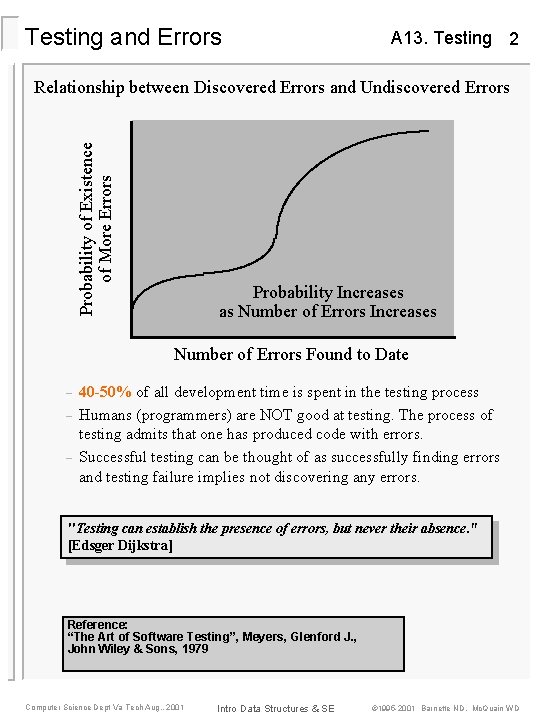
Testing and Errors A 13. Testing 2 Probability of Existence of More Errors Relationship between Discovered Errors and Undiscovered Errors Probability Increases as Number of Errors Increases Number of Errors Found to Date – – – 40 -50% of all development time is spent in the testing process Humans (programmers) are NOT good at testing. The process of testing admits that one has produced code with errors. Successful testing can be thought of as successfully finding errors and testing failure implies not discovering any errors. "Testing can establish the presence of errors, but never their absence. " [Edsger Dijkstra] Reference: “The Art of Software Testing”, Meyers, Glenford J. , John Wiley & Sons, 1979 Computer Science Dept Va Tech Aug. , 2001 Intro Data Structures & SE © 1995 -2001 Barnette ND, Mc. Quain WD
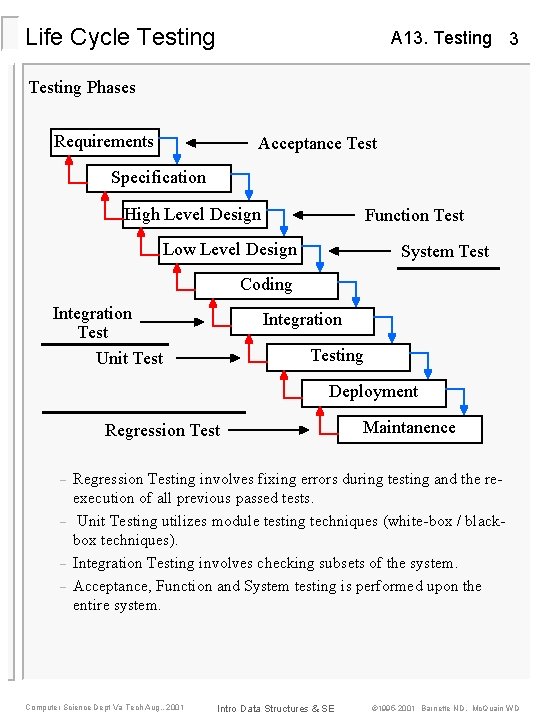
Life Cycle Testing A 13. Testing 3 Testing Phases Requirements Acceptance Test Specification High Level Design Function Test Low Level Design System Test Coding Integration Test Unit Test Integration Testing Deployment Regression Test – – Maintanence Regression Testing involves fixing errors during testing and the reexecution of all previous passed tests. Unit Testing utilizes module testing techniques (white-box / blackbox techniques). Integration Testing involves checking subsets of the system. Acceptance, Function and System testing is performed upon the entire system. Computer Science Dept Va Tech Aug. , 2001 Intro Data Structures & SE © 1995 -2001 Barnette ND, Mc. Quain WD
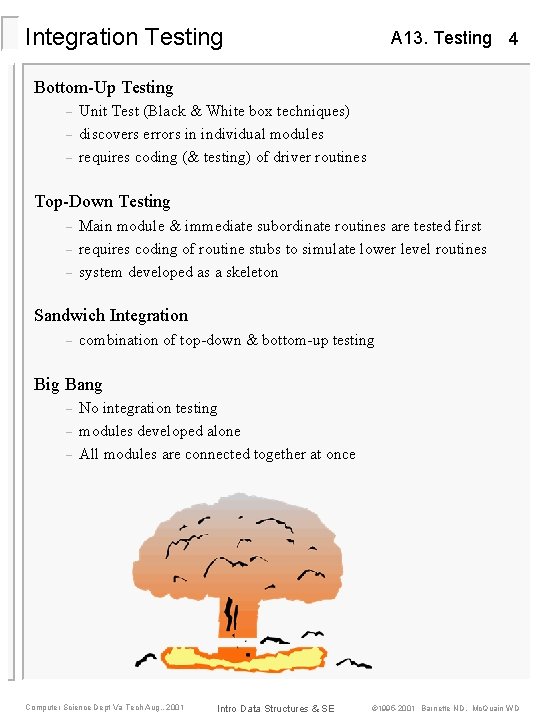
Integration Testing A 13. Testing 4 Bottom-Up Testing – – – Unit Test (Black & White box techniques) discovers errors in individual modules requires coding (& testing) of driver routines Top-Down Testing – – – Main module & immediate subordinate routines are tested first requires coding of routine stubs to simulate lower level routines system developed as a skeleton Sandwich Integration – combination of top-down & bottom-up testing Big Bang – – – No integration testing modules developed alone All modules are connected together at once Computer Science Dept Va Tech Aug. , 2001 Intro Data Structures & SE © 1995 -2001 Barnette ND, Mc. Quain WD
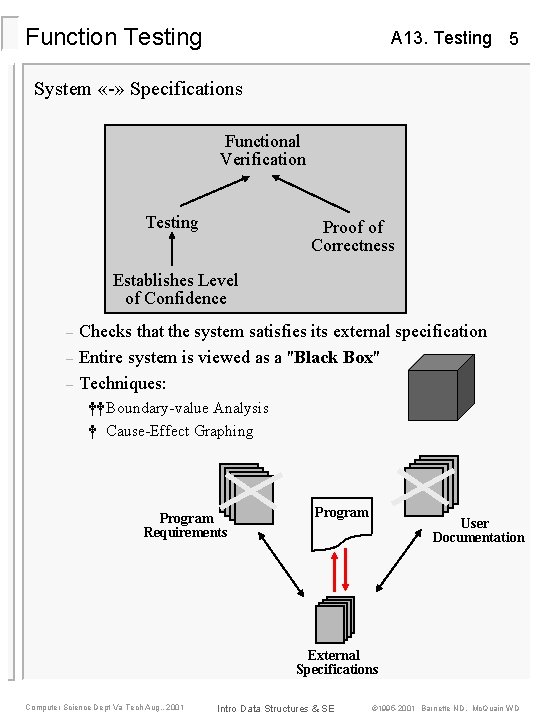
Function Testing A 13. Testing 5 System «-» Specifications Functional Verification Testing Proof of Correctness Establishes Level of Confidence – – – Checks that the system satisfies its external specification Entire system is viewed as a "Black Box" Techniques: †† Boundary-value Analysis † Cause-Effect Graphing Program Requirements Program User Documentation External Specifications Computer Science Dept Va Tech Aug. , 2001 Intro Data Structures & SE © 1995 -2001 Barnette ND, Mc. Quain WD
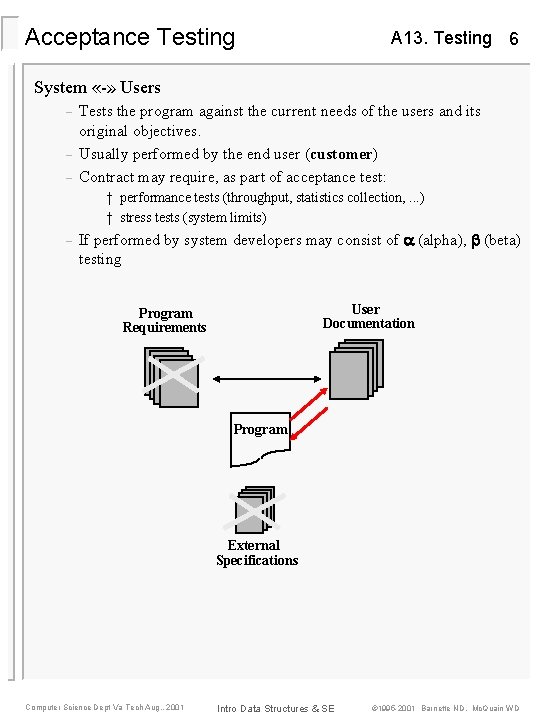
Acceptance Testing A 13. Testing 6 System «-» Users – – – Tests the program against the current needs of the users and its original objectives. Usually performed by the end user (customer) Contract may require, as part of acceptance test: † performance tests (throughput, statistics collection, . . . ) † stress tests (system limits) – If performed by system developers may consist of (alpha), (beta) testing User Documentation Program Requirements Program External Specifications Computer Science Dept Va Tech Aug. , 2001 Intro Data Structures & SE © 1995 -2001 Barnette ND, Mc. Quain WD
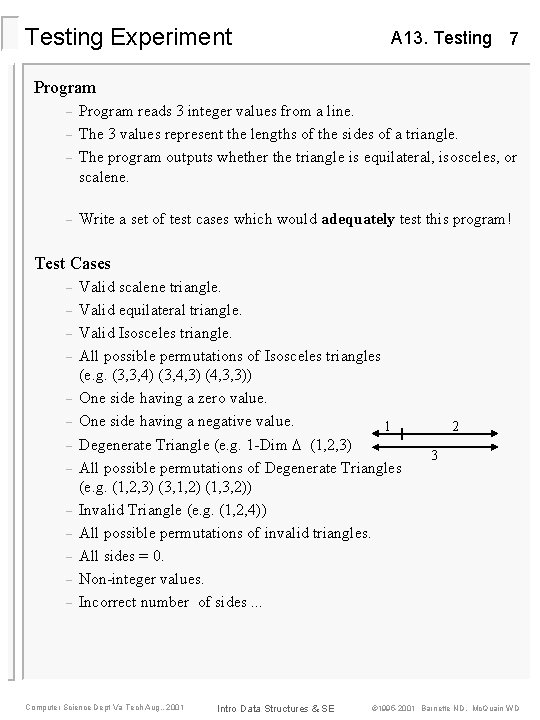
Testing Experiment A 13. Testing 7 Program – – Program reads 3 integer values from a line. The 3 values represent the lengths of the sides of a triangle. The program outputs whether the triangle is equilateral, isosceles, or scalene. Write a set of test cases which would adequately test this program! Test Cases – – – – Valid scalene triangle. Valid equilateral triangle. Valid Isosceles triangle. All possible permutations of Isosceles triangles (e. g. (3, 3, 4) (3, 4, 3) (4, 3, 3)) One side having a zero value. One side having a negative value. 1 Degenerate Triangle (e. g. 1 -Dim (1, 2, 3) All possible permutations of Degenerate Triangles (e. g. (1, 2, 3) (3, 1, 2) (1, 3, 2)) Invalid Triangle (e. g. (1, 2, 4)) All possible permutations of invalid triangles. All sides = 0. Non-integer values. Incorrect number of sides. . . Computer Science Dept Va Tech Aug. , 2001 Intro Data Structures & SE 2 3 © 1995 -2001 Barnette ND, Mc. Quain WD
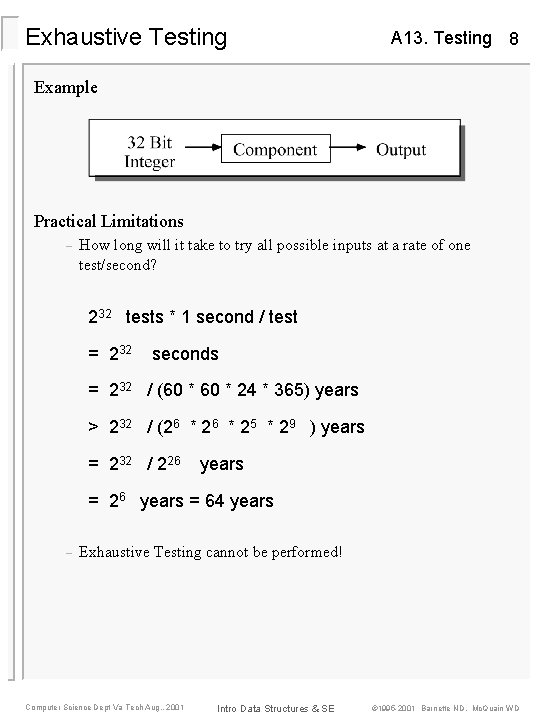
Exhaustive Testing A 13. Testing 8 Example Practical Limitations – How long will it take to try all possible inputs at a rate of one test/second? 232 tests * 1 second / test = 232 seconds = 232 / (60 * 24 * 365) years > 232 / (26 * 25 * 29 ) years = 232 / 226 years = 64 years – Exhaustive Testing cannot be performed! Computer Science Dept Va Tech Aug. , 2001 Intro Data Structures & SE © 1995 -2001 Barnette ND, Mc. Quain WD
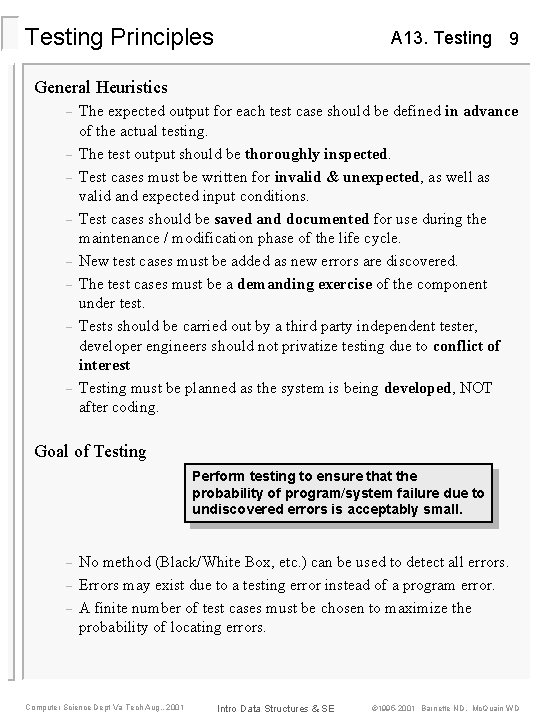
Testing Principles A 13. Testing 9 General Heuristics – – – – The expected output for each test case should be defined in advance of the actual testing. The test output should be thoroughly inspected. Test cases must be written for invalid & unexpected, as well as valid and expected input conditions. Test cases should be saved and documented for use during the maintenance / modification phase of the life cycle. New test cases must be added as new errors are discovered. The test cases must be a demanding exercise of the component under test. Tests should be carried out by a third party independent tester, developer engineers should not privatize testing due to conflict of interest Testing must be planned as the system is being developed, NOT after coding. Goal of Testing Perform testing to ensure that the probability of program/system failure due to undiscovered errors is acceptably small. – – – No method (Black/White Box, etc. ) can be used to detect all errors. Errors may exist due to a testing error instead of a program error. A finite number of test cases must be chosen to maximize the probability of locating errors. Computer Science Dept Va Tech Aug. , 2001 Intro Data Structures & SE © 1995 -2001 Barnette ND, Mc. Quain WD
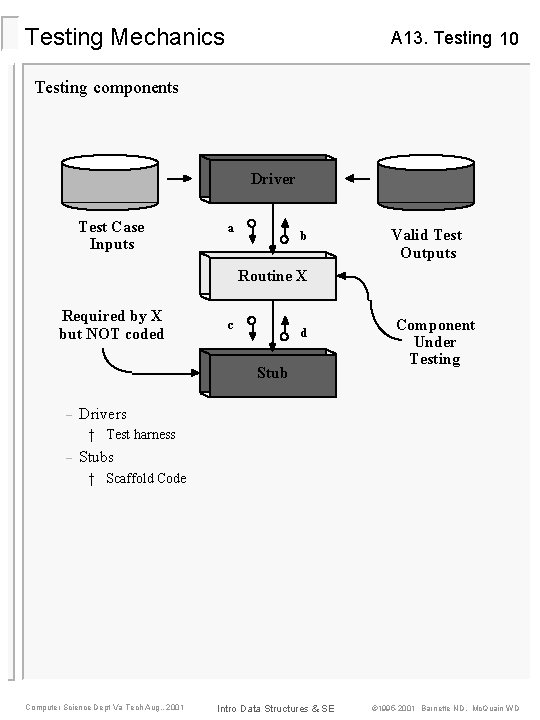
Testing Mechanics A 13. Testing 10 Testing components Driver Test Case Inputs a b Valid Test Outputs Routine X Required by X but NOT coded c d Stub – Component Under Testing Drivers † Test harness – Stubs † Scaffold Code Computer Science Dept Va Tech Aug. , 2001 Intro Data Structures & SE © 1995 -2001 Barnette ND, Mc. Quain WD
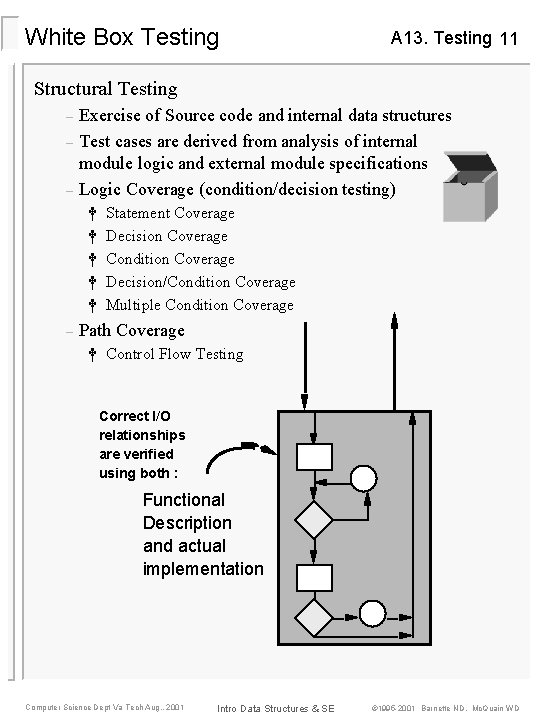
White Box Testing A 13. Testing 11 Structural Testing – – – Exercise of Source code and internal data structures Test cases are derived from analysis of internal module logic and external module specifications Logic Coverage (condition/decision testing) † † † – Statement Coverage Decision Coverage Condition Coverage Decision/Condition Coverage Multiple Condition Coverage Path Coverage † Control Flow Testing Correct I/O relationships are verified using both : Functional Description and actual implementation Computer Science Dept Va Tech Aug. , 2001 Intro Data Structures & SE © 1995 -2001 Barnette ND, Mc. Quain WD
White Box: Logic Testing A 13. Testing 12 Logic Coverage – Statement Coverage † Every statement is executed at least once. – Decision Coverage † Each decision is tested for TRUE & FALSE. † correctness of conditions within the decisions are NOT tested – Condition Coverage † Each condition in a decision takes on all possible outcomes at least once. † Does not necessarily test all decision outcomes. † Test cases do not take into account how the conditions affect the decisions. Eg: if (x >= 5 && y != 7 && z= =9) { ; at least 3 tests } – Decision/Condition Coverage † Satisfies both decision coverage and condition coverage. † Does NOT necessarily test all possible combinations of conditions in a decision. Multiple Condition Coverage † Test all possible combinations of conditions in a decision † Does not test all possible combinations of decision branches. Eg: if (x >= 5 && y != 7 && z= =9) { ; //2^3=8 tests! } Computer Science Dept Va Tech Aug. , 2001 Intro Data Structures & SE © 1995 -2001 Barnette ND, Mc. Quain WD
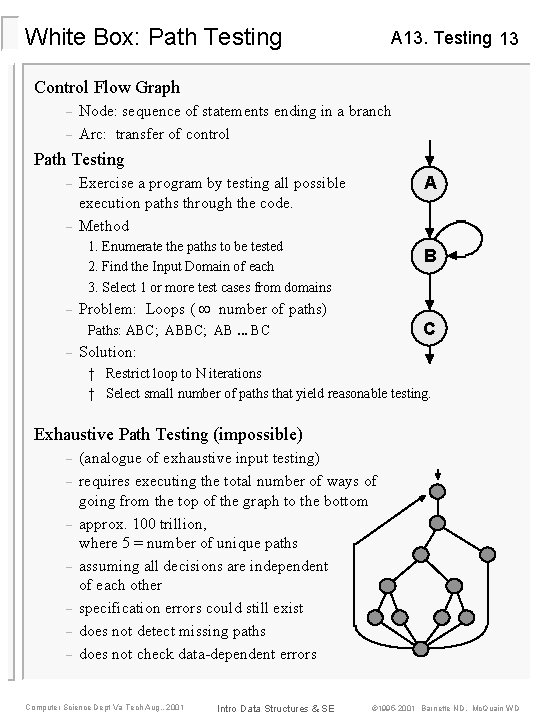
White Box: Path Testing A 13. Testing 13 Control Flow Graph – – Node: sequence of statements ending in a branch Arc: transfer of control Path Testing – – – Exercise a program by testing all possible execution paths through the code. Method A 1. Enumerate the paths to be tested 2. Find the Input Domain of each 3. Select 1 or more test cases from domains B Problem: Loops ( number of paths) C Paths: ABC; AB. . . BC – Solution: † Restrict loop to N iterations † Select small number of paths that yield reasonable testing. Exhaustive Path Testing (impossible) – – – – (analogue of exhaustive input testing) requires executing the total number of ways of going from the top of the graph to the bottom approx. 100 trillion, where 5 = number of unique paths assuming all decisions are independent of each other specification errors could still exist does not detect missing paths does not check data-dependent errors Computer Science Dept Va Tech Aug. , 2001 Intro Data Structures & SE © 1995 -2001 Barnette ND, Mc. Quain WD
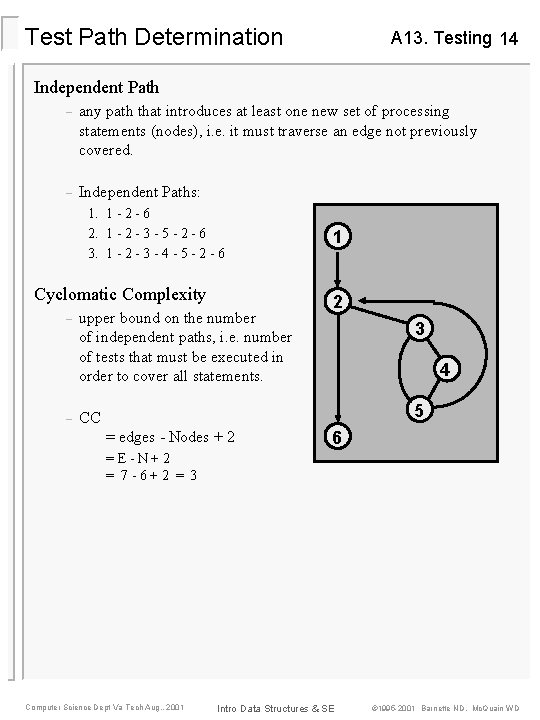
Test Path Determination A 13. Testing 14 Independent Path – any path that introduces at least one new set of processing statements (nodes), i. e. it must traverse an edge not previously covered. – Independent Paths: 1. 1 - 2 - 6 2. 1 - 2 - 3 - 5 - 2 - 6 3. 1 - 2 - 3 - 4 - 5 - 2 - 6 Cyclomatic Complexity – – upper bound on the number of independent paths, i. e. number of tests that must be executed in order to cover all statements. 1 2 3 4 5 CC = edges - Nodes + 2 6 =E-N+2 = 7 -6+2 = 3 Computer Science Dept Va Tech Aug. , 2001 Intro Data Structures & SE © 1995 -2001 Barnette ND, Mc. Quain WD
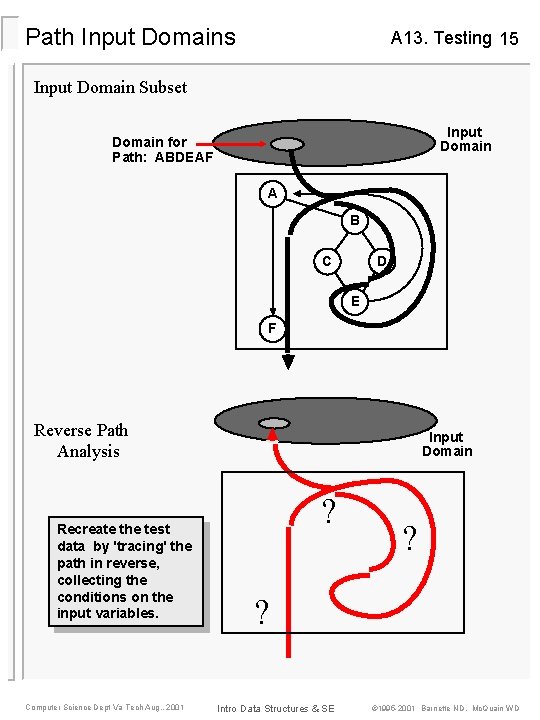
Path Input Domains A 13. Testing 15 Input Domain Subset Input Domain for Path: ABDEAF A B C D E F Reverse Path Analysis Recreate the test data by 'tracing' the path in reverse, collecting the conditions on the input variables. Computer Science Dept Va Tech Aug. , 2001 Input Domain ? ? ? Intro Data Structures & SE © 1995 -2001 Barnette ND, Mc. Quain WD
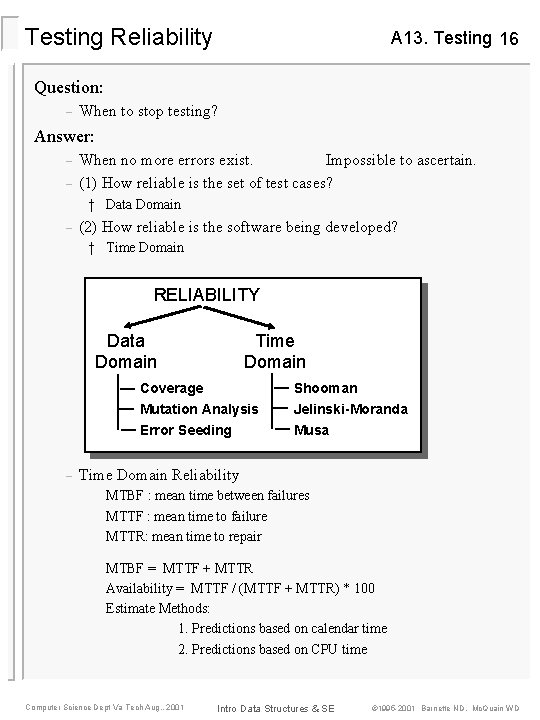
Testing Reliability A 13. Testing 16 Question: – When to stop testing? Answer: – – When no more errors exist. Impossible to ascertain. (1) How reliable is the set of test cases? † Data Domain – (2) How reliable is the software being developed? † Time Domain RELIABILITY Data Domain – Time Domain Coverage Shooman Mutation Analysis Error Seeding Jelinski-Moranda Musa Time Domain Reliability MTBF : mean time between failures MTTF : mean time to failure MTTR: mean time to repair MTBF = MTTF + MTTR Availability = MTTF / (MTTF + MTTR) * 100 Estimate Methods: 1. Predictions based on calendar time 2. Predictions based on CPU time Computer Science Dept Va Tech Aug. , 2001 Intro Data Structures & SE © 1995 -2001 Barnette ND, Mc. Quain WD
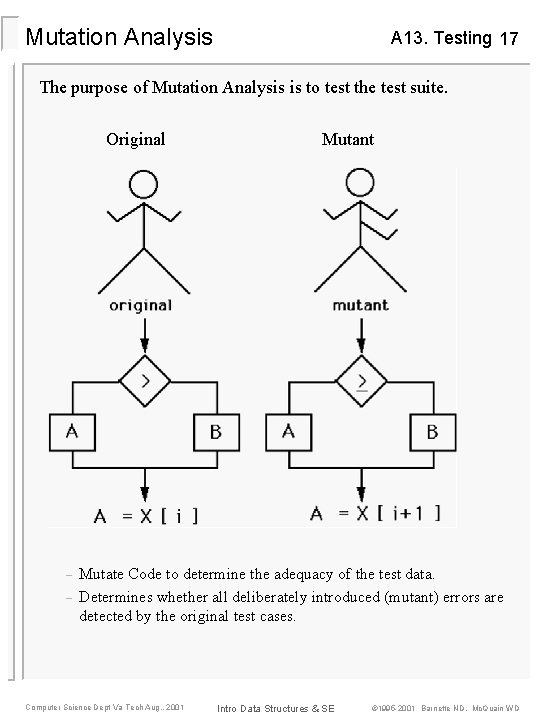
Mutation Analysis A 13. Testing 17 The purpose of Mutation Analysis is to test the test suite. Original – – Mutant Mutate Code to determine the adequacy of the test data. Determines whether all deliberately introduced (mutant) errors are detected by the original test cases. Computer Science Dept Va Tech Aug. , 2001 Intro Data Structures & SE © 1995 -2001 Barnette ND, Mc. Quain WD
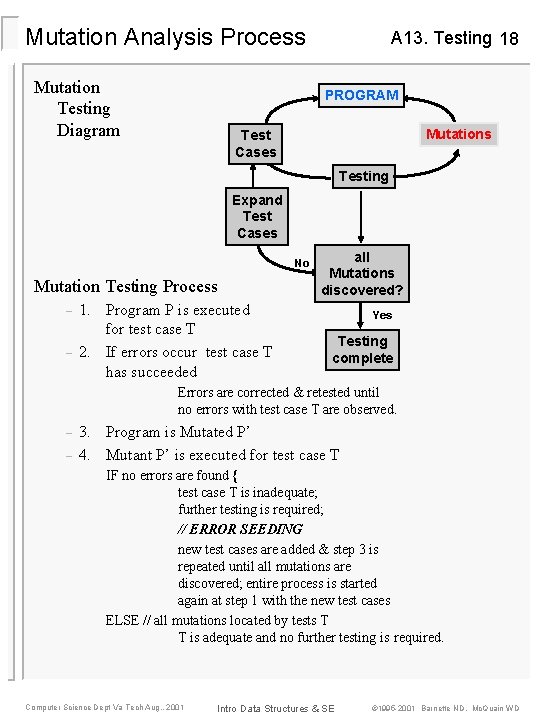
Mutation Analysis Process Mutation Testing Diagram A 13. Testing 18 PROGRAM Mutations Test Cases Testing Expand Test Cases No Mutation Testing Process – – 1. Program P is executed for test case T 2. If errors occur test case T has succeeded all Mutations discovered? Yes Testing complete Errors are corrected & retested until no errors with test case T are observed. – – 3. Program is Mutated P’ 4. Mutant P’ is executed for test case T IF no errors are found { test case T is inadequate; further testing is required; // ERROR SEEDING new test cases are added & step 3 is repeated until all mutations are discovered; entire process is started again at step 1 with the new test cases ELSE // all mutations located by tests T T is adequate and no further testing is required. Computer Science Dept Va Tech Aug. , 2001 Intro Data Structures & SE © 1995 -2001 Barnette ND, Mc. Quain WD
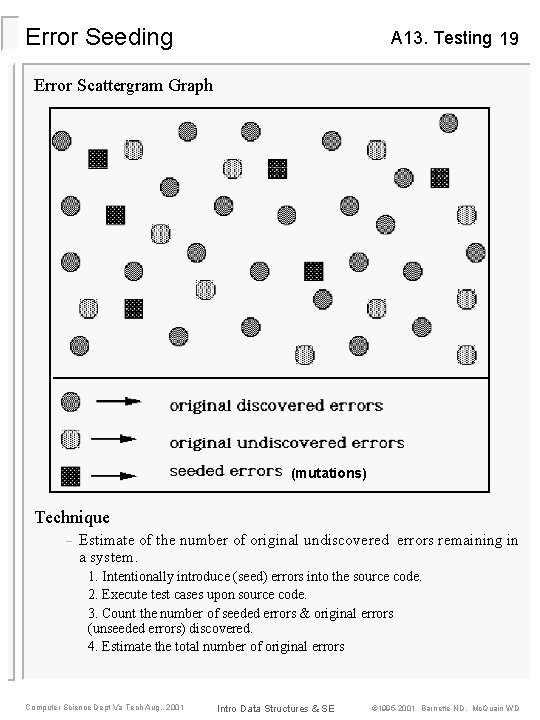
Error Seeding A 13. Testing 19 Error Scattergram Graph (mutations) Technique – Estimate of the number of original undiscovered errors remaining in a system. 1. Intentionally introduce (seed) errors into the source code. 2. Execute test cases upon source code. 3. Count the number of seeded errors & original errors (unseeded errors) discovered. 4. Estimate the total number of original errors Computer Science Dept Va Tech Aug. , 2001 Intro Data Structures & SE © 1995 -2001 Barnette ND, Mc. Quain WD