
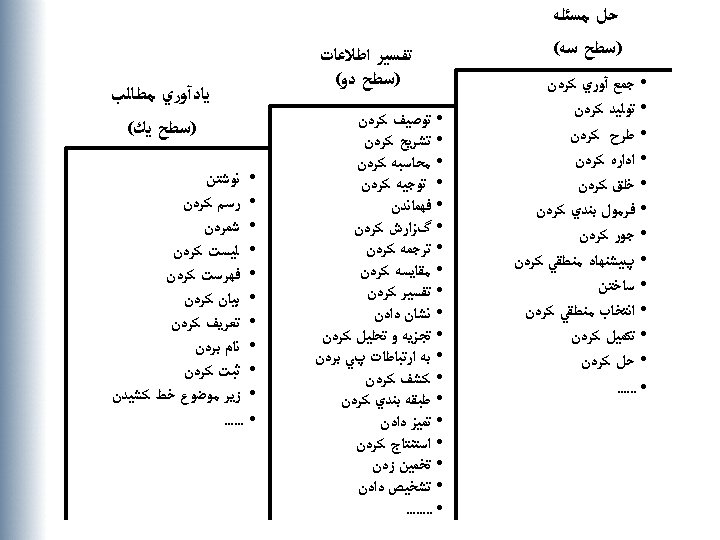
Levels of understanding label for LOU Nature of
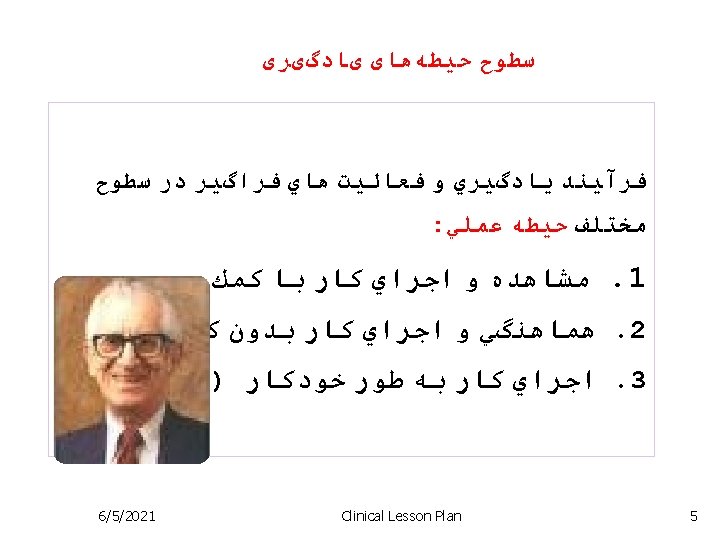
Levels of understanding label for LOU Nature of understanding in the level edc@goums. ac. ir ﺩکﺘﺮ ﻟیﻼ ﺟﻮیﺒﺎﺭی . ﻣﺮکﺰ ﻣﻄﺎﻟﻌﺎﺕ ﻭ ﺗﻮﺳﻌﻪ آﻤﻮﺯﺵ ﻋﻠﻮﻡ پﺰﺷکی
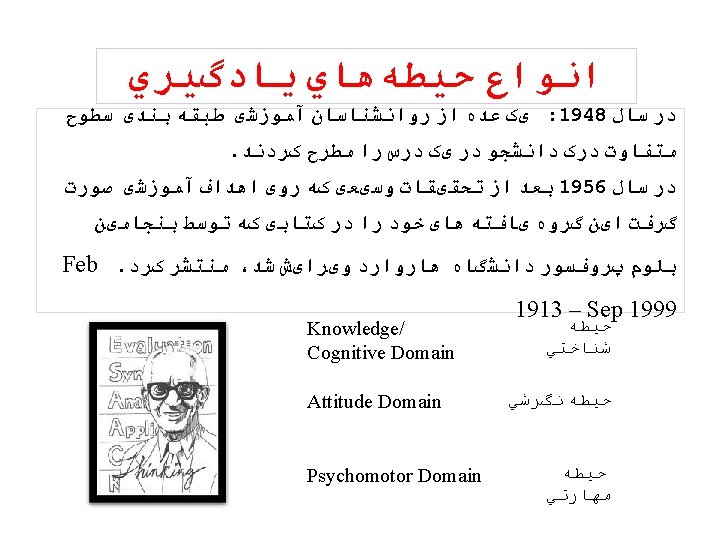
BLOOM’S TAXONOMY • In 1956, Benjamin Bloom headed a group of educational psychologists who developed a classification of levels of intellectual behavior important in learning. • This became a taxonomy including three overlapping domains; the cognitive, psychomotor, and affective.
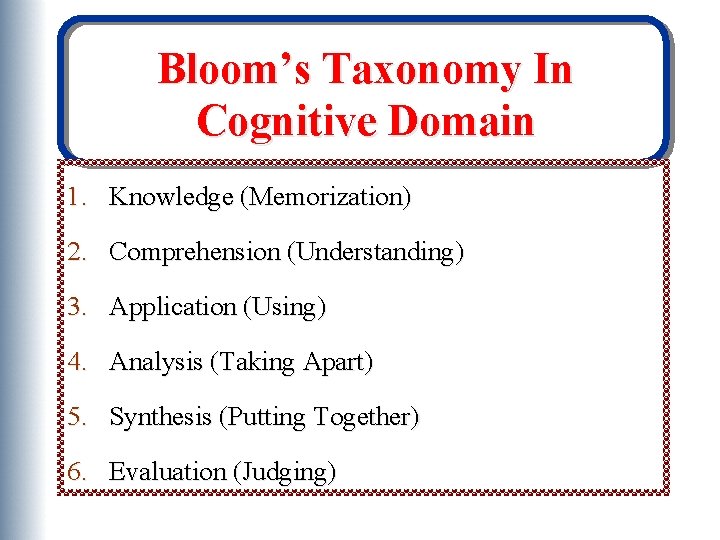
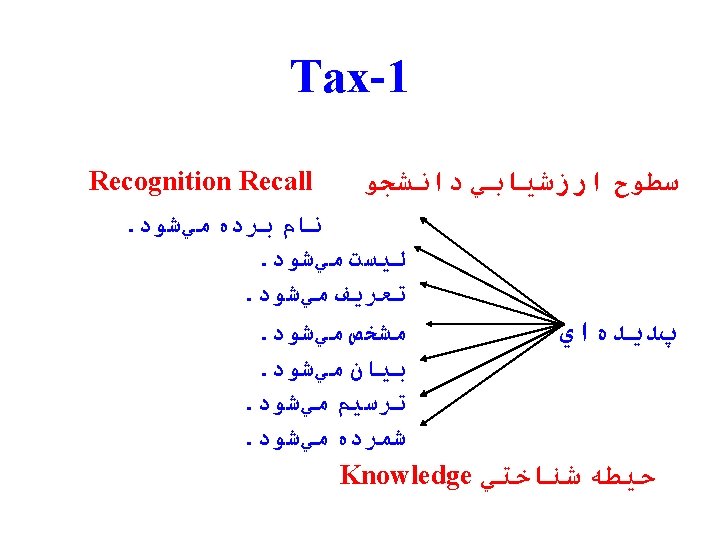
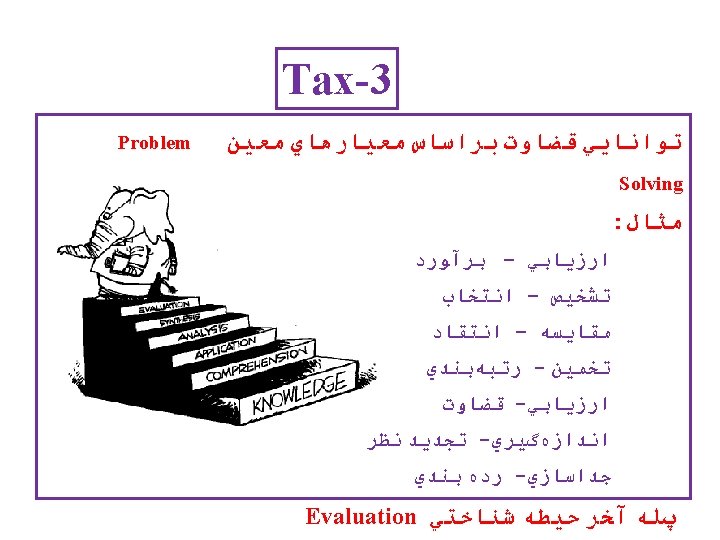
Bloom’s Taxonomy In Cognitive Domain 1. Knowledge (Memorization) 2. Comprehension (Understanding) 3. Application (Using) 4. Analysis (Taking Apart) 5. Synthesis (Putting Together) 6. Evaluation (Judging)

Knowledge (Memorization)
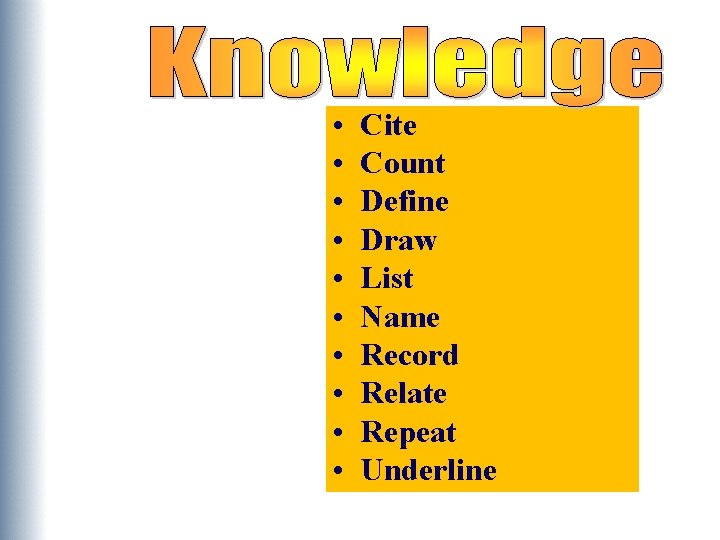
• • • Cite Count Define Draw List Name Record Relate Repeat Underline
Comprehension (Understanding)
§ § § Compute Describe Discuss Translate Express Identify Locate Report Restate Review tell Compute
Application (Using)
• • • Apply Calculate Dramatize Employ Examine Illustrate Operate Practice Sketch Solve Schedule Use
Analysis (Taking Apart)
• • • • Analyze Appraise Calculate Categorize Compare Construct Debate Diagram Differentiate Examine Inventory Question test
SYNTHESIS (PUTTING TOGETHER)
Synthesis (Putting Together) § Putting Many Parts Together To Make A New Whole § A Professional Activity Referred To As Design § An Open-ended Process With More Than A Single Correct Answer § Clinical Design Of A New Plan Or Process
• • • • Arrange Assemble Collect Compose Construct Create Design Formulate Integrate Manage Organize Plan Prescribe propose
EVALUATION (JUDGING)
Evaluation (Judging) § Making A Judgment About A Solution, Design, Report, Material § May Involve Internal Or External Criteria § Internal Criteria: Best Models, Logical, Free Of Errors § External Criteria: Environmental, Legal, Economic, Sociological § Selection Among Clinical Plans & Algorithm For Implementation
• • • Assess Choose Compare Criticize Estimate Judge Measure Rank Rate Revise Score select
BLOOM’S TAXONOMY “MISCONCEPTION” Do Not Say Taxonomy 1, 2 Or 3 Say Level 1, 2 Or 3
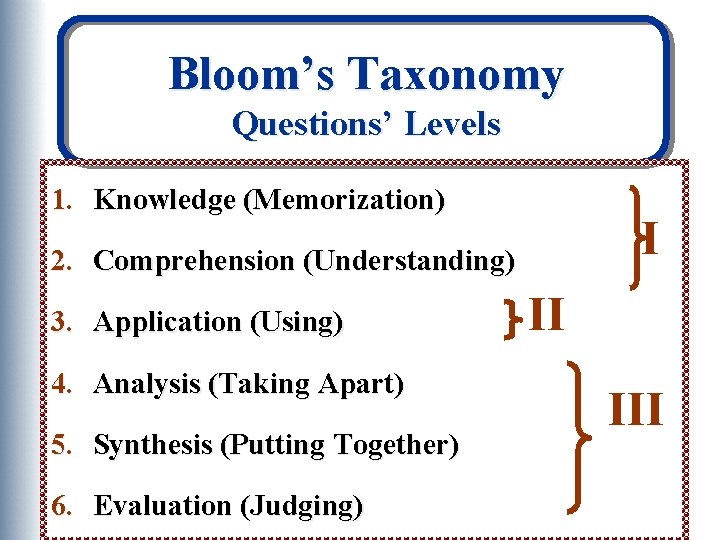
Bloom’s Taxonomy Questions’ Levels 1. Knowledge (Memorization) I 2. Comprehension (Understanding) 3. Application (Using) 4. Analysis (Taking Apart) 5. Synthesis (Putting Together) 6. Evaluation (Judging) II III
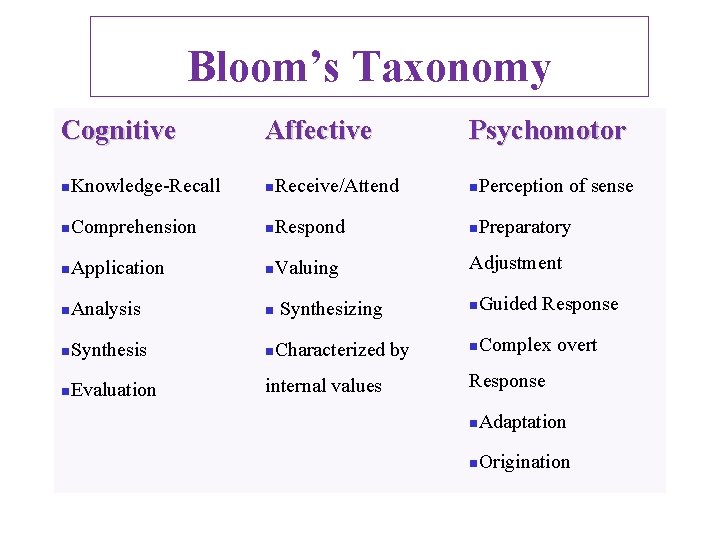
Bloom’s Taxonomy Cognitive Affective Psychomotor n Knowledge-Recall n Receive/Attend n Perception of sense n Comprehension n Respond n Preparatory n Application n Valuing Adjustment n Analysis n n Synthesis n n Evaluation internal values Synthesizing Characterized by n Guided Response n Complex overt Response n Adaptation n Origination
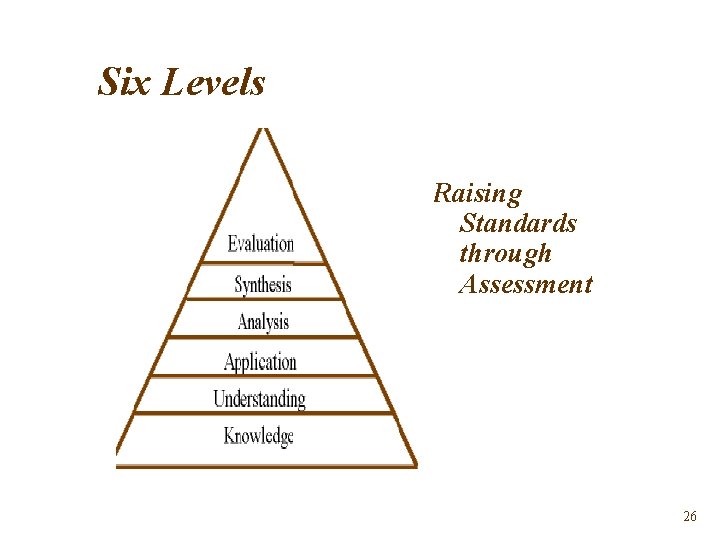
Six Levels Raising Standards through Assessment 26
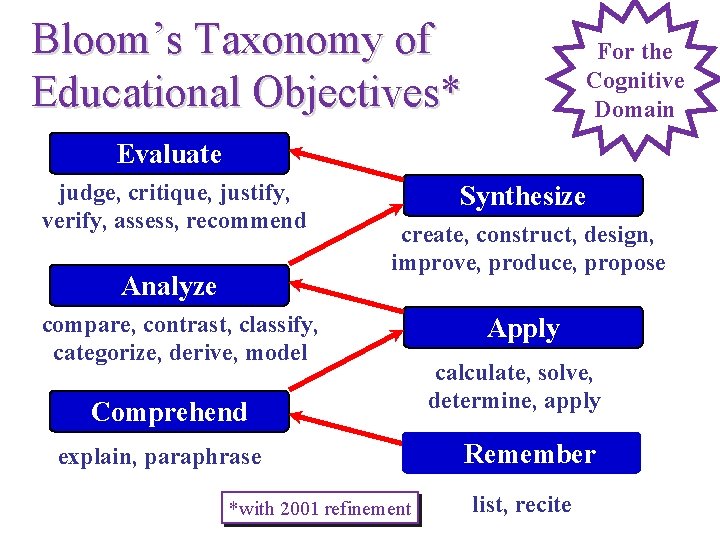
Bloom’s Taxonomy of Educational Objectives* For the Cognitive Domain Evaluate judge, critique, justify, verify, assess, recommend Analyze Synthesize create, construct, design, improve, produce, propose compare, contrast, classify, categorize, derive, model Comprehend explain, paraphrase *with 2001 refinement Apply calculate, solve, determine, apply Remember list, recite
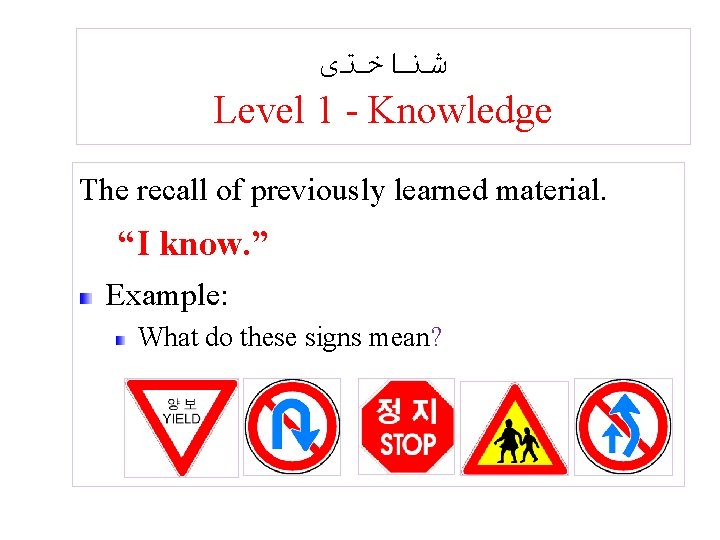
ﺷﻨﺎﺧﺘی Level 1 - Knowledge The recall of previously learned material. “I know. ” Example: What do these signs mean?
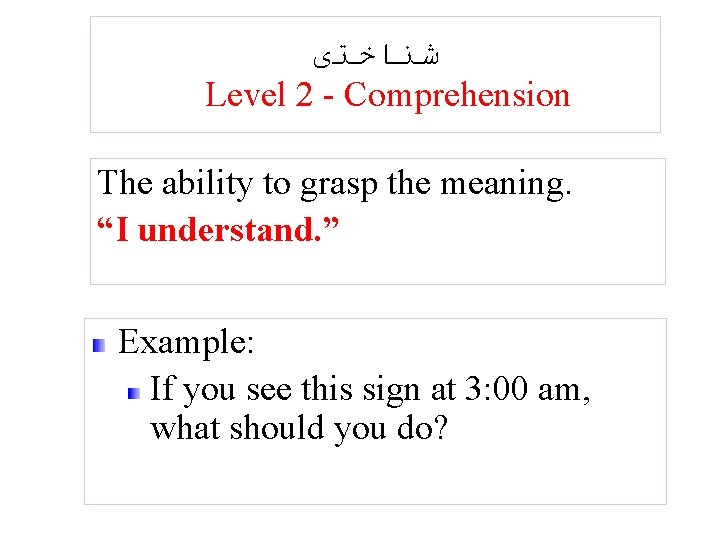
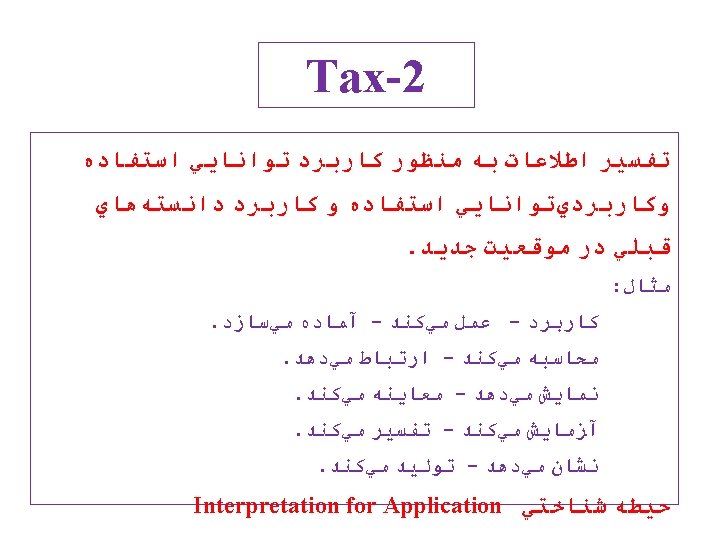
ﺷﻨﺎﺧﺘی Level 2 - Comprehension The ability to grasp the meaning. “I understand. ” Example: If you see this sign at 3: 00 am, what should you do?
ﺷﻨﺎﺧﺘی Level 3 - Application Applying knowledge to a new situation. Example: Can you stop at this sign?
ﺷﻨﺎﺧﺘی Level 4 - Analysis Breaking things down into component parts. “I can see relationships. ” Example: You are a policeman and attend the scene of an accident. What facts should you gather?
ﺷﻨﺎﺧﺘی Level 5 - Synthesis The ability to formulate a new idea. “I can create. ” Example: As a policeman you have gathered facts from the scene of an accident and you must now prepare a report that may be used in court.
ﺷﻨﺎﺧﺘی Level 6 - Evaluation Ability to assess the value of something. “I can judge. ” Example: You are the judge in a case to determine who is responsible for the accident.
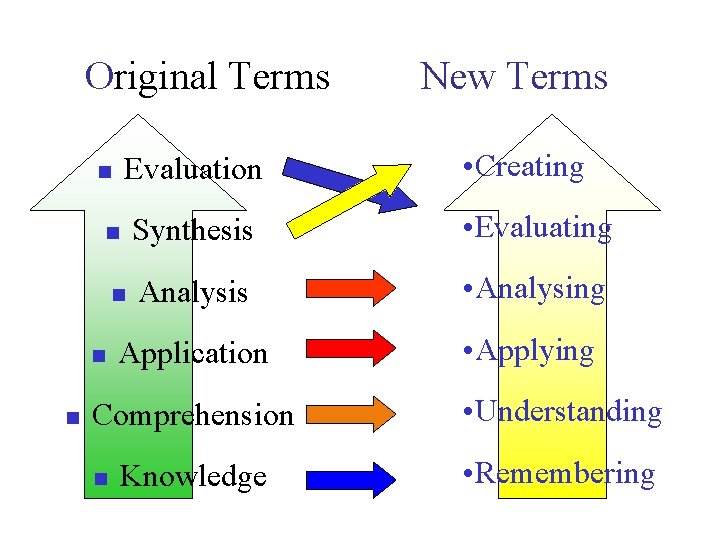
Original Terms Evaluation • Creating n Synthesis • Evaluating n Analysis • Analysing Application • Applying n n n New Terms Comprehension • Understanding Knowledge • Remembering n
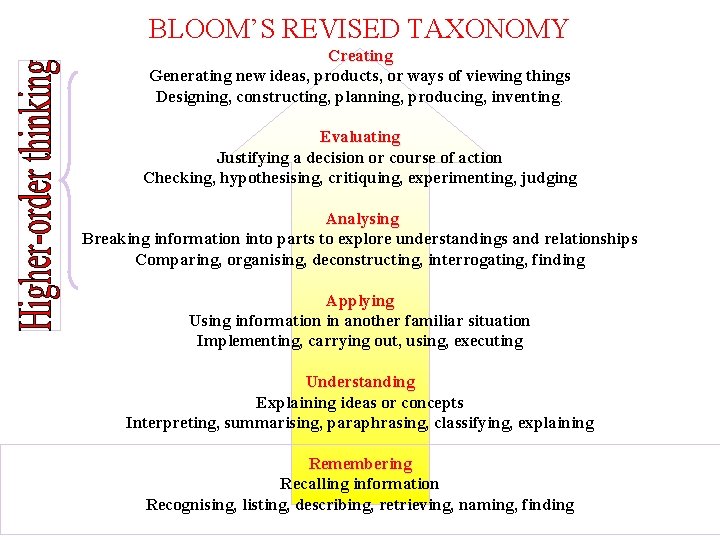
BLOOM’S REVISED TAXONOMY Creating Generating new ideas, products, or ways of viewing things Designing, constructing, planning, producing, inventing. Evaluating Justifying a decision or course of action Checking, hypothesising, critiquing, experimenting, judging Analysing Breaking information into parts to explore understandings and relationships Comparing, organising, deconstructing, interrogating, finding Applying Using information in another familiar situation Implementing, carrying out, using, executing Understanding Explaining ideas or concepts Interpreting, summarising, paraphrasing, classifying, explaining Remembering Recalling information Recognising, listing, describing, retrieving, naming, finding

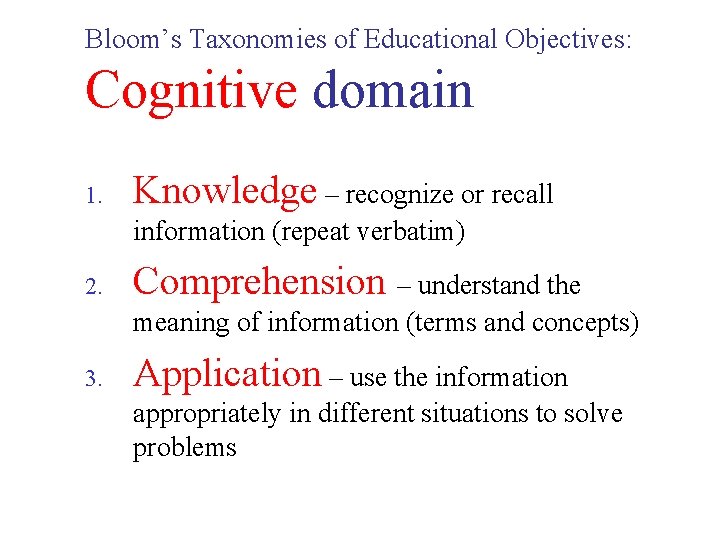
Bloom’s Taxonomies of Educational Objectives: Cognitive domain 1. Knowledge – recognize or recall information (repeat verbatim) 2. Comprehension – understand the meaning of information (terms and concepts) 3. Application – use the information appropriately in different situations to solve problems
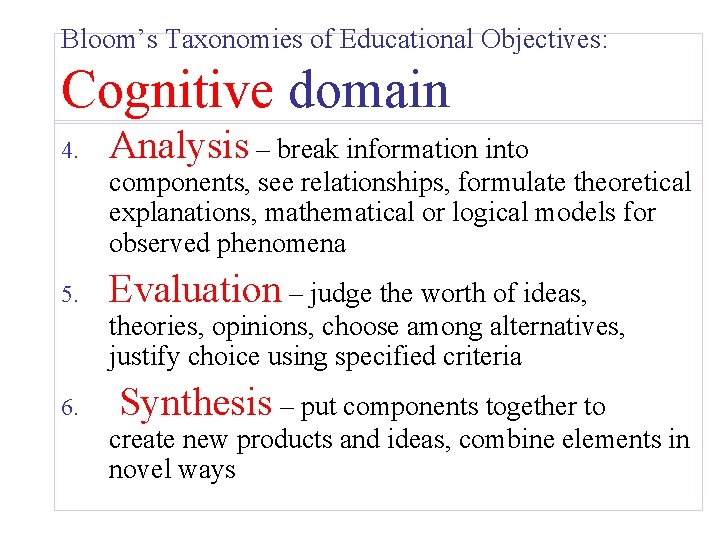
Bloom’s Taxonomies of Educational Objectives: Cognitive domain 4. Analysis – break information into components, see relationships, formulate theoretical explanations, mathematical or logical models for observed phenomena 5. Evaluation – judge the worth of ideas, theories, opinions, choose among alternatives, justify choice using specified criteria 6. Synthesis – put components together to create new products and ideas, combine elements in novel ways

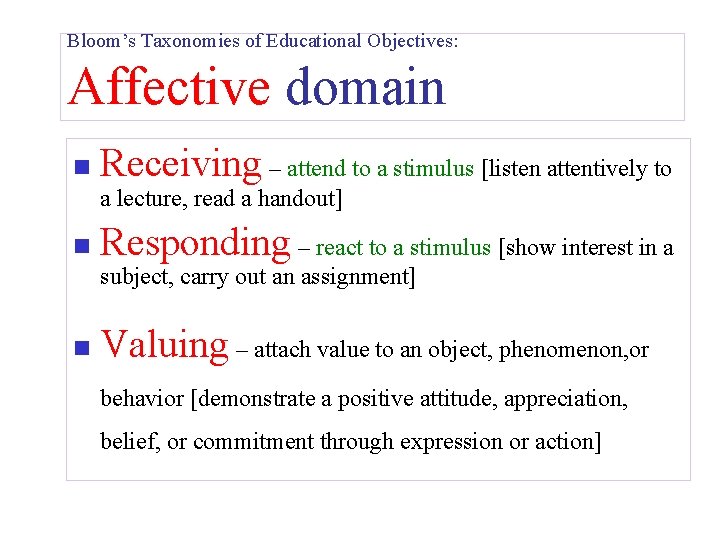
Bloom’s Taxonomies of Educational Objectives: Affective domain n Receiving – attend to a stimulus [listen attentively to a lecture, read a handout] n Responding – react to a stimulus [show interest in a subject, carry out an assignment] n Valuing – attach value to an object, phenomenon, or behavior [demonstrate a positive attitude, appreciation, belief, or commitment through expression or action]
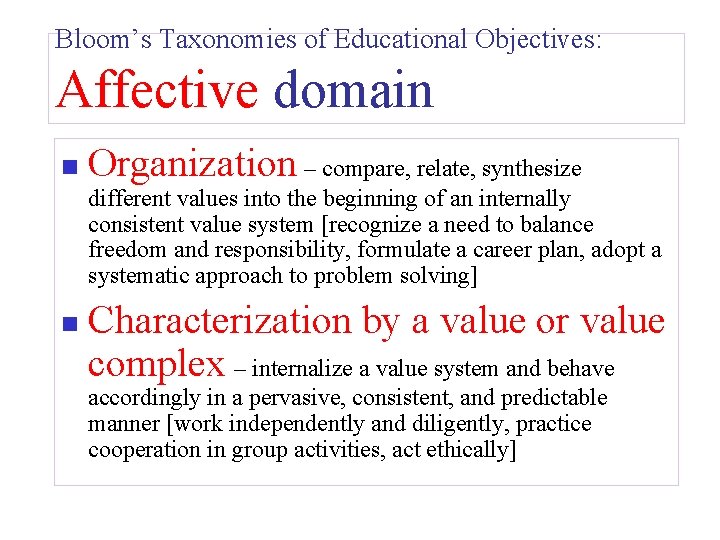
Bloom’s Taxonomies of Educational Objectives: Affective domain n Organization – compare, relate, synthesize different values into the beginning of an internally consistent value system [recognize a need to balance freedom and responsibility, formulate a career plan, adopt a systematic approach to problem solving] n Characterization by a value or value complex – internalize a value system and behave accordingly in a pervasive, consistent, and predictable manner [work independently and diligently, practice cooperation in group activities, act ethically]


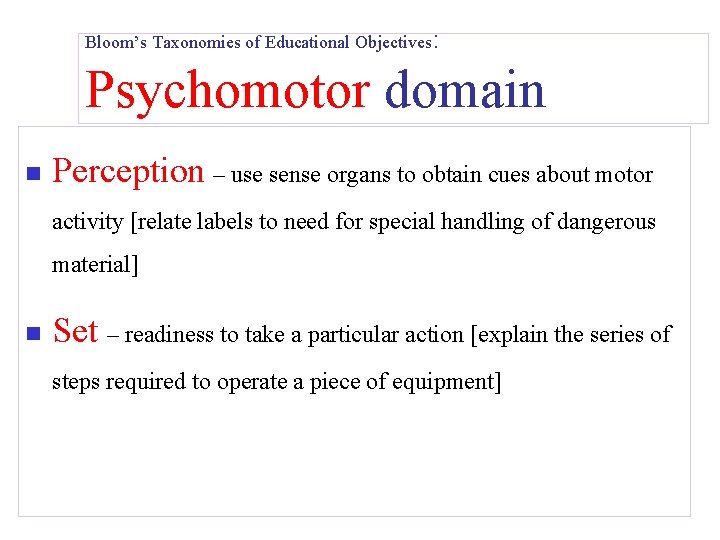
Bloom’s Taxonomies of Educational Objectives: Psychomotor domain n Perception – use sense organs to obtain cues about motor activity [relate labels to need for special handling of dangerous material] n Set – readiness to take a particular action [explain the series of steps required to operate a piece of equipment]
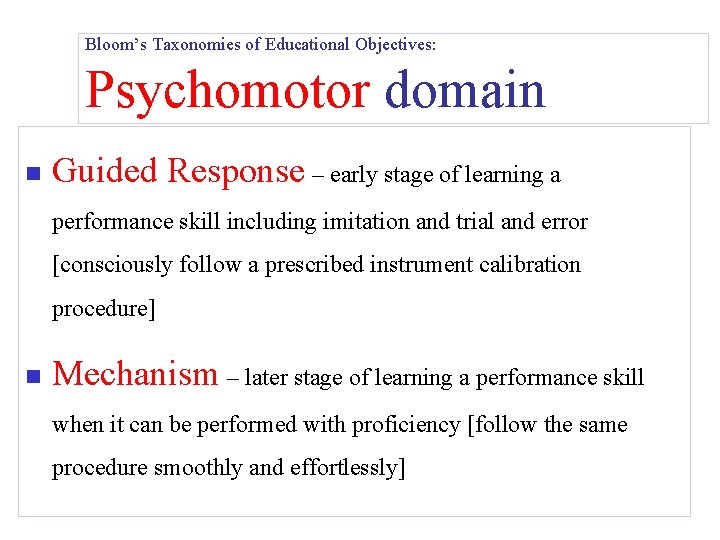
Bloom’s Taxonomies of Educational Objectives: Psychomotor domain n Guided Response – early stage of learning a performance skill including imitation and trial and error [consciously follow a prescribed instrument calibration procedure] n Mechanism – later stage of learning a performance skill when it can be performed with proficiency [follow the same procedure smoothly and effortlessly]
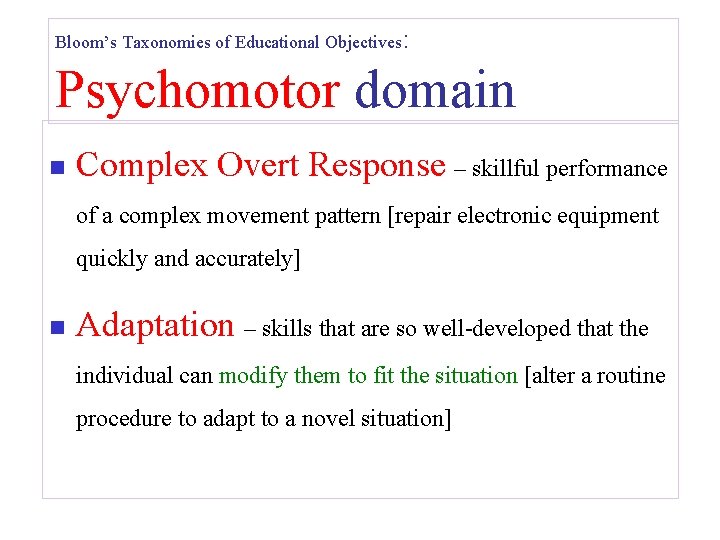
Bloom’s Taxonomies of Educational Objectives: Psychomotor domain n Complex Overt Response – skillful performance of a complex movement pattern [repair electronic equipment quickly and accurately] n Adaptation – skills that are so well-developed that the individual can modify them to fit the situation [alter a routine procedure to adapt to a novel situation]
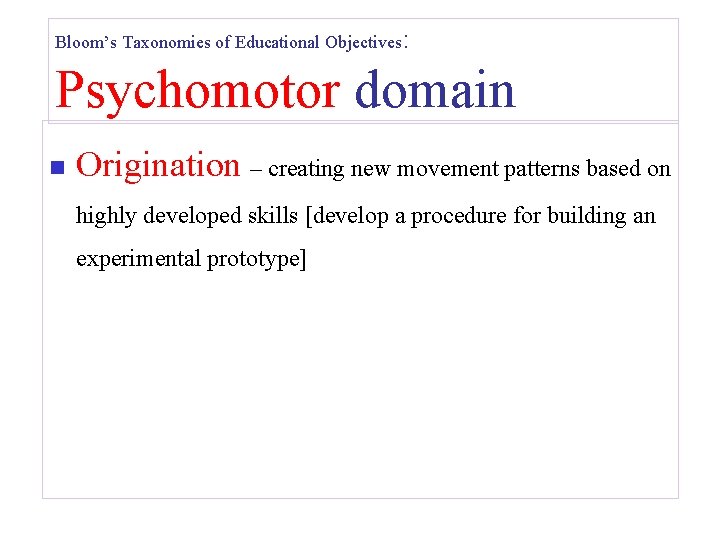
Bloom’s Taxonomies of Educational Objectives: Psychomotor domain n Origination – creating new movement patterns based on highly developed skills [develop a procedure for building an experimental prototype]
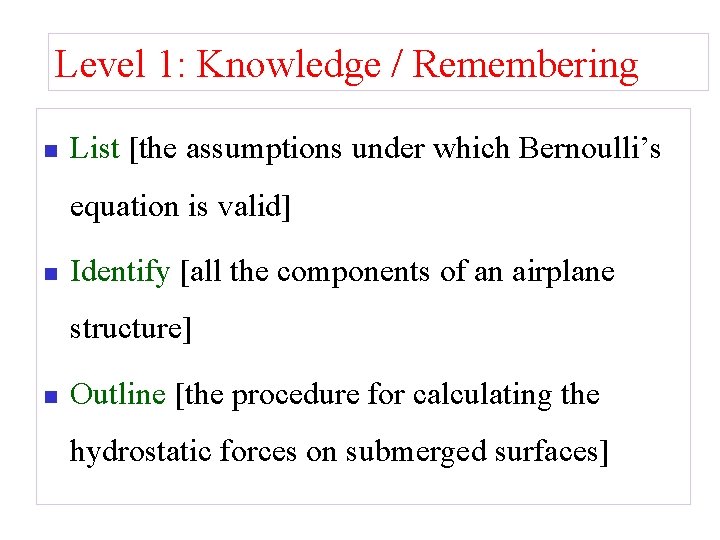
Level 1: Knowledge / Remembering n List [the assumptions under which Bernoulli’s equation is valid] n Identify [all the components of an airplane structure] n Outline [the procedure for calculating the hydrostatic forces on submerged surfaces]
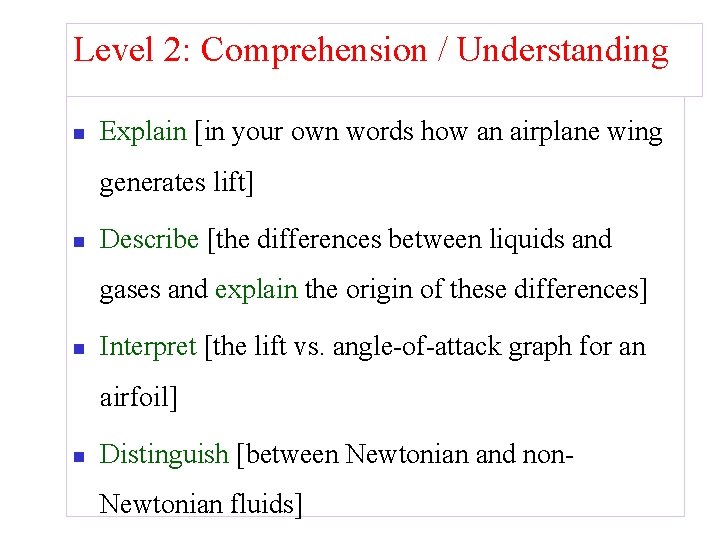
Level 2: Comprehension / Understanding n Explain [in your own words how an airplane wing generates lift] n Describe [the differences between liquids and gases and explain the origin of these differences] n Interpret [the lift vs. angle-of-attack graph for an airfoil] n Distinguish [between Newtonian and non. Newtonian fluids]
Level 3: Application / Applying n Use [the Moody diagram to solve problems involving head losses in pipes]. n Calculate [the static margin of an airplane using the longitudinal stability equation]. n Apply [the continuity equation to calculate velocities in a variety of cases involving 1 -D, uniform, incompressible, steady flows].
Level 4: Analysis / Analyzing n Derive [the momentum equation for a fluid, starting with Newton’s 2 nd law of motion] n Explain [how Hero’s fountain forms] n Analyze the aerodynamic interference for wings flying in the vicinity of each other
Level 5: (Evaluation) Evaluating n Classify [a flow as 1 -D, 2 -D, 3 -D] n Optimize [the weight distribution along the longitudinal axis, to result in a slightly unstable airplane] n Evaluate [the available options for placing the wing on the fuselage], select [one of these options], and justify [your choice].
- Slides: 55