
Levels of Thinking and Reasoning The BloomMarzano Hierarchy
Levels of Thinking and Reasoning The Bloom-Marzano Hierarchy Scott King-Owen, Instructional Services
![Welcome! ]Make sure you sign the Schoollink roster! ]Pick up your workshop materials. ]Scott](http://slidetodoc.com/presentation_image/4543be4732c3869478fb40e99c08d410/image-2.jpg "Welcome! ]Make sure you sign the Schoollink roster! ]Pick up your workshop materials. ]Scott")
Welcome! ]Make sure you sign the Schoollink roster! ]Pick up your workshop materials. ]Scott King-Owen, gkingowe@nhcs. net

Objectives 1. Define the levels of thinking and reasoning used in the Standard Course of Study and testing in North Carolina. 2. Generate content-specific examples of the levels of thinking and reasoning. 3. Apply the levels of thinking and reasoning to classroom practice. 4. Evaluate effective use of the levels of thinking and reasoning in classroom practice.
![Pre-Assessment ] On your own paper, construct a circle map. ] Within your circle](http://slidetodoc.com/presentation_image/4543be4732c3869478fb40e99c08d410/image-4.jpg "Pre-Assessment ] On your own paper, construct a circle map. ] Within your circle")
Pre-Assessment ] On your own paper, construct a circle map. ] Within your circle write down all you know about Bloom’s Taxonomy. Bloom’s Taxonom y
![Bloom’s Taxonomy ]1956: Benjamin Bloom publishes a small volume called Taxonomy of Educational Objectives,](http://slidetodoc.com/presentation_image/4543be4732c3869478fb40e99c08d410/image-5.jpg "Bloom’s Taxonomy ]1956: Benjamin Bloom publishes a small volume called Taxonomy of Educational Objectives,")
Bloom’s Taxonomy ]1956: Benjamin Bloom publishes a small volume called Taxonomy of Educational Objectives, The Classification of Educational Goals, Handbook I: Cognitive Domain.
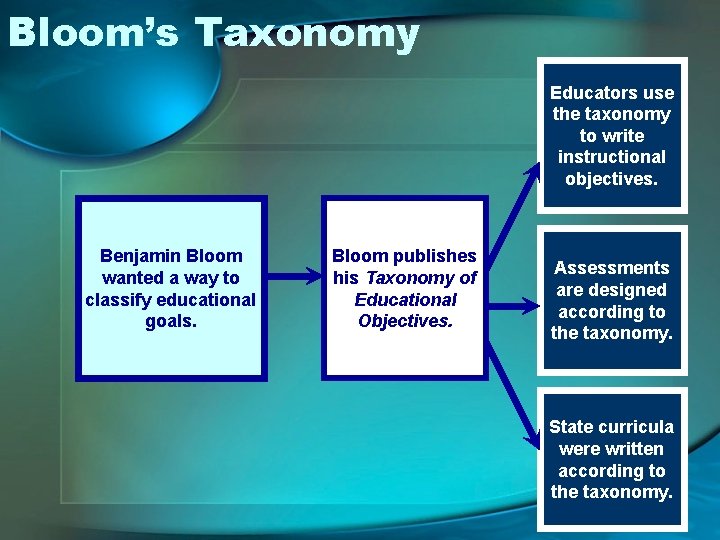
Bloom’s Taxonomy Educators use the taxonomy to write instructional objectives. Benjamin Bloom wanted a way to classify educational goals. Bloom publishes his Taxonomy of Educational Objectives. Assessments are designed according to the taxonomy. State curricula were written according to the taxonomy.
![Bloom’s Taxonomy ]Bloom’s Taxonomy was updated in 2001 by Anderson and Krathwol. So, why](http://slidetodoc.com/presentation_image/4543be4732c3869478fb40e99c08d410/image-7.jpg "Bloom’s Taxonomy ]Bloom’s Taxonomy was updated in 2001 by Anderson and Krathwol. So, why")
Bloom’s Taxonomy ]Bloom’s Taxonomy was updated in 2001 by Anderson and Krathwol. So, why do we still not use Bloom’s Taxonomy in North Carolina?
![Taxonomy Redefined ]Problems with Bloom’s taxonomy: ÄOversimplifies the nature of thought and its relationship](http://slidetodoc.com/presentation_image/4543be4732c3869478fb40e99c08d410/image-8.jpg "Taxonomy Redefined ]Problems with Bloom’s taxonomy: ÄOversimplifies the nature of thought and its relationship")
Taxonomy Redefined ]Problems with Bloom’s taxonomy: ÄOversimplifies the nature of thought and its relationship to learning (Furst, 1994). ÄThe taxonomy implied a hierarchy of thought processes running from lower to higher which did not hold up in research studies (Marzano, 2001).
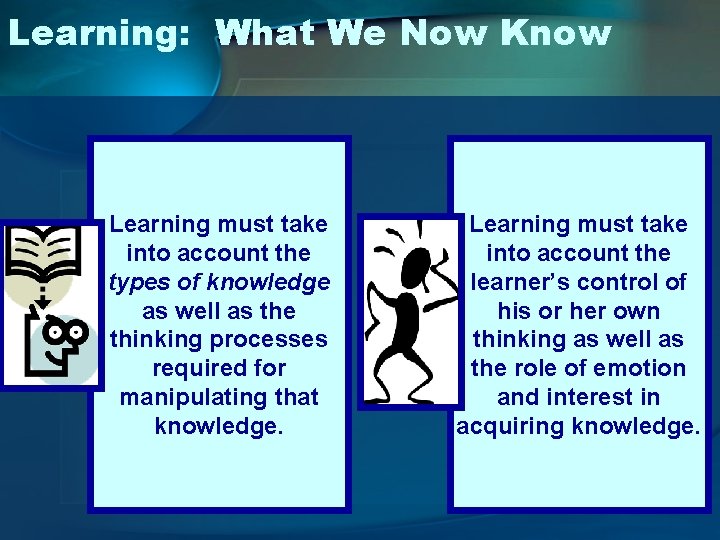
Learning: What We Now Know Learning must take into account the types of knowledge as well as the thinking processes required for manipulating that knowledge. Learning must take into account the learner’s control of his or her own thinking as well as the role of emotion and interest in acquiring knowledge.
![The Birth of Marzano’s Hierarchy ]Robert Marzano set out to repair the deficiencies of](http://slidetodoc.com/presentation_image/4543be4732c3869478fb40e99c08d410/image-10.jpg "The Birth of Marzano’s Hierarchy ]Robert Marzano set out to repair the deficiencies of")
The Birth of Marzano’s Hierarchy ]Robert Marzano set out to repair the deficiencies of Bloom’s Taxonomy in the 1990 s. ]The result was Designing a New Taxonomy of Educational Objectives (2001). ]Revised as The New Taxonomy of Educational Objectives (2006)
![Marzano and North Carolina ]North Carolina’s ABCs program required testing, and the test designers](http://slidetodoc.com/presentation_image/4543be4732c3869478fb40e99c08d410/image-11.jpg "Marzano and North Carolina ]North Carolina’s ABCs program required testing, and the test designers")
Marzano and North Carolina ]North Carolina’s ABCs program required testing, and the test designers needed a taxonomy for aligning the goals and objectives to test questions so that we would teach what we test and test what we teach. ]The resulting “Understanding North Carolina Tests: Thinking Skill Level” was published in 1999.
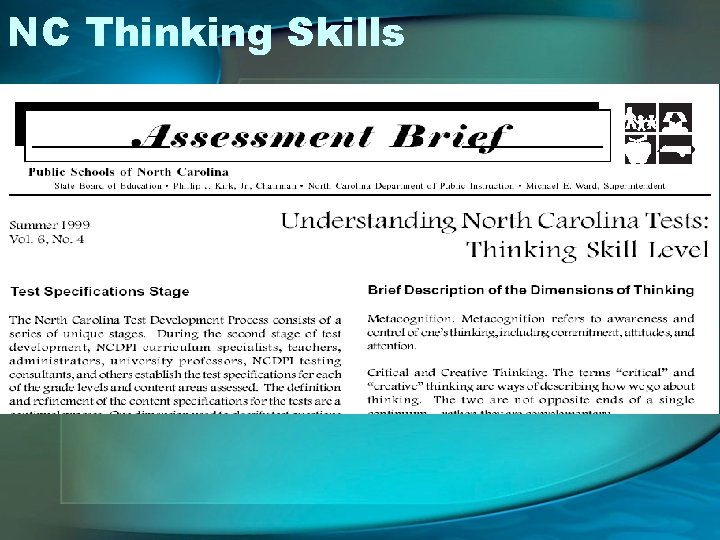
NC Thinking Skills
Marzano and North Carolina Misconception Alert: North Carolina did not fully adopt Marzano’s hierarchy. Instead, state officials hybridized Marzano’s work with the original Bloom’s Taxonomy.
![So What? ]Why does the hierarchy matter? ÄThe goals and objectives of the Standard](http://slidetodoc.com/presentation_image/4543be4732c3869478fb40e99c08d410/image-14.jpg "So What? ]Why does the hierarchy matter? ÄThe goals and objectives of the Standard")
So What? ]Why does the hierarchy matter? ÄThe goals and objectives of the Standard Course of Study are written with the levels of thinking and reasoning based on Marzano’s work. So, to effectively teach the SCOS, teachers must be intimate with the hierarchy in order to know how to really teach the cognitive demands in the objectives.
![So What? ]Why does the hierarchy matter? ÄAll North Carolina EOGs and EOCs are](http://slidetodoc.com/presentation_image/4543be4732c3869478fb40e99c08d410/image-15.jpg "So What? ]Why does the hierarchy matter? ÄAll North Carolina EOGs and EOCs are")
So What? ]Why does the hierarchy matter? ÄAll North Carolina EOGs and EOCs are written with the hierarchy. So, in order to effectively prepare students for state assessments, teachers must be able to transform objectives into measurable test items.
![Reflection ]What is the most important “big idea” uncovered in the previous slides? What](http://slidetodoc.com/presentation_image/4543be4732c3869478fb40e99c08d410/image-16.jpg "Reflection ]What is the most important “big idea” uncovered in the previous slides? What")
Reflection ]What is the most important “big idea” uncovered in the previous slides? What would be different about the way we teach and assess if we all knew this “big idea”? ]In groups, come to consensus about one “big idea” from the material.
![A Closer Look at Bloom and Marzano ]Who can name the levels of Bloom’s](http://slidetodoc.com/presentation_image/4543be4732c3869478fb40e99c08d410/image-17.jpg "A Closer Look at Bloom and Marzano ]Who can name the levels of Bloom’s")
A Closer Look at Bloom and Marzano ]Who can name the levels of Bloom’s Taxonomy? Knowledge Bloom’s Taxonomy Comprehension Application Analysis Synthesis Evaluation
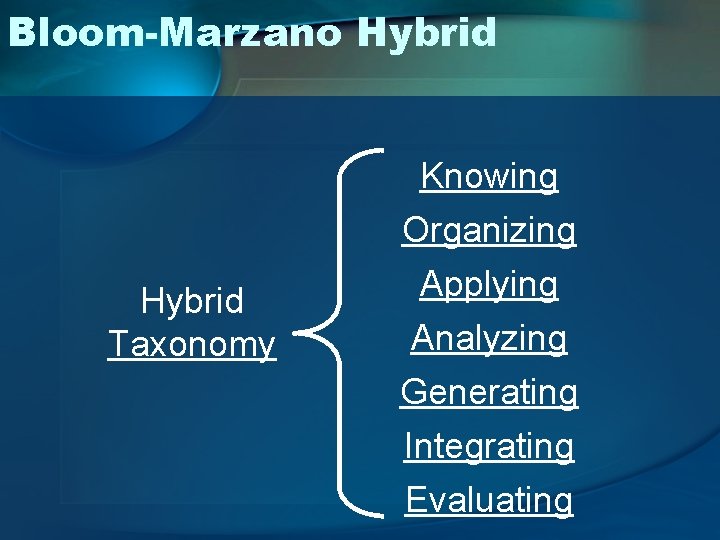
Bloom-Marzano Hybrid Knowing Hybrid Taxonomy Organizing Applying Analyzing Generating Integrating Evaluating
![Similarities and Differences ] In groups, construct a Double-Bubble map comparing the Bloom Hierarchy](http://slidetodoc.com/presentation_image/4543be4732c3869478fb40e99c08d410/image-19.jpg "Similarities and Differences ] In groups, construct a Double-Bubble map comparing the Bloom Hierarchy")
Similarities and Differences ] In groups, construct a Double-Bubble map comparing the Bloom Hierarchy to the hybrid Marzano-Bloom hierarchy.
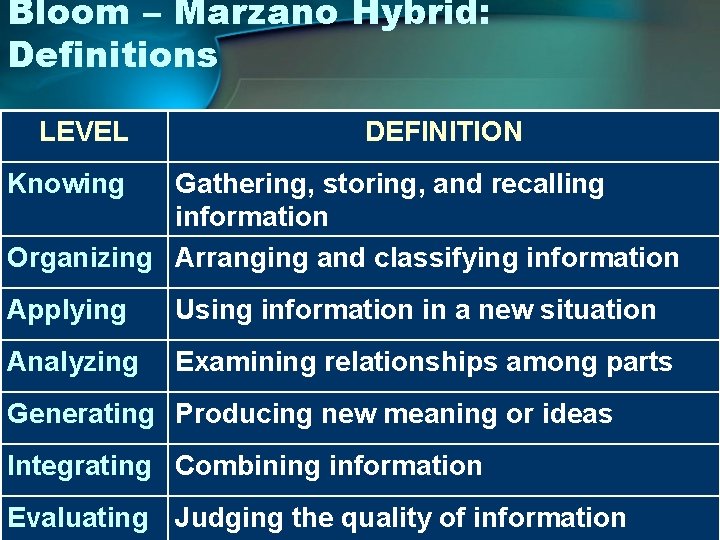
Bloom – Marzano Hybrid: Definitions LEVEL DEFINITION Knowing Gathering, storing, and recalling information Organizing Arranging and classifying information Applying Using information in a new situation Analyzing Examining relationships among parts Generating Producing new meaning or ideas Integrating Combining information Evaluating Judging the quality of information
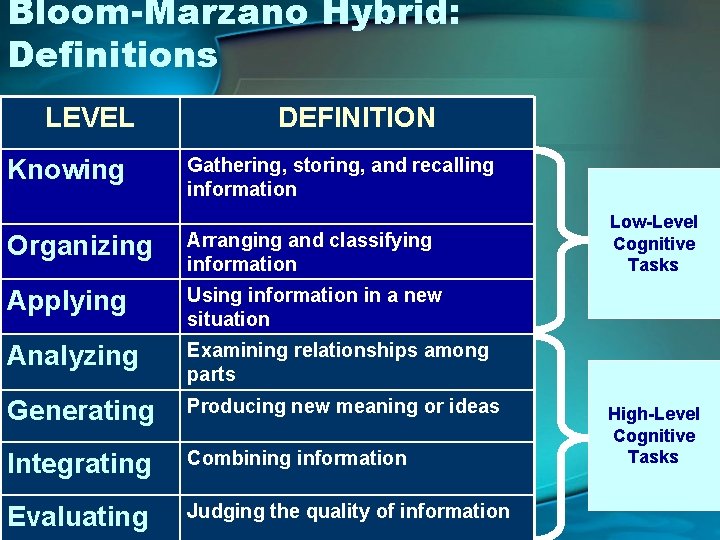
Bloom-Marzano Hybrid: Definitions LEVEL Knowing DEFINITION Gathering, storing, and recalling information Organizing Arranging and classifying information Applying Using information in a new situation Analyzing Examining relationships among parts Generating Producing new meaning or ideas Integrating Combining information Evaluating Judging the quality of information Low-Level Cognitive Tasks High-Level Cognitive Tasks

Part 1: Low-Level Cognitive Tasks LEVEL DEFINITION Knowing Gathering, storing, and recalling information Organizing Arranging and classifying information Applying Using information in a new situation
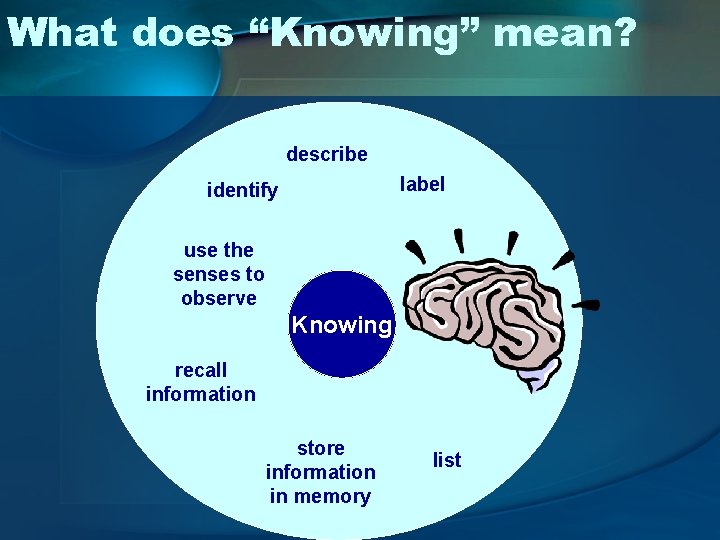
What does “Knowing” mean? describe label identify use the senses to observe Knowing recall information store information in memory list
![“Knowing” Objectives ]ESL 3, NL 3. 02 – Recognize some high frequency words in](http://slidetodoc.com/presentation_image/4543be4732c3869478fb40e99c08d410/image-24.jpg "“Knowing” Objectives ]ESL 3, NL 3. 02 – Recognize some high frequency words in")
“Knowing” Objectives ]ESL 3, NL 3. 02 – Recognize some high frequency words in simple or patterned text. ]Science 2, 1. 03 – Observe the different stages of an insect life cycle. ]Social Studies 5, 4. 03 – Describe the contributions of people of diverse cultures throughout the history of the United States.
![“Knowing” Questions ] What is federalism? A. a form of government with elected representatives](http://slidetodoc.com/presentation_image/4543be4732c3869478fb40e99c08d410/image-25.jpg "“Knowing” Questions ] What is federalism? A. a form of government with elected representatives")
“Knowing” Questions ] What is federalism? A. a form of government with elected representatives B. a division of power between the national and state governments C. a belief in the idea of national sovereignty D. a form of government in which elected officials make all economic decisions
![“Knowing” Questions ] What led to the decline of soapstone mining? A. Dwindling supplies](http://slidetodoc.com/presentation_image/4543be4732c3869478fb40e99c08d410/image-26.jpg "“Knowing” Questions ] What led to the decline of soapstone mining? A. Dwindling supplies")
“Knowing” Questions ] What led to the decline of soapstone mining? A. Dwindling supplies B. Discovery of mica C. Preference for pottery D. Interest in gold mining
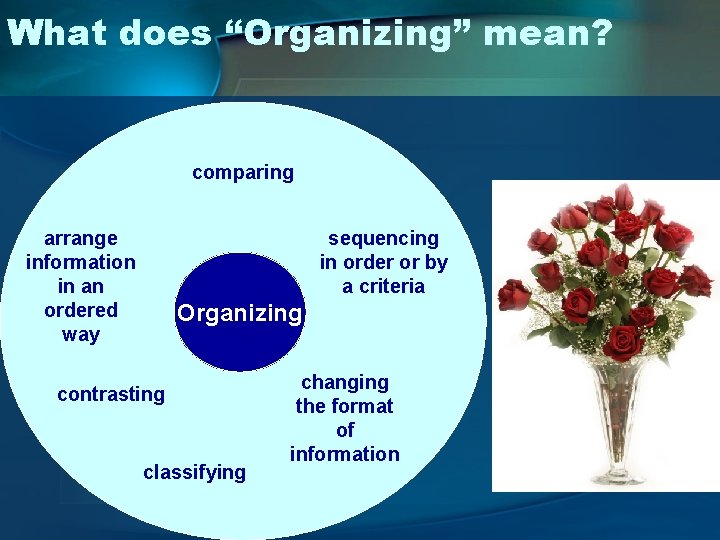
What does “Organizing” mean? comparing arrange information in an ordered way sequencing in order or by a criteria Organizing contrasting classifying changing the format of information
![“Organizing” Objectives ]Social Studies 6, 9. 01 – Trace the historical development of governments.](http://slidetodoc.com/presentation_image/4543be4732c3869478fb40e99c08d410/image-28.jpg "“Organizing” Objectives ]Social Studies 6, 9. 01 – Trace the historical development of governments.")
“Organizing” Objectives ]Social Studies 6, 9. 01 – Trace the historical development of governments. . . ]ELA 8, 3. 03 – Evaluate and create arguments by arranging details, examples, and reasons effectively. ]Advanced Functions, 1. 02 – Compare distributions of univariate data.
![“Organizing” Questions ] Why are parallel circuits, rather than series circuits, commonly used in](http://slidetodoc.com/presentation_image/4543be4732c3869478fb40e99c08d410/image-29.jpg "“Organizing” Questions ] Why are parallel circuits, rather than series circuits, commonly used in")
“Organizing” Questions ] Why are parallel circuits, rather than series circuits, commonly used in wiring houses? A. They allow appliances to operate separately. B. They are cheaper. C. They have a higher total resistance. D. The voltage drop varies with each resistor.
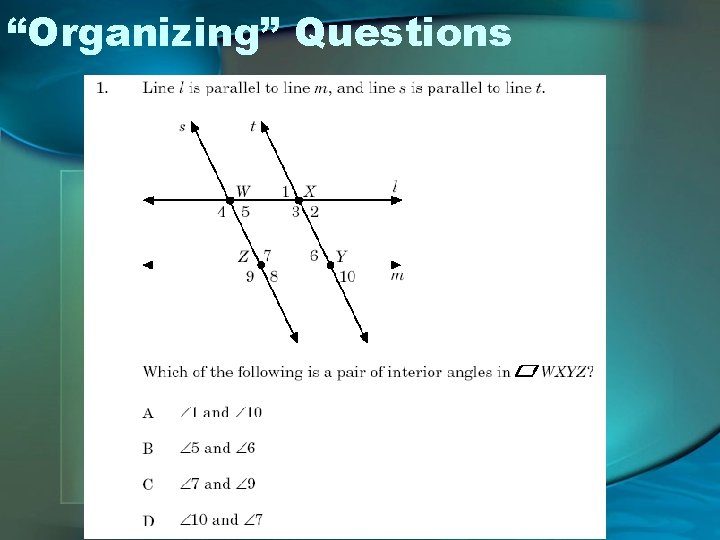
“Organizing” Questions

What does “Applying” mean? knowing when to use knowledge using prior knowledge in a new situation Applying bringing together information to solve problems transferring knowledge from one field to another recognizing similarities and differences between situations
![“Applying” Objectives ] Healthy Living K, 2. 06 – Demonstrate how to get help](http://slidetodoc.com/presentation_image/4543be4732c3869478fb40e99c08d410/image-32.jpg "“Applying” Objectives ] Healthy Living K, 2. 06 – Demonstrate how to get help")
“Applying” Objectives ] Healthy Living K, 2. 06 – Demonstrate how to get help in an emergency. ] Theatre Arts 6, 3. 02 -- Plan and create a simple set formal or informal dramatic presentations. ] Spanish for Native Speakers 1, 3. 07 -- Apply understanding of conventional written and spoken expressions in a variety of settings by using appropriate and exact words to influence reactions, perceptions, and beliefs.
![“Applying” Questions ] Which propaganda technique is represented by the quote “My opponent is](http://slidetodoc.com/presentation_image/4543be4732c3869478fb40e99c08d410/image-33.jpg "“Applying” Questions ] Which propaganda technique is represented by the quote “My opponent is")
“Applying” Questions ] Which propaganda technique is represented by the quote “My opponent is soft on crime!”? A. Name calling B. Bandwagon C. Glittering generality D. Stacked cards
![“Applying” Questions ] A boulder falls from a cliff. What is the boulder’s acceleration](http://slidetodoc.com/presentation_image/4543be4732c3869478fb40e99c08d410/image-34.jpg "“Applying” Questions ] A boulder falls from a cliff. What is the boulder’s acceleration")
“Applying” Questions ] A boulder falls from a cliff. What is the boulder’s acceleration during the fifth second of the fall? A. 2. 0 m/s 2 B. 9. 8 m/s 2 C. 20. 0 m/s 2 D. 98 m/s 2
![Review and Application ]In your groups, you will be given some sample objectives and](http://slidetodoc.com/presentation_image/4543be4732c3869478fb40e99c08d410/image-35.jpg "Review and Application ]In your groups, you will be given some sample objectives and")
Review and Application ]In your groups, you will be given some sample objectives and test questions. Identify the thinking skill level for the objectives and test questions. ]Be prepared to defend your thoughts to the whole group.
![Categorizing Objectives and Questions - A Caveat ] OFTEN, categorizing a question or an](http://slidetodoc.com/presentation_image/4543be4732c3869478fb40e99c08d410/image-36.jpg "Categorizing Objectives and Questions - A Caveat ] OFTEN, categorizing a question or an")
Categorizing Objectives and Questions - A Caveat ] OFTEN, categorizing a question or an objective requires that you understand the amount of prior knowledge needed to process the objective at a particular level. ] Objectives in higher grades often assume prior knowledge, so what may be “knowing” to you is categorized as “applying” by the state.
![Strange Verbs in the SCOS ]To what levels do you assign the following verbs?](http://slidetodoc.com/presentation_image/4543be4732c3869478fb40e99c08d410/image-37.jpg "Strange Verbs in the SCOS ]To what levels do you assign the following verbs?")
Strange Verbs in the SCOS ]To what levels do you assign the following verbs? ÄAcquire. . . Verbs that often call for ÄInteract. . . the student to do something imply ÄShare knowledge. . . procedural knowledge. ÄInvestigate. . . Procedural knowledge requires the use of ÄDevelop. . . information to complete a ÄExplore. . . task. Many times this is nothing more than ÄCompose. . . application. ÄObserve. . .
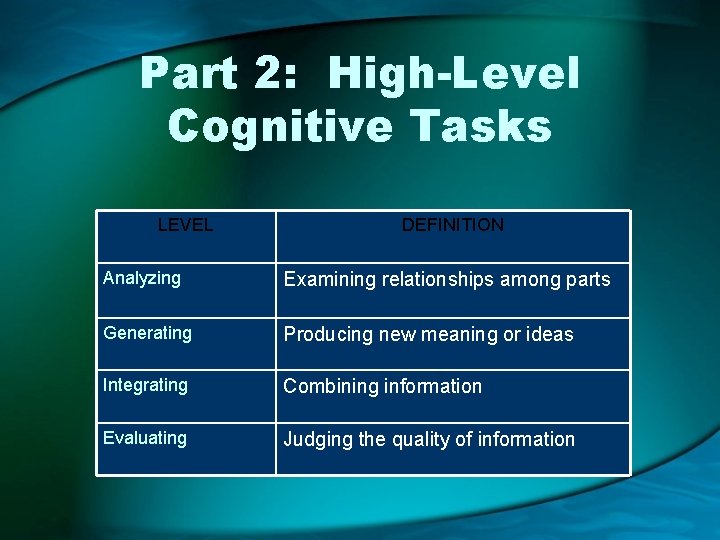
Part 2: High-Level Cognitive Tasks LEVEL DEFINITION Analyzing Examining relationships among parts Generating Producing new meaning or ideas Integrating Combining information Evaluating Judging the quality of information
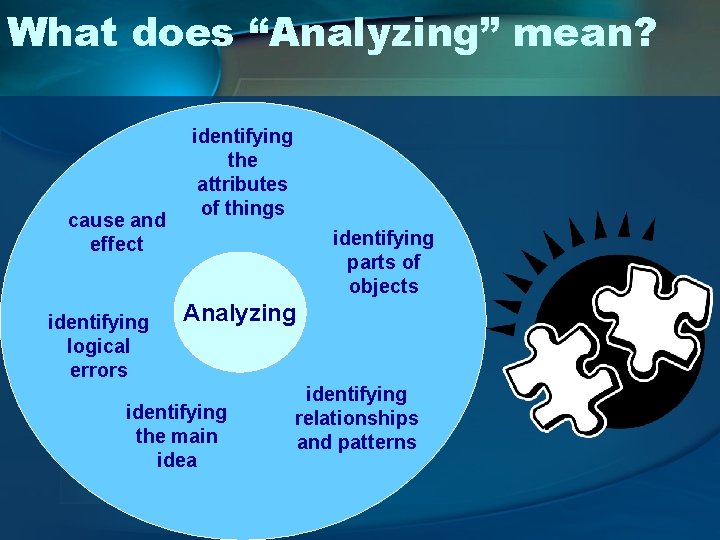
What does “Analyzing” mean? cause and effect identifying logical errors identifying the attributes of things identifying parts of objects Analyzing identifying the main idea identifying relationships and patterns
![“Analyzing” Objectives ]Physics, 8. 01 – Analyze the nature of electrical charges. ]US History,](http://slidetodoc.com/presentation_image/4543be4732c3869478fb40e99c08d410/image-40.jpg "“Analyzing” Objectives ]Physics, 8. 01 – Analyze the nature of electrical charges. ]US History,")
“Analyzing” Objectives ]Physics, 8. 01 – Analyze the nature of electrical charges. ]US History, 6. 01 – Examine the factors that led to the United States taking an increasingly active role in world affairs. ]Visual Arts 7, 3. 04 -- Explore and discuss the value of intuitive perceptions in the problem -solving process.
![“Analyzing” Questions ] A cell with 5% solute concentration is placed in a beaker](http://slidetodoc.com/presentation_image/4543be4732c3869478fb40e99c08d410/image-41.jpg "“Analyzing” Questions ] A cell with 5% solute concentration is placed in a beaker")
“Analyzing” Questions ] A cell with 5% solute concentration is placed in a beaker with a 1% solute concentration. What will happen to the cell over time? A. The cell will gain H 2 O and expand. B. The cell will lose H 2 O and shrink. C. The cell will both gain and lose equal amounts of H 2 O; thus, it will remain the same size. D. The cell will undergo no exchange of H 2 O with its surroundings.
![“Analyzing” Questions ] Why did the horse in “The Runaway Stallion” most likely run](http://slidetodoc.com/presentation_image/4543be4732c3869478fb40e99c08d410/image-42.jpg "“Analyzing” Questions ] Why did the horse in “The Runaway Stallion” most likely run")
“Analyzing” Questions ] Why did the horse in “The Runaway Stallion” most likely run through the water to the opposite bank? A. He was afraid that Jeff was trying to capture him. B. He wanted the oats in the bucket. C. He needed to cool down in the water before eating. D. He was frightened by a noise that Hank made.
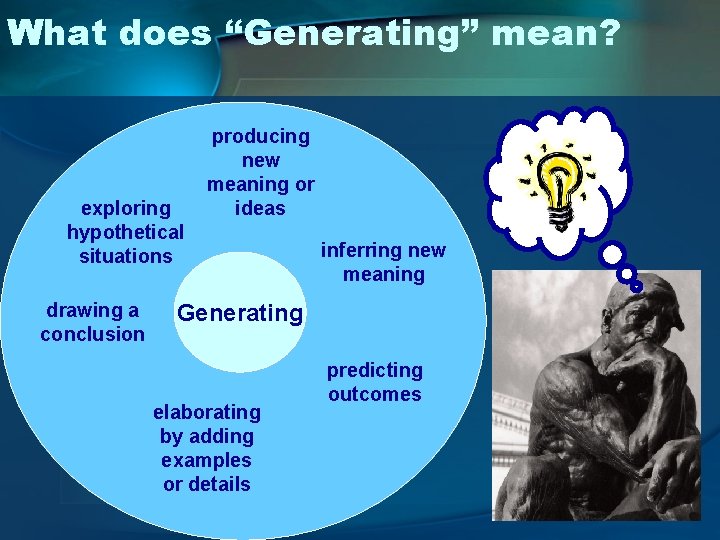
What does “Generating” mean? exploring hypothetical situations drawing a conclusion producing new meaning or ideas inferring new meaning Generating elaborating by adding examples or details predicting outcomes
![“Generating” Objectives ] Theatre Arts 6, 5. 04 -- Infer meaning from a script](http://slidetodoc.com/presentation_image/4543be4732c3869478fb40e99c08d410/image-44.jpg "“Generating” Objectives ] Theatre Arts 6, 5. 04 -- Infer meaning from a script")
“Generating” Objectives ] Theatre Arts 6, 5. 04 -- Infer meaning from a script to create characters. ] Science 8, 5. 05 -- Use maps, ground truthing and remote sensing to make predictions regarding changes over time, land use, urban sprawl, and resource management. ] Civics, 2. 02 – Explain how the United States Constitution grants and limits the authority of public officials and government agencies.
![“Generating” Questions ] Which best explains why the author includes this line in the](http://slidetodoc.com/presentation_image/4543be4732c3869478fb40e99c08d410/image-45.jpg "“Generating” Questions ] Which best explains why the author includes this line in the")
“Generating” Questions ] Which best explains why the author includes this line in the play? HANNAH: There are tougher questions we have to deal with than baseball movies. . . or which river is the longest. . . or. . . A. To create sympathy for Jay B. To reveal Hannah’s wisdom C. To foreshadow the choice Jay will have to make D. To reduce the tension building between Jay and Hannah
![“Generating” Questions ] While cleaning a saltwater aquarium, students placed the aquarium plants in](http://slidetodoc.com/presentation_image/4543be4732c3869478fb40e99c08d410/image-46.jpg "“Generating” Questions ] While cleaning a saltwater aquarium, students placed the aquarium plants in")
“Generating” Questions ] While cleaning a saltwater aquarium, students placed the aquarium plants in a container of distilled water. What effect will this have on the plants? A. The plant cells will separate. B. The plant cells will shrink. C. The plant cells will swell. D. The plant cells will remain the same.
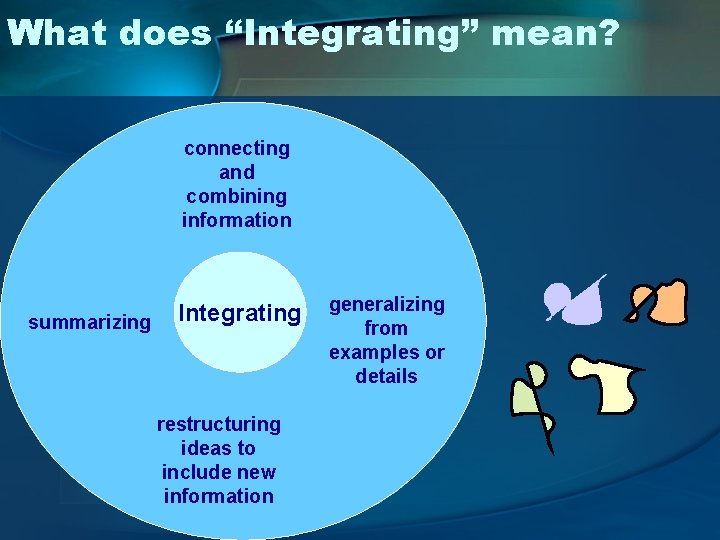
What does “Integrating” mean? connecting and combining information summarizing Integrating restructuring ideas to include new information generalizing from examples or details
![“Integrating” Objectives ]ESL 9 -12, IH 4. 05 -- Write an organized and focused](http://slidetodoc.com/presentation_image/4543be4732c3869478fb40e99c08d410/image-48.jpg "“Integrating” Objectives ]ESL 9 -12, IH 4. 05 -- Write an organized and focused")
“Integrating” Objectives ]ESL 9 -12, IH 4. 05 -- Write an organized and focused composition with supporting details on familiar and previously studied topics. ]US History, 12. 01 – Summarize significant events in foreign policy since the Vietnam War. ]Science 7, 5. 05 -- Summarize the genetic transmittance of disease.
![“Integrating” Questions ] Which of the following statements concerning diffusion and active transport is](http://slidetodoc.com/presentation_image/4543be4732c3869478fb40e99c08d410/image-49.jpg "“Integrating” Questions ] Which of the following statements concerning diffusion and active transport is")
“Integrating” Questions ] Which of the following statements concerning diffusion and active transport is correct? A. Both diffusion and active transport require cell energy. B. Neither diffusion nor active transport require cell energy. C. Diffusion requires cell energy while active transport does not. D. Active transport requires cell energy while diffusion does not.
![“Integrating” Questions ] A house plant is wilting; however, it is still green. What](http://slidetodoc.com/presentation_image/4543be4732c3869478fb40e99c08d410/image-50.jpg "“Integrating” Questions ] A house plant is wilting; however, it is still green. What")
“Integrating” Questions ] A house plant is wilting; however, it is still green. What vital resource is it most likely lacking? A. Plant food B. Water C. Sunlight D. Air
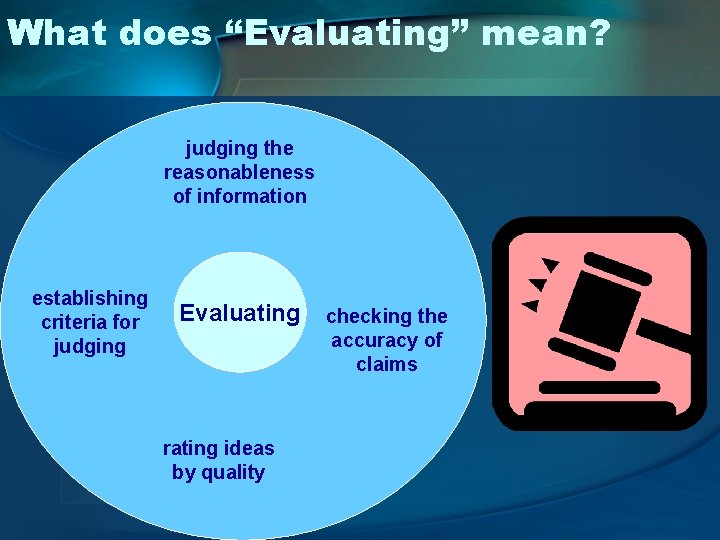
What does “Evaluating” mean? judging the reasonableness of information establishing criteria for judging Evaluating rating ideas by quality checking the accuracy of claims
![“Evaluating” Objectives ] Civics, 6. 08 – Evaluate methods used by society to address](http://slidetodoc.com/presentation_image/4543be4732c3869478fb40e99c08d410/image-52.jpg "“Evaluating” Objectives ] Civics, 6. 08 – Evaluate methods used by society to address")
“Evaluating” Objectives ] Civics, 6. 08 – Evaluate methods used by society to address criminal and anti-social behaviors. ] Algebra II, -- 2. 05 Use rational equations to model and solve problems; justify results. ] ELA 7, 4. 03 -- Develop the stance of a critic by considering and presenting alternative points of view or reasons, remaining fair-minded and open to other interpretations, and creating a critical response/review of a work/topic.
![“Evaluating” Questions ] The scatterplot shows the number of absences in a week for](http://slidetodoc.com/presentation_image/4543be4732c3869478fb40e99c08d410/image-53.jpg "“Evaluating” Questions ] The scatterplot shows the number of absences in a week for")
“Evaluating” Questions ] The scatterplot shows the number of absences in a week for classes of different sizes. Trevor concluded that there is a positive correlation between class size and the number of absences. Which statement best describes why Trevor’s conclusion was incorrect? A. The largest class does not have the most absences. B. The smallest class does not have the least number of absences. C. The data show no relationship between class size and number of absences. D. The data show a negative relationship between class size and number of absences.
![“Evaluating” Questions ] Which of the following pieces of information is most helpful in](http://slidetodoc.com/presentation_image/4543be4732c3869478fb40e99c08d410/image-54.jpg "“Evaluating” Questions ] Which of the following pieces of information is most helpful in")
“Evaluating” Questions ] Which of the following pieces of information is most helpful in supporting the writer’s request for a replacement? A. The writer knew she had the perfect gift for her mother. B. The writer gave the hand vacuum to her mother fortieth birthday. C. The vacuum had no suction. D. The writer and her father read the owner’s manual together.
![Review and Application ]In your groups, will you be given some sample objectives and](http://slidetodoc.com/presentation_image/4543be4732c3869478fb40e99c08d410/image-55.jpg "Review and Application ]In your groups, will you be given some sample objectives and")
Review and Application ]In your groups, will you be given some sample objectives and test questions. Identify the thinking skill level for the objectives and test questions. ]Be prepared to defend your thoughts to the whole group.
![Thoughts for the Classroom ]Should teachers start at the bottom of the hierarchy and](http://slidetodoc.com/presentation_image/4543be4732c3869478fb40e99c08d410/image-56.jpg "Thoughts for the Classroom ]Should teachers start at the bottom of the hierarchy and")
Thoughts for the Classroom ]Should teachers start at the bottom of the hierarchy and work their way up to more complex levels of thinking? ]In other words, should we always start with knowing and end up at evaluating?
![Some Thoughts for the Classroom ]“[The] view [that learners must start at the bottom](http://slidetodoc.com/presentation_image/4543be4732c3869478fb40e99c08d410/image-57.jpg "Some Thoughts for the Classroom ]“[The] view [that learners must start at the bottom")
Some Thoughts for the Classroom ]“[The] view [that learners must start at the bottom and work toward the top] may be characterized as the ‘climbing the ladder’ model of cognition. ” This model is “at odds with contemporary views of the learning process” and may confine students to a boring regimen of “low-level, skill-drill activities, rote memorization of discrete facts, and mind-numbing test prep worksheets. ”
![Some Thoughts for the Classroom ]Teachers should incorporate Marzano’s vocabulary into questioning: » Use](http://slidetodoc.com/presentation_image/4543be4732c3869478fb40e99c08d410/image-58.jpg "Some Thoughts for the Classroom ]Teachers should incorporate Marzano’s vocabulary into questioning: » Use")
Some Thoughts for the Classroom ]Teachers should incorporate Marzano’s vocabulary into questioning: » Use a variety of questions at different cognitive levels. » Ask different students questions. » Vary the questions asked for each student. » Challenge all students to answer complex questions.
![Some Thoughts for the Classroom ]Use the Marzano structure for developing assessment items: »](http://slidetodoc.com/presentation_image/4543be4732c3869478fb40e99c08d410/image-59.jpg "Some Thoughts for the Classroom ]Use the Marzano structure for developing assessment items: »")
Some Thoughts for the Classroom ]Use the Marzano structure for developing assessment items: » Write or re-write multiple choice items to match the hierarchy. » Construct open-ended items according to the cognitive demands of the objective.
![Some Thoughts for the Classroom ]Embed using the vocabulary of the hierarchy in everyday](http://slidetodoc.com/presentation_image/4543be4732c3869478fb40e99c08d410/image-60.jpg "Some Thoughts for the Classroom ]Embed using the vocabulary of the hierarchy in everyday")
Some Thoughts for the Classroom ]Embed using the vocabulary of the hierarchy in everyday work without focusing on the structure itself: » Students do not need to know the levels of thinking and reasoning. » Students do need to know what common terms like “verify, ” “assess, ” “analyze, ” and “infer” mean.
![Some Thoughts for the Classroom ] Does posting the objective daily mean that the](http://slidetodoc.com/presentation_image/4543be4732c3869478fb40e99c08d410/image-61.jpg "Some Thoughts for the Classroom ] Does posting the objective daily mean that the")
Some Thoughts for the Classroom ] Does posting the objective daily mean that the teachers or the students actually understand it? » NO! NO! » The evidence of understanding of the objective comes from how it is “unpacked” in the classroom. » Teachers should work at making objectives “student” friendly and encouraging students to personalize objectives.
![Marzano and CITW ]How does this hierarchy connect to Marzano’s Classroom Instruction that Works?](http://slidetodoc.com/presentation_image/4543be4732c3869478fb40e99c08d410/image-62.jpg "Marzano and CITW ]How does this hierarchy connect to Marzano’s Classroom Instruction that Works?")
Marzano and CITW ]How does this hierarchy connect to Marzano’s Classroom Instruction that Works? Similarities and Differences Comparing & Classifying = Organizing Metaphors & Analogies = Analyzing and Generating Nonlinguistic Representation All forms of NR can be used at each level of the hierarchy. Setting Objectives and Objectives (NC SCOS) Providing Feedback = Analyzing and Evaluating
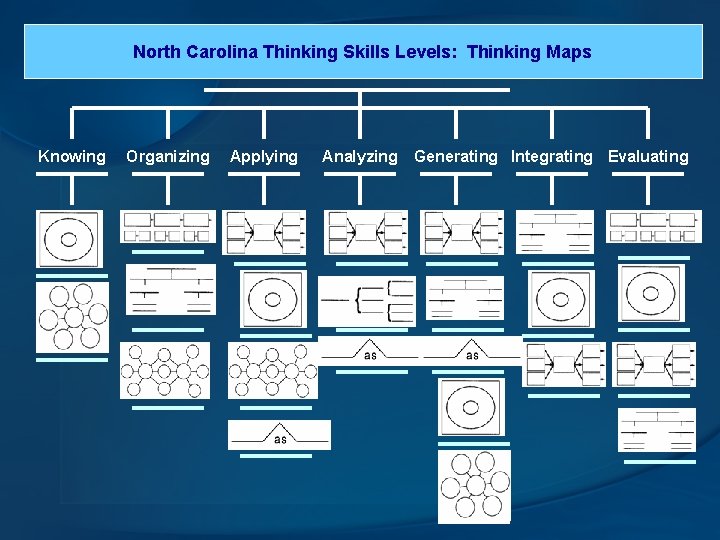
North Carolina Thinking Skills Levels: Thinking Maps Knowing Organizing Applying Analyzing Generating Integrating Evaluating
![A Few Big Ideas ] Categorizing an ] Since the Bloomobjective or a question](http://slidetodoc.com/presentation_image/4543be4732c3869478fb40e99c08d410/image-64.jpg "A Few Big Ideas ] Categorizing an ] Since the Bloomobjective or a question")
A Few Big Ideas ] Categorizing an ] Since the Bloomobjective or a question Marzano hierarchy is often depends on the language of the interpretation of that SCOS of testing, it is item as well as the essential that it be background knowledge understood and of the student. applied to classroom practice.
![A Few Big Ideas ] Objectives must be “unpacked” to get at what is](http://slidetodoc.com/presentation_image/4543be4732c3869478fb40e99c08d410/image-65.jpg "A Few Big Ideas ] Objectives must be “unpacked” to get at what is")
A Few Big Ideas ] Objectives must be “unpacked” to get at what is implied for students to know, understand, and be able to do in the classroom. ] The NC SCOS did not adopt the full Marzano hierarchy, so teachers must pay attention to other critical issues such as metacognition, emotion, and interest and the roles they play in learning.
![Conclusion -- Administration ]As a result of this information, ÄHow will my administrative practice](http://slidetodoc.com/presentation_image/4543be4732c3869478fb40e99c08d410/image-66.jpg "Conclusion -- Administration ]As a result of this information, ÄHow will my administrative practice")
Conclusion -- Administration ]As a result of this information, ÄHow will my administrative practice change? ÄWhat will I look for in lesson plans and observations? ÄHow has my understanding of the curriculum and testing changed?
![Conclusion -- Teachers ]As a result of this information, ÄWhat will I do differently](http://slidetodoc.com/presentation_image/4543be4732c3869478fb40e99c08d410/image-67.jpg "Conclusion -- Teachers ]As a result of this information, ÄWhat will I do differently")
Conclusion -- Teachers ]As a result of this information, ÄWhat will I do differently in my classroom assessments? ÄWhat will I do with my lesson planning? ÄHow will I “unpack” my curriculum to get at what students should know, understand, and be able to do?
![Conclusion ]Questions? ]Comments? ]Next Steps? ]For more information, contact Scott King. Owen, gkingowe@nhcs. net](http://slidetodoc.com/presentation_image/4543be4732c3869478fb40e99c08d410/image-68.jpg "Conclusion ]Questions? ]Comments? ]Next Steps? ]For more information, contact Scott King. Owen, gkingowe@nhcs. net")
Conclusion ]Questions? ]Comments? ]Next Steps? ]For more information, contact Scott King. Owen, gkingowe@nhcs. net
- Slides: 68