
Levels of Studying International Relations Why Study it
- Slides: 10
Levels of Studying International Relations Why Study it? What are the levels?
Definition of International Relations �The term international was first used by Jeremy Bentham in the later part of 18 th Century with regard to laws. �Some Scholars refer International Relations as official relation conducted by authorized leaders of the Nation. Others say it encompasses all relations between nations apart from official relations. �According to Palmer and Parkins, “Contemporary International Relations is a study of the world community in transition”---embracing the totality of relations among people and groups in world society— embracing a great variety of transnational relationships at different levels, above and below the nation State.
Cont. �The crux of the study is context and content. �International Relations examines the relation between two or more states influenced by geopolitics, historical regions, ideologies and strategic features. �The relationship is considered at the juncture of conflict and cooperation �It is power that determines the decision making among nations. �Equation of power----predominance , balance of power or compromise ----entails conflict of interest or cooperative bilateral or multilateral relations
Why we study the levels of analysis? �To unravel the dynamics of power �To understand the complex problem of international relation and explore evidences to occurrences of incidents. �To fathom the influences behind particular decision making �To find out the priorities that impact decision making �To point out at the objectives that operate behind specific decisions between nations
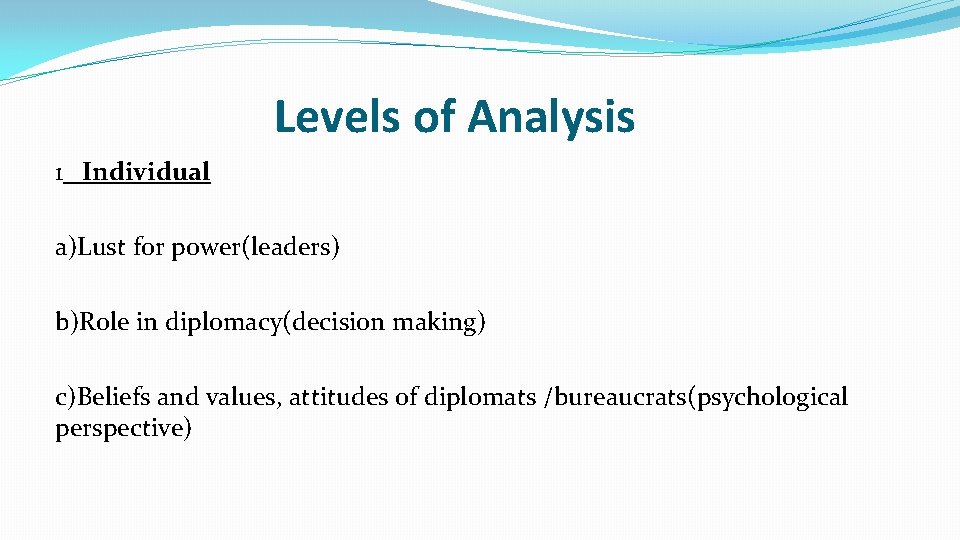
Levels of Analysis 1 Individual a)Lust for power(leaders) b)Role in diplomacy(decision making) c)Beliefs and values, attitudes of diplomats /bureaucrats(psychological perspective)
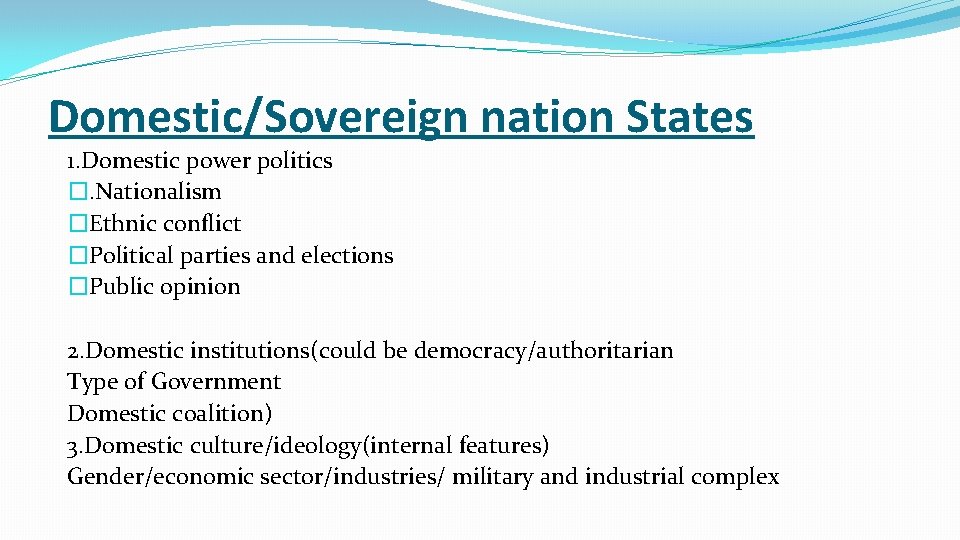
Domestic/Sovereign nation States 1. Domestic power politics �. Nationalism �Ethnic conflict �Political parties and elections �Public opinion 2. Domestic institutions(could be democracy/authoritarian Type of Government Domestic coalition) 3. Domestic culture/ideology(internal features) Gender/economic sector/industries/ military and industrial complex
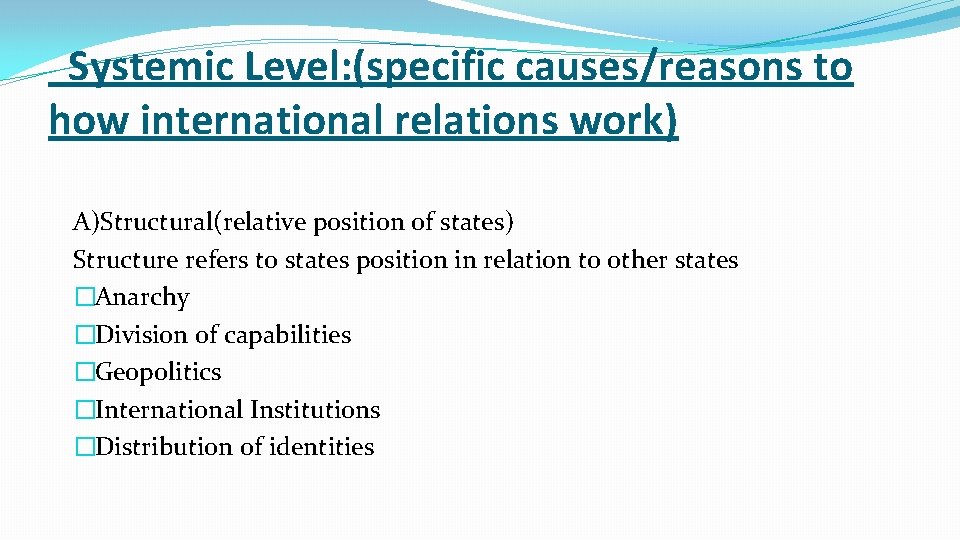
Systemic Level: (specific causes/reasons to how international relations work) A)Structural(relative position of states) Structure refers to states position in relation to other states �Anarchy �Division of capabilities �Geopolitics �International Institutions �Distribution of identities
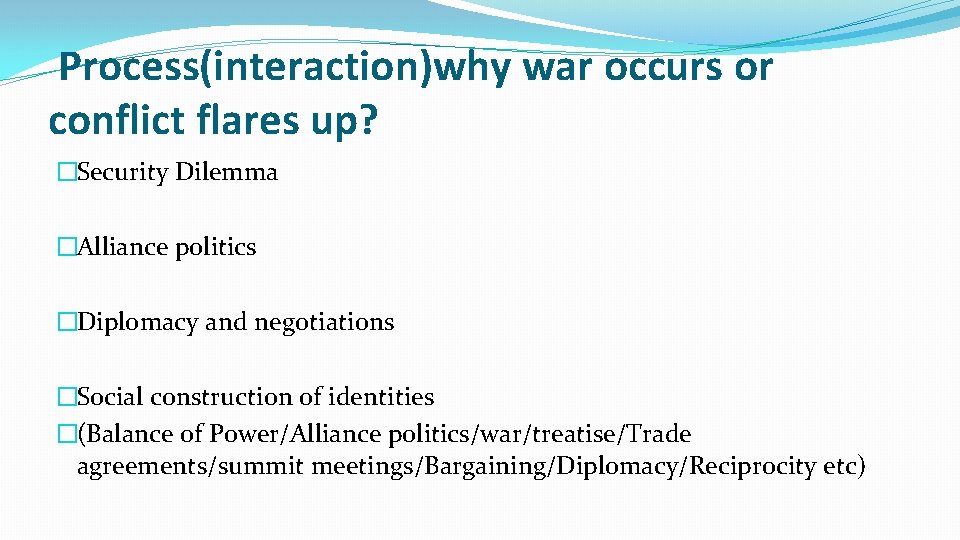
Process(interaction)why war occurs or conflict flares up? �Security Dilemma �Alliance politics �Diplomacy and negotiations �Social construction of identities �(Balance of Power/Alliance politics/war/treatise/Trade agreements/summit meetings/Bargaining/Diplomacy/Reciprocity etc)
Global Level(global factors that transcend the interaction of states) �North South gap �United Nations �European Imperialism �World regions �World environments �Technological Change �Information Revolution �World wide scientific business communities �Global telecommunication etc
Levels of analysis are like guidelines that help us comprehend the why and what of policies undertaken by nation states engaged in relationship of conflict or cooperation in the international domain. It broadens and expands our knowledge about the wide array of complexity encompassing international relations and politics. Dr Rupa Sen(Associate Professor) Dept of Political Science