
LEVELS OF PHYSICAL ACTIVITY AND FACTORS FOR DECREASED
- Slides: 16
LEVELS OF PHYSICAL ACTIVITY AND FACTORS FOR DECREASED PHYSICAL ACTIVITY IN SECONDARY SCHOOL CHILDREN JAMSHED TOWN, KARACHI Ismat Jabeen Rukhsana W Zuberi Family Medicine, AKU 17 th National Health Sciences Research February 27, 2014
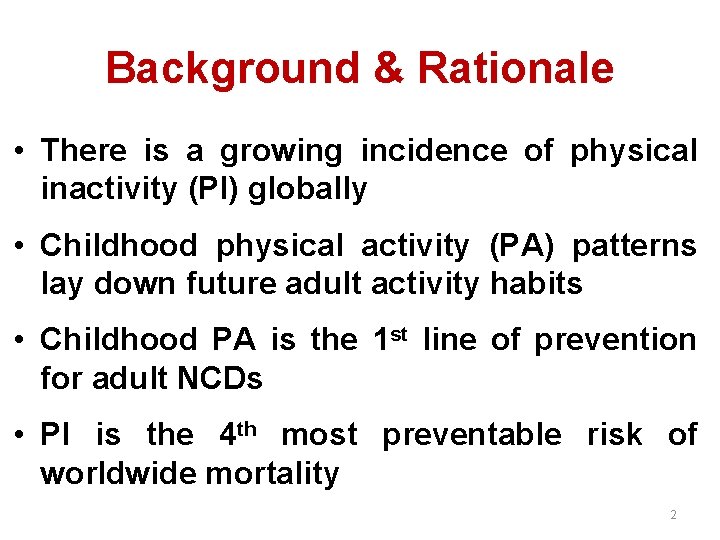
Background & Rationale • There is a growing incidence of physical inactivity (PI) globally • Childhood physical activity (PA) patterns lay down future adult activity habits • Childhood PA is the 1 st line of prevention for adult NCDs • PI is the 4 th most preventable risk of worldwide mortality 2
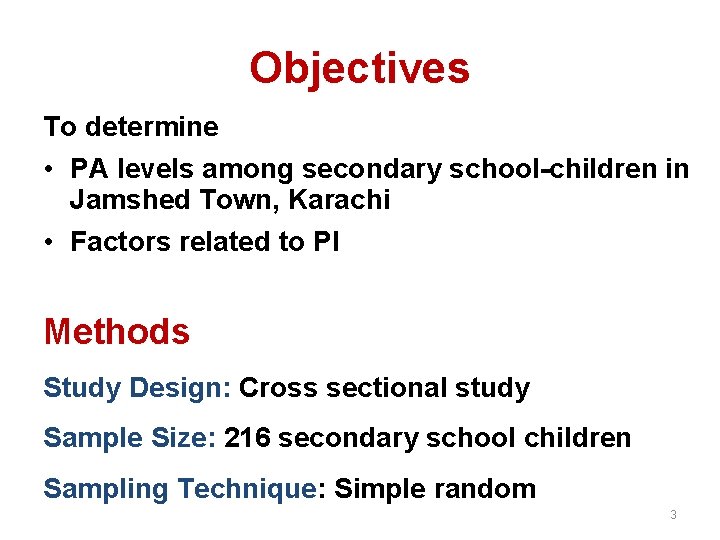
Objectives To determine • PA levels among secondary school-children in Jamshed Town, Karachi • Factors related to PI Methods Study Design: Cross sectional study Sample Size: 216 secondary school children Sampling Technique: Simple random 3
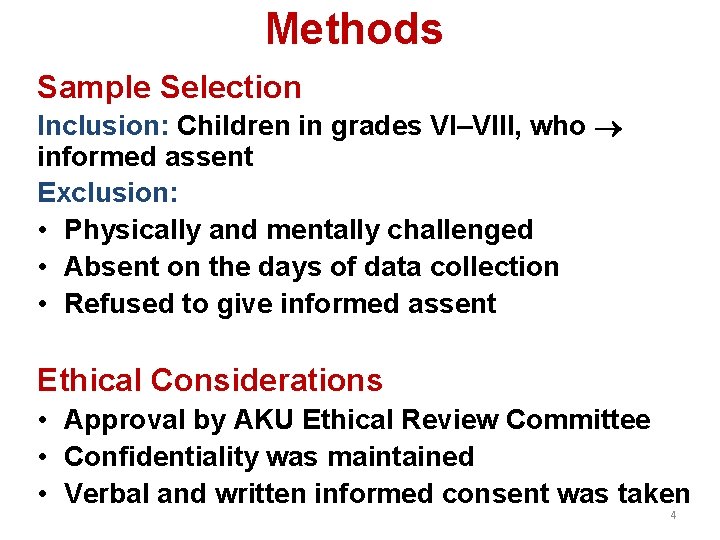
Methods Sample Selection Inclusion: Children in grades VI–VIII, who informed assent Exclusion: • Physically and mentally challenged • Absent on the days of data collection • Refused to give informed assent Ethical Considerations • Approval by AKU Ethical Review Committee • Confidentiality was maintained • Verbal and written informed consent was taken 4
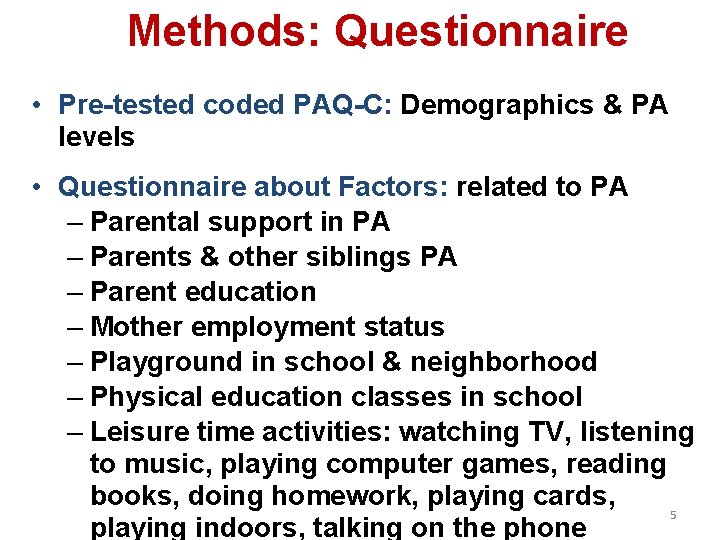
Methods: Questionnaire • Pre-tested coded PAQ-C: Demographics & PA levels • Questionnaire about Factors: related to PA – Parental support in PA – Parents & other siblings PA – Parent education – Mother employment status – Playground in school & neighborhood – Physical education classes in school – Leisure time activities: watching TV, listening to music, playing computer games, reading books, doing homework, playing cards, 5 playing indoors, talking on the phone
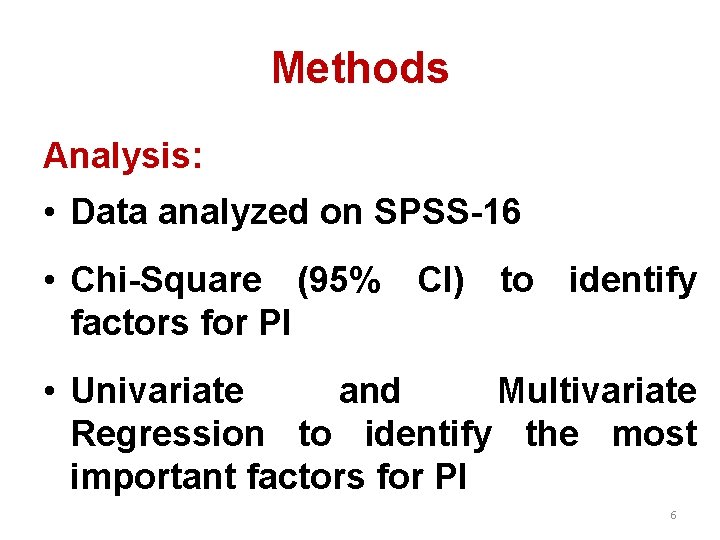
Methods Analysis: • Data analyzed on SPSS-16 • Chi-Square (95% CI) to identify factors for PI • Univariate and Multivariate Regression to identify the most important factors for PI 6
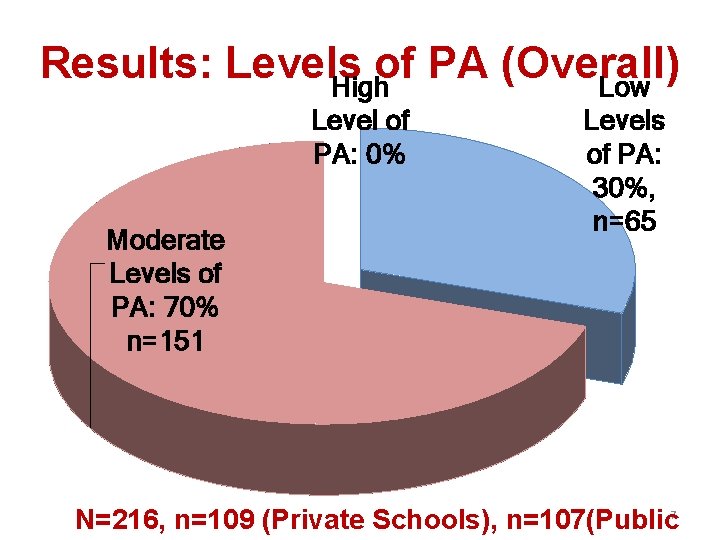
Results: Levels of PA (Overall) High Low Level of PA: 0% Moderate Levels of PA: 70% n=151 Levels of PA: 30%, n=65 7 N=216, n=109 (Private Schools), n=107(Public
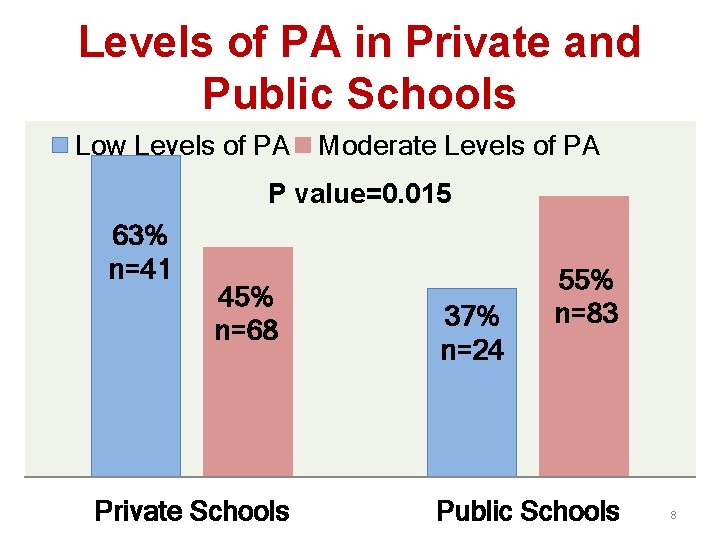
Levels of PA in Private and Public Schools Low Levels of PA Moderate Levels of PA P value=0. 015 63% n=41 45% n=68 Private Schools 37% n=24 55% n=83 Public Schools 8
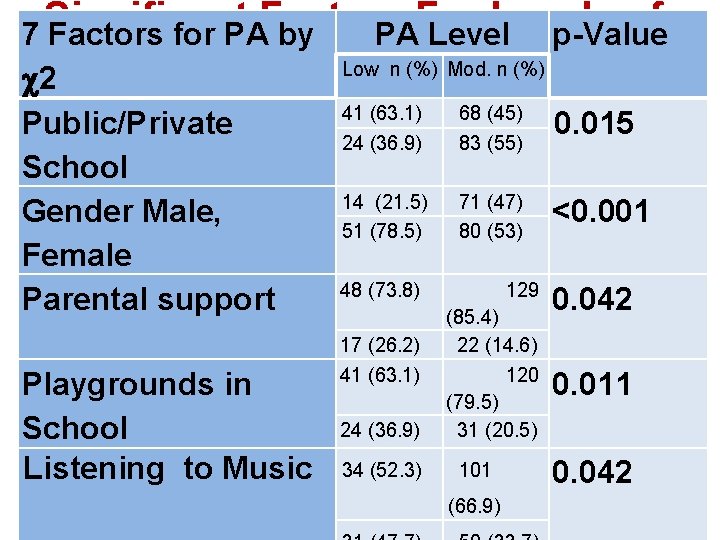
Significant Factors For Levels of 7 Factors for PA by PA Level p-Value Low n (%) Mod. n (%) 2 PA in Both Private and Public 41 (63. 1) 68 (45) Public/Private Schools 0. 015 School Gender Male, Female Parental support Playgrounds in School Listening to Music 24 (36. 9) 83 (55) 14 (21. 5) 51 (78. 5) 71 (47) 80 (53) 48 (73. 8) 17 (26. 2) 41 (63. 1) 24 (36. 9) 34 (52. 3) 129 (85. 4) 22 (14. 6) 120 (79. 5) 31 (20. 5) 101 (66. 9) <0. 001 0. 042 0. 011 0. 042 9
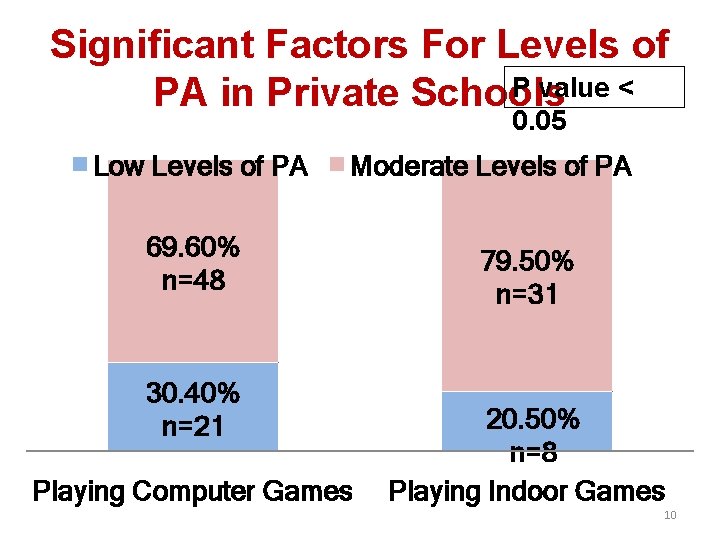
Significant Factors For Levels of P value < PA in Private Schools 0. 05 Low Levels of PA Moderate Levels of PA 69. 60% n=48 30. 40% n=21 Playing Computer Games 79. 50% n=31 20. 50% n=8 Playing Indoor Games 10
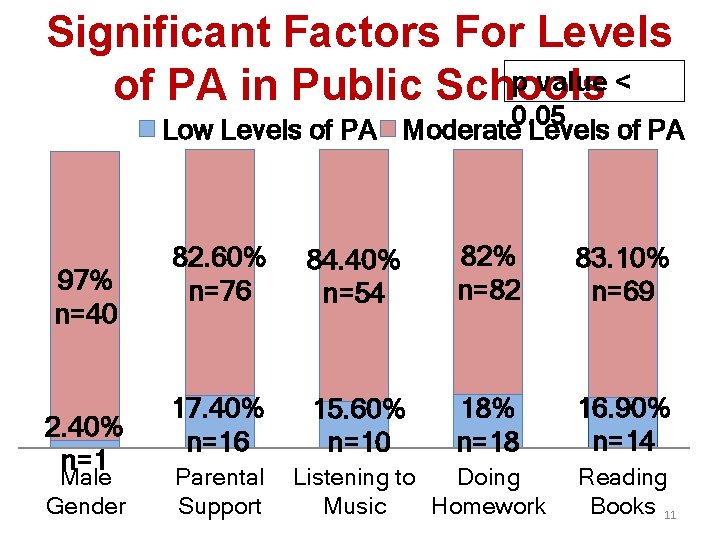
Significant Factors For Levels p value < of PA in Public Schools 0. 05 Low Levels of PA Moderate Levels of PA 97% n=40 2. 40% n=1 Male Gender 82. 60% n=76 84. 40% n=54 82% n=82 83. 10% n=69 17. 40% n=16 15. 60% n=10 18% n=18 16. 90% n=14 Parental Support Listening to Doing Music Homework Reading Books 11
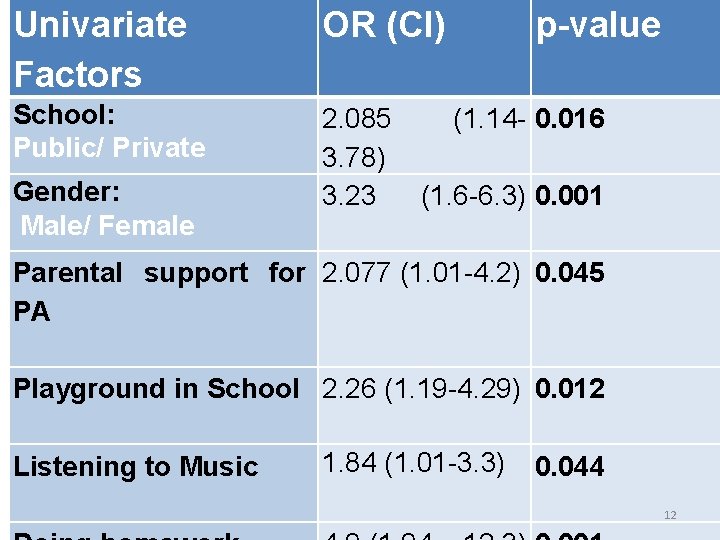
Univariate OR (CI) p-value Univariate Regression Factors School: Public/ Private Gender: Male/ Female Analysis 2. 085 (1. 14 - 0. 016 3. 78) 3. 23 (1. 6 -6. 3) 0. 001 Parental support for 2. 077 (1. 01 -4. 2) 0. 045 PA Playground in School 2. 26 (1. 19 -4. 29) 0. 012 Listening to Music 1. 84 (1. 01 -3. 3) 0. 044 12
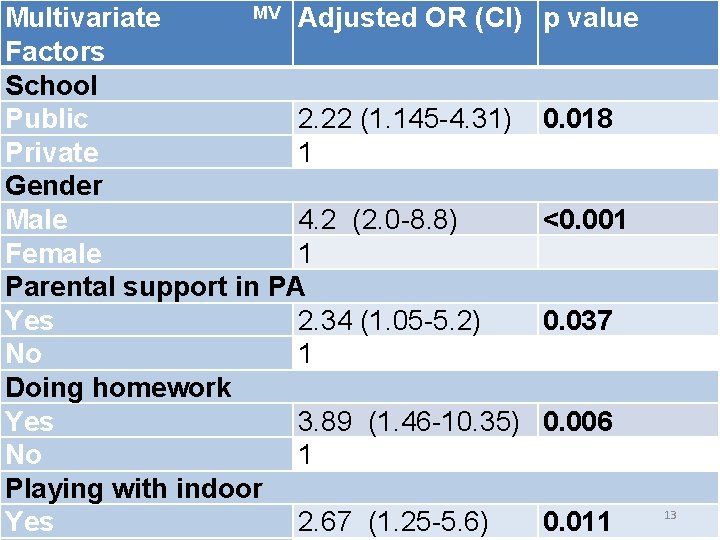
MV Adjusted OR (CI) p value Multivariate Factors Multivariate Regression School Analysis Public 2. 22 (1. 145 -4. 31) 0. 018 Private 1 Gender Male 4. 2 (2. 0 -8. 8) <0. 001 Female 1 Parental support in PA Yes 2. 34 (1. 05 -5. 2) 0. 037 No 1 Doing homework Yes 3. 89 (1. 46 -10. 35) 0. 006 No 1 Playing with indoor Yes 2. 67 (1. 25 -5. 6) 0. 011 13
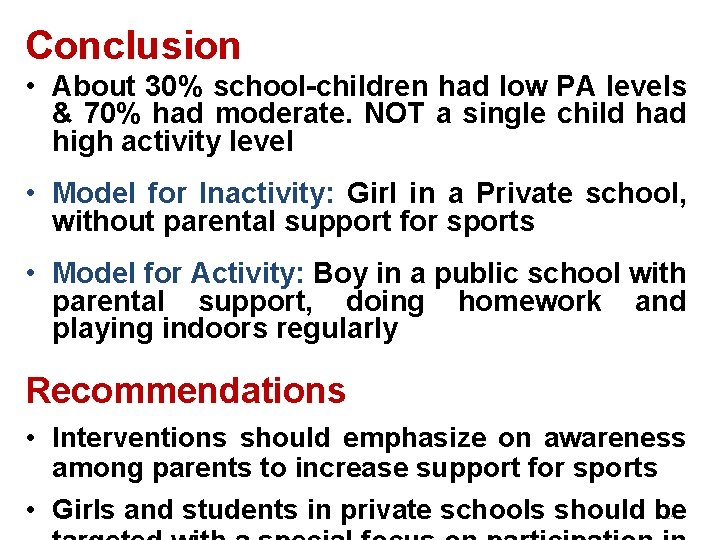
Conclusion • About 30% school-children had low PA levels & 70% had moderate. NOT a single child had high activity level • Model for Inactivity: Girl in a Private school, without parental support for sports • Model for Activity: Boy in a public school with parental support, doing homework and playing indoors regularly Recommendations • Interventions should emphasize on awareness among parents to increase support for sports 14 • Girls and students in private schools should be
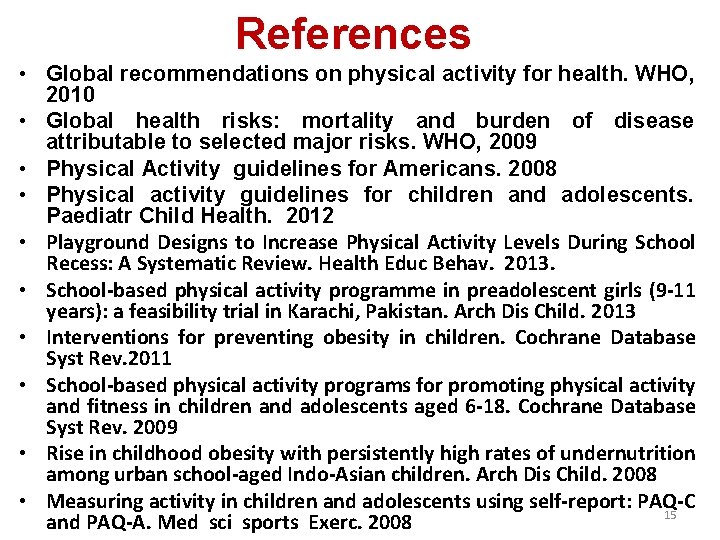
References • Global recommendations on physical activity for health. WHO, 2010 • Global health risks: mortality and burden of disease attributable to selected major risks. WHO, 2009 • Physical Activity guidelines for Americans. 2008 • Physical activity guidelines for children and adolescents. Paediatr Child Health. 2012 • Playground Designs to Increase Physical Activity Levels During School Recess: A Systematic Review. Health Educ Behav. 2013. • School-based physical activity programme in preadolescent girls (9 -11 years): a feasibility trial in Karachi, Pakistan. Arch Dis Child. 2013 • Interventions for preventing obesity in children. Cochrane Database Syst Rev. 2011 • School-based physical activity programs for promoting physical activity and fitness in children and adolescents aged 6 -18. Cochrane Database Syst Rev. 2009 • Rise in childhood obesity with persistently high rates of undernutrition among urban school-aged Indo-Asian children. Arch Dis Child. 2008 • Measuring activity in children and adolescents using self-report: PAQ-C 15 and PAQ-A. Med sci sports Exerc. 2008
“Stop waiting for things to happen. Go out and make them happen” 16