
Levels of Organization How do organisms obtain energy
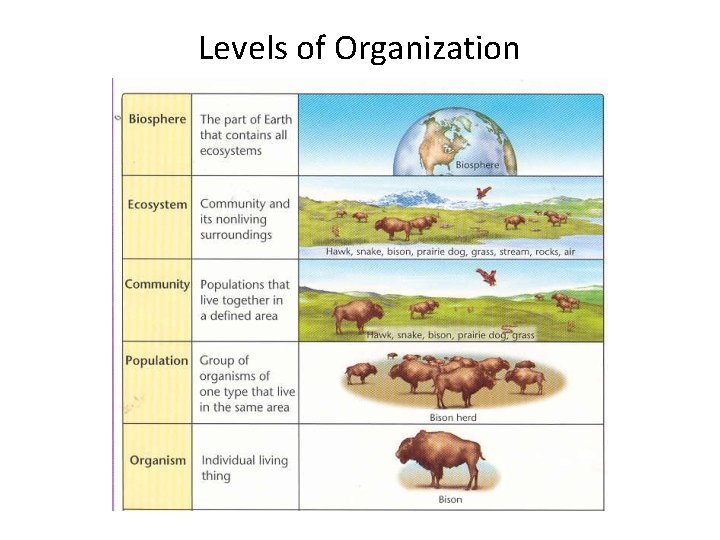
Levels of Organization
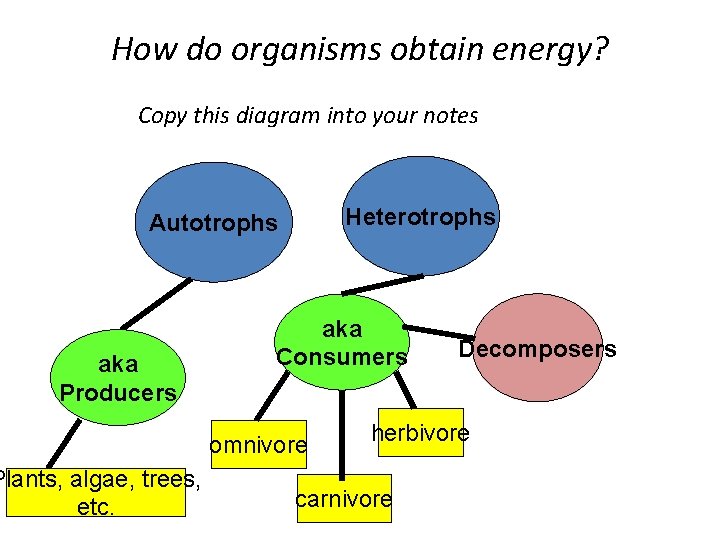
How do organisms obtain energy? Copy this diagram into your notes Heterotrophs Autotrophs aka Producers Plants, algae, trees, etc. aka Consumers omnivore Decomposers herbivore carnivore
Heterotrophs aka Consumers • Heterotrophs- also known as consumers -they rely on other organisms for food. Examples- animals, reptiles, insects, birds, bacteria (everything other than a plant) Carnivores- Organisms that eat other animals (meat eaters) -hawk Herbivores- organisms that eat plants -rabbits Omnivores- organism that eat both plants and animals. -crows, humans Decomposers- break down the remains of dead organisms and recycle the nutrients back to the soil. -bacteria & fungi Scavengers-organisms that feed upon dead organisms that other organisms have killed. -vultures
Autotrophs aka Producers Autotrophs- also known as producers They produce their own food by Photosynthesis! GLUCOSE!!! Examples-Plants, algae, some bacteria -Remember that plants produce organic compounds (glucose-C 6 H 12 O 6) from inorganic raw materials (CO 2 and H 2 O)
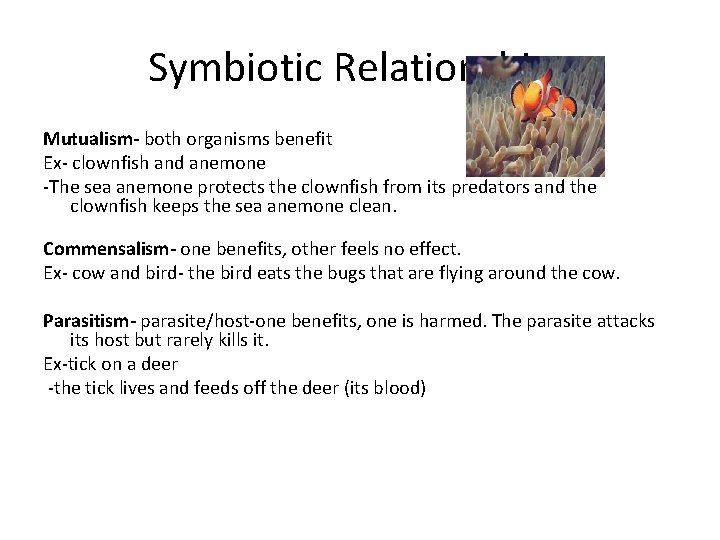
Symbiotic Relationships Mutualism- both organisms benefit Ex- clownfish and anemone -The sea anemone protects the clownfish from its predators and the clownfish keeps the sea anemone clean. Commensalism- one benefits, other feels no effect. Ex- cow and bird- the bird eats the bugs that are flying around the cow. Parasitism- parasite/host-one benefits, one is harmed. The parasite attacks its host but rarely kills it. Ex-tick on a deer -the tick lives and feeds off the deer (its blood)
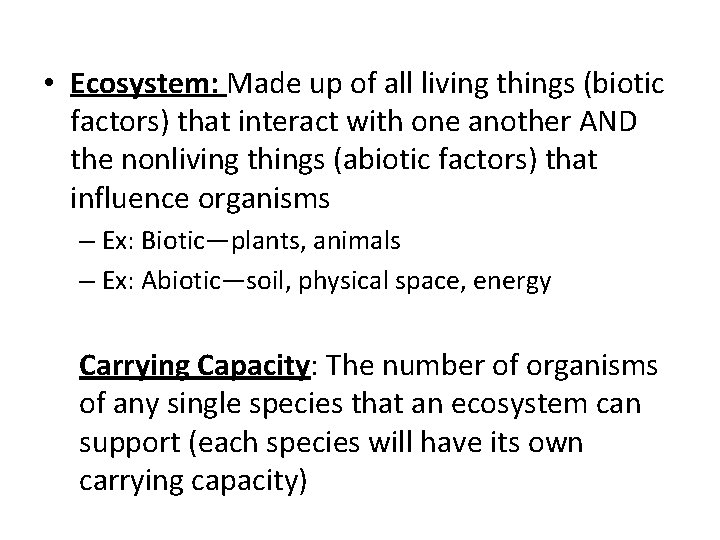
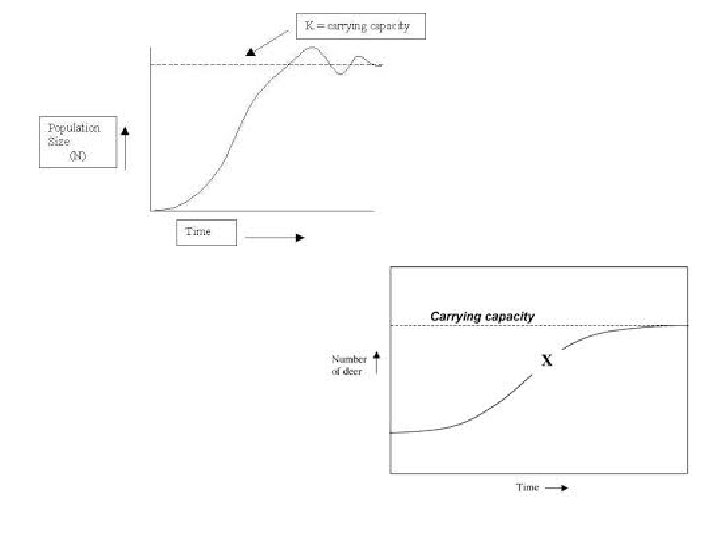
• Ecosystem: Made up of all living things (biotic factors) that interact with one another AND the nonliving things (abiotic factors) that influence organisms – Ex: Biotic—plants, animals – Ex: Abiotic—soil, physical space, energy Carrying Capacity: The number of organisms of any single species that an ecosystem can support (each species will have its own carrying capacity)
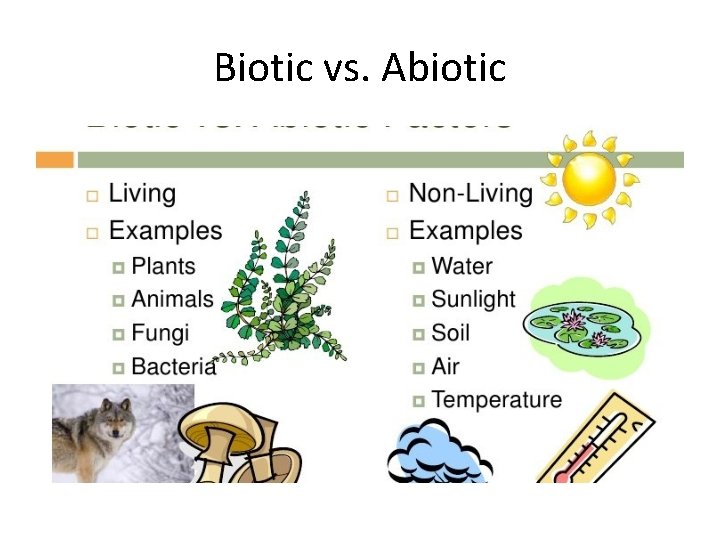
Biotic vs. Abiotic
Limits on Population Size • All ecosystems have a limited amount of resources (Ex: Food, water, space, sunlight, oxygen) which limits the population size and leads to competition. • Limiting Factors: factors in the environment that limit population size – Can be abiotic (non-living)—amount of light, oxygen, minerals, etc. – Can be biotic (living)—amount of animals, plants, mates, predators (kill and eat other organisms), prey (are killed for food)
Biodiversity? • Biodiversity is the measurement of the degree to which species vary within an ecosystem. • It represent the different variety of species in an ecosystem. • Greater variety of species (animals, plants, etc) = MORE biodiveristy
• Niche: the role that a species plays in an ecosystem • Only one species at a time can occupy a niche. If two attempt to fill the same role, competition results, and one Is eventually forced out.
Food Chains/Webs/Energy Pyramid **The food pyramid and energy pyramid are basically the same thing, food=energy** -All species are interrelated -Producers (autotrophs) make their own food through the process of photosynthesis (their source of energy is the sun). -Producers contain the most amount of energy and are found in the greatest number. They are located at the bottom of the pyramid.
• Decomposers: – Break down/consume the wastes of dead bodies – RECYCLE materials (and energy) that can be reused by producers – VITAL to an ecosystem. Without decomposers energy would be lost and the ecosystem could not survive. – Examples: fungi, worms, bacteria • Scavengers: – Eat dead organisms (nature’s “clean up”—Not the same as decomposers) – Example: Vultures
• Parasites: Attack live organisms (hosts) but rarely kill them – Ex: Ticks feeding on blood of humans
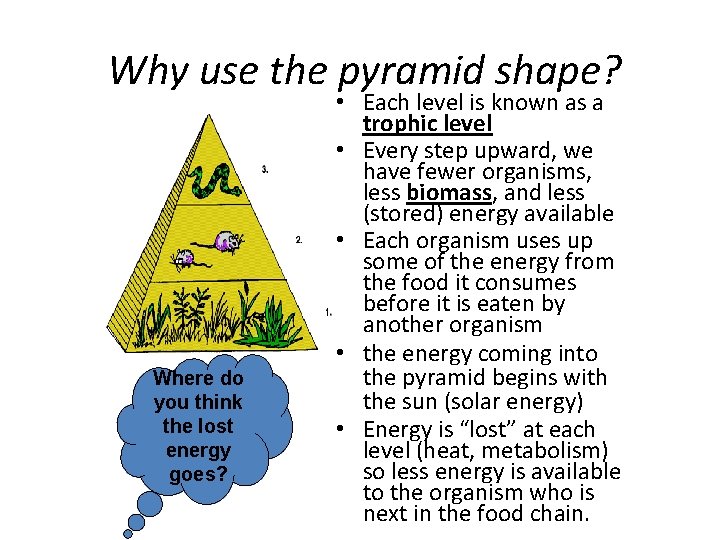
Why use the pyramid shape? Where do you think the lost energy goes? • Each level is known as a trophic level • Every step upward, we have fewer organisms, less biomass, and less (stored) energy available • Each organism uses up some of the energy from the food it consumes before it is eaten by another organism • the energy coming into the pyramid begins with the sun (solar energy) • Energy is “lost” at each level (heat, metabolism) so less energy is available to the organism who is next in the food chain.
Ecological Succession The series of changes by which one habitat changes into another. Ecological occurs due to the way organisms modify the environment. Stability increases over time with diversity when it reaches climax community
Recycling and Reusing Materials • Decomposers extract the last bit of energy contained in the dead organisms and use it to sustain their life processes. • As they do this, they return the raw materials to the soil (which are needed by plants) • Decomposition: the process of breaking down dead organisms and wastes and returning the materials/nutrients to the ecosystem
Examples of Ecosystem Recycling • 1) Decomposers recycling nutrients from dead organisms to the soil • 2) Oxygen and Carbon Dioxide: – Plants give off oxygen (through the process of photosynthesis) and animals/plants use this oxygen to carry out cellular respiration. – Cellular Respiration gives off carbon dioxide which plants take in to carry out photosynthesis. • 3) The water cycle **See diagram on page 108 of workbook**
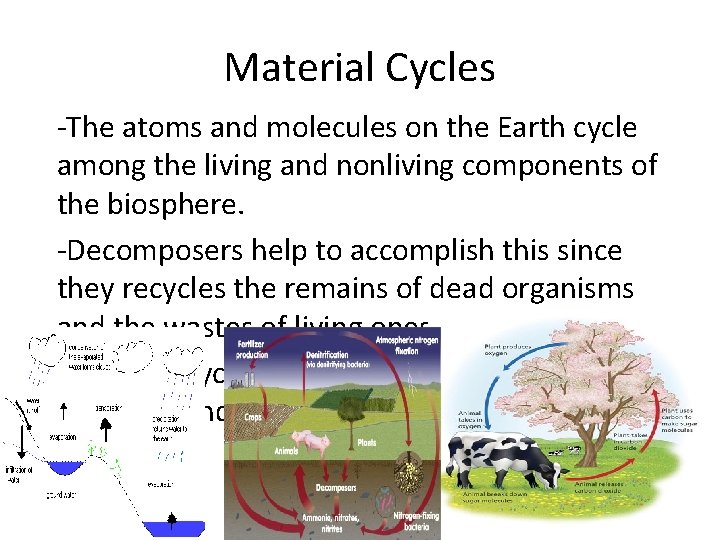
Material Cycles -The atoms and molecules on the Earth cycle among the living and nonliving components of the biosphere. -Decomposers help to accomplish this since they recycles the remains of dead organisms and the wastes of living ones. -Material cycles: water, carbon-oxygen, nitrogen, and phosphorus.
Diagrams of Cycles • http: //www. buzzle. com/articles/the-carboncycle-steps. html • http: //www. bigelow. org/bacteria/ • http: //www. shmoop. com/ecology/watercycle. html
- Slides: 20