
Levels of involvement Levels of involvement in research

- Slides: 34
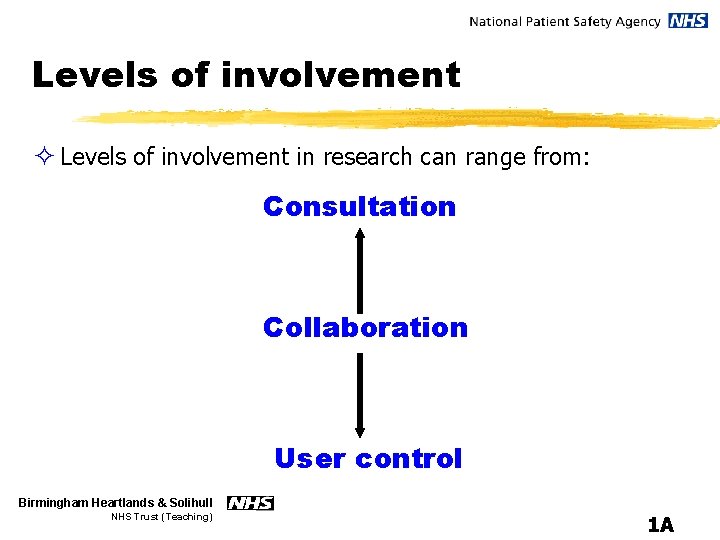
Levels of involvement ² Levels of involvement in research can range from: Consultation Collaboration User control Birmingham Heartlands & Solihull NHS Trust (Teaching) 1 A
Designing and doing research ² Outline exactly what you are going to do and how in a research and development project. You must decide: ¶ What the specific research question is and be able to explain why it is important ¶ Who is going to be involved and how many of them: w Which specific groups of people w Where you will find them w How you will invite them to take part ¶ What information you want to collect ¶ How you will collect that information ¶ How you will analyse that information Birmingham Heartlands & Solihull NHS Trust (Teaching) 1 B
The research question ² You must be very clear about your research question – for example you may tell people that you are doing: ¶research in diabetes but the actual question is: Which combination of treatments for childhood diabetes lead to the best outcomes for good management of the disease? ¶or, research on supporting families when a family member is dying, but the actual question is: What elements of palliative care provide the most assistance in helping family members deal with their grief? ¶the question may be even more specific than that – what is important is that it is clear enough to guide all the other aspects of the design Birmingham Heartlands & Solihull NHS Trust (Teaching) 1 C
Why is the question important? ² When you are explaining why the research is important, that is when you read what other research has been done on the specific area as well as areas closely related to it this is called a literature review: ² You need to read things like: ¶Research reports and discussions in professional journals ¶Books on the topic ¶Government or project reports in the area ¶Information on the Internet ¶Papers given at conferences and seminars Birmingham Heartlands & Solihull NHS Trust (Teaching) 1 D
Who is going to be involved? ² Specific groups of people – this may be based on their: ¶Age ¶Gender ¶Health or social issue ¶Type of treatment or care they receive ¶Cultural identity ¶Life experience ¶Location – city, town, rural, remote ¶Living situation – stable, unsettled, homeless ¶Place they live – own house/flat, nursing home, foster care, etc Birmingham Heartlands & Solihull NHS Trust (Teaching) 1 E
Who is going to be involved? ² Finding them – you need to know where these groups of people are and how far you need to go to find them. ¶Are they anywhere in the UK? ¶Are they in your health region? ¶Do they just use your health or social service or a particular part of the service? ² This may depend on how big or small your project is – or how much detail you want to gain ¶The more information you want to gain and analyse, the more likely that you will work with a smaller group of people Birmingham Heartlands & Solihull NHS Trust (Teaching) 1 F
Who is going to be involved? ² Inviting people to take part – there are different methods for doing this. For example: ¶ Write to the health and social service or organisations where you can find these people ¶ Write to all people in a health and social service or unit ¶ Put up posters or handing out flyers at places where the people are found ¶ Advertise by newspaper, radio or TV ¶ Talk to relevant groups where the people may be found and inviting people to volunteer ¶ Use your own, health and social service staff or user and carer personal networks ¶ Once people are interested you may ask them to talk to others and encourage them to be involved, or suggest others you can contact Birmingham Heartlands & Solihull NHS Trust (Teaching) 1 G
What information do you want? ² The information you want depends on what you need to know so you can answer your research question - this is not a complete list, but it may be things like: ¶ Type, seriousness and length of the health or social problem ¶ Results of medical tests or assessments ¶ Measures of your body function, blood or other body fluids ¶ Information on your personal behaviour ¶ Opinions on the services or care a person receives ¶ Stories of how the health and social service problem affects people, or how people cope with it ¶ Types and lengths of treatments ¶ Effectiveness of treatments Birmingham Heartlands & Solihull NHS Trust (Teaching) 1 H
How will you collect the information? ²Number based information = quantitative research ¶Standard tests where you: w Answer questions and are judged on how accurate you are w Identify how many problems you do or do not have or how bad they are w Have parts of your body, blood or fluid tested or observed ¶Surveys where information is turned into numbers by answering questions with tick boxes or ratings scales ¶Observation where a person’s behaviour or an event is coded and then counted up ¶Checklists where things are ticked of if they did or did not happen Birmingham Heartlands & Solihull NHS Trust (Teaching) 1 I
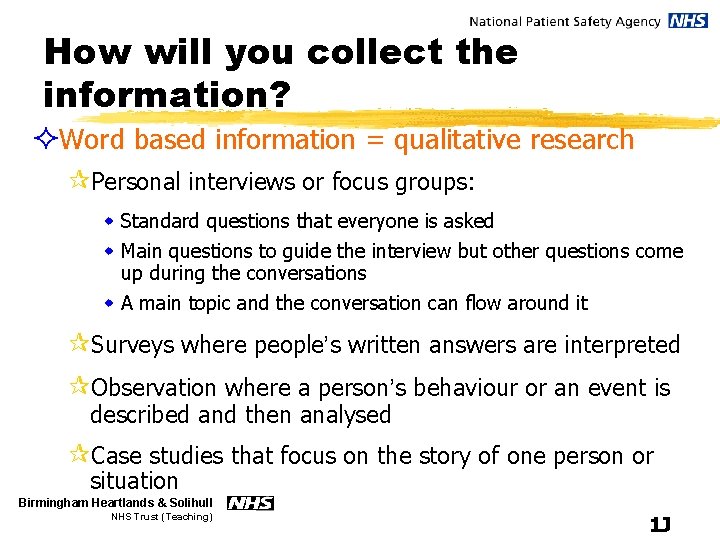
How will you collect the information? ²Word based information = qualitative research ¶Personal interviews or focus groups: w Standard questions that everyone is asked w Main questions to guide the interview but other questions come up during the conversations w A main topic and the conversation can flow around it ¶Surveys where people’s written answers are interpreted ¶Observation where a person’s behaviour or an event is described and then analysed ¶Case studies that focus on the story of one person or situation Birmingham Heartlands & Solihull NHS Trust (Teaching) 1 J
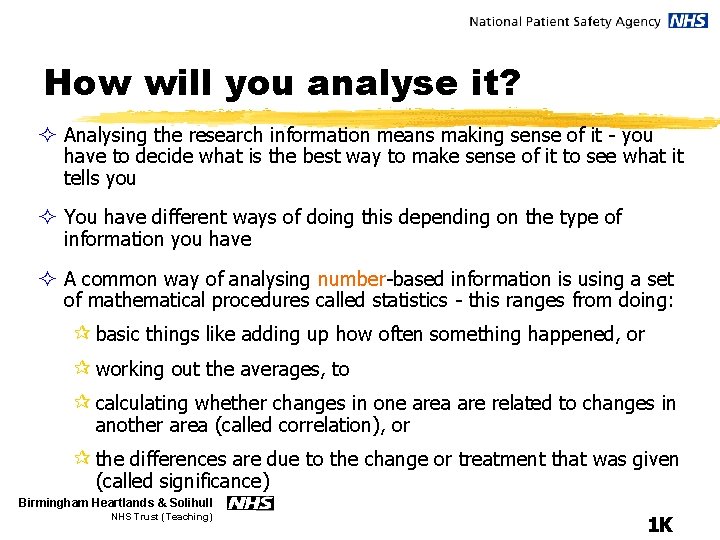
How will you analyse it? ² Analysing the research information means making sense of it - you have to decide what is the best way to make sense of it to see what it tells you ² You have different ways of doing this depending on the type of information you have ² A common way of analysing number-based information is using a set of mathematical procedures called statistics - this ranges from doing: ¶ basic things like adding up how often something happened, or ¶ working out the averages, to ¶ calculating whether changes in one area are related to changes in another area (called correlation), or ¶ the differences are due to the change or treatment that was given (called significance) Birmingham Heartlands & Solihull NHS Trust (Teaching) 1 K
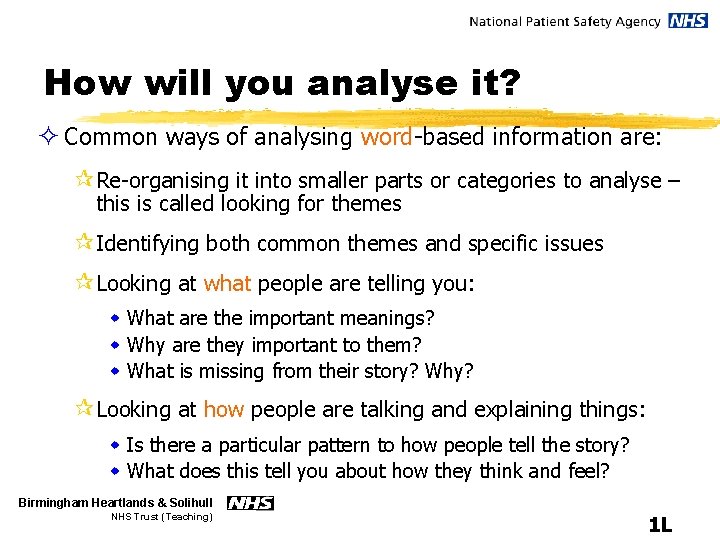
How will you analyse it? ² Common ways of analysing word-based information are: ¶Re-organising it into smaller parts or categories to analyse – this is called looking for themes ¶Identifying both common themes and specific issues ¶Looking at what people are telling you: w What are the important meanings? w Why are they important to them? w What is missing from their story? Why? ¶Looking at how people are talking and explaining things: w Is there a particular pattern to how people tell the story? w What does this tell you about how they think and feel? Birmingham Heartlands & Solihull NHS Trust (Teaching) 1 L
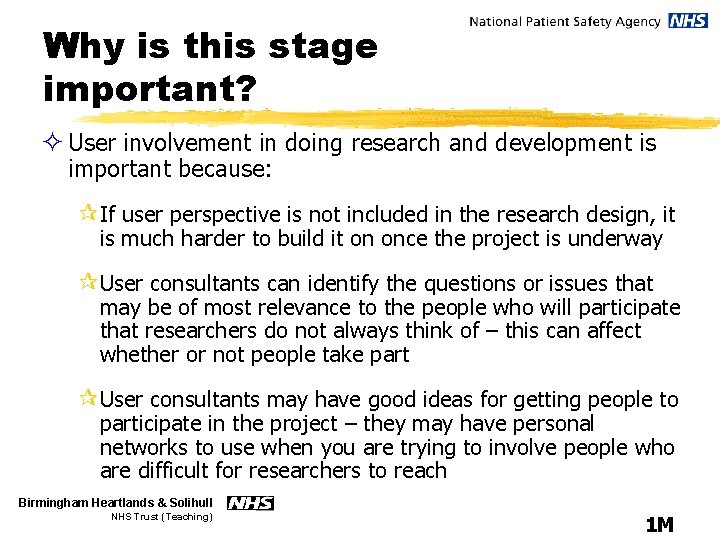
Why is this stage important? ² User involvement in doing research and development is important because: ¶If user perspective is not included in the research design, it is much harder to build it on once the project is underway ¶User consultants can identify the questions or issues that may be of most relevance to the people who will participate that researchers do not always think of – this can affect whether or not people take part ¶User consultants may have good ideas for getting people to participate in the project – they may have personal networks to use when you are trying to involve people who are difficult for researchers to reach Birmingham Heartlands & Solihull NHS Trust (Teaching) 1 M
Why is this stage important? ² It is also important because: ¶User consultants may gain information from participants that participants would not tell to researchers ¶User consultants can make sense of research information that researchers may not think is important or do not understand easily ¶User consultants may have specific expertise or skills in the research area that it is not possible for researchers to have Birmingham Heartlands & Solihull NHS Trust (Teaching) 1 N
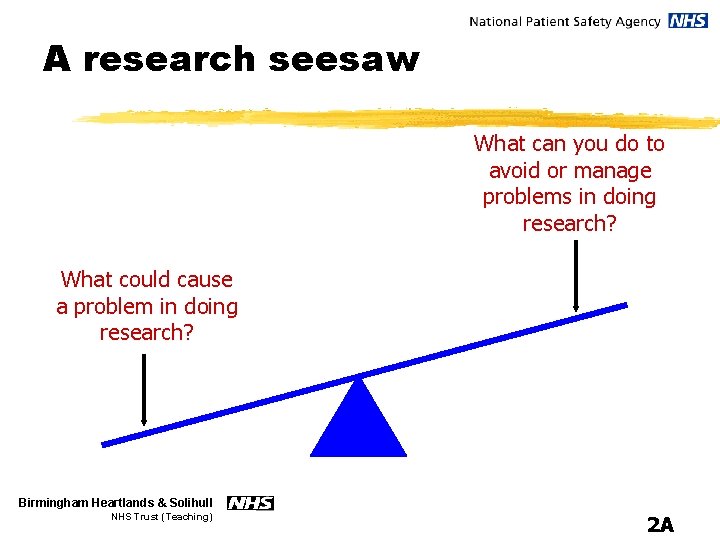
A research seesaw What can you do to avoid or manage problems in doing research? What could cause a problem in doing research? Birmingham Heartlands & Solihull NHS Trust (Teaching) 2 A
Being a researcher ² What is your position – learner or expert? ¶ Your role is to learn about the area you are looking into – you are not there just because you think you know the answers already and just want some evidence to back them up ² What is your identity – who are you as a person? ¶ ‘Who you are’ influences the research because your identity shapes how they see the world ¶ You cannot be neutral although some researchers still like to think can be - the best you can do is be aware of how your identity helps or stops you from seeing things that are important to other people who are a lot or a little different to you – particularly people who are participants in the project Birmingham Heartlands & Solihull NHS Trust (Teaching) 2 B
Being a researcher ² What are your values? You must be aware of you personal values and that they will come out in research. This affects: ¶ what research you decide to do ¶ what research questions you ask ¶ how you decide to do the research ¶ who you include ¶ how you make sense of the research information you gather ² Having the right skills – you bring skills to research but usually need training in other skills too. This can happen via: ¶ training courses and reading books and research guides ¶ doing it hands-on with mentors and role-models Birmingham Heartlands & Solihull NHS Trust (Teaching) 2 C
Ethical principles ² Honesty: ¶ Being honest about the results of the research, what happened and getting the results to people who need to know about them ² Respect: ¶ Showing respect for the people who participate in research - their personal and physical welfare, rights, beliefs, perceptions, customs and cultural heritage at an individual and group level ¶ Not discriminating against a person or group being involved, unless you are only looking at the difference between specific groups of people Birmingham Heartlands & Solihull NHS Trust (Teaching) 2 D
Ethical principles ² Do no harm: ¶ Research and development should not result in physical or emotional harm or lead to a loss of dignity, independence or self -esteem ¶ If there is risk of harm you must say how you will avoid it, or deal with it if it happens ² Benefits or research merit: This is about how worthwhile it is to do the research – can it be justified? You need to answer questions like: ¶ What contribution will it make to people’s lives? ¶ Will the benefits of doing this outweigh the risks? Birmingham Heartlands & Solihull NHS Trust (Teaching) 2 E
Ethical principles ² Justice: ¶ There are both benefits and burdens if a person is participating in research – these need to be a fair sharing of these across people in any society ¶ If the same group of people are targeted as participants, they carry more of the burden and gain less benefit compared to those who are not participating yet benefit from the research ² No deception: ¶ This means that there are no surprises ¶ You will be upfront about what is required of the person and what will happen to them in the project Birmingham Heartlands & Solihull NHS Trust (Teaching) 2 F
Ethical principles ² Informed consent: ¶Participants need accurate and clear written information on what they are being asked to do and what are the likely consequences for them if they choose to participate ¶Researchers must get the right balance in providing this information and avoid using technical and difficult language - if the information is too overwhelming the person will not read or understand it anyway ¶Participants need to understand that they can withdraw from the research at any time without negative consequences Birmingham Heartlands & Solihull NHS Trust (Teaching) 2 G
Ethical principles ² Confidentiality: ¶ Participants need to know how recognisable or not their personal identity will be in the presentation of research outcomes and who has access to the research information ¶ Researchers must explain how they will protect people’s identities ² Privacy: ¶ Sounds similar to confidentiality, but it means the personal space that is or is not off-limits for the research to inquire into ¶ Participants must have the right to refuse to discuss or respond to issues/questions about which they are not comfortable or consider private Birmingham Heartlands & Solihull NHS Trust (Teaching) 2 H
Example 1 – Peer interviewers as project team members ²Purpose: ¶A research team wanted to find out about the views and experiences of parents who use illegal drugs in using health and social services ¶They would share their outcomes with local health and social services so the needs of this group could be better met Birmingham Heartlands & Solihull NHS Trust (Teaching) 3 A
Setting up the project ² The project covered two local areas – they identified suitable people to be ‘peer researchers’ in this way: ¶In Area 1 the researchers approached: w a Community Drug Team who had volunteers who were former drug users and were now leading stable lives w they discovered that some of the volunteers had already been involved in conducting surveys in the local area w they invited two to join the team ¶In Area 2 they asked: w local service providers to suggest suitable people who were in control of their drug use and could have the skills to be peer interviewers - two were nominated Birmingham Heartlands & Solihull NHS Trust (Teaching) 3 B
Roles of the user consultants ² The peer researchers used their networks to encourage people to participate in the research who do not currently use services, as well as those that did ² They interviewed all of the former drug users or people who did not use services, and some of the people currently using services ² They assisted the researches to make sense of – analyse – the information that was gained in the interviews Birmingham Heartlands & Solihull NHS Trust (Teaching) 3 C
Support provided to user consultants ² All peer researchers received: ¶personalised training, either individually or in pairs ¶were debriefed after every two or three interviews ¶with their agreement the researchers stayed in contact with the peer interviewers’ key workers to support them remaining drug free while in contact with other drug users ¶a fee for each completed interview, and an hourly rate for attending training and meetings Birmingham Heartlands & Solihull NHS Trust (Teaching) 3 D
Level of influence or decision -making ² Peer researchers were involved throughout the research in discussions on: ¶the design of the interview guide ¶the themes coming out of the interviews ² They influenced the analysis of the interview information using their personal expertise about being an illegal drugs user – the language and meanings commonly used ² They did not have a strong role in the final report or other things written on the project Birmingham Heartlands & Solihull NHS Trust (Teaching) 3 E
Activities that happened ² The whole project team did 52 interviews of drug-using parents, including people who did and did not use services ² The researchers analysed this information with assistance from the peer researchers ² The researchers developed a report with recommendations for local services ² They also wrote a journal article, but with no input from the peer researchers Birmingham Heartlands & Solihull NHS Trust (Teaching) 3 F
Outcomes achieved ²The research project was able to: ¶reach members of a hidden and reluctant group who would be difficult or impossible for the researchers to reach in any other way ¶collect data quickly due to the peer researchers’ local knowledge - this helped meet the needs of the health and local authorities who wanted to do something about the issue soon Birmingham Heartlands & Solihull NHS Trust (Teaching) 3 G
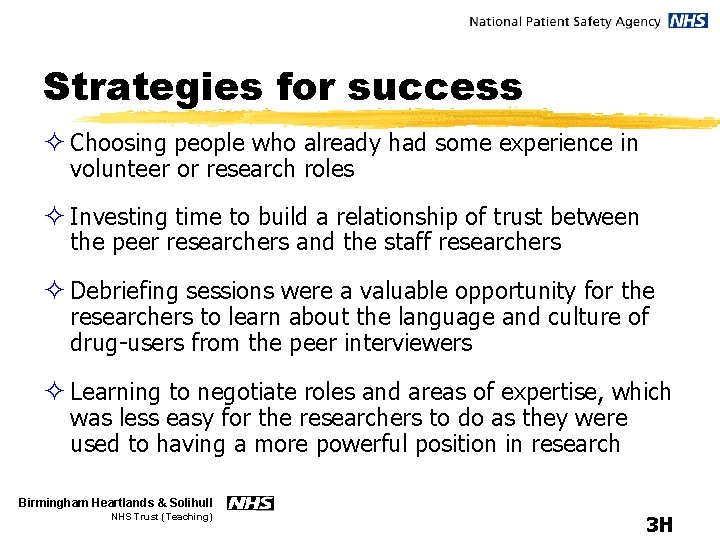
Strategies for success ² Choosing people who already had some experience in volunteer or research roles ² Investing time to build a relationship of trust between the peer researchers and the staff researchers ² Debriefing sessions were a valuable opportunity for the researchers to learn about the language and culture of drug-users from the peer interviewers ² Learning to negotiate roles and areas of expertise, which was less easy for the researchers to do as they were used to having a more powerful position in research Birmingham Heartlands & Solihull NHS Trust (Teaching) 3 H
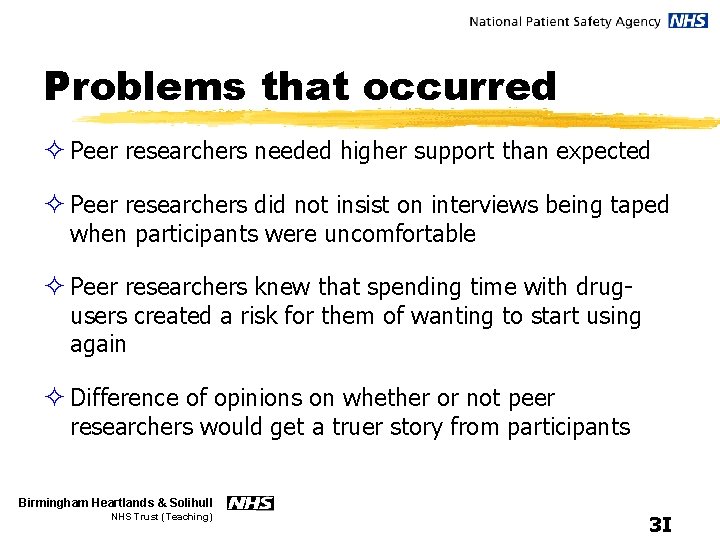
Problems that occurred ² Peer researchers needed higher support than expected ² Peer researchers did not insist on interviews being taped when participants were uncomfortable ² Peer researchers knew that spending time with drug- users created a risk for them of wanting to start using again ² Difference of opinions on whether or not peer researchers would get a truer story from participants Birmingham Heartlands & Solihull NHS Trust (Teaching) 3 I
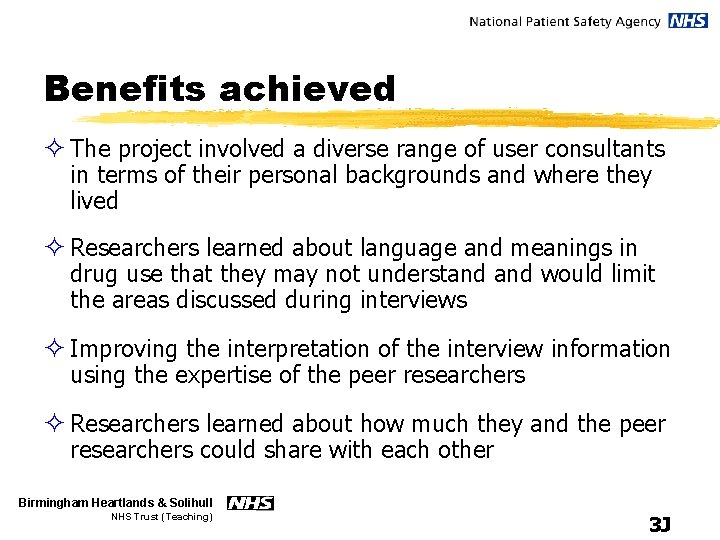
Benefits achieved ² The project involved a diverse range of user consultants in terms of their personal backgrounds and where they lived ² Researchers learned about language and meanings in drug use that they may not understand would limit the areas discussed during interviews ² Improving the interpretation of the interview information using the expertise of the peer researchers ² Researchers learned about how much they and the peer researchers could share with each other Birmingham Heartlands & Solihull NHS Trust (Teaching) 3 J
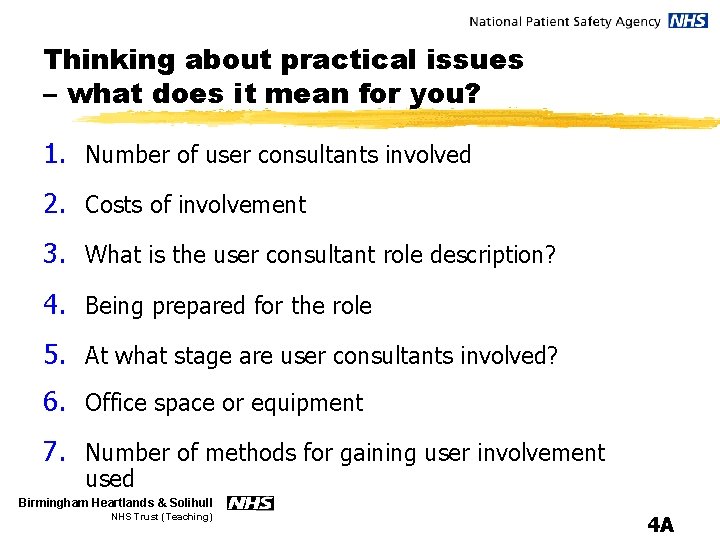
Thinking about practical issues – what does it mean for you? 1. Number of user consultants involved 2. Costs of involvement 3. What is the user consultant role description? 4. Being prepared for the role 5. At what stage are user consultants involved? 6. Office space or equipment 7. Number of methods for gaining user involvement used Birmingham Heartlands & Solihull NHS Trust (Teaching) 4 A
Thinking about practical issues – what does it mean for you? 8. How much information you receive 9. Handling confidential information 10. Training 11. Mentoring 12. Your connection to a network of other users, carers, the public 13. Debriefing opportunities or support 14. Opportunity to reflect on what you learn 15. Dealing with personal difficulties Birmingham Heartlands & Solihull NHS Trust (Teaching) 4 B