
Levels of involvement Levels of involvement in research
- Slides: 15
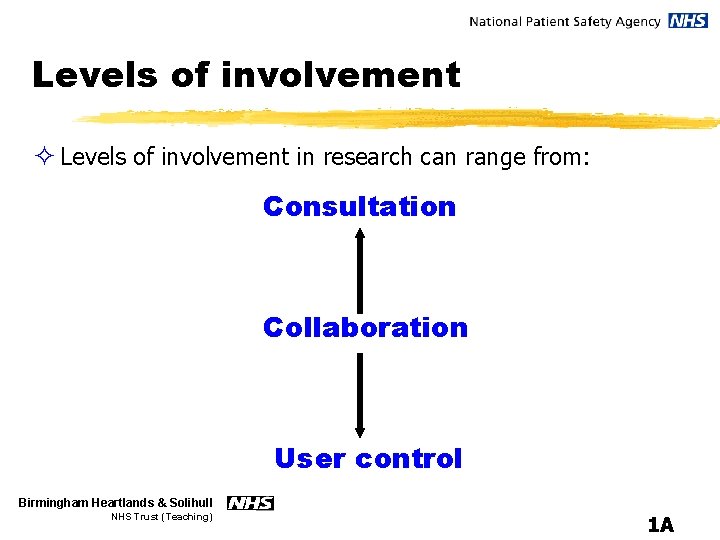
Levels of involvement ² Levels of involvement in research can range from: Consultation Collaboration User control Birmingham Heartlands & Solihull NHS Trust (Teaching) 1 A
Disseminating research ² Disseminating is getting the message about research and development projects and their outcomes out to people who need to know about it ² When disseminating research you need to think about: ¶Methods - ways that you will get the message out ¶Audience – who you need to reach ¶Level of user involvement – what tasks and how much of them you get to do Birmingham Heartlands & Solihull NHS Trust (Teaching) 1 B
Methods for disseminating research ² Common or standard ways are: ¶ Writing reports ¶ Writing a summary of the larger report ¶ Publishing in professional journals, magazines or on Internet websites ¶ Publishing in user/carer association newsletters, magazines or on Internet websites ¶ Writing a chapter in a book or writing a whole book ¶ Conferences or seminar papers and workshops ¶ Presenting a ‘poster’ at a conference or seminar – a short summary of the research and its outcomes on a large poster Birmingham Heartlands & Solihull NHS Trust (Teaching) 1 C
Methods for disseminating research ² Different ways include: ¶ Writing a leaflet or short brochure (2 -4 pages) ¶ Creating a poster that gives a summary of the project using words and pictures ¶ Running community forums to present and discuss the outcomes ¶ Speaking at Patient Forums, user/carer associations, self-help groups ¶ Holding workshops and inviting specific groups who may be interested in the research ¶ Talking on radio – this may include inviting people to call in and discuss the outcomes with you ¶ Appearing on TV ¶ Creating a drama performance or role play Birmingham Heartlands & Solihull NHS Trust (Teaching) 1 D
Who is the audience? ² It can include: ¶ health and social service staff and researchers, ¶ university research groups, ¶ government departments and local government shires, ¶ private companies who are involved with health and social services through the focus of their own work or sponsorship, ¶ users, carers and their associations, ¶ the media, and ¶ the public. ² It could include particular industries – restaurant or catering, mining, agricultural - or schools and childcare centres Birmingham Heartlands & Solihull NHS Trust (Teaching) 1 E
Levels of involvement ² Users, carers and the public may be involved in several different ways: ² Some ways are examples of consultation: ¶joining meetings or workshops to discuss the drafts of final versions with other people – including health and social service staff, researchers and other users, carers and the public – and to decide how the work should be disseminated ¶reading and providing comments on drafts or final versions of the documents by writing a review or talking to the authors Birmingham Heartlands & Solihull NHS Trust (Teaching) 1 F
Levels of involvement ² Other ways are examples of collaboration: ¶co-writing drafts or final versions of the documents you want to produce ¶co-presenting the outcomes at conferences seminars, patient forums, user/carer groups, community forums or invited workshops ¶giving an interview to the newspaper or on radio or appearing on TV together with a health and social service staff researcher ¶co-designing posters ¶co-developing drama performances – possibly also being involved in performing them Birmingham Heartlands & Solihull NHS Trust (Teaching) 1 G
Levels of involvement ² On some occasions they are examples of user control: ¶writing drafts or final versions of the documents you want to produce ¶presenting the outcomes at conferences seminars, patient forums, user/carer groups, community forums or invited workshops ¶giving an interview to the newspaper or on radio or appearing on TV ¶designing posters ¶developing drama performances – possibly also being involved in performing them Birmingham Heartlands & Solihull NHS Trust (Teaching) 1 H
Why is this stage important? ² User involvement in disseminating research and development is important because: ¶ Users, carers and the public may be aware of audiences who need to hear about the research that health and social service researchers may not ¶ User consultants can personally help share results through their personal networks, user/carer groups and associations ¶ User consultants can advise health and social service researchers about the most effective and suitable ways of getting the message across - the language and the ways of presenting it ¶ It demonstrates stronger commitment to user involvement in research and development if user consultants have a strong role in the disseminating stage Birmingham Heartlands & Solihull NHS Trust (Teaching) 1 I
Example 1 – The Mental Health Foundation: Strategies for Living project ² Strategies for Living began in 1997. It: ¶Supports many user-led research projects across the UK: w some of these are examples of user control w others are collaborative examples between users, carers and health and social services researchers ¶funds them and provides training and resources on doing research, e. g. the DIY Guide to Survivor Research ¶provides hands-on advice and support throughout every step the project, including writing the reports ¶publishes them on The Mental Health Foundation website Birmingham Heartlands & Solihull NHS Trust (Teaching) 2 A
Example 1: Strategies for Living – The ‘ups and downs’ of bipolar carers ² Lesley Jenkins is a mental health service user who lives with bi-polar disorder. She was funded by ‘Strategies for Living’ to investigate the experiences, coping strategies and needs of carers who support a person with bi-polar disorder. She: ¶did 13 in depth interviews with carers of people with bipolar disorder ¶analysed the information in the interviews ¶wrote a report where she emphasised the need to: w increase awareness of carers’ needs with mental health services w ensure that carers get appropriate support and understanding Birmingham Heartlands & Solihull NHS Trust (Teaching) 2 B
Example 2 – The Alzheimer’s Society: Quality Research in Dementia Network ² They publish a monthly newsletter for the QRD Network which gives updates on the work of the network – it is two to three pages long ² Every 6 months they do a ‘bumper research newsletter’ – eight or so pages long that provides: ¶what research they plan to fund or are funding and why ¶summaries of completed research projects ¶a list of all current projects ¶progress reports on some of the current projects Birmingham Heartlands & Solihull NHS Trust (Teaching) 2 C
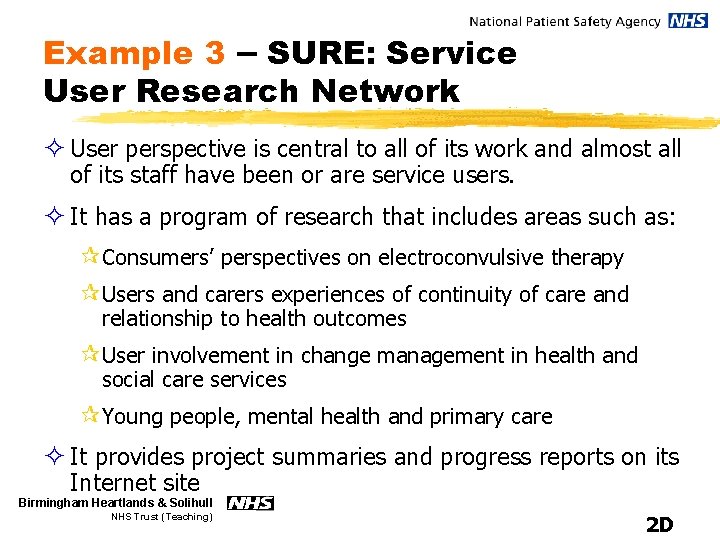
Example 3 – SURE: Service User Research Network ² User perspective is central to all of its work and almost all of its staff have been or are service users. ² It has a program of research that includes areas such as: ¶Consumers’ perspectives on electroconvulsive therapy ¶Users and carers experiences of continuity of care and relationship to health outcomes ¶User involvement in change management in health and social care services ¶Young people, mental health and primary care ² It provides project summaries and progress reports on its Internet site Birmingham Heartlands & Solihull NHS Trust (Teaching) 2 D
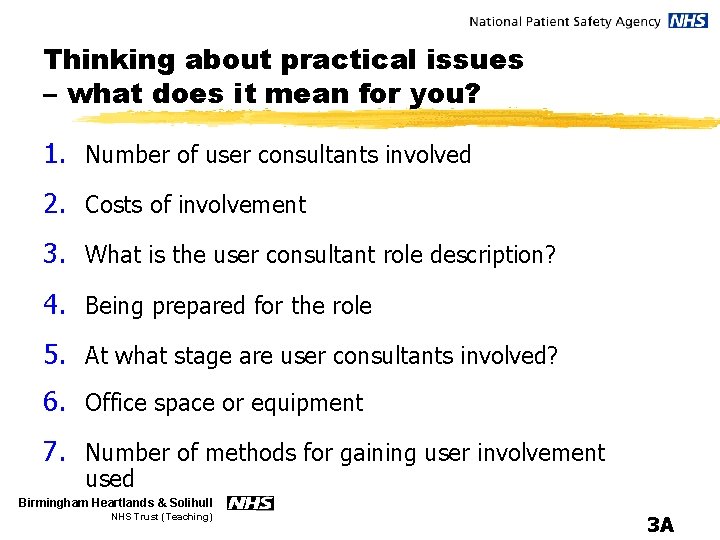
Thinking about practical issues – what does it mean for you? 1. Number of user consultants involved 2. Costs of involvement 3. What is the user consultant role description? 4. Being prepared for the role 5. At what stage are user consultants involved? 6. Office space or equipment 7. Number of methods for gaining user involvement used Birmingham Heartlands & Solihull NHS Trust (Teaching) 3 A
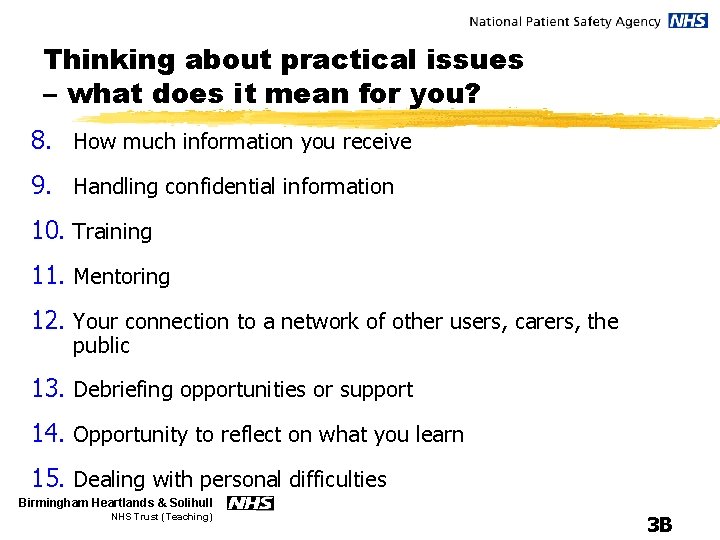
Thinking about practical issues – what does it mean for you? 8. How much information you receive 9. Handling confidential information 10. Training 11. Mentoring 12. Your connection to a network of other users, carers, the public 13. Debriefing opportunities or support 14. Opportunity to reflect on what you learn 15. Dealing with personal difficulties Birmingham Heartlands & Solihull NHS Trust (Teaching) 3 B