
LEVELS OF DEVELOPMENT WHAT IS DEVELOPMENT Development is
- Slides: 21
LEVELS OF DEVELOPMENT
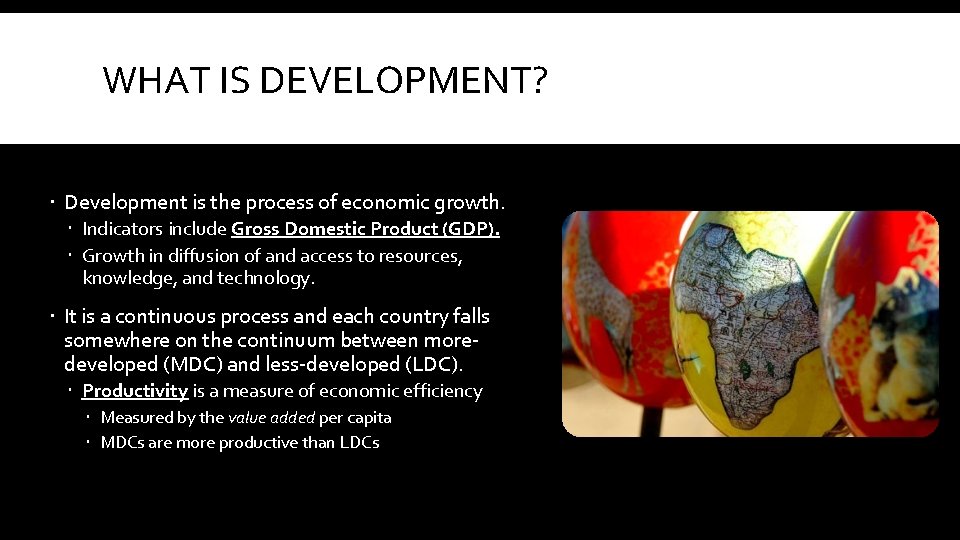
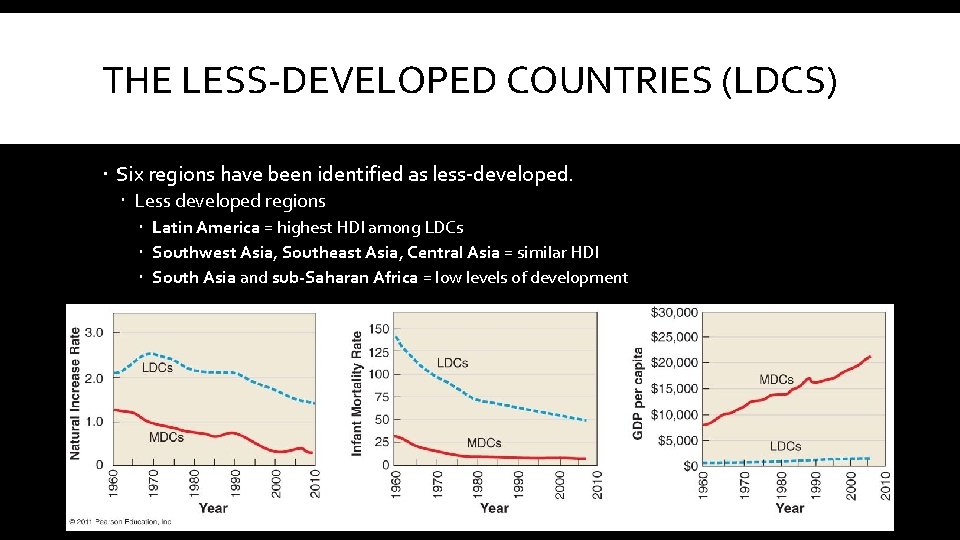
WHAT IS DEVELOPMENT? Development is the process of economic growth. Indicators include Gross Domestic Product (GDP). Growth in diffusion of and access to resources, knowledge, and technology. It is a continuous process and each country falls somewhere on the continuum between moredeveloped (MDC) and less-developed (LDC). Productivity is a measure of economic efficiency Measured by the value added per capita MDCs are more productive than LDCs
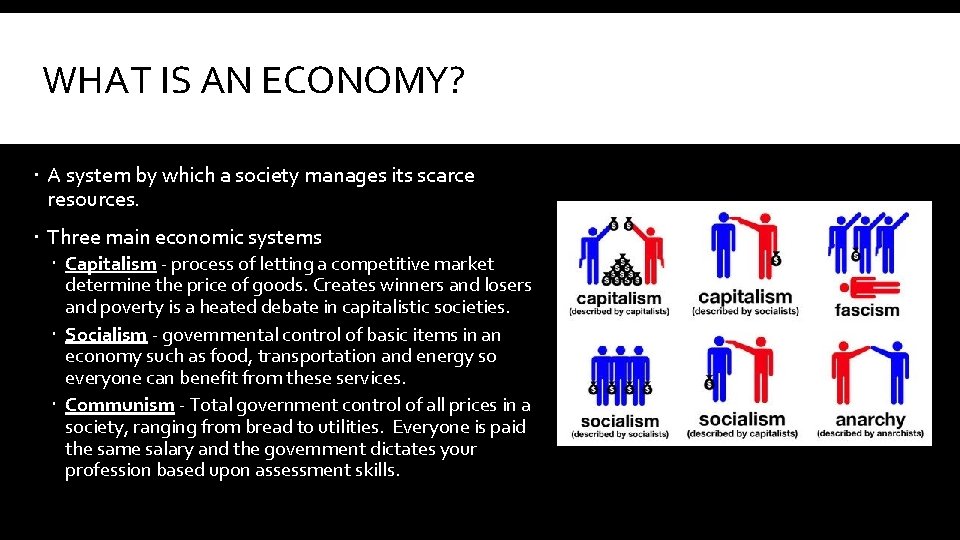
WHAT IS AN ECONOMY? A system by which a society manages its scarce resources. Three main economic systems Capitalism - process of letting a competitive market determine the price of goods. Creates winners and losers and poverty is a heated debate in capitalistic societies. Socialism - governmental control of basic items in an economy such as food, transportation and energy so everyone can benefit from these services. Communism - Total government control of all prices in a society, ranging from bread to utilities. Everyone is paid the same salary and the government dictates your profession based upon assessment skills.
SECTORS OF ECONOMIC ACTIVITY Primary – Harvest or extraction activities such as mining and farming. It is the main form of economic activity in LDCs or periphery countries. Secondary – Manufacturing and assembly and it forms the main economic activity in semi-periphery countries. Tertiary – Service industry as well as selling, moving and trading goods produced from secondary activities. Quaternary – Information exchange – teaching, banking, tourism. FIRE activities as well – finance, insurance and real eastate. Quinary – governmental research and highest-levels of decision making and research – Legislatures, think-tanks etc.
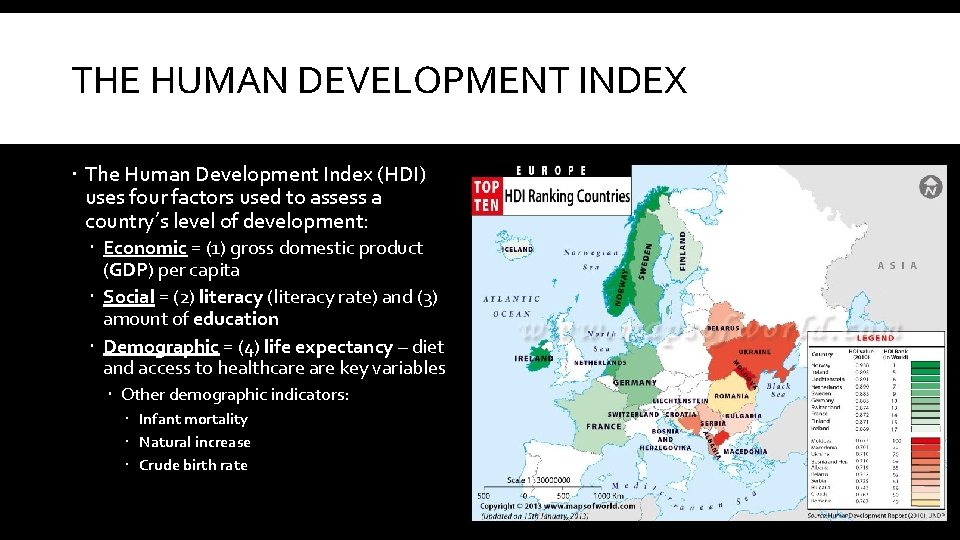
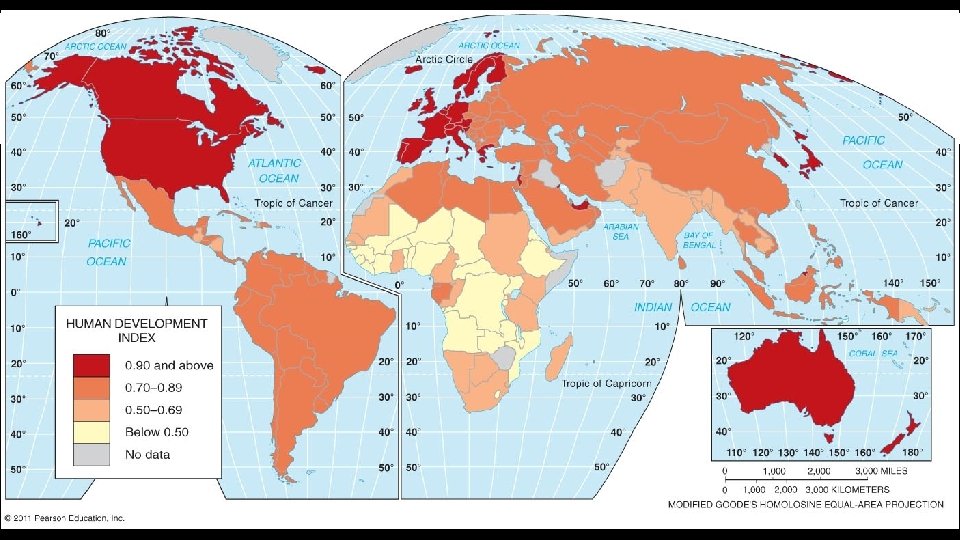
THE HUMAN DEVELOPMENT INDEX The Human Development Index (HDI) uses four factors used to assess a country’s level of development: Economic = (1) gross domestic product (GDP) per capita Social = (2) literacy (literacy rate) and (3) amount of education Demographic = (4) life expectancy – diet and access to healthcare key variables Other demographic indicators: Infant mortality Natural increase Crude birth rate
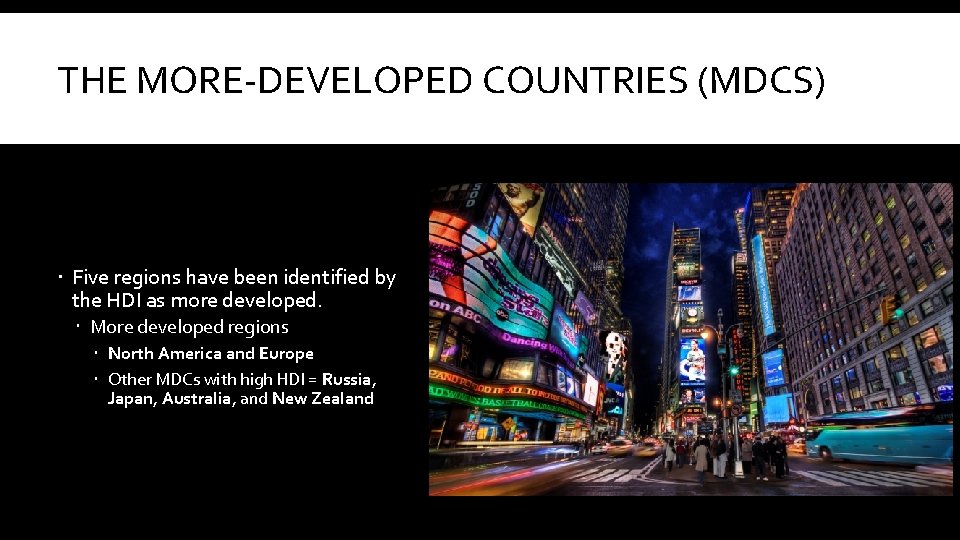
THE MORE-DEVELOPED COUNTRIES (MDCS) Five regions have been identified by the HDI as more developed. More developed regions North America and Europe Other MDCs with high HDI = Russia, Japan, Australia, and New Zealand
THE LESS-DEVELOPED COUNTRIES (LDCS) Six regions have been identified as less-developed. Less developed regions Latin America = highest HDI among LDCs Southwest Asia, Southeast Asia, Central Asia = similar HDI South Asia and sub-Saharan Africa = low levels of development
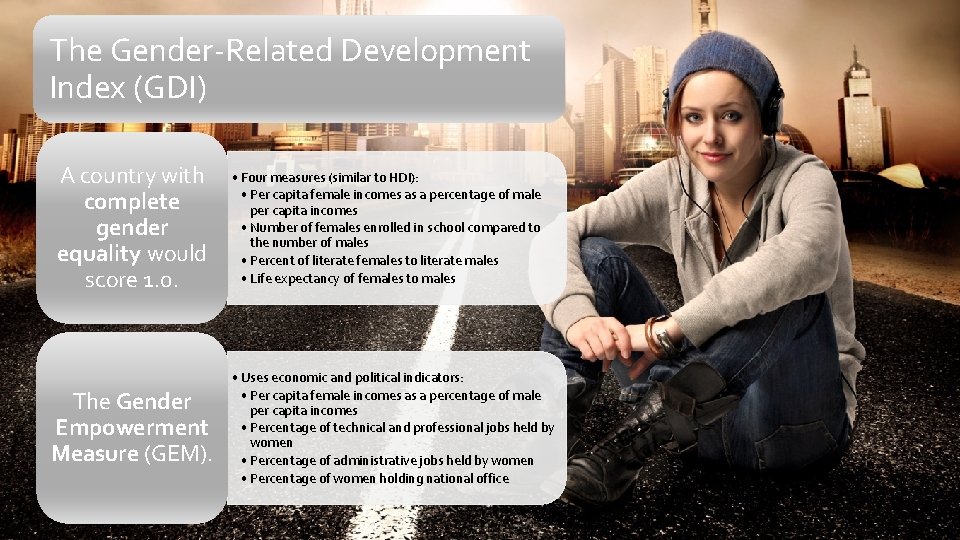
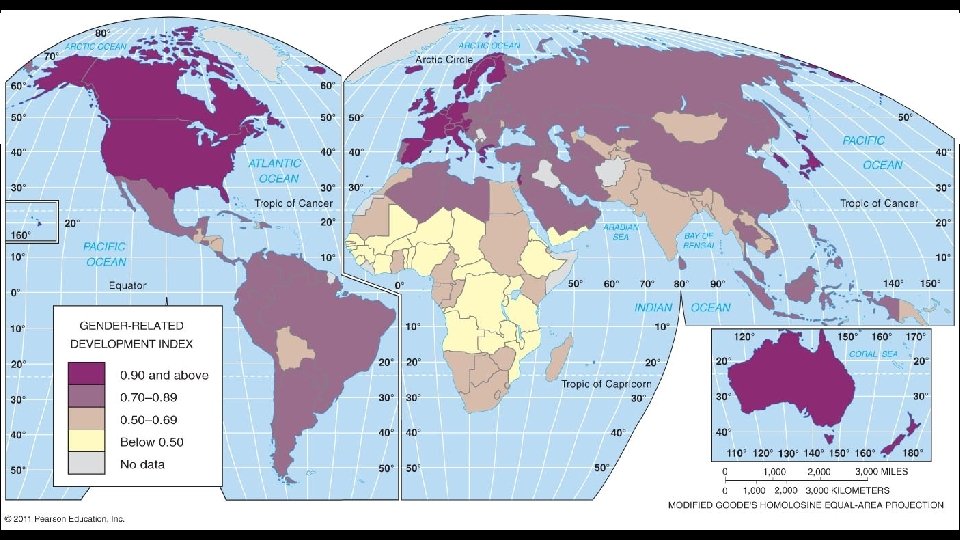
The Gender-Related Development Index (GDI) A country with complete gender equality would score 1. 0. The Gender Empowerment Measure (GEM). • Four measures (similar to HDI): • Per capita female incomes as a percentage of male per capita incomes • Number of females enrolled in school compared to the number of males • Percent of literate females to literate males • Life expectancy of females to males • Uses economic and political indicators: • Per capita female incomes as a percentage of male per capita incomes • Percentage of technical and professional jobs held by women • Percentage of administrative jobs held by women • Percentage of women holding national office
W. W. ROSTOW’S MODEL OF DEVELOPMENT Modernization Model (a “liberal” model) - Walt Whitman Rostow – 1960 s. Countries undergo 5 stages of development in order Model does not account for factors which may cause a country to progress out of the 5 steps: Global politics, colonialism, physical geography, war, culture, and ethnic conflicts
STAGE 1 -- TRADITIONAL SOCIETY The economy is dominated by subsistence activity where output is consumed by producers rather than traded. Any trade is carried out by barter where goods are exchanged directly for other goods. Agriculture is the most important industry and production is labor intensive using only limited quantities of capital. Limited technology, static society Resource allocation is determined chiefly by traditional methods of production.
STAGE 2 -- TRANSITIONAL STAGE (THE PRECONDITIONS FOR TAKEOFF) Increased specialization generates surpluses for trading. External trade also occurs concentrating on primary economic activity products. Commercial agriculture Emergence of a transport infrastructure to support trade. Entrepreneurs emerge.
STAGE 3 -- TAKE OFF �Industrialization increases, with workers switching from the agricultural sector to the manufacturing sector. �Growth is uneven and concentrated in a few regions of the country and in one or two manufacturing industries. �Physical infrastructure improves: roads, railways �The level of investment increases to over 10% of GNP. �The economic transitions are accompanied by the evolution of new political and social institutions that support the industrialization. (political & social elites) �The growth is self-sustaining as investment leads to increasing incomes in turn generating more savings to finance further investment.
STAGE 4 -- DRIVE TO MATURITY The economy is diversifying into new areas. (International trade, Leaving “the Gap” that Barnett talked about) Technological innovation is providing a diverse range of investment opportunities. The economy is producing a wide range of goods and services and there is less reliance on imports.
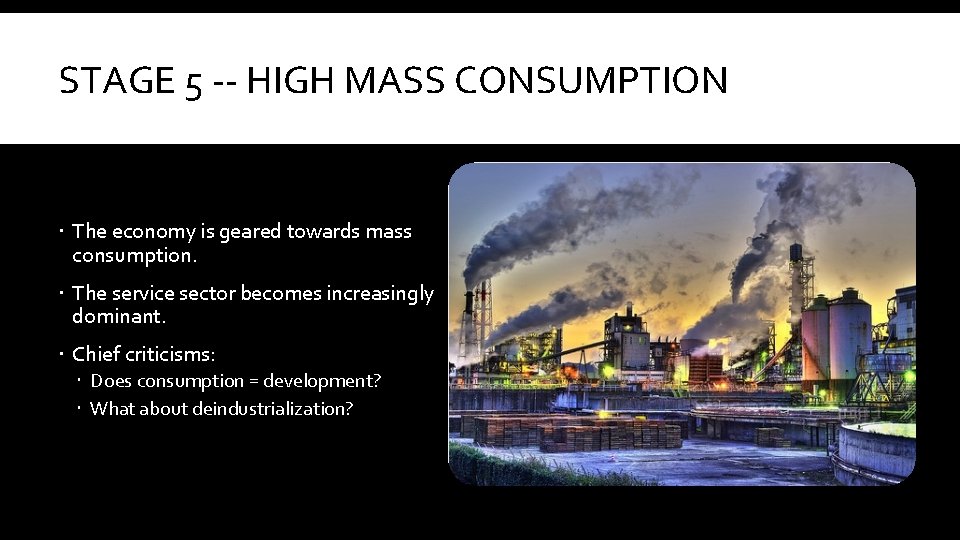
STAGE 5 -- HIGH MASS CONSUMPTION The economy is geared towards mass consumption. The service sector becomes increasingly dominant. Chief criticisms: Does consumption = development? What about deindustrialization?
DEPENDENCY THEORY Core-Periphery Model, Wallerstein’s World-Systems Theory Core – regions with concentrations of employment, capital & economic control; develops with agglomeration. Attracts new investment through: Backward linkages – supplies firms with components & services Forward linkages – help firms find uses & markets for their products Ancillary industries – firms providing services for other corporations Investment into infrastructure & technology
DEPENDENCY THEORIES Political and economic relationships between countries and regions control and also limit the developmental possibilities of less well-off areas (e. g. Imperialism caused colonies to be dependent – this helps sustain the prosperity of dominant areas and poverty of other regions) Elites in society prosper at the expense of lower classes.
THE INTERNATIONAL TRADE APPROACH Development through international trade Rostow’s model of development Examples of international trade approach The “four Asian dragons” Petroleum-rich Arabian Peninsula states Three major problems: Uneven resource distribution Increased dependence on MDCs Market decline
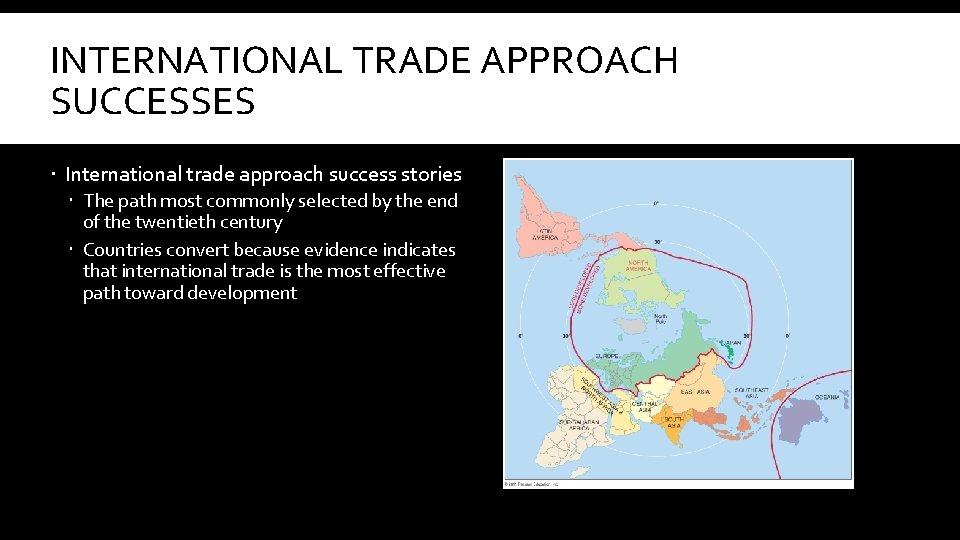
INTERNATIONAL TRADE APPROACH SUCCESSES International trade approach success stories The path most commonly selected by the end of the twentieth century Countries convert because evidence indicates that international trade is the most effective path toward development
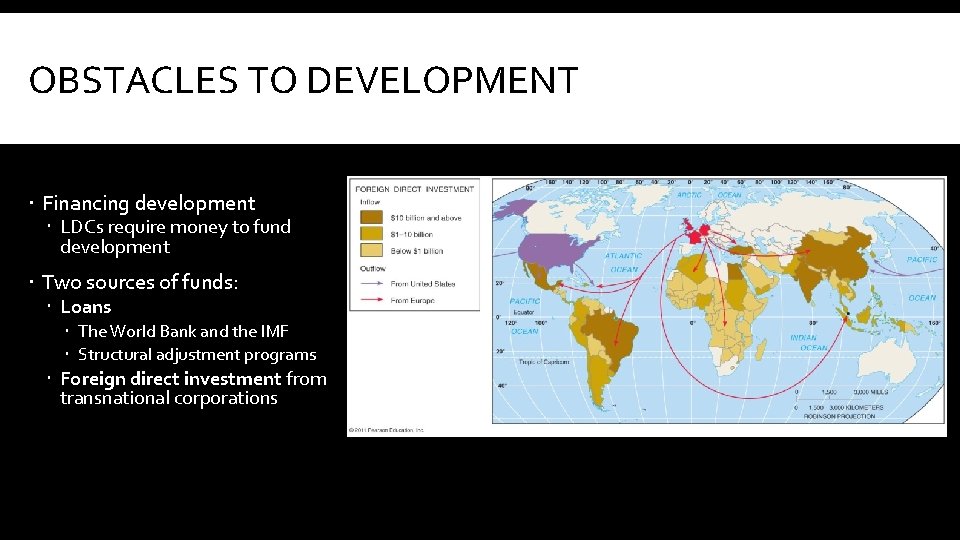
OBSTACLES TO DEVELOPMENT Financing development LDCs require money to fund development Two sources of funds: Loans The World Bank and the IMF Structural adjustment programs Foreign direct investment from transnational corporations