
Levels of Description Mental Modules Reminder Tutorials start

- Slides: 32
Levels of Description & Mental Modules
Reminder: Tutorials start this week on Thursday. Tuesday tutorials start next week. Notice: The next two lectures have been switched around. Language of Thought Hypothesis next week. Folk Psychology the following week. New optional readings on last week’s powerpoint. 1) Readings from Fodor and Pinker about modularity of mind 2) A pair of Scientific American articles, one by Searle presenting his Chinese Room argument, and one by Patricia and Paul Churchland, refuting the Chinese Room.
Follow-up on questions raised last week: 1) Would Searle allow that a computer that modelled the neurochemical processes of the brain might have real intentionality (i. e. might really think)? No, because only the brain has the right kind of causal powers. See the Scientific American article by Searle.
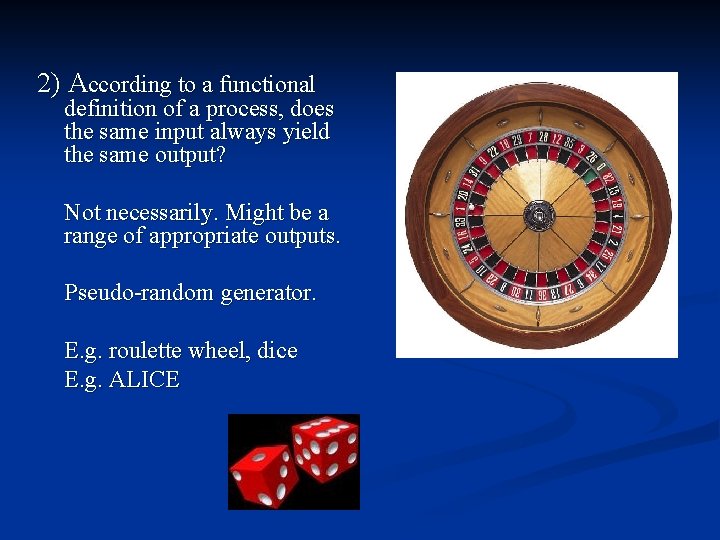
2) According to a functional definition of a process, does the same input always yield the same output? Not necessarily. Might be a range of appropriate outputs. Pseudo-random generator. E. g. roulette wheel, dice E. g. ALICE
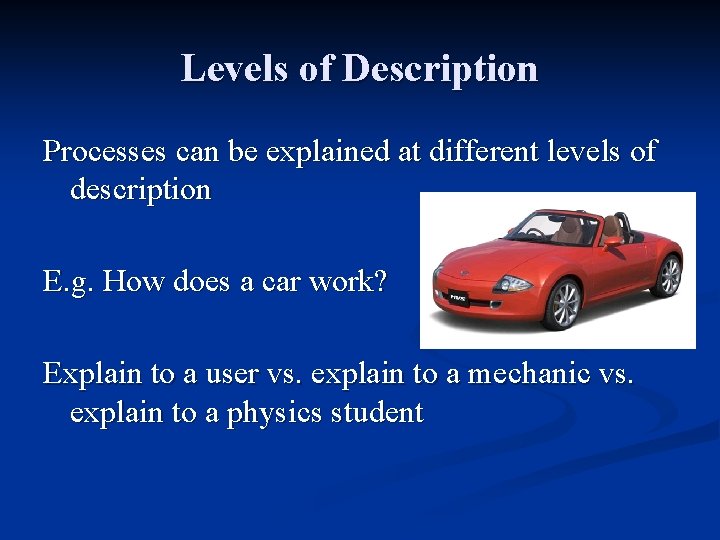
Levels of Description Processes can be explained at different levels of description E. g. How does a car work? Explain to a user vs. explain to a mechanic vs. explain to a physics student
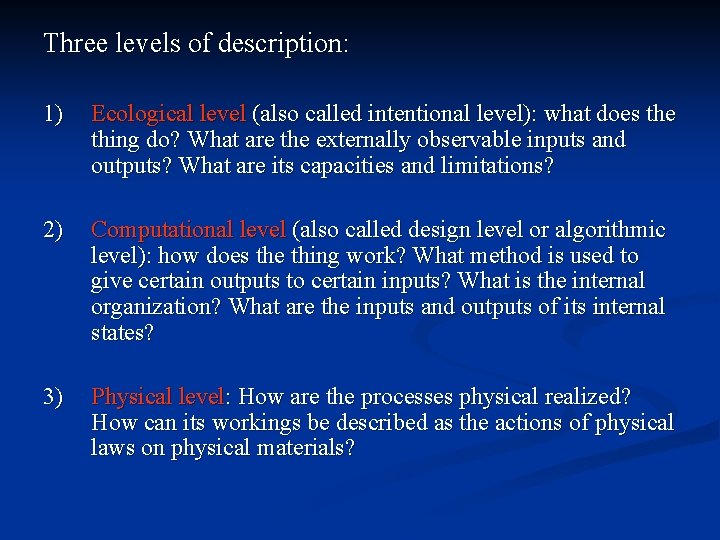
Three levels of description: 1) Ecological level (also called intentional level): what does the thing do? What are the externally observable inputs and outputs? What are its capacities and limitations? 2) Computational level (also called design level or algorithmic level): how does the thing work? What method is used to give certain outputs to certain inputs? What is the internal organization? What are the inputs and outputs of its internal states? 3) Physical level: How are the processes physical realized? How can its workings be described as the actions of physical laws on physical materials?
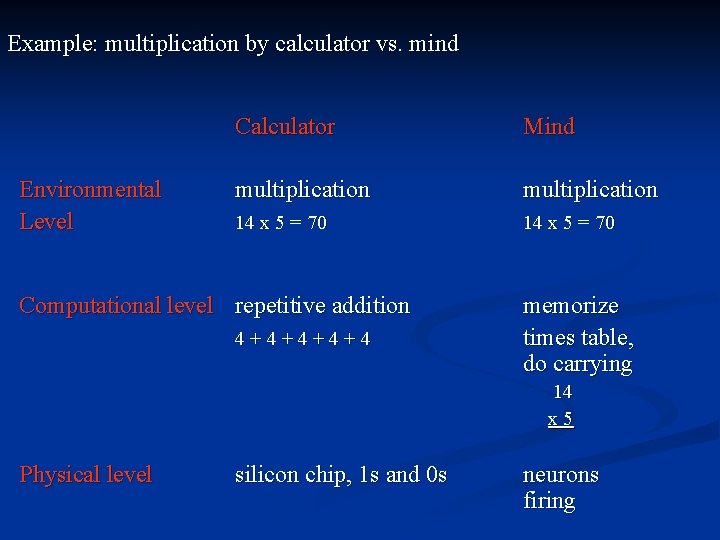
Example: multiplication by calculator vs. mind Environmental Level Calculator Mind multiplication 14 x 5 = 70 Computational level repetitive addition 4+4+4 memorize times table, do carrying 14 x 5 Physical level silicon chip, 1 s and 0 s neurons firing
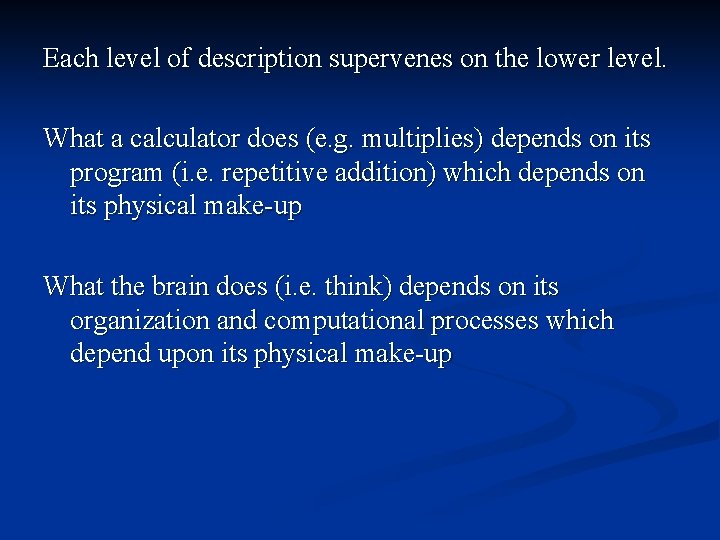
Each level of description supervenes on the lower level. What a calculator does (e. g. multiplies) depends on its program (i. e. repetitive addition) which depends on its physical make-up What the brain does (i. e. think) depends on its organization and computational processes which depend upon its physical make-up
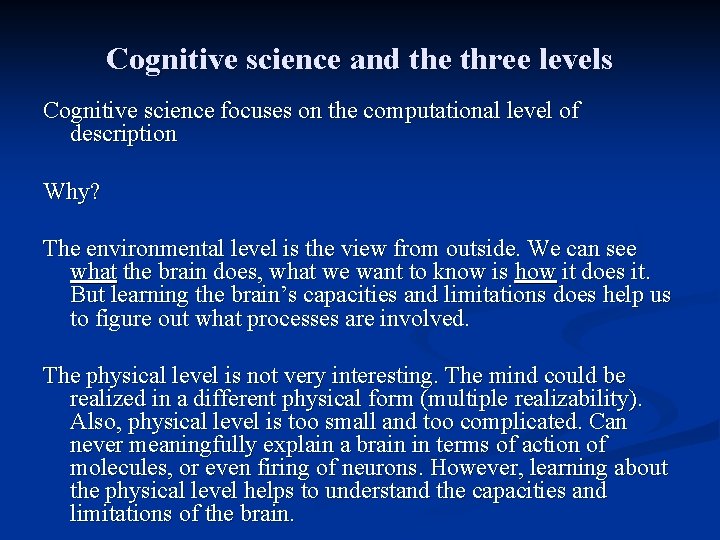
Cognitive science and the three levels Cognitive science focuses on the computational level of description Why? The environmental level is the view from outside. We can see what the brain does, what we want to know is how it does it. But learning the brain’s capacities and limitations does help us to figure out what processes are involved. The physical level is not very interesting. The mind could be realized in a different physical form (multiple realizability). Also, physical level is too small and too complicated. Can never meaningfully explain a brain in terms of action of molecules, or even firing of neurons. However, learning about the physical level helps to understand the capacities and limitations of the brain.
Levels within levels But, there is not just one computational level. The distinction between levels is sometimes unclear. There are levels within levels. The organization of the internal functional modules is a computational description of the whole brain The organization of smaller functional units of a functional module is a computational description of that functional module The organization of sub-routines within a functional unit is a computational level description of that functional unit
Each module, functional unit or sub-routine can itself be described at an ecological level, a computational level or a physical level, e. g. what does this functional unit do (in relation to other functional units of the brain/module), how does it do it, and how is its operation physically realized? Attempts to describe the brain at a computational level can zoom in or zoom out to focus on different levels of detail.
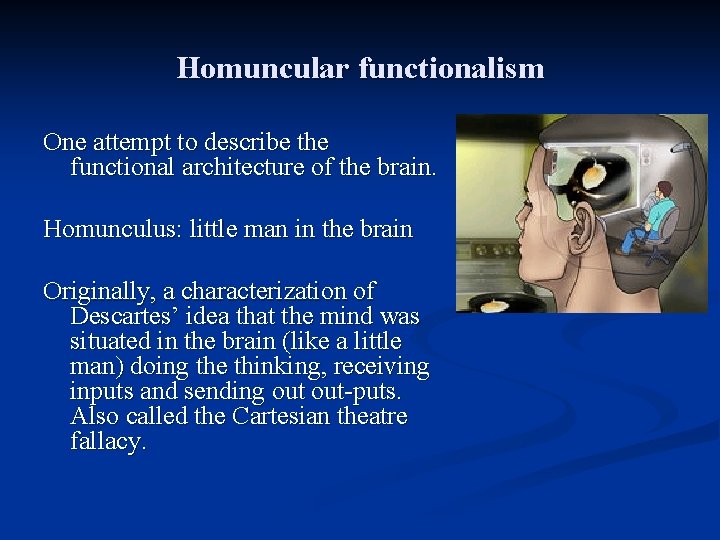
Homuncular functionalism One attempt to describe the functional architecture of the brain. Homunculus: little man in the brain Originally, a characterization of Descartes’ idea that the mind was situated in the brain (like a little man) doing the thinking, receiving inputs and sending out-puts. Also called the Cartesian theatre fallacy.
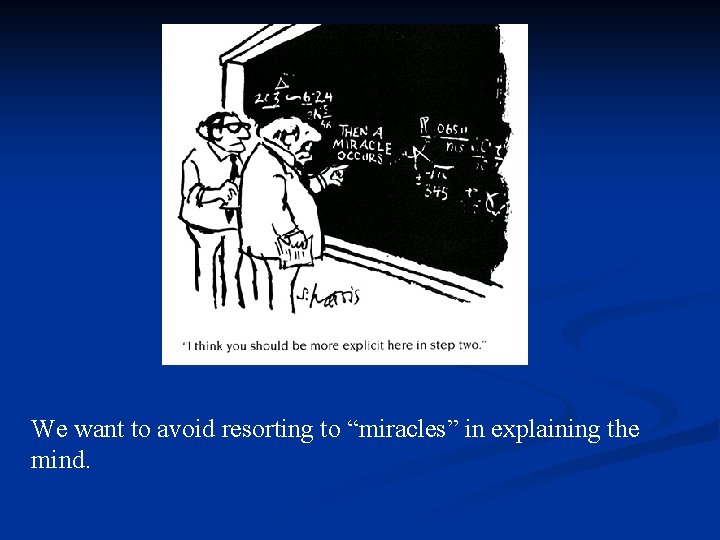
The cognitive science use of the word “homunculus” is used to refer to autonomous functional units of the brain. Homuncular functionalism is the attempt to describe the operation of the brain in terms of (computational level descriptions of) the interaction of smaller and smaller units, until the most basic units can be explained in simple, mechanistic terms (ideally, explainable at a physical level of description). Undischarged homunculi: any homunculus that is posited but whose internal workings are not broken down into more basic levels of explanation. Undischarged homunculi are a problem for any description of the brain.
We want to avoid resorting to “miracles” in explaining the mind.
Modularity of Mind n A computational level description of the mind involves describing the mind’s functional architecture, i. e. how the different functions of the mind are carried out by different structures of the brain. n The mind can be described as organized into different functional modules, i. e. different functionally distinct faculties.
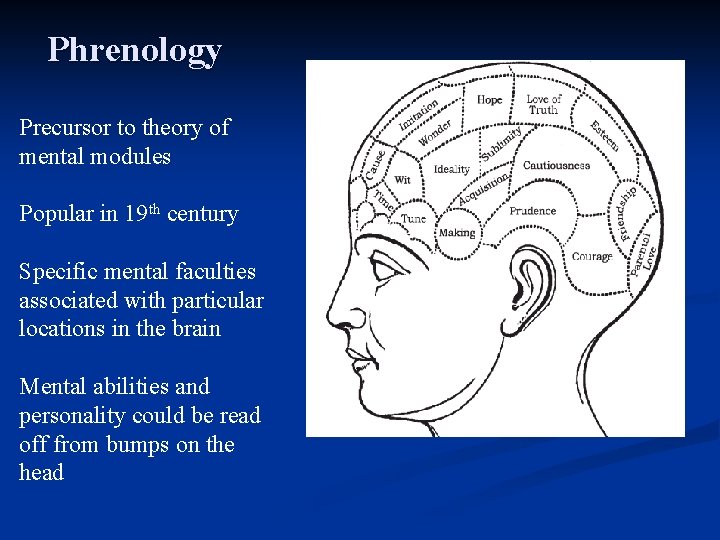
Phrenology Precursor to theory of mental modules Popular in 19 th century Specific mental faculties associated with particular locations in the brain Mental abilities and personality could be read off from bumps on the head
n n n Modern theory of mental modules put forward by Jerry Fodor in 1983. Different parts of the brain are specialized in the performing of different types of function. Modules: a division of labor in the brain. Unlike in phrenology, the modules do not have to occupy a specific location – they can be spread out over different areas of the brain n
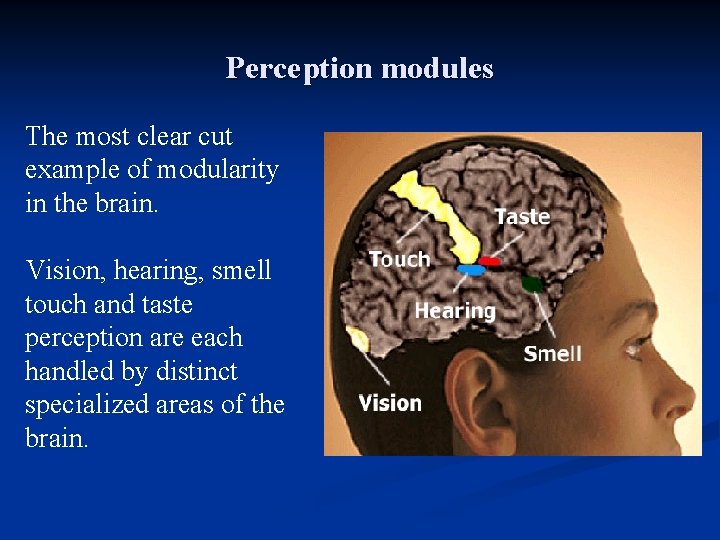
Perception modules The most clear cut example of modularity in the brain. Vision, hearing, smell touch and taste perception are each handled by distinct specialized areas of the brain.
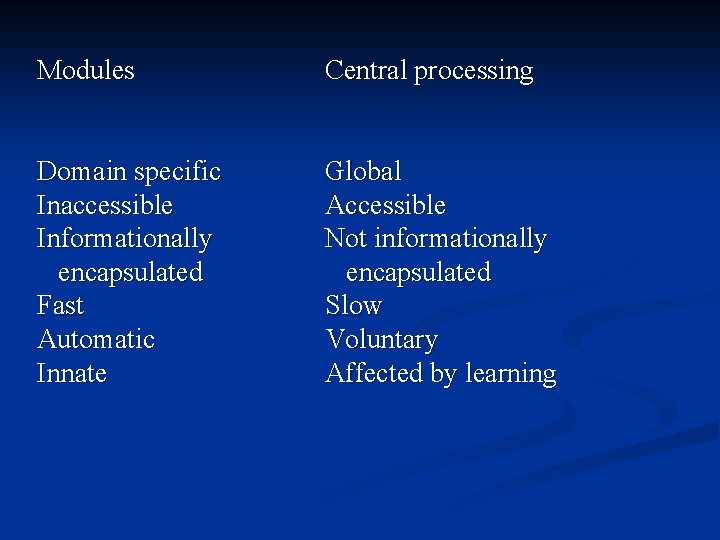
Characteristics of modules According to Fodor, a specialized faculty of the mind must be the following criteria in order to be true modules: 1) 2) 3) 4) 5) 6) 7) Domain specificity Inaccessibility Informational encapsulation, modules need not refer to other psychological systems in order to operate Automatic Fast Innate Fixed neural architecture.
1) Domain specificity: modules are specialized and only operate on one kind of input, e. g. the vision module only operates on visual input – it does not respond to input from other sensory organs or from other parts of the brain. 2) Inaccessibility: you cannot perceive the internal workings of a module, e. g. you cannot look into your mind and find out how your visual system works. You can only perceive the output, e. g. you just see a scene in front of you
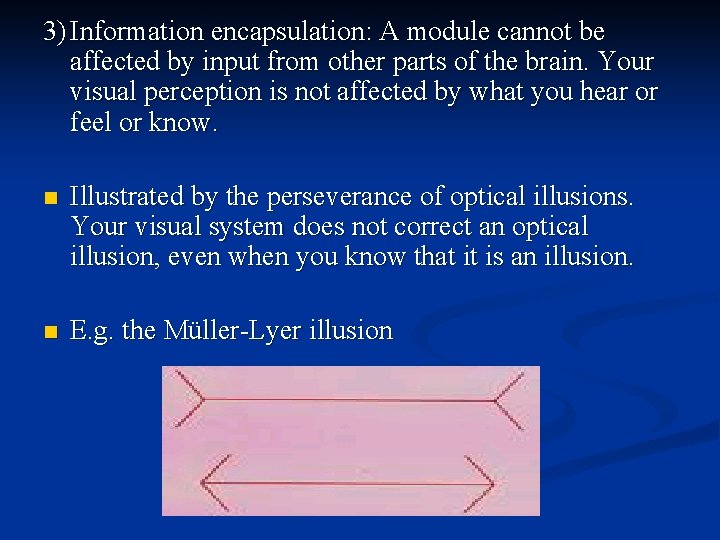
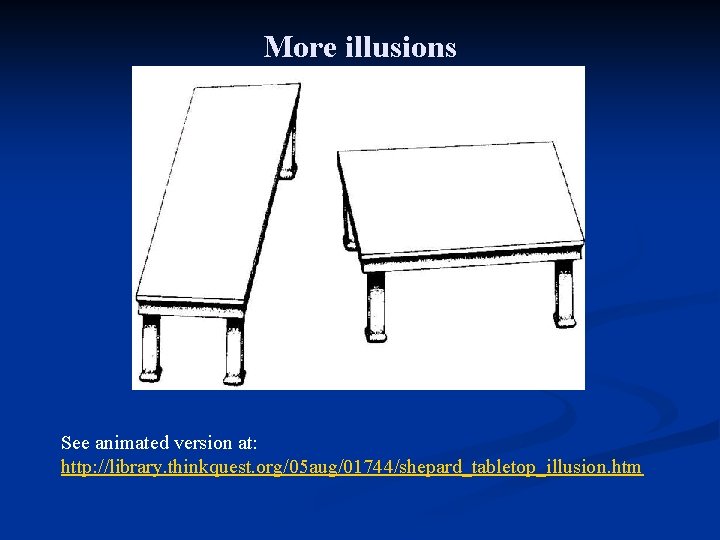
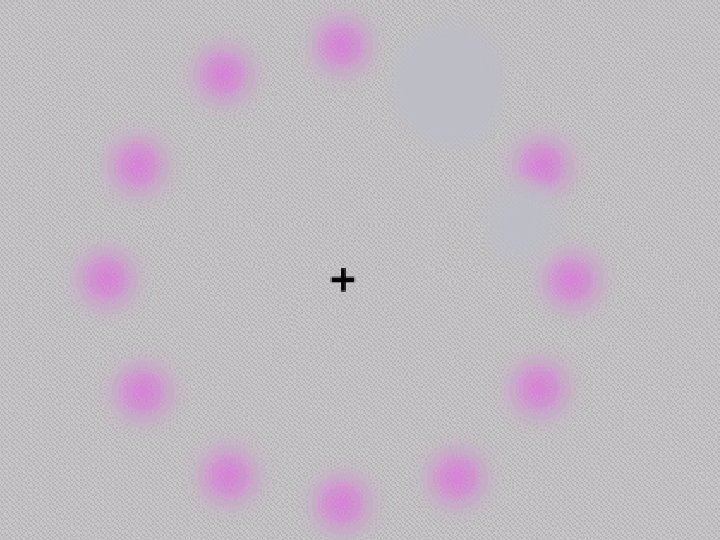
3) Information encapsulation: A module cannot be affected by input from other parts of the brain. Your visual perception is not affected by what you hear or feel or know. n Illustrated by the perseverance of optical illusions. Your visual system does not correct an optical illusion, even when you know that it is an illusion. n E. g. the Müller-Lyer illusion
More illusions See animated version at: http: //library. thinkquest. org/05 aug/01744/shepard_tabletop_illusion. htm
4) Automatic: modules perform their function automatically and it is impossible to turn off the function, e. g. if someone brings a durian into class, you cannot decide not to smell it (unfortunately) 5) Fast: modules work extremely fast, so, for example, you appear to sense things immediately. You are unaware of any delay between opening your eyes and seeing the world. 6) Innate: the capacities of a module are inborn, and not developed through experience 7) Fixed neural architecture: there are particular neural systems associated with particular modules
Modules within modules Modules can very often be broken down to sub-modules. e. g. the visual system appears contain the following modules: 1) 2) 3) Motion processing module Color processing module Form processing module
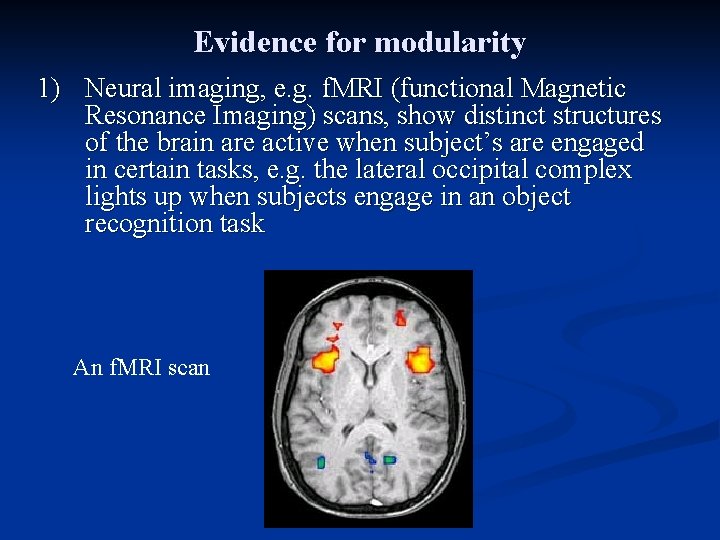
Evidence for modularity 1) Neural imaging, e. g. f. MRI (functional Magnetic Resonance Imaging) scans, show distinct structures of the brain are active when subject’s are engaged in certain tasks, e. g. the lateral occipital complex lights up when subjects engage in an object recognition task An f. MRI scan
2) Brain injuries. An injury (or lesion) in a certain region of the brain results in characteristic problems, e. g. injury to the lateral occipital complex results in the inability to recognize objects (visual agnosia). A patient with this problem can describe the visual appearance of an object, and yet not know what it is. In “The Man who Mistook his Wife for a Hat” by Oliver Sacks, a man with visual aphasia was handed a rose. He described it as the object as “a convoluted red form with a linear green attachment”, but was unable to recognize it as a rose. One problem with brain injury evidence: damage to a particular structure of the brain may interfere with the operation of a function even if it is not directly associated with that function, e. g. alien damages water fountain in busy office.
3) Double dissociation: if A can be found without B, and B can be found without A, then A and B are distinct and independent things. E. g. Visual aphasia can be found in patients who have no problem in seeing motion or recognizing color. Patients can be unable to see motion (akinetopsia), yet recognize colors and objects with no problem. Patients can be unable to recognize colors (akromatopsia) (in spite of normal vision) and yet have no problems with color or object recognition.
Face recognition module The form recognition module itself contains at least one submodule: the face recognition module. Double dissociation: some people have a very specific deficit in recognizing faces, called prosopagnosia or face blindness. They have no trouble recognizing other objects. People with face blindness can recognize friends and acquaintances by looking at other visual cues, e. g. body shape, haircut, glasses, etc. Interesting video on face blindness: in “The Human Face”, a BBC television series, Episode 2.
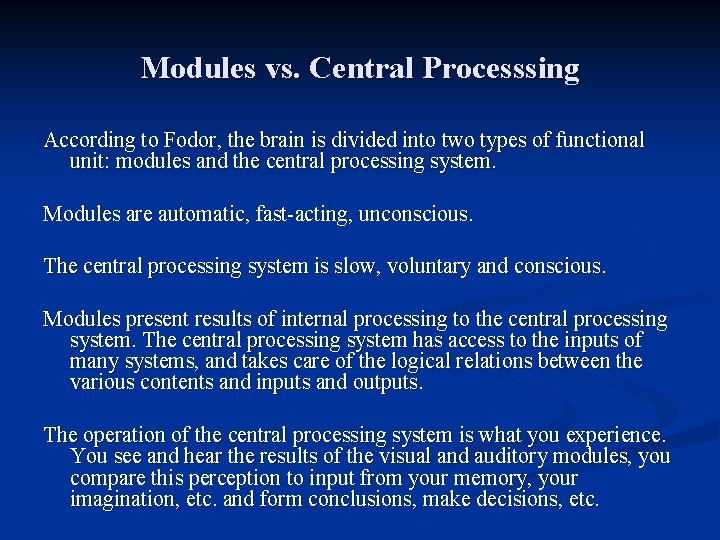
Modules vs. Central Processsing According to Fodor, the brain is divided into two types of functional unit: modules and the central processing system. Modules are automatic, fast-acting, unconscious. The central processing system is slow, voluntary and conscious. Modules present results of internal processing to the central processing system. The central processing system has access to the inputs of many systems, and takes care of the logical relations between the various contents and inputs and outputs. The operation of the central processing system is what you experience. You see and hear the results of the visual and auditory modules, you compare this perception to input from your memory, your imagination, etc. and form conclusions, make decisions, etc.
Modules Central processing Domain specific Inaccessible Informationally encapsulated Fast Automatic Innate Global Accessible Not informationally encapsulated Slow Voluntary Affected by learning
Readings Required: Sterelny, Kim, The Representational Theory of Mind, Chapter 2, pgs. 19 -41, on reserve in Philosophy Department Optional: Pinker, Stephen, The Language Instinct, Ch. 3 “Mentalese”, pgs. 55 -82, on reserve in the Philosophy Department Dennett, Daniel, Brainstorms, “A Cure for the Common Code”, pgs. 90 -108, on reserve in the Philosophy