
Levels of Data Service What must you do
- Slides: 22
Levels of Data Service What must you do? What could you do? How much work is involved? Vince Gray Ontario DLI Training April 5, 2004
Finding the balance Work is piled on your plate in four spots: 1. 2. 3. 4. What you can do What you want to do What you are told to do What your patrons need you to do You must balance all four simultaneously
Questions to consider n n n Staffing Equipment Physical considerations Politics Pragmatics http: //idls. ssc. uwo. ca/idls/Presentation/DLIOrientation/Levels_of_Service. html
Staffing n n n Team approach? With or without specialist? Variant levels of service depending on staff member present? Other staff resources to draw upon? Location of other staff? Skill set of available staff?
Equipment n Number and nature of machines where data files are to be delivered n Ability and authority to install software n Budget available for unanticipated needs
Physical Considerations n n n After hour and remote access to data? Authentication system to know who is using the data? How do users connect to the service?
Politics n n n Level of support from administration Working relationship with library systems department & campus computing service “Contracting out” of some data delivery
Pragmatics n n What do your patrons need? What does your library system want to provide or expect of the service?
“Minimalist” Data Service n Download data from ftp. statcan. ca n Order data from dlilist@statcan. ca n Provide data to the user
Recommended Services n Basic reference: find and identify data files n Basic assistance with documentation n Refer patrons to other people who can provide them assistance
Words of Advice n Record and archive what you’ve done n Keep usage statistics n DON’T DO THE SAME WORK TWICE!!
Possible services (1) n n n “Sophisticated” documentation assistance Assistance with sophisticated data packages, such as Canada Food Stats Archival storage of data deposited by faculty or staff
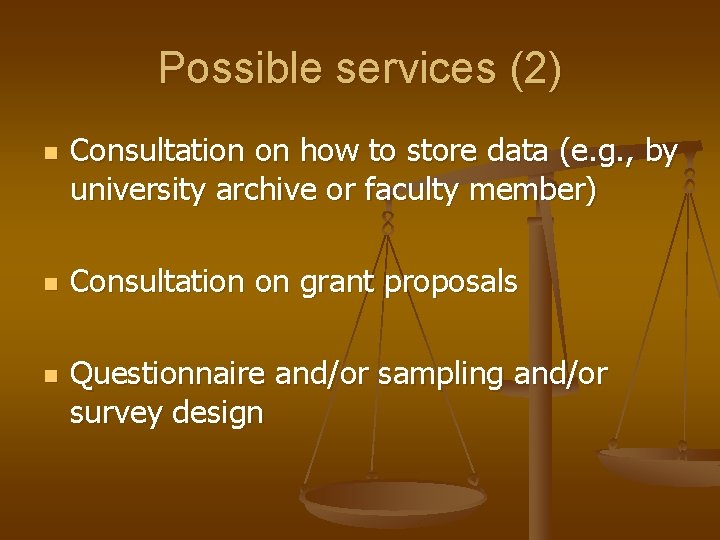
Possible services (2) n n n Consultation on how to store data (e. g. , by university archive or faculty member) Consultation on grant proposals Questionnaire and/or sampling and/or survey design
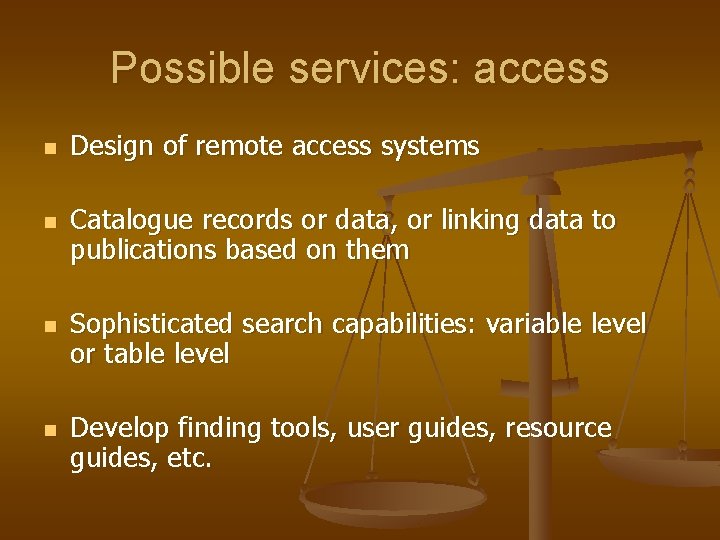
Possible services: access n n Design of remote access systems Catalogue records or data, or linking data to publications based on them Sophisticated search capabilities: variable level or table level Develop finding tools, user guides, resource guides, etc.
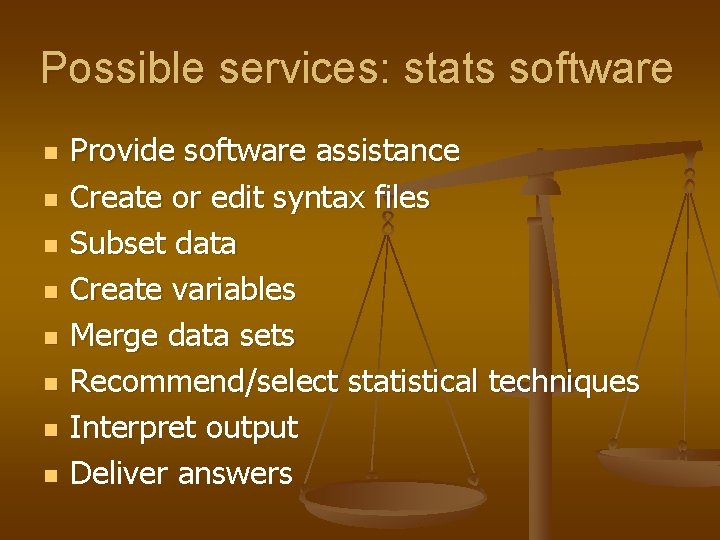
Possible services: stats software n n n n Provide software assistance Create or edit syntax files Subset data Create variables Merge data sets Recommend/select statistical techniques Interpret output Deliver answers
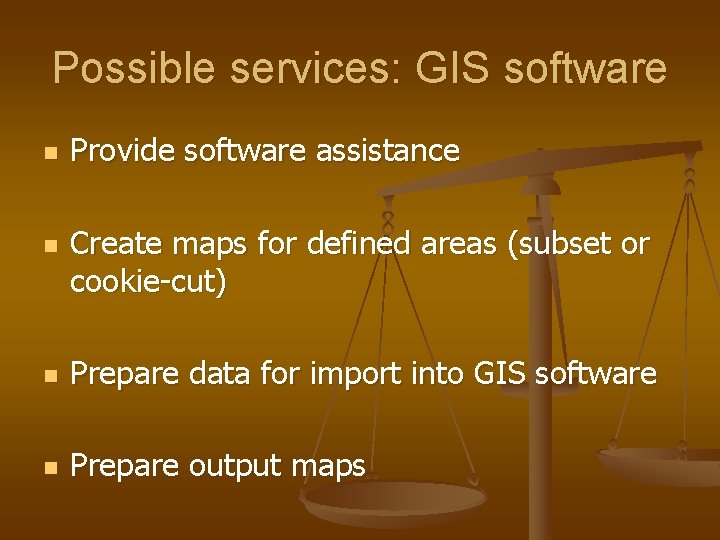
Possible services: GIS software n n Provide software assistance Create maps for defined areas (subset or cookie-cut) n Prepare data for import into GIS software n Prepare output maps
Possible services: migrate data n n n Conversion from one format or platform to another Can be done for maps, for GIS-linked data, or for data itself Requires varying levels of software sophistication
Possible service: instruction n n Classroom or individual based instruction On availability of data, of data services, of software, of remote access to data, etc. n Software instruction n Use of particular data sets n Online tools (e. g. , viewlets developed at Winnipeg)
Possible services: other n Develop custom services for local users (e. g. , assist in development of cumulative codebooks) n Create “local” data subsets n Create cross-reference / concordance tools n Develop documentation
Summary n n n Your data service will be unlike any other Increase what you do as you add resources and/or expertise Change what you do as users discover your service and themselves change
Last words Everything takes time and money! ENJOY! WORKING WITH DATA IS FUN!
Presenter n n n n Vince Gray Data Resources Librarian University of Western Ontario London N 6 A 5 C 2 E-mail: vince@uwo. ca Phone: 519 -661 -2111 ext. 85044 Fax: 519 -661 -3231