
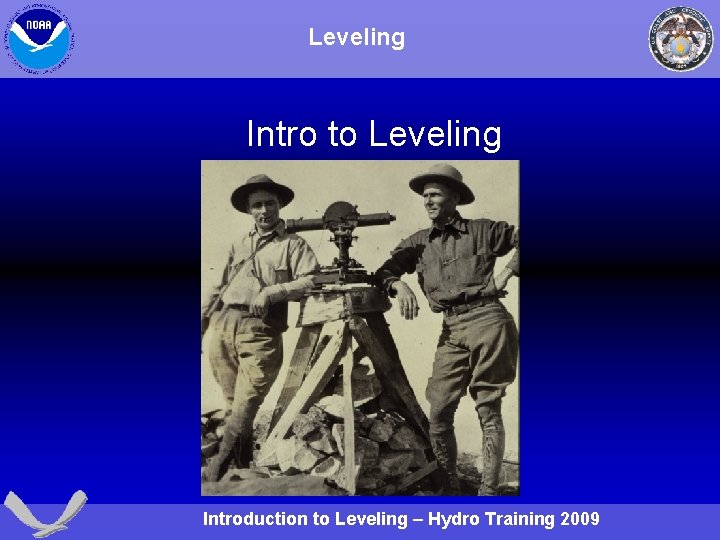
Leveling Intro to Leveling Introduction to Leveling Hydro
- Slides: 23
Leveling Intro to Leveling Introduction to Leveling – Hydro Training 2009
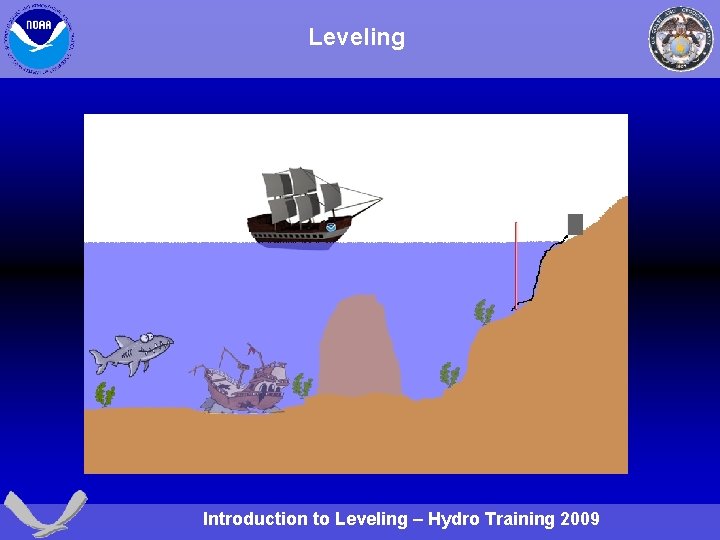
Why do we level? • To determine elevation with respect to an imaginary level surface (geoid) • Leveling allows you to tie the depths acquired with the sonar to the geoid Introduction to Leveling – Hydro Training 2009
Leveling Introduction to Leveling – Hydro Training 2009
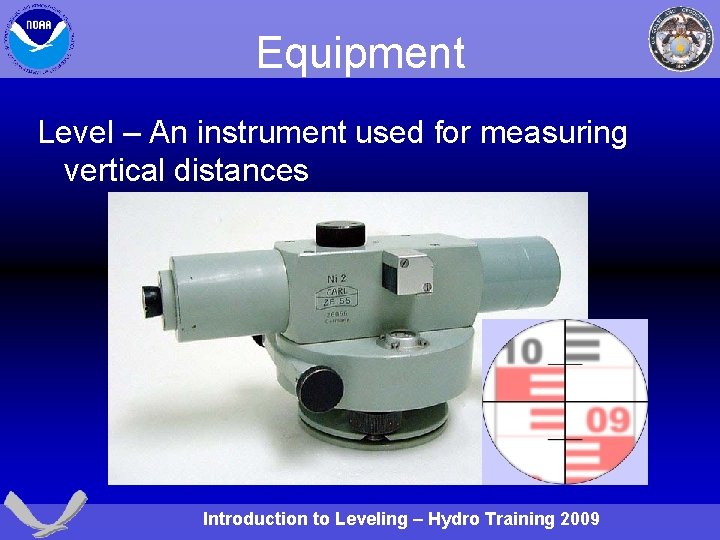
Equipment Level – An instrument used for measuring vertical distances Introduction to Leveling – Hydro Training 2009
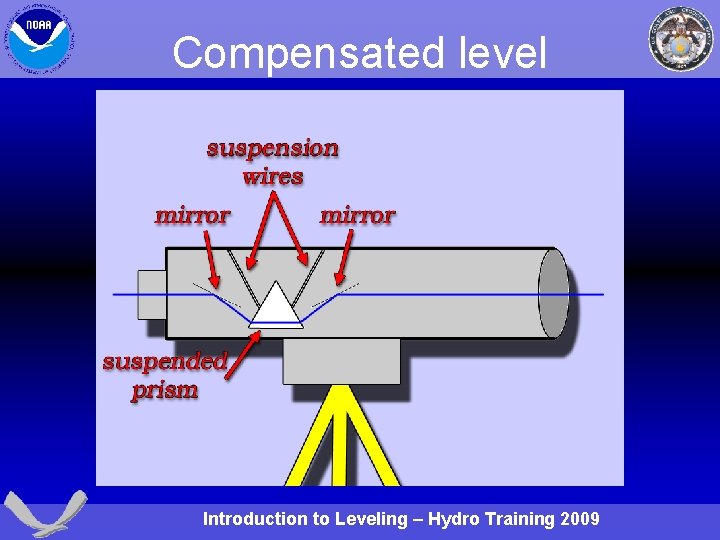
Compensated level Introduction to Leveling – Hydro Training 2009
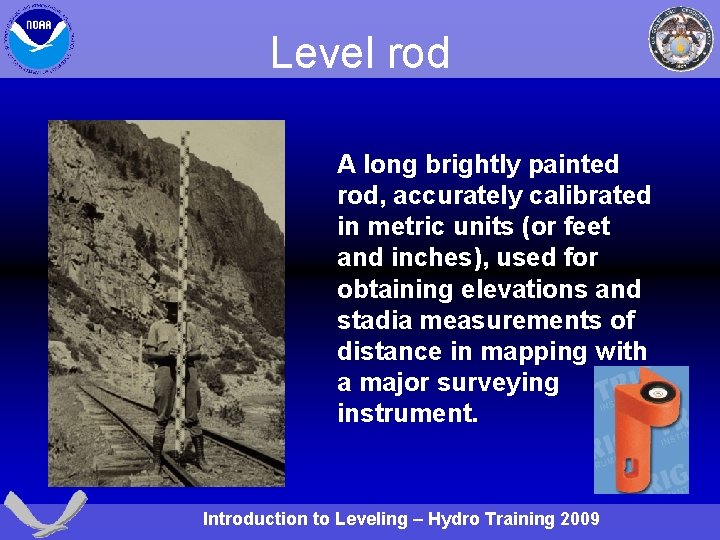
Level rod A long brightly painted rod, accurately calibrated in metric units (or feet and inches), used for obtaining elevations and stadia measurements of distance in mapping with a major surveying instrument. Introduction to Leveling – Hydro Training 2009
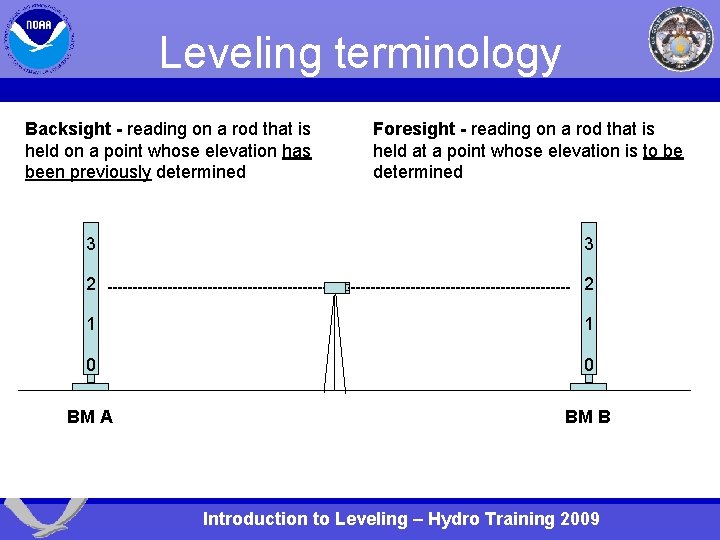
Leveling terminology Backsight - reading on a rod that is held on a point whose elevation has been previously determined Foresight - reading on a rod that is held at a point whose elevation is to be determined 3 3 2 2 1 1 0 0 BM A BM B Introduction to Leveling – Hydro Training 2009
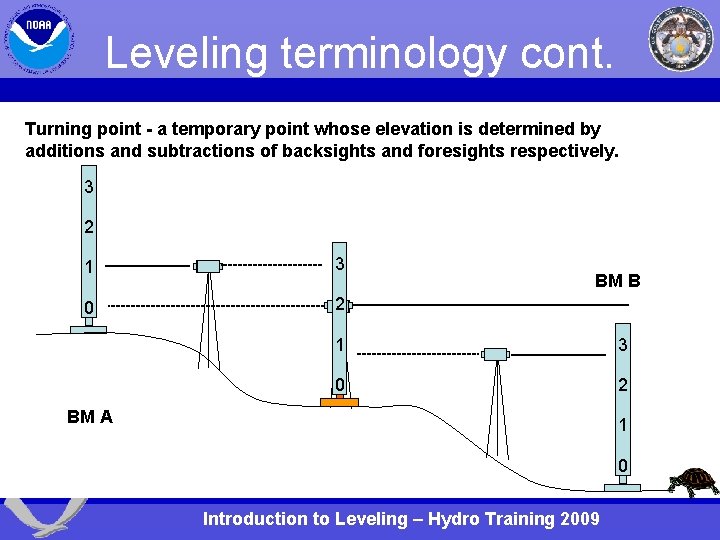
Leveling terminology cont. Turning point - a temporary point whose elevation is determined by additions and subtractions of backsights and foresights respectively. 3 2 1 3 0 2 BM B 1 3 0 2 BM A 1 0 Introduction to Leveling – Hydro Training 2009
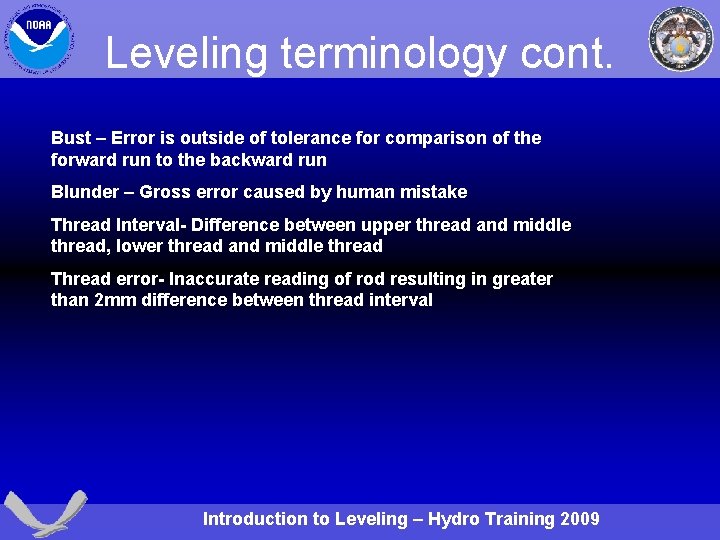
Leveling terminology cont. Bust – Error is outside of tolerance for comparison of the forward run to the backward run Blunder – Gross error caused by human mistake Thread Interval- Difference between upper thread and middle thread, lower thread and middle thread Thread error- Inaccurate reading of rod resulting in greater than 2 mm difference between thread interval Introduction to Leveling – Hydro Training 2009
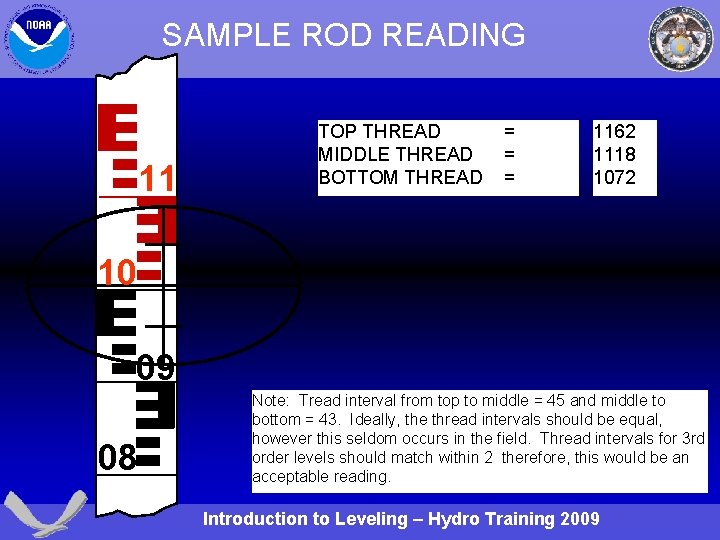
SAMPLE ROD READING 11 TOP THREAD MIDDLE THREAD BOTTOM THREAD = = = 1162 1048 0937 1003 0892 1118 0960 0848 1072 10 09 08 Note: Tread interval from top to middle = 45 and middle to bottom = 43. Ideally, the thread intervals should be equal, however this seldom occurs in the field. Thread intervals for 3 rd order levels should match within 2 therefore, this would be an acceptable reading. Introduction to Leveling – Hydro Training 2009
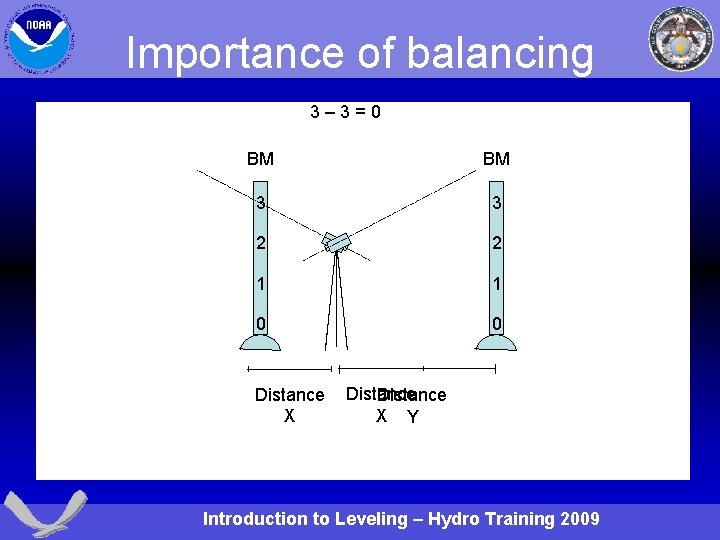
Importance of balancing 3– 3=0 BM BM 3 3 2 2 1 1 0 0 Distance X Y Introduction to Leveling – Hydro Training 2009
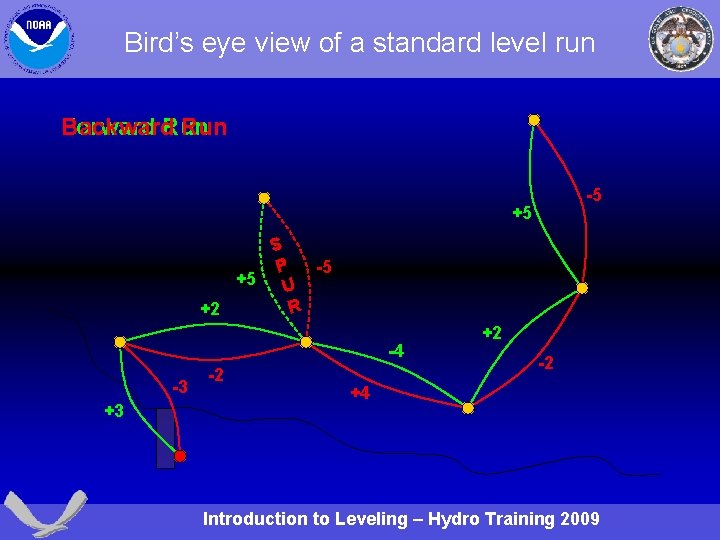
Bird’s eye view of a standard level run Forward Run Backward Run -5 +5 S P -5 +5 U R +2 -4 -3 +3 -2 +2 -2 +4 Introduction to Leveling – Hydro Training 2009
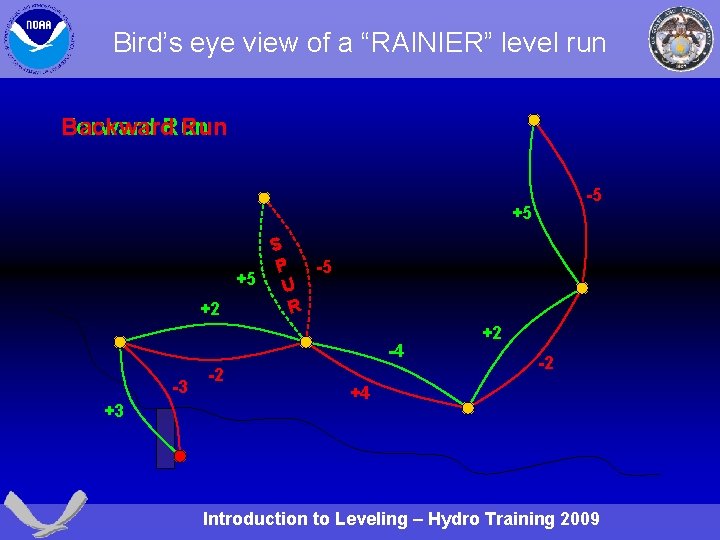
Bird’s eye view of a “RAINIER” level run Forward Run Backward Run -5 +5 S P -5 +5 U R +2 -4 -3 +3 -2 +2 -2 +4 Introduction to Leveling – Hydro Training 2009
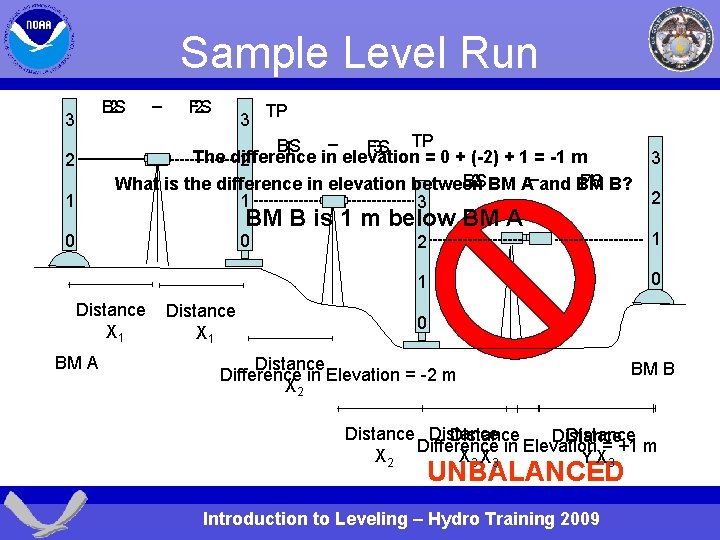
Sample Level Run 2 BS _ 2 FS 3 TP _ TP BS FS 3 1 The difference in elevation = 0 + (-2) + 1 = -1 m 3 2 _ BS FS 1 B? 2 BM A and BM What is the difference in elevation between 2 1 3 3 2 1 BM B is 1 m below BM A 0 0 Distance X 1 BM A Distance X 1 2 1 1 0 0 Distance Difference in Elevation = -2 m X 2 BM B Distance Distance Difference in Elevation = +1 m X 2 X 3 Y X 3 UNBALANCED Introduction to Leveling – Hydro Training 2009
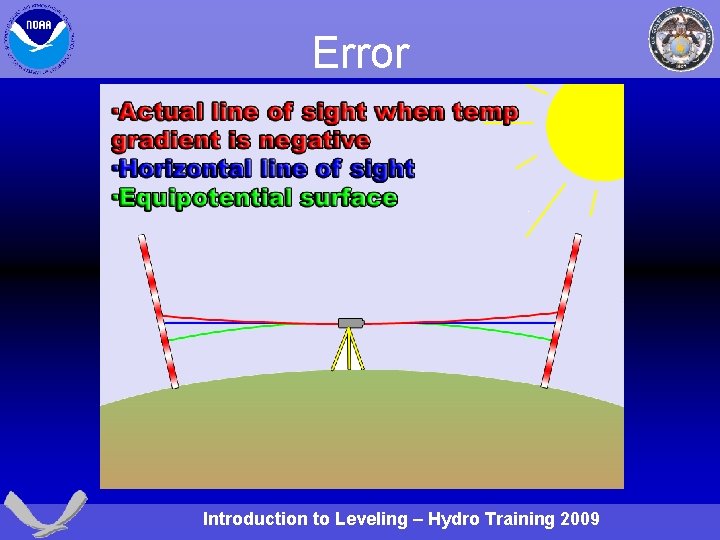
Error Introduction to Leveling – Hydro Training 2009
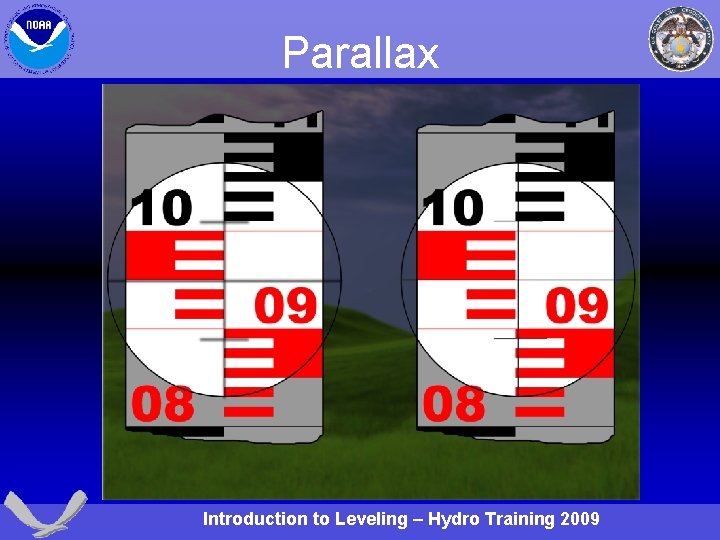
Parallax Introduction to Leveling – Hydro Training 2009
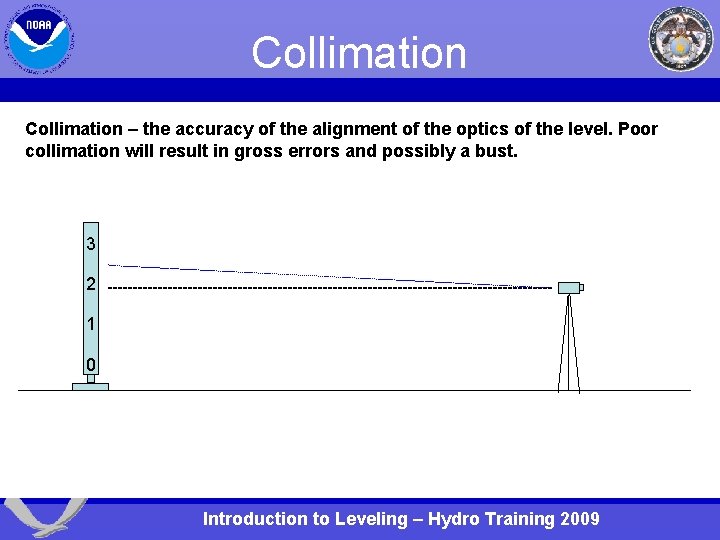
Collimation – the accuracy of the alignment of the optics of the level. Poor collimation will result in gross errors and possibly a bust. 3 2 1 0 Introduction to Leveling – Hydro Training 2009
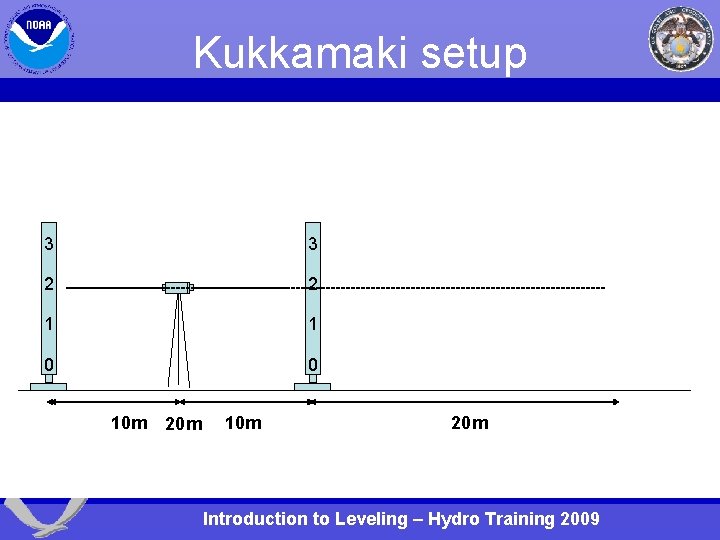
Kukkamaki setup 3 3 2 2 1 1 0 0 10 m 20 m 10 m Allow instruments to acclimate to ambient temperature for at least 10 minutes!! 20 m Introduction to Leveling – Hydro Training 2009
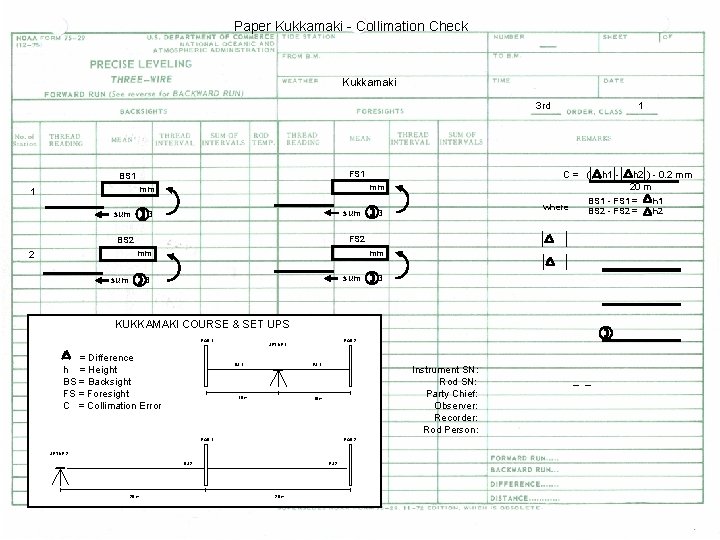
Paper Kukkamaki - Collimation Check Kukkamaki 3 rd FS 1 BS 1 sum )3 sum where ) 3 )3 sum )3 KUKKAMAKI COURSE & SET UPS ROD 1 = Difference h = Height BS = Backsight FS = Foresight C = Collimation Error BS 1 FS 1 10 m ) ROD 2 SET UP 1 Instrument SN: Rod SN: Party Chief: Observer: Recorder: Rod Person: 10 m ROD 1 ROD 2 SET UP 2 BS 2 20 m h 2 ) - 0. 2 mm 20 m BS 1 - FS 1 = BS 2 - FS 2 = mm mm sum h 1 - FS 2 BS 2 2 C= ( mm mm 1 1 FS 2 20 m Introduction to Leveling – Hydro Training 2009 h 1 h 2
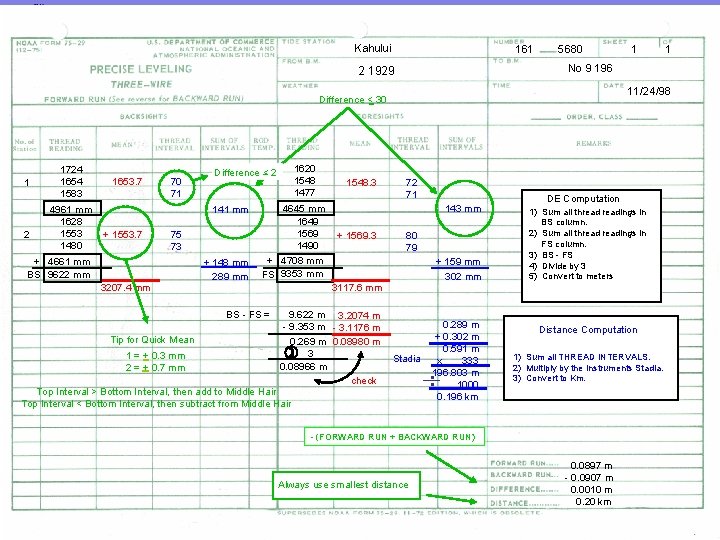
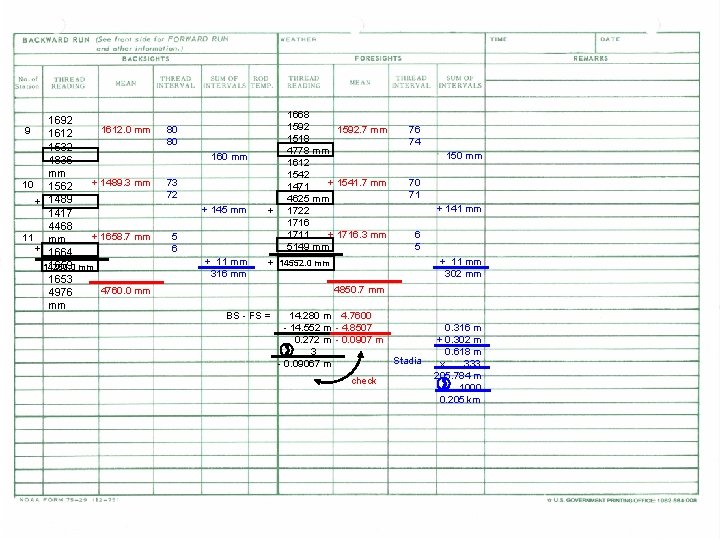
Kahului 161 5680 11/24/98 Difference < 30 2 1724 1654 1583 4961 mm 1628 1553 1480 1653. 7 70 71 141 mm + 1553. 7 75 73 + 4661 mm BS 9622 mm 1620 1548 1477 Difference < 2 + 148 mm 289 mm 4645 mm 1649 1569 1490 + 4708 mm FS 9353 mm BS - FS = 1 = + 0. 3 mm 2 = + 0. 7 mm 72 71 143 mm + 1569. 3 80 79 + 159 mm 302 mm DE Computation 1) Sum all threadings in BS column. 2) Sum all threadings in FS column. 3) BS - FS 4) Divide by 3 5) Convert to meters 3117. 6 mm 3207. 4 mm Tip for Quick Mean 1548. 3 9. 622 m 3. 2074 m - 9. 353 m - 3. 1176 m 0. 269 m 0. 08980 m 3 0. 08966 m check ) 1 No 9 196 2 1929 1 1 Stadia Top Interval > Bottom Interval, then add to Middle Hair Top Interval < Bottom Interval, then subtract from Middle Hair 0. 289 m + 0. 302 m 0. 591 m x 333 196. 803 m 1000 0. 196 km : Distance Computation 1) Sum all THREAD INTERVALS. 2) Multiply by the Instruments Stadia. 3) Convert to Km. - (FORWARD RUN + BACKWARD RUN) Always use smallest distance 0. 0897 m - 0. 0907 m 0. 0010 m 0. 20 km Introduction to Leveling – Hydro Training 2009
1692 1612. 0 mm 9 1612 1532 4836 mm + 1489. 3 mm 10 1562 + 1489 1417 4468 + 1658. 7 mm 11 mm + 1664 1659 mm 14280. 0 1653 4760. 0 mm 4976 mm 80 80 160 mm 73 72 + 145 mm + 5 6 + 11 mm 316 mm 1668 1592. 7 mm 1518 4778 mm 1612 1542 + 1541. 7 mm 1471 4625 mm 1722 1716 1711 + 1716. 3 mm 5149 mm 76 74 150 mm 70 71 + 141 mm 6 5 + 11 mm 302 mm + 14552. 0 mm 4850. 7 mm BS - FS = 14. 280 m 4. 7600 - 14. 552 m - 4. 8507 0. 272 m - 0. 0907 m 3 Stadia - 0. 09067 m ) check 0. 316 m + 0. 302 m 0. 618 m x 333 205. 784 m 1000 0. 205 km ) Introduction to Leveling – Hydro Training 2009
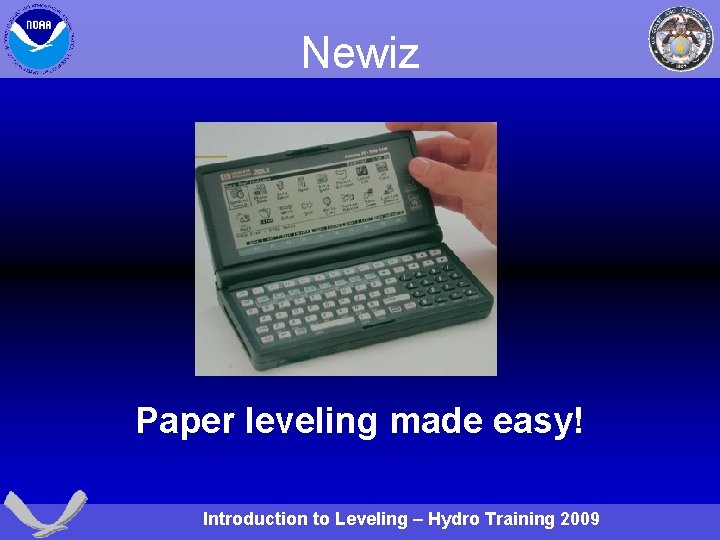
Newiz Paper leveling made easy! Introduction to Leveling – Hydro Training 2009
Run Introduction to Leveling – Hydro Training 2009