
Level of Encoding and False Memory Typicality Undergraduate


- Slides: 17
Level of Encoding and False Memory Typicality Undergraduate Research Symposium Christiaan Manno May 15, 2004
FACT: YOUR MEMORY IS NOT PERFECT! l False Memories occur everyday - Can occur via the result of competing stimuli on either the encoding or retrieval end. l Easily Created in an experimental environment.
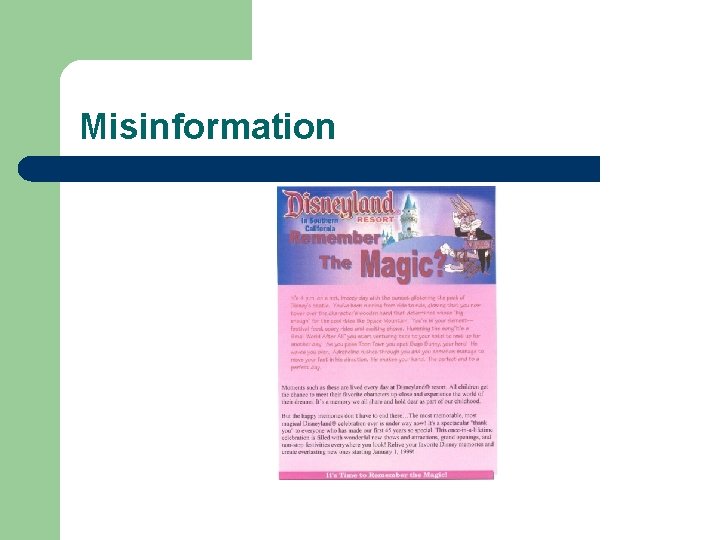
Misinformation
False Memory Research l False Feedback Paradigm (Loftus) l DRM Paradigm (Deese, Roediger, and Mc. Dermott, 1995) -Categorized Word Lists -Critical Intrusions
Theoretical Basis l Reproductive and Reconstructive Memory (Bartlett, 1932) l Depth of Analysis (Craik and Lockhart, 1972) -Memories as merely byproducts of perceptual analysis. l Word Typicality/Representativeness (Barsalou, 1983) -(i. e. , robin, pigeon, and ostrich)
Implications of False Memory Research l Eyewitness Testimony -Negative Impact of Leading Questions (power of suggestion). -Questions of Validity. l Repressed Memories -Negative Impact of Clinical Memory Retrieval methods. -Questions of Validity.
Implications of False Memory Research (cont. ) l Based on Theories of Reconstructive Memory and Spreading Activation Theory (Collins & Loftus, 1975). -Memories often contain associated information. -Gives us a clue of how information is stored in your mind.
Hypothesis The variability of false memories (critical intrusions), within the list learning paradigm, depends on the level of encoding participants employ. l The anticipated trend is that deeper encoding leads to greater variability in intrusions. l
Method l Phase One -Establish levels of Category Output Dominance. -Participants were asked to write down members of a given category. -Commonly mentioned item = Highly Typical. All participants were undergraduate students enrolled in psychology courses.
Method (cont. ) l Phase Two -Primary Test Phase. -Presented with word lists. -Semantic (Deep) or Non -semantic (Shallow) encoding. -Recall.
Results l The primary hypothesis was not confirmed.
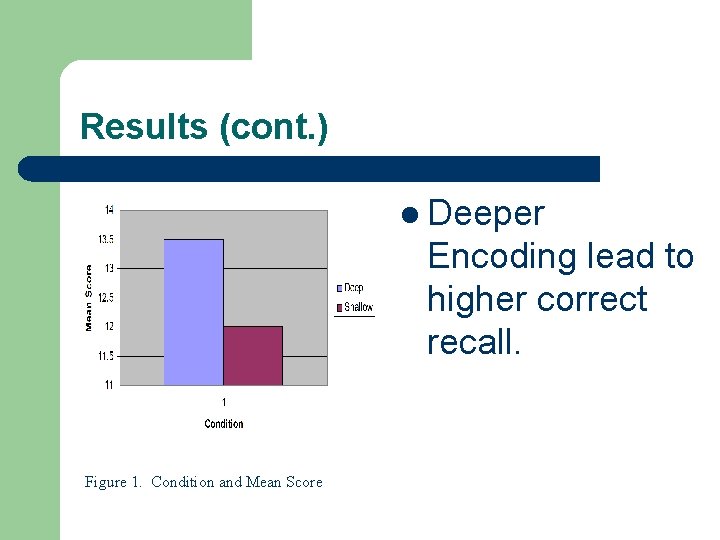
Results (cont. ) l Deeper Encoding lead to higher correct recall. Figure 1. Condition and Mean Score
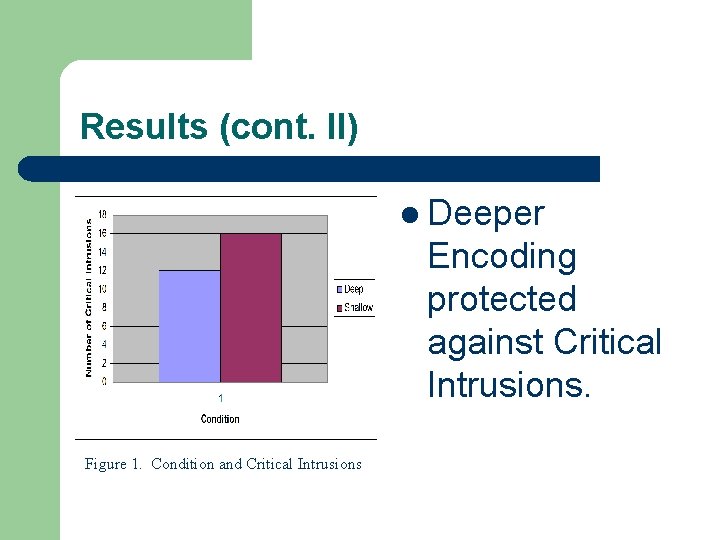
Results (cont. II) l Deeper Encoding protected against Critical Intrusions. Figure 1. Condition and Critical Intrusions
Discussion Results confirm prior research on the role of Level of Encoding. l This research is important because it helps us to better understand how to avoid the occurrence of false memories. l
Experimental Considerations l l Alpha levels were not sufficient to attain significant results. Further analyses suggested minor design flaws.
Acknowledgements l l l Distinguished Professor Elizabeth Loftus Dr. Valerie Jenness, Social Ecology Honors Program Coordinator Rick Harvey, Grad Student Extraordinaire Ben Palmer, Research Assistant UCI Undergraduate Research Opportunities Program
For Further Inquiries: Christiaan P. Manno Department of Psychology and Social Behavior University of California, Irvine cmanno@uci. edu