
Level of Detail A Brief Overview David Luebke
Level of Detail: A Brief Overview David Luebke University of Virginia

Introduction l Level of detail (LOD) is an important tool for maintaining interactivity – Focuses on the fidelity / performance tradeoff – Not the only tool! Complementary with: n n n l Parallel rendering Occlusion culling Image-based rendering [etc] I’ll talk at a high level about LOD today – Introduce main concepts – Place today’s papers into context – Give some opinions
Level of Detail: The Basic Idea l The problem: – Geometric datasets can be too complex to render at interactive rates l One solution: – Simplify the polygonal geometry of small or distant objects – Known as Level of Detail or LOD n A. k. a. polygonal simplification, geometric simplification, mesh reduction, decimation, multiresolution modeling, …
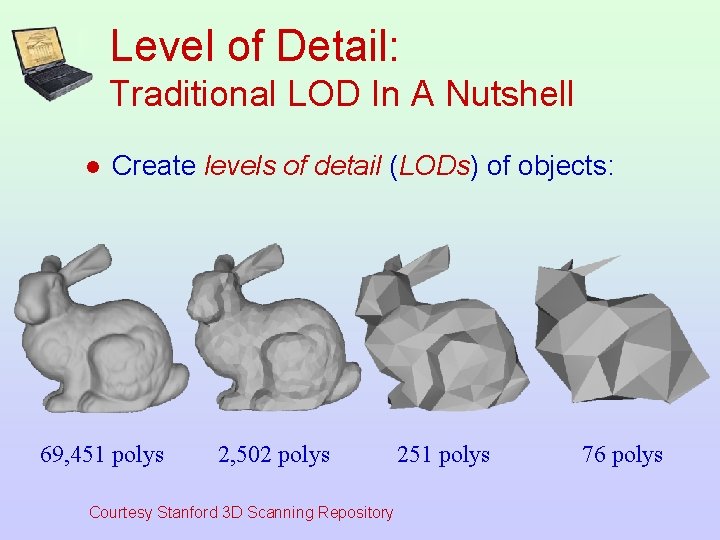
Level of Detail: Traditional LOD In A Nutshell l Create levels of detail (LODs) of objects: 69, 451 polys 2, 502 polys Courtesy Stanford 3 D Scanning Repository 251 polys 76 polys
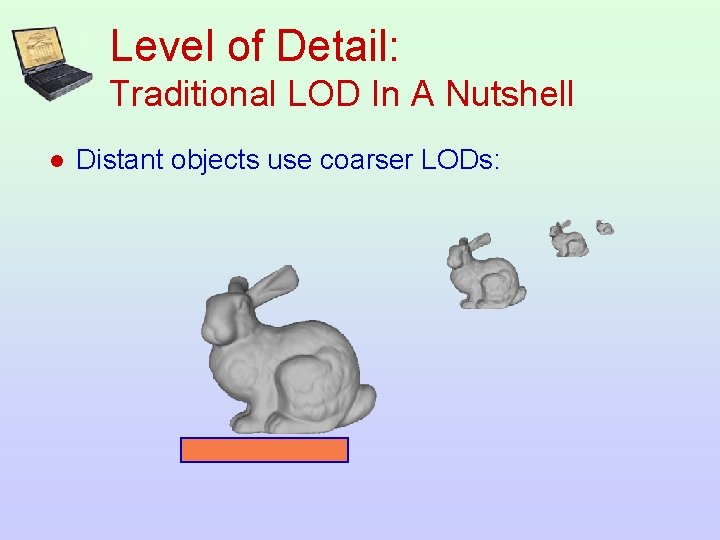
Level of Detail: Traditional LOD In A Nutshell l Distant objects use coarser LODs:

Level of Detail: The Big Questions l How to represent and generate simpler versions of a complex model? 69, 451 polys 2, 502 polys Courtesy Stanford 3 D Scanning Repository 251 polys 76 polys
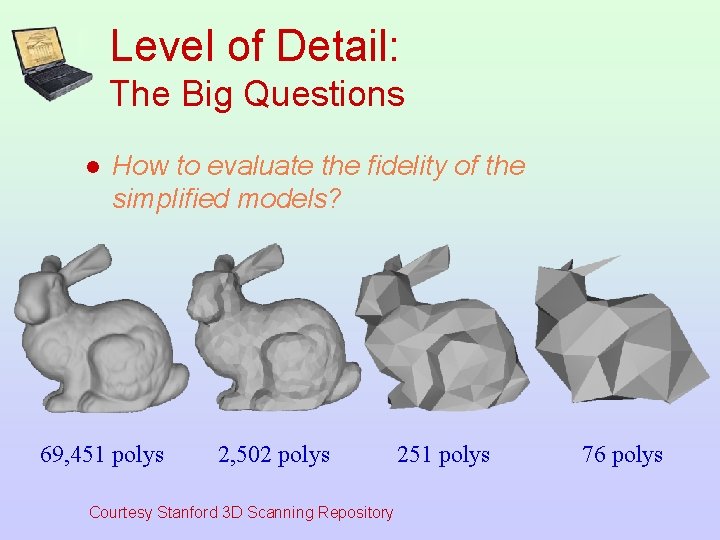
Level of Detail: The Big Questions l How to evaluate the fidelity of the simplified models? 69, 451 polys 2, 502 polys Courtesy Stanford 3 D Scanning Repository 251 polys 76 polys
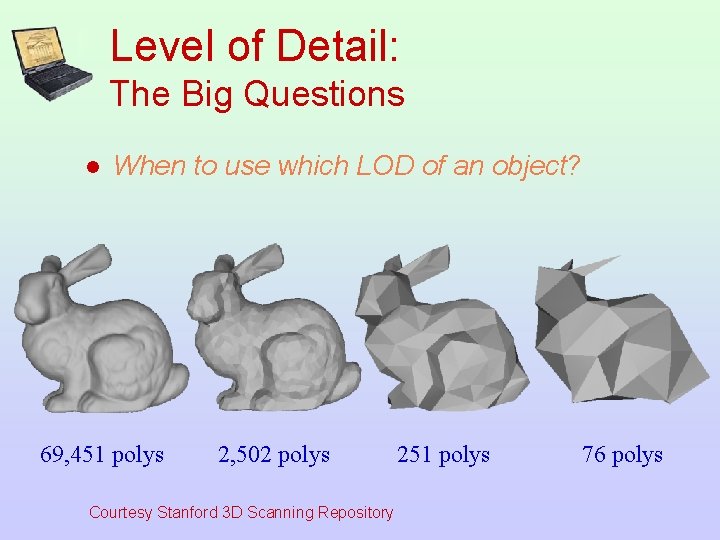
Level of Detail: The Big Questions l When to use which LOD of an object? 69, 451 polys 2, 502 polys Courtesy Stanford 3 D Scanning Repository 251 polys 76 polys
Some Background l History of LOD techniques – Early history: Clark (1976), flight simulators – Handmade LODs automatic LODs – LOD run-time management: reactive predictive (Funkhouser) l LOD frameworks – Discrete (1976) – Continuous (1996) – View-dependent (1997)
Traditional Approach: Discrete Level of Detail l Traditional LOD in a nutshell: – Create LODs for each object separately in a preprocess – At run-time, pick each object’s LOD according to the object’s distance (or similar criterion) l Since LODs are created offline at fixed resolutions, we call this discrete LOD
Discrete LOD: Advantages l Simplest programming model; decouples simplification and rendering – LOD creation need not address real-time rendering constraints – Run-time rendering need only pick LODs
Discrete LOD: Advantages l Fits modern graphics hardware well – Easy to compile each LOD into triangle strips, display lists, vertex arrays, … – These render much faster than unorganized triangles on today’s hardware (3 -5 x)
Discrete LOD: Disadvantages l l l So why use anything but discrete LOD? Answer: sometimes discrete LOD not suited for drastic simplification Some problem cases: – – Terrain flyovers Volumetric isosurfaces Super-detailed range scans Massive CAD models
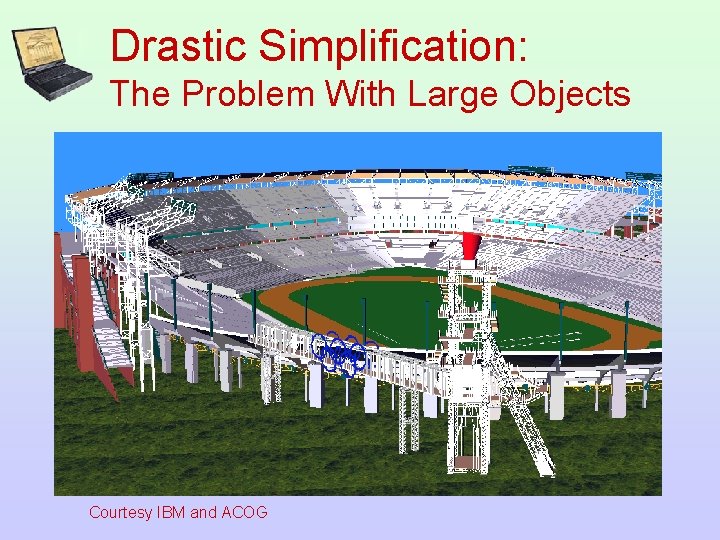
Drastic Simplification: The Problem With Large Objects Courtesy IBM and ACOG
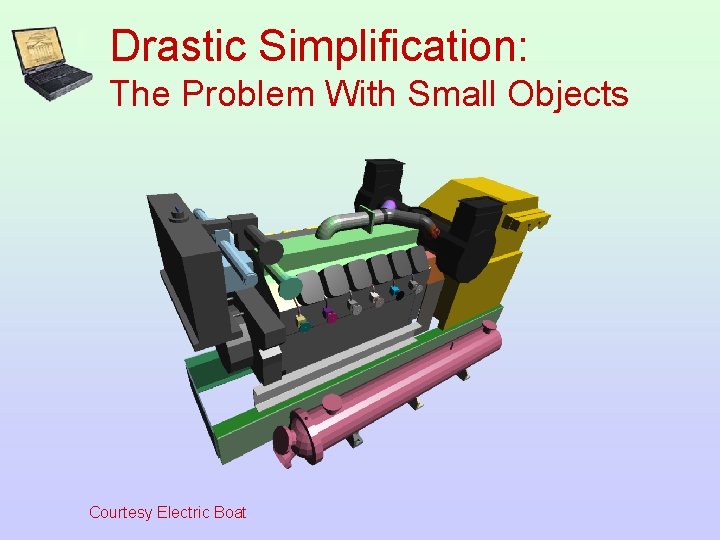
Drastic Simplification: The Problem With Small Objects Courtesy Electric Boat
Drastic Simplification l For drastic simplification: – Large objects must be subdivided – Small objects must be combined l l Difficult or impossible with discrete LOD So what can we do?

Continuous Level of Detail l A departure from the traditional discrete approach: – Discrete LOD: create individual levels of detail in a preprocess – Continuous LOD: create data structure from which a desired level of detail can be extracted at run time.
Continuous LOD: Advantages l Better granularity better fidelity – LOD is specified exactly, not chosen from a few pre-created options – Thus objects use no more polygons than necessary, which frees up polygons for other objects – Net result: better resource utilization, leading to better overall fidelity/polygon
Continuous LOD: Advantages l Better granularity smoother transitions – Switching between traditional LODs can introduce visual “popping” effect – Continuous LOD can adjust detail gradually and incrementally, reducing visual pops n Can even geomorph the fine-grained simplification operations over several frames to eliminate pops [Hoppe 96, 98]
![Continuous LOD: Advantages l Supports progressive transmission – Progressive Meshes [Hoppe 97] – Progressive](http://slidetodoc.com/presentation_image/09d9bbdefa1b25ab2a6c733293888973/image-20.jpg "Continuous LOD: Advantages l Supports progressive transmission – Progressive Meshes [Hoppe 97] – Progressive")
Continuous LOD: Advantages l Supports progressive transmission – Progressive Meshes [Hoppe 97] – Progressive Forest Split Compression [Taubin 98] l Leads to view-dependent LOD – Use current view parameters to select best representation for the current view – Single objects may thus span several levels of detail
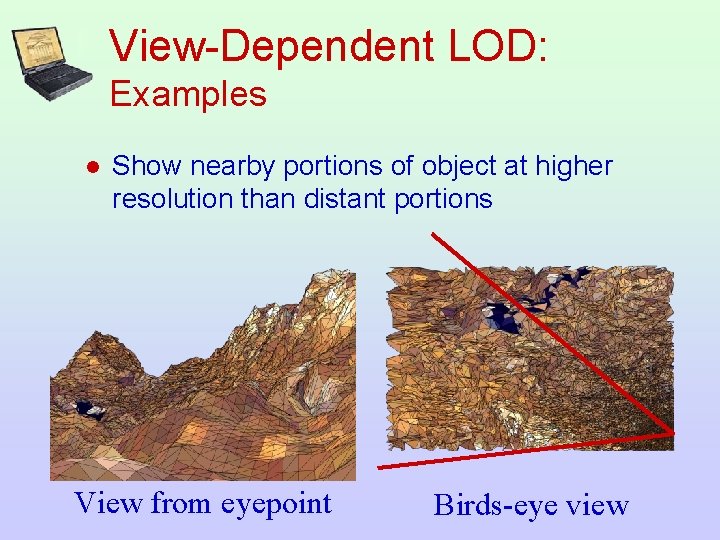
View-Dependent LOD: Examples l Show nearby portions of object at higher resolution than distant portions View from eyepoint Birds-eye view
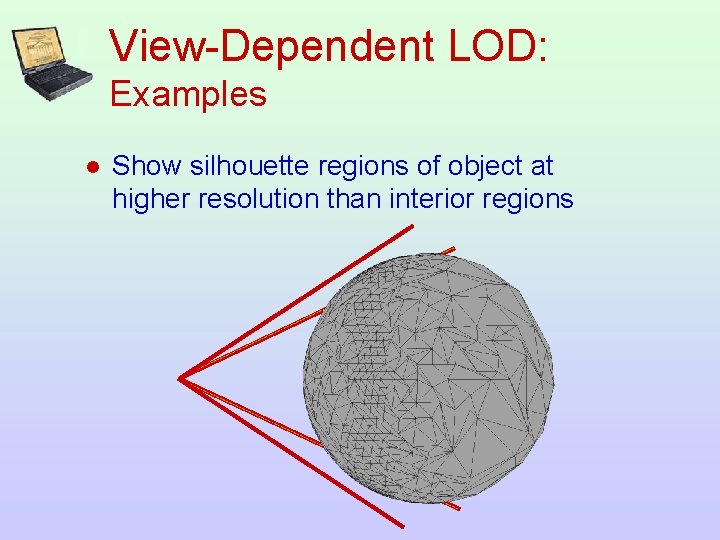
View-Dependent LOD: Examples l Show silhouette regions of object at higher resolution than interior regions
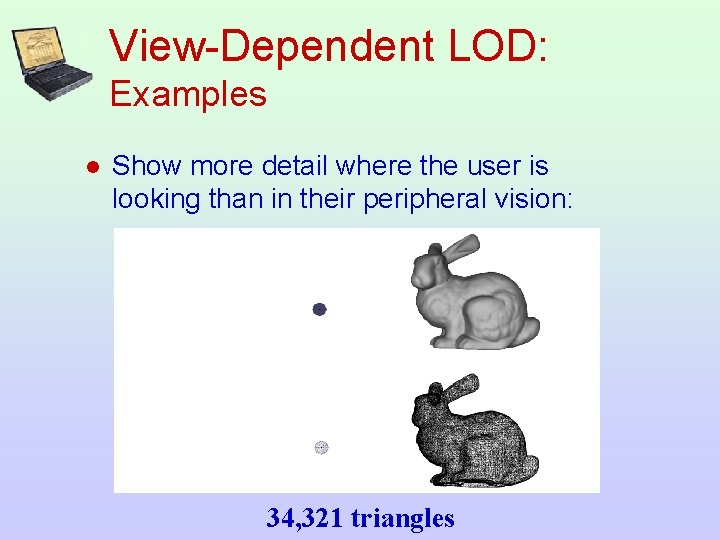
View-Dependent LOD: Examples l Show more detail where the user is looking than in their peripheral vision: 34, 321 triangles
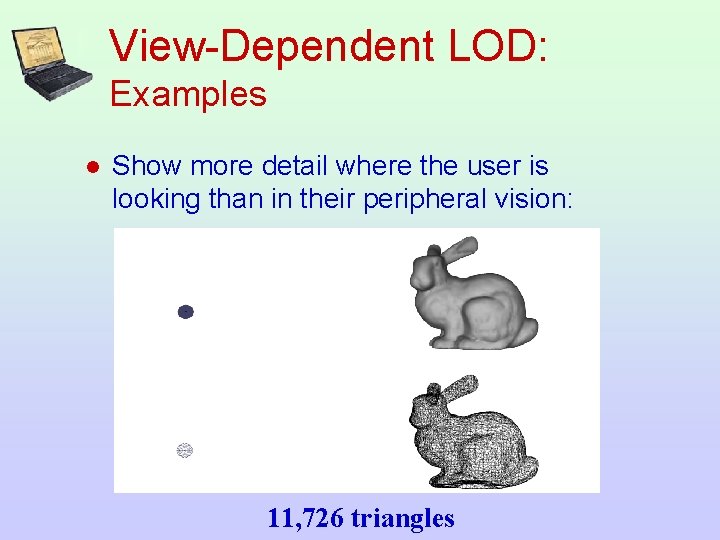
View-Dependent LOD: Examples l Show more detail where the user is looking than in their peripheral vision: 11, 726 triangles
View-Dependent LOD: Advantages l Even better granularity – Allocates polygons where they are most needed, within as well as among objects – Enables even better overall fidelity l Enables drastic simplification of very large objects – Example: stadium model – Example: terrain flyover
An Aside: Hierarchical LOD l l View-dependent LOD solves the Problem With Large Objects Hierarchical LOD can solve the Problem With Small Objects – Merge objects into assemblies – At sufficient distances, simplify assemblies, not individual objects – How to represent this in a scene graph?
An Aside: Hierarchical LOD l Hierarchical LOD dovetails nicely with view-dependent LOD – Treat the entire scene as a single object to be simplified in view-dependent fashion l Hierarchical LOD can also sit atop traditional discrete LOD schemes – Imposters [Maciel 95] – HLODs [Erikson 01]

Choosing LODs: LOD Run-Time Management l Fundamental LOD issue: where in the scene to allocate detail? – For discrete LOD this equates to choosing which LOD will represent each object – Run every frame on every object; keep it fast

Choosing LODs l Describe a simple method for the system to choose LODs – Assign each LOD a range of distances – Calculate distance from viewer to object – Use corresponding LOD l How might we implement this in a scenegraph based system?
Choosing LODs l What’s wrong with this simple approach? – Visual “pop” when switching LODs can be disconcerting – Doesn’t maintain constant frame rate; lots of objects still means slow frame times – Requires someone to assign switching distances by hand – Correct switching distance may vary with field of view, resolution, etc. l What can we do about each of these?
Choosing LODs Maintaining constant frame rate l One solution: scale LOD switching distances by a “bias” – Implement a feedback mechanism: n n If last frame took too long, decrease bias If last frame took too little time, increase bias – Dangers: n n Oscillation caused by overly aggressive feedback Sudden change in rendering load can still cause overly long frame times
- Slides: 31