
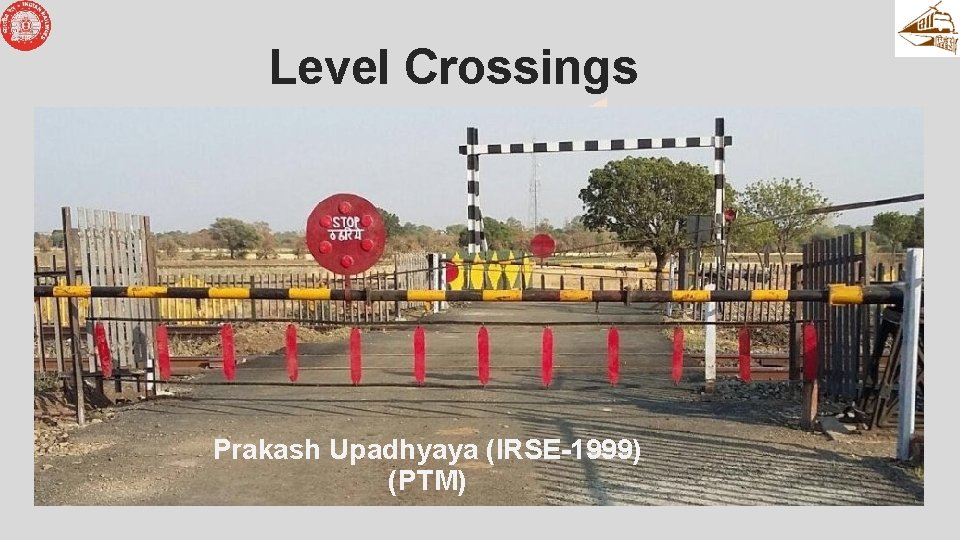
Level Crossings Prakash Upadhyaya IRSE1999 PTM Level Crossings
- Slides: 61
Level Crossings Prakash Upadhyaya (IRSE-1999) (PTM)
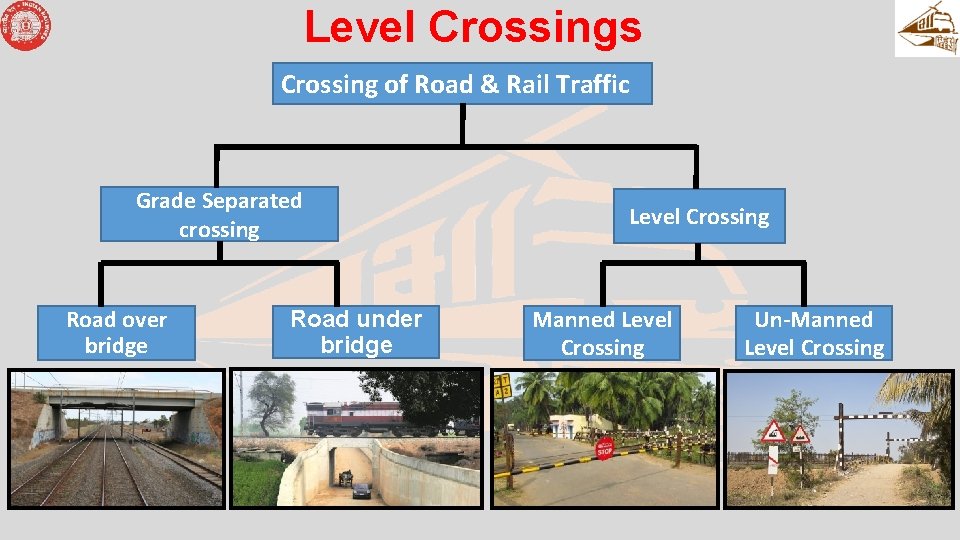
Level Crossings Crossing of Road & Rail Traffic Grade Separated crossing Road over bridge Road under bridge Level Crossing Manned Level Crossing Un-Manned Level Crossing
Level Crossings • Level Crossings are one of the bottlenecks in Rly system but very critical asset for Engineering Department. • Separate chapter (no. 9) in IRPWM on Level Crossing
Importance of LC for Engineers • Majority of the LC’s are manned by Engineering deptt. • Even on Operating LC Gates, most of the issues pertain to Engg deptt. • These LC’s are the most inspected asset of Railway by various department. • Engg deptt are most vulnerable on this aspect- has to defend for the complaints by driver/station master, officers of other department for inattentive GK’s.
Important Aspects of LC • Classification of LC • Census of LC • Track Structure • Civil Infrastructure at LC • Gate keepers • Inspection of LC at stipulated frequency • Periodic Overhauling of LC
Classification of LC • Classification of LC as per Train Vehicle Units (TVU) Census • Classification of LC as per Location or controlling department • Classification of LC as per Manning system • Classification of LC as per Interlocking system • Classification of LC as per Normal position of Gate • Classification of LC as per Road crossing angle
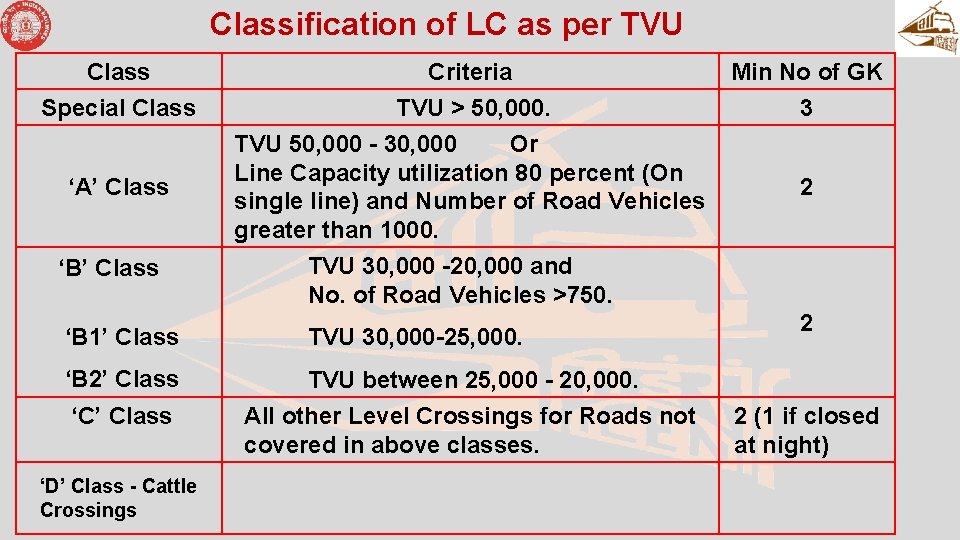
Classification of LC as per TVU Class Criteria Min No of GK Special Class TVU > 50, 000. 3 ‘A’ Class TVU 50, 000 - 30, 000 Or Line Capacity utilization 80 percent (On single line) and Number of Road Vehicles greater than 1000. 2 ‘B’ Class TVU 30, 000 -20, 000 and No. of Road Vehicles >750. ‘B 1’ Class TVU 30, 000 -25, 000. ‘B 2’ Class TVU between 25, 000 - 20, 000. ‘C’ Class All other Level Crossings for Roads not covered in above classes. ‘D’ Class - Cattle Crossings 2 2 (1 if closed at night)
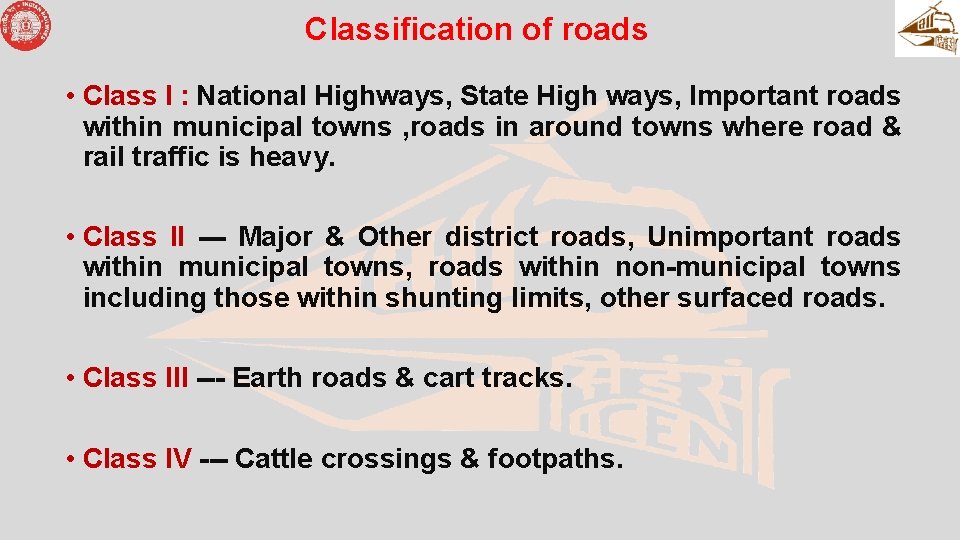
Classification of roads • Class I : National Highways, State High ways, Important roads within municipal towns , roads in around towns where road & rail traffic is heavy. • Class II --- Major & Other district roads, Unimportant roads within municipal towns, roads within non-municipal towns including those within shunting limits, other surfaced roads. • Class III --- Earth roads & cart tracks. • Class IV --- Cattle crossings & footpaths.
Traffic Census of LC • Periodical census of traffic at all level crossings, unmanned/ manned shall be taken) once every three years. • This shall be carried out for 7 days • Total Train Vehicle Units (TVUs) / Day are worked out. • Census of LC in TVU per day = (T x R) / 7 • T = Total no. of train units in 7 days (Each Train is taken as 1 Unit) • R = Total no. of Road vehicle units in 7 days. • Each 4 -wheeler motor Vehicle, Bullock Carts and Tongas : one road vehicle unit, • Cycle rickshaw / Auto rickshaw : half road vehicle unit; and • Motorized two wheelers : 0. 25 road vehicle unit.
Traffic Census of LC • The census shall be carried out by a multi disciplinary inspectorial team consisting of representative of CE, S&T and Traffic Departments. • The mechanism shall be set up by the Divisional Railway Manager to ensure that the representatives are present for the census by laying down advance time table for carrying out of census of level crossings.
Classification of LC as per Location or controlling department 1. Traffic Gates– • level crossings located between the outermost stop signals. • The manning and operation of the gates shall be under the control of Operating Department. • The level crossings and structures pertaining thereto shall be maintained by the Engineering Department. • When protected by signals the equipment shall be governed by the signals of the station/block hut and the operation as per the station working rules. 2. Engineering Gates– • Level crossings beyond the outermost stop signals • shall be under the control of the SSE(P. Way) in-charge both as regards to their operation and maintenance. In case Gates are protected with Signals (Interlocked) the maintenance of signals, interlocking and communication equipment will rest with the Signal Department irrespective of traffic or Engineering gate.
Classification of LC …. . Contd… • Classification of LC as per Manning system • Manned Level Crossing • Un-manned Level Crossing • Classification of LC as per Interlocking system • Interlocked (Signal protected – for train) • Non-intercocked (Not protected with signal- for train) • Classification of LC as per Normal position of Gate • Open to Road • Closed to Road • Classification of LC as per Road crossing angle • Normal LC- Road Crossing the track at right angle • Skew LC – Road Crossing the track at some angle but should not be less than 45°. At all Level crossings the Gate posts shall be fixed square to the road.
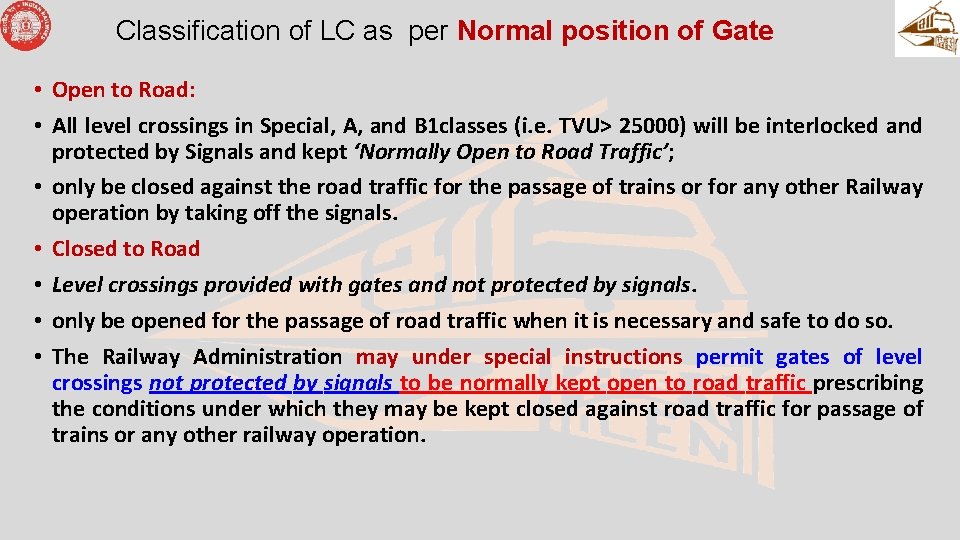
Classification of LC as per Normal position of Gate • Open to Road: • All level crossings in Special, A, and B 1 classes (i. e. TVU> 25000) will be interlocked and protected by Signals and kept ‘Normally Open to Road Traffic’; • only be closed against the road traffic for the passage of trains or for any other Railway operation by taking off the signals. • Closed to Road • Level crossings provided with gates and not protected by signals. • only be opened for the passage of road traffic when it is necessary and safe to do so. • The Railway Administration may under special instructions permit gates of level crossings not protected by signals to be normally kept open to road traffic prescribing the conditions under which they may be kept closed against road traffic for passage of trains or any other railway operation.
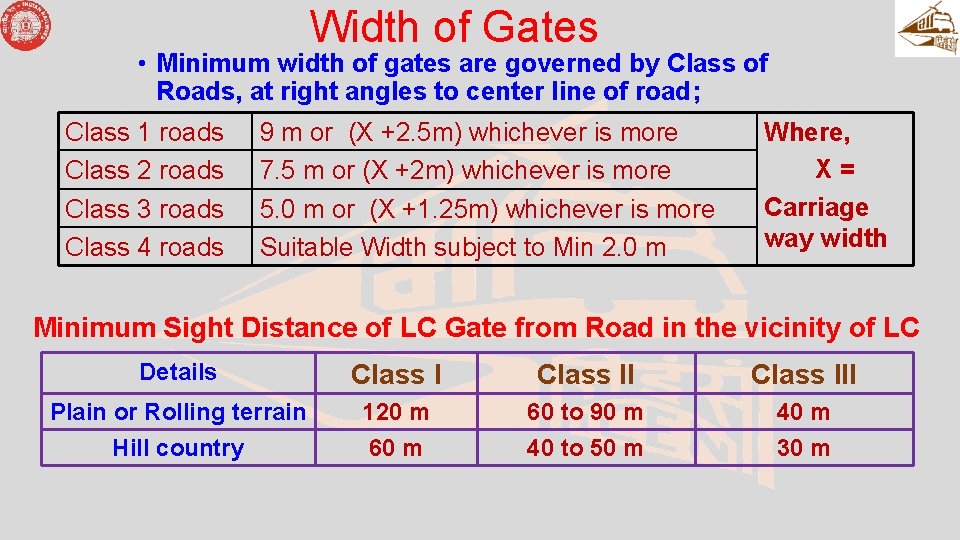
Width of Gates • Minimum width of gates are governed by Class of Roads, at right angles to center line of road; Class 1 roads Class 2 roads Class 3 roads Class 4 roads 9 m or (X +2. 5 m) whichever is more 7. 5 m or (X +2 m) whichever is more 5. 0 m or (X +1. 25 m) whichever is more Suitable Width subject to Min 2. 0 m Where, X= Carriage way width Minimum Sight Distance of LC Gate from Road in the vicinity of LC Details Class III Plain or Rolling terrain 120 m 60 to 90 m 40 m Hill country 60 m 40 to 50 m 30 m
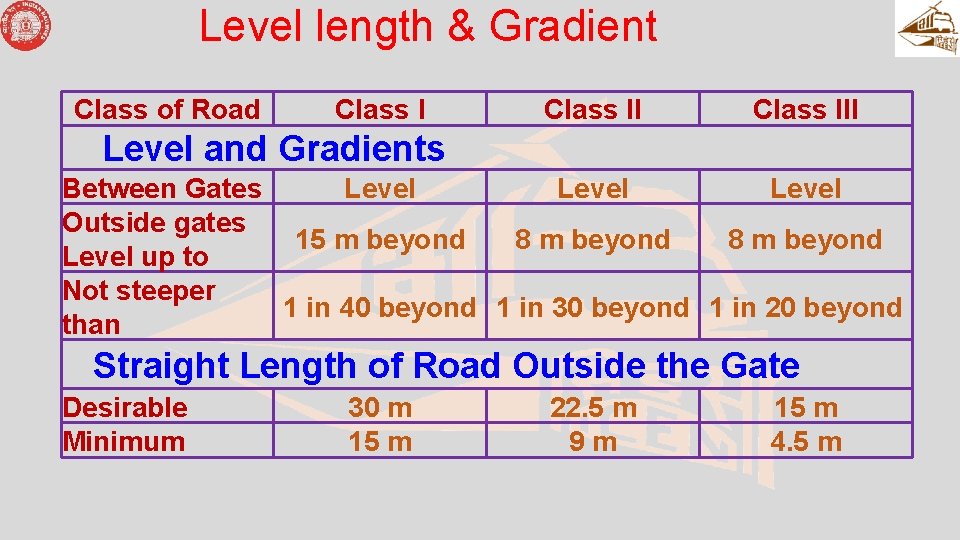
Level length & Gradient Class of Road Class III Level and Gradients Between Gates Level Outside gates 15 m beyond 8 m beyond Level up to Not steeper 1 in 40 beyond 1 in 30 beyond 1 in 20 beyond than Straight Length of Road Outside the Gate Desirable Minimum 30 m 15 m 22. 5 m 9 m 15 m 4. 5 m
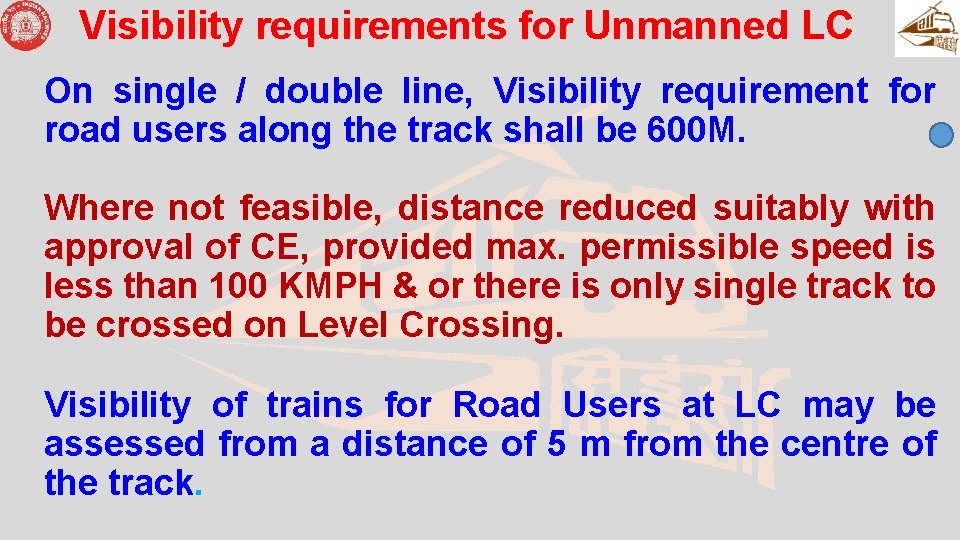
Visibility requirements for Unmanned LC On single / double line, Visibility requirement for road users along the track shall be 600 M. Where not feasible, distance reduced suitably with approval of CE, provided max. permissible speed is less than 100 KMPH & or there is only single track to be crossed on Level Crossing. Visibility of trains for Road Users at LC may be assessed from a distance of 5 m from the centre of the track.
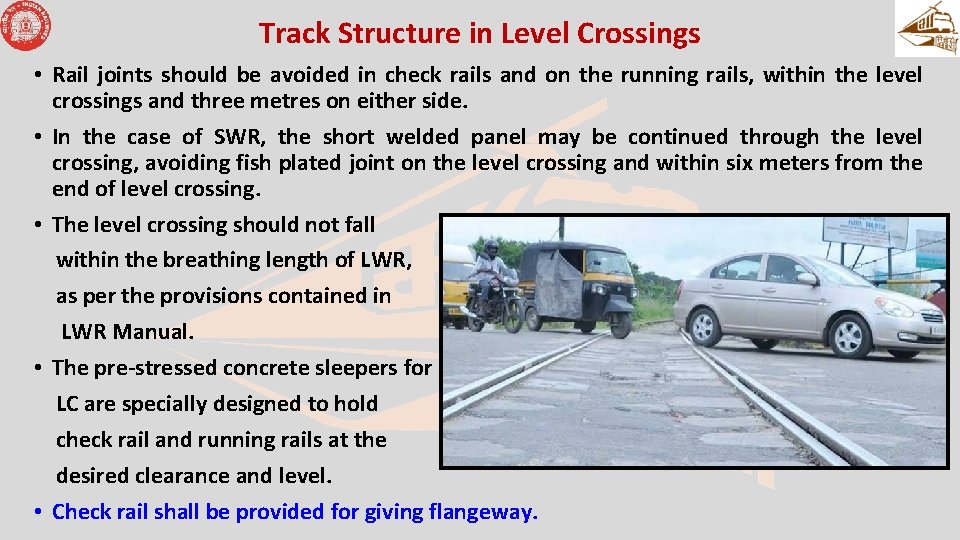
Track Structure in Level Crossings • Rail joints should be avoided in check rails and on the running rails, within the level crossings and three metres on either side. • In the case of SWR, the short welded panel may be continued through the level crossing, avoiding fish plated joint on the level crossing and within six meters from the end of level crossing. • The level crossing should not fall within the breathing length of LWR, as per the provisions contained in LWR Manual. • The pre-stressed concrete sleepers for LC are specially designed to hold check rail and running rails at the desired clearance and level. • Check rail shall be provided for giving flangeway.
Civil Infrastructure at Level Crossing
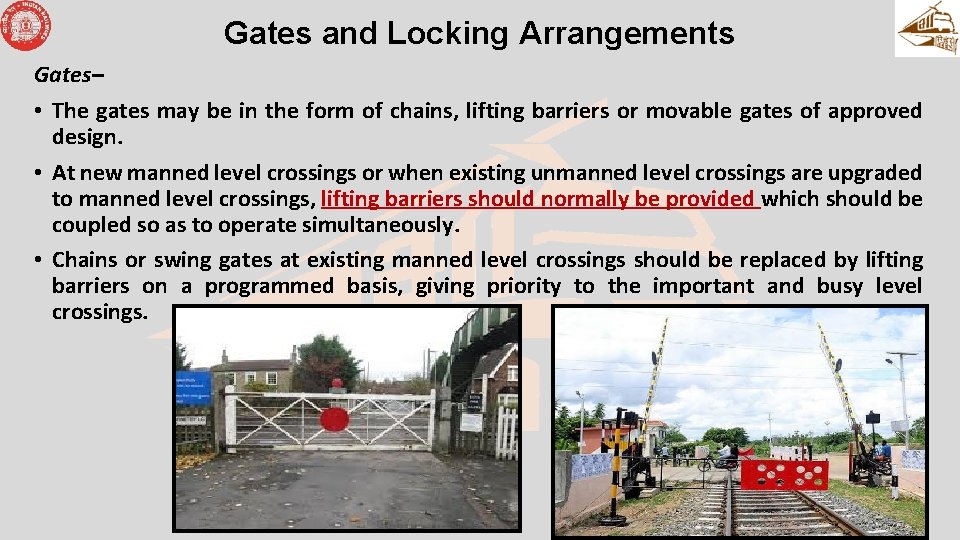
Gates and Locking Arrangements Gates– • The gates may be in the form of chains, lifting barriers or movable gates of approved design. • At new manned level crossings or when existing unmanned level crossings are upgraded to manned level crossings, lifting barriers should normally be provided which should be coupled so as to operate simultaneously. • Chains or swing gates at existing manned level crossings should be replaced by lifting barriers on a programmed basis, giving priority to the important and busy level crossings.
Gates and Locking Arrangements Locking arrangements– • Lifting type barriers, swing gates or chains when closed against road traffic shall be securely locked. • When the locking arrangement is of the hasp and staple type with padlocks, two spare chains with loops at both ends should be provided for locking the gates when the locking arrangement goes out of order. • Stops should be provided to prevent level crossing gates from swinging towards the track and causing infringement. • Catches should be provided to secure gates when in the open position to avoid obstruction to road traffic.
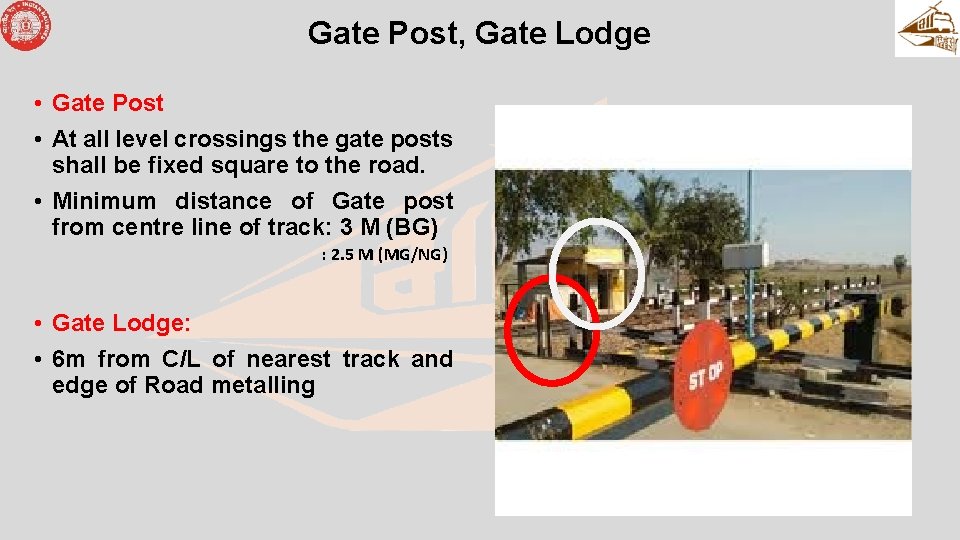
Gate Post, Gate Lodge • Gate Post • At all level crossings the gate posts shall be fixed square to the road. • Minimum distance of Gate post from centre line of track: 3 M (BG) : 2. 5 M (MG/NG) • Gate Lodge: • 6 m from C/L of nearest track and edge of Road metalling
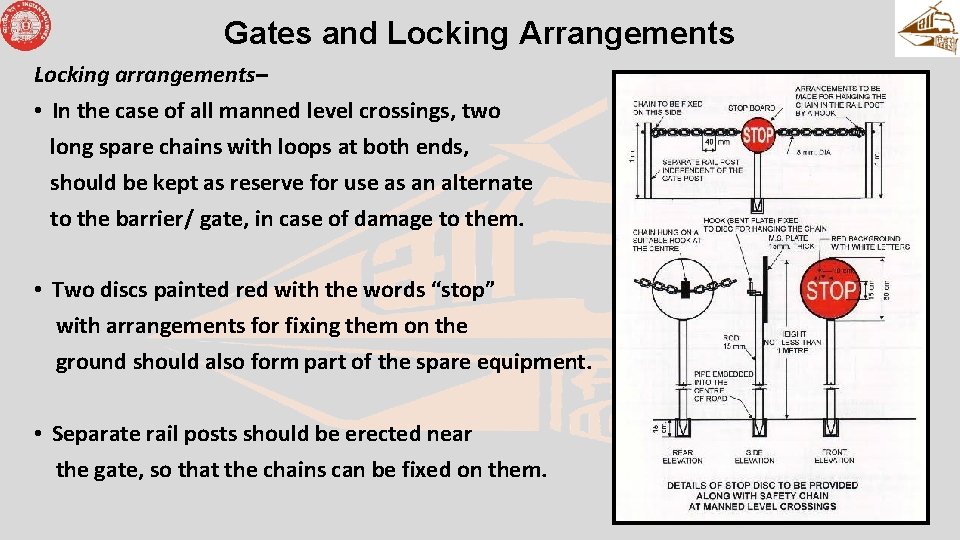
Gates and Locking Arrangements Locking arrangements– • In the case of all manned level crossings, two long spare chains with loops at both ends, should be kept as reserve for use as an alternate to the barrier/ gate, in case of damage to them. • Two discs painted red with the words “stop” with arrangements for fixing them on the ground should also form part of the spare equipment. • Separate rail posts should be erected near the gate, so that the chains can be fixed on them.
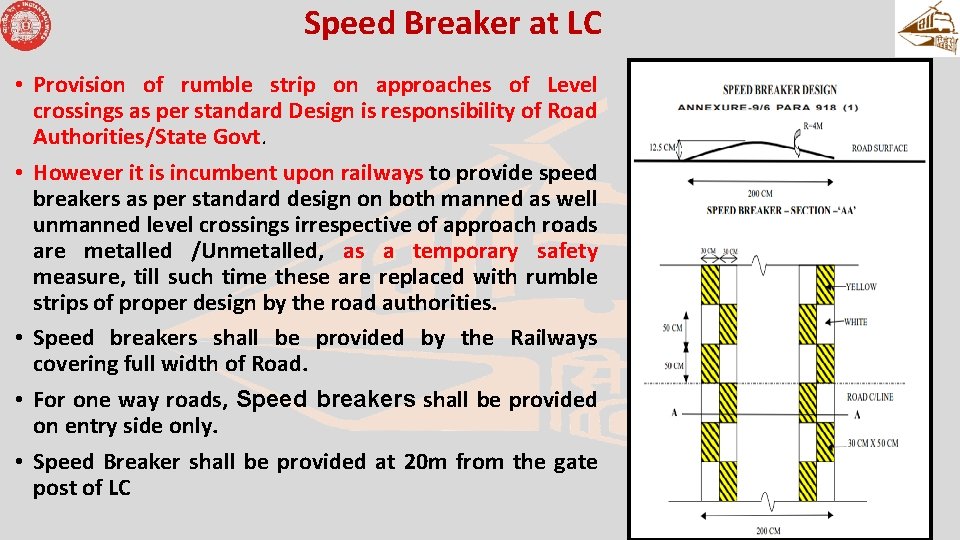
Speed Breaker at LC • Provision of rumble strip on approaches of Level crossings as per standard Design is responsibility of Road Authorities/State Govt. • However it is incumbent upon railways to provide speed breakers as per standard design on both manned as well unmanned level crossings irrespective of approach roads are metalled /Unmetalled, as a temporary safety measure, till such time these are replaced with rumble strips of proper design by the road authorities. • Speed breakers shall be provided by the Railways covering full width of Road. • For one way roads, Speed breakers shall be provided on entry side only. • Speed Breaker shall be provided at 20 m from the gate post of LC
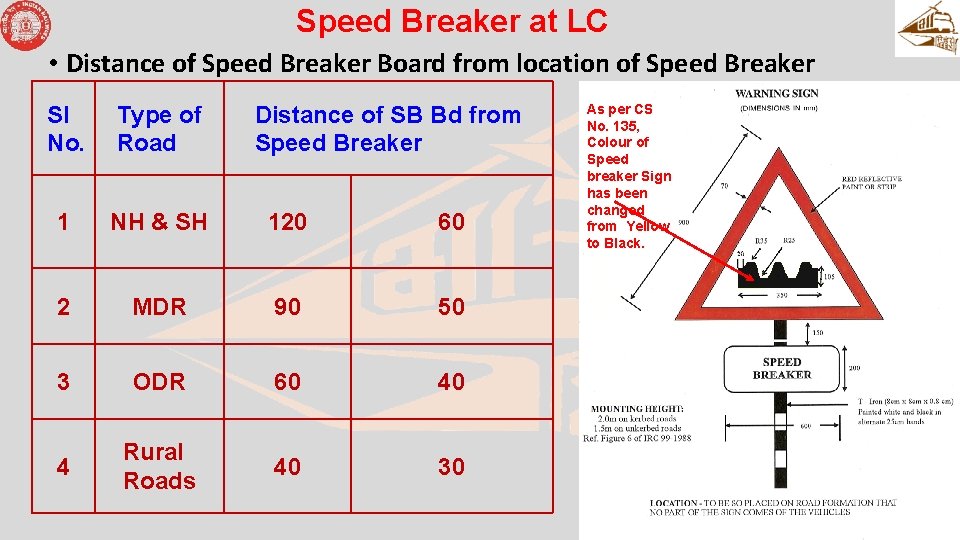
Speed Breaker at LC • Distance of Speed Breaker Board from location of Speed Breaker Sl No. Type of Road Distance of SB Bd from Speed Breaker 1 NH & SH 120 60 2 MDR 90 50 3 ODR 60 40 4 Rural Roads 40 30 As per CS No. 135, Colour of Speed breaker Sign has been changed from Yellow to Black.
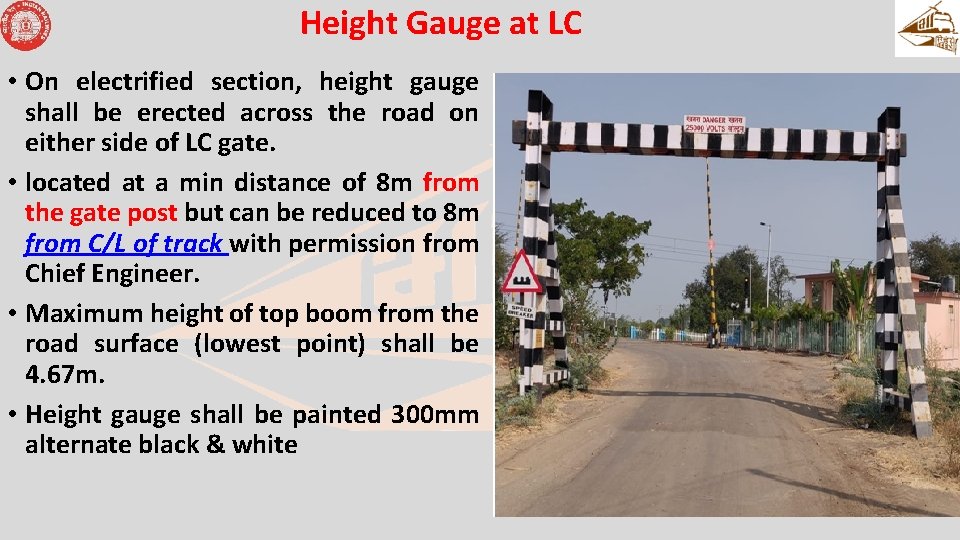
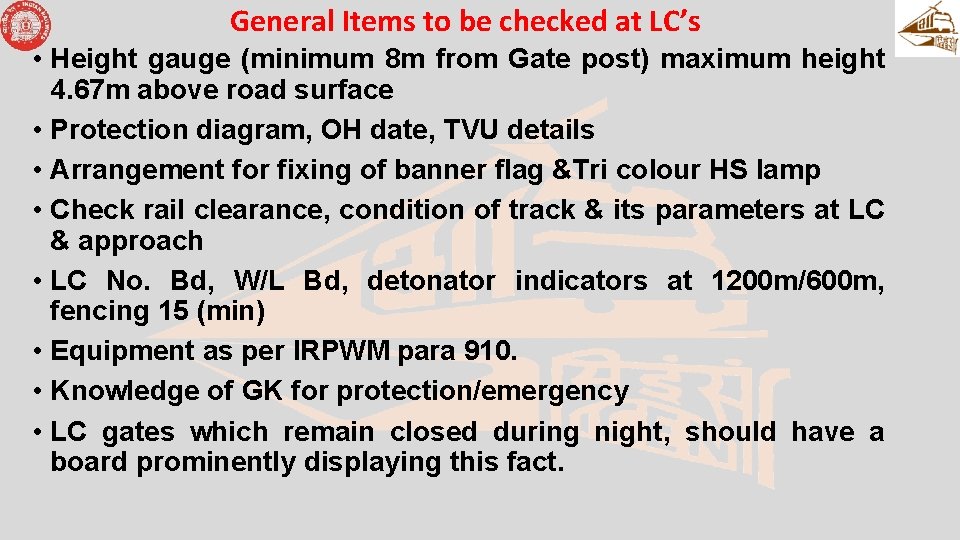
Height Gauge at LC • On electrified section, height gauge shall be erected across the road on either side of LC gate. • located at a min distance of 8 m from the gate post but can be reduced to 8 m from C/L of track with permission from Chief Engineer. • Maximum height of top boom from the road surface (lowest point) shall be 4. 67 m. • Height gauge shall be painted 300 mm alternate black & white
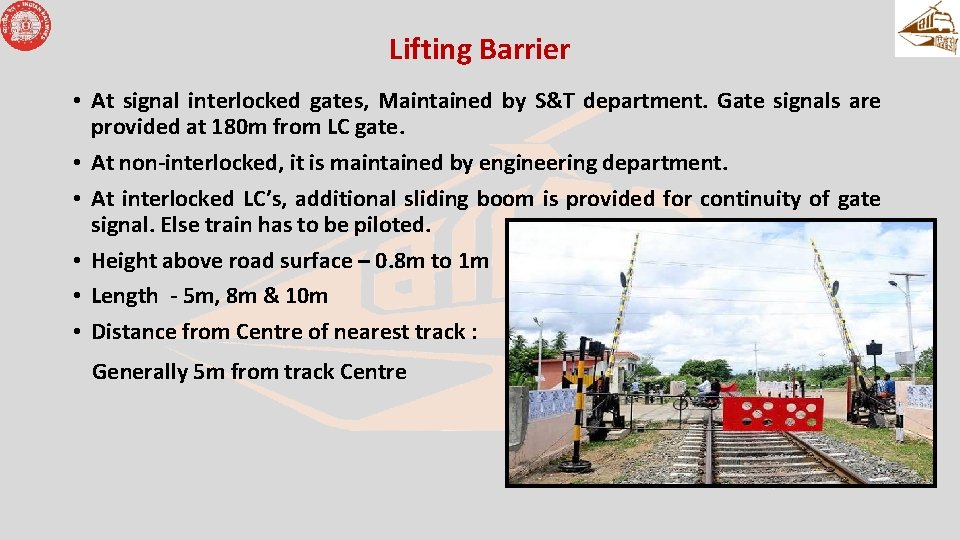
Lifting Barrier • At signal interlocked gates, Maintained by S&T department. Gate signals are provided at 180 m from LC gate. • At non-interlocked, it is maintained by engineering department. • At interlocked LC’s, additional sliding boom is provided for continuity of gate signal. Else train has to be piloted. • Height above road surface – 0. 8 m to 1 m • Length - 5 m, 8 m & 10 m • Distance from Centre of nearest track : Generally 5 m from track Centre
Provision of Wicket Gate for Foot Passengers Spl Class – To be provided , Except where FOB provided ‘A’ Class – To be provided , Except where FOB provided ‘B’ Class – ‘To be provided , Except where FOB provided ‘C’ Class – To be provided on Need Basis after assessing the requirement by committee constituted by Railway • ‘D’ Class – Not to be provided • •
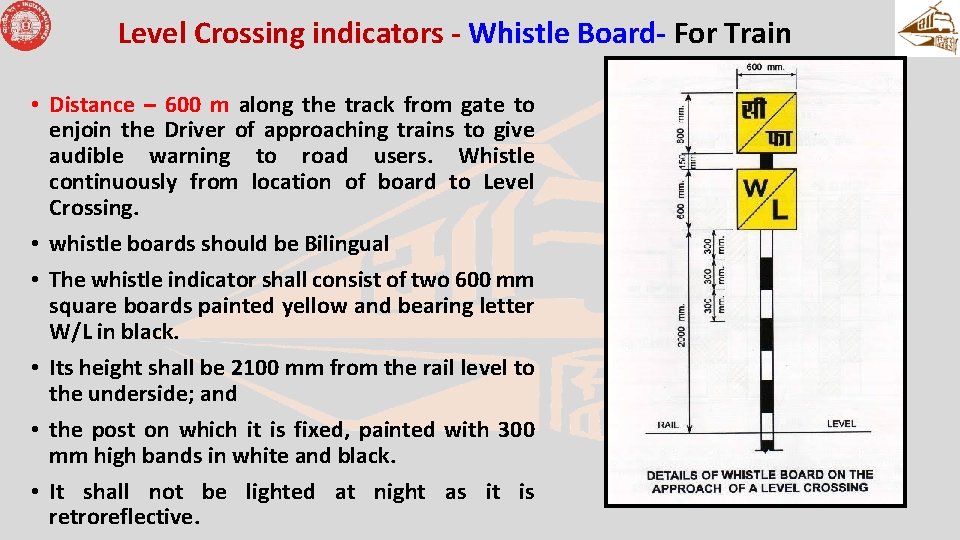
Level Crossing indicators - Whistle Board- For Train • Distance – 600 m along the track from gate to enjoin the Driver of approaching trains to give audible warning to road users. Whistle continuously from location of board to Level Crossing. • whistle boards should be Bilingual • The whistle indicator shall consist of two 600 mm square boards painted yellow and bearing letter W/L in black. • Its height shall be 2100 mm from the rail level to the underside; and • the post on which it is fixed, painted with 300 mm high bands in white and black. • It shall not be lighted at night as it is retroreflective.
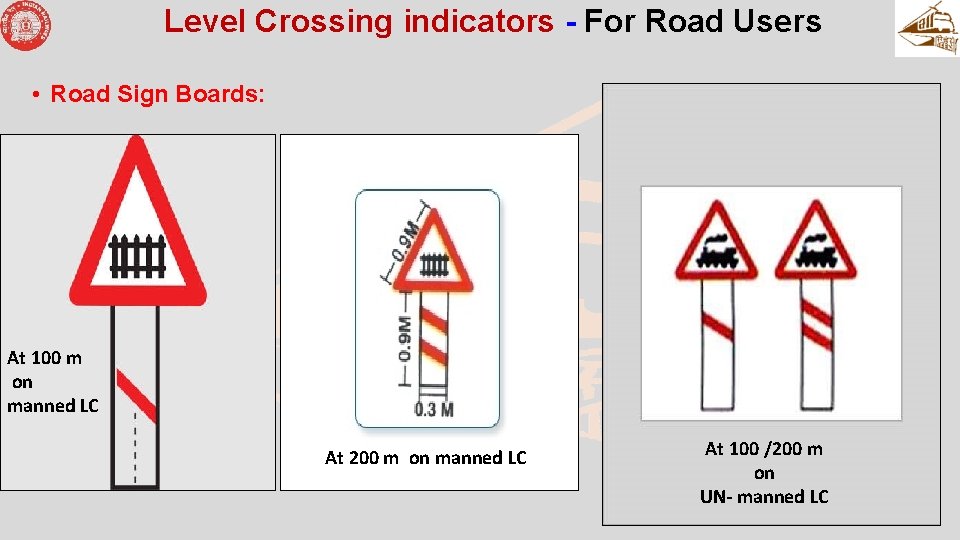
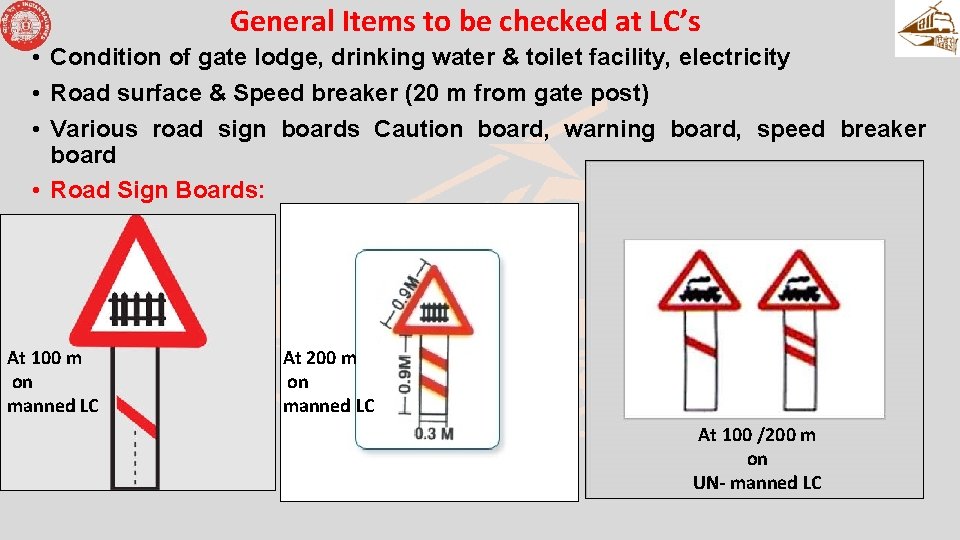
Level Crossing indicators - For Road Users • Road Sign Boards: At 100 m on manned LC At 200 m on manned LC At 100 /200 m on UN- manned LC
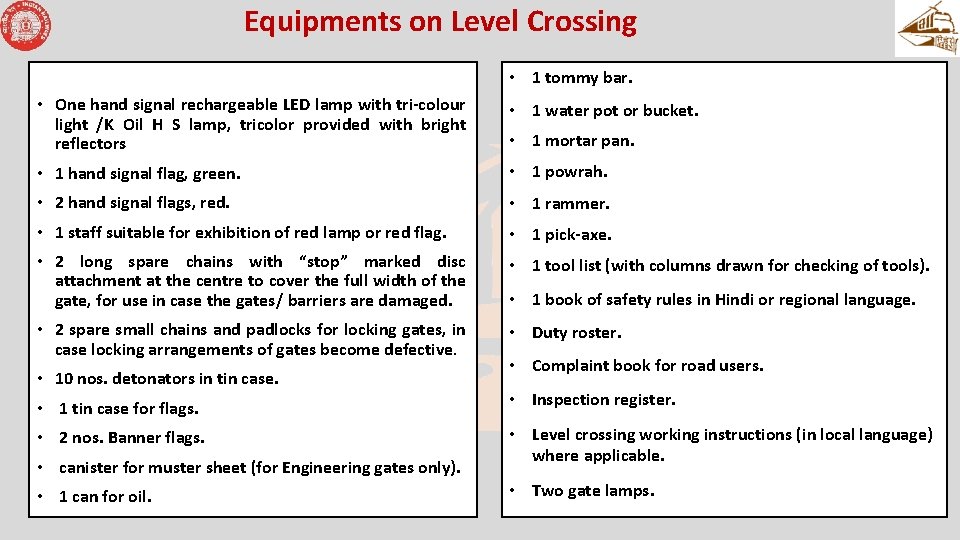
Equipments on Level Crossing • 1 tommy bar. • One hand signal rechargeable LED lamp with tri-colour light /K Oil H S lamp, tricolor provided with bright reflectors • 1 water pot or bucket. • 1 hand signal flag, green. • 1 powrah. • 2 hand signal flags, red. • 1 rammer. • 1 staff suitable for exhibition of red lamp or red flag. • 1 pick-axe. • 2 long spare chains with “stop” marked disc attachment at the centre to cover the full width of the gate, for use in case the gates/ barriers are damaged. • 1 tool list (with columns drawn for checking of tools). • 2 spare small chains and padlocks for locking gates, in case locking arrangements of gates become defective. • Duty roster. • 10 nos. detonators in tin case. • 1 mortar pan. • 1 book of safety rules in Hindi or regional language. • Complaint book for road users. • 1 tin case for flags. • Inspection register. • 2 nos. Banner flags. • Level crossing working instructions (in local language) where applicable. • canister for muster sheet (for Engineering gates only). • 1 can for oil. • Two gate lamps.
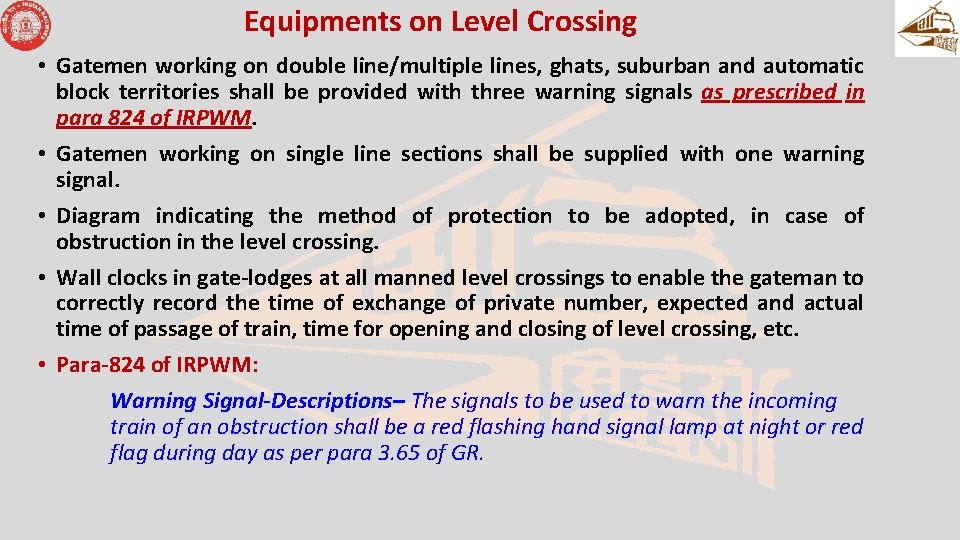
Equipments on Level Crossing • Gatemen working on double line/multiple lines, ghats, suburban and automatic block territories shall be provided with three warning signals as prescribed in para 824 of IRPWM. • Gatemen working on single line sections shall be supplied with one warning signal. • Diagram indicating the method of protection to be adopted, in case of obstruction in the level crossing. • Wall clocks in gate-lodges at all manned level crossings to enable the gateman to correctly record the time of exchange of private number, expected and actual time of passage of train, time for opening and closing of level crossing, etc. • Para-824 of IRPWM: Warning Signal-Descriptions– The signals to be used to warn the incoming train of an obstruction shall be a red flashing hand signal lamp at night or red flag during day as per para 3. 65 of GR.
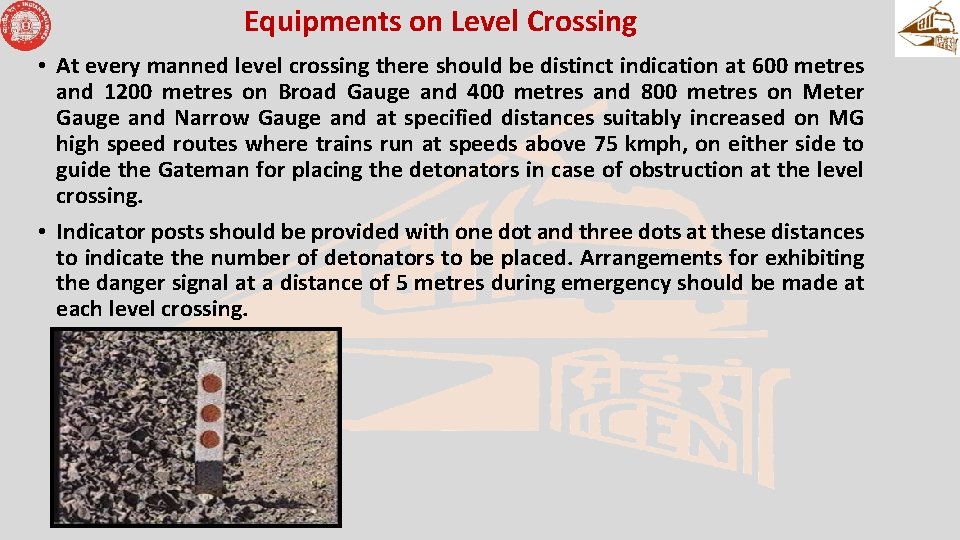
Equipments on Level Crossing • At every manned level crossing there should be distinct indication at 600 metres and 1200 metres on Broad Gauge and 400 metres and 800 metres on Meter Gauge and Narrow Gauge and at specified distances suitably increased on MG high speed routes where trains run at speeds above 75 kmph, on either side to guide the Gateman for placing the detonators in case of obstruction at the level crossing. • Indicator posts should be provided with one dot and three dots at these distances to indicate the number of detonators to be placed. Arrangements for exhibiting the danger signal at a distance of 5 metres during emergency should be made at each level crossing.
Siting of Gate-Lodges • Gate-Lodges shall be so sited that a clear and unobstructed view is obtained of all approaching trains and road vehicles, care being taken that allowance is made for all future extensions, e. g. , doubling of line or widening of roadway. • Where the level crossing is on a curve, the gate-lodge should be built on the outside of the curve. • Level crossing at cuttings or near cuttings should be avoided as far as possible.
Duties of Gateman • Alertness – Alert and be prepared to take immediate action should Danger be apprehend. Position , during passage of trains – Stand facing the track, on gate lodge side of approaching trains. Observe all passing trains and be prepared to take action for safety of trains. Should stand at specified location (clearly demarcated) during passage of train.
Duties of Gateman • Action in Emergency – In case of any obstruction at the Level Crossing, the gateman should maintain the gate signal , if any, in ON position and if unable to remove, protect the line and should take immediate action to inform Mate, PWI and nearest Station Master through messenger or any other means.
Duties of Gateman • Action during parting of train – On noticing, that the train has parted, he shall not show a stop hand signal to the driver , but shall try to attract the attention of the driver and the Guard by shouting, gesticulating or other means. • He shall ensure that Gate lamps and lamps of all gate signals are lighted and kept burning continuously from sunset to sunrise.
Duties of Gateman • No gateman shall leave his gate unless other gateman has taken charge of it. If required in emergency, he should close and lock the gate for road traffic. • The gateman should see that the channel for the flange of the wheel is kept clear. • The gateman should keep the road surface well watered and rammed. • The gateman should ensure that the equipment supplied to the gate is in good order and ready for immediate use. • Every gateman shall as far as possible prevent trespassing by person or cattle.
Duties of Gateman • If any gate or barrier gets damaged/out of order at Level crossing, he should use spare chain and Disc for closing against road traffic and inform Station Manager, Gangmate, PWI. • When the gate signal is defective, the gateman should close and lock the gates on sighting the train and hand signal or pilot the train past defective signal and advice Driver about the defective signal to next Station Manager. • In all Level Crossings provided with telephone connections literate gateman capable of exchanging private numbers, should be posted.
Duties of Gateman • The Hours of duty for Gateman should be laid down as per regulations in force. Rosters for gateman should be maintained at gate lodge. No gateman shall change his hours of duty without order of PWI. • Full particulars regarding PME and Vision test of each gateman shall be maintained at gatelodge. • While handing over and taking over charge, the gateman and relievers should jointly check all equipment and test all gears to see that they are in order. • Every gateman shall be fully conversant with the use of Hand signals, detonators, fusees and protection rules.
Examination of Gateman. • Scrutinize Medical certificate (A-3 category) • When last examined? • When next due? • With or without Glasses? • Scrutinize Competency Certificate • Date of issue & issuing authority • Validity • Whether he is working as per duty roster?
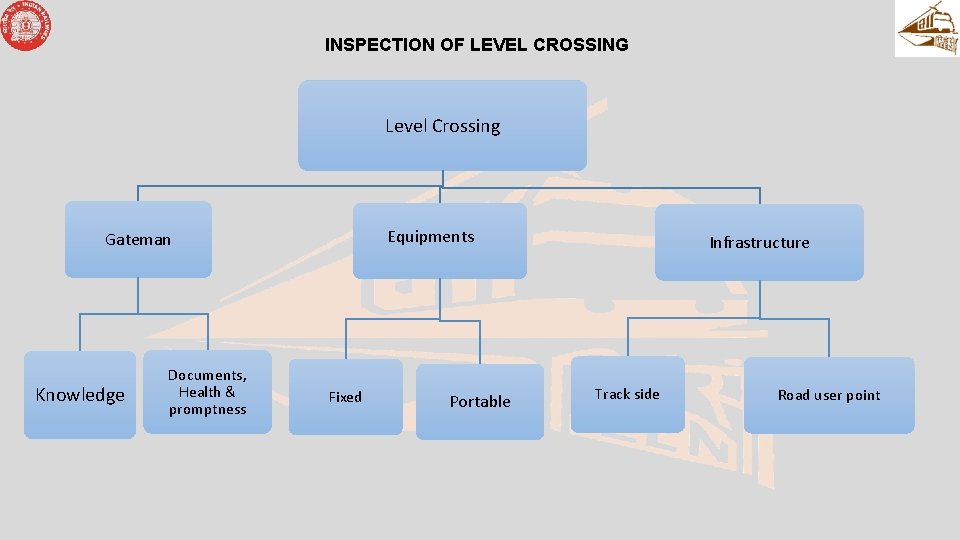
INSPECTION OF LEVEL CROSSING Level Crossing Equipments Gateman Knowledge Documents, Health & promptness Fixed Portable Infrastructure Track side Road user point
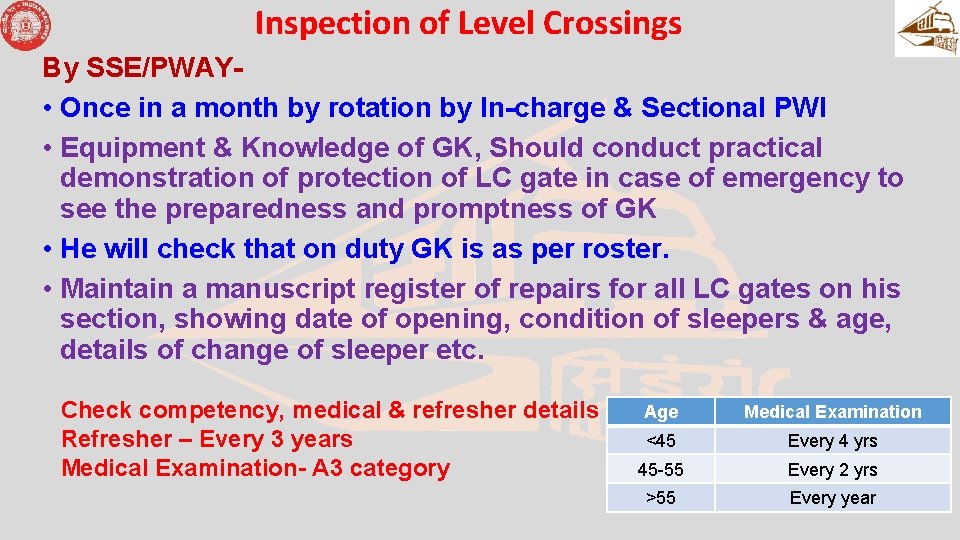
Inspection of Level Crossings By SSE/PWAY • Once in a month by rotation by In-charge & Sectional PWI • Equipment & Knowledge of GK, Should conduct practical demonstration of protection of LC gate in case of emergency to see the preparedness and promptness of GK • He will check that on duty GK is as per roster. • Maintain a manuscript register of repairs for all LC gates on his section, showing date of opening, condition of sleepers & age, details of change of sleeper etc. Check competency, medical & refresher details Refresher – Every 3 years Medical Examination- A 3 category Age Medical Examination <45 Every 4 yrs 45 -55 Every 2 yrs >55 Every year
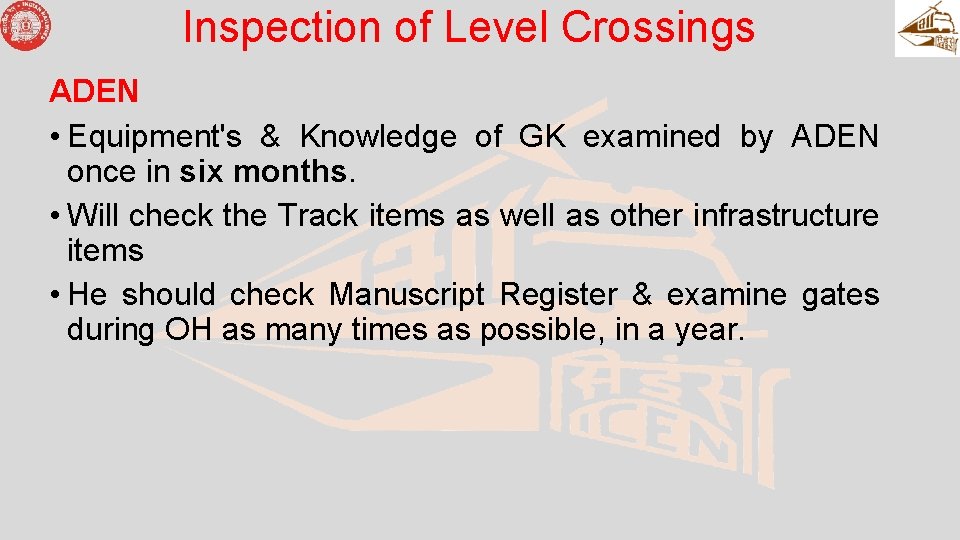
Inspection of Level Crossings ADEN • Equipment's & Knowledge of GK examined by ADEN once in six months. • Will check the Track items as well as other infrastructure items • He should check Manuscript Register & examine gates during OH as many times as possible, in a year.
General Items to be checked at LC’s • Condition of gate lodge, drinking water & toilet facility, electricity • Road surface & Speed breaker (20 m from gate post) • Various road sign boards Caution board, warning board, speed breaker board • Road Sign Boards: At 100 m on manned LC At 200 m on manned LC At 100 /200 m on UN- manned LC
General Items to be checked at LC’s • Height gauge (minimum 8 m from Gate post) maximum height 4. 67 m above road surface • Protection diagram, OH date, TVU details • Arrangement for fixing of banner flag &Tri colour HS lamp • Check rail clearance, condition of track & its parameters at LC & approach • LC No. Bd, W/L Bd, detonator indicators at 1200 m/600 m, fencing 15 (min) • Equipment as per IRPWM para 910. • Knowledge of GK for protection/emergency • LC gates which remain closed during night, should have a board prominently displaying this fact.
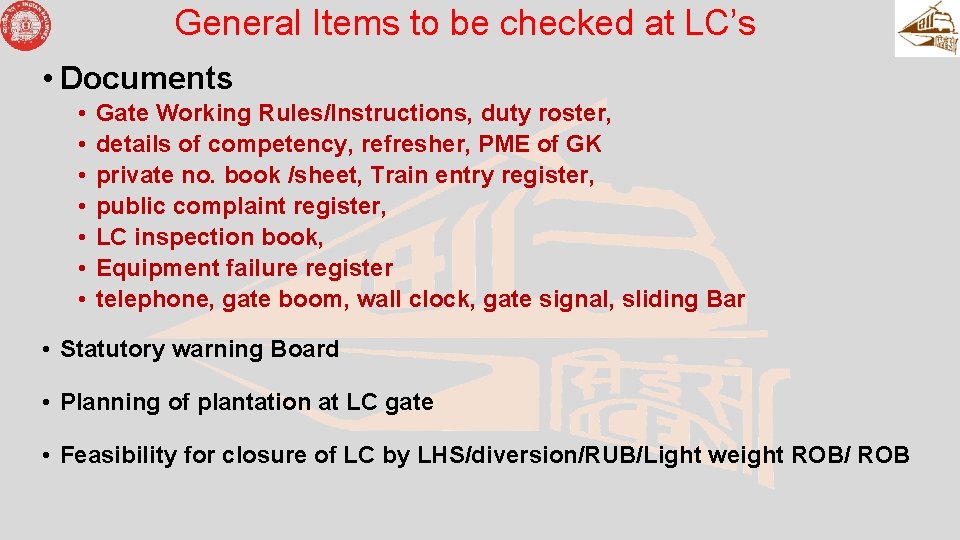
General Items to be checked at LC’s • Documents • • Gate Working Rules/Instructions, duty roster, details of competency, refresher, PME of GK private no. book /sheet, Train entry register, public complaint register, LC inspection book, Equipment failure register telephone, gate boom, wall clock, gate signal, sliding Bar • Statutory warning Board • Planning of plantation at LC gate • Feasibility for closure of LC by LHS/diversion/RUB/Light weight ROB/ ROB
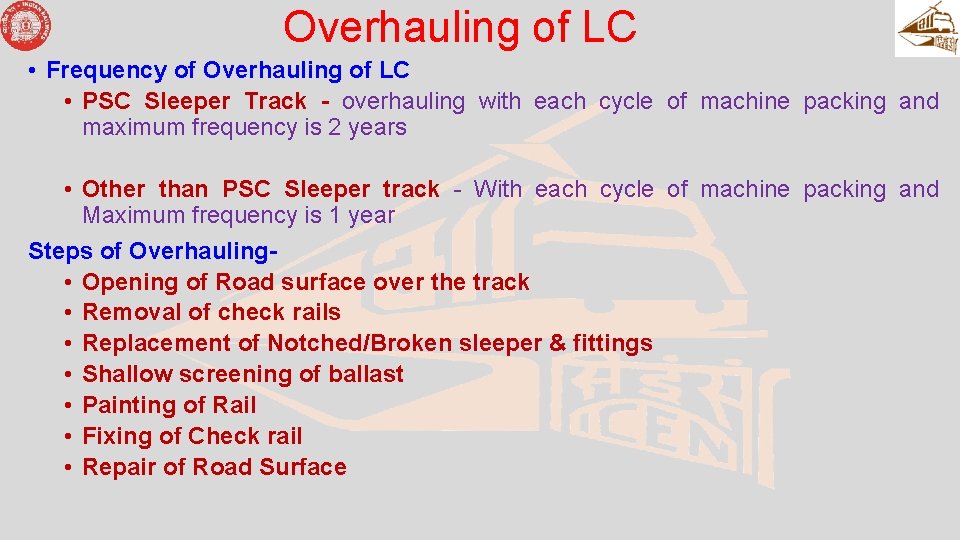
Overhauling of LC • Frequency of Overhauling of LC • PSC Sleeper Track - overhauling with each cycle of machine packing and maximum frequency is 2 years • Other than PSC Sleeper track - With each cycle of machine packing and Maximum frequency is 1 year Steps of Overhauling • Opening of Road surface over the track • Removal of check rails • Replacement of Notched/Broken sleeper & fittings • Shallow screening of ballast • Painting of Rail • Fixing of Check rail • Repair of Road Surface
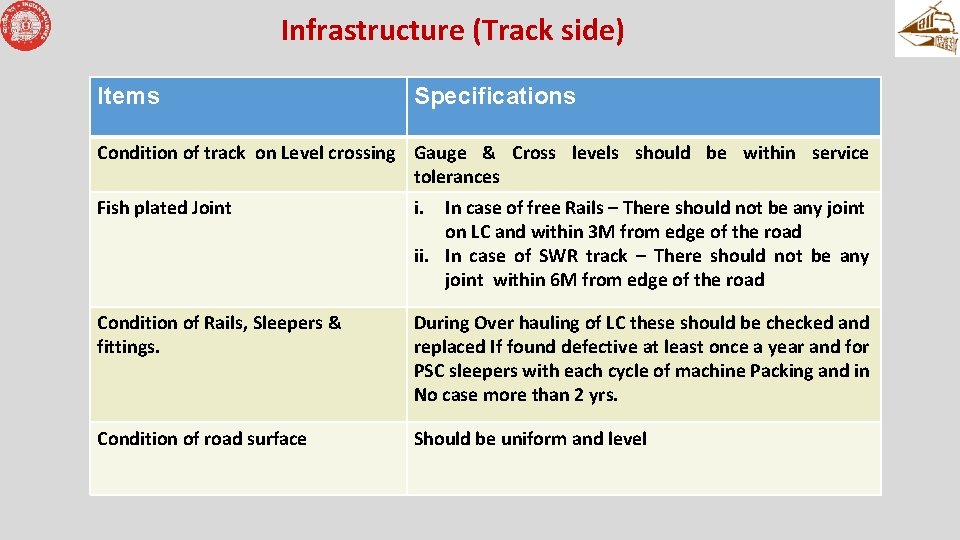
Infrastructure (Track side) Items Specifications Condition of track on Level crossing Gauge & Cross levels should be within service tolerances Fish plated Joint i. Condition of Rails, Sleepers & fittings. During Over hauling of LC these should be checked and replaced If found defective at least once a year and for PSC sleepers with each cycle of machine Packing and in No case more than 2 yrs. Condition of road surface Should be uniform and level In case of free Rails – There should not be any joint on LC and within 3 M from edge of the road ii. In case of SWR track – There should not be any joint within 6 M from edge of the road
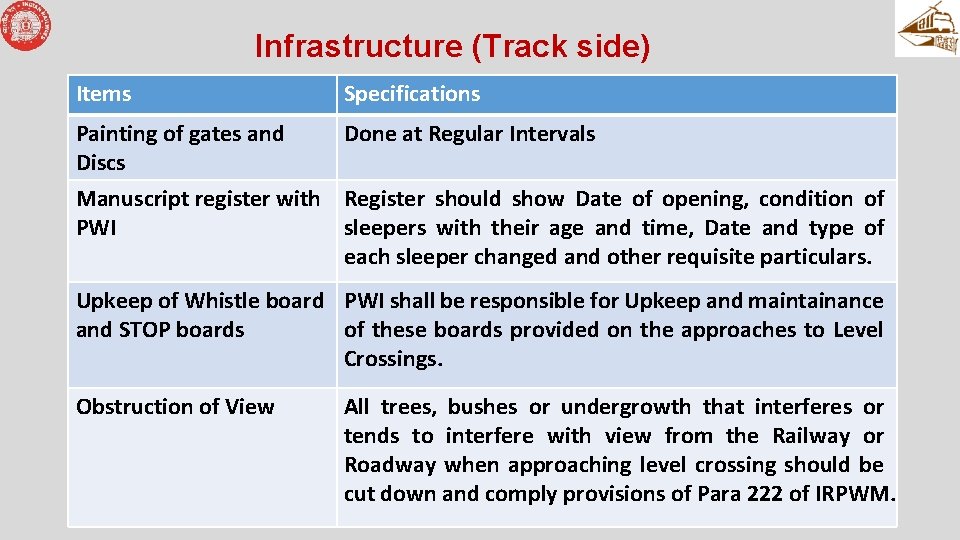
Infrastructure (Track side) Items Specifications Painting of gates and Done at Regular Intervals Discs Manuscript register with Register should show Date of opening, condition of PWI sleepers with their age and time, Date and type of each sleeper changed and other requisite particulars. Upkeep of Whistle board PWI shall be responsible for Upkeep and maintainance and STOP boards of these boards provided on the approaches to Level Crossings. Obstruction of View All trees, bushes or undergrowth that interferes or tends to interfere with view from the Railway or Roadway when approaching level crossing should be cut down and comply provisions of Para 222 of IRPWM.
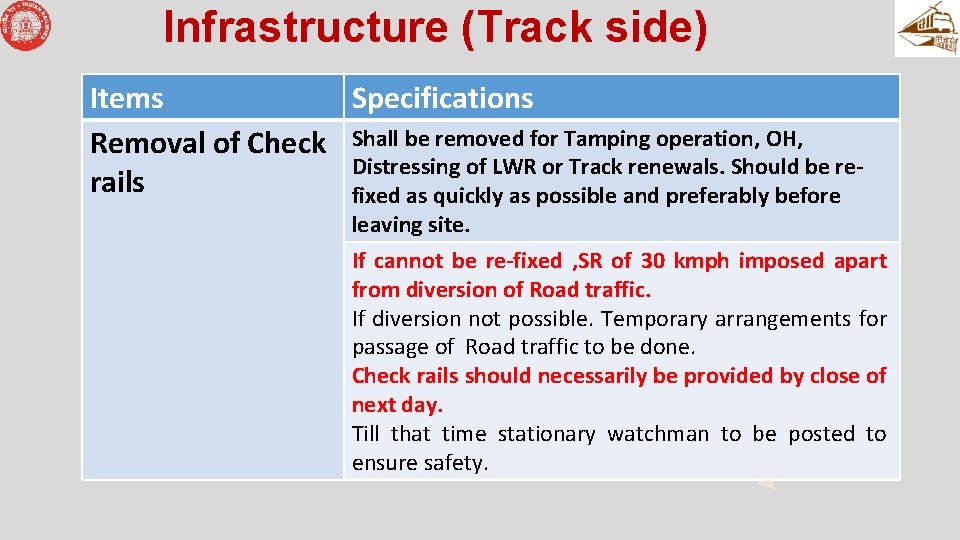
Infrastructure (Track side) Items Specifications Removal of Check Shall be removed for Tamping operation, OH, Distressing of LWR or Track renewals. Should be rerails fixed as quickly as possible and preferably before leaving site. If cannot be re-fixed , SR of 30 kmph imposed apart from diversion of Road traffic. If diversion not possible. Temporary arrangements for passage of Road traffic to be done. Check rails should necessarily be provided by close of next day. Till that time stationary watchman to be posted to ensure safety.
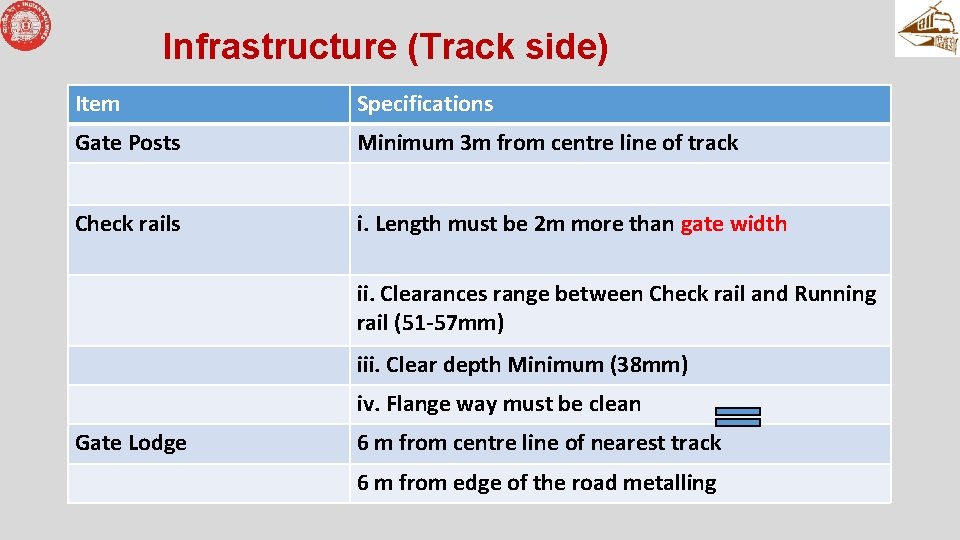
Infrastructure (Track side) Item Specifications Gate Posts Minimum 3 m from centre line of track Check rails i. Length must be 2 m more than gate width ii. Clearances range between Check rail and Running rail (51 -57 mm) iii. Clear depth Minimum (38 mm) iv. Flange way must be clean Gate Lodge 6 m from centre line of nearest track 6 m from edge of the road metalling
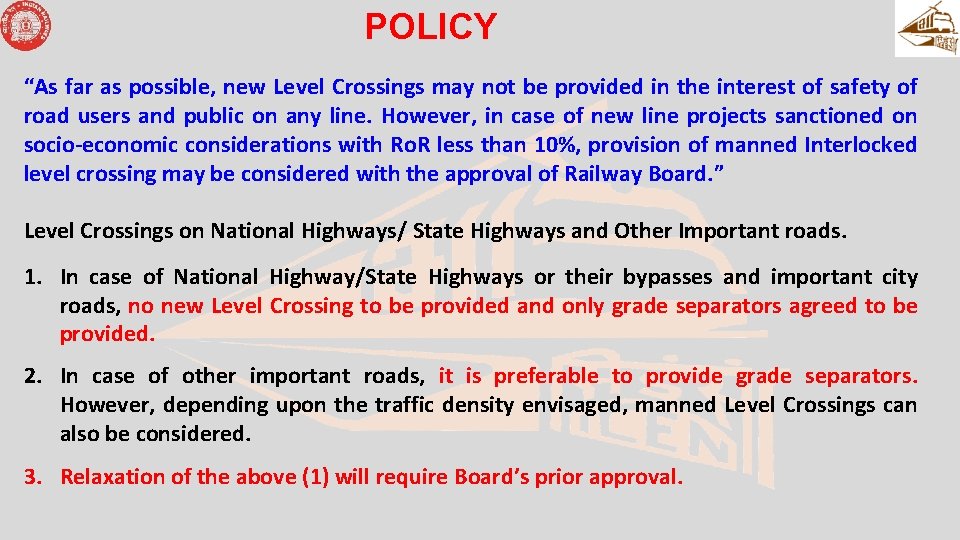
POLICY “As far as possible, new Level Crossings may not be provided in the interest of safety of road users and public on any line. However, in case of new line projects sanctioned on socio-economic considerations with Ro. R less than 10%, provision of manned Interlocked level crossing may be considered with the approval of Railway Board. ” Level Crossings on National Highways/ State Highways and Other Important roads. 1. In case of National Highway/State Highways or their bypasses and important city roads, no new Level Crossing to be provided and only grade separators agreed to be provided. 2. In case of other important roads, it is preferable to provide grade separators. However, depending upon the traffic density envisaged, manned Level Crossings can also be considered. 3. Relaxation of the above (1) will require Board’s prior approval.
POLICY Provision of New Level Crossings/ Manning/Demanning/Elimination– Provision of the new level crossings– • If, provision of new level crossing is inescapable, then only manned level crossing is to be provided. • This is applicable to all existing lines, new constructions and gauge conversions. • However, these instructions are not applicable in case of private sidings.
POLICY Manning of Unmanned Level Crossing: Based on traffic density and visibility etc. unmanned level crossings have been categorized into III for manning at Railways cost in a phased manner as per following priority– Category I All Unmanned Level Crossings with TVU above 3000. Category II All Unmanned Level Crossings with visibility restricted to 800 metres for road users and TVU above 2500. Category III All Unmanned Level Crossings which do not fall in Category– I & II above and which cannot be eliminated by any other methods like construction of diversion road, subway, closure of gates having low TVU or any other means as per extant policy instructions.
POLICY Manning of Unmanned Level Crossing: contd…… Note for Category III– • Divisional Railway Manager shall, ensure identification of unmanned level crossings, which can be eliminated by any other means, get necessary works sanctioned and simultaneously obtain No Objection Certificate (NOC) i. e. consent for closure of unmanned level crossings from the State Govt. /District Magistrate to avoid delay in closure. • For remaining unmanned level crossings, i. e. which cannot be eliminated by any other methods and where manning is the only solution; Divisional Railway Manager shall recommend proposals of manning of unmanned level crossings, in order of priority, for timely sanction by the competent authority. • Manning of level crossings can be prioritized in order of TVU or any other relevant site specific factors. Manning of such unmanned level crossing gates will require specific approval of the General Manager.
POLICY Manning of Unmanned Level Crossing: contd…… • All unmanned level crossings on Rajdhani and Shatabdi routes where maximum permissible speed is 120 kmph or more should be manned on priority. • Further train route wise priority to be followed for manning will be 'A' route followed by 'B', 'C', 'D Spl. ', 'E Spl. ' and 'E'.
POLICY Elimination of Level Crossing– A detailed review/survey of the existing level crossings both manned and unmanned should be carried out with a view to eliminate them by, I. Construction of Subways, along with adequate drainage arrangements. II. Construction of roads along Railway boundary to divert road traffic to the nearest level crossing/grade separator/ existing Railway bridge, wherever adequate land width is available, III. Closure of low TVU gates, IV. Construction of ROB/RUB as per para 925, etc.
POLICY Para 925: Criteria for Replacement of Existing Level Crossings (other than those provided on deposit terms) with Road Over/Under Bridges on Cost Sharing Basis– 1. Minimum Train Vehicle Units on a Level Crossing should be 1 lakh per day to become eligible for replacement with Road Over/Under Bridges on ‘Cost Sharing’ basis. However, this could be relaxed in the following cases: a) Suburban sections having high frequency of train services; and b) Near stations where detentions to road traffic are very high on account of either shunting operations or multi-directional receipt/despatch of trains or stabling of trains etc.
POLICY Para 925: Contd…… 2. Preference should be given to the Level Crossings located on trunk routes vis-à-vis those located on branch lines. In any case, minimum number of times the level crossing is required to be closed against the road traffic should at least be 12 times per day. 3. Subject to (1) and (2) above, priority should generally be accorded by the concerned State Government giving preference to Level crossings on National Highways.
POLICY Para 925: Contd…… (4) In case of Road Over/Under Bridges constructed in replacement of busy level crossings situated in Municipal/Corporation/ Metropolitan areas where Light Vehicular traffic is considerable and where the Railways are satisfied that closure of the level crossings would cause hardship, additional provision may be made for construction of the sub-way or a light Over Bridge with ramps for the use of light vehicular traffic at the time of framing the proposal for the construction of Road Over/ Under Bridges. The proposals for providing the ramps/sub-way should be examined critically and should be provided for only in the case of genuine hardships and not as a matter of course. The cost of these ramps/subway will be shared equally with the Sponsoring Authority on 50: 50 basis. (5) Closure of the Level Crossings should be ensured before commissioning of the Road Over/Under Bridges. All such cases where State/Local Authorities do not agree to abide by this should be reported to the Railway Board promptly.
THANKS