
Level 3 Extended Project Qualification WJEC Entry Code


- Slides: 33
Level 3 Extended Project Qualification WJEC Entry Code: 9500 03 Teaching from 2015 INTRODUCTION
Key features: Level 3 Extended Project Qualification • Available to centres in England, Wales, Northern Ireland, British Oversees centres and British Forces Oversees centres • Level 3, one-unit, stand-alone qualification • Available for Summer series only
• Internally assessed and externally moderated • Free online e-submission platform available to all centres • Diversity is a key element of the EPQ philosophy
• Helps learners develop a range of independent learning skills • Universities are including the EPQ in their UCAS offer • Fewer learners pursuing a fourth A level • Worth more than an AS; A* in EPQ carries 28 UCAS points compared to a minimum 20 points for AS grade ‘A’
• EPQ allows learners to research topic of their choice • Offers flexible timetabling options for centres • Contributes to the Level 3 Threshold and Performance points in England Wales
Why choose WJEC for the EPQ • Face-to-face and online CPD training courses • Free centre visits to new centres • Continuous direct access to subject specialists • Unlimited access to free educational resources
• Continuous support offered on approving project proposals & titles • Wide range of exemplar materials on our secure website • Access to Regional Support Officers
Online e-submission platform (Secure. Assess) • Submit Extended Projects online Simple to use and developed to streamline the administration for both teachers and learners Significant savings for centres in terms of postage, print and stationery costs Candidate work is submitted online and securely stored on WJEC servers
Centres do not have to make up paper based portfolios and send samples in the post to External Moderators It meets candidates' expectations for the operation of qualifications in a digital age • Guidance and continuous support on using the e-submission platform is available
Specification overview Develop knowledge and understanding of a specific topic through research Develop as critical, independent, self-evaluative learners by improving and reviewing their own learning and performance Develop their communication and presentation skills
Demonstrate initiative, creativity and flexibility in responding to challenges and in applying new technologies, where appropriate Support their personal aspirations for higher education and employment EPQ can be developed from one or more programme of study or topic of personal interest
Can be in the form of a dissertation, field investigation, artefact, design or a performance Requires 120 GLH, 45 GLH recommended for Teaching & Learning Programme It has a taught element, a skill based individual piece of work and a supervisor for every learner
EXTENDED PROJECT - The Process • Choosing a project topic and writing a proposal outlining the aims and objectives, and a project plan of how the project outcome will be achieved • Recording progress demonstrating what was learned from the taught element, how research has been conducted, decisions made, problems solved and how the whole process was reviewed and evaluated, including meetings with supervisors
• Producing a project outcome providing evidence of the final piece of written work or product in an appropriate format • Making a presentation to a non-specialist audience explaining the project outcome including a review of their own performance and learning through a question and answer session
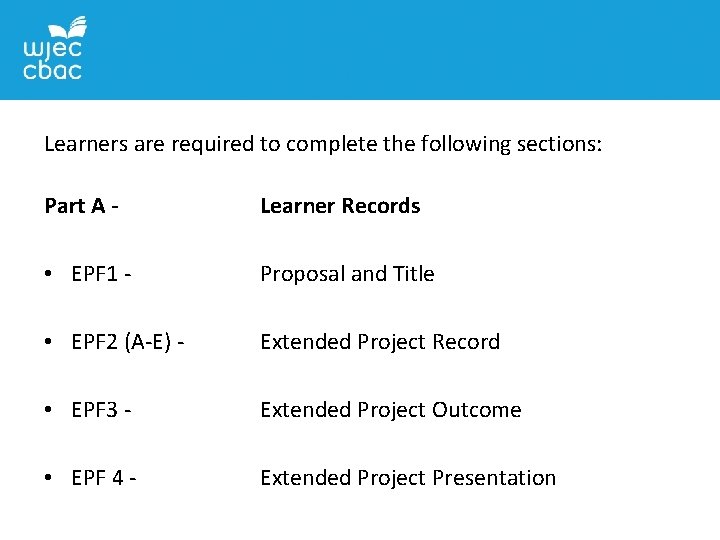
Learners are required to complete the following sections: Part A - Learner Records • EPF 1 - Proposal and Title • EPF 2 (A-E) - Extended Project Record • EPF 3 - Extended Project Outcome • EPF 4 - Extended Project Presentation
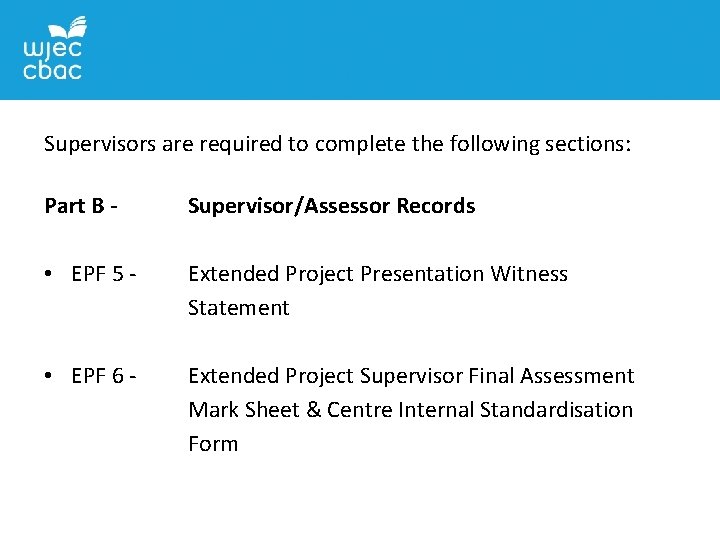
Supervisors are required to complete the following sections: Part B - • EPF 5 - Supervisor/Assessor Records • EPF 6 - Extended Project Supervisor Final Assessment Mark Sheet & Centre Internal Standardisation Form Extended Project Presentation Witness Statement
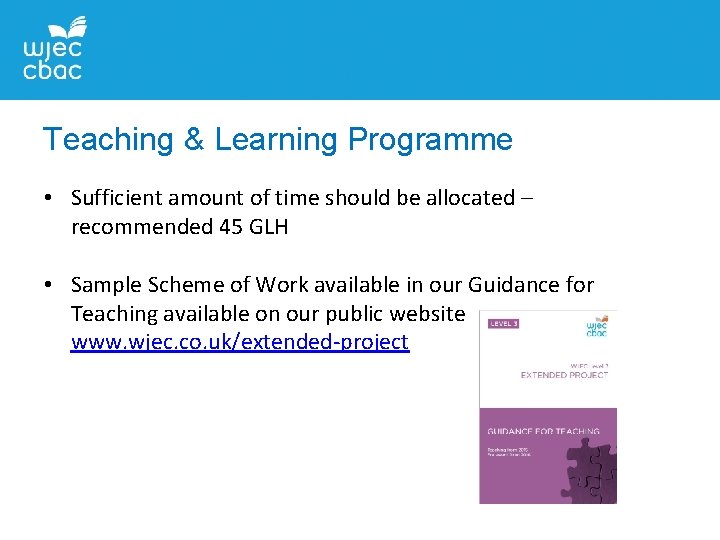
Teaching & Learning Programme • Sufficient amount of time should be allocated – recommended 45 GLH • Sample Scheme of Work available in our Guidance for Teaching available on our public website www. wjec. co. uk/extended-project
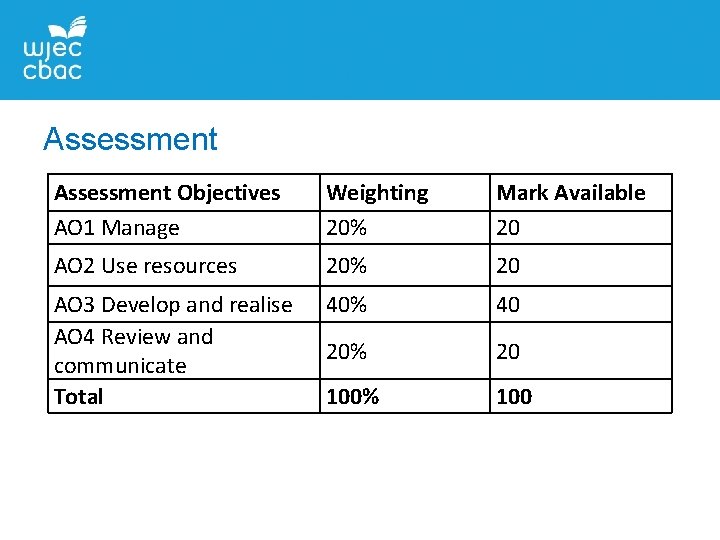
Assessment Objectives AO 1 Manage Weighting 20% Mark Available 20 AO 2 Use resources 20% 20 AO 3 Develop and realise AO 4 Review and communicate Total 40% 40 20% 20 100% 100
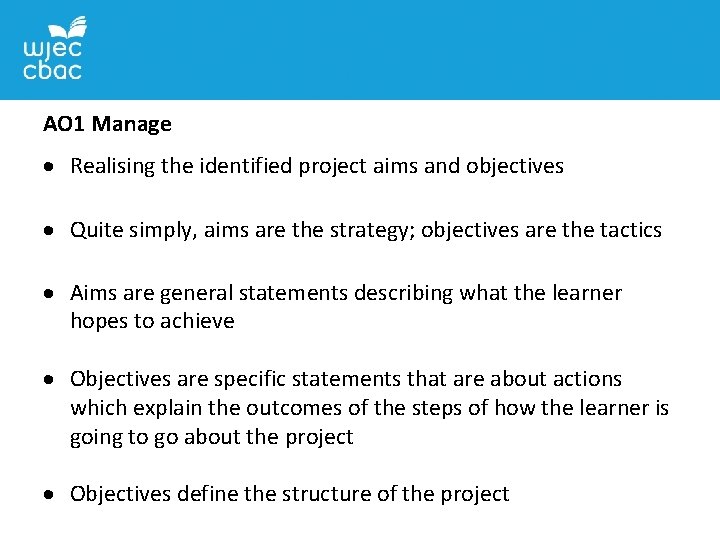
AO 1 Manage Realising the identified project aims and objectives Quite simply, aims are the strategy; objectives are the tactics Aims are general statements describing what the learner hopes to achieve Objectives are specific statements that are about actions which explain the outcomes of the steps of how the learner is going to go about the project Objectives define the structure of the project
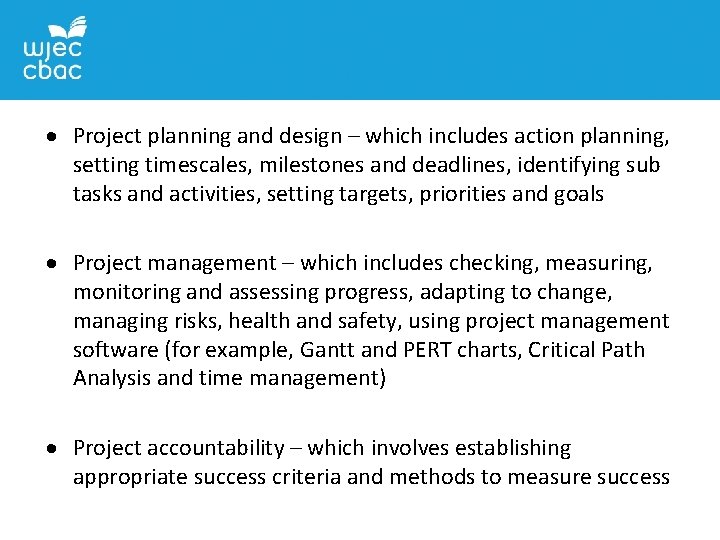
Project planning and design – which includes action planning, setting timescales, milestones and deadlines, identifying sub tasks and activities, setting targets, priorities and goals Project management – which includes checking, measuring, monitoring and assessing progress, adapting to change, managing risks, health and safety, using project management software (for example, Gantt and PERT charts, Critical Path Analysis and time management) Project accountability – which involves establishing appropriate success criteria and methods to measure success
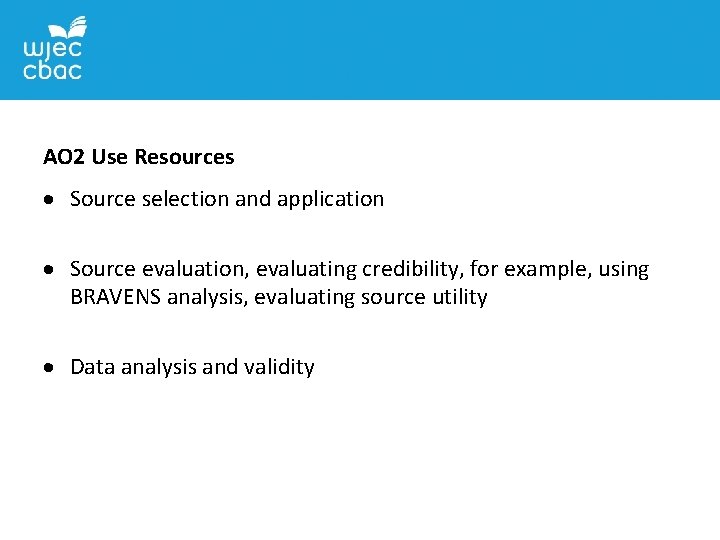
AO 2 Use Resources Source selection and application Source evaluation, evaluating credibility, for example, using BRAVENS analysis, evaluating source utility Data analysis and validity
Source referencing and avoiding plagiarism Synthesising complex information and data Ethical considerations
AO 3 Develop and Realise Problem solving Decision making Use of language and argument Use of new technologies, such as 3 D printers, new software, online publishing, etc.
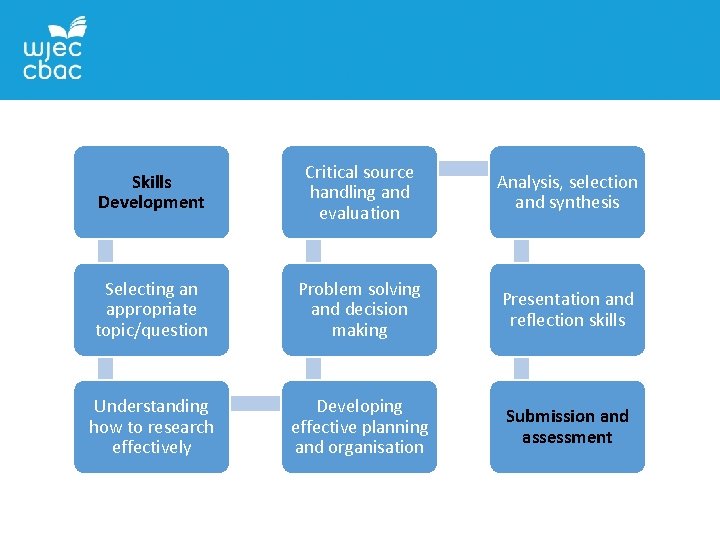
Skills Development Critical source handling and evaluation Analysis, selection and synthesis Selecting an appropriate topic/question Problem solving and decision making Presentation and reflection skills Understanding how to research effectively Developing effective planning and organisation Submission and assessment
Structured and fluent writing with a clear line of argument Have a focus on critical analysis over description Have strong supporting evidence, correctly referenced Show evidence of the counter-argument They need to be well-structured and coherent paragraphs
Be a minimum of 5, 000 words in length, although there is no penalty for going over this word count Show evidence of drafting and proof reading but only the final draft is required for submission Be evidence based and show developed conclusion that fully addresses the identified aims & objectives Have an academic bibliography Learners need to have given attention to SPa. G issues
Dissertation or artefact? Both dissertation (written project outcome) and artefact (non -written project) outcome are equally valid Weak artefacts that are unlikely to meet the demands of a Level 3 qualification Best artefacts have clear aims and objectives and are rooted explicitly in research
Examples of good artefacts: ‘To produce a scale model of a trebuchet for under £ 100 that is capable of throwing a tennis ball over ten metres. ’ ‘To manufacture a leather bomber jacket for under £ 100 using the school laser cutter. ’ ‘To write and produce a short film on the Syrian refugee crisis aimed at learners of sixth form age. ’
AO 4 Review and Communicate Presentation skills – learners need to structure their ideas effectively, ensuring audience engagement and avoiding ‘death-by-slide’, and deal with challenging questions Evaluate and reflect on what they have done
Key requirements for AO 4 - Presentation The learner’s supervisor has to be present as ultimately s/he has to assess the effectiveness of the presentation The learner has to answer a series of questions from the audience at the end of the presentation and these questions must not be previously shared with the learner
Other resources www. wjec. co. uk/qualifications/extended-project/ EPQ specification Student Guide Guidance for Teaching Administration Handbook FAQs CPD events details Principal Moderator’s report
Other resources www. wjecservices. co. uk CPD materials Exemplars
Contact Details Glenda Kinsey Extended Project Qualification manager 02920 265348 Glenda. kinsey@wjec. co. uk Tania Lucas Subject Support Officer 02920 265343 Tania. lucas@wjec. co. uk For further details, please visit the Extended Project web page on the WJEC website