
Level 3 BTEC Childrens Play Learning and Development

Level 3 BTEC Children’s Play, Learning and Development. Passport to Sixth Form Name: ____________ 1
What will I be studying in CPLD? The Pearson BTEC Level 3 National Extended Certificate in Children’s Play, Learning and Development gives an introduction to study of the sector. It is equivalent in size to one A Level. The Pearson BTEC Level 3 National Extended Diploma in Children’s Play, Learning and Development, equivalent in size to three A Levels, which will confer early years educator status, qualifying students to work directly in the sector. These course involve the study of the following: Unit 1: Children’s Development Students will gain an understanding of children’s developmental progress from birth up to seven years 11 months. Learning about child development is vital for working with children in an early years setting. It gives you a background of the key theories that will govern all aspects of your working practice and everything you do as an early years educator. In this unit, you will learn about theories and models of development that explain how and why children develop and how this relates to the Early Years Foundation Stage. You will develop an understanding of a range of factors that may influence children’s development, and consider the short- and long-term effects on their development. The knowledge you will gain in this unit will prepare you for a variety of careers as a childminder, family support worker or early years educator in the private, voluntary or state sector and/or allow progression to higher education studies in early years education or management. This unit is assessed through an external examination - 1 hour and 45 minutes and worth 90 marks. Unit 2: Development of Children’s Communication, Literacy and Numeracy Skills Students will gain an understanding of how children develop literacy, language, numeracy and communication skills and how to promote and support this development. Children’s development of speech, communication, language, literacy and numeracy skills is an essential part of early childhood development, beginning from birth and continuing at home and in the early years setting. In this unit, you will learn the sequence of children’s speech, communication, language, literacy and numeracy skills development. You will plan stage appropriate activities that encourage children’s development and understanding by stimulating their enthusiasm, and using exciting and interesting ways to enable them to find out more. This unit will be assessed through an external task set and marked by the examination board. This task is worth 68 marks. Unit 3: Play and Learning Students study the benefits of play, the influence of theories and approaches to play, and how to provide and support purposeful play and learning activities for children. In this unit, you will learn about the types of play and the opportunities that should be made available to children at different ages and stages of development. You will consider why play is so important and how it supports children’s learning and development. This unit will be assessed through internally set assignments. Unit 4: Enquiries into Current Research in Early Years Practice (Level 3 National Extended Diploma in Children’s Play, Learning and Development only) Students explore the methodologies of contemporary research and investigate the implications for early years practice. In this unit, you will find out about the different research methods that can be used to gather information and the ethical issues that will need to be considered. You will develop skills that will enable you to carry out secondary research into a contemporary issue. You will review the research carried out into a contemporary issue in the sector, and then carry out your own secondary research into the issue. This unit will be assessed through an external task set and marked by the examination board. This task is worth 65 marks. Part A is released four weeks before Part B is scheduled for students to carry out research. Part B is a supervised assessment of three hours taken in a single morning session. In addition there will be optional units to study. 2
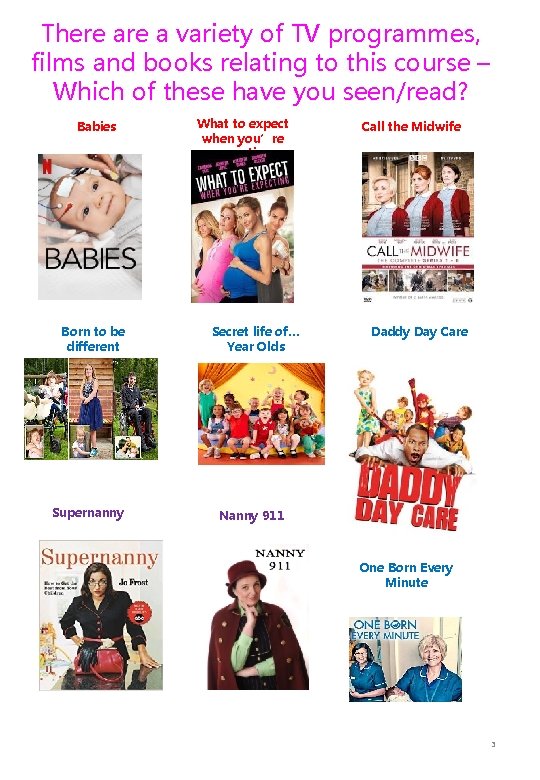
There a variety of TV programmes, films and books relating to this course – Which of these have you seen/read? Babies Born to be different Supernanny What to expect when you’re expecting Secret life of… Year Olds Call the Midwife Daddy Day Care Nanny 911 One Born Every Minute 3
Learning Log Record here any additional reading/viewing you are undertaking in order to show what you have been completing in order to prepare you for the CPLD course. Date Title Summary of content My thoughts 4
Task: To prepare you for the CPLD course research and define the following words: Term: Definition: Development Growth Gross motor skills Fine motor skills Physical development Cognitive development Language development Emotional development Social development 5
Task: To prepare you for the CPLD course research and define the following words: Term: Definition: Gestation Reflexes Milestones Mouthing Cruising Solitary play Cooperative play Onlooker play Parallel play 6
Research and activity tasks Research task : Maslow’s hierarchy of needs 1. Explain what they are. 2. Download a diagram of Maslow’s hierarchy of needs. Activity task 1: Learning through play can stimulate a child’s development. 1. Design an outdoor play environment for nursery aged children. 2. What have you included in your design. 3. Why have you placed the different equipment in particular places? 4. How will this play environment help the children to develop? Activity task 2: When working in an early years setting staff may decide to take the children on a trip. (For instance – a day trip to the Zoo where the children can feed the animals) 1. Make a list of all the safety aspects the staff would need to consider to maintain the safety of the children on the trip. (For example: a) Consent and involvement of families – Staff will need consent from families and guardians so that they will know how many children will be involved in the trip. Staff will need the parents and guardian’s signature on the consent form and to fill out a medical form so that this will cover the legal requirements the school has to follow. b) Staff: child ratios – Staff need to know exactly how many children are going on the trip and the age range of the children so they can work out the supervision that is needed. Also children who have special needs may need extra support. c) ? ? ? ? ? d) ? ? ? ? ? e) ? ? ? ? ? f) ? ? ? ? ? g) ? ? ? ? ? 7
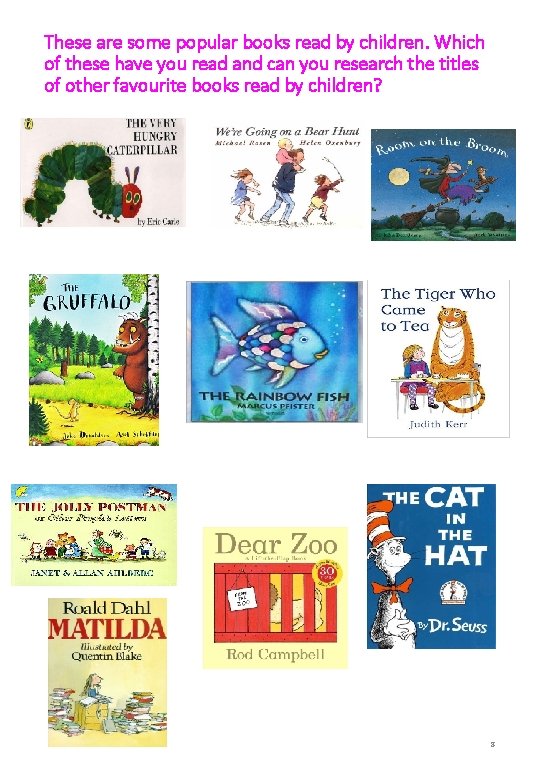
These are some popular books read by children. Which of these have you read and can you research the titles of other favourite books read by children? 8
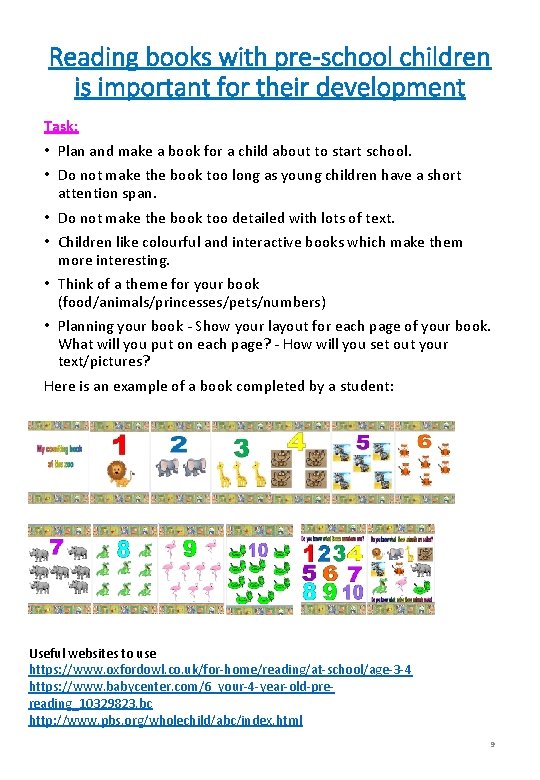
Reading books with pre-school children is important for their development Task: • Plan and make a book for a child about to start school. • Do not make the book too long as young children have a short attention span. • Do not make the book too detailed with lots of text. • Children like colourful and interactive books which make them more interesting. • Think of a theme for your book (food/animals/princesses/pets/numbers) • Planning your book - Show your layout for each page of your book. What will you put on each page? - How will you set out your text/pictures? Here is an example of a book completed by a student: Useful websites to use https: //www. oxfordowl. co. uk/for-home/reading/at-school/age-3 -4 https: //www. babycenter. com/6_your-4 -year-old-prereading_10329823. bc http: //www. pbs. org/wholechild/abc/index. html 9
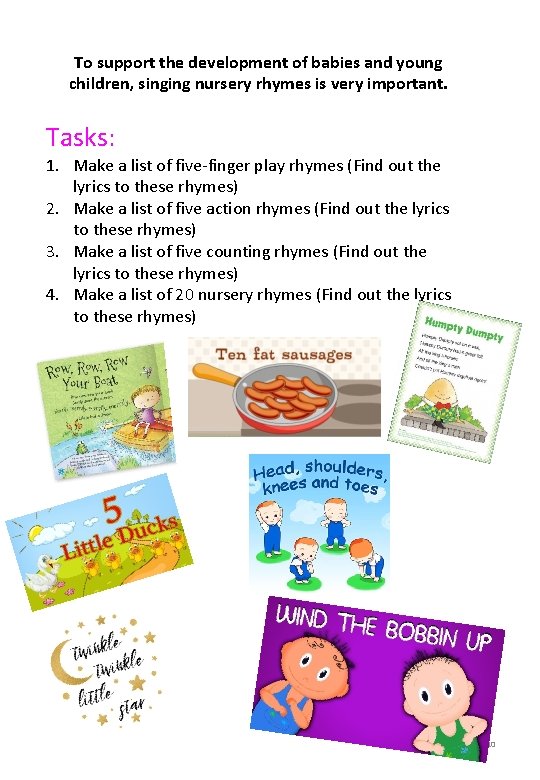
To support the development of babies and young children, singing nursery rhymes is very important. Tasks: 1. Make a list of five-finger play rhymes (Find out the lyrics to these rhymes) 2. Make a list of five action rhymes (Find out the lyrics to these rhymes) 3. Make a list of five counting rhymes (Find out the lyrics to these rhymes) 4. Make a list of 20 nursery rhymes (Find out the lyrics to these rhymes) 10
Passport to Sixth Form Check list Use this list to make sure you have everything you need to hand in, in September in order to be well prepared for your Level 3 CPLD course. Complete the learning log. Completed glossary of key terms. Research task : Maslow’s hierarchy of needs. Activity task 1: Design an outdoor play environment. Activity task 2: List of all the safety aspects on the trip. Research the title of favourite books read by children. Task: Plan and make a book for a child about to start school. List of nursey rhymes.
- Slides: 11