
Level 3 Air Conditioning Inspections for Buildings 7
. Level 3 Air Conditioning Inspections for Buildings 7. Compressors (Day 2) PRESENTED BY Anthony Balaam aircon@stroma. com
Compressors Basics of Compressors Ø Is to draw ‘low pressure’ refrigerant vapour from the ‘Evaporator’ and compress it to a ‘higher pressure’. Ø It allows the refrigerant vapour to be condensed back into a liquid by some convenient low-cost source of cooling (ambient air or water). Ø Compressor housings can be either: 1. hermetic/ 2. semi-hermetic or 3. opentype. Ø Main types of compressors are: This area hear High pressure Ø 1. Reciprocating Compressors Ø 2. Screw Compressors Low pressure Ø 3. Scroll Compressors Ø 4. Centrifugal Compressors Stroma Certification – ABBE Level 3 Air Conditioning course material 2015 House keeping © Stroma Certification 2014 | Version 1. 0
Housings 1. Hermetically Sealed: Ø Built into the same housing as the compressor parts. Ø Welded shell with no access to internal parts for servicing or repair. 2. Semi-Hermetically Sealed: Ø Assembled with removable covers – limited access for onsite servicing. Ø Above about 8 k. W motor power, these types are usually suction gas cooled. Ø i. e. Refrigerant cools the motor before compression. Reduces compressor capacity. Ø Externally cooled types – vapour passes directly into the cylinders. ü Usually about 8% more efficient than the above. Stroma Certification – ABBE Level 3 Air Conditioning course material 2015 House keeping © Stroma Certification 2014 | Version 1. 0
Housings 3. Open Type: Ø Drive Shaft passes through a rotating vapour seal. Ø Motor is connected to the external drive shaft – by direct coupling/belts. Ø Motor must be accurately sized for compressor’s duty and starting torque. Running a motor below the design duty reduces its power factor and efficiency. Ø When comparing efficiency with previous types: Ø Motor’s efficiency and drive losses need to be taken into account. Stroma Certification – ABBE Level 3 Air Conditioning course material 2015 House keeping © Stroma Certification 2014 | Version 1. 0
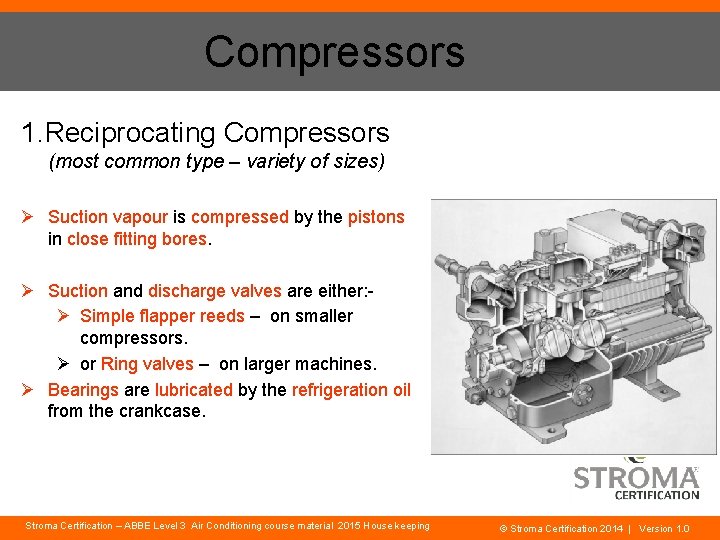
Compressors 1. Reciprocating Compressors (most common type – variety of sizes) Ø Suction vapour is compressed by the pistons in close fitting bores. Ø Suction and discharge valves are either: Ø Simple flapper reeds – on smaller compressors. Ø or Ring valves – on larger machines. Ø Bearings are lubricated by the refrigeration oil from the crankcase. Stroma Certification – ABBE Level 3 Air Conditioning course material 2015 House keeping © Stroma Certification 2014 | Version 1. 0
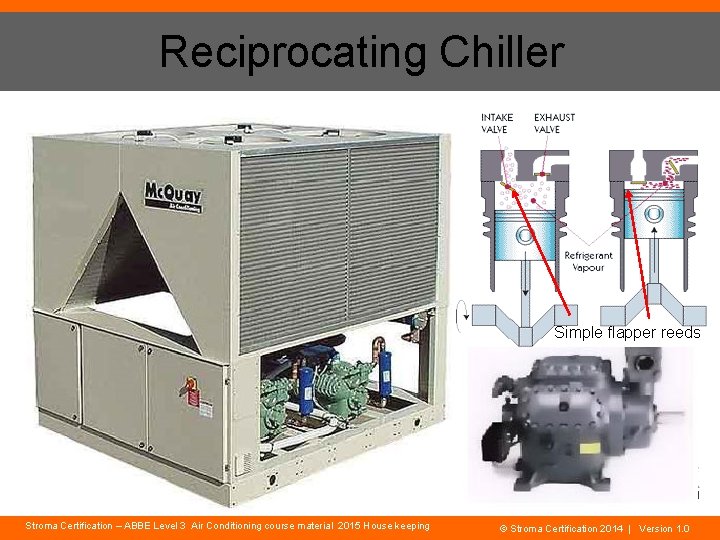
Reciprocating Chiller Simple flapper reeds Stroma Certification – ABBE Level 3 Air Conditioning course material 2015 House keeping © Stroma Certification 2014 | Version 1. 0
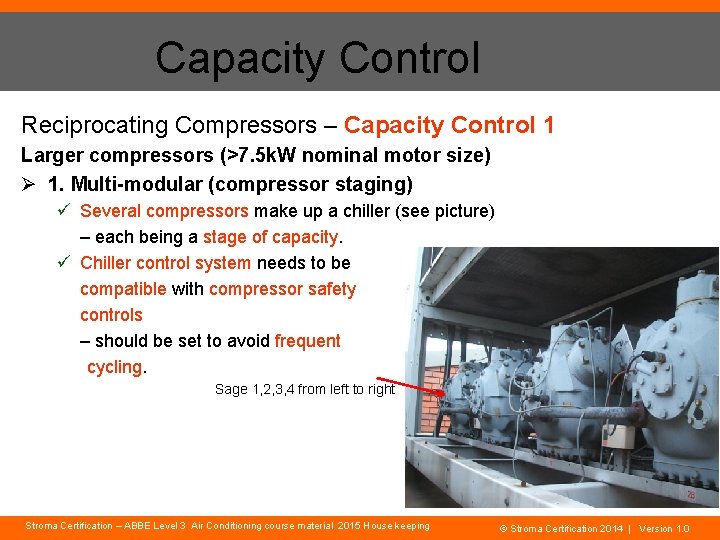
Capacity Control Reciprocating Compressors – Capacity Control 1 Larger compressors (>7. 5 k. W nominal motor size) Ø 1. Multi-modular (compressor staging) ü Several compressors make up a chiller (see picture) – each being a stage of capacity. ü Chiller control system needs to be compatible with compressor safety controls – should be set to avoid frequent cycling. Sage 1, 2, 3, 4 from left to right Stroma Certification – ABBE Level 3 Air Conditioning course material 2015 House keeping © Stroma Certification 2014 | Version 1. 0
Capacity Control Reciprocating Compressors – Capacity Control 2 Larger compressors (>7. 5 k. W nominal motor size) Ø 2. Cylinder unloading (blocked suction unloading) Ø Achieved by maintaining one or more cylinders in the raised position by hydraulic pressure. Ø Allows refrigerant gas to pass back and forth without check – reducing mass flow through the compressor. Ø Flow needs to be maintained to minimise overheating and ensure adequate oil return. Insufficient oil return will trip oil safety switch. Long hours of operation with cylinder unloading should be avoided. Stroma Certification – ABBE Level 3 Air Conditioning course material 2015 House keeping © Stroma Certification 2014 | Version 1. 0
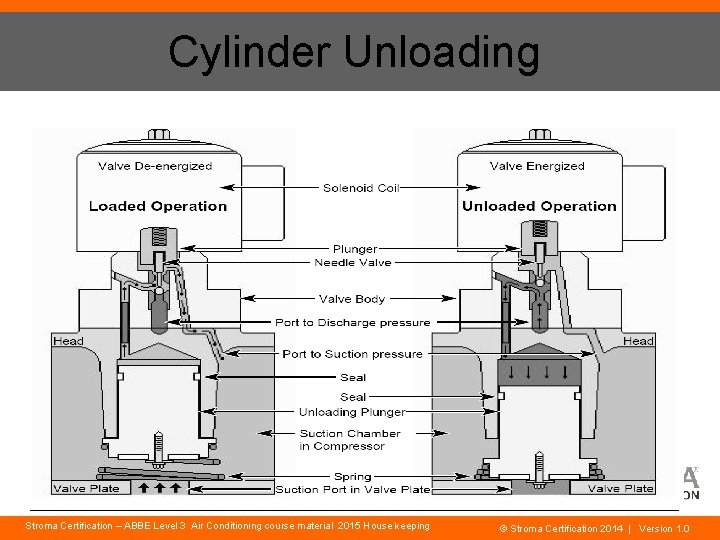
Cylinder Unloading Stroma Certification – ABBE Level 3 Air Conditioning course material 2015 House keeping © Stroma Certification 2014 | Version 1. 0
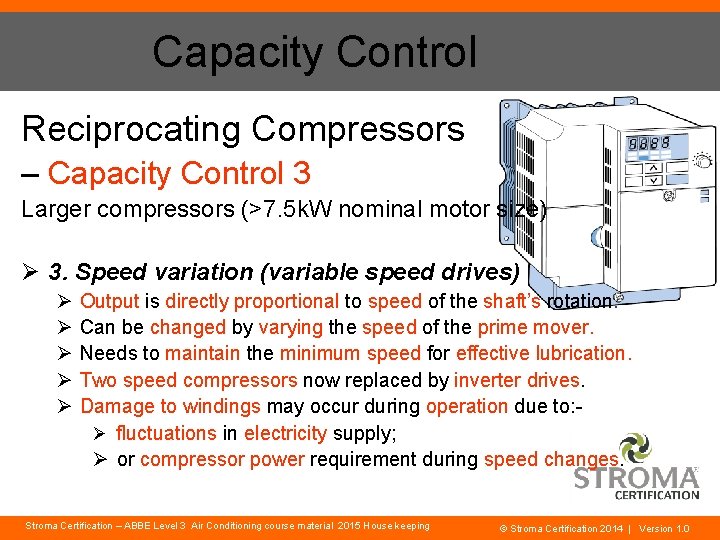
Capacity Control Reciprocating Compressors – Capacity Control 3 Larger compressors (>7. 5 k. W nominal motor size) Ø 3. Speed variation (variable speed drives) Ø Ø Ø Output is directly proportional to speed of the shaft’s rotation. Can be changed by varying the speed of the prime mover. Needs to maintain the minimum speed for effective lubrication. Two speed compressors now replaced by inverter drives. Damage to windings may occur during operation due to: Ø fluctuations in electricity supply; Ø or compressor power requirement during speed changes. Stroma Certification – ABBE Level 3 Air Conditioning course material 2015 House keeping © Stroma Certification 2014 | Version 1. 0
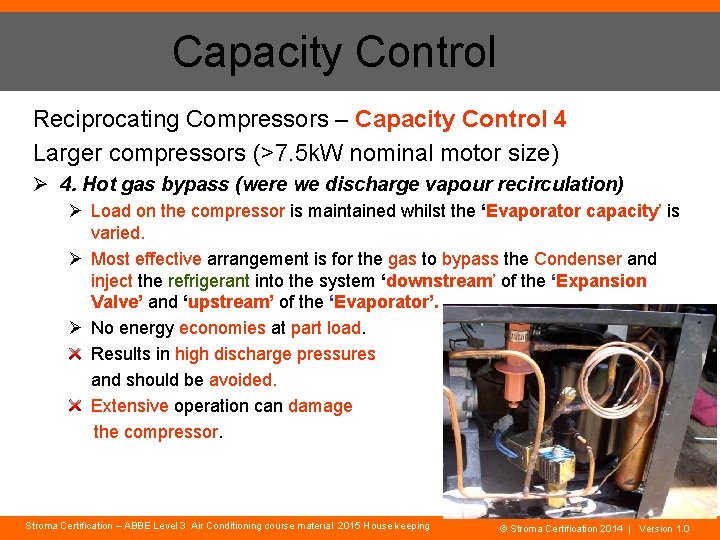
Capacity Control Reciprocating Compressors – Capacity Control 4 Larger compressors (>7. 5 k. W nominal motor size) Ø 4. Hot gas bypass (were we discharge vapour recirculation) Ø Load on the compressor is maintained whilst the ‘Evaporator capacity’ is varied. Ø Most effective arrangement is for the gas to bypass the Condenser and inject the refrigerant into the system ‘downstream’ of the ‘Expansion Valve’ and ‘upstream’ of the ‘Evaporator’. Ø No energy economies at part load. Results in high discharge pressures and should be avoided. Extensive operation can damage the compressor. Stroma Certification – ABBE Level 3 Air Conditioning course material 2015 House keeping © Stroma Certification 2014 | Version 1. 0
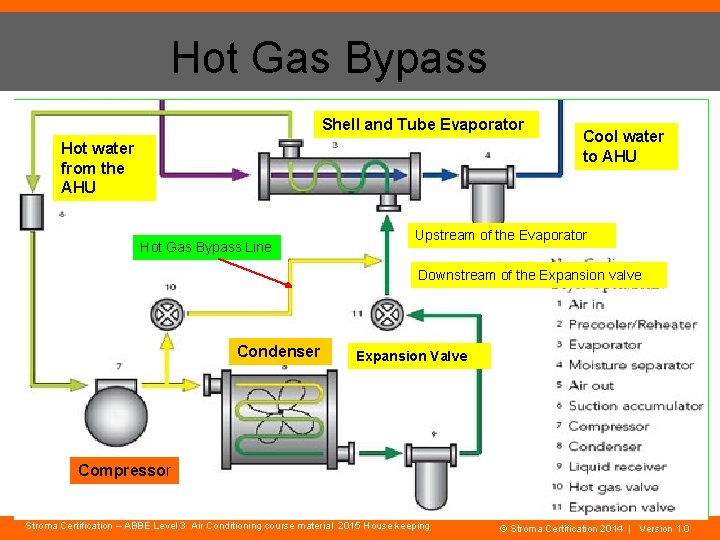
Hot Gas Bypass Shell and Tube Evaporator Hot water from the AHU Hot Gas Bypass Line Cool water to AHU Upstream of the Evaporator Downstream of the Expansion valve Condenser Expansion Valve Compressor Stroma Certification – ABBE Level 3 Air Conditioning course material 2015 House keeping © Stroma Certification 2014 | Version 1. 0
Compressors Reciprocating Compressors – Capacity Control 5 Larger compressors (>7. 5 k. W nominal motor size) Ø 5. Evaporator pressure regulator Ø It’s a means of maintaining evaporator suction pressure by throttling the flow of gas to the suction of the compressor. Energy efficiency is impaired. This method should be avoided. Stroma Certification – ABBE Level 3 Air Conditioning course material 2015 House keeping © Stroma Certification 2014 | Version 1. 0
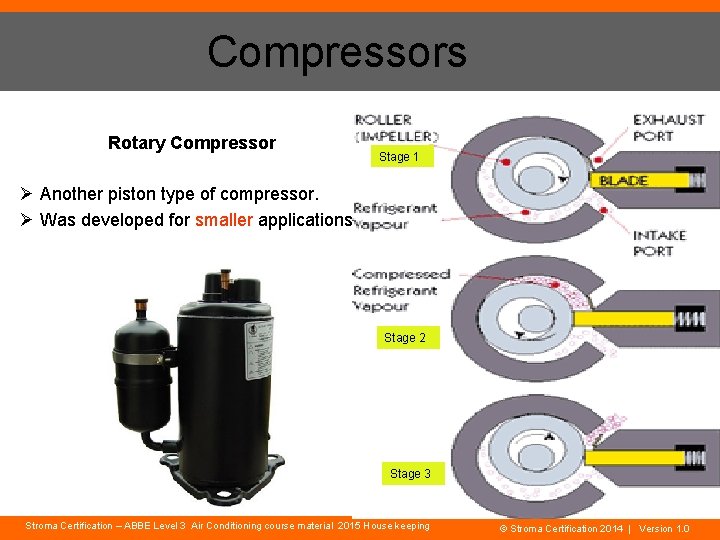
Compressors Rotary Compressor Stage 1 Ø Another piston type of compressor. Ø Was developed for smaller applications. Stage 2 Stage 3 Stroma Certification – ABBE Level 3 Air Conditioning course material 2015 House keeping © Stroma Certification 2014 | Version 1. 0
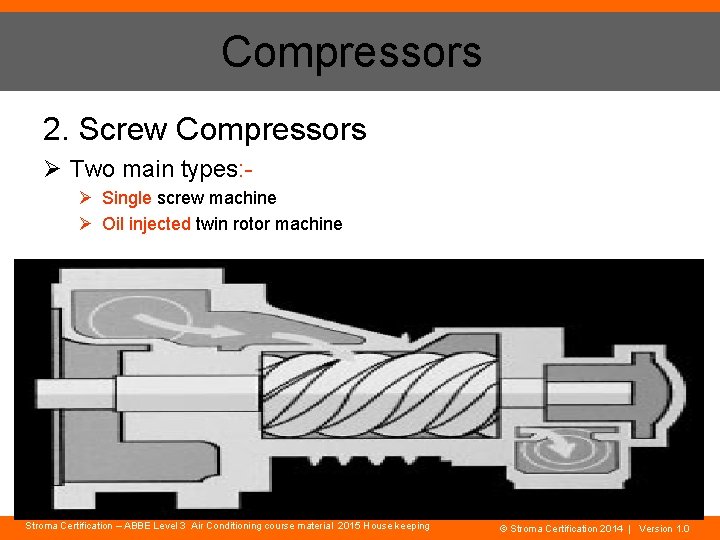
Compressors 2. Screw Compressors Ø Two main types: Ø Single screw machine Ø Oil injected twin rotor machine Stroma Certification – ABBE Level 3 Air Conditioning course material 2015 House keeping © Stroma Certification 2014 | Version 1. 0
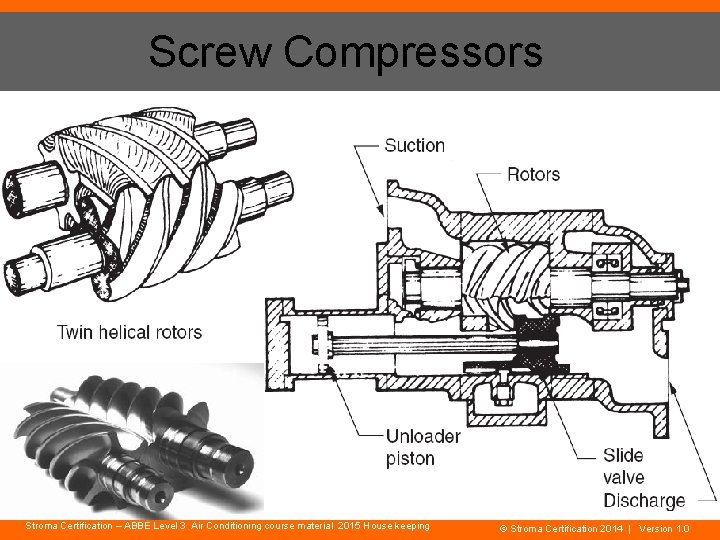
Screw Compressors Stroma Certification – ABBE Level 3 Air Conditioning course material 2015 House keeping © Stroma Certification 2014 | Version 1. 0
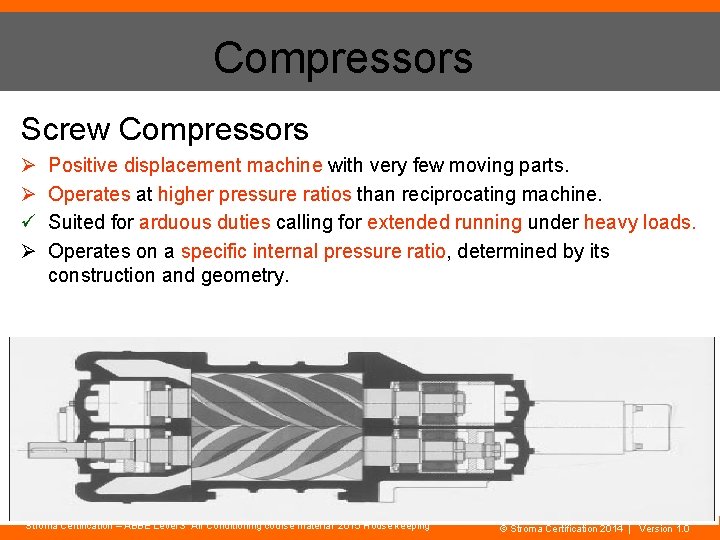
Compressors Screw Compressors Ø Ø ü Ø Positive displacement machine with very few moving parts. Operates at higher pressure ratios than reciprocating machine. Suited for arduous duties calling for extended running under heavy loads. Operates on a specific internal pressure ratio, determined by its construction and geometry. Stroma Certification – ABBE Level 3 Air Conditioning course material 2015 House keeping © Stroma Certification 2014 | Version 1. 0
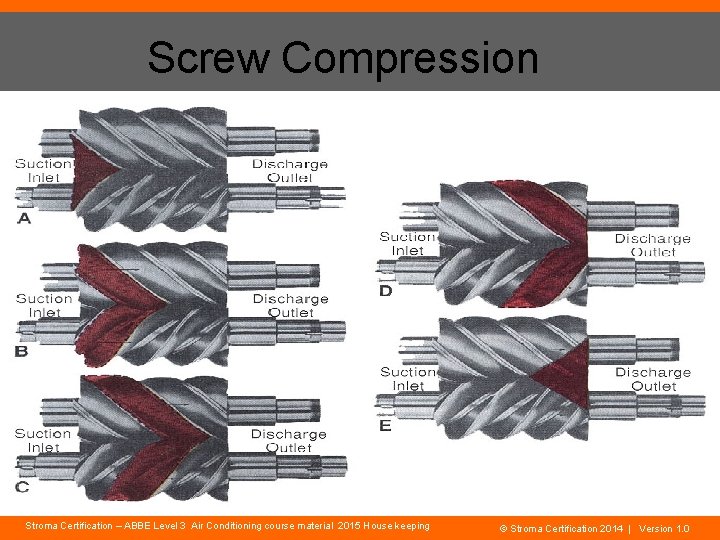
Screw Compression Stroma Certification – ABBE Level 3 Air Conditioning course material 2015 House keeping © Stroma Certification 2014 | Version 1. 0
Compressors Screw Compressors Ø For optimum efficiency: Internal pressure ratio = external pressure ratio (in terms of the system) Ø Where: Ø Internal pressure ratio: is determined by the volume ratio of the compressor. Ø External pressure ratio: exists across the refrigeration system. Modern screw compressors have the ability to adjust their internal geometry to match the varying head pressure. Stroma Certification – ABBE Level 3 Air Conditioning course material 2015 House keeping © Stroma Certification 2014 | Version 1. 0
Compressors Screw Compressors Ø Normally cooled by oil that is injected into the machine to seal the running clearances between the rotors and casing, absorbing a significant amount of the compression heat. ü For optimum efficiency the oil is cooled externally to the machine in a shell and tube heat exchanger which is cooled by either: Ø Refrigerant Ø Water Ø Thermo-syphon cooling Cooling by direct injection of refrigerant into the compressor reduces available capacity – hence reducing efficiency. Stroma Certification – ABBE Level 3 Air Conditioning course material 2015 House keeping © Stroma Certification 2014 | Version 1. 0

Capacity Control Screw Compressors Capacity Control 1 Ø Sliding Valve Ø Which adjusts the compressor displacement: Ø Retards the point at which compression begins. Ø Reduces the size of the discharge port to obtain volume ratio. Ø Typically allows 10 -100% capacity control. Ø Below 60% full load – efficiency very low. Stroma Certification – ABBE Level 3 Air Conditioning course material 2015 House keeping © Stroma Certification 2014 | Version 1. 0
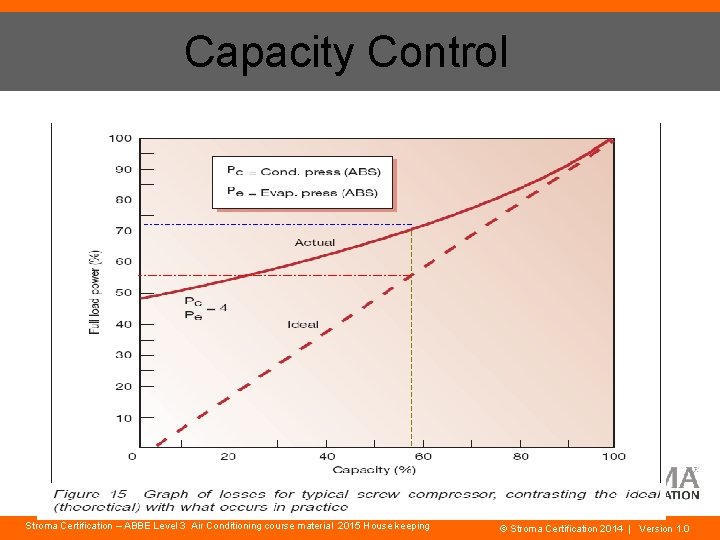
Capacity Control Stroma Certification – ABBE Level 3 Air Conditioning course material 2015 House keeping © Stroma Certification 2014 | Version 1. 0
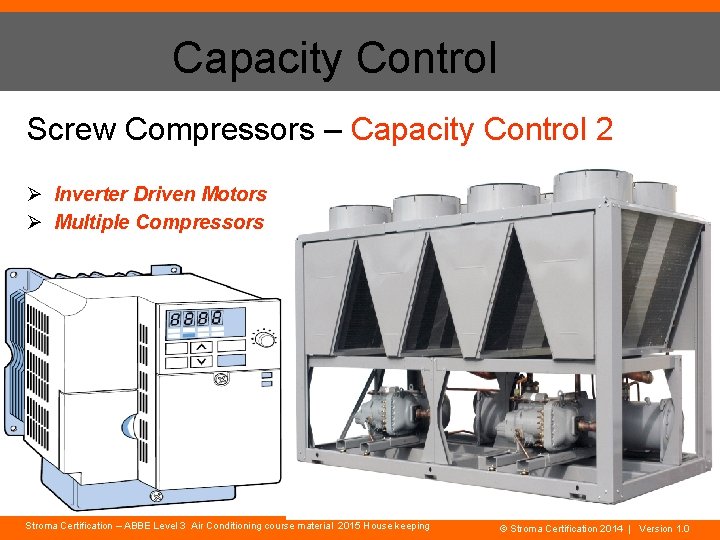
Capacity Control Screw Compressors – Capacity Control 2 Ø Inverter Driven Motors Ø Multiple Compressors Stroma Certification – ABBE Level 3 Air Conditioning course material 2015 House keeping © Stroma Certification 2014 | Version 1. 0
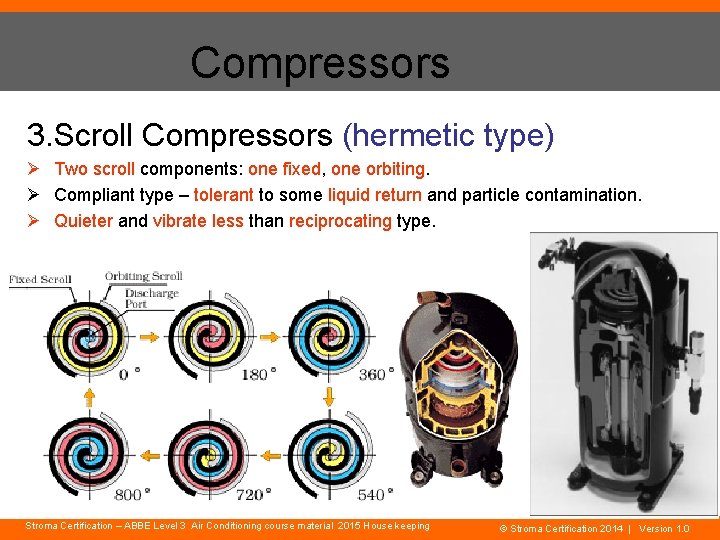
Compressors 3. Scroll Compressors (hermetic type) Ø Two scroll components: one fixed, one orbiting. Ø Compliant type – tolerant to some liquid return and particle contamination. Ø Quieter and vibrate less than reciprocating type. Stroma Certification – ABBE Level 3 Air Conditioning course material 2015 House keeping © Stroma Certification 2014 | Version 1. 0
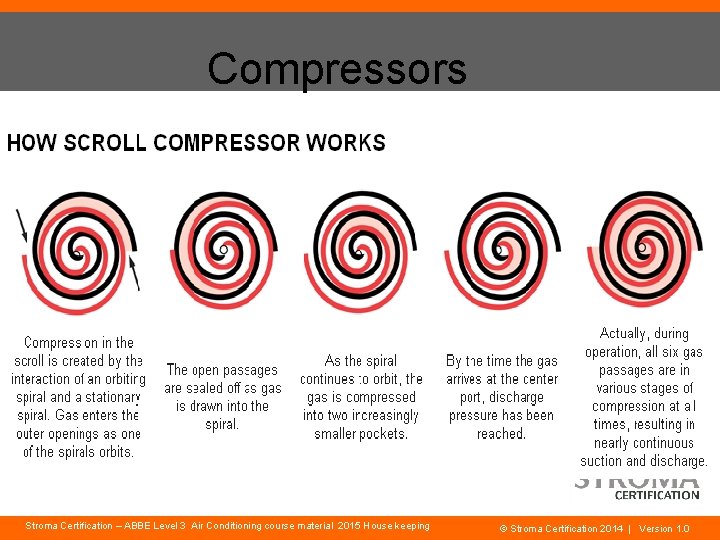
Compressors Stroma Certification – ABBE Level 3 Air Conditioning course material 2015 House keeping © Stroma Certification 2014 | Version 1. 0
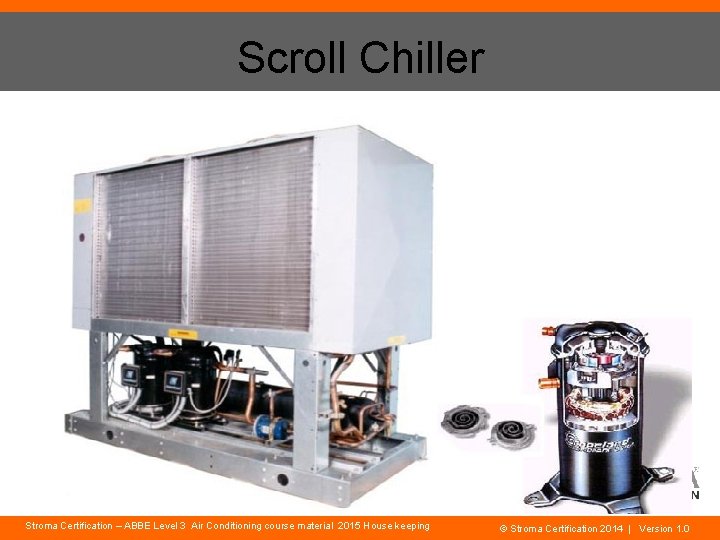
Scroll Chiller Stroma Certification – ABBE Level 3 Air Conditioning course material 2015 House keeping © Stroma Certification 2014 | Version 1. 0
Compressors Scroll Compressors – Capacity Control 1 Ø Two speed motors ü Ideal for multiple compressors Ø Variable speed drives Can be used, however, not ideal – effects lubrication of the system. Not compatible with method of radial compliance, which prevents damage by small quantities of liquid refrigerant or solid particles. Ø Electronic modulation system Ø Momentarily separates the scrolls axially. ü Can give between 10 -100% capacity variation. ü Does not effect lubrication as shaft continues to rotate. Stroma Certification – ABBE Level 3 Air Conditioning course material 2015 House keeping © Stroma Certification 2014 | Version 1. 0
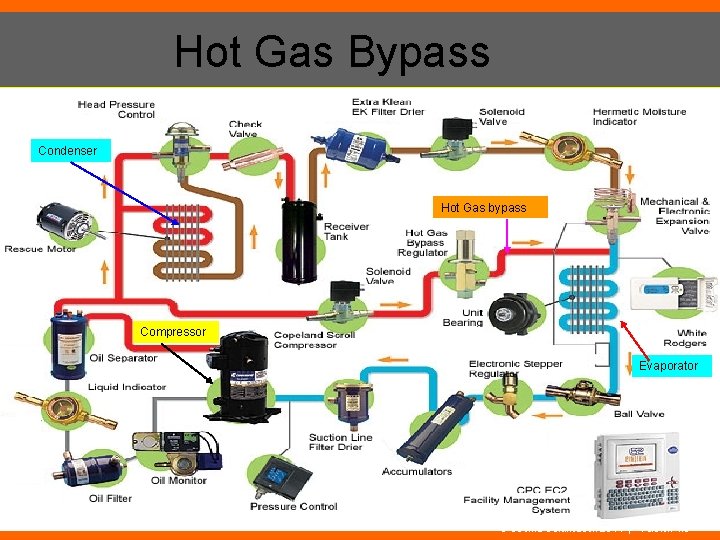
Hot Gas Bypass Condenser Hot Gas bypass Compressor Evaporator Stroma Certification – ABBE Level 3 Air Conditioning course material 2015 House keeping © Stroma Certification 2014 | Version 1. 0
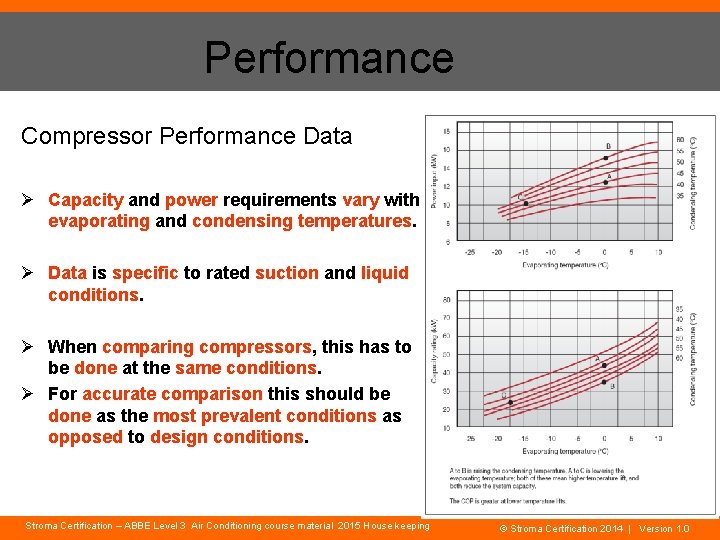
Performance Compressor Performance Data Ø Capacity and power requirements vary with evaporating and condensing temperatures. Ø Data is specific to rated suction and liquid conditions. Ø When comparing compressors, this has to be done at the same conditions. Ø For accurate comparison this should be done as the most prevalent conditions as opposed to design conditions. Stroma Certification – ABBE Level 3 Air Conditioning course material 2015 House keeping © Stroma Certification 2014 | Version 1. 0
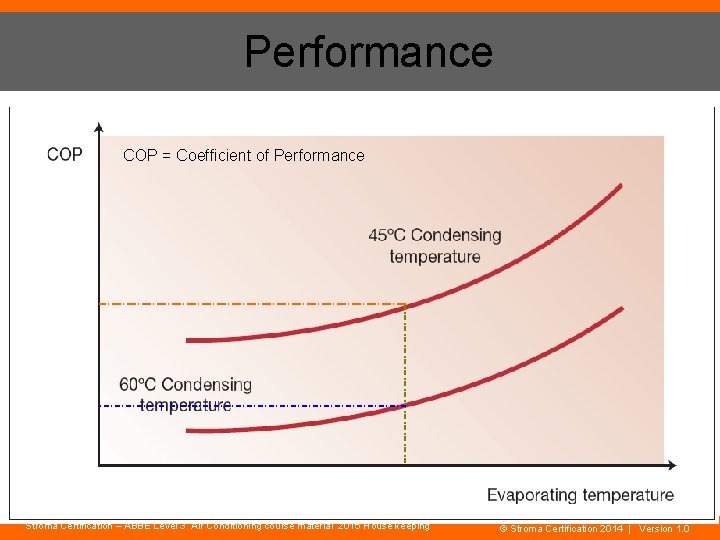
Performance COP = Coefficient of Performance Stroma Certification – ABBE Level 3 Air Conditioning course material 2015 House keeping © Stroma Certification 2014 | Version 1. 0
Efficiency Compressor Efficiency Issues Ø Varies significantly with type. Ø Some compressors require ancillaries which absorb power. ü For large loads, having multi-modular staging is good for sharing the load. ü If these are unevenly sized, the degree of control is increased. Frequent starting and stopping as a result of matching the capacity of an oversized compressor to a load can erode efficiency and reduce reliability. Stroma Certification – ABBE Level 3 Air Conditioning course material 2015 House keeping © Stroma Certification 2014 | Version 1. 0
Efficiency Compressor Efficiency Issues Ø Operation on in-built capacity control should be avoided or minimised, achieved by: ü Avoid the use of a single large compressor. ü Selecting a combination of compressor sizes which avoids the need for operation of one or more of the compressors on capacity control. ü For multiple compressors – use a control strategy which minimises the operation of the compressors on part-load (especially avoid 2 @ 50%, as opposed to 1 @ 100%). Stroma Certification – ABBE Level 3 Air Conditioning course material 2015 House keeping © Stroma Certification 2014 | Version 1. 0
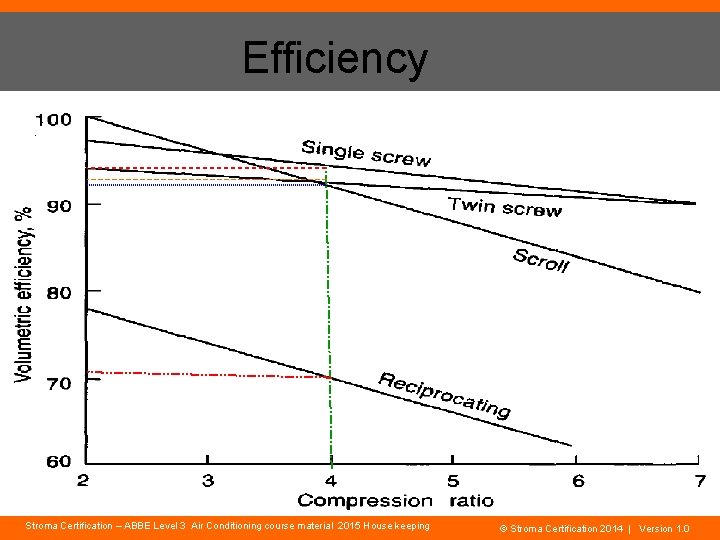
Efficiency Stroma Certification – ABBE Level 3 Air Conditioning course material 2015 House keeping © Stroma Certification 2014 | Version 1. 0
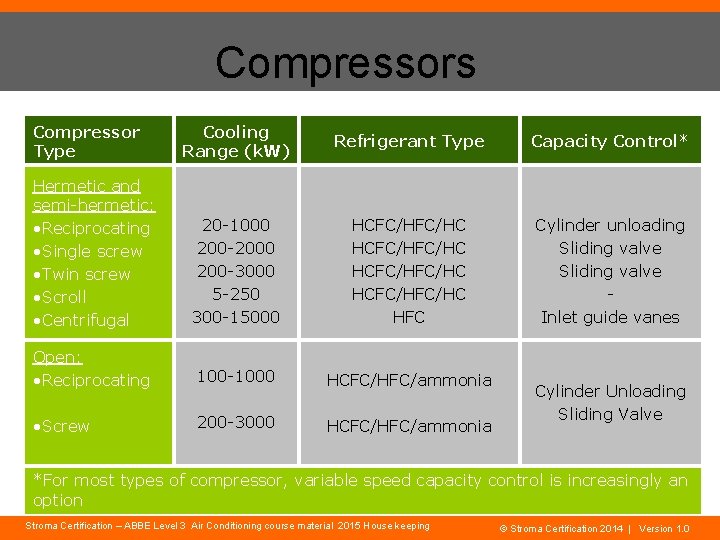
Compressors Compressor Type Cooling Range (k. W) Refrigerant Type Capacity Control* Hermetic and semi-hermetic: • Reciprocating • Single screw • Twin screw • Scroll • Centrifugal 20 -1000 200 -2000 200 -3000 5 -250 300 -15000 HCFC/HFC/HC HFC Cylinder unloading Sliding valve Inlet guide vanes Open: • Reciprocating 100 -1000 HCFC/HFC/ammonia • Screw 200 -3000 HCFC/HFC/ammonia Cylinder Unloading Sliding Valve *For most types of compressor, variable speed capacity control is increasingly an option Stroma Certification – ABBE Level 3 Air Conditioning course material 2015 House keeping © Stroma Certification 2014 | Version 1. 0
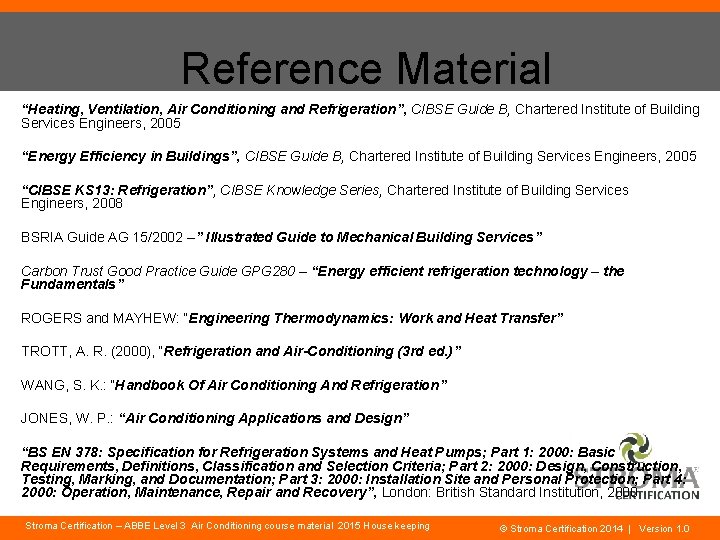
Reference Material “Heating, Ventilation, Air Conditioning and Refrigeration”, CIBSE Guide B, Chartered Institute of Building Services Engineers, 2005 “Energy Efficiency in Buildings”, CIBSE Guide B, Chartered Institute of Building Services Engineers, 2005 “CIBSE KS 13: Refrigeration”, CIBSE Knowledge Series, Chartered Institute of Building Services Engineers, 2008 BSRIA Guide AG 15/2002 –” Illustrated Guide to Mechanical Building Services” Carbon Trust Good Practice Guide GPG 280 – “Energy efficient refrigeration technology – the Fundamentals” ROGERS and MAYHEW: “Engineering Thermodynamics: Work and Heat Transfer” TROTT, A. R. (2000), “Refrigeration and Air-Conditioning (3 rd ed. )” WANG, S. K. : “Handbook Of Air Conditioning And Refrigeration” JONES, W. P. : “Air Conditioning Applications and Design” “BS EN 378: Specification for Refrigeration Systems and Heat Pumps; Part 1: 2000: Basic Requirements, Definitions, Classification and Selection Criteria; Part 2: 2000: Design, Construction, Testing, Marking, and Documentation; Part 3: 2000: Installation Site and Personal Protection; Part 4: 2000: Operation, Maintenance, Repair and Recovery”, London: British Standard Institution, 2000 Stroma Certification – ABBE Level 3 Air Conditioning course material 2015 House keeping © Stroma Certification 2014 | Version 1. 0
LEVEL 3 Air Conditioning ENERGY ASSESSORS TRAINING ANY QUESTIONS OR FEEDBACK ON ANY SLIDE Stroma Certification – ABBE Level 3 Air Conditioning course material 2015 House keeping © Stroma Certification 2014 | Version 1. 0
STROMA Certification Ltd – Contacts Web Links www. stroma. com/certification Contacts: STROMA Certification Ltd. 4 Pioneer Way, Castleford, WF 10 5 QU 0845 621 11 11 training@stroma. com Stroma Certification – ABBE Level 3 Air Conditioning course material 2015 House keeping © Stroma Certification 2014 | Version 1. 0
End of this section Stroma Certification – ABBE Level 3 Air Conditioning course material 2015 House keeping © Stroma Certification 2014 | Version 1. 0
- Slides: 38