
Level 2 Safeguarding Training for Schools 2020 21
- Slides: 28
Level 2 Safeguarding Training for Schools 2020 -21 Inspecting safeguarding Jo Barclay, Head of Education Safeguarding and Wellbeing September 2020
Education Inspection Framework Ofsted, 2019
Education Inspection Framework (2019) Inspectors will always take into account how well learners are helped and protected so that they are kept safe. Although inspectors will not provide a separate numerical grade for this important aspect of a provider’s work, they will always make a written judgement under ‘leadership and management’ about whether the arrangements for safeguarding learners are effective.
Education Inspection Framework (2019) Inspectors will make judgements on overall effectiveness and the four key judgements: �the quality of education �behaviour and attitudes �personal development �leadership and management and, where relevant, on the quality of provision in: �early years education �the sixth form
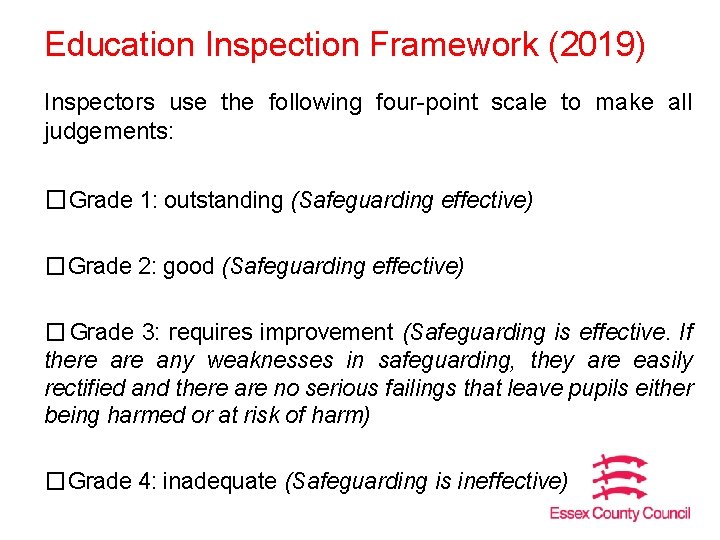
Education Inspection Framework (2019) Inspectors use the following four-point scale to make all judgements: �Grade 1: outstanding (Safeguarding effective) �Grade 2: good (Safeguarding effective) � Grade 3: requires improvement (Safeguarding is effective. If there any weaknesses in safeguarding, they are easily rectified and there are no serious failings that leave pupils either being harmed or at risk of harm) �Grade 4: inadequate (Safeguarding is ineffective)
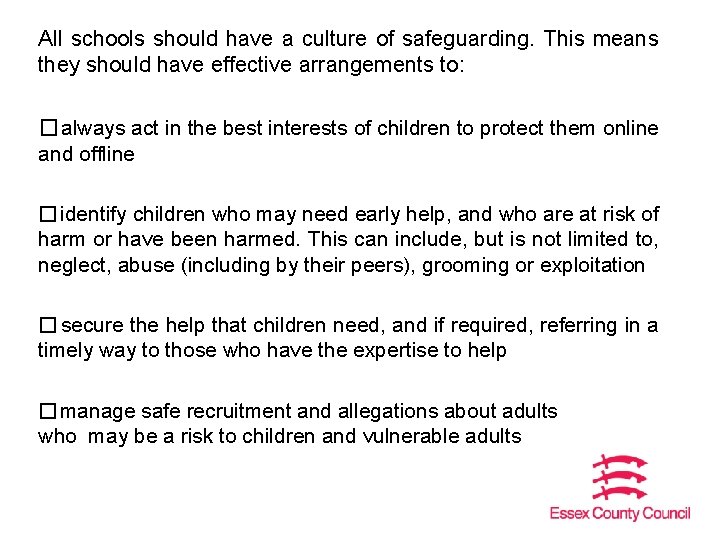
All schools should have a culture of safeguarding. This means they should have effective arrangements to: � always act in the best interests of children to protect them online and offline � identify children who may need early help, and who are at risk of harm or have been harmed. This can include, but is not limited to, neglect, abuse (including by their peers), grooming or exploitation � secure the help that children need, and if required, referring in a timely way to those who have the expertise to help �manage safe recruitment and allegations about adults who may be a risk to children and vulnerable adults
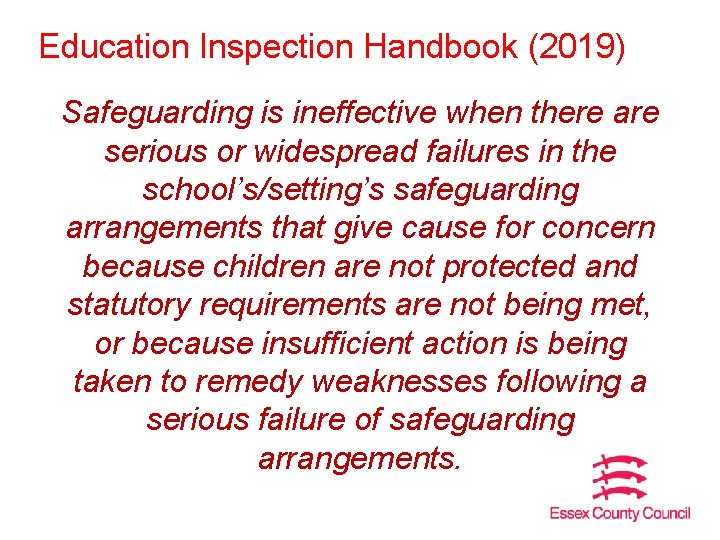
Education Inspection Handbook (2019) Safeguarding is ineffective when there are serious or widespread failures in the school’s/setting’s safeguarding arrangements that give cause for concern because children are not protected and statutory requirements are not being met, or because insufficient action is being taken to remedy weaknesses following a serious failure of safeguarding arrangements.
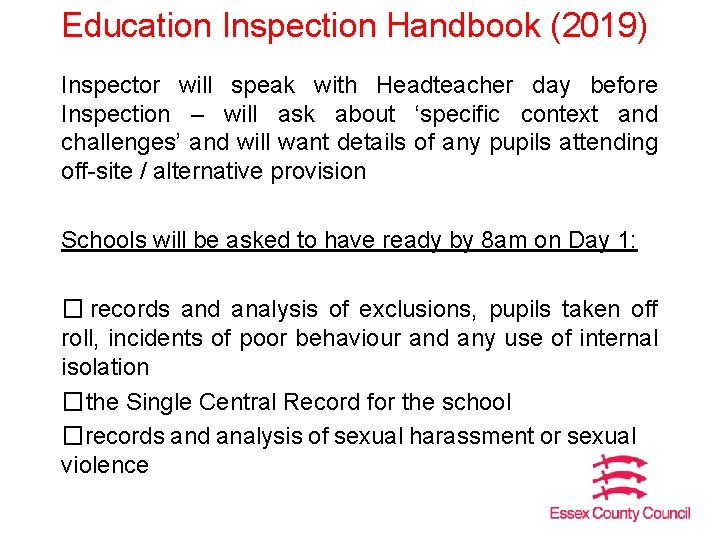
Education Inspection Handbook (2019) Inspector will speak with Headteacher day before Inspection – will ask about ‘specific context and challenges’ and will want details of any pupils attending off-site / alternative provision Schools will be asked to have ready by 8 am on Day 1: � records and analysis of exclusions, pupils taken off roll, incidents of poor behaviour and any use of internal isolation �the Single Central Record for the school �records and analysis of sexual harassment or sexual violence
Education Inspection Handbook (2019) � records and analysis of bullying, discriminatory and prejudiced behaviour, either directly or indirectly, including racist, sexist, disability and homophobic / biphobic / transphobic bullying, use of derogatory language and racist incidents � a list of referrals made to the designated person for safeguarding in the school and those who were subsequently referred to the local authority, along with brief details of the resolution � a list of all pupils who have open cases with children’s services/social care and for whom there is a multi-agency plan �up-to-date attendance analysis for all groups of pupils
Inspecting safeguarding in early years, education and skills settings Guidance for inspectors undertaking inspection under the common inspection framework Ofsted, 2019
Inspecting safeguarding in early years, education and skills settings • It is essential inspectors are familiar with the content of: – Keeping Children Safe in Education (Df. E, 2020) – Working Together to Safeguard Children (HMG 2018) – PREVENT duty guidance (Counter-Terrorism and Security Act 2015) – The Education (Independent School Standards) Regulation 2014 • Definition of safeguarding taken from Working Together to Safeguard Children’
Safeguarding action may be needed to protect learners from: • Neglect, physical, emotional and sexual abuse • Bullying (including online and prejudice-based) • Racist, disability and homophobic / transphobic abuse • Gender-based violence • Radicalisation / extremism • CSE / trafficking • Criminal exploitation (including county lines) • • • Risks linked to technology Teenage relationship abuse Substance misuse Local issues Domestic abuse So-called honour-based abuse • Fabricated / induced illness • Poor parenting • AND ANY OTHER ISSUES THAT POSE A RISK!!
Safeguarding also relates to broader aspects of care and education, including: • Learners’ health and safety and their wellbeing / mental health • Meeting needs of children with SEN / disabilities • Use of reasonable force • Meeting needs of pupils with medical conditions • • Providing ‘First Aid’ Educational visits Intimate care Online safety (and associated issues) • Appropriate arrangements for school security
Signs of successful safeguarding arrangements: • Children are protected and feel safe • Effective (and well-understood) child protection and staff behaviour policies in place • All staff and adults clear on procedures • Effective DL empowered to play effective role in pursuing concerns and protecting children • Children can identify a trusted adult (to whom they can communicate concerns)
Signs of successful safeguarding arrangements: • Written records are made in a timely way and held securely • Record of any referral is retained and there is evidence that any agreed action following the referral has been taken promptly – effective plans in place • CME receive ‘well co-ordinated responses’ to reduce harm or risk of harm – all statutory and local procedures understood and implemented • Adults understand risks to vulnerable children and share concerns with other appropriate agencies
Signs of successful safeguarding arrangements: • Learners are protected and know how to get support if they experience bullying / discriminatory behaviour • Adults understand the risks associated with technology – well-developed strategies in place to keep children safe and to support them to develop their own understanding of these risks and in learning how to keep themselves and others safe • Leaders and staff make clear risk assessments to protect children while enabling them to take age-appropriate and reasonable risks as part of growth and development
Signs of successful safeguarding arrangements: • Children feel secure and experience positive support from all staff when presenting risky behaviours – staff set clear boundaries for safe and acceptable behaviour • Staff seek to understand triggers for behaviour • Positive behaviour is consistently promoted – staff use effective de-escalation techniques specific to individual need and use ‘reasonable force’ only in strict accordance with legislative framework
Signs of successful safeguarding arrangements: • Adults understand that poor behaviour may be a sign that children are suffering harm or have been traumatised by abuse • Staff consider what support may be needed by perpetrators, as well as victims, in cases of peer-on-peer abuse • Staff and volunteers are carefully selected and vetted according to statutory requirements (and consideration once appointed given to ongoing suitability to prevent opportunities to harm children)
Signs of successful safeguarding arrangements: • Clear and effective arrangements for staff development and training - staff and other adults receive regular supervision and support (if working directly with children whose safety and welfare at risk) • The physical environment is safe and secure and protects children from harm (or the risk of it) • All staff and carers have a copy of and understand procedures for managing allegations of harm • All staff know how to make a complaint and understand ‘whistleblowing’ policies
Evidence to look for: • Extent to which leaders create a positive culture and ethos where safeguarding is an important part of everyday life, backed up by training at every level • Application and effectiveness of safeguarding policies and procedures • Quality of safeguarding practice and evidence that staff are aware of signs that learners may be at risk in the setting or wider community
Evidence to look for: Inspectors will consider how far leaders and managers have put in place effective arrangements to: • Identify children who may need early help or are at risk of neglect, abuse, grooming or exploitation • Help prevent abuse by raising awareness among children of safeguarding risks and how and where to get help and support if they need it • Help those children at risk of abuse and needing early help or statutory social care involvement, keeping accurate records and making timely referrals • Manage allegations about adults who may be a risk, and check the suitability of staff to work with children, learners and vulnerable adults
Safeguarding culture – evidence: Inspectors will consider how well leaders and managers have created a culture of vigilance where children’s and learners’ welfare is promoted and timely and appropriate safeguarding action is taken for children or learners who need extra help or who may be suffering or likely to suffer harm. Inspectors should evaluate how well settings fulfil their statutory responsibilities and how well staff exercise their professional judgement in keeping children and learners safe
• Discuss how your school may evidence these aspects of safeguarding • What action is required to ensure these requirements can be met?
Key documents: • Keeping Children Safe in Education (Df. E, 2020) • SET Procedures (ESCB, 2019) • Working Together (HMG, 2018) • What to do if you're worried a child is being abused (HMG, 2015) • Teaching online safety in school (Df. E, 2019)
Key documents: Inspecting safeguarding in early years, schools and skills settings (Ofsted, 2019) PREVENT Duty Guidance (HMG, 2015) - Counter-Terrorism and Security Act 2015 Essex Effective Support for Children and Families (ESCB, 2017) Sexting in schools and colleges: responding to incidents and safeguarding young people (UKCCIS, 2016) Sexual harassment and sexual violence between children in schools and colleges (Df. E, 2019) 25
Essex School Infolink: Essex School Infolink (ESI) Safeguarding page • Model Child Protection Policy • Level 2 training programme • Information on CSE • Information on PREVENT • Training opportunities • Key documents and useful resources • Safeguarding Audit • Termly briefings • How to make a child protection referral • How to manage allegations against members of the workforce • Templates for reporting and recording concerns
‘Working Together’ (2018) “effective safeguarding of children can only be achieved by putting children at the centre of the system, and by every individual and agency playing their full part, working together to meet the needs of our most vulnerable children. ”
Head of Education Safeguarding and Wellbeing: jo. barclay@essex. gov. uk 033301 31078 Education Safeguarding Adviser: matthew. lewis@essex. gov. uk 033301 31072