
Level 2 Safeguarding Training for Schools 2020 21
- Slides: 32
Level 2 Safeguarding Training for Schools 2020 -21 Keeping children safe in education – the management of safeguarding Jo Barclay, Head of Education Safeguarding and Wellbeing September 2020
What is safeguarding?
Safeguarding and promoting the welfare of children is defined in Keeping Children Safe in Education (Df. E, 2020) as: “protecting children from maltreatment; preventing impairment of children’s health or development; ensuring that children grow up in circumstances consistent with the provision of safe and effective care; and taking action to enable all children to have the best outcomes”
• government introduced the concept of ‘safeguarding children’ in 2004/05 • Safeguarding is much broader concept (than child protection) based around preventing children / young people from being harmed – focus upon promoting the child / young person’s welfare • Child protection is part of safeguarding and promoting welfare. It refers to activity undertaken to protect specific children identified as either suffering or at risk of suffering significant harm as a result of abuse or neglect. • It is only multi-agency working which effectively safeguards children
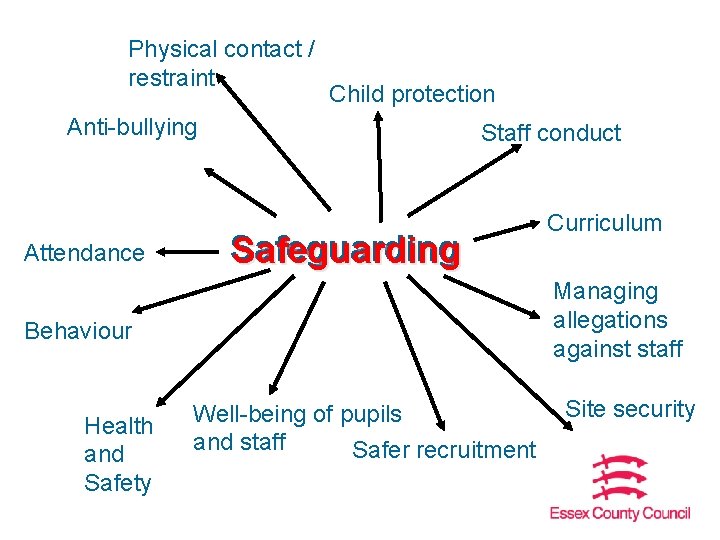
Physical contact / restraint Child protection Anti-bullying Attendance Staff conduct Safeguarding Managing allegations against staff Behaviour Health and Safety Curriculum Well-being of pupils and staff Safer recruitment Site security
The Essex Safeguarding Children Board (ESCB): • Working Together 2018 removed statutory requirement for LSCBs – in Essex, ESCB name and brand was retained as part of multiagency safeguarding arrangements (from September 2019) • Aim is to improve outcomes for children by co-ordinating the work of local agencies to safeguard and promote the welfare of children • Links with Southend and Thurrock (SET procedures – ESCB, 2019) • Director for Education sits on the Board and the Headteacher associations are represented • Head of Education Safeguarding and Wellbeing sits on Stay Safe Groups and other ESCB sub-committees
Key documents for schools and other settings: • Working Together (HMG, 2018) • SET Procedures (ESCB, 2019) • Keeping Children Safe in Education (Df. E, 2020)
Working Together to Safeguard Children (HMG, 2018) Two key principles: – Safeguarding is everyone's responsibility: for services to be effective each individual and organisation should play their full part; – A child centred approach: for services to be effective they should be based on a clear understanding of the needs and views of children.
SET Procedures 2019 ESCB The Southend, Essex and Thurrock (SET) Procedures set out how agencies and individuals should work together to safeguard and promote the welfare of children and young people
SET Procedures (2019) Schools should implement their duty to safeguard and promote the welfare of their pupils under the Education Act 2002 by having a policy that demonstrates how the school will: • Create and maintain a safe learning environment for children by having arrangements in place to address a range of issues; • Contribute to safeguarding and promoting the welfare of children through the curriculum, by developing children’s understanding, awareness, and resilience; • Identify where there are child welfare concerns and take action to address them, in partnership with other agencies where appropriate.
SET Procedures (2019) Schools should ensure that they designate a member of the Senior Leadership Team who has been appropriately trained to take overall responsibility for the safeguarding arrangements within the school The designated lead should ensure that all staff in the school are aware of the indicators of abuse, changes in behaviour that give rise to concern or the failure of a child to develop, and that reporting arrangements in these circumstances are in place
SET Procedures (2019) The designated lead should ensure that appropriate staff are competent to work in partnership with the local authority children’s social care by: • Contributing to the assessment of a child's needs; • Implementing agreed actions to meet those needs The designated lead should ensure that files relating to child protection processes for individual children are kept safely and securely and appropriately transferred at time of transition from one school to another Schools should remedy any deficiencies or weaknesses in arrangements for safeguarding and promoting welfare that are brought to its attention without delay
The role of Local Authority Designated Officer (LADO) Involved where there is a concern or allegation that someone working or volunteering with children: • Has or may have harmed a child • May have committed a criminal related to a child • Behaved towards a child or children in a way that indicates they may pose a risk of harm to children ESI / LADO
Keeping Children Safe in Education (Df. E, September 2020)
Keeping Children Safe in Education (Df. E, September 2020) “Schools and colleges and their staff form part of the wider safeguarding system for children” Should be read in conjunction with Working Together to Safeguard Children (HMG, 2018) and SET Procedures (ESCB, 2019) The Teachers’ Standards 2012 state that teachers, including Headteachers, should safeguard children’s wellbeing and maintain public trust in the teaching profession as part of their professional duties
Keeping Children Safe in Education (September 2020) Guidance applies to governing bodies, proprietors / academy trusts and management committees Above persons should ensure that ALL STAFF read at least Part 1 (including Annex A) and that mechanisms are in place to assist staff to understand discharge their role and responsibilities ‘Children’ includes everyone under age of 18
Responsibility of governing bodies, proprietors and management committees • Must ensure they comply with their legal duties and that all policies, procedures and training are effective / comply with law at all times • Should have lead at senior board level to take leadership responsibility for safeguarding arrangements • Must ensure there appropriate policies and procedures in place – this should include: – Individual / effective Child Protection policy (should reflect local procedures, be updated at least annually and be publically available) – Staff Behaviour / Code of Conduct policy – Safeguarding arrangements for children who go missing from education (particularly on repeat occasions)
Responsibility of governing bodies, proprietors and management committees All staff should be aware of systems within their school which support safeguarding - should be explained as part of staff induction (should take proportionate risk-based approach to information for temporary staff / volunteers). This includes: – the Child Protection Policy – the Behaviour Policy – the Staff Behaviour Policy (sometimes called a code of conduct) – the safeguarding response to children who go missing from education – the role of the designated safeguarding lead (and identity of DL and any deputies)
Responsibility of governing bodies, proprietors and management committees • should ensure an appropriate senior member of staff, from the school or college leadership team, is appointed as DL (should be explicit in their job description: Annex B - role of DL) • Should ensure the school contributes to inter-agency working (in line with Working Together (HMG, 2018) and works with the three safeguarding partners (Local Authority, Health and Police) • Should ensure arrangements take into account procedures and practice of ESCB
Responsibility of governing bodies, proprietors and management committees • Should recognise importance of sharing information between professionals and agencies and ensure this is done appropriately • Should have due regard to relevant data protection legislation and principles – Data Protection Act 2018 and the GDPR place duties on organisations and individuals to process personal information fairly and lawfully and to keep the information they hold safe and secure • CP file must ‘follow the child’ - Designated Lead must ensure files are transferred to next setting
Further details on information sharing: • Chapter one of Working Together (HMG, 2018), which includes a myth-busting guide to information sharing • at Information Sharing: Advice for Practitioners Providing Safeguarding Services to Children, Young People, Parents and Carers (the seven golden rules for sharing information) • at The Information Commissioner’s Office (ICO), which includes ICO GDPR FAQs and guidance from the department • in Data protection: toolkit for schools - guidance to support schools with data protection activity, including compliance with the GDPR.
Responsibility of governing bodies, proprietors and management committees • Should ensure all staff members receive regular safeguarding and CP updates (DL and Deputies should attend Level 3 training every two years) • Should provide staff with the opportunity to contribute to and shape safeguarding arrangements and CP policy • Should ensure children are safeguarded from potentially harmful and inappropriate online material – should ensure appropriate filters and monitoring systems are in place • Should ensure children are taught about safeguarding (including online safety) as part of a balanced curriculum
Responsibility of governing bodies, proprietors and management committees • should prevent people who pose a risk of harm from working with children by following safer recruitment procedures (Part 3, KCSIE) • Should ensure procedures in place to manage concerns / allegations against staff (including supply staff and volunteers) and for referral to the Disclosure and Barring Service (DBS) • Should ensure the CP policy includes procedures to minimise risk of peer on peer abuse and reflects different forms it can take and gender issues in relation to this • Should ensure wishes / feelings of children (where there is a safeguarding concern) are taken into account
Responsibility of governing bodies, proprietors and management committees • Should ensure that, where child has a Social Worker, DL should work with them to make decisions about safeguarding and welfare • Should ensure there are clear systems and processes in place for identifying mental health problems, including routes to refer and escalate concerns • should ensure CP policy reflects additional barriers for children with SEND (and that pastoral support is provided if needed)
Responsibility of governing bodies, proprietors and management committees • Should ensure that appropriate staff have necessary information on a child’s looked after legal status – also care information and contact details for key professionals involved • Must appoint a designated teacher for looked after pupils (also responsible for educational achievement of children previously in care) • Should recognise that a child previously in care remains vulnerable and ensure all staff have skills, knowledge and understanding to keep them safe
Responsibility of governing bodies, proprietors and management committees Section on ‘reasonable force’ – should ensure there appropriate policies and procedures in place and that staff are appropriately trained Arrangements should be published in appropriate policies (see local authority guidance ‘Understanding and Supporting Behaviour - Safe Practice for Schools’ – Autumn 2020)
Questions for you… • What do you do to ensure all statutory requirements for safeguarding are met? • How do you support and appropriately challenge the Headteacher / DL around safeguarding work? • How do you ‘test’ / check processes and systems? • Is there appropriate supervision and support in place for staff (particularly Headteacher / DL) • Do governors have sufficient information to ensure they have strategic oversight of safeguarding?
Key documents: • Keeping Children Safe in Education (Df. E, 2020) • SET Procedures (ESCB, 2019) • Working Together (HMG, 2018) • What to do if you're worried a child is being abused (HMG, 2015) • Teaching online safety in school (Df. E, 2019)
Key documents: Inspecting safeguarding in early years, schools and skills settings (Ofsted, 2019) PREVENT Duty Guidance (HMG, 2015) - Counter-Terrorism and Security Act 2015 Essex Effective Support for Children and Families (ESCB, 2017) Sexting in schools and colleges: responding to incidents and safeguarding young people (UKCCIS, 2016) Sexual harassment and sexual violence between children in schools and colleges (Df. E, 2019)
Essex School Infolink: Essex School Infolink (ESI) Safeguarding page • Model Child Protection Policy • Level 2 training programme • Information on CSE • Information on PREVENT • Training opportunities • Key documents and useful resources • Safeguarding Audit • Termly briefings • How to make a child protection referral • How to manage allegations against members of the workforce • Templates for reporting and recording concerns
‘Working Together’ (2018) “effective safeguarding of children can only be achieved by putting children at the centre of the system, and by every individual and agency playing their full part, working together to meet the needs of our most vulnerable children. ”
Head of Education Safeguarding and Wellbeing: jo. barclay@essex. gov. uk 033301 31078 Education Safeguarding Adviser: matthew. lewis@essex. gov. uk 033301 31072