
Level 1 Fundamentals Training 1 RMT Sales Training



![Exercise 56 4. Temperature transmitter. [ ] 5. Device which adjusts the measured value](https://slidetodoc.com/presentation_image/3da100cce062bd3f9089d6797c6b911e/image-56.jpg "Exercise 56 4. Temperature transmitter. [ ] 5. Device which adjusts the measured value")
![Exercise 59 14. Involves master & slave controllers. [ ] 15. The output of](https://slidetodoc.com/presentation_image/3da100cce062bd3f9089d6797c6b911e/image-59.jpg "Exercise 59 14. Involves master & slave controllers. [ ] 15. The output of")
- Slides: 59
Level 1 Fundamentals Training 1 RMT Sales Training - 05 /98 Phase I - Control Fundamental
Contents Topics: • Process Control Terminology • Control Principles • Basic Control Loop • Advance Control Loop • Control Algorithm • Control System • Exercise RMT Training - 05 /98 2 Slide No: 3 - 10 11 - 18 19 - 23 24 - 31 32 - 46 47 - 54 55 - 59 Level 1 - Control
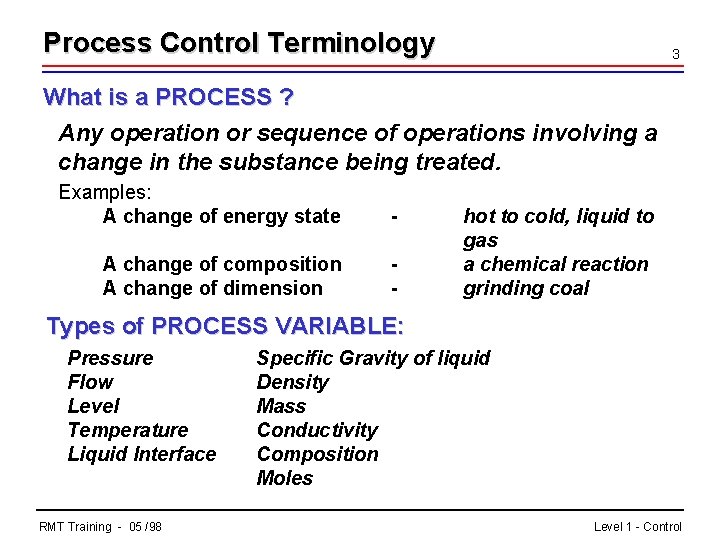
Process Control Terminology 3 What is a PROCESS ? Any operation or sequence of operations involving a change in the substance being treated. Examples: A change of energy state - A change of composition A change of dimension - hot to cold, liquid to gas a chemical reaction grinding coal Types of PROCESS VARIABLE: Pressure Flow Level Temperature Liquid Interface RMT Training - 05 /98 Specific Gravity of liquid Density Mass Conductivity Composition Moles Level 1 - Control
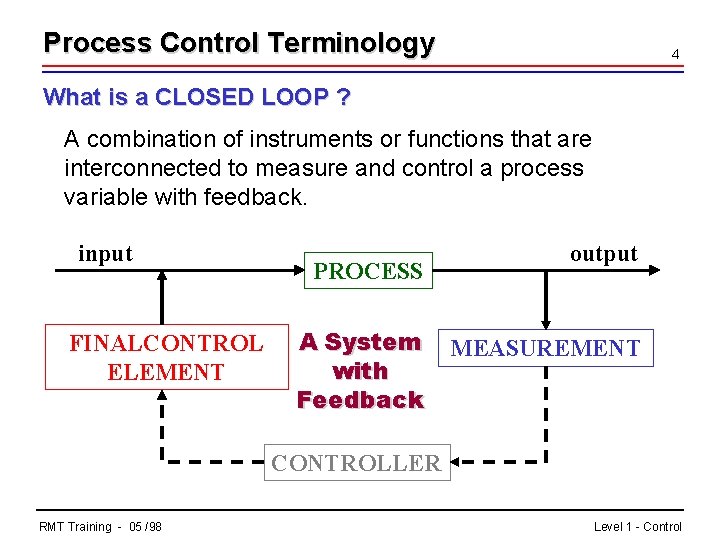
Process Control Terminology 4 What is a CLOSED LOOP ? A combination of instruments or functions that are interconnected to measure and control a process variable with feedback. input FINALCONTROL ELEMENT PROCESS A System with Feedback output MEASUREMENT CONTROLLER RMT Training - 05 /98 Level 1 - Control
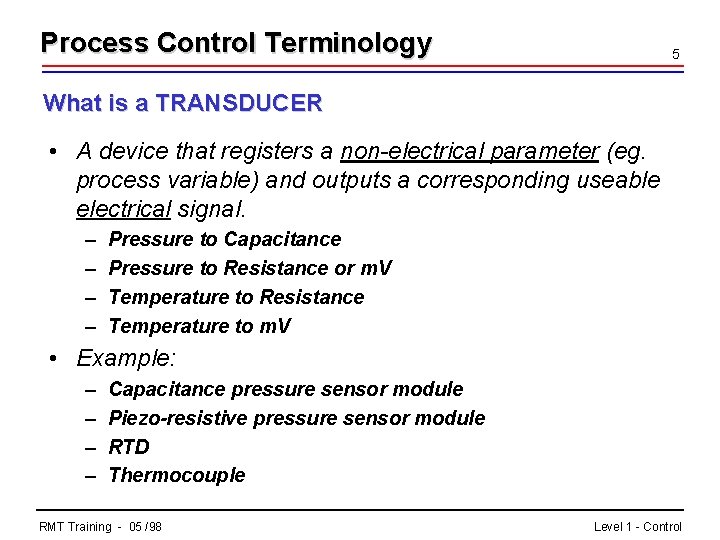
Process Control Terminology 5 What is a TRANSDUCER • A device that registers a non-electrical parameter (eg. process variable) and outputs a corresponding useable electrical signal. – – Pressure to Capacitance Pressure to Resistance or m. V Temperature to Resistance Temperature to m. V • Example: – – Capacitance pressure sensor module Piezo-resistive pressure sensor module RTD Thermocouple RMT Training - 05 /98 Level 1 - Control
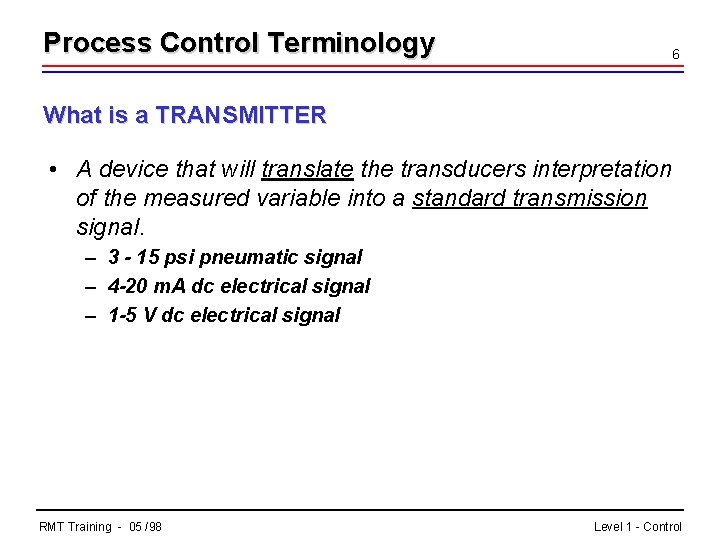
Process Control Terminology 6 What is a TRANSMITTER • A device that will translate the transducers interpretation of the measured variable into a standard transmission signal. – 3 - 15 psi pneumatic signal – 4 -20 m. A dc electrical signal – 1 -5 V dc electrical signal RMT Training - 05 /98 Level 1 - Control
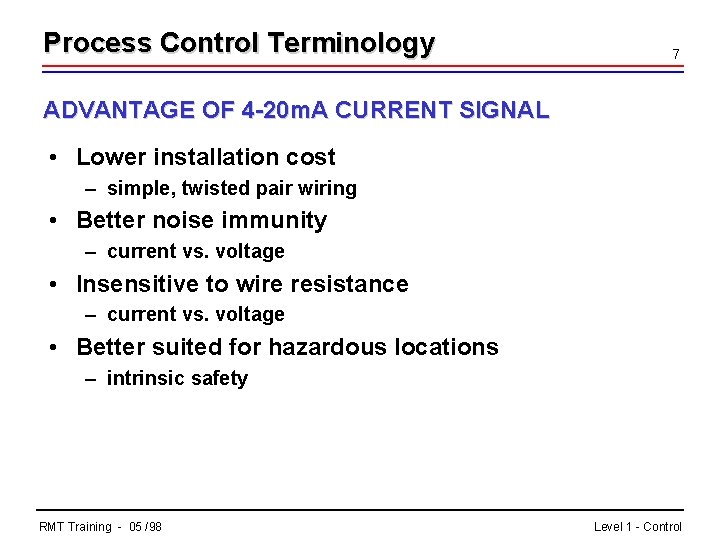
Process Control Terminology 7 ADVANTAGE OF 4 -20 m. A CURRENT SIGNAL • Lower installation cost – simple, twisted pair wiring • Better noise immunity – current vs. voltage • Insensitive to wire resistance – current vs. voltage • Better suited for hazardous locations – intrinsic safety RMT Training - 05 /98 Level 1 - Control
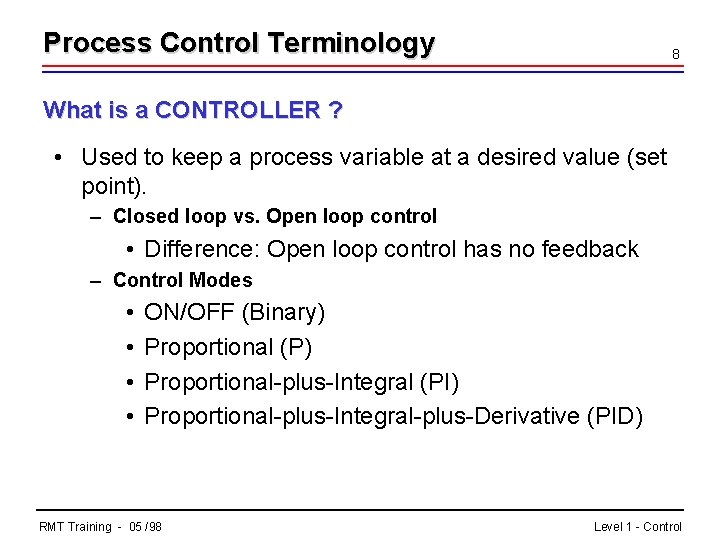
Process Control Terminology 8 What is a CONTROLLER ? • Used to keep a process variable at a desired value (set point). – Closed loop vs. Open loop control • Difference: Open loop control has no feedback – Control Modes • • ON/OFF (Binary) Proportional (P) Proportional-plus-Integral (PI) Proportional-plus-Integral-plus-Derivative (PID) RMT Training - 05 /98 Level 1 - Control
Process Control Terminology 9 What is a SIGNAL ? • An event that conveys data from one point to another. What is an INDICATOR ? • An instrument which visually shows the value of the variable. What is a RECORDER ? • An instrument that makes and displays a continuous graphic, acoustic or magnetic record of a measured variable. What is a DCS ? • Distributed Control System consisting of functional integrated subsystems. The subsystems are connected by a communication linkage (eg) data bus, data highway. RMT Training - 05 /98 Level 1 - Control
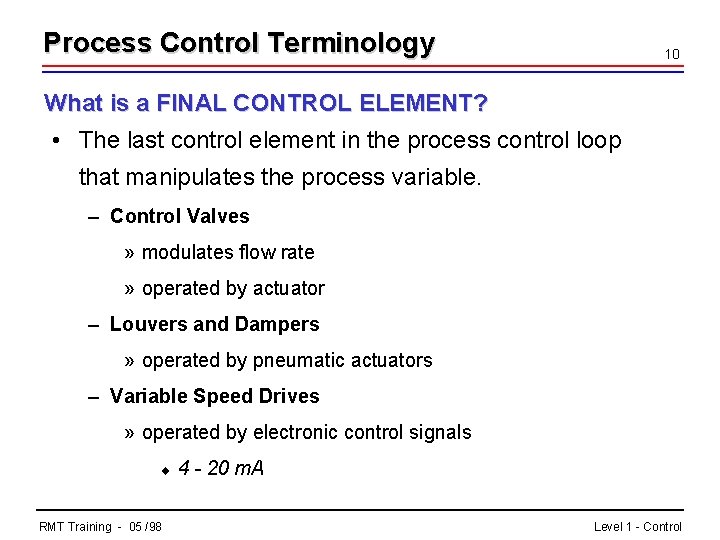
Process Control Terminology 10 What is a FINAL CONTROL ELEMENT? • The last control element in the process control loop that manipulates the process variable. – Control Valves » modulates flow rate » operated by actuator – Louvers and Dampers » operated by pneumatic actuators – Variable Speed Drives » operated by electronic control signals ¨ RMT Training - 05 /98 4 - 20 m. A Level 1 - Control
Control Principle RMT Training - 05 /98 11 Level 1 - Control
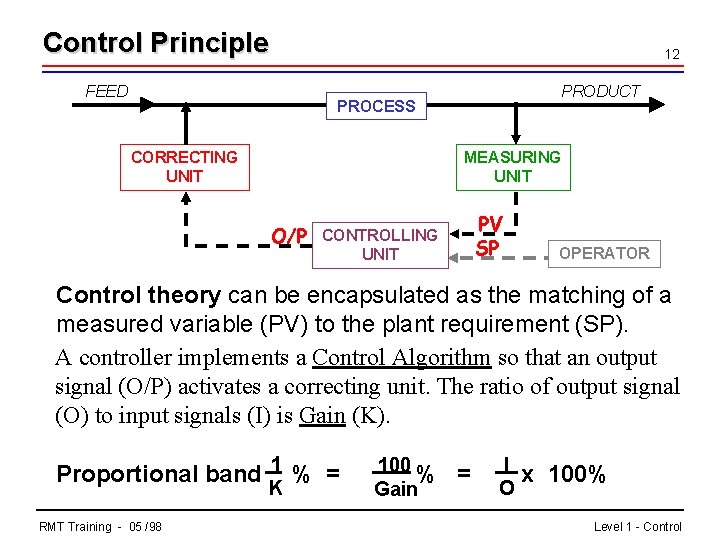
Control Principle 12 FEED PRODUCT PROCESS CORRECTING UNIT MEASURING UNIT O/P PV SP CONTROLLING UNIT OPERATOR Control theory can be encapsulated as the matching of a measured variable (PV) to the plant requirement (SP). A controller implements a Control Algorithm so that an output signal (O/P) activates a correcting unit. The ratio of output signal (O) to input signals (I) is Gain (K). Proportional band 1 % = K RMT Training - 05 /98 100 % Gain = I O x 100% Level 1 - Control
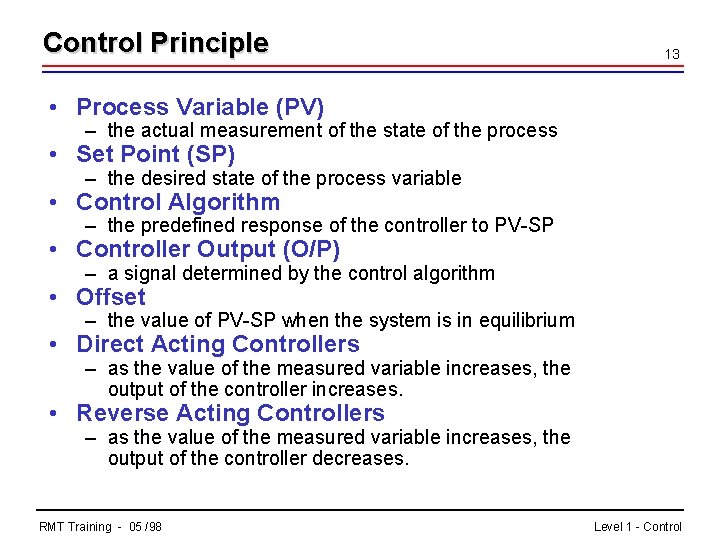
Control Principle 13 • Process Variable (PV) – the actual measurement of the state of the process • Set Point (SP) – the desired state of the process variable • Control Algorithm – the predefined response of the controller to PV-SP • Controller Output (O/P) – a signal determined by the control algorithm • Offset – the value of PV-SP when the system is in equilibrium • Direct Acting Controllers – as the value of the measured variable increases, the output of the controller increases. • Reverse Acting Controllers – as the value of the measured variable increases, the output of the controller decreases. RMT Training - 05 /98 Level 1 - Control
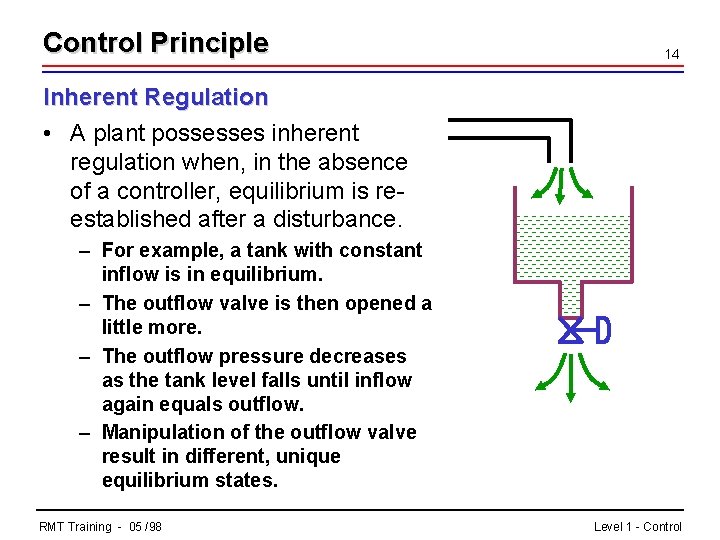
Control Principle 14 Inherent Regulation • A plant possesses inherent regulation when, in the absence of a controller, equilibrium is reestablished after a disturbance. – For example, a tank with constant inflow is in equilibrium. – The outflow valve is then opened a little more. – The outflow pressure decreases as the tank level falls until inflow again equals outflow. – Manipulation of the outflow valve result in different, unique equilibrium states. RMT Training - 05 /98 Level 1 - Control
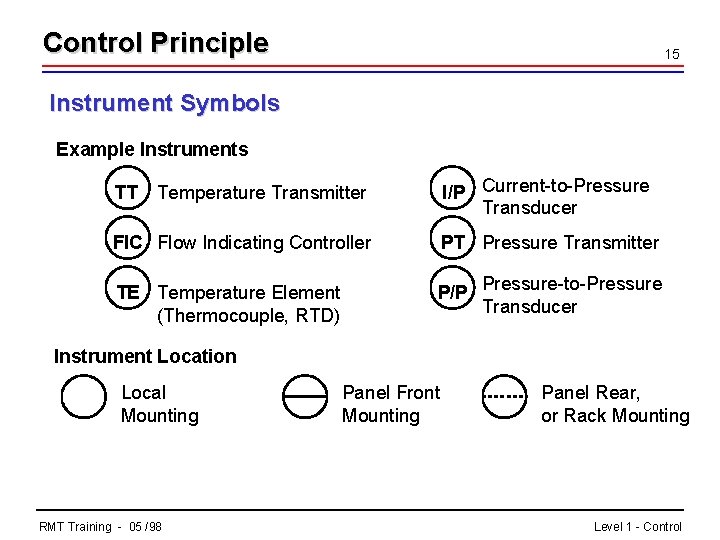
Control Principle 15 Instrument Symbols Example Instruments TT I/P Current-to-Pressure Transducer Temperature Transmitter FIC Flow Indicating Controller PT Pressure Transmitter TE Temperature Element (Thermocouple, RTD) P/P Pressure-to-Pressure Transducer Instrument Location Local Mounting RMT Training - 05 /98 Panel Front Mounting Panel Rear, or Rack Mounting Level 1 - Control
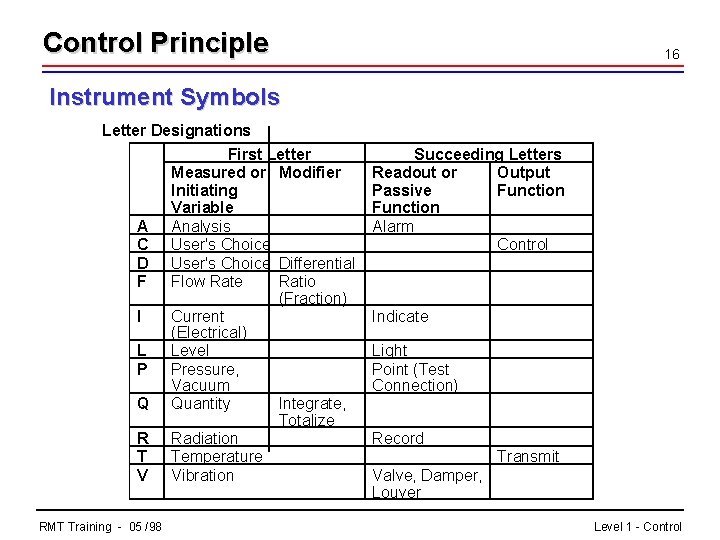
Control Principle 16 Instrument Symbols Letter Designations A C D F I L P Q R T V RMT Training - 05 /98 First Letter Measured or Modifier Initiating Variable Analysis User's Choice Differential Flow Rate Ratio (Fraction) Current (Electrical) Level Pressure, Vacuum Quantity Integrate, Totalize Radiation Temperature Vibration Succeeding Letters Readout or Output Passive Function Alarm Control Indicate Light Point (Test Connection) Record Transmit Valve, Damper, Louver Level 1 - Control
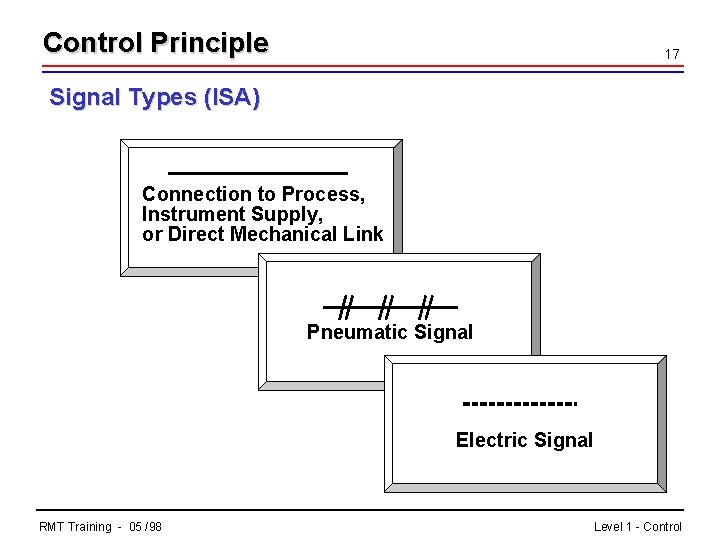
Control Principle 17 Signal Types (ISA) Connection to Process, Instrument Supply, or Direct Mechanical Link Pneumatic Signal Electric Signal RMT Training - 05 /98 Level 1 - Control
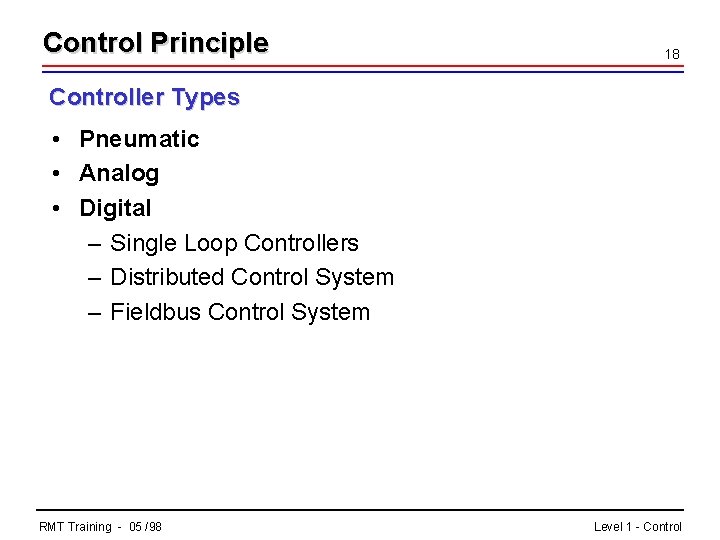
Control Principle 18 Controller Types • Pneumatic • Analog • Digital – Single Loop Controllers – Distributed Control System – Fieldbus Control System RMT Training - 05 /98 Level 1 - Control
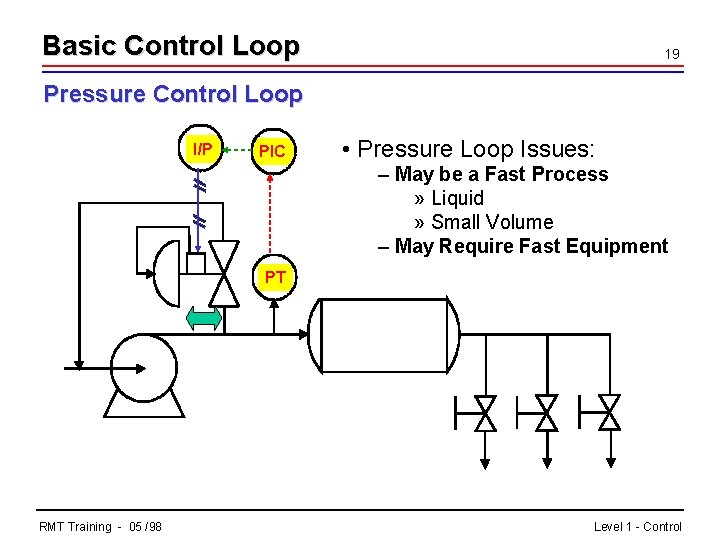
Basic Control Loop 19 Pressure Control Loop I/P PIC • Pressure Loop Issues: – May be a Fast Process » Liquid » Small Volume – May Require Fast Equipment PT RMT Training - 05 /98 Level 1 - Control
Basic Control Loop 20 Temperature Control Loop • Temperature Loop Issues: Fluid response slowly to change in input heat – Requires advanced control strategies » Feedforward Control – Load Disturbance TIC Cold Water I/P TT Steam Hot Water RMT Training - 05 /98 Level 1 - Control
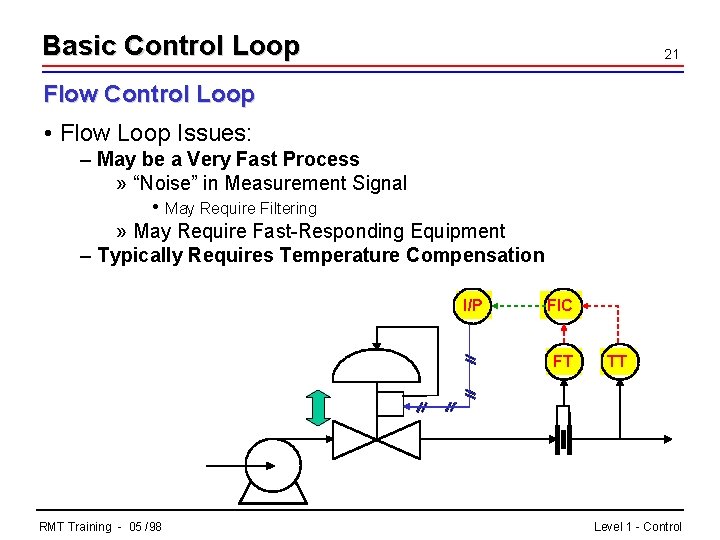
Basic Control Loop 21 Flow Control Loop • Flow Loop Issues: – May be a Very Fast Process » “Noise” in Measurement Signal • May Require Filtering » May Require Fast-Responding Equipment – Typically Requires Temperature Compensation I/P FIC FT RMT Training - 05 /98 TT Level 1 - Control
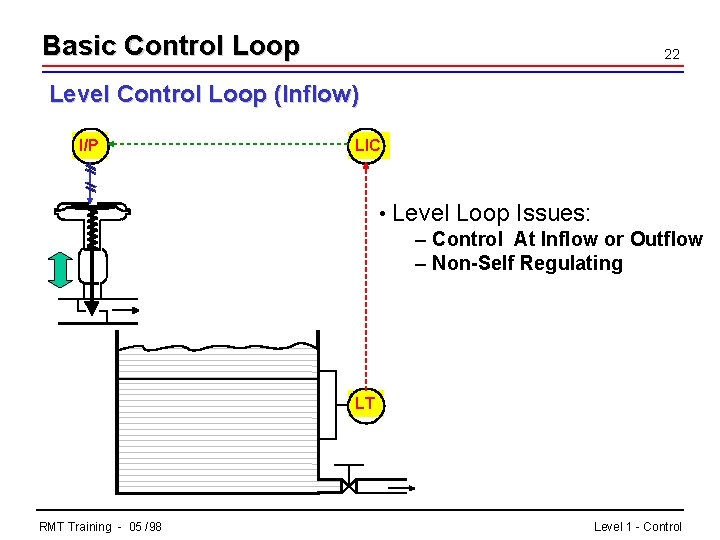
Basic Control Loop 22 Level Control Loop (Inflow) I/P LIC • Level Loop Issues: – Control At Inflow or Outflow – Non-Self Regulating LT RMT Training - 05 /98 Level 1 - Control
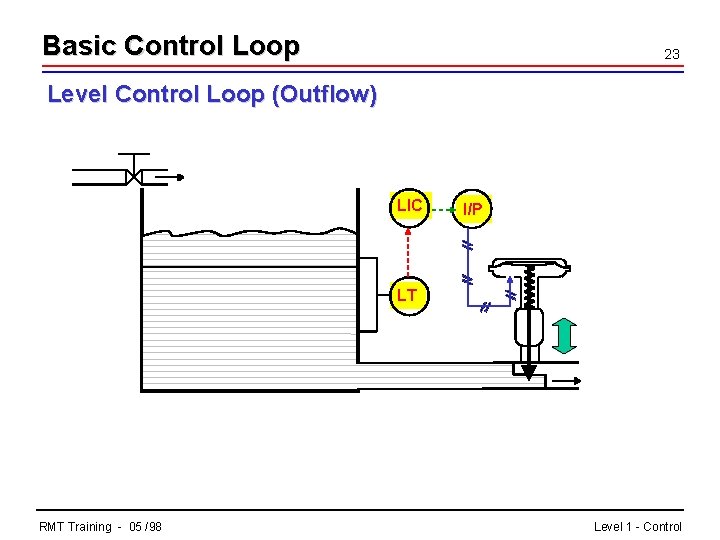
Basic Control Loop 23 Level Control Loop (Outflow) LIC I/P LT RMT Training - 05 /98 Level 1 - Control
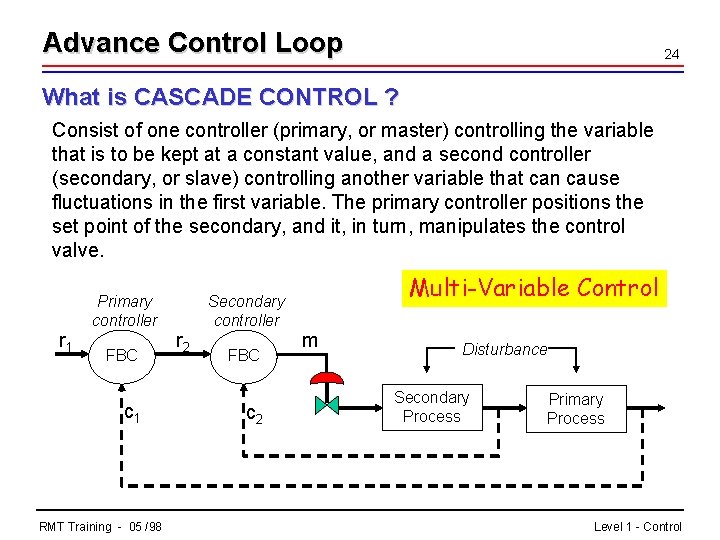
Advance Control Loop 24 What is CASCADE CONTROL ? Consist of one controller (primary, or master) controlling the variable that is to be kept at a constant value, and a second controller (secondary, or slave) controlling another variable that can cause fluctuations in the first variable. The primary controller positions the set point of the secondary, and it, in turn, manipulates the control valve. r 1 Primary controller FBC c 1 RMT Training - 05 /98 r 2 Secondary controller FBC c 2 Multi-Variable Control m Disturbance Secondary Process Primary Process Level 1 - Control
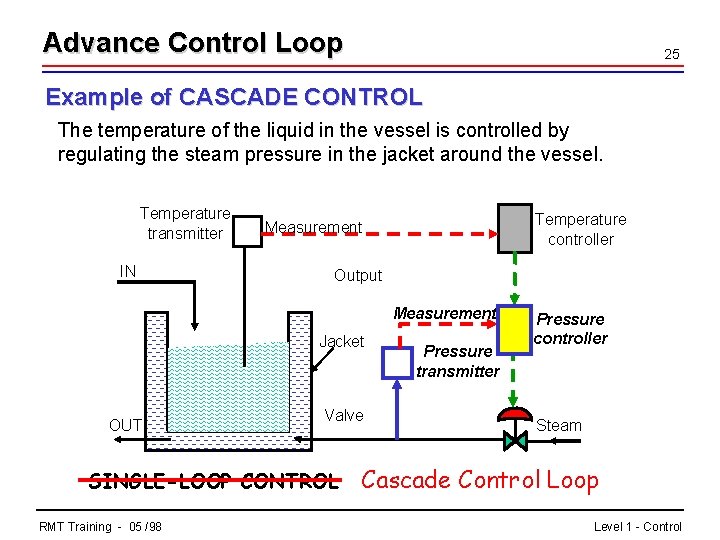
Advance Control Loop 25 Example of CASCADE CONTROL The temperature of the liquid in the vessel is controlled by regulating the steam pressure in the jacket around the vessel. Temperature transmitter IN Temperature controller Measurement Output Measurement Jacket OUT Valve SINGLE-LOOP CONTROL RMT Training - 05 /98 Pressure transmitter Pressure controller Steam Cascade Control Loop Level 1 - Control
Advance Control Loop 26 Implementing Cascade Control RMT Training - 05 /98 Level 1 - Control
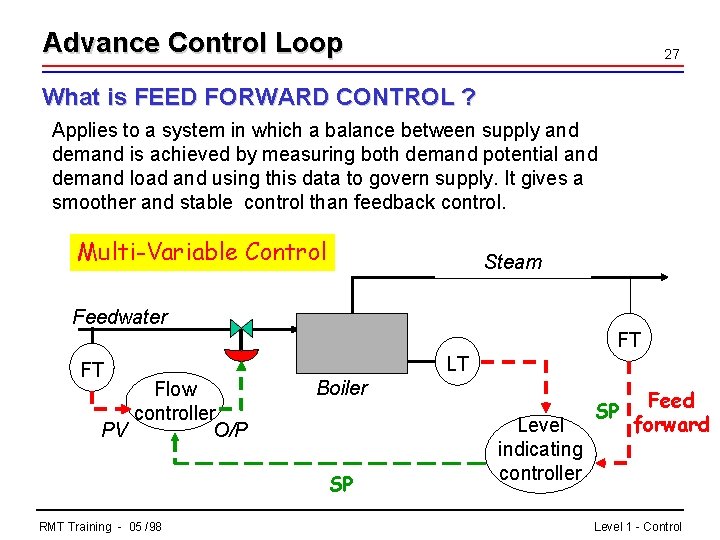
Advance Control Loop 27 What is FEED FORWARD CONTROL ? Applies to a system in which a balance between supply and demand is achieved by measuring both demand potential and demand load and using this data to govern supply. It gives a smoother and stable control than feedback control. Multi-Variable Control Steam Feedwater FT FT Flow controller PV O/P LT Boiler SP RMT Training - 05 /98 Level indicating controller SP Feed forward Level 1 - Control
Advance Control Loop 28 Implementing Feedforward Control RMT Training - 05 /98 Level 1 - Control
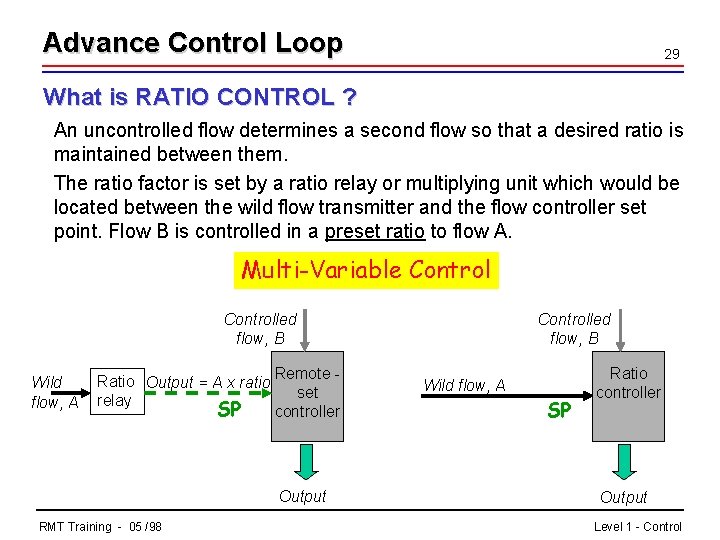
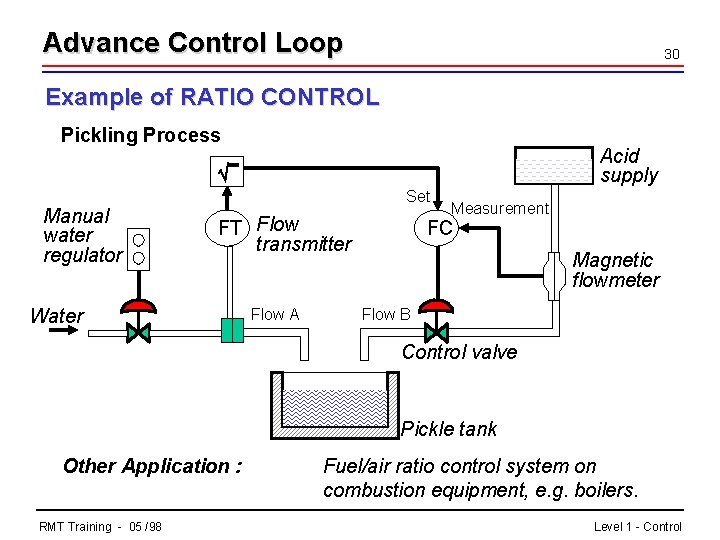
Advance Control Loop 29 What is RATIO CONTROL ? An uncontrolled flow determines a second flow so that a desired ratio is maintained between them. The ratio factor is set by a ratio relay or multiplying unit which would be located between the wild flow transmitter and the flow controller set point. Flow B is controlled in a preset ratio to flow A. Multi-Variable Controlled flow, B Wild flow, A Ratio Output = A x ratio relay SP Remote set controller Output RMT Training - 05 /98 Controlled flow, B Wild flow, A SP Ratio controller Output Level 1 - Control
Advance Control Loop 30 Example of RATIO CONTROL Pickling Process Acid supply Manual water regulator Set FT Flow transmitter Water Flow A Measurement FC Magnetic flowmeter Flow B Control valve Pickle tank Other Application : RMT Training - 05 /98 Fuel/air ratio control system on combustion equipment, e. g. boilers. Level 1 - Control
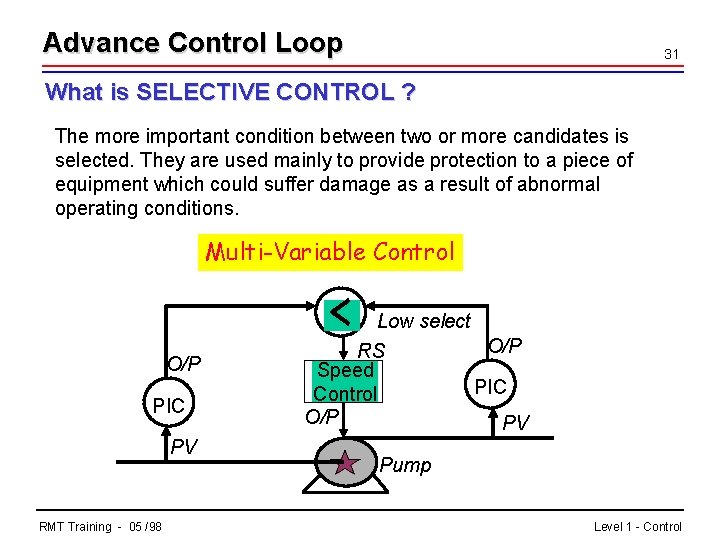
Advance Control Loop 31 What is SELECTIVE CONTROL ? The more important condition between two or more candidates is selected. They are used mainly to provide protection to a piece of equipment which could suffer damage as a result of abnormal operating conditions. Multi-Variable Control Low select O/P PIC PV RMT Training - 05 /98 RS Speed Control O/P PIC PV Pump Level 1 - Control
Control Algorithm 32 • On/Off • Multi-step • Proportional • Integral • Derivative RMT Training - 05 /98 Level 1 - Control
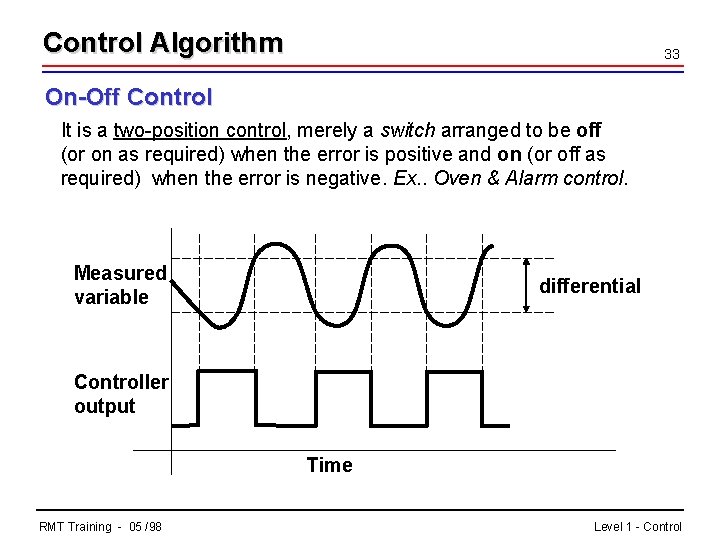
Control Algorithm 33 On-Off Control It is a two-position control, merely a switch arranged to be off (or on as required) when the error is positive and on (or off as required) when the error is negative. Ex. . Oven & Alarm control. Measured variable differential Controller output Time RMT Training - 05 /98 Level 1 - Control
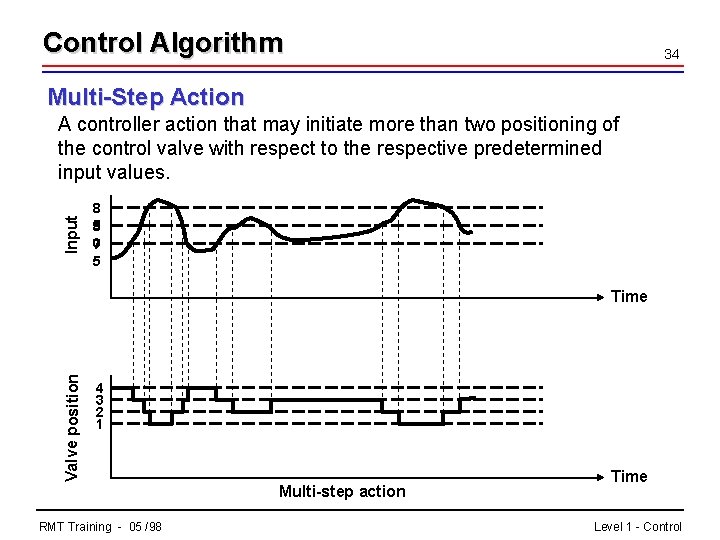
Control Algorithm 34 Multi-Step Action Input A controller action that may initiate more than two positioning of the control valve with respect to the respective predetermined input values. 8 5 8 0 7 5 Valve position Time 4 3 2 1 RMT Training - 05 /98 Multi-step action Time Level 1 - Control
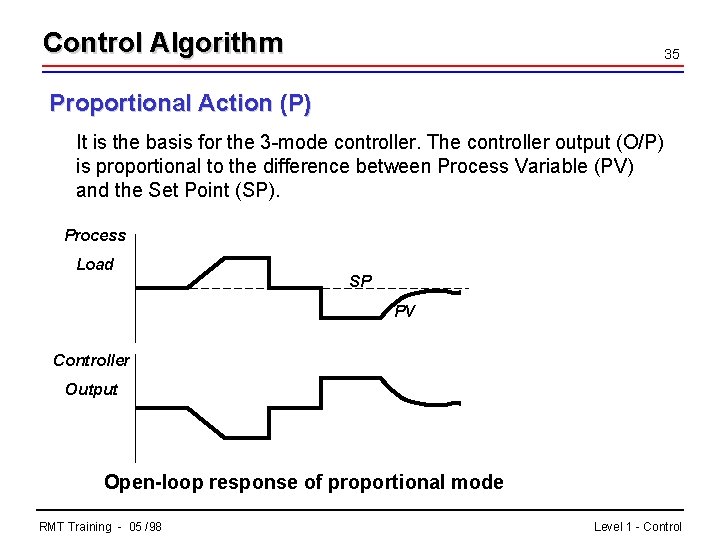
Control Algorithm 35 Proportional Action (P) It is the basis for the 3 -mode controller. The controller output (O/P) is proportional to the difference between Process Variable (PV) and the Set Point (SP). Process Load SP PV Controller Output Open-loop response of proportional mode RMT Training - 05 /98 Level 1 - Control
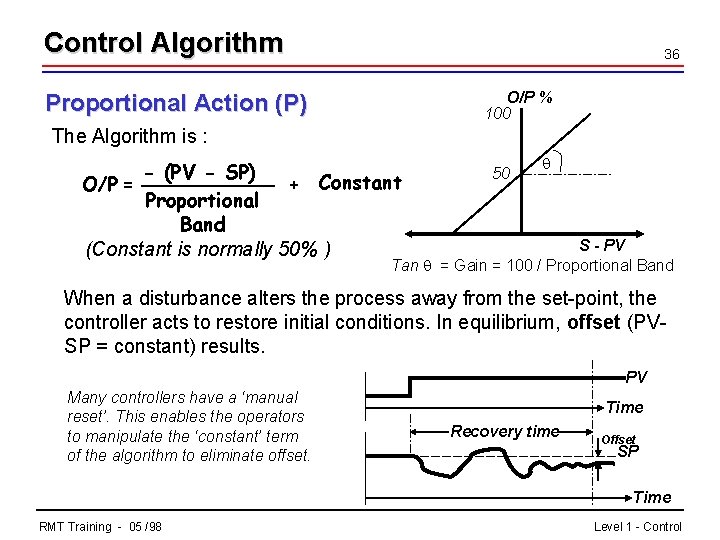
Control Algorithm 36 O/P % 100 Proportional Action (P) The Algorithm is : - (PV - SP) O/P = + Constant Proportional Band (Constant is normally 50% ) 50 S - PV Tan = Gain = 100 / Proportional Band When a disturbance alters the process away from the set-point, the controller acts to restore initial conditions. In equilibrium, offset (PVSP = constant) results. PV Many controllers have a ‘manual reset’. This enables the operators to manipulate the ‘constant’ term of the algorithm to eliminate offset. Time Recovery time Offset SP Time RMT Training - 05 /98 Level 1 - Control
Control Algorithm 37 Low Proportional Gain: (Closed Loop) RMT Training - 05 /98 Level 1 - Control
Control Algorithm 38 High Proportional Gain: (Closed Loop) RMT Training - 05 /98 Level 1 - Control
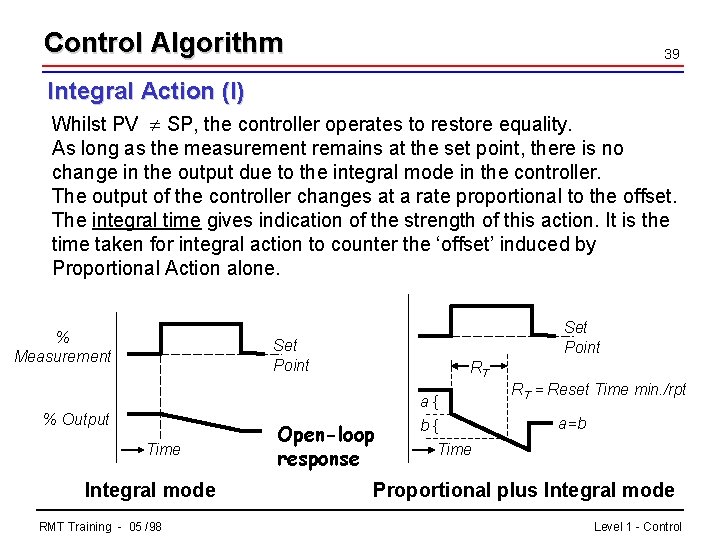
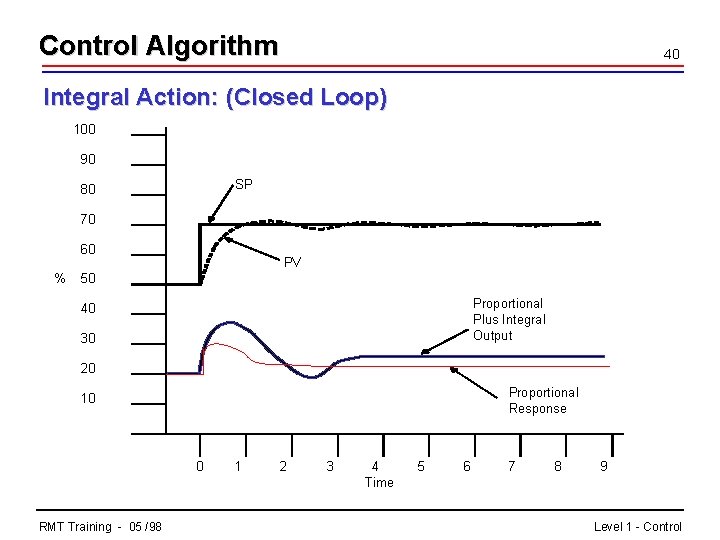
Control Algorithm 39 Integral Action (I) Whilst PV SP, the controller operates to restore equality. As long as the measurement remains at the set point, there is no change in the output due to the integral mode in the controller. The output of the controller changes at a rate proportional to the offset. The integral time gives indication of the strength of this action. It is the time taken for integral action to counter the ‘offset’ induced by Proportional Action alone. % Measurement Set Point % Output Time Integral mode RMT Training - 05 /98 RT Open-loop response a{ b{ Time RT = Reset Time min. /rpt a=b Proportional plus Integral mode Level 1 - Control
Control Algorithm 40 Integral Action: (Closed Loop) 100 90 SP 80 70 60 % PV 50 Proportional Plus Integral Output 40 30 20 Proportional Response 10 0 RMT Training - 05 /98 1 2 3 4 Time 5 6 7 8 9 Level 1 - Control
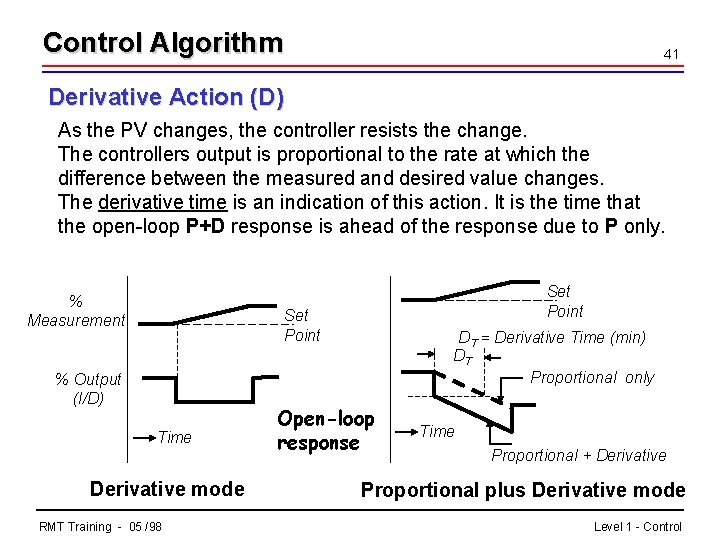
Control Algorithm 41 Derivative Action (D) As the PV changes, the controller resists the change. The controllers output is proportional to the rate at which the difference between the measured and desired value changes. The derivative time is an indication of this action. It is the time that the open-loop P+D response is ahead of the response due to P only. % Measurement Set Point % Output (I/D) Time Derivative mode RMT Training - 05 /98 DT = Derivative Time (min) DT Proportional only Open-loop response Time Proportional + Derivative Proportional plus Derivative mode Level 1 - Control
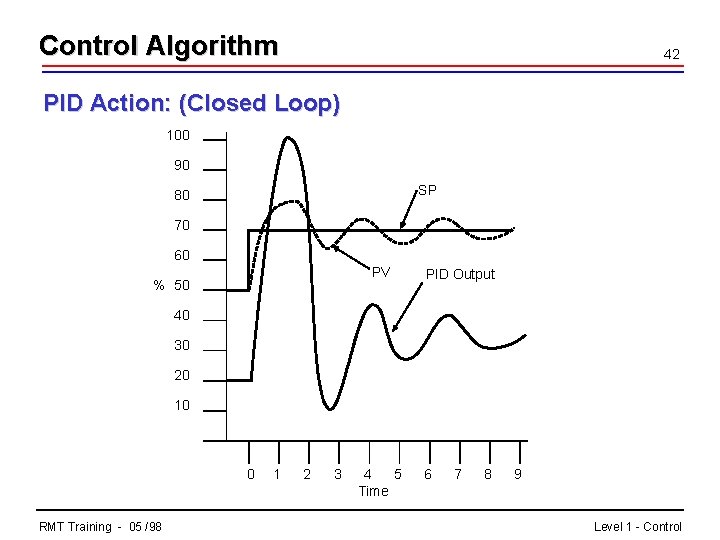
Control Algorithm 42 PID Action: (Closed Loop) 100 90 SP 80 70 60 PV % 50 PID Output 40 30 20 10 0 RMT Training - 05 /98 1 2 3 4 5 Time 6 7 8 9 Level 1 - Control
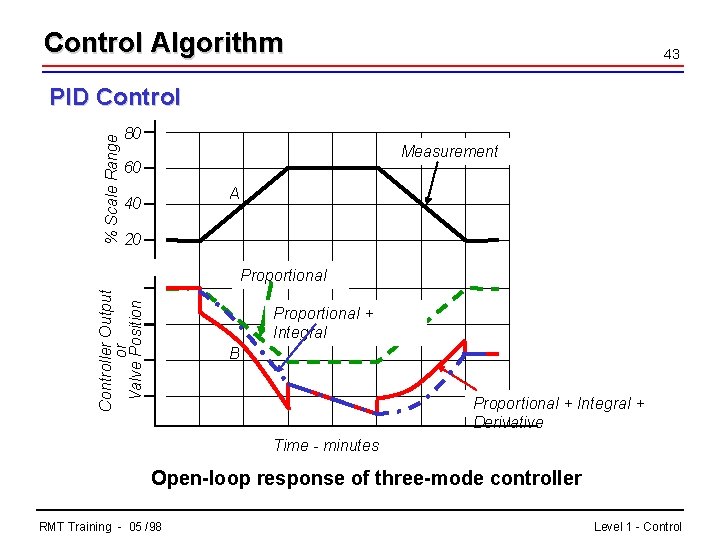
Control Algorithm 43 % Scale Range PID Control 80 Measurement 60 A 40 20 Controller Output or Valve Position Proportional + Integral B Proportional + Integral + Derivative Time - minutes Open-loop response of three-mode controller RMT Training - 05 /98 Level 1 - Control
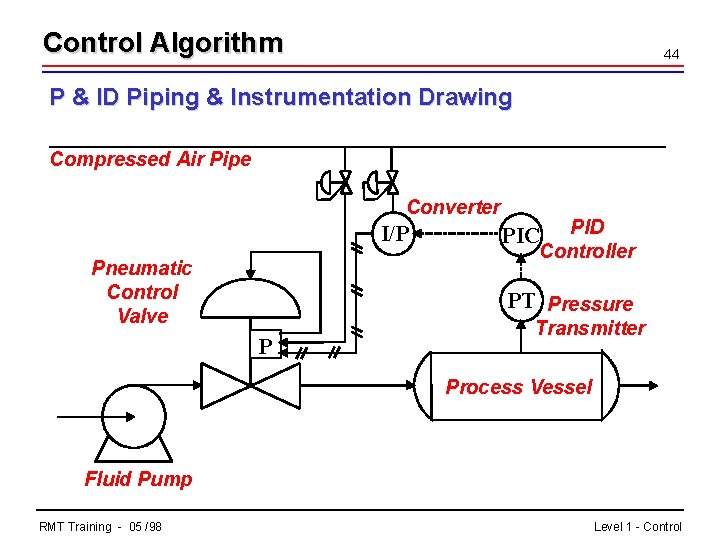
Control Algorithm 44 P & ID Piping & Instrumentation Drawing Compressed Air Pipe Converter I/P Pneumatic Control Valve PID Controller PIC PT Pressure P Transmitter Process Vessel Fluid Pump RMT Training - 05 /98 Level 1 - Control
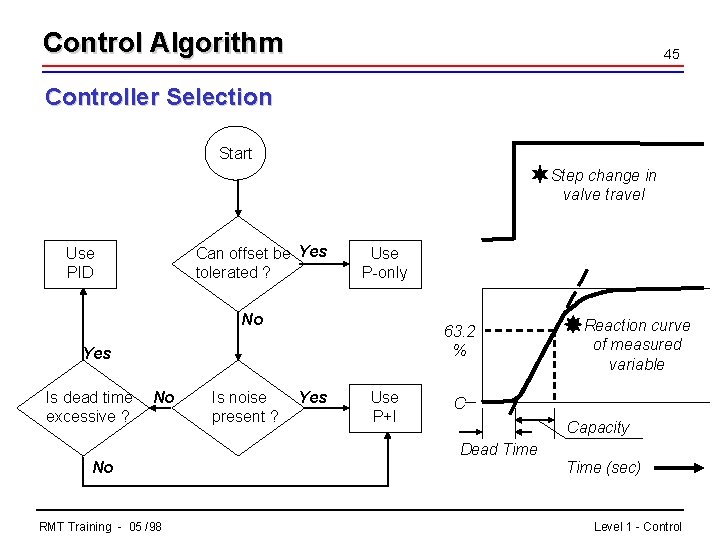
Control Algorithm 45 Controller Selection Start Step change in valve travel Can offset be Yes tolerated ? Use PID Use P-only No 63. 2 % Yes Is dead time excessive ? No Is noise present ? Yes Use P+I Reaction curve of measured variable C Capacity Dead Time No RMT Training - 05 /98 Time (sec) Level 1 - Control
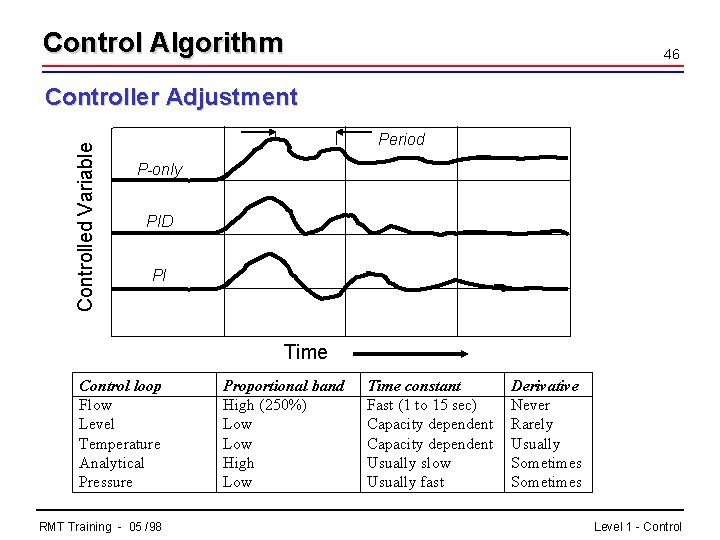
Control Algorithm 46 Controlled Variable Controller Adjustment Period P-only PID PI Time Control loop Flow Level Temperature Analytical Pressure RMT Training - 05 /98 Proportional band High (250%) Low High Low Time constant Fast (1 to 15 sec) Capacity dependent Usually slow Usually fast Derivative Never Rarely Usually Sometimes Level 1 - Control
Control System 47 Adaptive Control An automatic control scheme in which the controller is programmed to evaluate its own effectiveness and modify its own control parameters to respond to dynamic conditions occurring in or to the process which affect the controlled variables. Ex) Digital Controller - Sensors are run to the computer’s input. - Servomechanisms are connected to the computer’s output. - Future changes don’t require re-wiring. - Changing control functions (P, I, and D) and configurations (between cascade mode and feedforward mode) will be made on the computer’s program and not necessarily to any hardware. RMT Training - 05 /98 Level 1 - Control
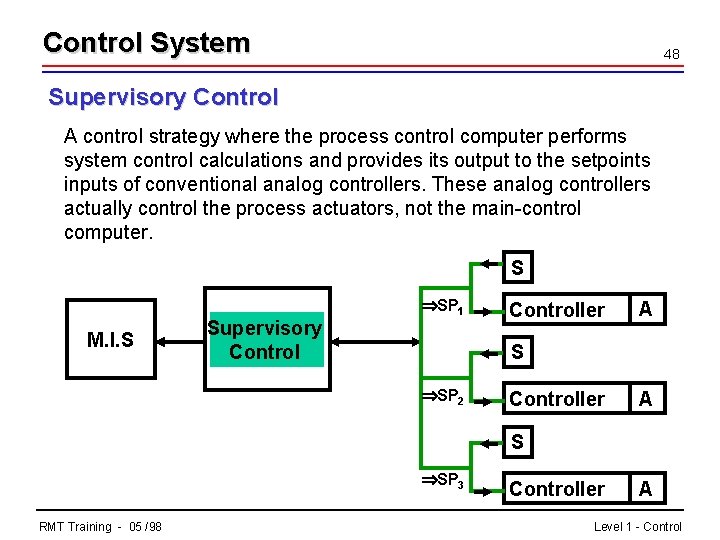
Control System 48 Supervisory Control A control strategy where the process control computer performs system control calculations and provides its output to the setpoints inputs of conventional analog controllers. These analog controllers actually control the process actuators, not the main-control computer. S SP 1 M. I. S Supervisory Controller A S SP 2 Controller A S SP 3 RMT Training - 05 /98 Controller A Level 1 - Control
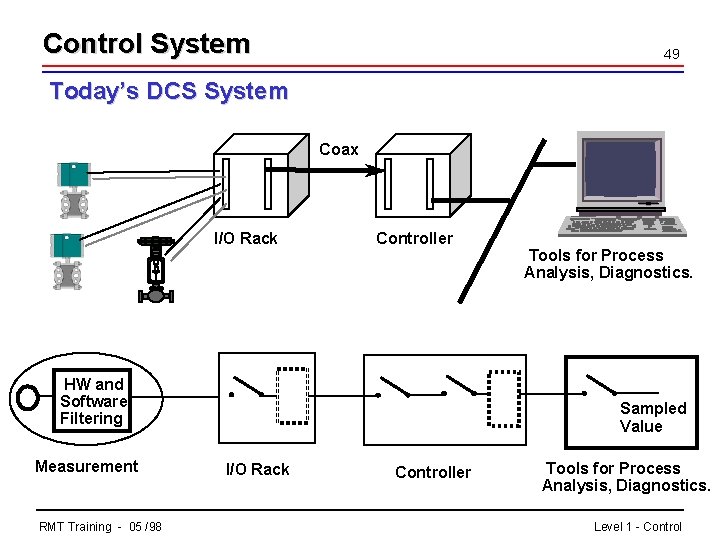
Control System 49 Today’s DCS System Coax I/O Rack Controller HW and Software Filtering Measurement RMT Training - 05 /98 Tools for Process Analysis, Diagnostics. Sampled Value I/O Rack Controller Tools for Process Analysis, Diagnostics. Level 1 - Control
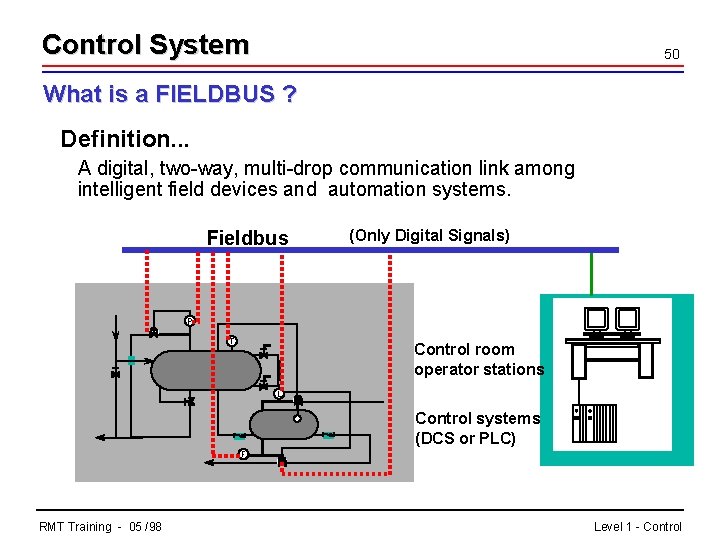
Control System 50 What is a FIELDBUS ? Definition. . . A digital, two-way, multi-drop communication link among intelligent field devices and automation systems. Fieldbus (Only Digital Signals) P T Control room operator stations L Control systems (DCS or PLC) F RMT Training - 05 /98 Level 1 - Control
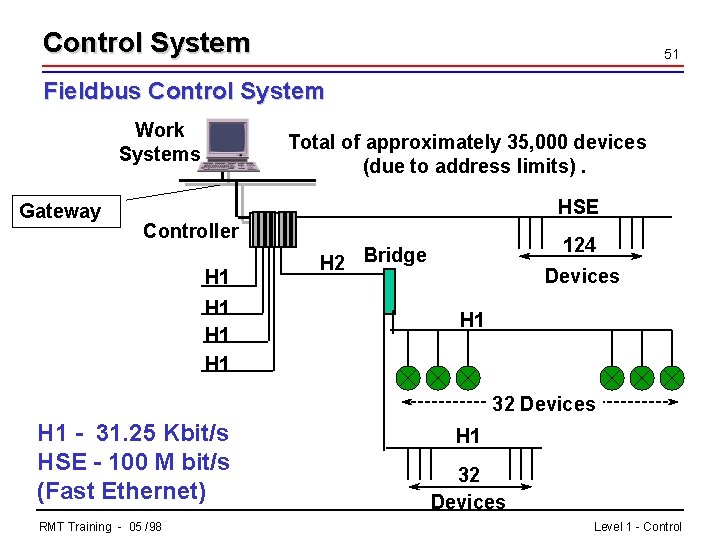
Control System 51 Fieldbus Control System Work Systems Gateway Total of approximately 35, 000 devices (due to address limits). HSE Controller H 1 H 1 124 H 2 Bridge Devices H 1 32 Devices H 1 - 31. 25 Kbit/s HSE - 100 M bit/s (Fast Ethernet) RMT Training - 05 /98 H 1 32 Devices Level 1 - Control
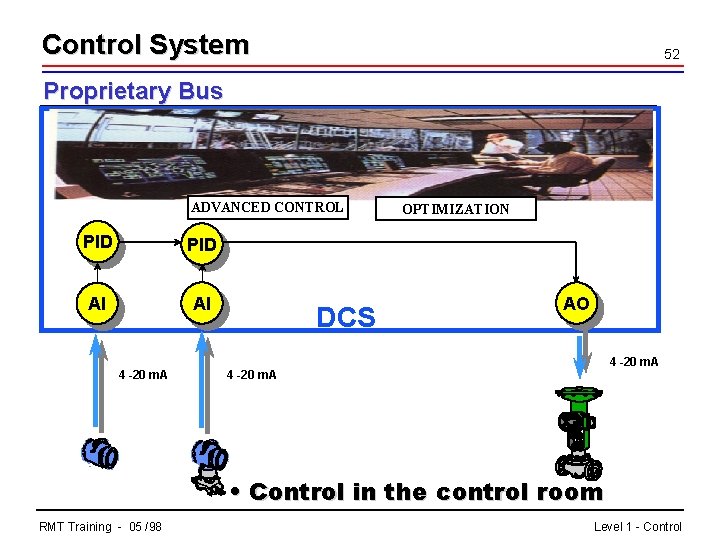
Control System 52 Proprietary Bus ADVANCED CONTROL PID AI AI DCS OPTIMIZATION AO 4 -20 m. A • Control in the control room RMT Training - 05 /98 Level 1 - Control
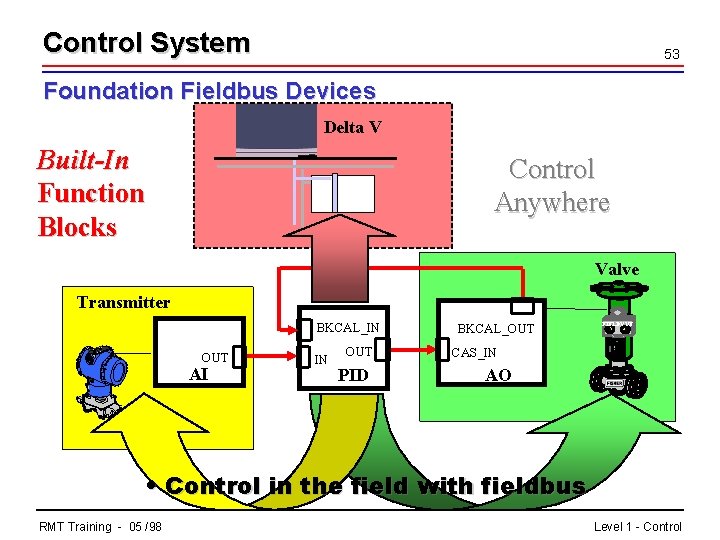
Control System 53 Foundation Fieldbus Devices Delta V Built-In Function Blocks Control Anywhere Valve Transmitter BKCAL_IN OUT AI IN OUT PID BKCAL_OUT FIELDVUE CAS_IN AO • Control in the field with fieldbus RMT Training - 05 /98 Level 1 - Control
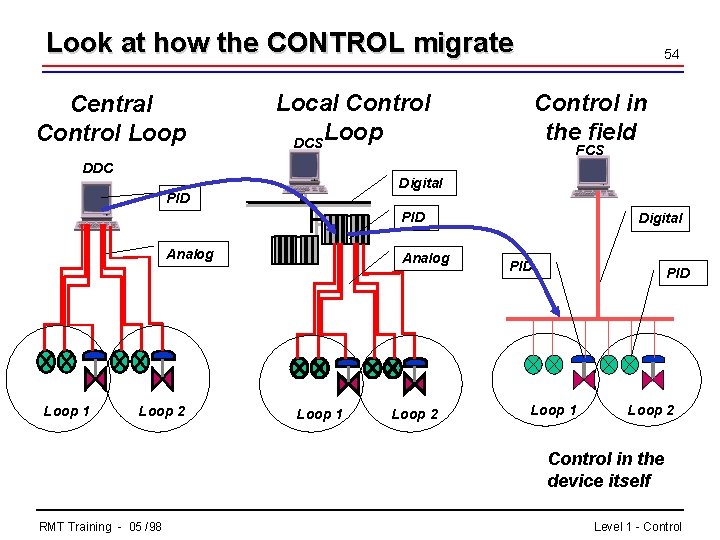
Look at how the CONTROL migrate Central Control Loop 54 Local Control Loop DCS DDC Control in the field FCS Digital PID Analog Loop 1 Loop 2 Digital PID Loop 1 Loop 2 Control in the device itself RMT Training - 05 /98 Level 1 - Control
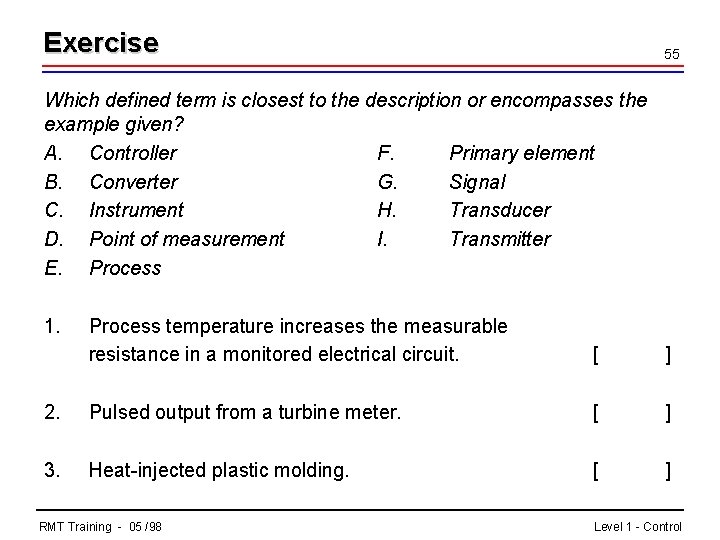
Exercise 55 Which defined term is closest to the description or encompasses the example given? A. Controller F. Primary element B. Converter G. Signal C. Instrument H. Transducer D. Point of measurement I. Transmitter E. Process 1. Process temperature increases the measurable resistance in a monitored electrical circuit. [ ] 2. Pulsed output from a turbine meter. [ ] 3. Heat-injected plastic molding. [ ] RMT Training - 05 /98 Level 1 - Control
Exercise 56 4. Temperature transmitter. [ ] 5. Device which adjusts the measured value of the process to the requirements of the operator. [ ] 6. Element, flow transmitter, controller and correcting unit. [ ] 7. A pipe piece is tapped for a sample fluid. ] [ 8. A device changes an industry standard pneumatic signal to an industry standard hydraulic signal. RMT Training - 05 /98 [ ] Level 1 - Control
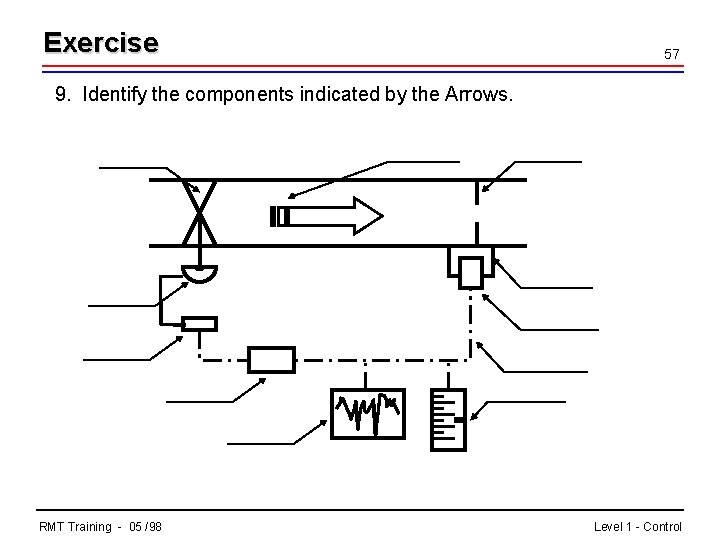
Exercise 57 9. Identify the components indicated by the Arrows. RMT Training - 05 /98 Level 1 - Control
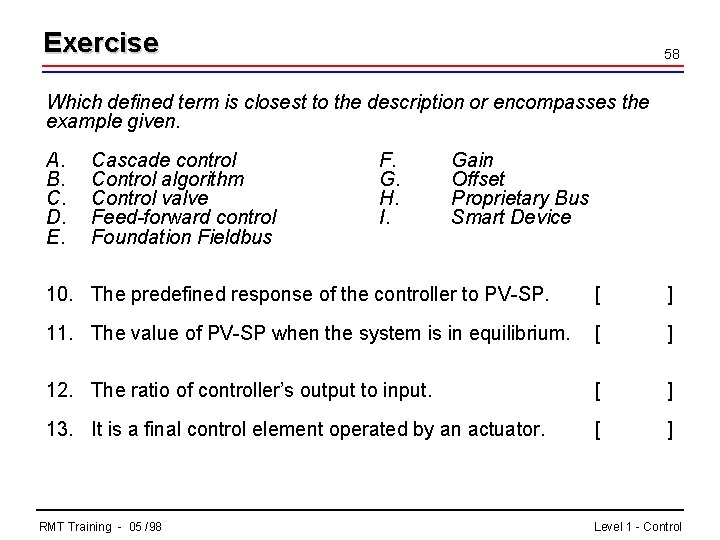
Exercise 58 Which defined term is closest to the description or encompasses the example given. A. B. C. D. E. Cascade control Control algorithm Control valve Feed-forward control Foundation Fieldbus F. G. H. I. Gain Offset Proprietary Bus Smart Device 10. The predefined response of the controller to PV-SP. [ ] 11. The value of PV-SP when the system is in equilibrium. [ ] 12. The ratio of controller’s output to input. [ ] 13. It is a final control element operated by an actuator. [ ] RMT Training - 05 /98 Level 1 - Control
Exercise 59 14. Involves master & slave controllers. [ ] 15. The output of the loop drives the input. [ ] 16. A digital communication based control network with control action in the controller only. [ ] 17. A digital communication based control network that allow control in the field. [ ] 18. A device that provide both analog & communication signal in its loop wire pair. [ ] RMT Training - 05 /98 Level 1 - Control