
LEV VYGOTSKY 1896 1934 Through others we become
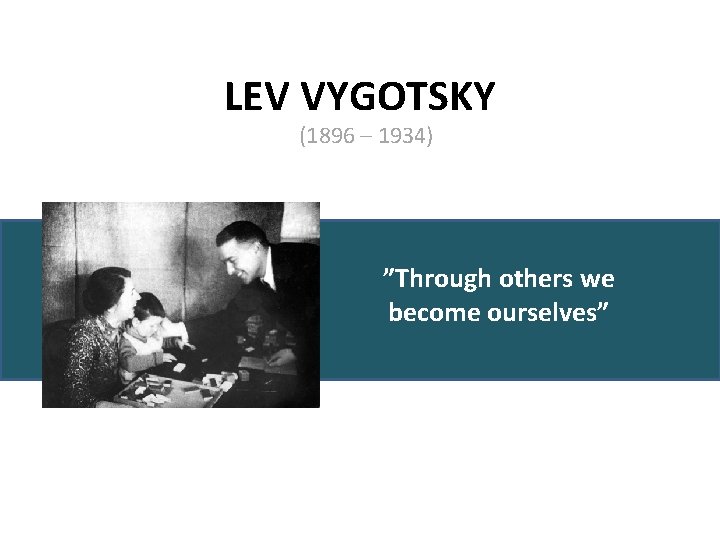
LEV VYGOTSKY (1896 – 1934) ”Through others we become ourselves”
TOPICS • View on learning Social Transmission • • Role of language Zone of Proximal Development Scaffolding Theory in use Pretend play + Story time
DEVELOPMENT AND LEARNING • Social interaction has a fundamental role in the development of cognition / mental development (precedes and promotes development) • Development can not be separated from its social context - No single principle can account for development - Individual development cannot be understood without reference to the social and cultural context
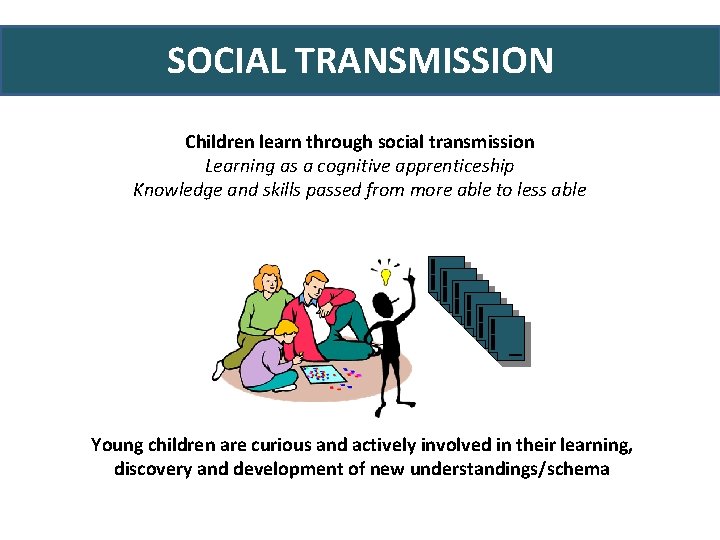
SOCIAL TRANSMISSION Children learn through social transmission Learning as a cognitive apprenticeship Knowledge and skills passed from more able to less able Young children are curious and actively involved in their learning, discovery and development of new understandings/schema
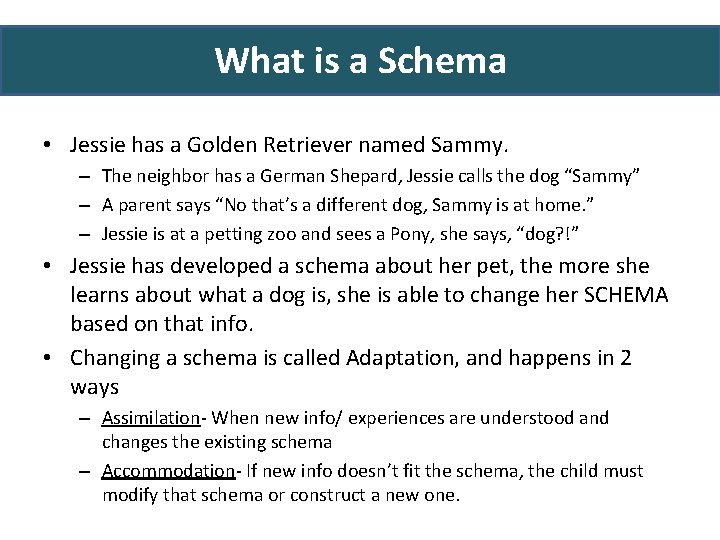
What is a Schema • Jessie has a Golden Retriever named Sammy. – The neighbor has a German Shepard, Jessie calls the dog “Sammy” – A parent says “No that’s a different dog, Sammy is at home. ” – Jessie is at a petting zoo and sees a Pony, she says, “dog? !” • Jessie has developed a schema about her pet, the more she learns about what a dog is, she is able to change her SCHEMA based on that info. • Changing a schema is called Adaptation, and happens in 2 ways – Assimilation- When new info/ experiences are understood and changes the existing schema – Accommodation- If new info doesn’t fit the schema, the child must modify that schema or construct a new one.
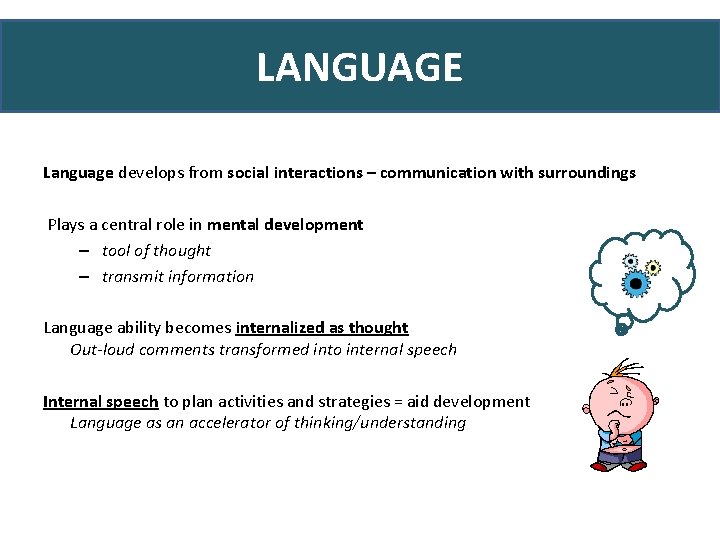
LANGUAGE Language develops from social interactions – communication with surroundings Plays a central role in mental development – tool of thought – transmit information Language ability becomes internalized as thought Out-loud comments transformed into internal speech Internal speech to plan activities and strategies = aid development Language as an accelerator of thinking/understanding
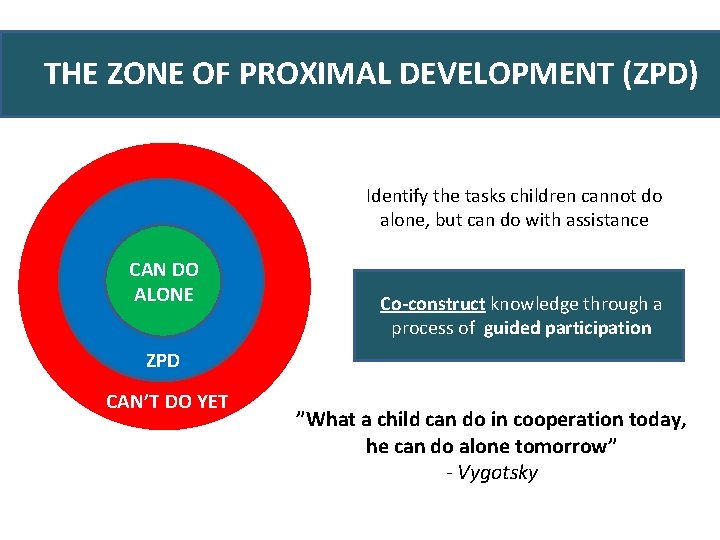
THE ZONE OF PROXIMAL DEVELOPMENT (ZPD) Identify the tasks children cannot do alone, but can do with assistance CAN DO ALONE Co-construct knowledge through a process of guided participation ZPD CAN’T DO YET ”What a child can do in cooperation today, he can do alone tomorrow” - Vygotsky
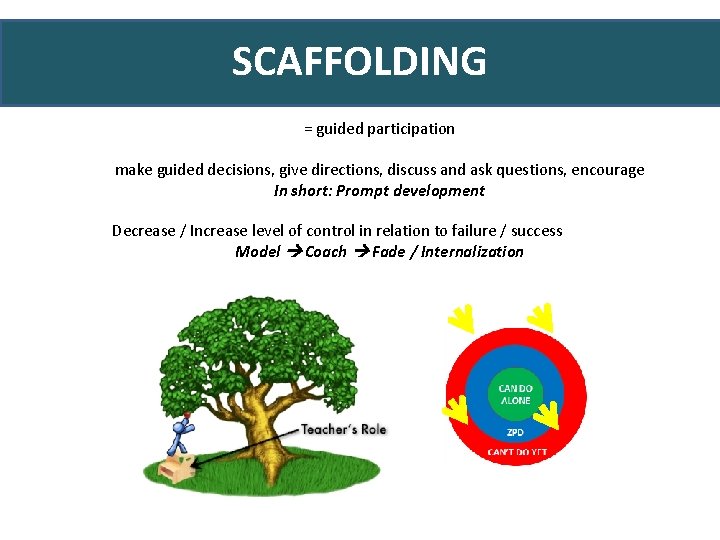
SCAFFOLDING = guided participation make guided decisions, give directions, discuss and ask questions, encourage In short: Prompt development Decrease / Increase level of control in relation to failure / success Model Coach Fade / Internalization
SCAFFOLDING IN USE As a teacher / parent: to identify ZPD + provide scaffolding within it to provide experiences and tasks within the child’s ZPD accompany by prompting, questioning, simplifications, adjustments Model performance while thinking out loud, give verbal instructions Guide and structure the task, connect to prior knowledge and skills, break down into sub-tasks In pair-work / group-work: cooperative learning, mixed-ability groups pair advanced learners with developing ones ”To know how to scaffold is to know how to teach” – Kathy Walker, holistic ’Walker Learning Approach’
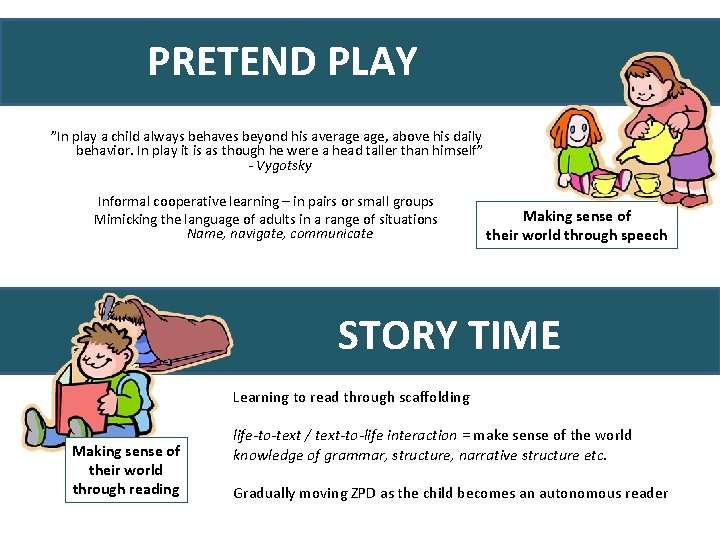
PRETEND PLAY ”In play a child always behaves beyond his average age, above his daily behavior. In play it is as though he were a head taller than himself” - Vygotsky Informal cooperative learning – in pairs or small groups Mimicking the language of adults in a range of situations Name, navigate, communicate Making sense of their world through speech STORY TIME Learning to read through scaffolding Making sense of their world through reading life-to-text / text-to-life interaction = make sense of the world knowledge of grammar, structure, narrative structure etc. Gradually moving ZPD as the child becomes an autonomous reader
SOURCES • Barton, David. (1994). Literacy: An Introduction to the Ecology of Written Language. • Geekie, P. , Cambourne, B. and Fitzsimmons, P. (2004) Learning as Puzzle Solving. The Routledge Farmer Reader. London: Routledge Farmer. • Mc. Leod, S. A. (2007). Vygotsky - Simply Psychology. http: //www. simplypsychology. org/vygotsky. html • Oswelt, Angela. Vygotsky's Social Developmental Emphasis. http: //www. sevencounties. org/poc/view_doc. php? type=doc&id=37680&cn=1272 • Play: The Work of Lev Vygotsky. http: //www. childdevelopmentmedia. com/play-the-work-of-lev-vygotsky • The Walker Learning Approach. http: //walkerlearning. com. au/info
- Slides: 11