
Lev 16 Yom Kippur Hebrew Definition Yom Kippur
Lev 16: Yom Kippur • • • Hebrew Definition Yom Kippur in Temple times Lev 16 – Shadow pictures of Messiah Similarities of Lev 16 and Revelation Yom Kippur – Valid today?
Yom Kippur • Lev 16: 30 -31 “For on that day he (High Priest) makes atonement for you, to cleanse you, to be clean from all your sins before “ יהוה It is a Sabbath of rest for you, and you shall afflict your beings – a law forever. • Num 29: 7 ‘And on the tenth day of this seventh month you have a set-apart gathering, and you shall afflict your beings, you do no work.
Yom Kippur • Lev 23: 27 -28, 31 -32 “On the tenth day of this seventh month is the Day of Atonement. It shall be a set-apart gathering for you. And you shall afflict your beings, and shall bring an offering made by fire to “ יהוה And you do no work on that same day, for it is the Day of Atonement, to make atonement for you before יהוה your Elohim. (31 -32) “You do no work – a law forever throughout your generations in all your dwellings. ‘It is a Sabbath of rest to you, and you shall afflict your beings. On the ninth day of the month at evening, from evening to evening, you observe your Sabbath. ”
Yom Kippur • To be observed the evening of the 9 th until the evening of the 10 th – a complete day (24 hr). (Lev 23: 32) • Israelite Nation as a whole to have a holy convocation. (Lev 23: 27) • No work was to be done (Lev 23: 28 -31) • Sabbath of rest (Lev 23: 32) • Statute forever throughout your generations (Lev 23: 31) • In the Jubilee- a time to proclaim liberty throughout Israel – (land resets back to original owner, slaves/servants go free) (Lev 25: 8 -17) • ‘Afflict your soul’ (Lev 23: 27, 32)
‘Afflict your soul’ • So how does one “afflict” oneself? It is generally understood and accepted through Biblical scholars that “afflicting” oneself in this regard would be to “deny” self. One way of denying self is through “fasting”. In the scroll of Ezra, Ezra the scribe and priest calls upon those who came with him from Babylon back to Israel to “afflict” themselves through “fasting”… • “Then I (Ezra) proclaimed a fast there, at the river of Ahava, that we might afflict ourselves before our God, to seek of him a right way for us, and for our little ones, and for all our substance. ” (Ezra 8: 21) (Emphasis Mine)
Afflict & Fast • During Yom Kippur, an observance of a 24 hour fast where you “humble” yourself physically (through abstaining from physical food), mentally, and spiritually (through heart-felt prayers of repentance before Yahweh) is generally practiced. Messiah Yahshua also had this to say concerning “fasting”: • “Moreover when ye fast, be not, as the hypocrites, of a sad countenance: for they disfigure their faces, that they may appear unto men to fast. Verily I say unto you, They have their reward. But thou, when thou fastest, anoint thine head, and wash thy face; That thou appear not unto men to fast, but unto thy Father which is in secret: and thy Father, which seeth in secret, shall reward thee openly. “ (Matthew 6: 16 -18)/(Isa 58)
‘Deny’ & ‘Afflict’ • To 'deny' oneself or to 'afflict' oneself contains many levels of meaning. On the literal/Pashat level, the meaning is to deny the flesh, meaning to 'fast'. On a deeper level, I believe that we not only 'afflict' our flesh and nefesh (soul), but we come before our King with humbleness and humility and open our hearts to HIM. . . recognize that each one of us has fallen short before our Kadosh ABBA. Pray to Him, talk to Him, listen to His still, calming voice. Spend some time in the word (as He leads). . . Praise Him for what He has done for you through Mashiach! It is a time to check our hearts and be eternally grateful for His love and compassion towards us through the atonement of His Son, Messiah Yahshua!
Atonement: • Atonement – What is the meaning? William Tyndale (1494 -1536), in translating the Bible into English, was trying to translate the Hebrew word ‘Kippur’ and came up with the word atonement. At-one-ment is a word containing three words in which the base meaning is: a condition of being at one (unity) with. • Origin: Medievel Latin ‘adunamentum, compare Middle English ‘onement’ (unity). • a·tone·ment: noun 1. reparation for a wrong or injury; amends. 2. Religion. reparation or expiation for sin. The High Priest offered a sacrifice to make atonement for the sins of Israel. • (atonement) Christian Theology. the reconciliation of God and humankind through Jesus Christ.
![Yom Kippur • H 3725 כפר kippu r (kip-poor‘) [noun] From H 3722; expiation](http://slidetodoc.com/presentation_image_h/bea1a2b66856b5b6ad901d4b8c87c358/image-9.jpg "Yom Kippur • H 3725 כפר kippu r (kip-poor‘) [noun] From H 3722; expiation")
Yom Kippur • H 3725 כפר kippu r (kip-poor‘) [noun] From H 3722; expiation (only in plural): - atonement. • H 3722 כפר ka phar (kaw-far‘) [verb]A primitive root; to cover (specifically with bitumen); figuratively to expiate or condone, to placate or cancel: - appease, make (an) atonement, cleanse, disannul, forgive, be merciful, pacify, pardon, to pitch, purge (away), put off, (make) reconcile (-liation). • H 3723 כפר ka pha r (kaw-fawr‘) [noun] From H 3722; a village (as protected by walls): - village. • H 3724 כפר ko pher (ko'-fer) [noun] From H 3722; properly a cover, that is, (literally) a village (as covered in); (specifically) bitumen (as used for coating), and the henna plant (as used for dyeing); figuratively a redemption price: - bribe, camphire, pitch, ransom, satisfaction, sum of money, village.
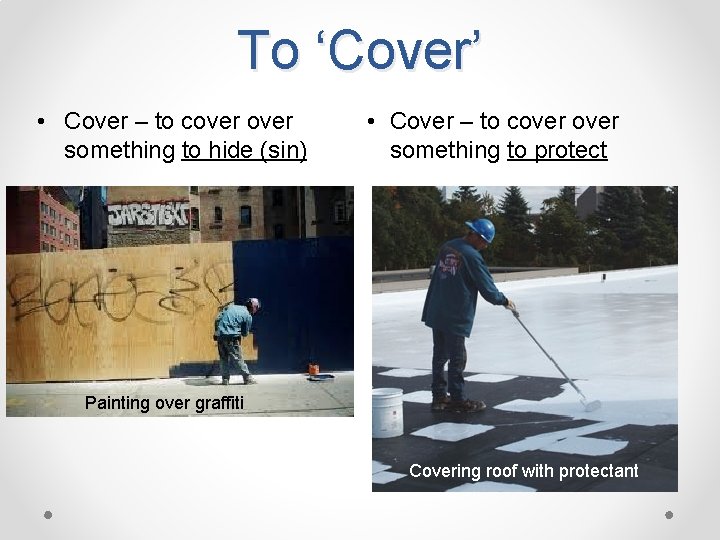
To ‘Cover’ • Cover – to cover something to hide (sin) • Cover – to cover something to protect Painting over graffiti Covering roof with protectant
![‘Coverture’ • Coverture: [noun] 1. a cover or covering; shelter; concealment. 2. Law. the](http://slidetodoc.com/presentation_image_h/bea1a2b66856b5b6ad901d4b8c87c358/image-11.jpg "‘Coverture’ • Coverture: [noun] 1. a cover or covering; shelter; concealment. 2. Law. the")
‘Coverture’ • Coverture: [noun] 1. a cover or covering; shelter; concealment. 2. Law. the status of a married woman considered as under the protection of her husband. • 1750’s – late 1800’s o Women and children under father/husbands covering o Had to go through the father/husband in order to get to the wife or children o A married woman was unable to be sued (she had the status of one having ‘diplomatic immunity’). o Doesn’t our Father (YHWH) provide & protect us? Current day- definition of coverture has changed… Reference: Frank Houtz “Kippor, a different kind of covering”
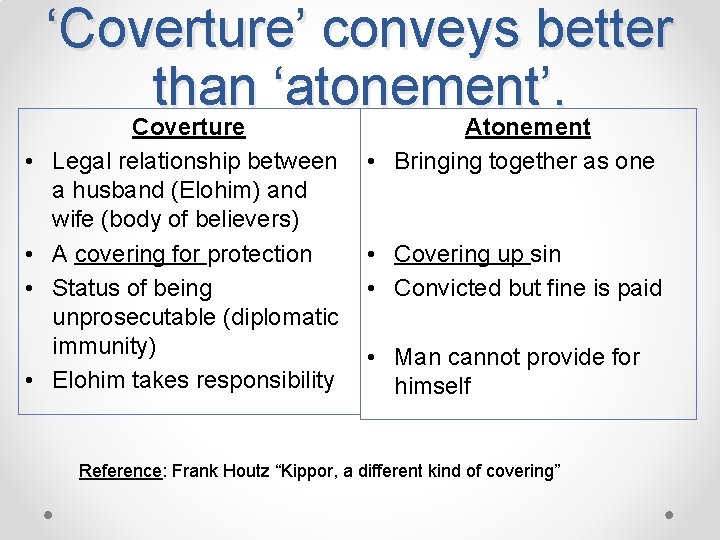
‘Coverture’ conveys better than ‘atonement’. • • Coverture Legal relationship between a husband (Elohim) and wife (body of believers) A covering for protection Status of being unprosecutable (diplomatic immunity) Elohim takes responsibility Atonement • Bringing together as one • Covering up sin • Convicted but fine is paid • Man cannot provide for himself Reference: Frank Houtz “Kippor, a different kind of covering”
Yom Kippur • Atonement covers one aspect: the coming together as one. Coverture is a more appropriate term. Coverture deals more with the relationship between a man (Father/Husband a woman (Child/Wife) where the father/husband ‘covers’ his wife (and family) from any harm or wrongdoing. Our Heavenly Father ‘covers’ us in this same way. • Why is the day of ‘atonement’ the holiest day of the year? o Is it because it declares your incapability ? o Or is Elohim declaring His responsibility in providing for you ! Reference: Frank Houtz “Kippor, a different kind of covering”
High Priestly Duties on Yom Kippur • Lev 16: 6 “And Aharon shall bring the bull as a sin offering, which is for himself, and make atonement for himself and for his house. • The High Priest would sacrifice the bull to ‘purge’ the Temple from any defilements caused by misdeeds of the Priest and of his household.
High Priestly Duties on Yom Kippur • Lev 16: 7 “And he shall take the two goats and let them stand before יהוה at the door of the Tent of Meeting. • Lev 16: 8 “And Aharon shall cast lots for the two goats, one lot for יהוה and the other lot for Azazel. • One of the goats is chosen by lot by the High Priest to be sacrificed to ‘purge’ the Holy Temple of any defilement by the misdeeds of the Israelite people. • The 2 nd goat, ‘Azazel’, is sent away into the wilderness to cleanse the people themselves.
High Priestly Duties on Yom Kippur • Before ‘Azazel’ is sent away into the wilderness, the High Priest lays both his hands upon the head of the goat and confesses over it all the transgressions and iniquities of the Israelite people… and so the Priest ‘transfers’ the sins of the people onto the head of the goat. • Lev 16: 22 And the goat shall bear upon him all their iniquities unto a land not inhabited: and he shall let go the goat in the wilderness.
Yom Kippur in Temple Times • Was performed exclusively by the High Priest himself • The High Priest (HP) alone is responsible for every aspect of the divine service on Yom Kippur. A total of 15 separate sacrifices were offered including the services concerning the menorah, incense, and other services. • There was a backup ‘High Priest’ in the event that the first HP could not fulfill his duties • On the morning of Yom Kippur, the HP would perform his 1 st of 5 required immersions located at the water gate
Yom Kippur in Temple Times • During the Yom Kippur (YK) services, the HP would exchange the Priestly garments for only white garments. • HP would make 3 separate offerings of incense o 2 upon the golden incense altar o 1 within the holy of holies • HP would offer a bull for a sin offering for himself and his household. • HP would take two male goats and offer one (drawn by lot) for a sin offering and the other one to make atonement upon it and send it out into the wilderness as the scapegoat (azazel).
Yom Kippur in Temple Times • HP would take incense, a firepan of coals from the altar, and the blood of the bull (repeated again later with the blood of the goat) and bring it into the holy of holies to sprinkle the blood on and in front of the mercy seat seven times. (The incense would cover the mercy seat with smoke). • HP would make atonement for the altar that is before YHWH with the blood of the bull and the goat to cleanse it from the impurities of the sons of Israel. • Once the HP finishes atoning for the holy place, tent of meeting, and altar, he presents the live goat (azazel).
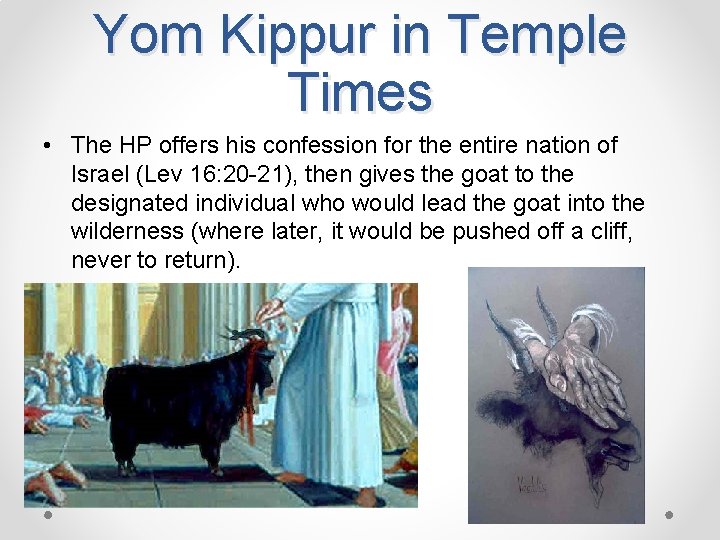
Yom Kippur in Temple Times • The HP offers his confession for the entire nation of Israel (Lev 16: 20 -21), then gives the goat to the designated individual who would lead the goat into the wilderness (where later, it would be pushed off a cliff, never to return).
• Yom Kippur in Temple Times The Scapegoat has parallels in the ANE: • Two of the Ebla tablets written between about 2500 and 2250 BCE in what is now Syria describe rituals to prepare a woman to marry the king of Ebla, one of which parallels those of the scapegoat in Leviticus 16: 7– 22. The tablets describe that to prepare for her wedding to the king, the woman hung the necklace of her old life around the neck of a goat and drove it into the hills of Alini, "Where it may stay forever. “ [1] • [1] Victor H. Matthews and Don C. Benjamin. "Ebla Archives. " In Old Testament Parallels: Laws and Stories from the Ancient Near East, page 260. New York: Paulist Press, Revised and Expanded Third Edition, 2006. ISBN 0 -8091 -4435 -2.
• Yom Kippur in Temple Times Once news has been received that Azazel wasn’t coming back, the High Priest descends to the Women's Court and reads aloud from the book of Leviticus (chapter 16, the reading for Yom Kippur) before the congregation. • Afterwards, "The bull and goat presented as sin-offerings, the blood of which was brought into the Sanctuary to make atonement, shall be taken outside the camp. " (Leviticus 16: 27) • The two offerings are taken out of the gate of Jerusalem to the site known as "the Place of the Ashes. “ • At the conclusion of the service, the High Priest gives the two sets of white vestments he has worn for the morning and afternoon services, over to his assistants, who dispose of them in the Chamber of Pinchas, a storeroom for priestly garments.
• Yom Kippur in Temple Times Lastly, the HP will bathe his body in water in a holy place and then put on his clothes (High Priestly garments) and offer the burnt offerings of those listed in Numbers 29: 7 -11 • Num 29: 7 -11 And ye shall have on the tenth day of this seventh month an holy convocation; and ye shall afflict your souls: ye shall not do any work therein: But ye shall offer a burnt offering unto the LORD for a sweet savour; one young bullock, one ram, and seven lambs of the first year; they shall be unto you without blemish: And their meat offering shall be of flour mingled with oil, three tenth deals to a bullock, and two tenth deals to one ram, A several tenth deal for one lamb, throughout the seven lambs: One kid of the goats for a sin offering; beside the sin offering of atonement, and the continual burnt offering, and the meat offering of it, and their drink offerings.
Leviticus 16 • Lev 16: 1 Begins with the death of Nadav & Avihu… Why? • Only ONE way to approach YHWH • Only ONE day of the year could the HP and ONLY the HP enters the Holy of Holies- not just any time • YHWH’s way- the ONLY way of Atonement. • Sacrifices made to YHWH ONLY by the High Priest, the appointed Mediator • Not following YHWH’s way could bring about DEATH
Shadow pictures- Lev 16 • The HP lays aside the ornate priestly garments – only wearing white undergarments, linen tunic, sash & turban. (Lev 16: 4) • Messiah Yahshua came to earth clothed in the flesh of man. The glory he had with the Father (John 17: 5) was set aside when he came in the likeness of a servant (Phil 2: 5) • The HP was required to wash his body in water prior to YK services- ritual purity. (Lev 16: 4) • Messiah Yahshua was pure- undefiled/untainted by the sin of Adam.
Shadow pictures- Lev 16 • HP chooses from ‘the congregation of the sons of Israel’ the animals to be sacrificed on Yom Kippur (Lev 16: 5) • Messiah Yahshua, the ultimate sacrifice, would come from among the people of Israel (John 11: 45 -52) • HP begins by offering the bull of purification for himself and his family (Lev 16: 6). He was not qualified to effect the ultimate atonement- he needed atonement. • Messiah Yahshua offered himself as atonement- for he was pure and without need for atonement (Heb 7: 27)
Shadow pictures- Lev 16 • HP presents 2 goats before YHWH at the doorway of the tent of meeting (Lev 16: 7). HP will draw lots, one goat designated L’YHWH (for YHWH) and one goat designated L’AZAZEL (for Azazel) (16: 8). • “And Aharon shall bring the goat on which the lot for יהוה fell, and shall prepare it as a sin offering. (16: 9) • Likewise, Messiah Yahshua was treated as a sin offering: 1 Cor 5: 21 “For He made Him who knew no sin to be sin for us, so that in Him we might become the righteousness of Elohim. ”
L’YHWH – L’AZAZEL • What spiritual application can we conclude from these two goats? • The death of the sacrificial animal (goat for YHWH) speaks to the payment for sin (justification = declared not guilty) • The carrying away of sin by the live goat (AZAZEL) speaks to a renewed life of holiness (sanctification). • The payment for sin is not enough- YHWH intends to redeem a people who are transformed into a righteous dwelling fit for the Kingdom of Elohim. 2 Cor 6: 16; Eze 37: 24 -28
Shadow pictures- Lev 16 • (Lev 16: 21) Interestingly, even though the High Priest ‘transfers’ the impurities of Israel by laying his hands upon the head of the goat (Azazel), he himself does not contract impurity. The designated individuals – the one who burns the remains of the sacrificial animals outside the camp (to the clean place) and the other person who leads the scapegoat (Azazel) into the wilderness both become ‘unclean’ and need to ‘mikveh’ before returning to the camp…but the High Priest remains ‘clean’. • Even though Yahshua (our High Priest) carried our sins upon himself in order to make atonement for us, he remained without sin himself.
• (Lev 16: 27) The hides, flesh, and refuse of the bull and goat of the sin offering whose blood was brought in to make atonement were taken to a clean place ‘outside the camp’. (In Temple times, the Miphkad altar located on the Mt. of Olives) • What is the writer of Hebrews conveying in Hebrews Ch. 13? • Heb 13: 10 -13 We have an altar (Miphkad), whereof they have no right to eat which serve the tabernacle. For the bodies of those beasts, whose blood is brought into the sanctuary by the high priest for sin, are burned without (outside) the camp. Wherefore Yahshua also, that he might sanctify the people with his own blood, suffered without (outside) the gate. Let us go forth therefore unto him without (outside) the camp, bearing his reproach. (emphasis mine)
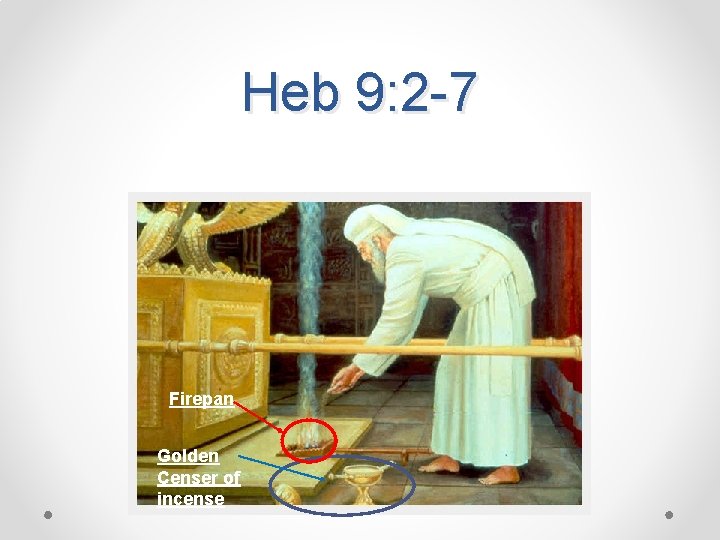
Heb 9: 2 -7 Firepan Golden Censer of incense
Lev 16 & Revelation • Smoke (incense) and Fire in the Temple of YHWH before the Mercy Seat: • Lev 16: 13: And he shall put the incense upon the fire before the LORD, that the cloud of the incense may cover the mercy seat that is upon the testimony, that he not die: • Rev 15: 8: And the temple was filled with smoke from the glory of God, and from his power; and no man was able to enter into the temple, till the seven plagues of the seven angels were fulfilled. • Rev 8: 3 -4: The incense before YHWH = prayers of the saints
Lev 16 & Revelation • No man could enter the tent of meeting while the HP made atonement. • Lev 16: 17: “And there shall be no man in the tabernacle of the congregation when he goeth in to make an atonement in the holy place, until he come out, and have made an atonement for himself, and for his household, and for all the congregation of Israel. ” • Rev 15: 8: No one could enter the Temple until the seven last plagues were finished- there was no access to the mercy seat during this time.
Lev 16 & Revelation • The Mercy seat and the ground were sprinkled seven times for cleansing. • Lev 16: 14: “And he shall take of the blood of the bullock, and sprinkle it with his finger upon the mercy seat eastward; and before the mercy seat shall he sprinkle of the blood with his finger seven times. ” • Rev 16: YHWH cleanses the earth through the seven bowl judgments (the ‘Wrath of YHWH’). • Why is the earth cleansed? The soul that sins shall die (Ezekiel 18: 4) and the wages of sin is death (Rom 6: 23). Man is held accountable for his own sin and either suffers the consequences of his sin or receives the atonement of the blood of Yahshua for the remission of sins.
YK- Valid Today? • Currently, the altar and Temple are not standing in Jerusalem (destroyed in 70 AD) but we should “setapart” these days in honor of Yahweh our Elohim. Our motive in celebration should be as Elohim originally intended, to remember and honor Yahweh that He is our Creator and our Elohim. Our desire should be to draw close to Him through “relationship”, not “man-made religion”. Yahweh said that His feasts were to be celebrated Forever (Leviticus 23)! Yahweh does not change (Malachi 3: 6) and therefore He still desires for us to worship him through love and obedience. Throughout scripture, Yahweh desires obedience over that of animal sacrifice.
YK- Valid Today? • “For I desired mercy, and not sacrifice; and the knowledge of God more than burnt offerings. ” (Hosea 6: 6) • “But go ye and learn what that meaneth, I will have mercy, and not sacrifice: for I am not come to call the righteous, but sinners to repentance. “ (Matthew 9: 13) • “But I say unto you, That in this place is one greater than the temple. But if ye had known what this meaneth, I will have mercy, and not sacrifice, ye would not have condemned the guiltless. ” (Matt 12: 6 -7) • “He hath shewed thee, O man, what is good; and what doth the LORD require of thee, but to do justly, and to love mercy, and to walk humbly with thy God? ” (Micah 6: 8) • “Let my prayer be set forth before thee as incense; and the lifting up of my hands as the evening sacrifice. ” (Psalm 141: 2 by David)
YK- Valid Today? • Even though the temple is not standing in Jerusalem, we are to be a living sacrifice to Yahweh through love and obedience to Him and to His word. Yahweh has always wanted love and obedience from his people. Abraham was one of those who believed and obeyed Yahweh: • “Because that Abraham obeyed my voice, and kept my charge, my commandments, my statutes, and my laws. ” (Genesis 26: 5). “And the scripture was fulfilled which saith, Abraham believed God, and it was imputed unto him for righteousness: and he was called the Friend of God. “ (James 2: 23).
YK- Valid Today? • Observing these Feasts is a dress rehearsal for us (as the bride) while we wait for the return of our “bridegroom”, Messiah Yahshua! It is also recorded in scripture that in the future we will still be honoring Yahweh’s feast days: (See Zechariah Chapter 14 and Ezekiel Chapter 45). • One important point to remember is that these “Feasts” were and are “The Feasts of Yahweh”. ALL people who identify with the Elohim of Abraham, Isaac, and Jacob are instructed to keep these Feast days and Holy convocations!
YK- Valid Today? • “One ordinance shall be both for you of the congregation, and also for the stranger that sojourneth with you, an ordinance forever in your generations: as ye are, so shall the stranger be before the LORD. One law and one manner shall be for you, and for the stranger that sojourneth with you. ” (Numbers 15: 15 -16) • “Ye shall have one manner of law, as well for the stranger, as for one of your own country: for I am the LORD your God. ” (Leviticus 24: 22) • “One law shall be to him that is homeborn, and unto the stranger that sojourneth among you. ” (Exodus 12: 49)
YK- Valid Today? • Mat 5: 17 -18 “Think not that I am come to destroy the law (Torah), or the prophets: I am not come to destroy, but to fulfil (Fill up with meaning). For verily I say unto you, Till heaven and earth pass, one jot or one tittle shall in no wise pass from the law, till all be fulfilled. ” • Remember, these are the words of our Messiah. The one who died for our sins… Yours and Mine. Is the earth still standing? Then the Law (Torah), along with the “Feast days of Yahweh” are likewise STILL IN EFFECT!
- Slides: 40