
Leukoplakia Dr Maji Jose LEUKOPLAKIA Leuko white Plakia

- Slides: 28
Leukoplakia Dr. Maji Jose
LEUKOPLAKIA • • Leuko- white, Plakia – patch Leukoplakia – white patch Its most common precancerous lesion Color results from – a thickened layer of surface keratin – and a thickened spinous layer Schwimmer first used this term Leukoplakia (Leukokeratosis) in 1877 to describe a white plaque on the tongue. Dr. Maji Jose
Since 1980, World Health Organization has changed the definition of leukoplakia as follows: • 1) A white patch or plaque that cannot be characterized clinically or histologically as any other disease. • 2) A predominantly white lesion of the oral mucosa that cannot be characterized as any other definable lesion. • 3) A white plaque of questionable risk having excluded (other) known disease or disorders that carry no increased risk for cancer. Dr. Maji Jose
LEUKOPLAKIA • Diagnosis is by exclusion of other white definable lesions • Considered a premalignant lesion although dysplasia or invasive carcinoma is found in only 5%-25% of biopsy samples Dr. Maji Jose
Etiology – Cause of leukoplakia is unknown Suggested etiological factors are – 1. Tobacco: – used in two forms • smoking of beedi or cigarette, • smokeless tobacco mainly chewing or use of snuff. • Both smoking and smokeless tobacco predisposes to Leukoplakia. • Chemical constituents of tobacco (tobacco specific nitrosamines)and combustion products such as tars and resins are irritable to mucosa and are carcinogenic. • In case of smoking, heat generated also ads to the dangerous effect of chemicals. Dr. Maji Jose
• This is considered because of following reasons – – 80% of leukoplakia patients are smokers – smokers have 60% more chances of developing Leukoplakia than non smokers – Heavy smokers develop Leukoplakia than light smokers – Discontinuing of habit showed regression of lesions Dr. Maji Jose
2. Alcohol: – not directly associated with leukoplakia – but has a synergistic effect with tobacco relative to oral cancer production – Difficult to assess the effect of alcohol alone because most of the alcoholics are smokers. – Alcohol may be contributing by increasing the permeability of mucosa to enhance the entry of chemicals released from tobacco Dr. Maji Jose
3. Microorganisms: • Bacteria- Treponema pallidum - tertiary syphilis, dorsal tongue • Fungus - Candida albicans - candidal leukoplakia • Viruses - Human papilloma virus (HPV) types 16 and 18 and HVH-1 (Herpes homonis type 1) and Dr. Maji Jose
• 4. Trauma – Chronic irritation from a sharp tooth or an ill fitting dentures were thought to cause leukoplakia. • However recent research shows that these lesions have to be diagnosed as only frictional keratosis Dr. Maji Jose
5. Vitamin deficiency – Vitamin A – – causes metaplasia & keratinization – supplementation of vit. A leads to regression of leukoplakic lesions Vit. B complex – causes alteration in oxidation pattern of epithelium and make it more susceptible to irritation. Dr. Maji Jose
6. Hormones – sex hormonesbecause of keratogenic effect. 7. Galvanism 8. Ultraviolet radiation: lower lip vermilion 9. Sanguinaria: herbal extract found in toothpaste or mouth rinses; maxillary vestibule or maxillary alveolar mucosa 10. Idiopathic: (Cryptogenic Leukoplakia) leukoplakia are seen without any etiology. They have a higher malignant potential. Dr. Maji Jose
Clinical features • Adults > 40 years of age; • M > F (70%) • 70% of cases are found on the lip vermilion, buccal mucosa, and gingiva • Tongue, lip vermilion, and floor of the mouth lesions account for 90% of cases that show dysplasia or carcinoma Dr. Maji Jose
• homogeneous leukoplakia Two main clinical variants of • nonhomogeneous leukoplakia are recognized: – speckled leukoplakia (red and white but predominantly white) – erythroleukoplakia (red and white but probably not predominantly white) – nodular leukoplakia, – verrucous leukoplakia, – proliferative verrucous leukoplakia Dr. Maji Jose
Clinical Classification • Homogeneous (uniformly white lesions) - Smooth - Furrowed / fissured - Ulcerated • Non homogeneous / speckled (raised white areas with red areas) Dr. Maji Jose
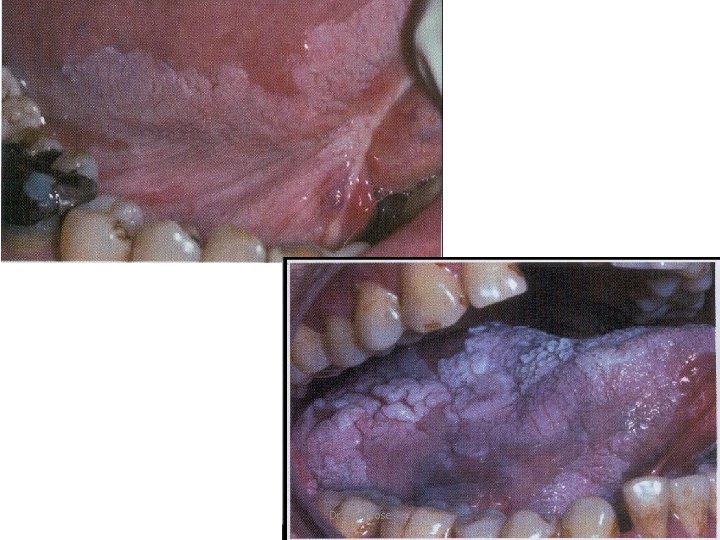
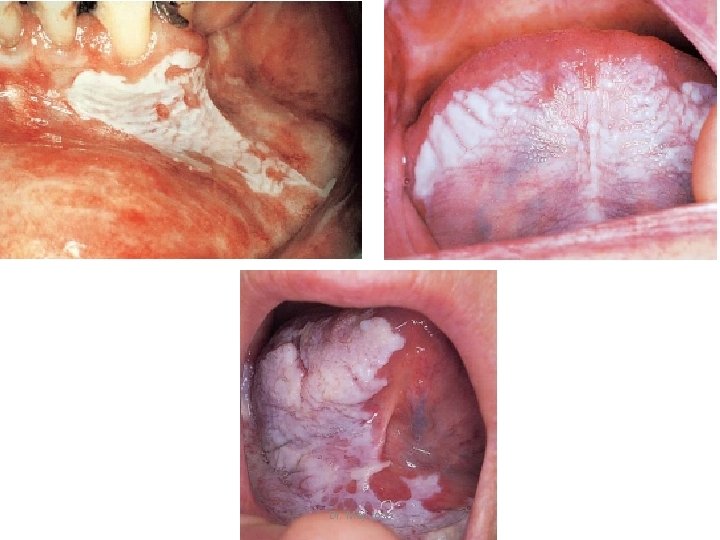
• Homogenous – Smooth & fissured • Homogenous – Ulcerated • Non Homogenous – Nodulo-speckled Dr. Maji Jose
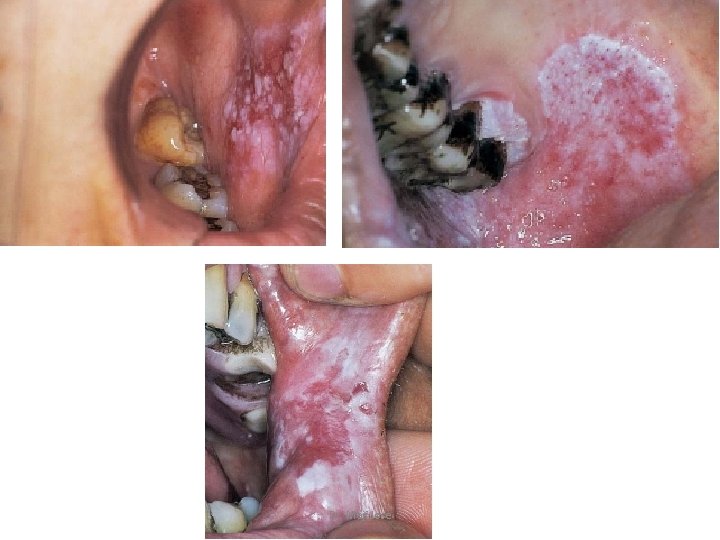
• Homogenous leukoplakia: It presents a consistent pattern throughout and may be a localized or an extensive white patch. The surface of this may be wrinkled or corrugated. • Non Homogenous leukoplakia/ Speckled/nodular/Granular - a mixed red and white pattern is seen in which small keratotic nodules are scattered over a red patch of the mucosa • Verrucous leukoplakia: In this type the lesion is made up of multiple papillary projections which are heavily keratinized. Dr. Maji Jose
Clinical appearance • Varies in different lesions • Changes over time Dr. Maji Jose
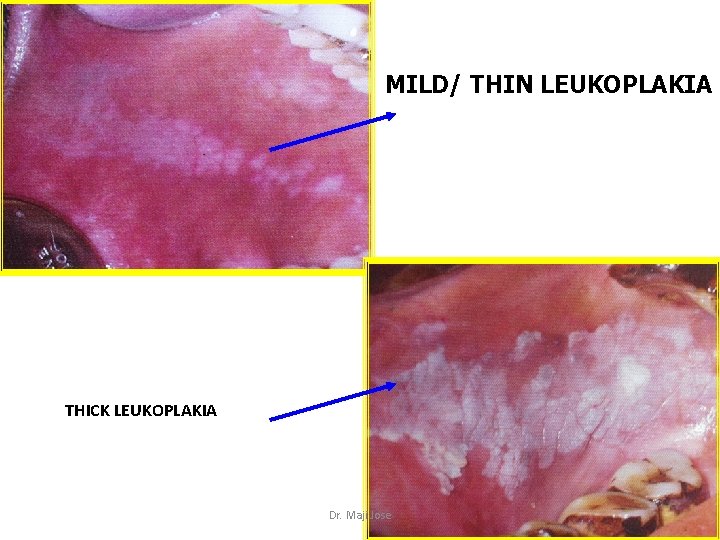
Thin leukoplakia/ early mild leukoplakia – Slightly elevated, well demarcated, soft , flat, transparent, gray/ grayish white plaque may be with wrinkled surface. – May disappear or progress further ( 2/3 rd progress if habits continued). Dr. Maji Jose
Thick leukoplakia/ homogenous leukoplakia – Thick distinctly white lesion, leathery on palpation. – May have smooth or slightly irregular surface – One third of thick leukoplakia may regress, remaining progress further Dr. Maji Jose
Granular or nodular leukoplakia – some of the thick leukoplakia develop irregular elevations on the surface & are termed as Granular or nodular leukoplakia. Dr. Maji Jose
Verrucous leukoplakia • some of the thick leukoplakia develops irregular, sharp or blunt projections Dr. Maji Jose
Speckled leukoplakia (erythroleukoplakia) – Homogenous leukoplakia lesions may progress further & develop some red spots scattered between white areas – Red spots are due to immature epithelium which is unable to produce keratin Dr. Maji Jose
MILD/ THIN LEUKOPLAKIA THICK LEUKOPLAKIA Dr. Maji Jose
Dr. Maji Jose
Dr. Maji Jose
Dr. Maji Jose
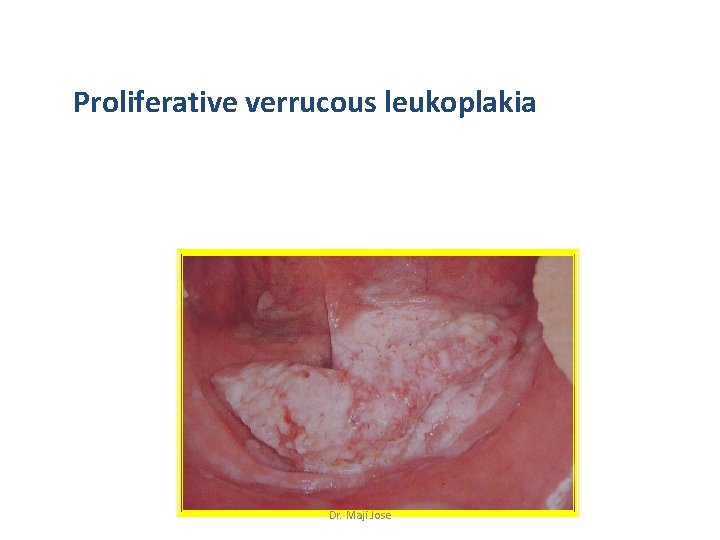
Proliferative verrucous leukoplakia - described by Hansen etal in 1985 • Strong female predilection (4: 1) • Multiple keratotic plaques with roughened surface projections • Spreads slowly and involves multiple oral sites • Eventually develops into dysplasia, verrucous carcinoma, and squamous cell carcinoma Dr. Maji Jose
Proliferative verrucous leukoplakia Dr. Maji Jose