
Letters Sounds Phonics Workshop for Parents Sue Gallagher
- Slides: 15
Letters & Sounds Phonics Workshop for Parents Sue Gallagher September 2020
What is Phonics? Why do we teach Phonics discretely? • Phonics: ‘our ability to hear, say and recognise the component sounds of language so they can be used in conversation, reading and writing. ’ • ‘Letters and Sounds’ programme which is a Government initiated programme consisting of letter sounds being taught in phases, not alphabetical order, we start with Phase 2. • Focus is on letter sounds not letter names as these are the building blocks of words that children use when learning to read and write.
Phonemes and Graphemes • We teach the sounds ‘phonemes’, most of which are represented by a different letter or ‘grapheme’ • Important that you demonstrate using sounds in their ‘pure’ form when working on phonics activities for accurate blending/segmenting http: //www. youtube. com/watch? v=5 J 2 Ddf_0 Om 8&feature=re lated (to 2: 00)
‘Blending’ and ‘Segmenting’ • We start with 19 phonemes that can be blended to form simple VC and CVC words e. g c/a/t and a/t. We call these words decodable i. e. they can be sounded out. • ‘Blending’ – combining phonemes to produce words Skill for reading unfamiliar words e. g. c-a-t = ‘cat’ by blending the 3 phonemes • ‘Segmenting’ – breaking words down into their constituent sounds Skill for writing unfamiliar words e. g. ‘man’ = m-a-n https: //www. youtube. com/watch? v=PAbht. D 5 at. I 0
Tricky Words • We teach high frequency ‘common’ words that are decodable e. g am, an, up • But some high frequency ‘common’ words are not decodable and they need to be taught by sight e. g the, I, to, go. We call these ‘Tricky Words’ • https: //central. espresso. co. uk/espresso/primary_uk/subject/ module/video/item 82459/gradef/module 61932/index. html
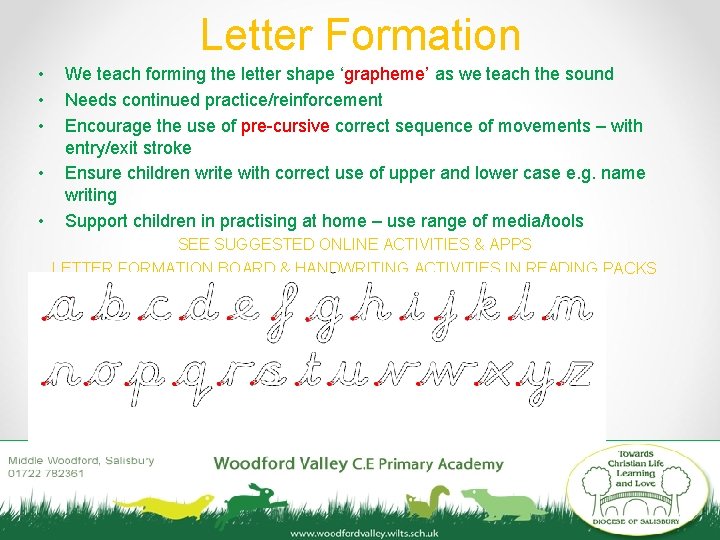
Letter Formation • • • We teach forming the letter shape ‘grapheme’ as we teach the sound Needs continued practice/reinforcement Encourage the use of pre-cursive correct sequence of movements – with entry/exit stroke Ensure children write with correct use of upper and lower case e. g. name writing Support children in practising at home – use range of media/tools SEE SUGGESTED ONLINE ACTIVITIES & APPS LETTER FORMATION BOARD & HANDWRITING ACTIVITIES IN READING PACKS
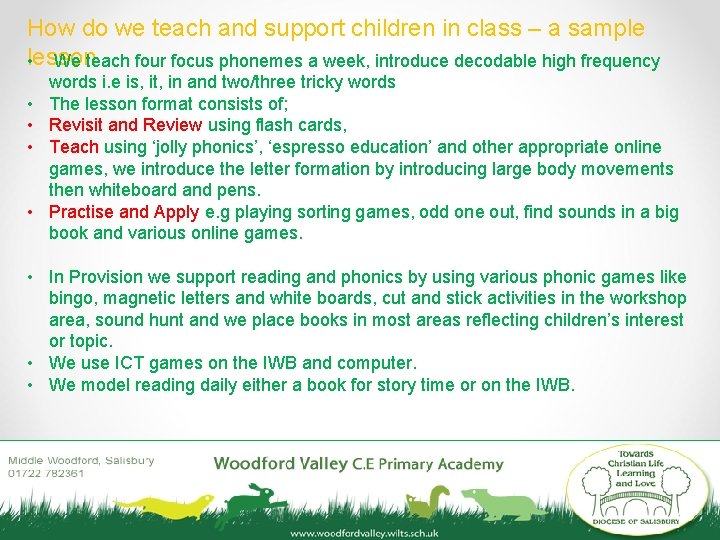
How do we teach and support children in class – a sample • lesson We teach four focus phonemes a week, introduce decodable high frequency • • words i. e is, it, in and two/three tricky words The lesson format consists of; Revisit and Review using flash cards, Teach using ‘jolly phonics’, ‘espresso education’ and other appropriate online games, we introduce the letter formation by introducing large body movements then whiteboard and pens. Practise and Apply e. g playing sorting games, odd one out, find sounds in a big book and various online games. • In Provision we support reading and phonics by using various phonic games like bingo, magnetic letters and white boards, cut and stick activities in the workshop area, sound hunt and we place books in most areas reflecting children’s interest or topic. • We use ICT games on the IWB and computer. • We model reading daily either a book for story time or on the IWB.
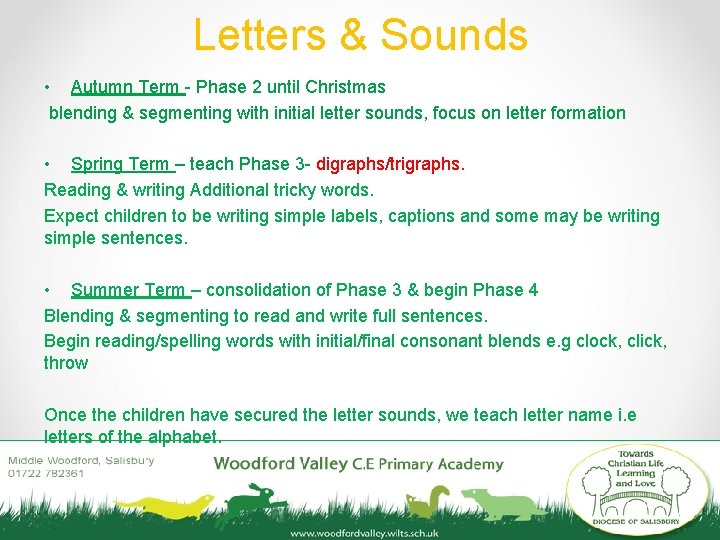
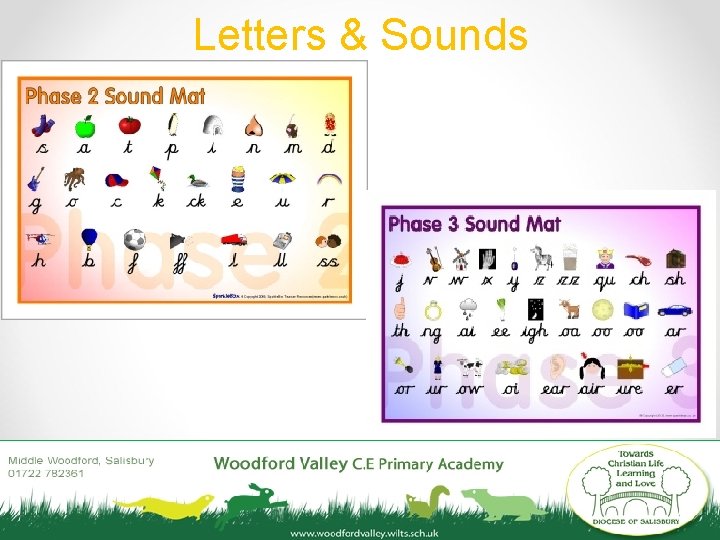
Letters & Sounds • Autumn Term - Phase 2 until Christmas blending & segmenting with initial letter sounds, focus on letter formation • Spring Term – teach Phase 3 - digraphs/trigraphs. Reading & writing Additional tricky words. Expect children to be writing simple labels, captions and some may be writing simple sentences. • Summer Term – consolidation of Phase 3 & begin Phase 4 Blending & segmenting to read and write full sentences. Begin reading/spelling words with initial/final consonant blends e. g clock, click, throw Once the children have secured the letter sounds, we teach letter name i. e letters of the alphabet.
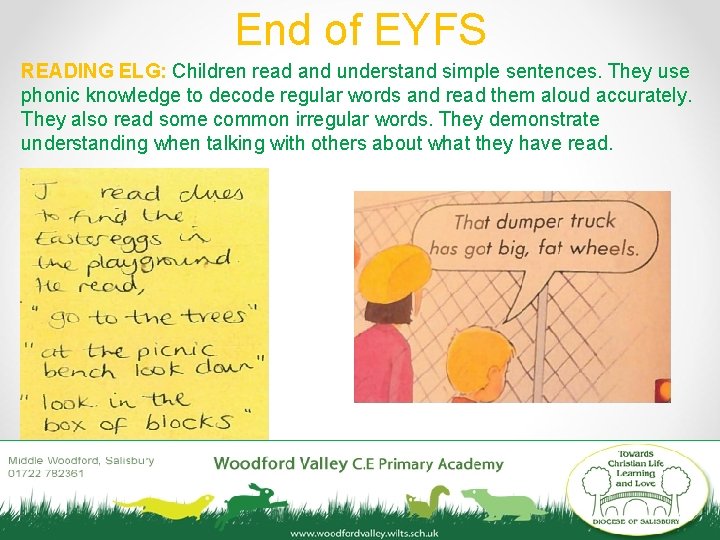
End of EYFS READING ELG: Children read and understand simple sentences. They use phonic knowledge to decode regular words and read them aloud accurately. They also read some common irregular words. They demonstrate understanding when talking with others about what they have read.
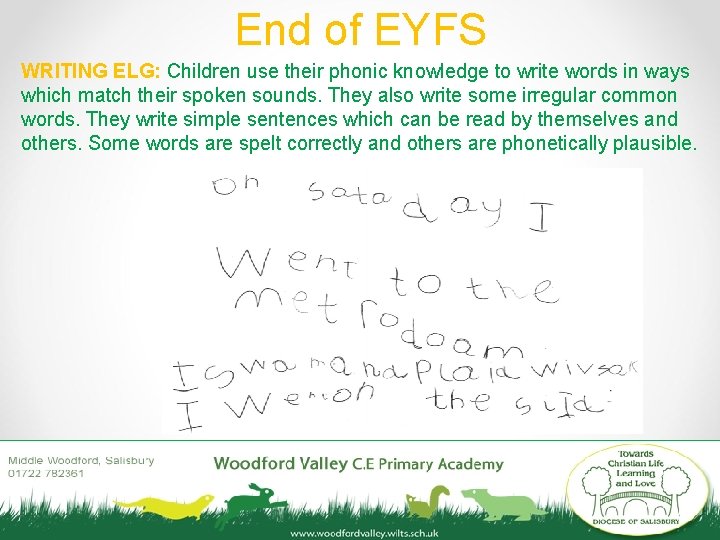
End of EYFS WRITING ELG: Children use their phonic knowledge to write words in ways which match their spoken sounds. They also write some irregular common words. They write simple sentences which can be read by themselves and others. Some words are spelt correctly and others are phonetically plausible.
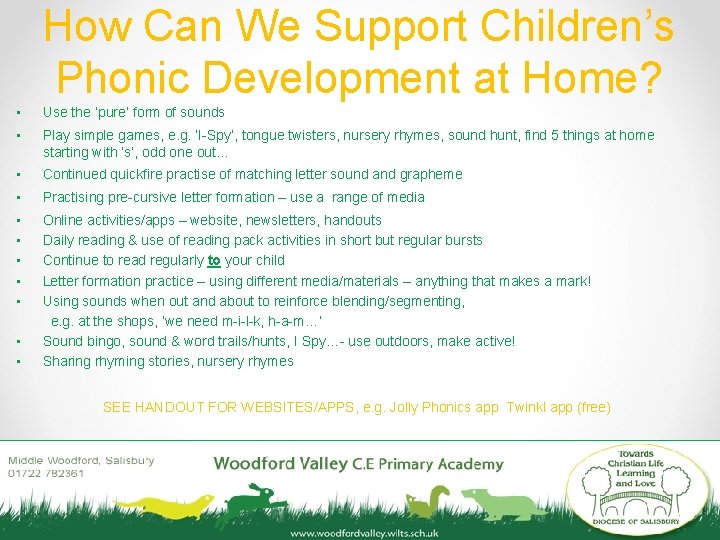
How Can We Support Children’s Phonic Development at Home? • Use the ‘pure’ form of sounds • Play simple games, e. g. ‘I-Spy’, tongue twisters, nursery rhymes, sound hunt, find 5 things at home starting with ‘s’, odd one out… • Continued quickfire practise of matching letter sound and grapheme • Practising pre-cursive letter formation – use a range of media • • • Online activities/apps – website, newsletters, handouts Daily reading & use of reading pack activities in short but regular bursts Continue to read regularly to your child Letter formation practice – using different media/materials – anything that makes a mark! Using sounds when out and about to reinforce blending/segmenting, e. g. at the shops, ‘we need m-i-l-k, h-a-m…’ Sound bingo, sound & word trails/hunts, I Spy…- use outdoors, make active! Sharing rhyming stories, nursery rhymes • • SEE HANDOUT FOR WEBSITES/APPS, e. g. Jolly Phonics app Twinkl app (free)
What Materials/Activities Will Be Sent Home? • Reading diary • Reading book – picture books to establish sequencing, storytelling, imagination, followed by text • ‘Tricky words’ – have to be learned by sight • Letter formation dry-wipe mats
Letters & Sounds
Reading Packs • We encourage you to visit each text more than once, use the book mark given to you for ideas on how to extend your child’s reading. • It is really important to continue to develop their storytelling skills, by encouraging children to retell stories, adding information from pictures, for example. • Developing their comprehension by talking about the characters, events, and making predictions/alternative endings is also important. • WE WILL CHECK READING DIARIES DAILY FOR NOTES/CORRESPONDENCE BUT WILL ONLY CHANGE BOOKS ONCE A WEEK- you will be given a day when it is your child’s turn to be heard to read and change their book.
Any Questions?