
Lets Talk About Water Quality COFOKLA June Meeting
Let’s Talk About Water Quality: COFOKLA June Meeting Scott Kishbaugh, P. E. Chief, Lake Monitoring and Assessment Section NYSDEC Division of Water NYS Department of Environmental Conservation
Why we (the state of New York) sample – Baseline water quality monitoring • • – In support of management WI-PWL, 106, 305(b), 303(d) Problem identification Trends evaluation 100% assessment • Fish stocking • TMDLs (development and post) • Lake management actions • Permit conditions – Water quality research • Development of water quality standards • Acid rain impacts • Fish kills • HABs – Public complaints or “incidents” • Fish kills • HABs • Invasive species NYS Department of Environmental Conservation 2
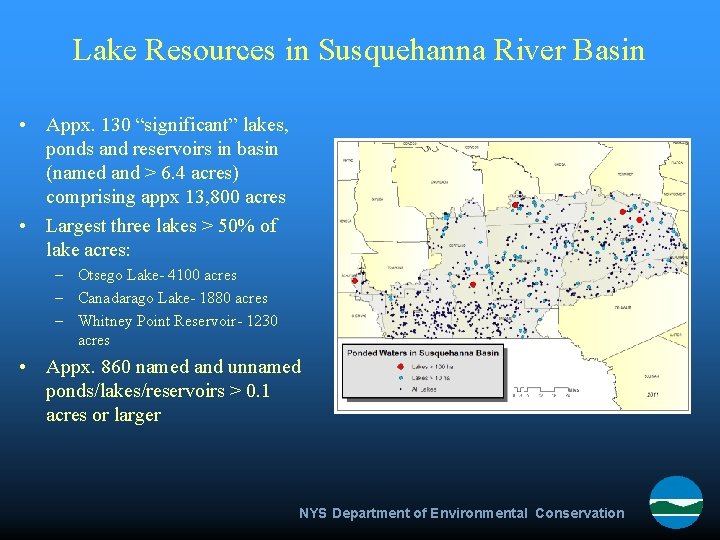
Lake Resources in Susquehanna River Basin • Appx. 130 “significant” lakes, ponds and reservoirs in basin (named and > 6. 4 acres) comprising appx 13, 800 acres • Largest three lakes > 50% of lake acres: – Otsego Lake- 4100 acres – Canadarago Lake- 1880 acres – Whitney Point Reservoir- 1230 acres • Appx. 860 named and unnamed ponds/lakes/reservoirs > 0. 1 acres or larger NYS Department of Environmental Conservation
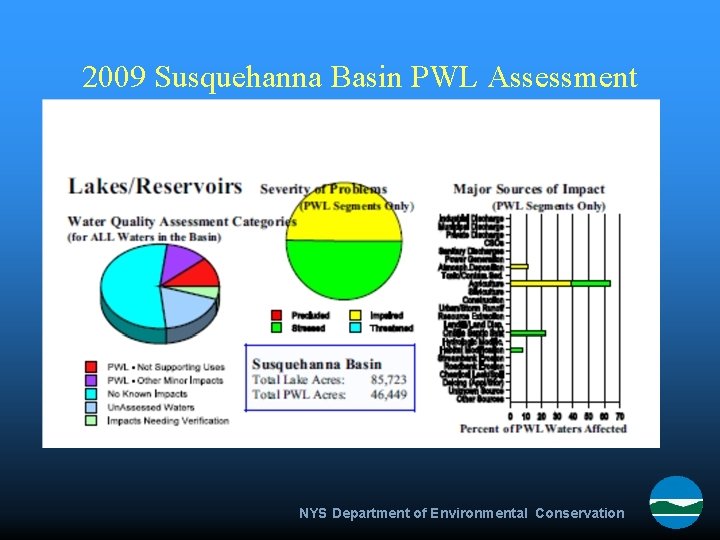
2009 Susquehanna Basin PWL Assessment NYS Department of Environmental Conservation
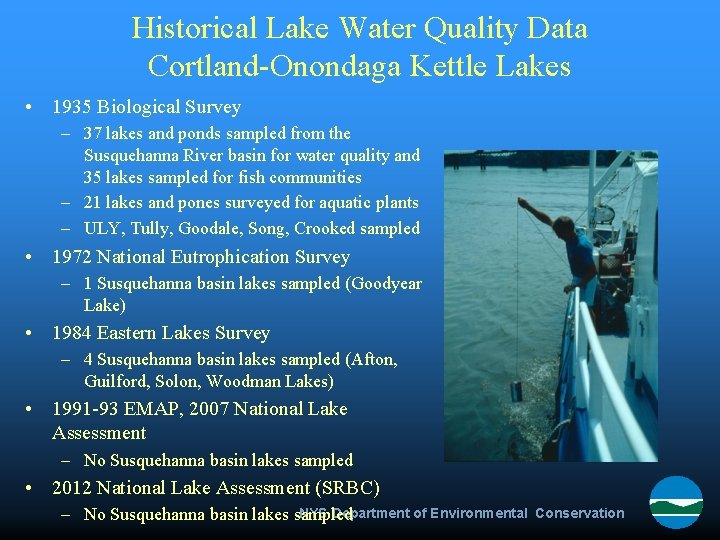
Historical Lake Water Quality Data Cortland-Onondaga Kettle Lakes • 1935 Biological Survey – 37 lakes and ponds sampled from the Susquehanna River basin for water quality and 35 lakes sampled for fish communities – 21 lakes and pones surveyed for aquatic plants – ULY, Tully, Goodale, Song, Crooked sampled • 1972 National Eutrophication Survey – 1 Susquehanna basin lakes sampled (Goodyear Lake) • 1984 Eastern Lakes Survey – 4 Susquehanna basin lakes sampled (Afton, Guilford, Solon, Woodman Lakes) • 1991 -93 EMAP, 2007 National Lake Assessment – No Susquehanna basin lakes sampled • 2012 National Lake Assessment (SRBC) NYS Department of Environmental – No Susquehanna basin lakes sampled Conservation
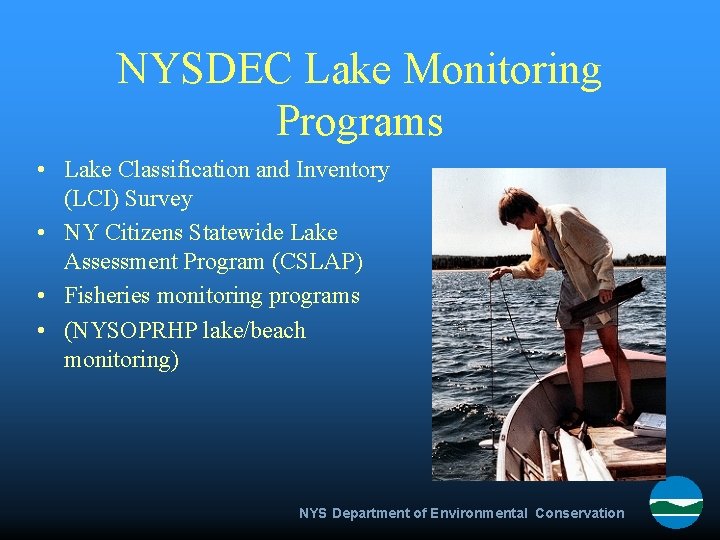
NYSDEC Lake Monitoring Programs • Lake Classification and Inventory (LCI) Survey • NY Citizens Statewide Lake Assessment Program (CSLAP) • Fisheries monitoring programs • (NYSOPRHP lake/beach monitoring) NYS Department of Environmental Conservation
LCI • DOW baseline monitoring program • LCI is the lakes equivalent to the RIBS program • Initially conducted 1976 and 1982 -1987 • Present LCI conducted since 1996 • Sampling conducted by DEC DOW staff from Albany and regional offices • 11 Susquehanna River basin lakes sampled at least 1 x though LCI in 1982 -2009 NYS Department of Environmental Conservation
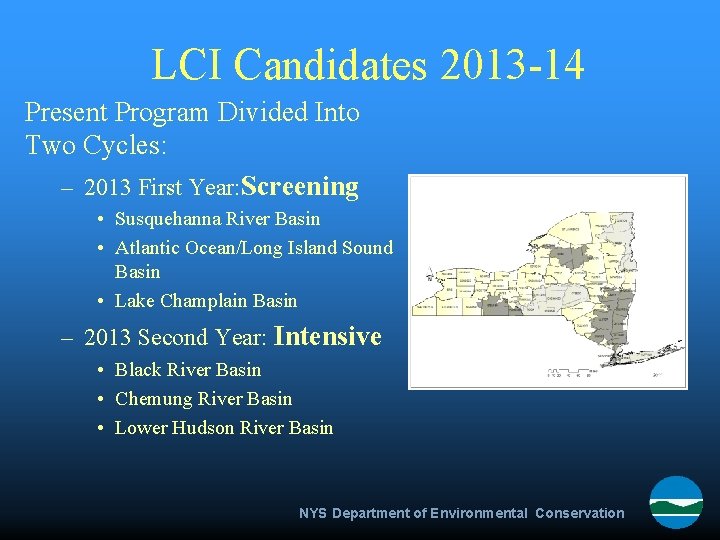
LCI Candidates 2013 -14 Present Program Divided Into Two Cycles: – 2013 First Year: Screening • Susquehanna River Basin • Atlantic Ocean/Long Island Sound Basin • Lake Champlain Basin – 2013 Second Year: Intensive • Black River Basin • Chemung River Basin • Lower Hudson River Basin NYS Department of Environmental Conservation
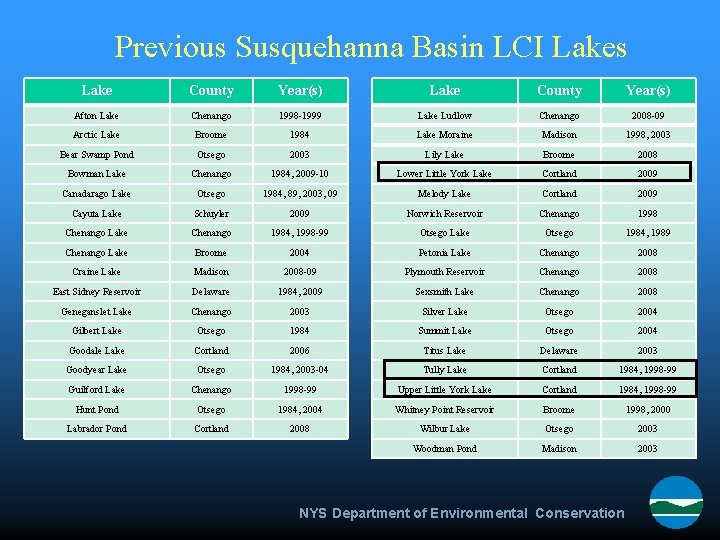
Previous Susquehanna Basin LCI Lakes Lake County Year(s) Afton Lake Chenango 1998 -1999 Lake Ludlow Chenango 2008 -09 Arctic Lake Broome 1984 Lake Moraine Madison 1998, 2003 Bear Swamp Pond Otsego 2003 Lily Lake Broome 2008 Bowman Lake Chenango 1984, 2009 -10 Lower Little York Lake Cortland 2009 Canadarago Lake Otsego 1984, 89, 2003, 09 Melody Lake Cortland 2009 Cayuta Lake Schuyler 2009 Norwich Reservoir Chenango 1998 Chenango Lake Chenango 1984, 1998 -99 Otsego Lake Otsego 1984, 1989 Chenango Lake Broome 2004 Petonia Lake Chenango 2008 Craine Lake Madison 2008 -09 Plymouth Reservoir Chenango 2008 East Sidney Reservoir Delaware 1984, 2009 Sexsmith Lake Chenango 2008 Geneganslet Lake Chenango 2003 Silver Lake Otsego 2004 Gilbert Lake Otsego 1984 Summit Lake Otsego 2004 Goodale Lake Cortland 2006 Titus Lake Delaware 2003 Goodyear Lake Otsego 1984, 2003 -04 Tully Lake Cortland 1984, 1998 -99 Guilford Lake Chenango 1998 -99 Upper Little York Lake Cortland 1984, 1998 -99 Hunt Pond Otsego 1984, 2004 Whitney Point Reservoir Broome 1998, 2000 Labrador Pond Cortland 2008 Wilbur Lake Otsego 2003 Woodman Pond Madison 2003 NYS Department of Environmental Conservation
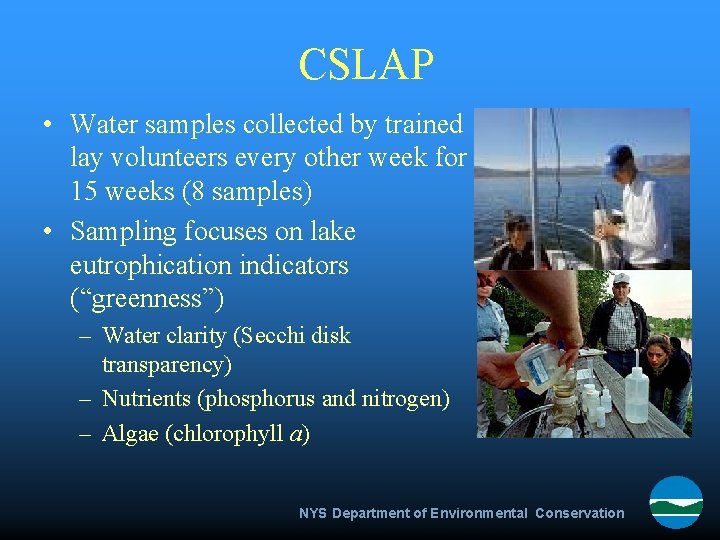
CSLAP • Water samples collected by trained lay volunteers every other week for 15 weeks (8 samples) • Sampling focuses on lake eutrophication indicators (“greenness”) – Water clarity (Secchi disk transparency) – Nutrients (phosphorus and nitrogen) – Algae (chlorophyll a) NYS Department of Environmental Conservation
CSLAP • Other water quality indicators: – Lake acidity (p. H) – Dissolved organics (“natural” color) – Dissolved ions (conductivity) – Susceptibility to zebra mussels (calcium) – Potable water indicators (iron, manganese, ammonia, arsenic) – Lake perception – Algal toxins (SUNY ESF and NYSDOH studies) • Aquatic plant identifications • Special studies on select lakes – Shoreline/riparian zone survey – Zebra mussel survey (drop a brick) – Lake level / ice-in/out evaluations – Angler survey – Boater survey NYS Department of Environmental Conservation
CSLAP • Candidate lakes chosen by NYS Federation of Lake Associations (NYSFOLA) • 23 Susquehanna River basin lakes have been sampled through CSLAP • 18 basin lakes will be sampled through CSLAP in 2013 NYS Department of Environmental Conservation
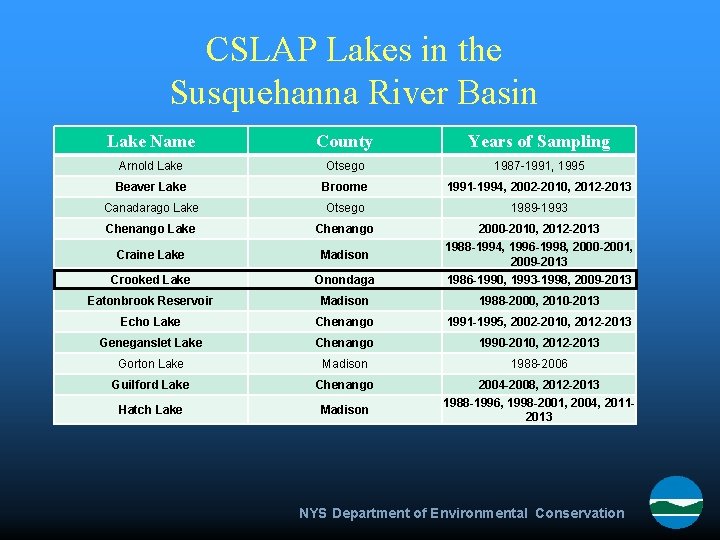
CSLAP Lakes in the Susquehanna River Basin Lake Name County Years of Sampling Arnold Lake Otsego 1987 -1991, 1995 Beaver Lake Broome 1991 -1994, 2002 -2010, 2012 -2013 Canadarago Lake Otsego 1989 -1993 Chenango Lake Chenango 2000 -2010, 2012 -2013 Craine Lake Madison 1988 -1994, 1996 -1998, 2000 -2001, 2009 -2013 Crooked Lake Onondaga 1986 -1990, 1993 -1998, 2009 -2013 Eatonbrook Reservoir Madison 1988 -2000, 2010 -2013 Echo Lake Chenango 1991 -1995, 2002 -2010, 2012 -2013 Geneganslet Lake Chenango 1990 -2010, 2012 -2013 Gorton Lake Madison 1988 -2006 Guilford Lake Chenango 2004 -2008, 2012 -2013 Hatch Lake Madison 1988 -1996, 1998 -2001, 2004, 20112013 NYS Department of Environmental Conservation
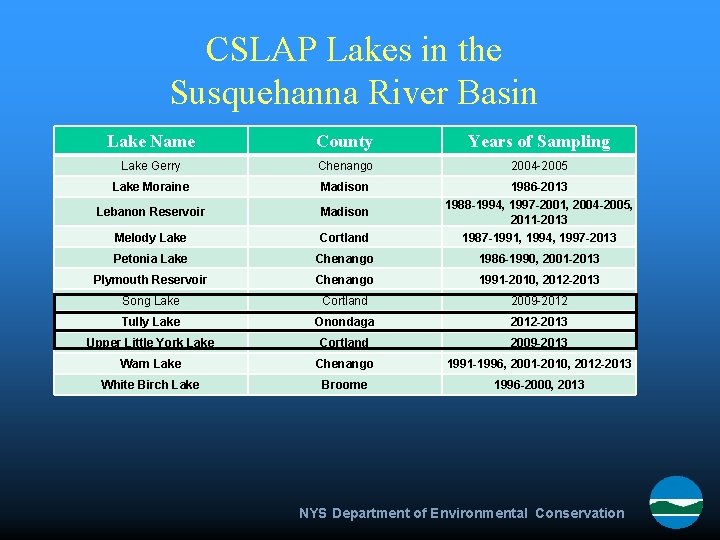
CSLAP Lakes in the Susquehanna River Basin Lake Name County Years of Sampling Lake Gerry Chenango 2004 -2005 Lake Moraine Madison 1986 -2013 Lebanon Reservoir Madison 1988 -1994, 1997 -2001, 2004 -2005, 2011 -2013 Melody Lake Cortland 1987 -1991, 1994, 1997 -2013 Petonia Lake Chenango 1986 -1990, 2001 -2013 Plymouth Reservoir Chenango 1991 -2010, 2012 -2013 Song Lake Cortland 2009 -2012 Tully Lake Onondaga 2012 -2013 Upper Little York Lake Cortland 2009 -2013 Warn Lake Chenango 1991 -1996, 2001 -2010, 2012 -2013 White Birch Lake Broome 1996 -2000, 2013 NYS Department of Environmental Conservation
So what does this data tell us? • Most WQ monitoring programs focus on key indicators – Eutrophication indicators – “Habitat” indicators – Presence of invasive species • All WQ data should be evaluated in context – Location (location, location…) – “Designated” use – Water quality standards/criteria NYS Department of Environmental Conservation
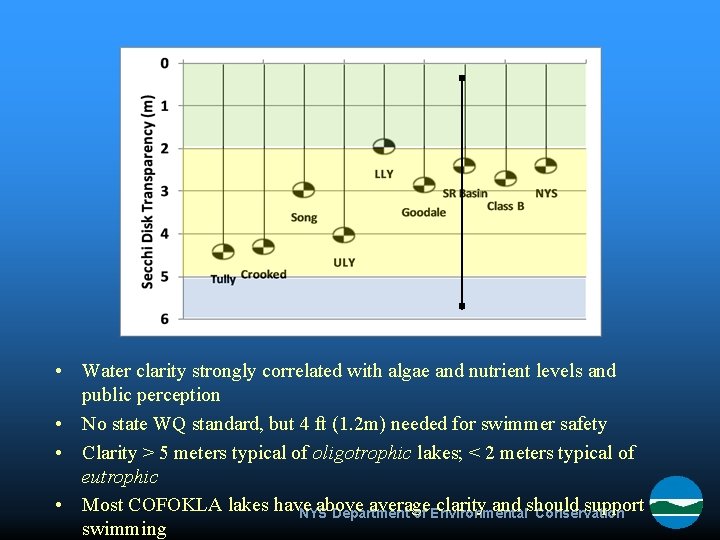
• Water clarity strongly correlated with algae and nutrient levels and public perception • No state WQ standard, but 4 ft (1. 2 m) needed for swimmer safety • Clarity > 5 meters typical of oligotrophic lakes; < 2 meters typical of eutrophic • Most COFOKLA lakes have above average clarity and should support NYS Department of Environmental Conservation swimming
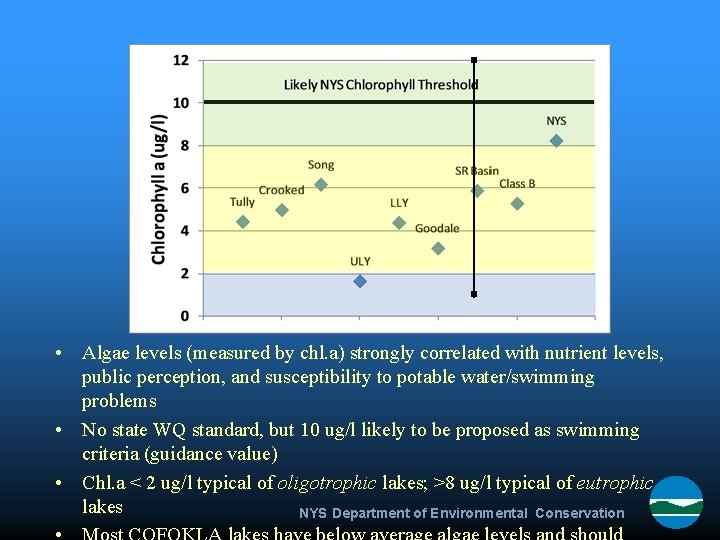
• Algae levels (measured by chl. a) strongly correlated with nutrient levels, public perception, and susceptibility to potable water/swimming problems • No state WQ standard, but 10 ug/l likely to be proposed as swimming criteria (guidance value) • Chl. a < 2 ug/l typical of oligotrophic lakes; >8 ug/l typical of eutrophic lakes NYS Department of Environmental Conservation
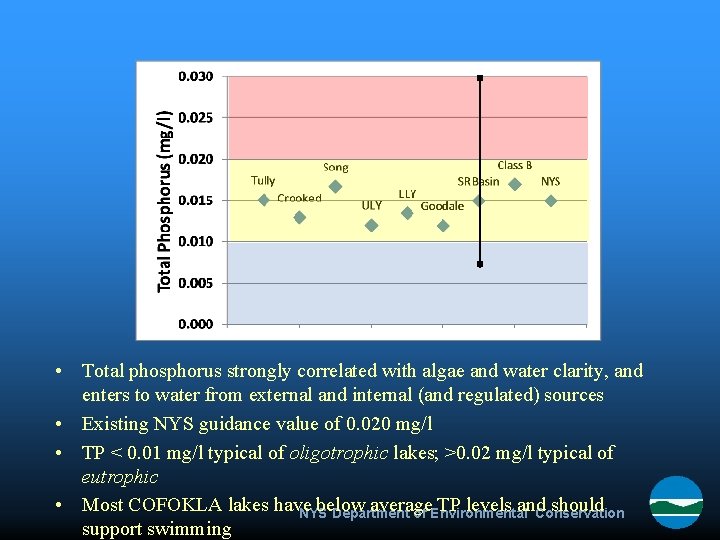
• Total phosphorus strongly correlated with algae and water clarity, and enters to water from external and internal (and regulated) sources • Existing NYS guidance value of 0. 020 mg/l • TP < 0. 01 mg/l typical of oligotrophic lakes; >0. 02 mg/l typical of eutrophic • Most COFOKLA lakes have below average TP levels and should NYS Department of Environmental Conservation support swimming
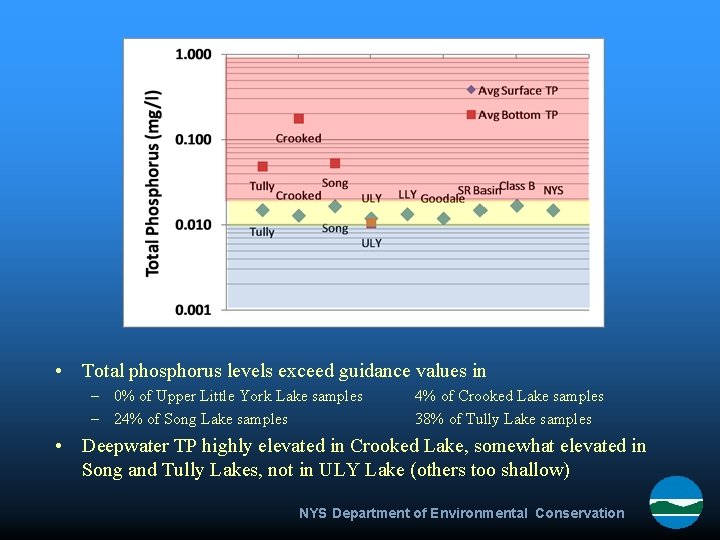
• Total phosphorus levels exceed guidance values in – 0% of Upper Little York Lake samples – 24% of Song Lake samples 4% of Crooked Lake samples 38% of Tully Lake samples • Deepwater TP highly elevated in Crooked Lake, somewhat elevated in Song and Tully Lakes, not in ULY Lake (others too shallow) NYS Department of Environmental Conservation
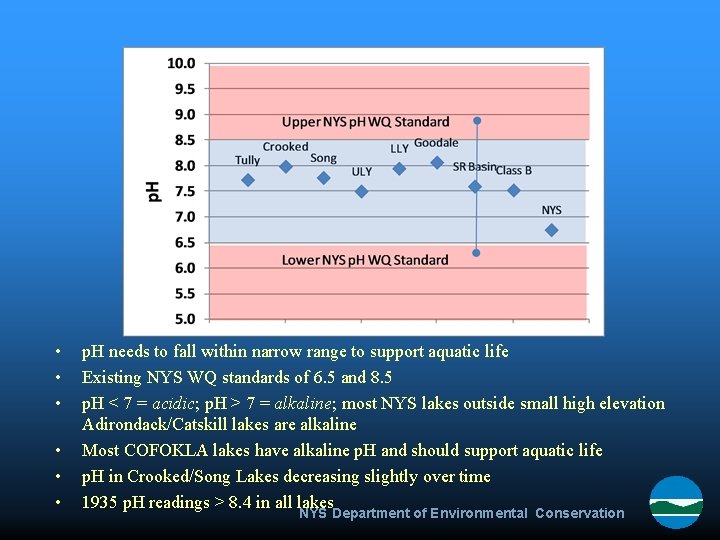
• • • p. H needs to fall within narrow range to support aquatic life Existing NYS WQ standards of 6. 5 and 8. 5 p. H < 7 = acidic; p. H > 7 = alkaline; most NYS lakes outside small high elevation Adirondack/Catskill lakes are alkaline Most COFOKLA lakes have alkaline p. H and should support aquatic life p. H in Crooked/Song Lakes decreasing slightly over time 1935 p. H readings > 8. 4 in all lakes NYS Department of Environmental Conservation
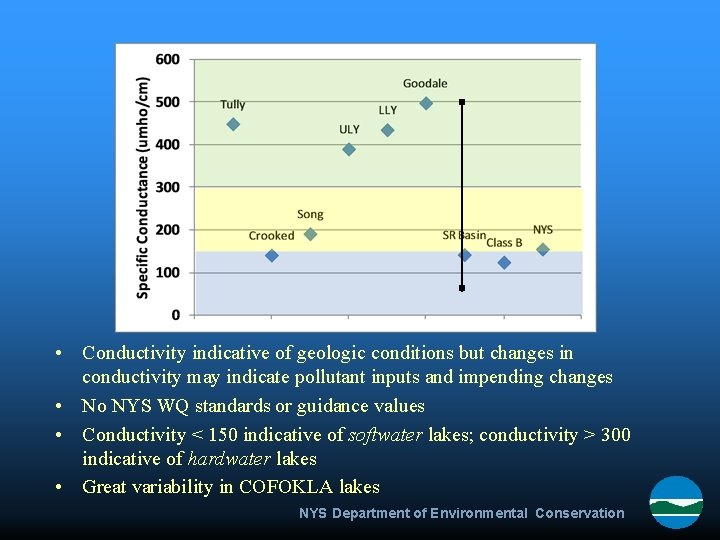
• Conductivity indicative of geologic conditions but changes in conductivity may indicate pollutant inputs and impending changes • No NYS WQ standards or guidance values • Conductivity < 150 indicative of softwater lakes; conductivity > 300 indicative of hardwater lakes • Great variability in COFOKLA lakes NYS Department of Environmental Conservation
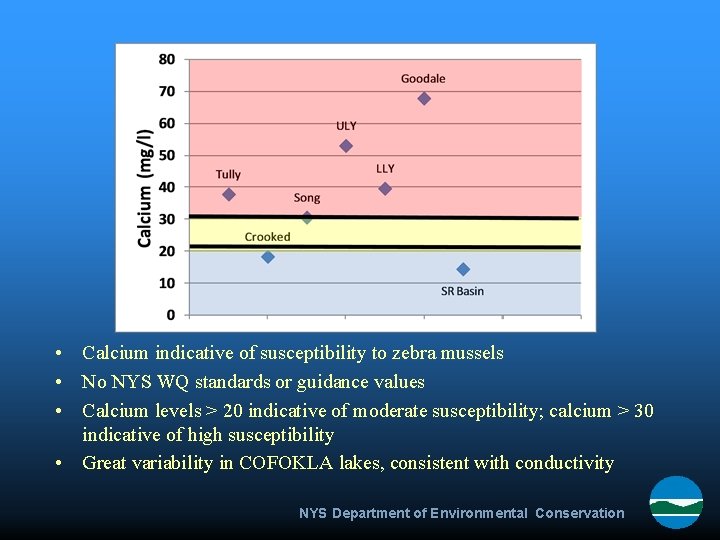
• Calcium indicative of susceptibility to zebra mussels • No NYS WQ standards or guidance values • Calcium levels > 20 indicative of moderate susceptibility; calcium > 30 indicative of high susceptibility • Great variability in COFOKLA lakes, consistent with conductivity NYS Department of Environmental Conservation
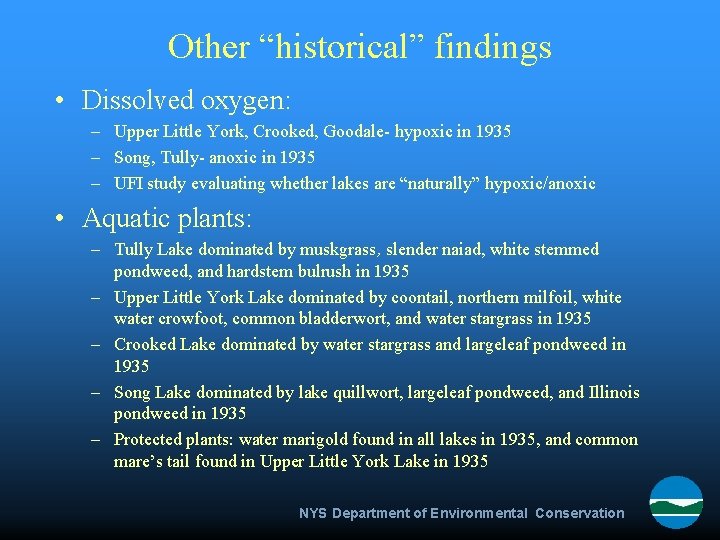
Other “historical” findings • Dissolved oxygen: – Upper Little York, Crooked, Goodale- hypoxic in 1935 – Song, Tully- anoxic in 1935 – UFI study evaluating whether lakes are “naturally” hypoxic/anoxic • Aquatic plants: – Tully Lake dominated by muskgrass, slender naiad, white stemmed pondweed, and hardstem bulrush in 1935 – Upper Little York Lake dominated by coontail, northern milfoil, white water crowfoot, common bladderwort, and water stargrass in 1935 – Crooked Lake dominated by water stargrass and largeleaf pondweed in 1935 – Song Lake dominated by lake quillwort, largeleaf pondweed, and Illinois pondweed in 1935 – Protected plants: water marigold found in all lakes in 1935, and common mare’s tail found in Upper Little York Lake in 1935 NYS Department of Environmental Conservation
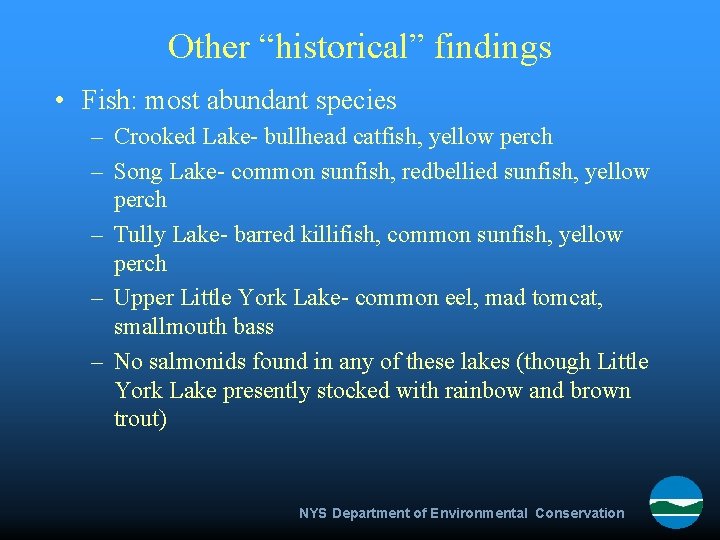
Other “historical” findings • Fish: most abundant species – Crooked Lake- bullhead catfish, yellow perch – Song Lake- common sunfish, redbellied sunfish, yellow perch – Tully Lake- barred killifish, common sunfish, yellow perch – Upper Little York Lake- common eel, mad tomcat, smallmouth bass – No salmonids found in any of these lakes (though Little York Lake presently stocked with rainbow and brown trout) NYS Department of Environmental Conservation
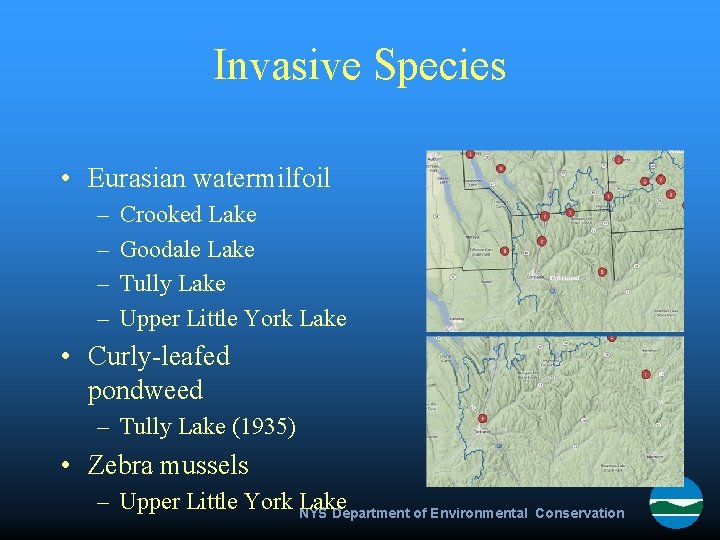
Invasive Species • Eurasian watermilfoil – – Crooked Lake Goodale Lake Tully Lake Upper Little York Lake • Curly-leafed pondweed – Tully Lake (1935) • Zebra mussels – Upper Little York Lake NYS Department of Environmental Conservation
2013 and Beyond: What COFOKLA Lakes Should Look For… • Harmful Algae Blooms – Presence of Blooms – Algal Toxins • Invasive Plants – Hydrilla – Water chestnut • Invasive Animals – Zebra mussels – Asian carp NYS Department of Environmental Conservation
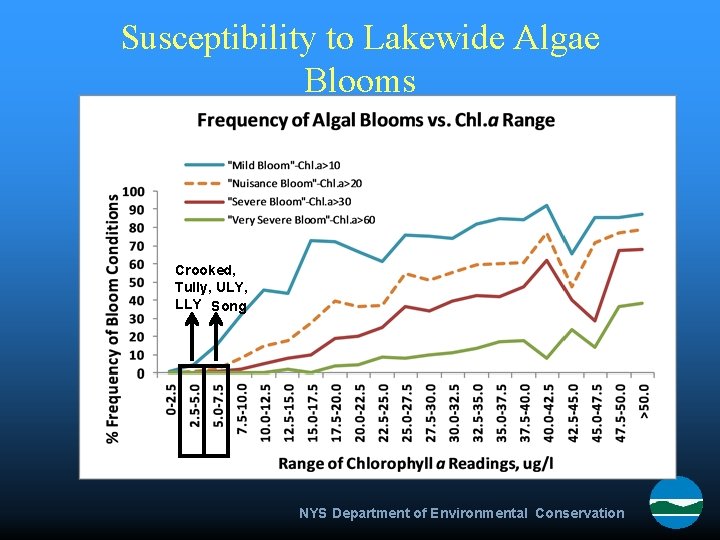
Susceptibility to Lakewide Algae Blooms Crooked, Tully, ULY, LLY Song NYS Department of Environmental Conservation
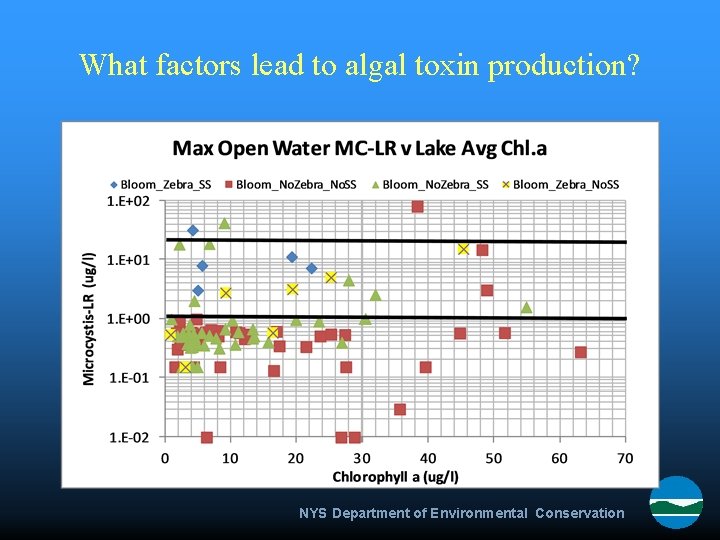
What factors lead to algal toxin production? NYS Department of Environmental Conservation
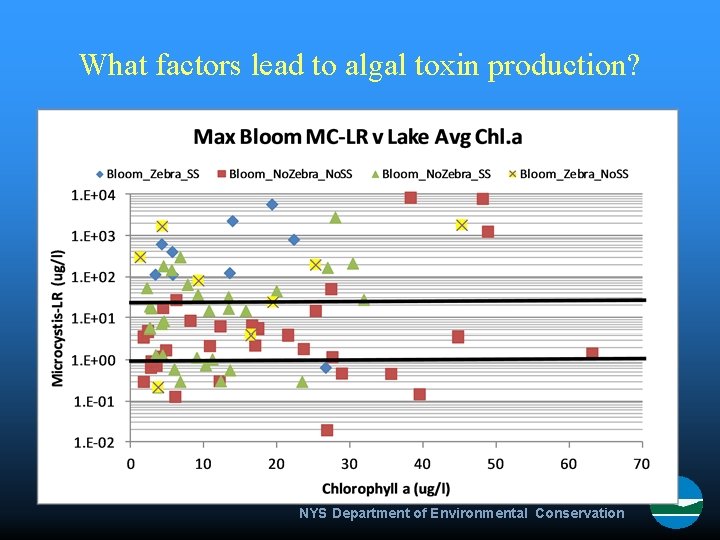
What factors lead to algal toxin production? NYS Department of Environmental Conservation
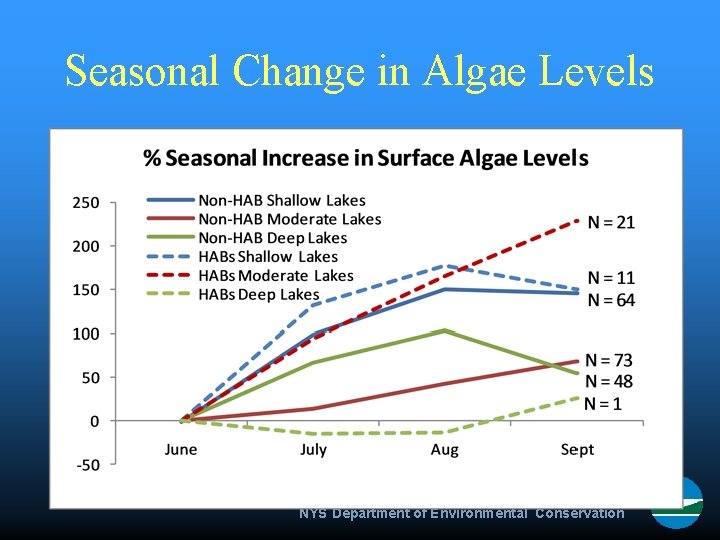
Seasonal Change in Algae Levels NYS Department of Environmental Conservation
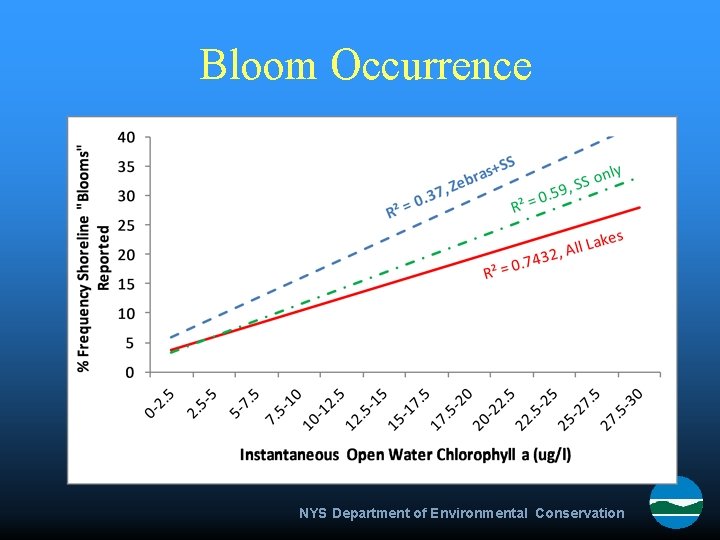
Bloom Occurrence NYS Department of Environmental Conservation
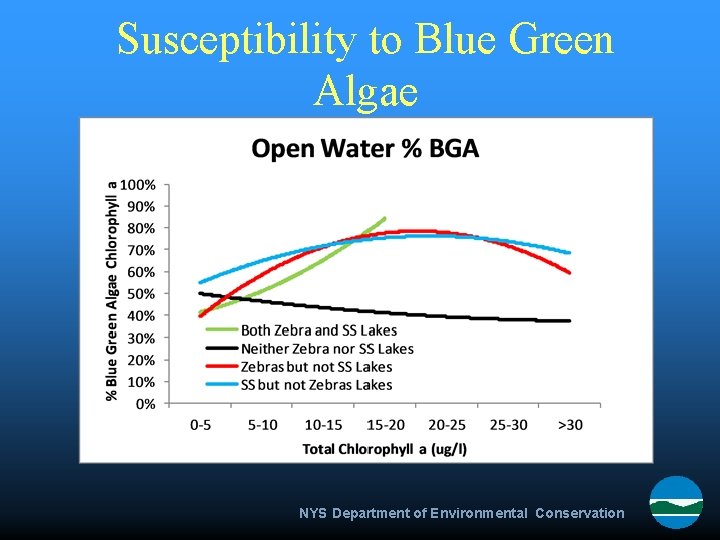
Susceptibility to Blue Green Algae NYS Department of Environmental Conservation
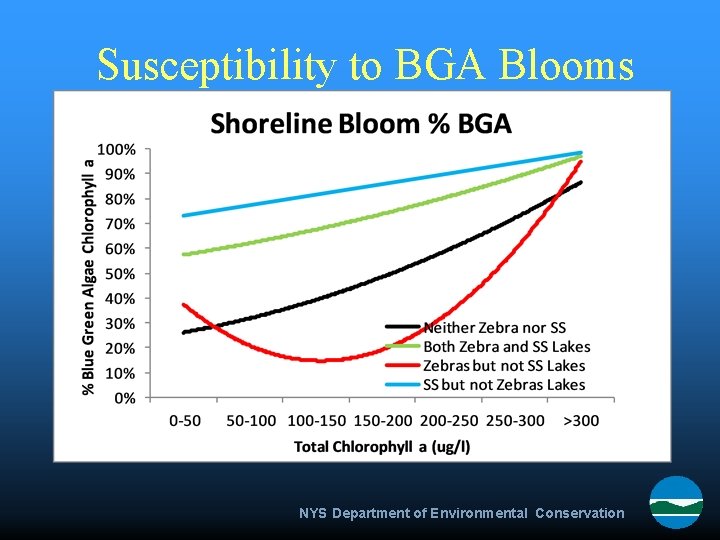
Susceptibility to BGA Blooms NYS Department of Environmental Conservation
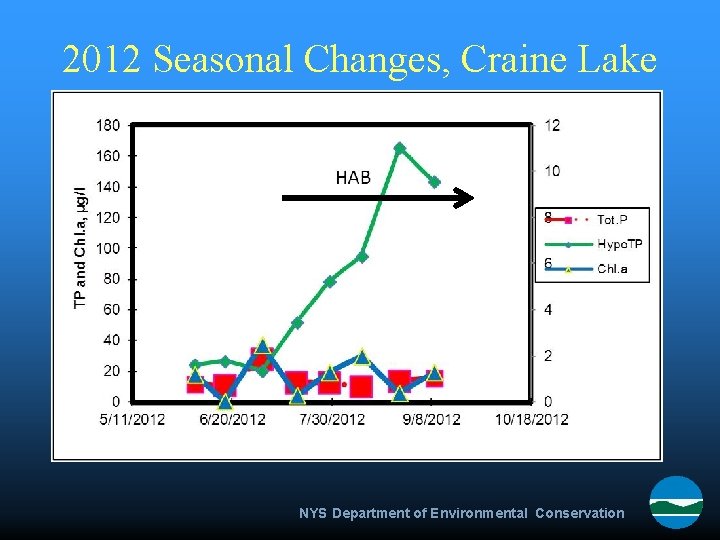
2012 Seasonal Changes, Craine Lake NYS Department of Environmental Conservation
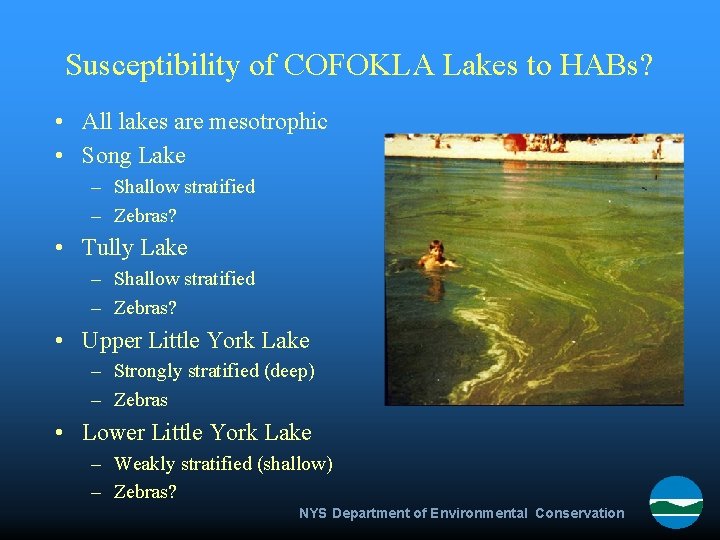
Susceptibility of COFOKLA Lakes to HABs? • All lakes are mesotrophic • Song Lake – Shallow stratified – Zebras? • Tully Lake – Shallow stratified – Zebras? • Upper Little York Lake – Strongly stratified (deep) – Zebras • Lower Little York Lake – Weakly stratified (shallow) – Zebras? NYS Department of Environmental Conservation
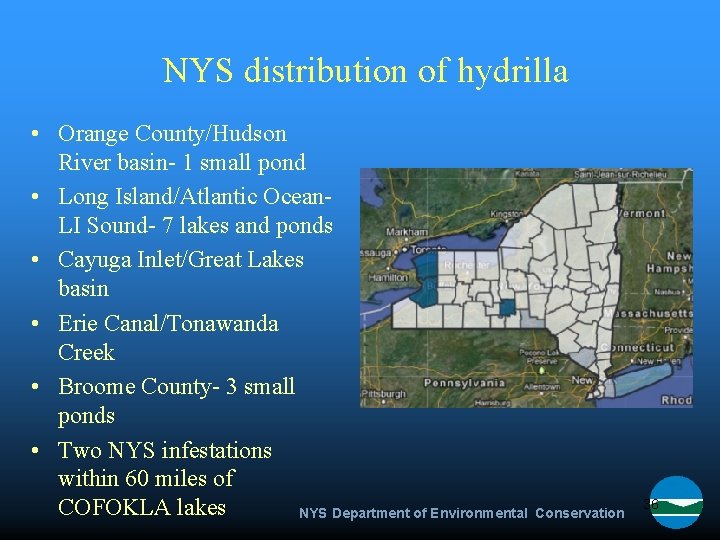
NYS distribution of hydrilla • Orange County/Hudson River basin- 1 small pond • Long Island/Atlantic Ocean. LI Sound- 7 lakes and ponds • Cayuga Inlet/Great Lakes basin • Erie Canal/Tonawanda Creek • Broome County- 3 small ponds • Two NYS infestations within 60 miles of COFOKLA lakes NYS Department of Environmental Conservation 36
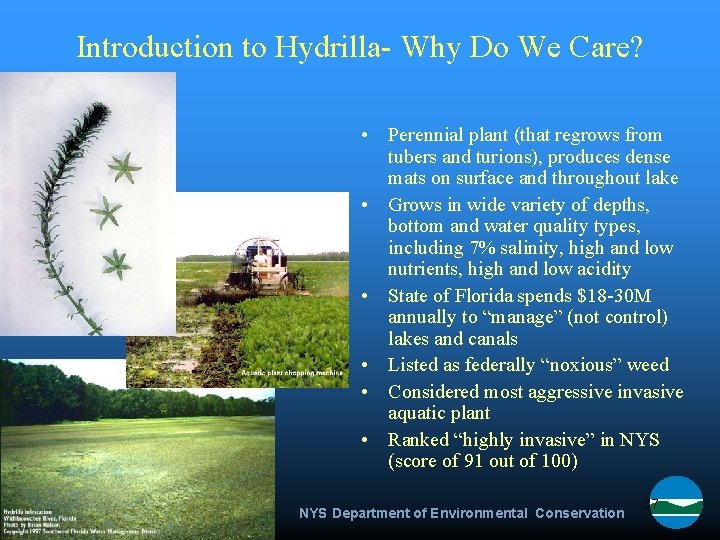
Introduction to Hydrilla- Why Do We Care? • Perennial plant (that regrows from tubers and turions), produces dense mats on surface and throughout lake • Grows in wide variety of depths, bottom and water quality types, including 7% salinity, high and low nutrients, high and low acidity • State of Florida spends $18 -30 M annually to “manage” (not control) lakes and canals • Listed as federally “noxious” weed • Considered most aggressive invasive aquatic plant • Ranked “highly invasive” in NYS (score of 91 out of 100) NYS Department of Environmental Conservation 37
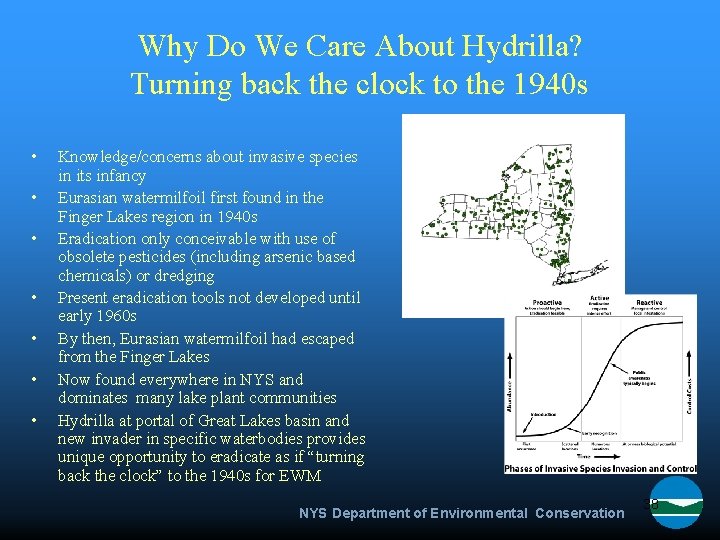
Why Do We Care About Hydrilla? Turning back the clock to the 1940 s • • Knowledge/concerns about invasive species in its infancy Eurasian watermilfoil first found in the Finger Lakes region in 1940 s Eradication only conceivable with use of obsolete pesticides (including arsenic based chemicals) or dredging Present eradication tools not developed until early 1960 s By then, Eurasian watermilfoil had escaped from the Finger Lakes Now found everywhere in NYS and dominates many lake plant communities Hydrilla at portal of Great Lakes basin and new invader in specific waterbodies provides unique opportunity to eradicate as if “turning back the clock” to the 1940 s for EWM NYS Department of Environmental Conservation 38
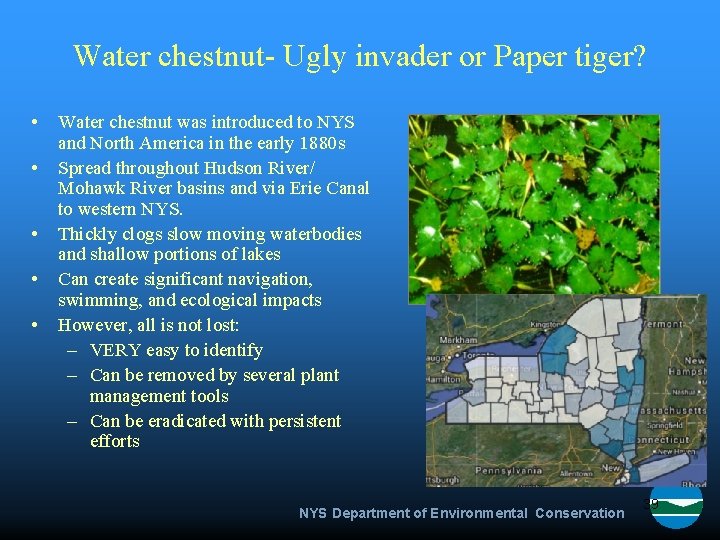
Water chestnut- Ugly invader or Paper tiger? • • • Water chestnut was introduced to NYS and North America in the early 1880 s Spread throughout Hudson River/ Mohawk River basins and via Erie Canal to western NYS. Thickly clogs slow moving waterbodies and shallow portions of lakes Can create significant navigation, swimming, and ecological impacts However, all is not lost: – VERY easy to identify – Can be removed by several plant management tools – Can be eradicated with persistent efforts NYS Department of Environmental Conservation 39
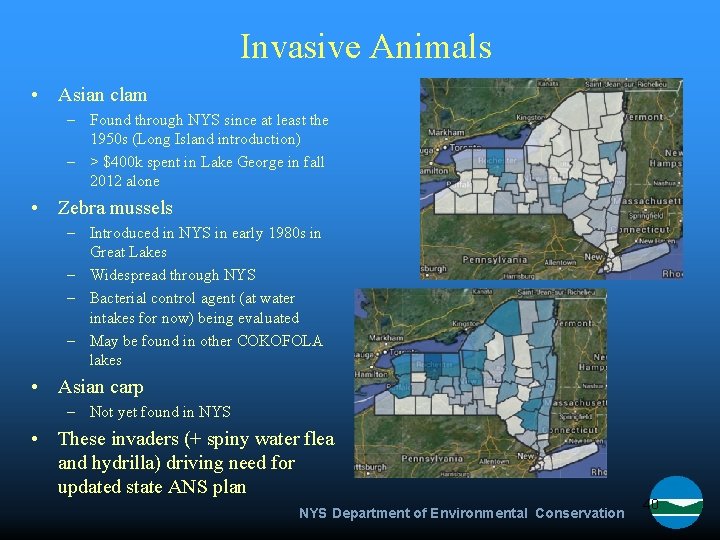
Invasive Animals • Asian clam – Found through NYS since at least the 1950 s (Long Island introduction) – > $400 k spent in Lake George in fall 2012 alone • Zebra mussels – Introduced in NYS in early 1980 s in Great Lakes – Widespread through NYS – Bacterial control agent (at water intakes for now) being evaluated – May be found in other COKOFOLA lakes • Asian carp – Not yet found in NYS • These invaders (+ spiny water flea and hydrilla) driving need for updated state ANS plan NYS Department of Environmental Conservation 40
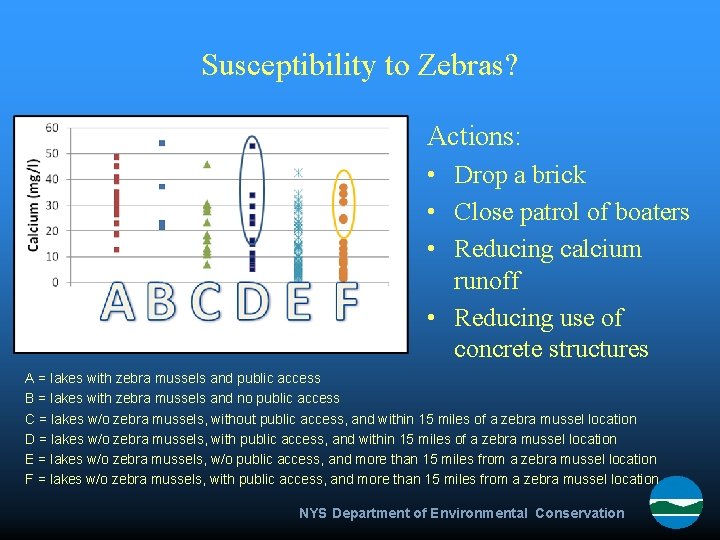
Susceptibility to Zebras? Actions: • Drop a brick • Close patrol of boaters • Reducing calcium runoff • Reducing use of concrete structures A = lakes with zebra mussels and public access B = lakes with zebra mussels and no public access C = lakes w/o zebra mussels, without public access, and within 15 miles of a zebra mussel location D = lakes w/o zebra mussels, with public access, and within 15 miles of a zebra mussel location E = lakes w/o zebra mussels, w/o public access, and more than 15 miles from a zebra mussel location F = lakes w/o zebra mussels, with public access, and more than 15 miles from a zebra mussel location NYS Department of Environmental Conservation
- Slides: 41