
Lets start with DNA Basic DNA structure Made
Let’s start with DNA…
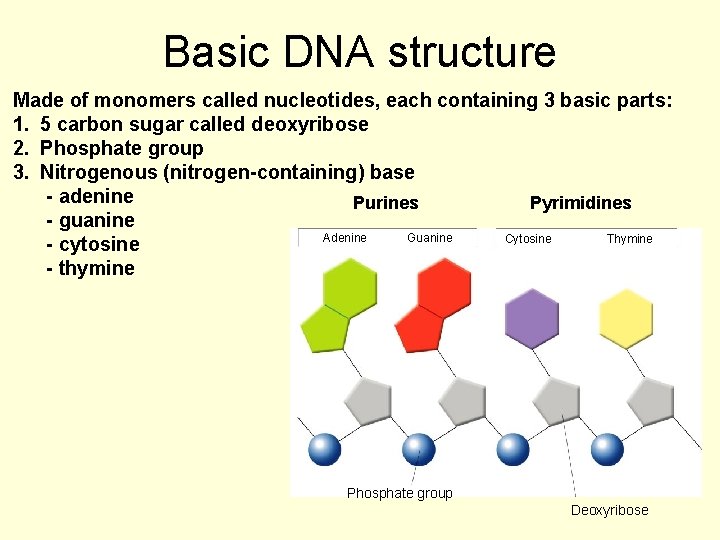
Basic DNA structure Made of monomers called nucleotides, each containing 3 basic parts: 1. 5 carbon sugar called deoxyribose 2. Phosphate group 3. Nitrogenous (nitrogen-containing) base - adenine Purines Pyrimidines - guanine Adenine Guanine Cytosine Thymine - cytosine - thymine Phosphate group Deoxyribose
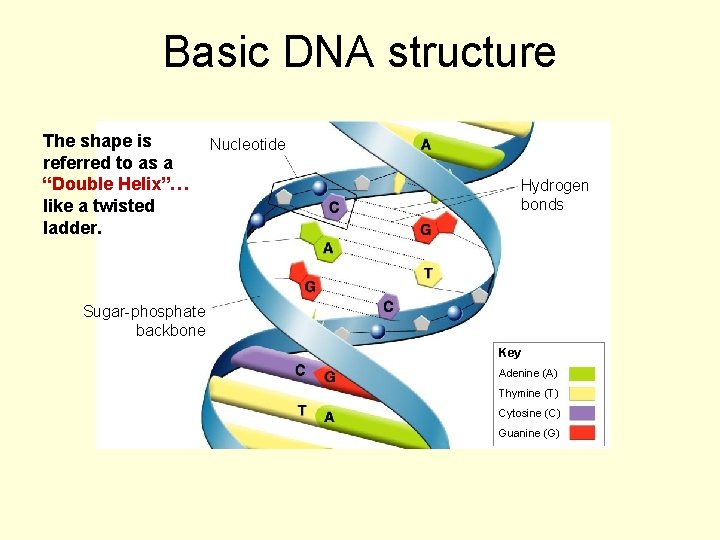
Basic DNA structure The shape is referred to as a “Double Helix”… like a twisted ladder. Nucleotide Hydrogen bonds Sugar-phosphate backbone Key Adenine (A) Thymine (T) Cytosine (C) Guanine (G)
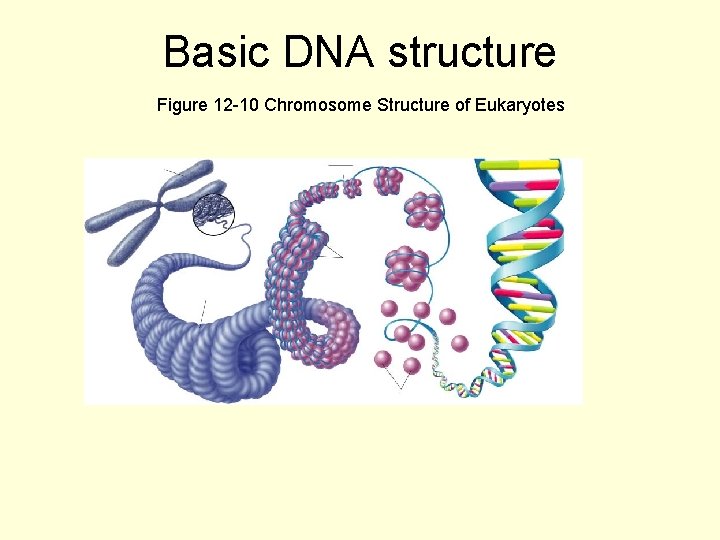
Basic DNA structure Figure 12 -10 Chromosome Structure of Eukaryotes
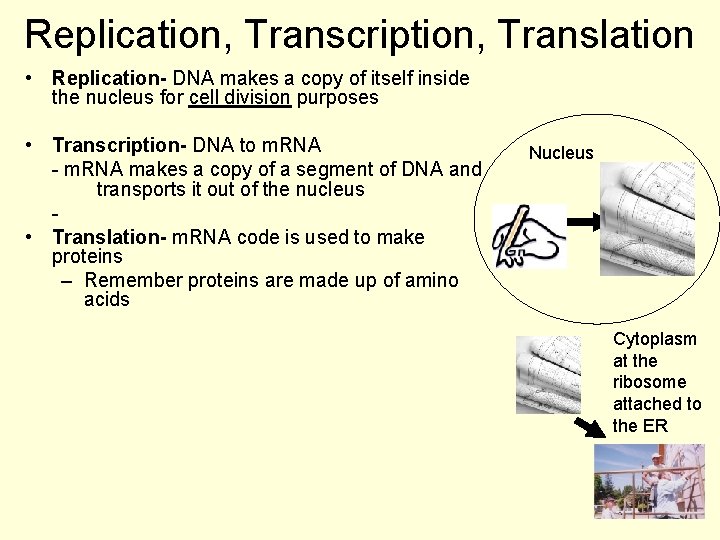
Replication, Transcription, Translation • Replication- DNA makes a copy of itself inside the nucleus for cell division purposes • Transcription- DNA to m. RNA - m. RNA makes a copy of a segment of DNA and transports it out of the nucleus • Translation- m. RNA code is used to make proteins – Remember proteins are made up of amino acids Nucleus Cytoplasm at the ribosome attached to the ER
• Using DNA to make DNA (copying itself) • Again, this is for CELL DIVISION purposes only! • DNA does not make a copy of itself to make proteins! m. RNA makes the copy. • This is a separate function from making proteins!!!
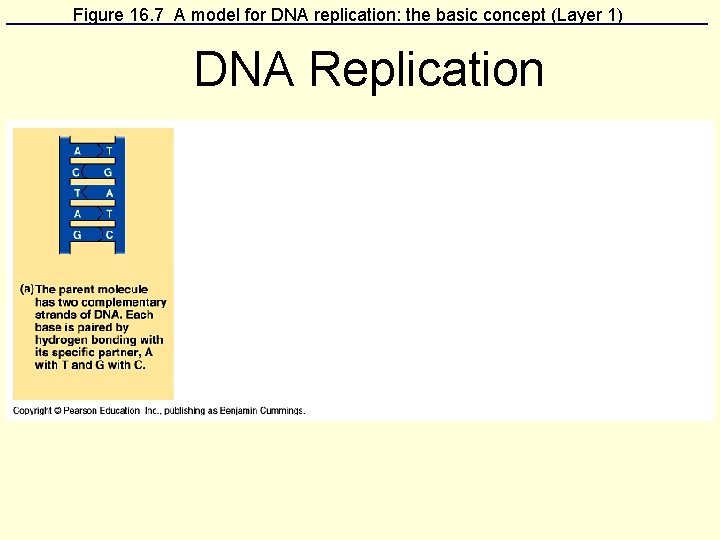
Figure 16. 7 A model for DNA replication: the basic concept (Layer 1) DNA Replication
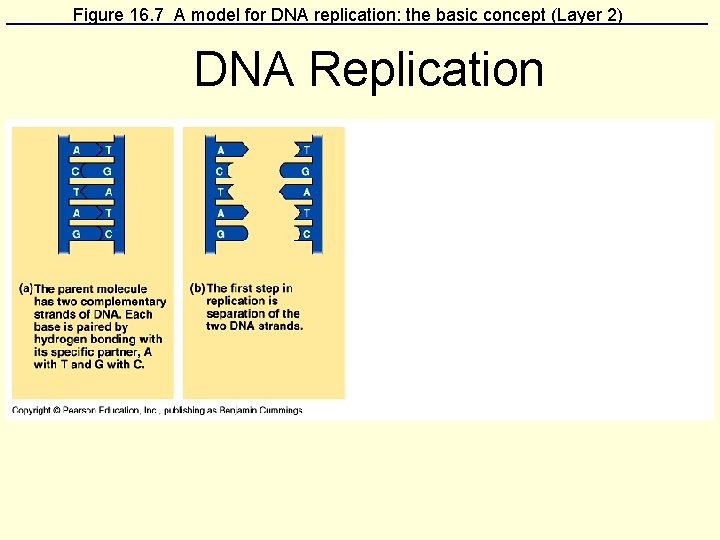
Figure 16. 7 A model for DNA replication: the basic concept (Layer 2) DNA Replication
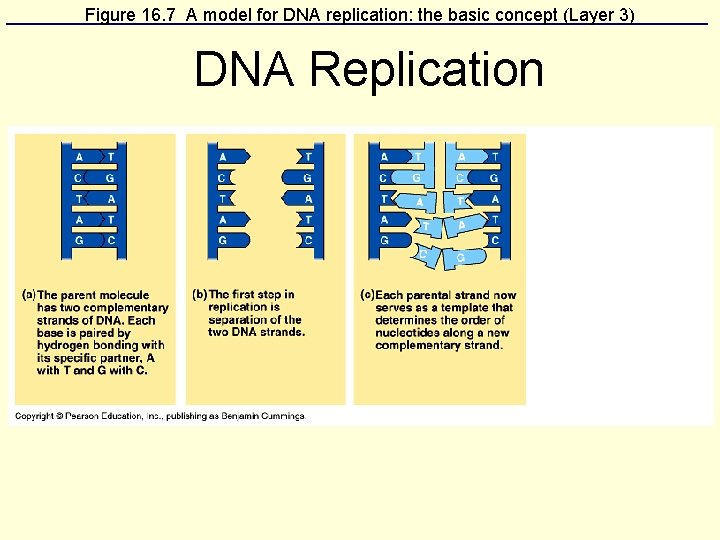
Figure 16. 7 A model for DNA replication: the basic concept (Layer 3) DNA Replication
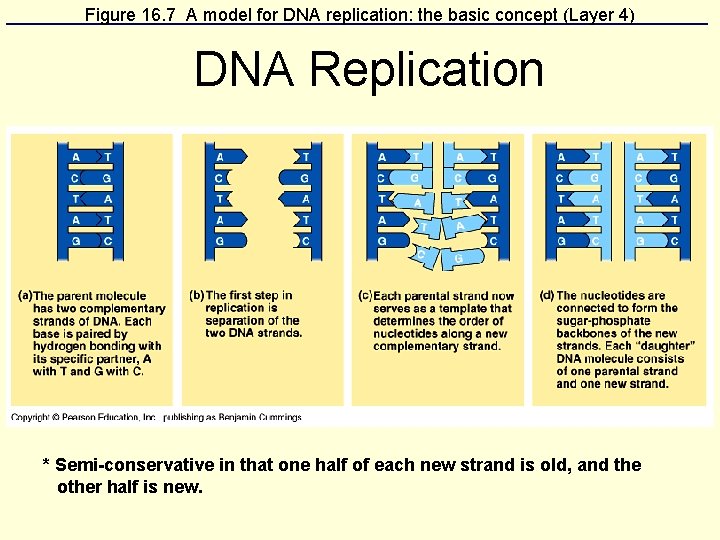
Figure 16. 7 A model for DNA replication: the basic concept (Layer 4) DNA Replication * Semi-conservative in that one half of each new strand is old, and the other half is new.
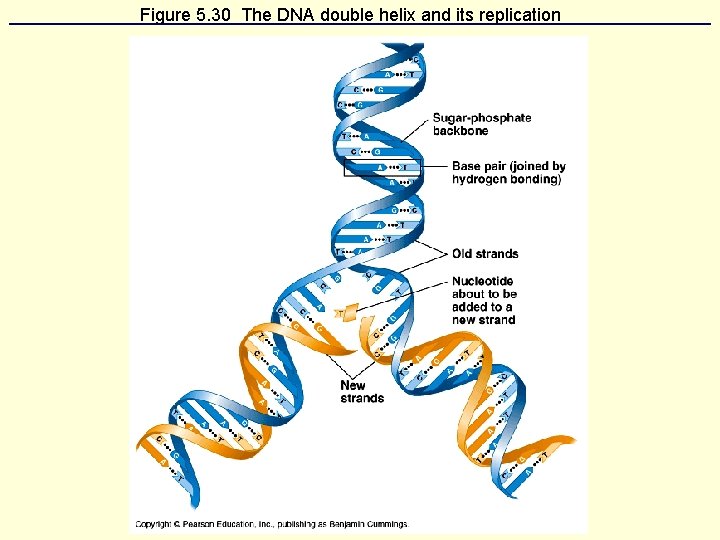
Figure 5. 30 The DNA double helix and its replication
DNA Replication • Occurs in a Replication bubble; each end is called a Replication fork • Catalyzed by enzymes (helicase and DNA polymerase for starters) – Helicase unwinds the original double strand by using ATP to break hydrogen bonds – DNA polymerase moves along the single strands of DNA recruiting free phosphates, sugars, and bases to “fill” the gaps • New nucleotides float in and pair in a complementary fashion – A to T, C to G and vice versa…
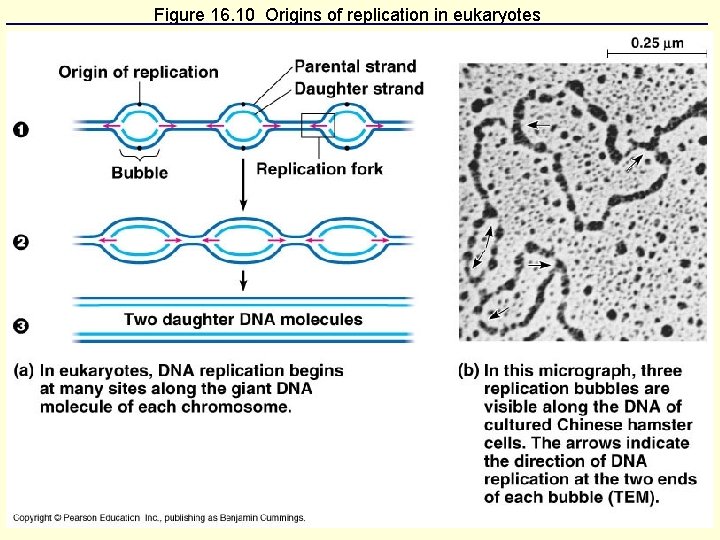
Figure 16. 10 Origins of replication in eukaryotes

Is Replication of DNA error-free? NO!!!, but it is relatively rare… • Errors in completed DNA molecule amount to only one in a billion nucleotides • Initial pairing errors – error rate of 1 per 10, 000 base pairs * Exposure damage – due to things such as reactive chemicals, radiation, X-rays, ultraviolet light -unpredictable, but common Ex. Skin cells and uv damage * Mismatch repair – DNA will occasionally put incorrect bases together…cells use special enzymes to fix incorrectly paired nucleotides
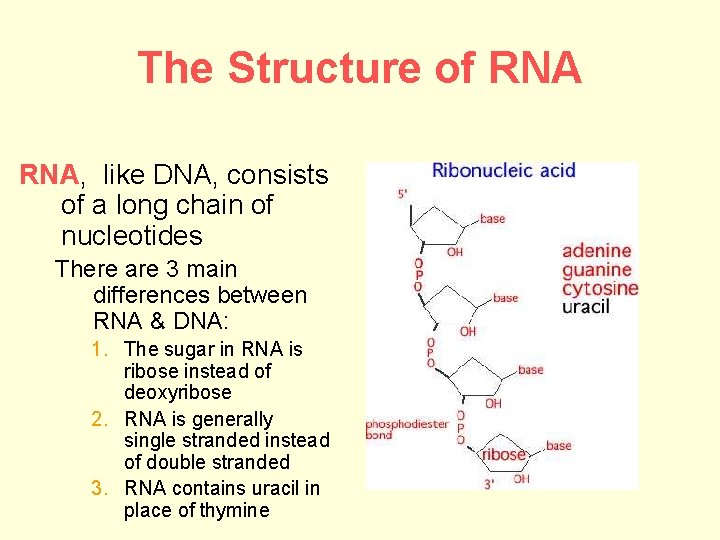
The Structure of RNA, like DNA, consists of a long chain of nucleotides There are 3 main differences between RNA & DNA: 1. The sugar in RNA is ribose instead of deoxyribose 2. RNA is generally single stranded instead of double stranded 3. RNA contains uracil in place of thymine
Now, to make a protein… • DNA is used IN PART. • Transcription and Translation make it possible • Need m. RNA, t. RNA, and r. RNA to make a protein (the three types of RNA)
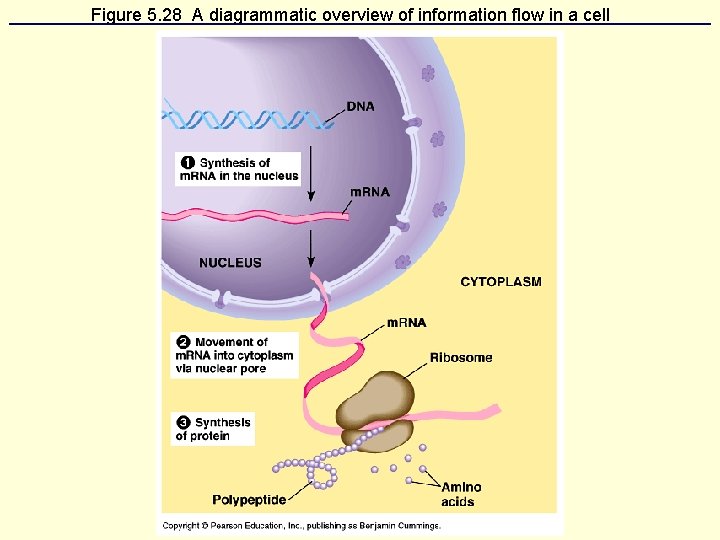
Figure 5. 28 A diagrammatic overview of information flow in a cell
RNA and Protein Synthesis 1. Messenger RNA (m. RNA) – carries information from DNA in the nucleus to the ribosomes where the proteins are assembled. It is a partial copy of ONLY the information needed for that specific job. It is read 3 bases at a time – codon. 2. Transfer RNA (t. RNA) – transfers the needed amino acids from the cytoplasm to the ribosome so the proteins dictated by the m. RNA can be assembled. (The three exposed bases are complementary to the m. RNA and are called the anticodon) 3. Ribosomal RNA (r. RNA) – found in ribosomes and helps in the attachment of m. RNA and in the assembly of proteins.
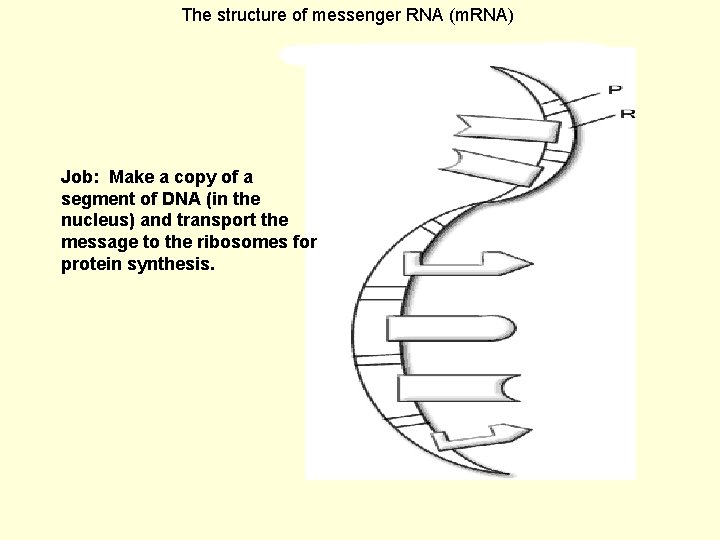
The structure of messenger RNA (m. RNA) Job: Make a copy of a segment of DNA (in the nucleus) and transport the message to the ribosomes for protein synthesis.
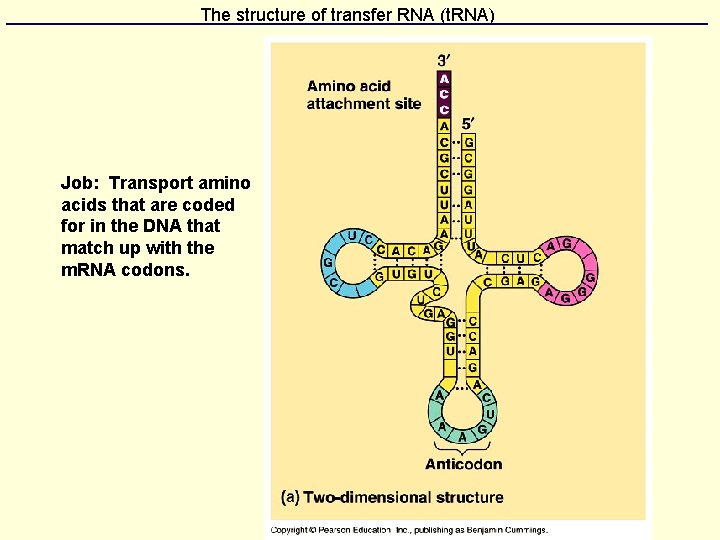
The structure of transfer RNA (t. RNA) Job: Transport amino acids that are coded for in the DNA that match up with the m. RNA codons.
How is the code of m. RNA transferred? • Codon- m. RNA is made up of nucleotide codes in sets of that each (set of 3) code for an amino acid • Anticodon- t. RNA has which brings in specific amino acids have 3 letter code which match the codon, these are called anticodons. • t. RNA is a transfer molecule that will bring in an amino acid that matches the m. RNA codon. The amino acids will fall off the t. RNA inside the ribosome during protein assembly
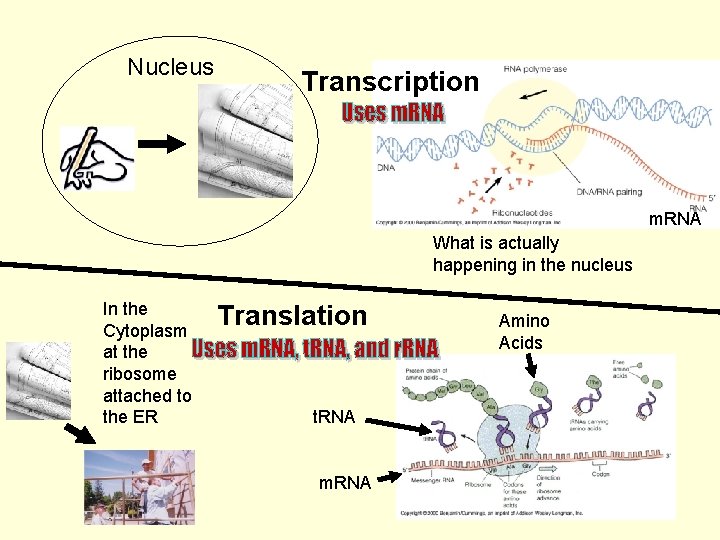
Nucleus Transcription m. RNA What is actually happening in the nucleus In the Cytoplasm at the ribosome attached to the ER Translation t. RNA m. RNA Amino Acids
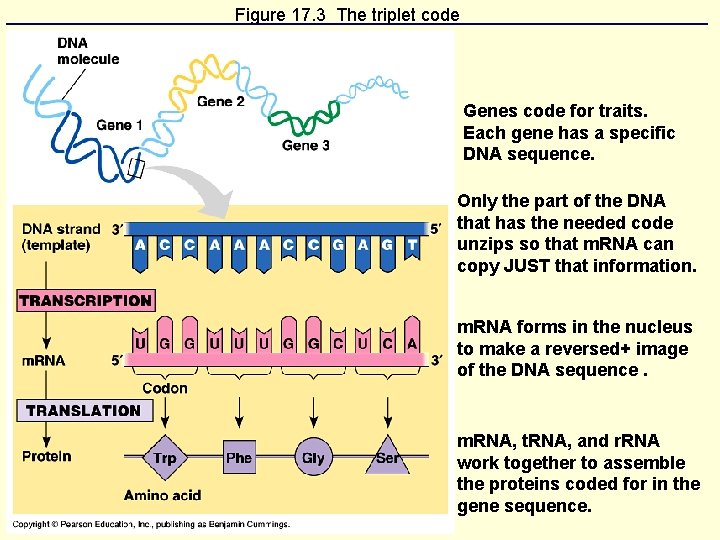
Figure 17. 3 The triplet code Genes code for traits. Each gene has a specific DNA sequence. Only the part of the DNA that has the needed code unzips so that m. RNA can copy JUST that information. m. RNA forms in the nucleus to make a reversed+ image of the DNA sequence. m. RNA, t. RNA, and r. RNA work together to assemble the proteins coded for in the gene sequence.
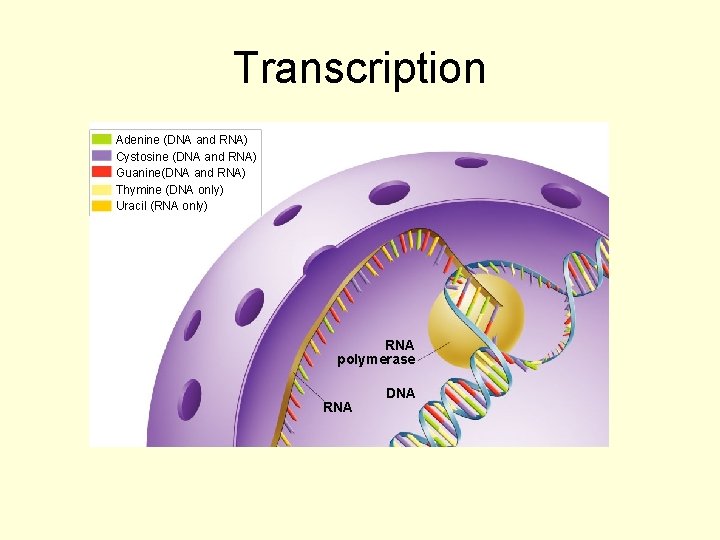
Section 12 -3 Transcription Adenine (DNA and RNA) Cystosine (DNA and RNA) Guanine(DNA and RNA) Thymine (DNA only) Uracil (RNA only) RNA polymerase RNA Go to Section: DNA
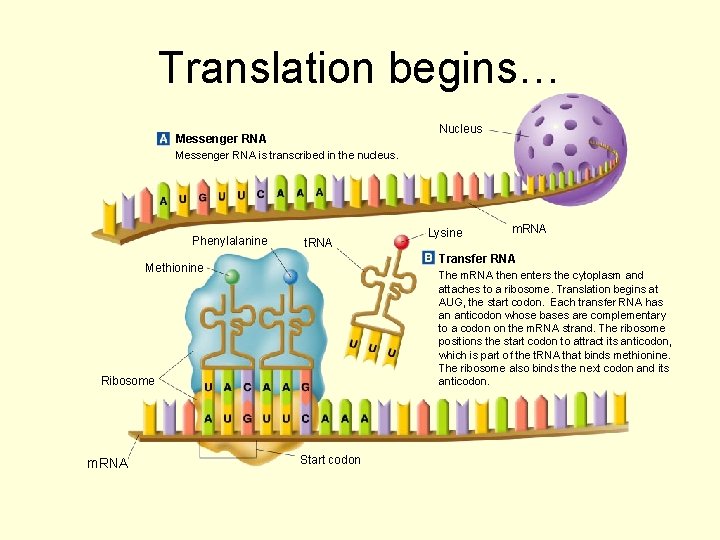
Section 12 -3 Translation begins… Nucleus Messenger RNA is transcribed in the nucleus. Phenylalanine t. RNA The m. RNA then enters the cytoplasm and attaches to a ribosome. Translation begins at AUG, the start codon. Each transfer RNA has an anticodon whose bases are complementary to a codon on the m. RNA strand. The ribosome positions the start codon to attract its anticodon, which is part of the t. RNA that binds methionine. The ribosome also binds the next codon and its anticodon. Ribosome Go to Section: m. RNA Transfer RNA Methionine m. RNA Lysine Start codon
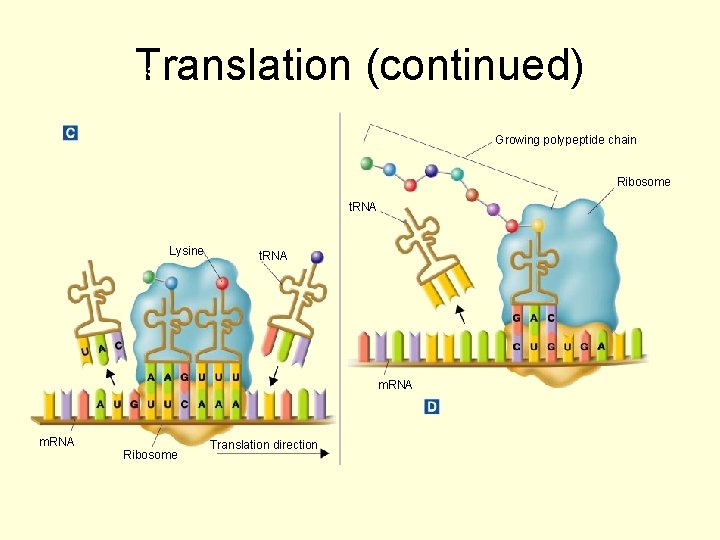
Translation (continued) Section 12 -3 Growing polypeptide chain Ribosome t. RNA Lysine t. RNA m. RNA Go to Section: Ribosome Translation direction
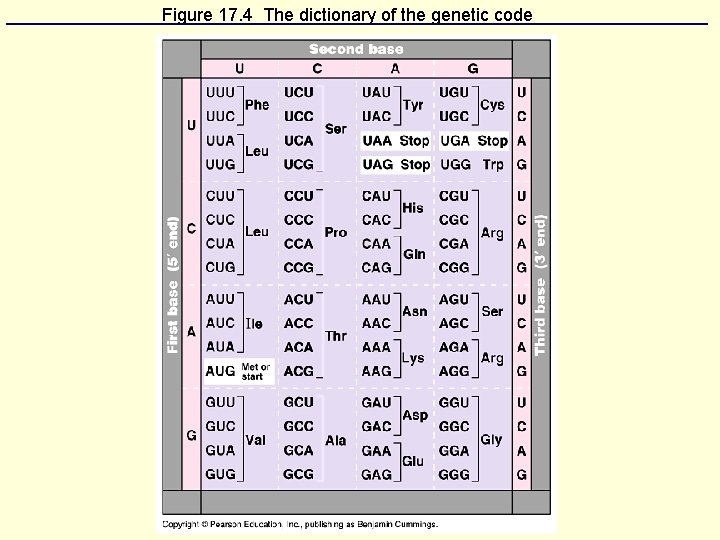
Figure 17. 4 The dictionary of the genetic code
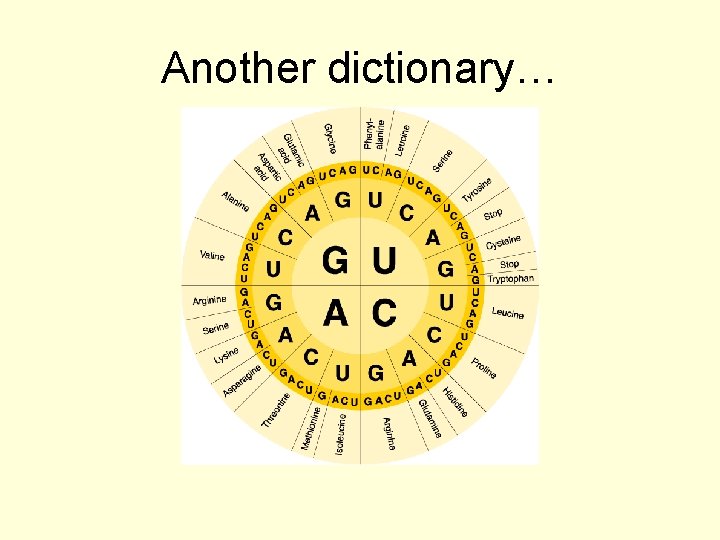
Section 12 -3 Go to Section: Another dictionary…
Mutations • Mutations are changes in the DNA sequence that affect genetic information – Gene mutations result from changes in a single gene – Chromosomal mutations involve changes in whole chromosomes • Mutations that affect one nucleotide are called point mutations • Frameshift mutations are those that shift the “reading” frame of the genetic message by inserting or deleting a nucleotide
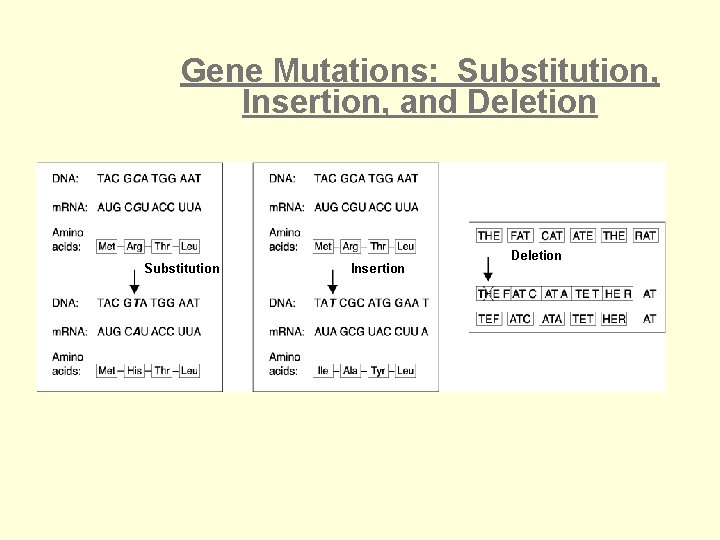
Section 12 -4 Gene Mutations: Substitution, Insertion, and Deletion Substitution Go to Section: Insertion Deletion
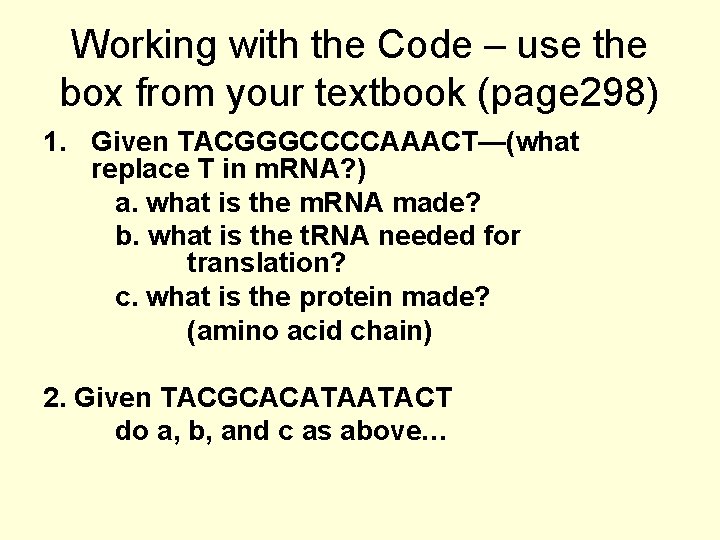
Working with the Code – use the box from your textbook (page 298) 1. Given TACGGGCCCCAAACT—(what replace T in m. RNA? ) a. what is the m. RNA made? b. what is the t. RNA needed for translation? c. what is the protein made? (amino acid chain) 2. Given TACGCACATAATACT do a, b, and c as above…
- Slides: 31