
Lets Solve Georgias Child and Adolescent Mental Health
- Slides: 25
Let’s Solve Georgia’s Child and Adolescent Mental Health Crisis Erica F. Sitkoff, Ph. D. Policy and Outreach Director Polly Mc. Kinney, Advocacy Director 11 -29 -16
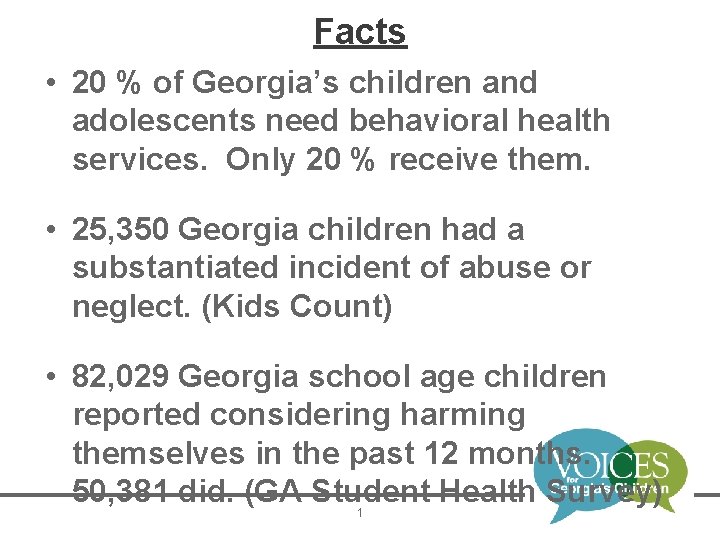
Facts • 20 % of Georgia’s children and adolescents need behavioral health services. Only 20 % receive them. • 25, 350 Georgia children had a substantiated incident of abuse or neglect. (Kids Count) • 82, 029 Georgia school age children reported considering harming themselves in the past 12 months. 50, 381 did. (GA Student Health Survey) 1
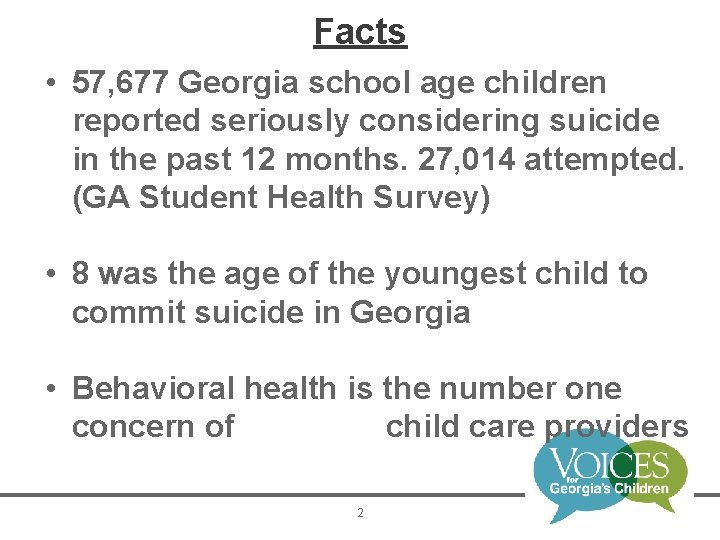
Facts • 57, 677 Georgia school age children reported seriously considering suicide in the past 12 months. 27, 014 attempted. (GA Student Health Survey) • 8 was the age of the youngest child to commit suicide in Georgia • Behavioral health is the number one concern of child care providers 2
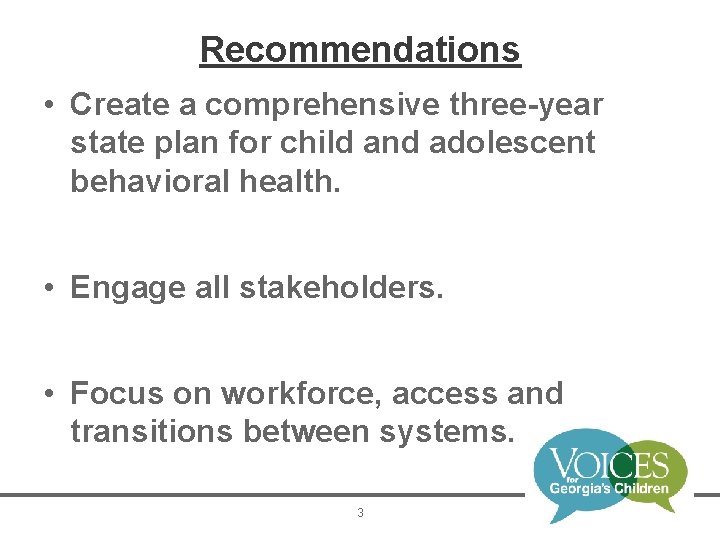
Recommendations • Create a comprehensive three-year state plan for child and adolescent behavioral health. • Engage all stakeholders. • Focus on workforce, access and transitions between systems. 3
Recommendations • Work to make sure it moves from a strategic conversation to an actionable plan. • Prioritize actions to ensure an immediate impact that instills hope for further change. • Implement it. 4
Broad Government Support • Children’s Mental Health Study Committee (House) • Youth Mental Health, and Substance Use Disorders Study Committee (Senate) • Health, Education and School-Based Health Centers Study Committee (House) • Governor’s Education Reform Commission • 2015 Child Welfare Reform Council Report • State agency strategic discussions • Interagency Directors Team 5
8 Components • ACCESS: IDENTIFYING AND SCALING EFFECTIVE PROGRAMS Which programs are effective and how do we expand them? • WORKFORCE DEVELOPMENT What workforce development strategies do we need? • FISCAL SUSTAINABILITY How do we achieve fiscal sustainability (beyond grants) for programs that are effective? • CROSS-SYSTEMS COORDINATION/ SYSTEMS OF CARE How do we maximize current resources to improve continuity of care across systems (and children of different ages)? 6
8 Components • IDENTIFYING and TREATING NEEDS EARLY How do we develop a coordinated screening and a “warm hand off” system that identifies and treats needs early? • POSITIVE CULTURE OF AWARENESS and PREVENTION What is needed to create a positive culture of awareness and prevention in child serving systems? • EVALUATION and CONTINUOUS IMPROVEMENT What oversight council, data and system is needed monitor what’s working, what’s missing, what’s not working and what’s possible? • CHANGING SOCIETAL CULTURE WITH EFFECTIVE COMMUNICATION AND ADVOCACY How can the stakeholders change culture, find buy-in and support for change? 7
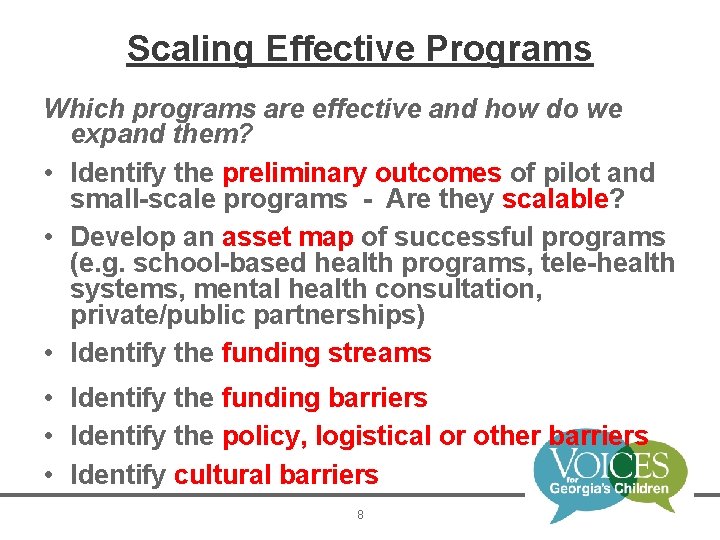
Scaling Effective Programs Which programs are effective and how do we expand them? • Identify the preliminary outcomes of pilot and small-scale programs - Are they scalable? • Develop an asset map of successful programs (e. g. school-based health programs, tele-health systems, mental health consultation, private/public partnerships) • Identify the funding streams • Identify the funding barriers • Identify the policy, logistical or other barriers • Identify cultural barriers 8
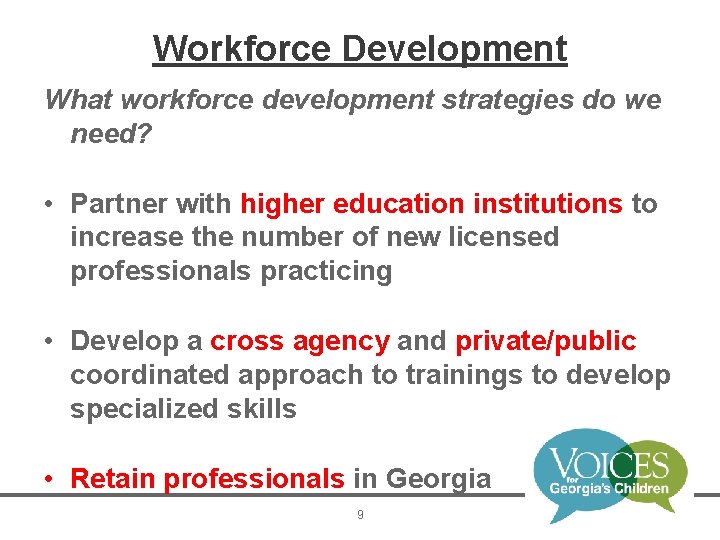
Workforce Development What workforce development strategies do we need? • Partner with higher education institutions to increase the number of new licensed professionals practicing • Develop a cross agency and private/public coordinated approach to trainings to develop specialized skills • Retain professionals in Georgia 9
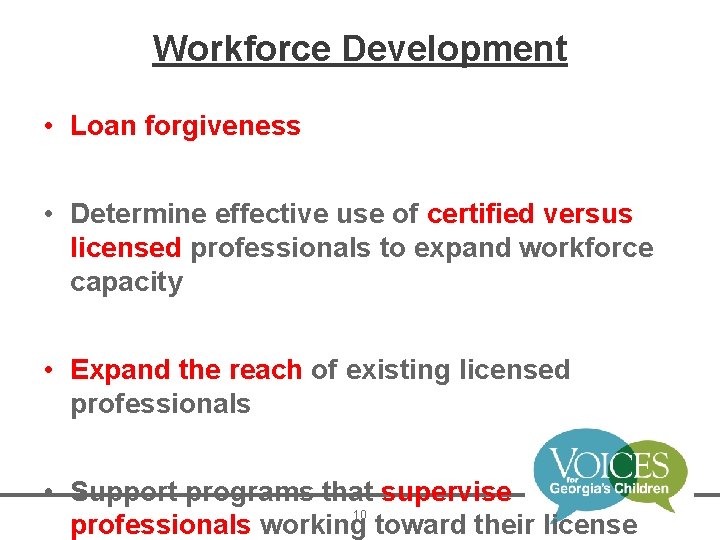
Workforce Development • Loan forgiveness • Determine effective use of certified versus licensed professionals to expand workforce capacity • Expand the reach of existing licensed professionals • Support programs that supervise 10 professionals working toward their license
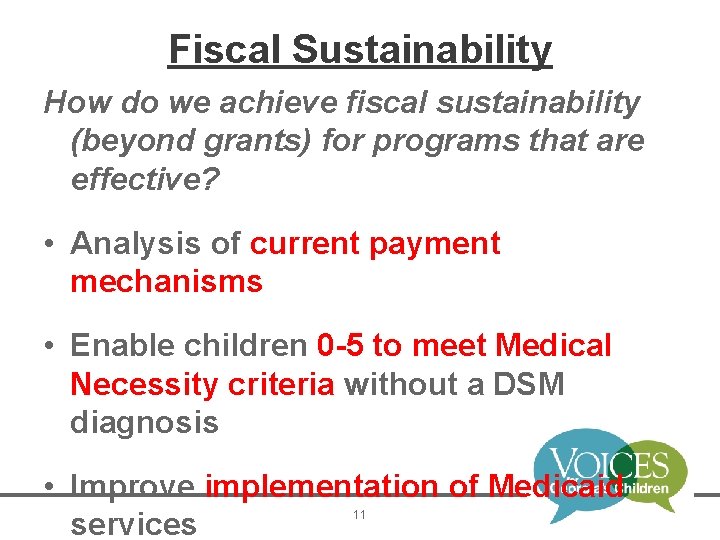
Fiscal Sustainability How do we achieve fiscal sustainability (beyond grants) for programs that are effective? • Analysis of current payment mechanisms • Enable children 0 -5 to meet Medical Necessity criteria without a DSM diagnosis • Improve implementation of Medicaid services 11
Fiscal Sustainability • Braid and blend federal funding streams • Maximize the reach of licensed professionals through consultation and telehealth • Ensure that all children eligible for public health insurance remain insured – o 166, 000 children in 12 Georgia are uninsured
Cross System Coordination/System of Care How do we maximize current resources to improve continuity of care across systems (and children of different ages)? • Adopt Systems of Care principles • Expand Georgia APEX (or similar approaches) to early childhood centers and Head Start • Expand School-based health to Pre-K, child care centers, Head Start, middle schools and high schools 13
Cross System Coordination/System of Care • Ensure providers have the medical history to treat new patients • Use telehealth to improve continuity of care and minimize trauma for children in out of home placements • Improve social emotional learning (SEL) supports for in-person family visitation • Strengthen communication and supports between IDT, Regional Interagency Planning Teams and Local Interagency Planning Teams 14
Identifying and Treating Needs Early How do we develop a coordinated screening and a “warm hand off” system that identifies and treats needs early? • Coordinate the strategy, resources and activities to identify children with special needs • Use screening data effectively to access services • Use Positive Behavioral Intervention and Supports (PBIS) implementation in childcare centers • Implement pilot programs for mental health consultation in child care centers and pediatric offices for early childhood mental health 15 • Expand the use of Parent Child Interaction
Culture of Awareness & Prevention What is needed to create a positive culture of awareness and prevention in child serving systems? • SEL curricula for Early Learning, Pre. K 12 • PBIS in Early Learning Centers and all K-12 • Full-time School Climate Specialists at each RESA 16
Culture of Awareness & Prevention • Training on trauma and brain development • Training on child abuse/neglect/ sexual abuse • Increase funding for and quality of Outof-School Time supports – e. g. , afterschool programs, DBHDD club houses, summer learning and nutrition) 17
Evaluation and Improvement What oversight council, data and system is needed monitor what’s working, missing, not working and possible? • Establish a standing advisory group, such as a Child and Adolescent Behavioral Health Reform Council • Institute an evaluation framework to evaluate annual progress • Include both access and quality metrics. • IDT Systems of Care goals and work are incorporated into larger efforts. • Examine current policies for effective support of systems of care • Public and private providers 18 • Collect core process, utilization and outcome
Communication and Advocacy How can the stakeholders change culture, find buy-in and support for change? • Develop three to four key messages about how to identify behavioral health issues, access help, and support others. • Develop culturally appropriate (targeted) messaging about the “normalcy” of seeking support. • Develop unlikely champions in the business, political and lead policy sectors for promoting change. • Develop a coordinated state behavioral health communications plan 19 and metrics.
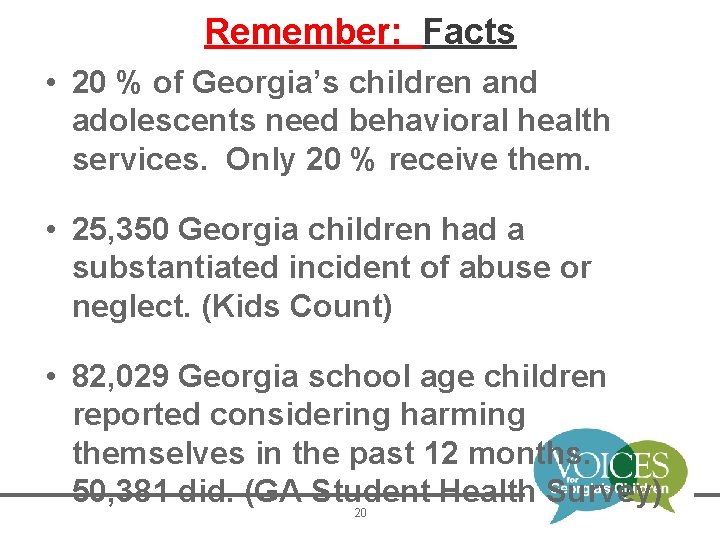
Remember: Facts • 20 % of Georgia’s children and adolescents need behavioral health services. Only 20 % receive them. • 25, 350 Georgia children had a substantiated incident of abuse or neglect. (Kids Count) • 82, 029 Georgia school age children reported considering harming themselves in the past 12 months. 50, 381 did. (GA Student Health Survey) 20
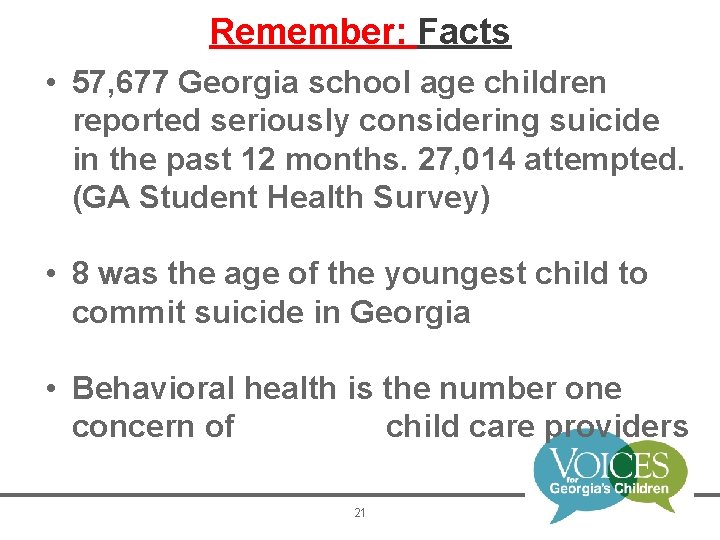
Remember: Facts • 57, 677 Georgia school age children reported seriously considering suicide in the past 12 months. 27, 014 attempted. (GA Student Health Survey) • 8 was the age of the youngest child to commit suicide in Georgia • Behavioral health is the number one concern of child care providers 21
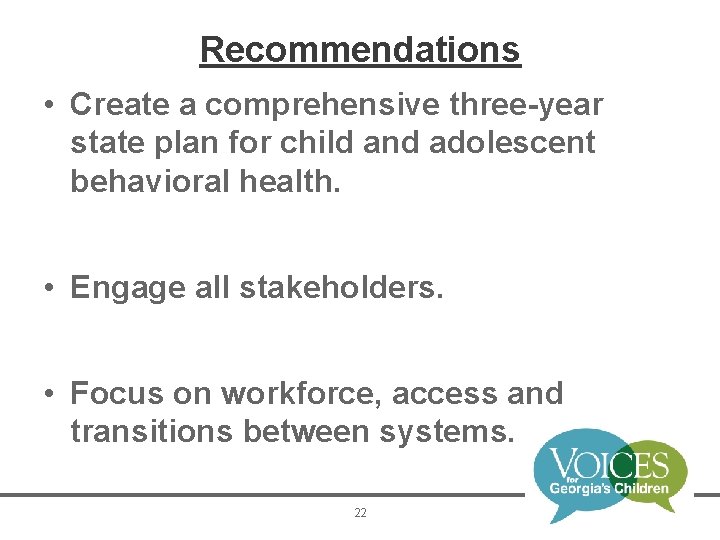
Recommendations • Create a comprehensive three-year state plan for child and adolescent behavioral health. • Engage all stakeholders. • Focus on workforce, access and transitions between systems. 22
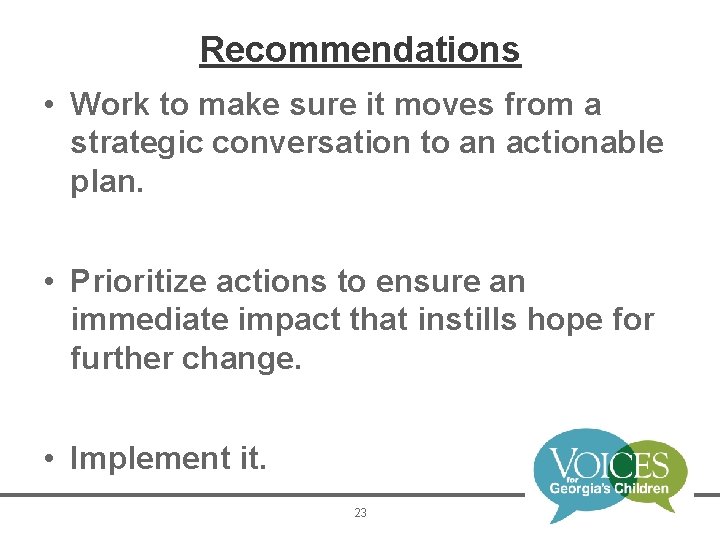
Recommendations • Work to make sure it moves from a strategic conversation to an actionable plan. • Prioritize actions to ensure an immediate impact that instills hope for further change. • Implement it. 23
Thank You! For more info: efenersitkoff@georgiavoices. org pmckinney@georgiavoices. org www. georgiavoices. org