
Lets Make Waves By Megan Kelly Allison Detlefs
“Lets Make Waves” By: Megan Kelly, Allison Detlefs, and Claire Long
Wind is a major factor: • Waves can be anything from gentle ripples to huge storm waves • It is noted that when it is windy at sea the waves are greatly affected • Wind speed is the most important force in driving ocean waves
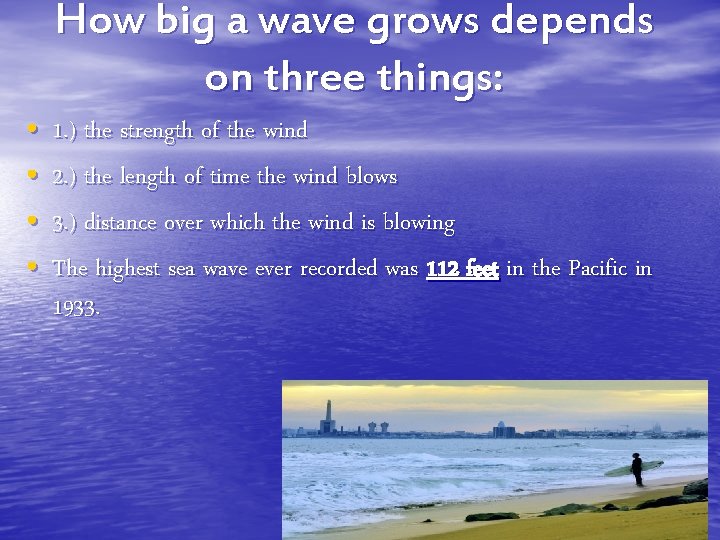
How big a wave grows depends on three things: • 1. ) the strength of the wind • 2. ) the length of time the wind blows • 3. ) distance over which the wind is blowing • The highest sea wave ever recorded was 112 feet in the Pacific in 1933.
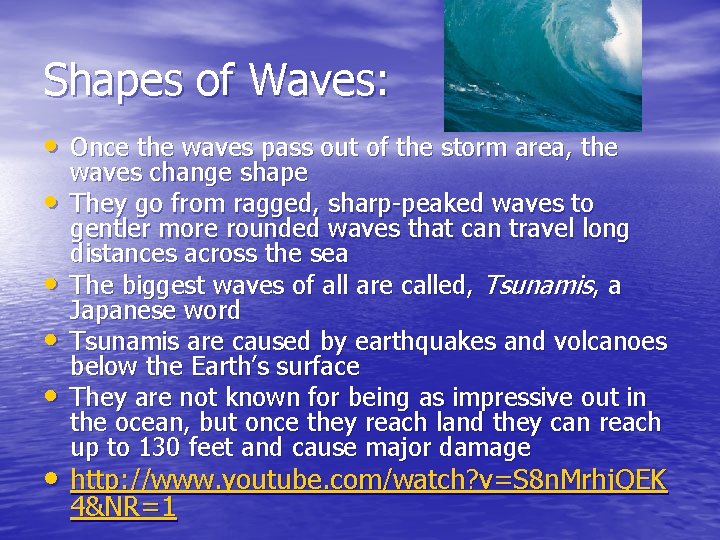
Shapes of Waves: • Once the waves pass out of the storm area, the • • waves change shape They go from ragged, sharp-peaked waves to gentler more rounded waves that can travel long distances across the sea The biggest waves of all are called, Tsunamis, a Japanese word Tsunamis are caused by earthquakes and volcanoes below the Earth’s surface They are not known for being as impressive out in the ocean, but once they reach land they can reach up to 130 feet and cause major damage • http: //www. youtube. com/watch? v=S 8 n. Mrhj. QEK 4&NR=1
Water in Waves: • • The top of the wave is called the crest The bottom of the wave is called the trough The distance from one wave to another is called the wavelength As waves travel they allow the surface water to form circles This allows the water deeper down to also move in circles The circles become smaller and smaller until they die out Once the waves reach the shore they are no longer moving in circular motions, but oval motions Because of this the crest becomes higher and steeper, and the distance between the waves gets shorter, this causes the crest to topple and break on shore

Passing Waves: • Waves pass through water • They do NOT take water with them as they • • • move This idea is shown if you watch a bottle on the water As the waves pass the bottle stays in the same place, but bobs up and down Eventually the bottle with drift, but only because of surface ocean currents
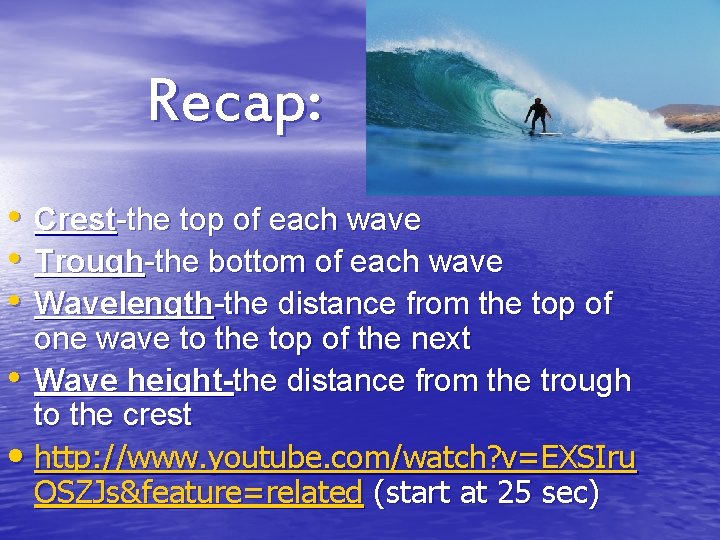
Recap: • • • Crest-the top of each wave Trough-the bottom of each wave Wavelength-the distance from the top of one wave to the top of the next • Wave height-the distance from the trough to the crest • http: //www. youtube. com/watch? v=EXSIru OSZJs&feature=related (start at 25 sec)
References • • • Academic Content Standards Book (K-12 Science) - http: //www. csmonitor. com/2004/0817/csmimg/p 18 a. pdf -www. youtube. com -Books: Asimov, Isaac. The Ocean Book. Canada: John Wiley & Sons, Inc. , 1989. 23. Bramwell, Martyn. The Oceans. New York: Franklin Watts, Inc. , 1987. 16 -17. Taylor, Barbara. Oceans. London: Franklin Watts, Inc. , 1997. 18 -19. Additional Resources: - http: //www. nationalgeographic. com/xpeditions/lessons/07/gk 2/wavesintro. html - Physical Oceanography. 2 nd ed. Arlington: National Sciences Teachers Association, 1995.
- Slides: 8