
Lets get started with Logic 10272020 1 Logic
- Slides: 35
Let’s get started with. . . Logic! 10/27/2020 1
Logic • Crucial for mathematical reasoning • Used for designing electronic circuitry • Logic is a system based on propositions. • A proposition is a statement that is either true or false (not both). • We say that the truth value of a proposition is either true (T) or false (F). • Corresponds to 1 and 0 in digital circuits 10/27/2020 2
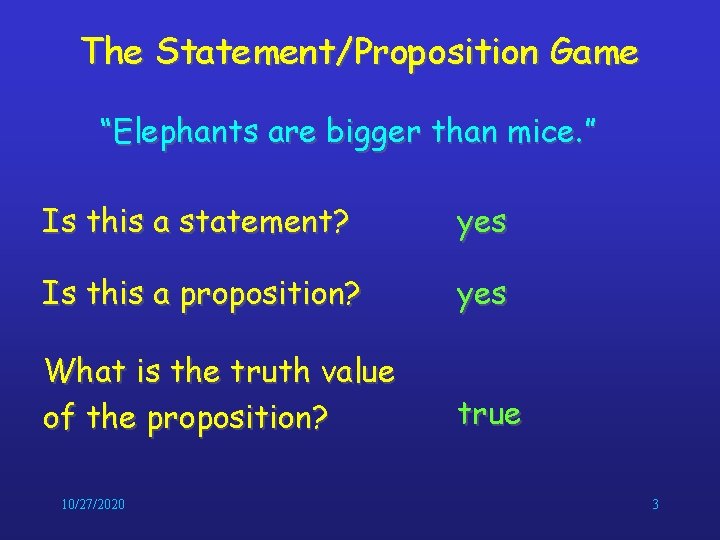
The Statement/Proposition Game “Elephants are bigger than mice. ” Is this a statement? yes Is this a proposition? yes What is the truth value of the proposition? true 10/27/2020 3
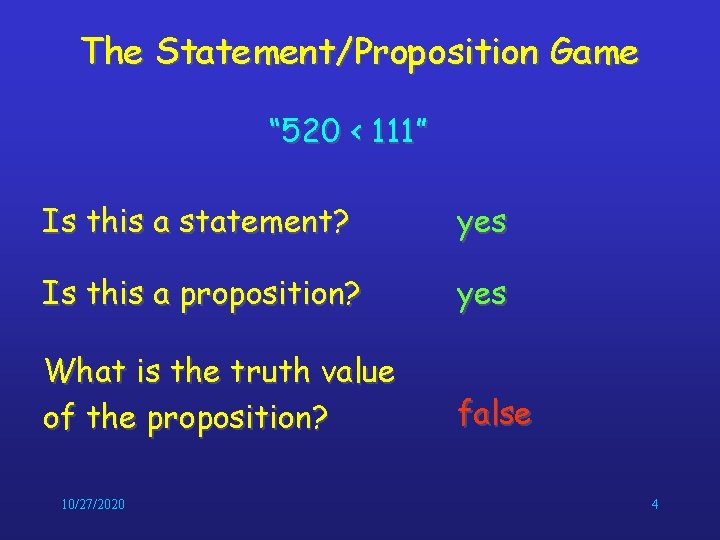
The Statement/Proposition Game “ 520 < 111” Is this a statement? yes Is this a proposition? yes What is the truth value of the proposition? false 10/27/2020 4
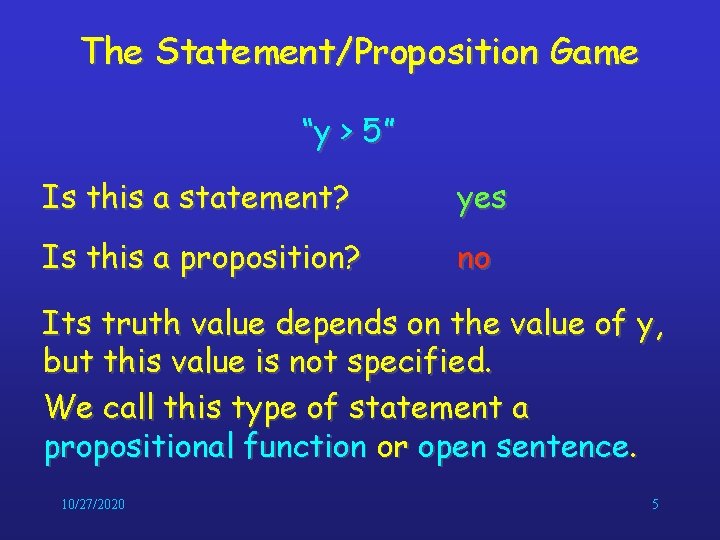
The Statement/Proposition Game “y > 5” Is this a statement? yes Is this a proposition? no Its truth value depends on the value of y, but this value is not specified. We call this type of statement a propositional function or open sentence. 10/27/2020 5
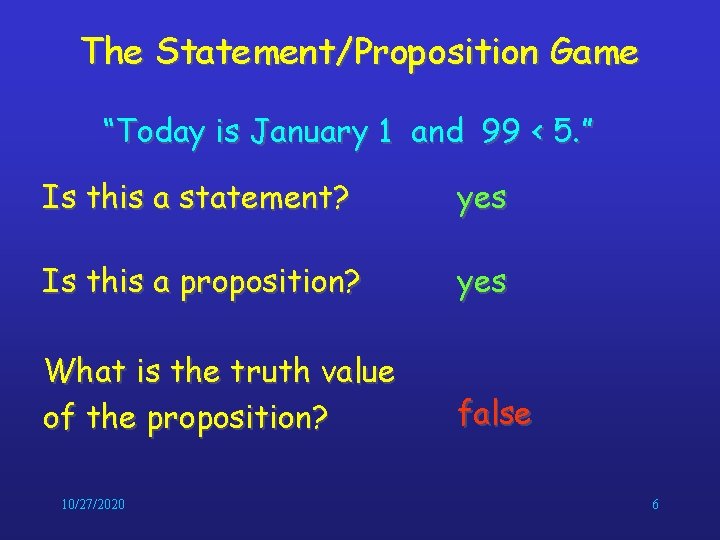
The Statement/Proposition Game “Today is January 1 and 99 < 5. ” Is this a statement? yes Is this a proposition? yes What is the truth value of the proposition? false 10/27/2020 6
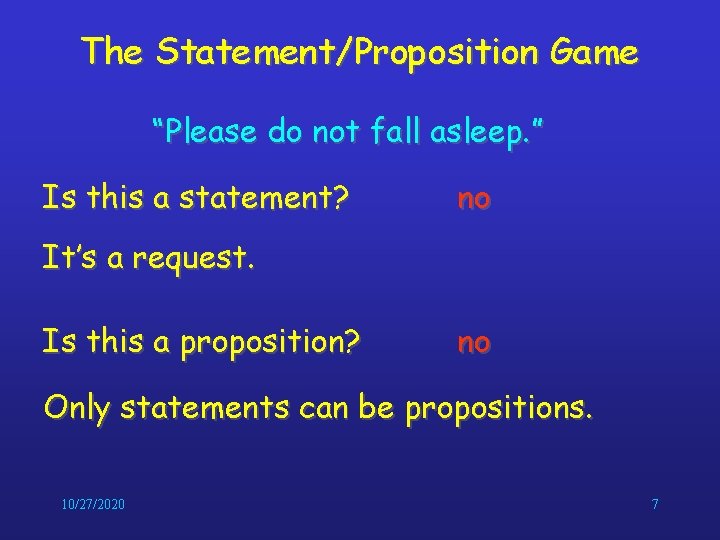
The Statement/Proposition Game “Please do not fall asleep. ” Is this a statement? no It’s a request. Is this a proposition? no Only statements can be propositions. 10/27/2020 7
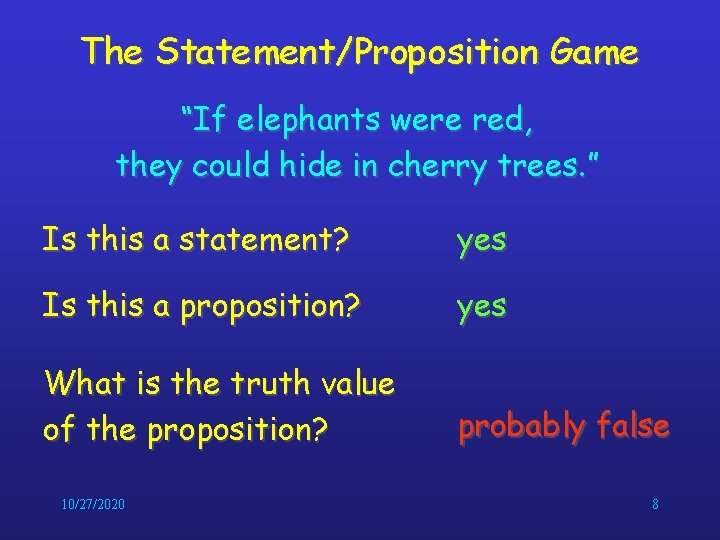
The Statement/Proposition Game “If elephants were red, they could hide in cherry trees. ” Is this a statement? yes Is this a proposition? yes What is the truth value of the proposition? probably false 10/27/2020 8
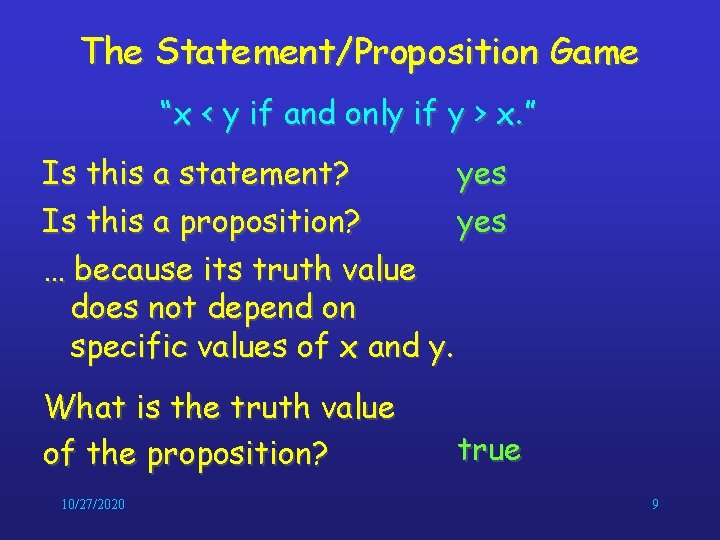
The Statement/Proposition Game “x < y if and only if y > x. ” Is this a statement? yes Is this a proposition? yes … because its truth value does not depend on specific values of x and y. What is the truth value of the proposition? 10/27/2020 true 9
Combining Propositions As we have seen in the previous examples, one or more propositions can be combined to form a single compound proposition. We formalize this by denoting propositions with letters such as p, q, r, s, and introducing several logical operators. 10/27/2020 10
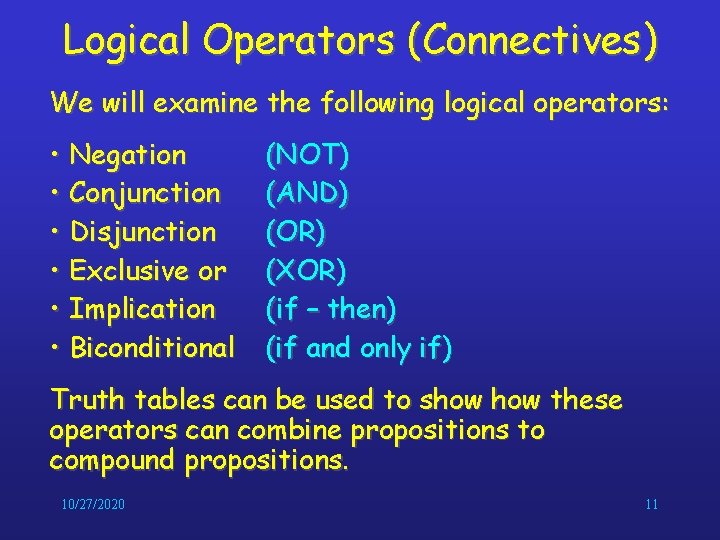
Logical Operators (Connectives) We will examine the following logical operators: • Negation • Conjunction • Disjunction • Exclusive or • Implication • Biconditional (NOT) (AND) (OR) (XOR) (if – then) (if and only if) Truth tables can be used to show these operators can combine propositions to compound propositions. 10/27/2020 11
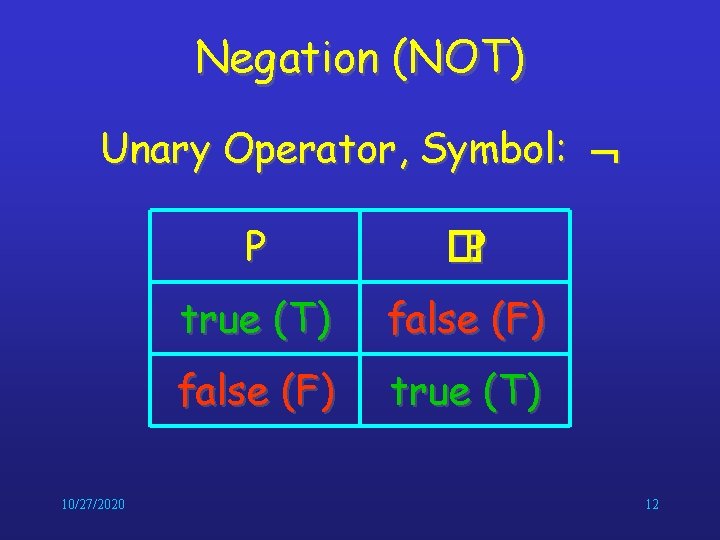
Negation (NOT) Unary Operator, Symbol: 10/27/2020 P �P true (T) false (F) true (T) 12
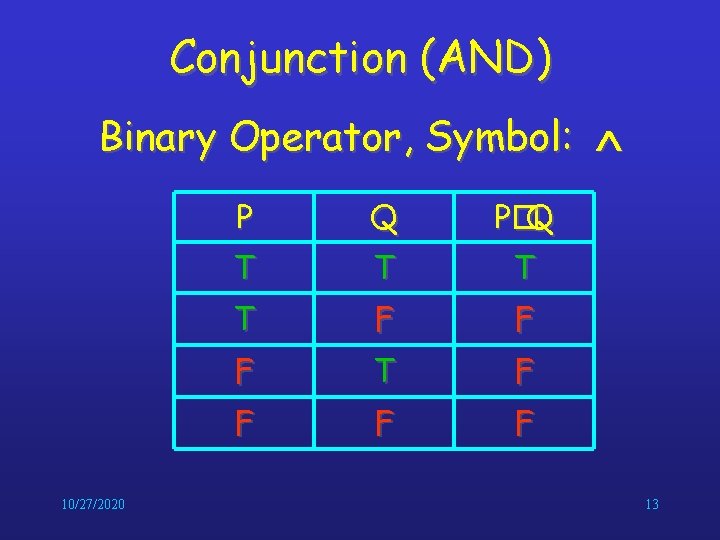
Conjunction (AND) Binary Operator, Symbol: 10/27/2020 P Q P�Q T T F F F T F F 13
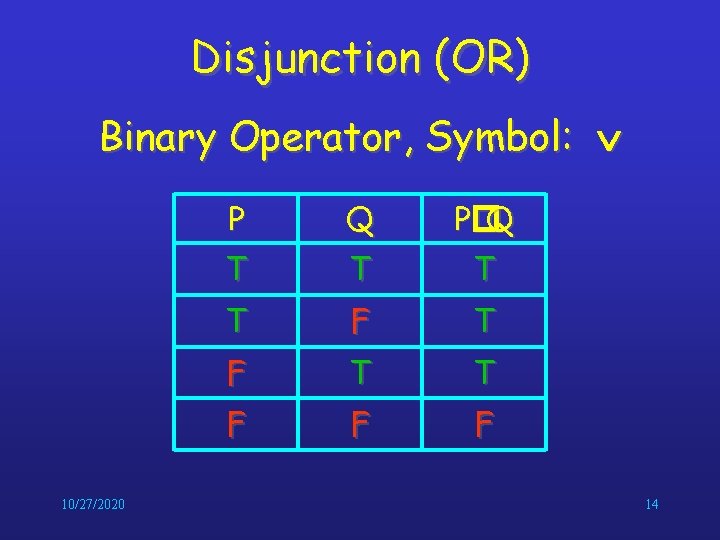
Disjunction (OR) Binary Operator, Symbol: 10/27/2020 P Q P�Q T T F F F 14
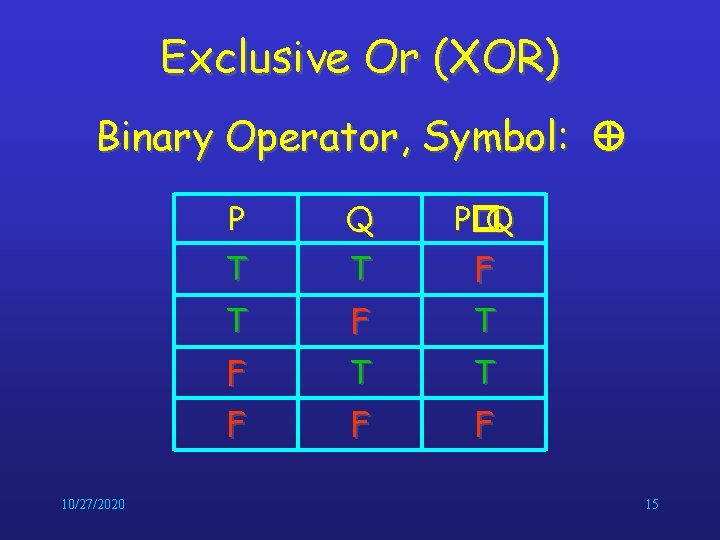
Exclusive Or (XOR) Binary Operator, Symbol: 10/27/2020 P Q P�Q T T F T F T T F F F 15
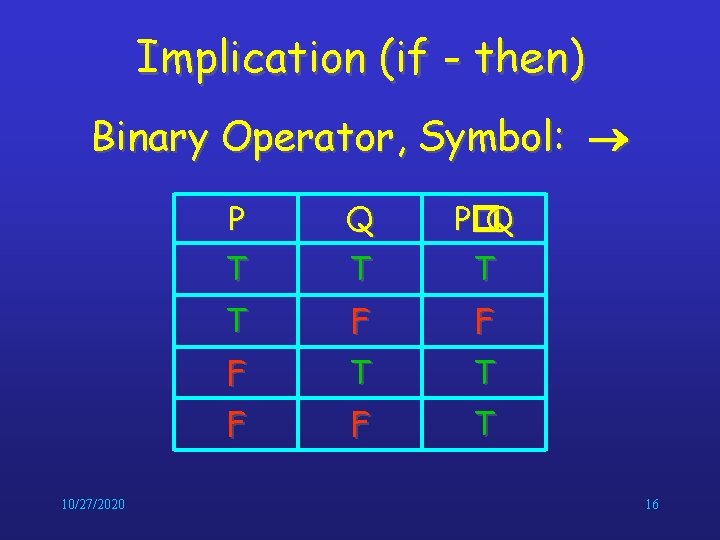
Implication (if - then) Binary Operator, Symbol: 10/27/2020 P Q P�Q T T F F F T T F F T 16
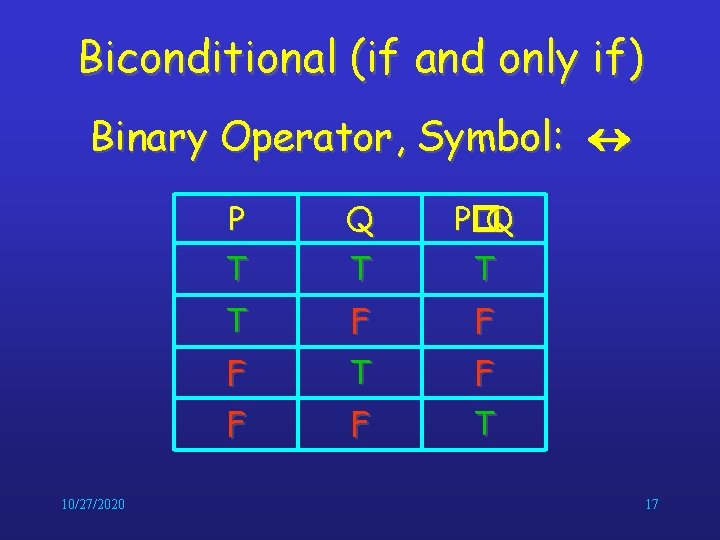
Biconditional (if and only if) Binary Operator, Symbol: 10/27/2020 P Q P�Q T T F F F T 17
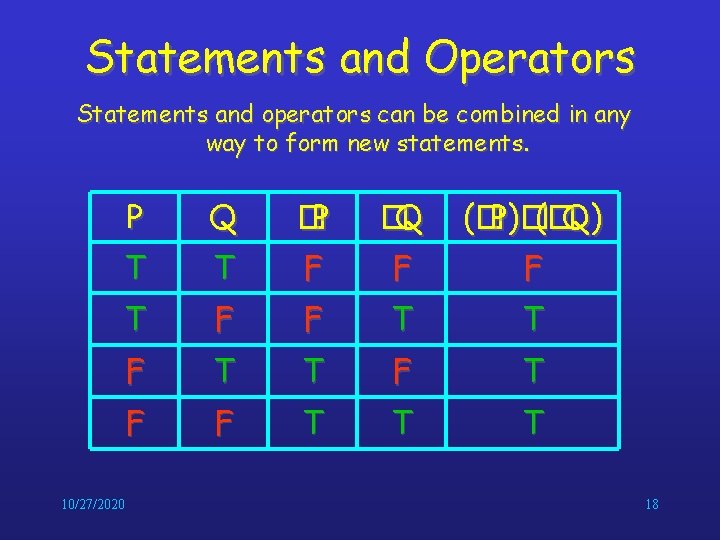
Statements and Operators Statements and operators can be combined in any way to form new statements. P Q �P �Q (�P)�(�Q) T T F F F T T F T F F T T T 10/27/2020 18
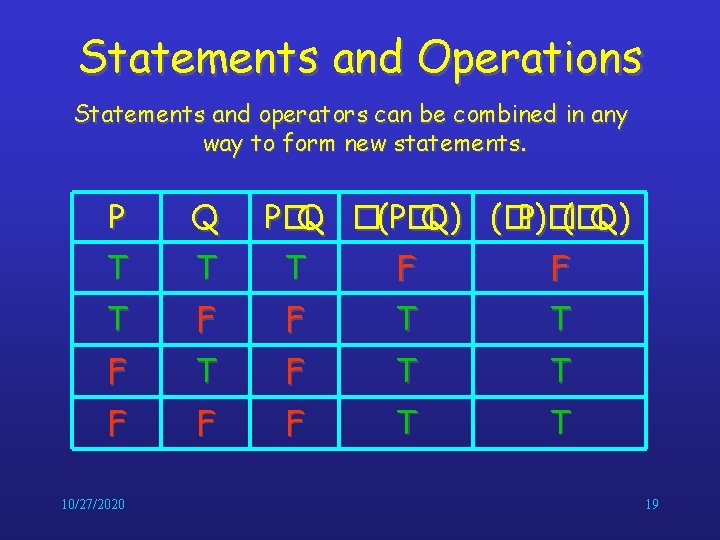
Statements and Operations Statements and operators can be combined in any way to form new statements. P Q T T T F F T T F F F T T 10/27/2020 P�Q �(P�Q) (�P)�(�Q) 19
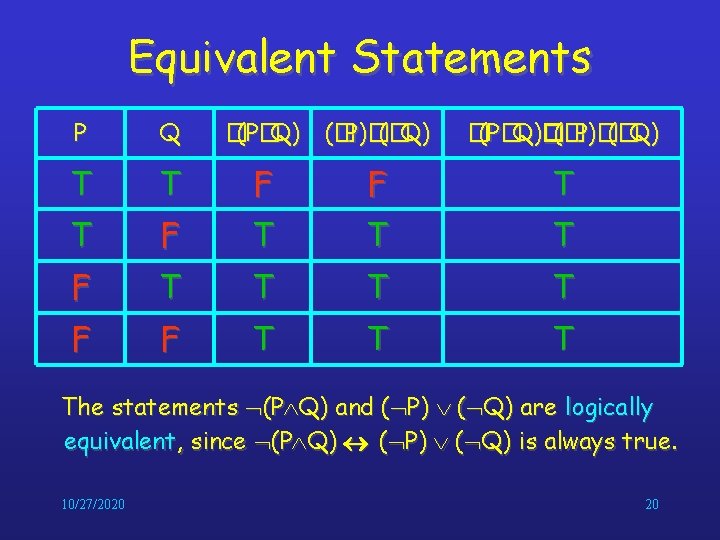
Equivalent Statements P Q � (P�Q) (� P)�(�Q) �(P�Q)�(�P)�(�Q) T T F F T T T F F T The statements (P Q) and ( P) ( Q) are logically equivalent, since (P Q) ( P) ( Q) is always true. 10/27/2020 20
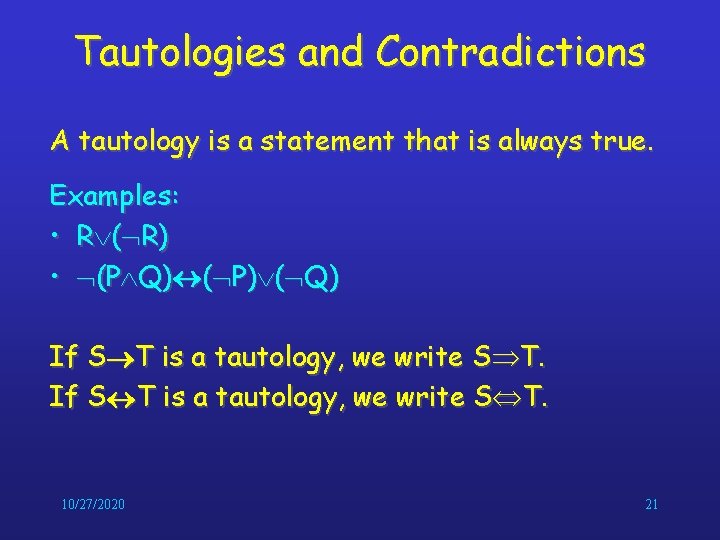
Tautologies and Contradictions A tautology is a statement that is always true. Examples: • R ( R) • (P Q) ( P) ( Q) If S T is a tautology, we write S T. 10/27/2020 21
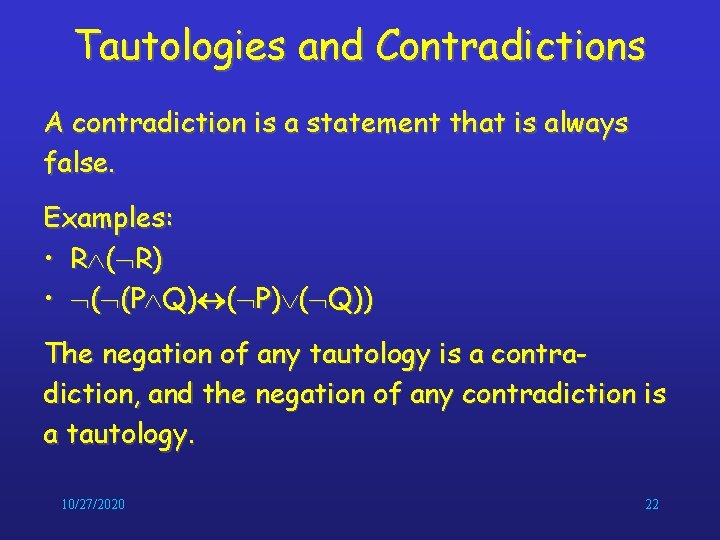
Tautologies and Contradictions A contradiction is a statement that is always false. Examples: • R ( R) • ( (P Q) ( P) ( Q)) The negation of any tautology is a contradiction, and the negation of any contradiction is a tautology. 10/27/2020 22
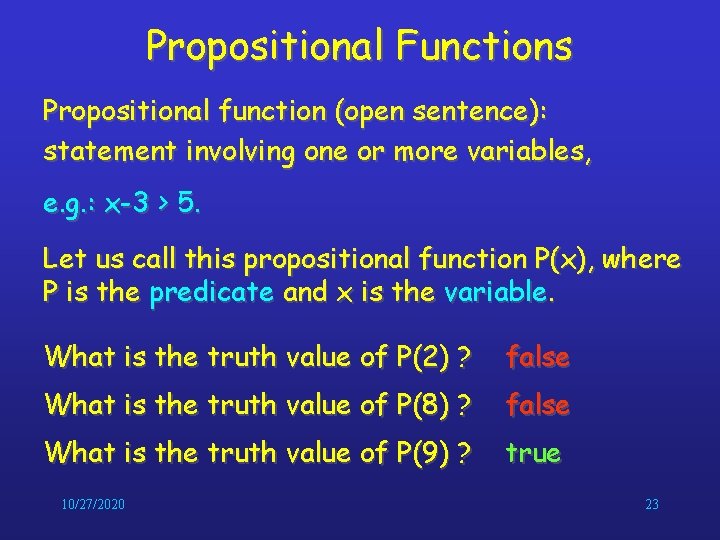
Propositional Functions Propositional function (open sentence): statement involving one or more variables, e. g. : x-3 > 5. Let us call this propositional function P(x), where P is the predicate and x is the variable. What is the truth value of P(2) ? false What is the truth value of P(8) ? false What is the truth value of P(9) ? true 10/27/2020 23
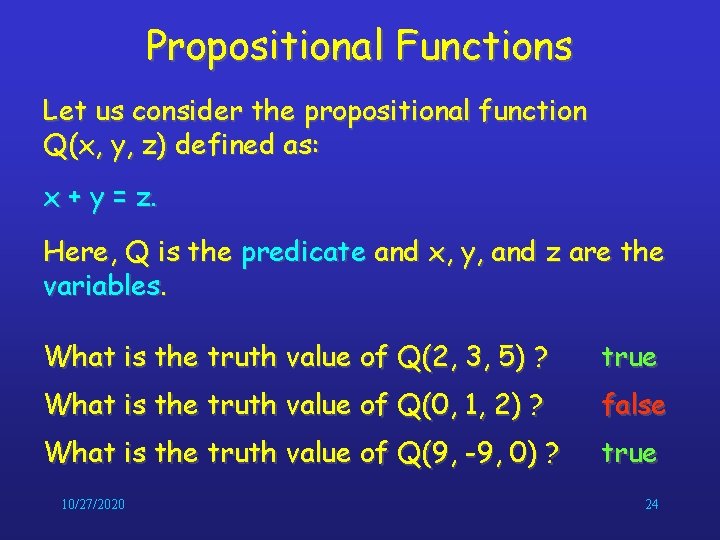
Propositional Functions Let us consider the propositional function Q(x, y, z) defined as: x + y = z. Here, Q is the predicate and x, y, and z are the variables. What is the truth value of Q(2, 3, 5) ? true What is the truth value of Q(0, 1, 2) ? false What is the truth value of Q(9, -9, 0) ? true 10/27/2020 24
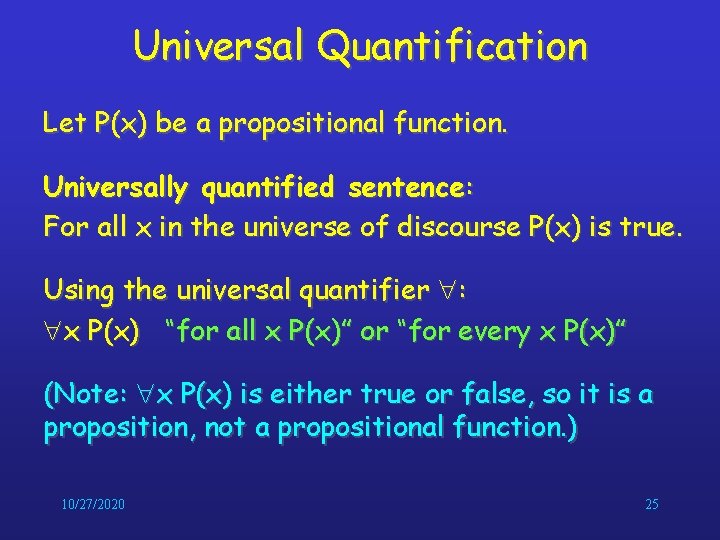
Universal Quantification Let P(x) be a propositional function. Universally quantified sentence: For all x in the universe of discourse P(x) is true. Using the universal quantifier : x P(x) “for all x P(x)” or “for every x P(x)” (Note: x P(x) is either true or false, so it is a proposition, not a propositional function. ) 10/27/2020 25
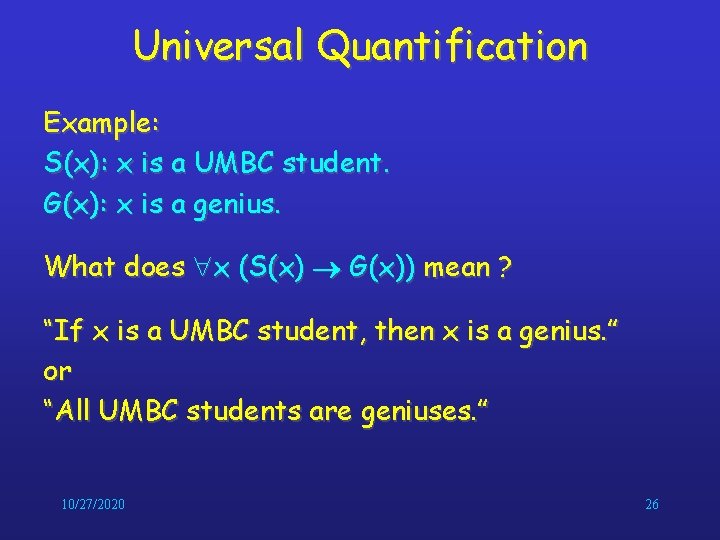
Universal Quantification Example: S(x): x is a UMBC student. G(x): x is a genius. What does x (S(x) G(x)) mean ? “If x is a UMBC student, then x is a genius. ” or “All UMBC students are geniuses. ” 10/27/2020 26
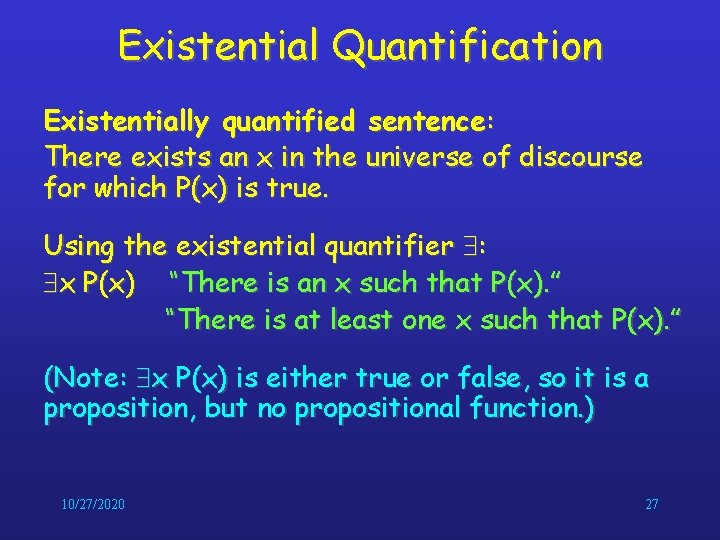
Existential Quantification Existentially quantified sentence: There exists an x in the universe of discourse for which P(x) is true. Using the existential quantifier : x P(x) “There is an x such that P(x). ” “There is at least one x such that P(x). ” (Note: x P(x) is either true or false, so it is a proposition, but no propositional function. ) 10/27/2020 27
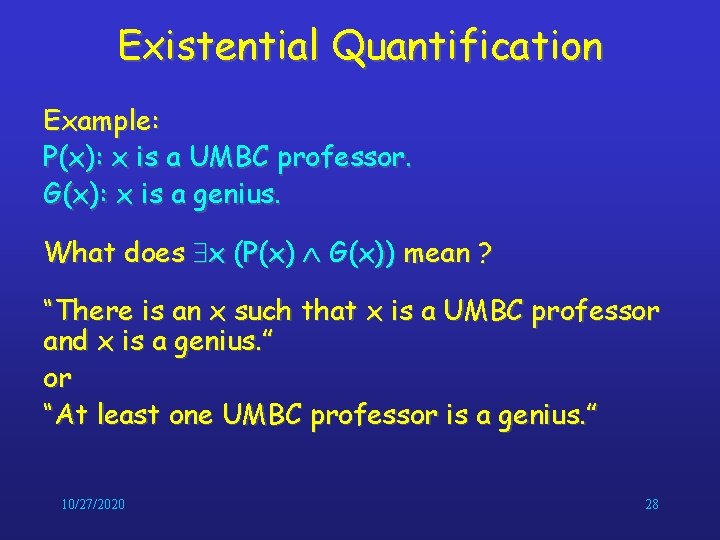
Existential Quantification Example: P(x): x is a UMBC professor. G(x): x is a genius. What does x (P(x) G(x)) mean ? “There is an x such that x is a UMBC professor and x is a genius. ” or “At least one UMBC professor is a genius. ” 10/27/2020 28
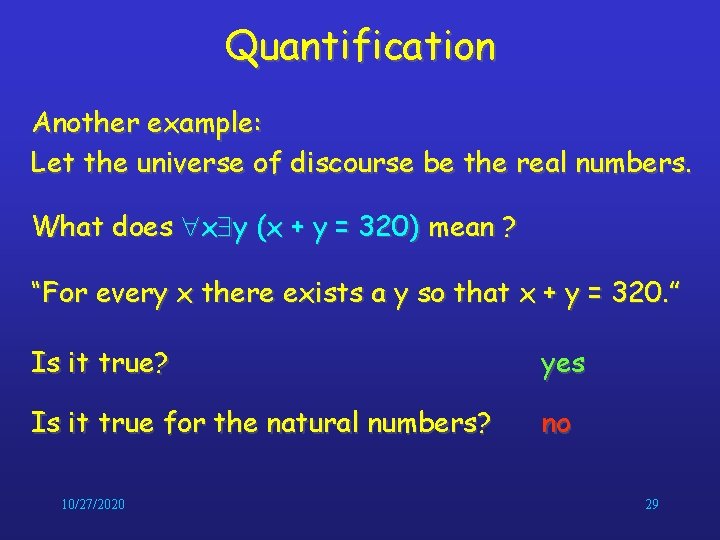
Quantification Another example: Let the universe of discourse be the real numbers. What does x y (x + y = 320) mean ? “For every x there exists a y so that x + y = 320. ” Is it true? yes Is it true for the natural numbers? no 10/27/2020 29
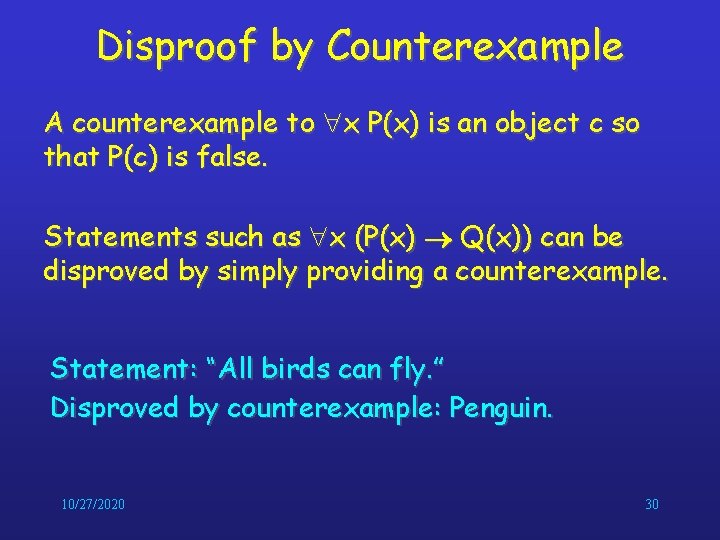
Disproof by Counterexample A counterexample to x P(x) is an object c so that P(c) is false. Statements such as x (P(x) Q(x)) can be disproved by simply providing a counterexample. Statement: “All birds can fly. ” Disproved by counterexample: Penguin. 10/27/2020 30
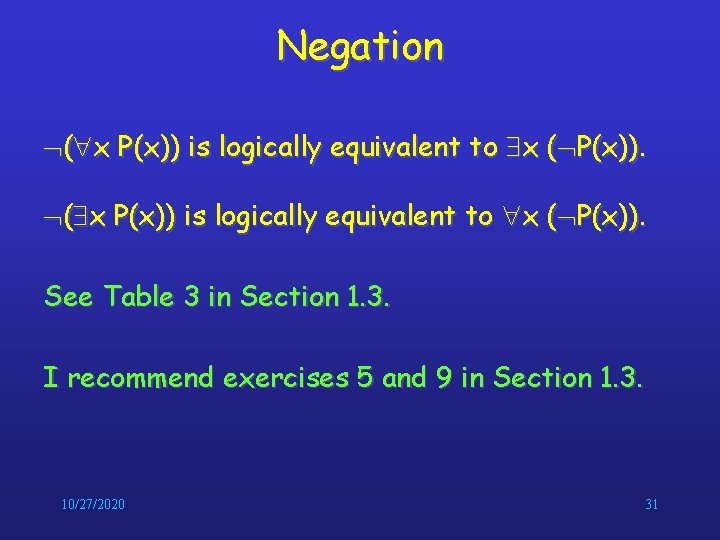
Negation ( x P(x)) is logically equivalent to x ( P(x)). See Table 3 in Section 1. 3. I recommend exercises 5 and 9 in Section 1. 3. 10/27/2020 31
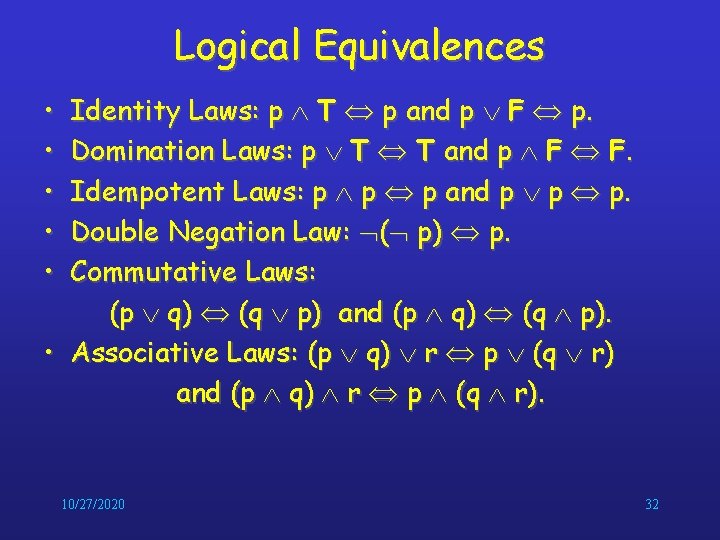
Logical Equivalences • • • Identity Laws: p T p and p F p. Domination Laws: p T T and p F F. Idempotent Laws: p p p and p p p. Double Negation Law: ( p) p. Commutative Laws: (p q) (q p) and (p q) (q p). • Associative Laws: (p q) r p (q r) and (p q) r p (q r). 10/27/2020 32
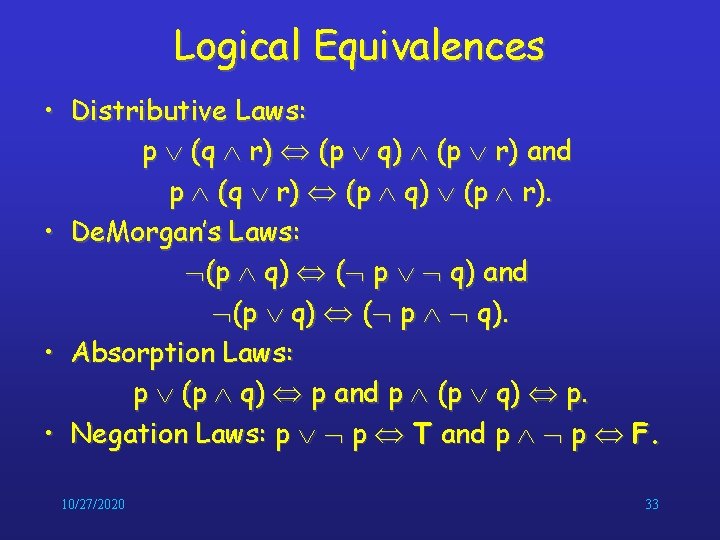
Logical Equivalences • Distributive Laws: p (q r) (p q) (p r) and p (q r) (p q) (p r). • De. Morgan’s Laws: (p q) ( p q) and (p q) ( p q). • Absorption Laws: p (p q) p and p (p q) p. • Negation Laws: p p T and p p F. 10/27/2020 33
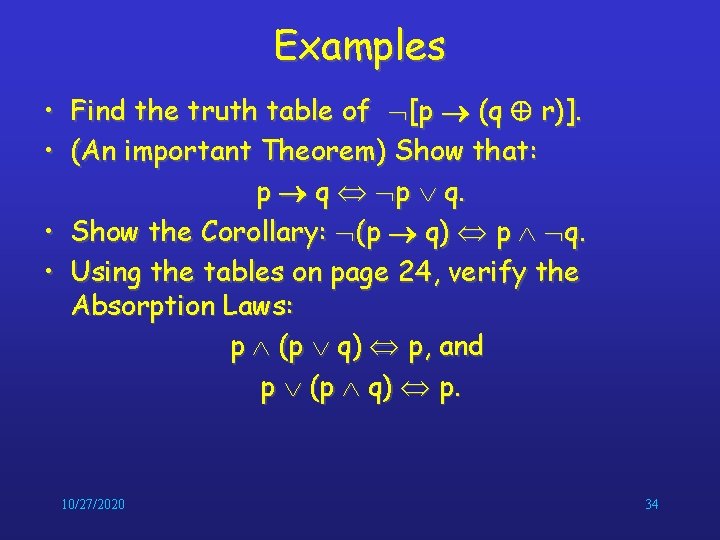
Examples • Find the truth table of [p (q r)]. • (An important Theorem) Show that: p q. • Show the Corollary: (p q) p q. • Using the tables on page 24, verify the Absorption Laws: p (p q) p, and p (p q) p. 10/27/2020 34
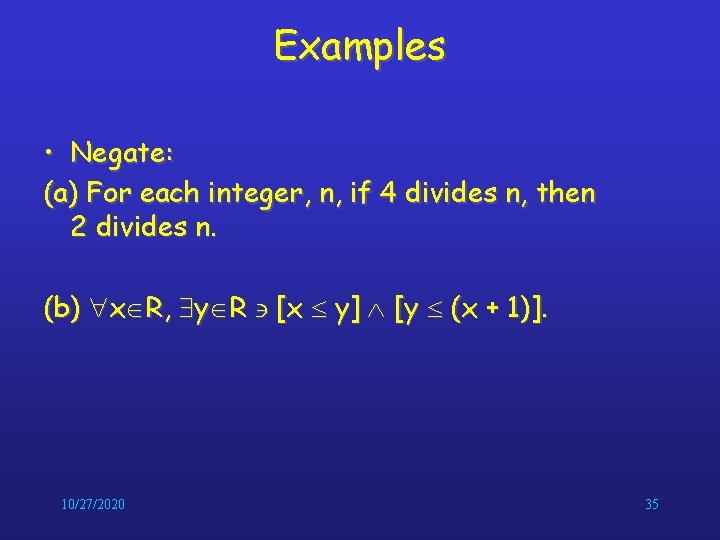
Examples • Negate: (a) For each integer, n, if 4 divides n, then 2 divides n. (b) x R, y R [x y] [y (x + 1)]. 10/27/2020 35