
Lets get some equality for disabled pepple in

Lets get some equality for disabled pepple in our schools: How can we use the Duty to promote Disability Equality Richard Rieser Disability Equality www. worldofinclusion. com
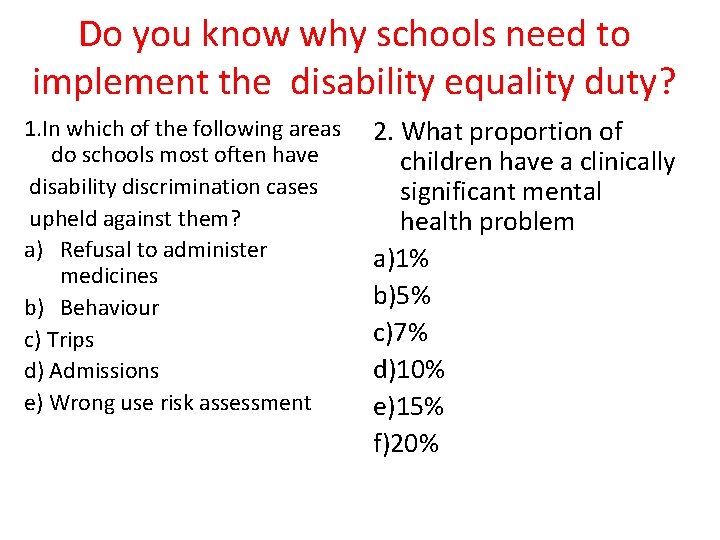
Do you know why schools need to implement the disability equality duty? 1. In which of the following areas do schools most often have disability discrimination cases upheld against them? a) Refusal to administer medicines b) Behaviour c) Trips d) Admissions e) Wrong use risk assessment 2. What proportion of children have a clinically significant mental health problem a)1% b)5% c)7% d)10% e)15% f)20%
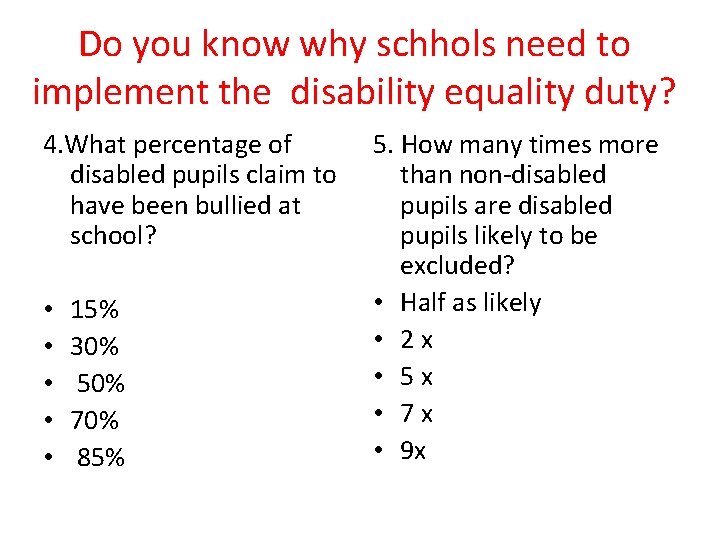
Do you know why schhols need to implement the disability equality duty? 4. What percentage of disabled pupils claim to have been bullied at school? • • • 15% 30% 50% 70% 85% 5. How many times more than non-disabled pupils are disabled pupils likely to be excluded? • Half as likely • 2 x • 5 x • 7 x • 9 x
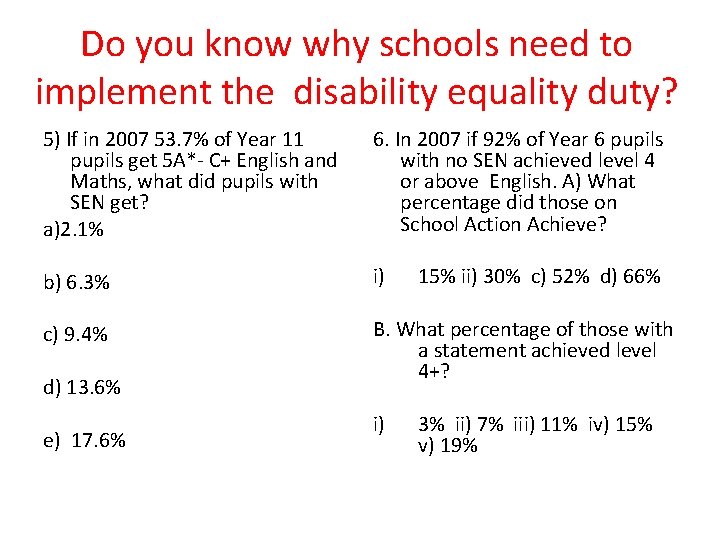
Do you know why schools need to implement the disability equality duty? 5) If in 2007 53. 7% of Year 11 pupils get 5 A*- C+ English and Maths, what did pupils with SEN get? a)2. 1% 6. In 2007 if 92% of Year 6 pupils with no SEN achieved level 4 or above English. A) What percentage did those on School Action Achieve? b) 6. 3% i) c) 9. 4% B. What percentage of those with a statement achieved level 4+? d) 13. 6% e) 17. 6% i) 15% ii) 30% c) 52% d) 66% 3% ii) 7% iii) 11% iv) 15% v) 19%

Who are disabled people? • Disability Discrimination Act Definition of disability • 1. “A person has a disability if he has a physical or mental impairment which has a substantial and long-term adverse effect on his ability to carry out normal day-to-day activities. ” - Part 1, Para. 1. 1. • For the purposes of definition, ignore the effects of medical or other treatments or aids and appliances.
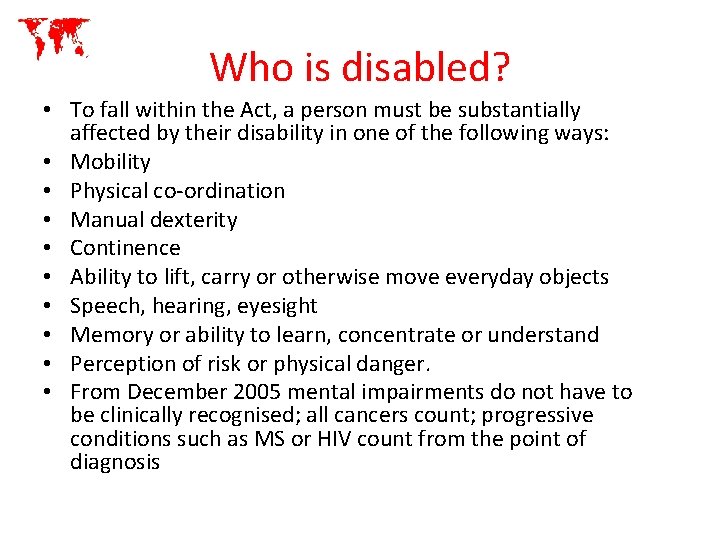
Who is disabled? • To fall within the Act, a person must be substantially affected by their disability in one of the following ways: • Mobility • Physical co-ordination • Manual dexterity • Continence • Ability to lift, carry or otherwise move everyday objects • Speech, hearing, eyesight • Memory or ability to learn, concentrate or understand • Perception of risk or physical danger. • From December 2005 mental impairments do not have to be clinically recognised; all cancers count; progressive conditions such as MS or HIV count from the point of diagnosis
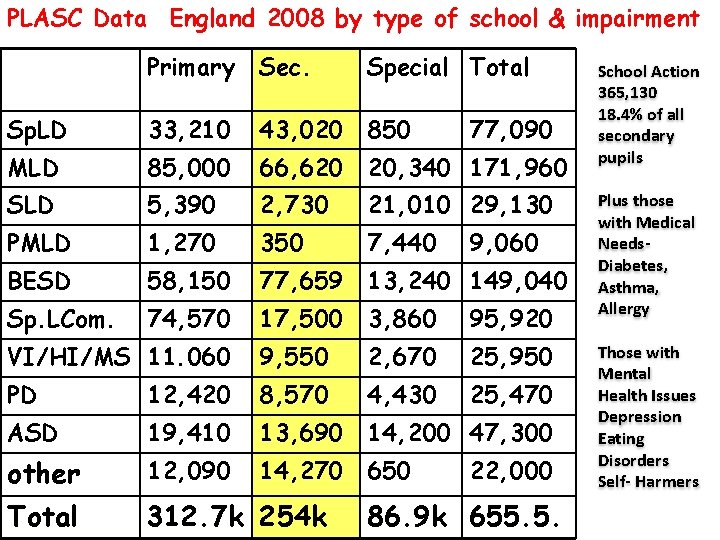
PLASC Data England 2008 by type of school & impairment Primary Sec. Special Total Sp. LD 33, 210 43, 020 850 MLD 85, 000 66, 620 20, 340 171, 960 SLD 5, 390 2, 730 21, 010 29, 130 PMLD 1, 270 350 7, 440 BESD 58, 150 77, 659 13, 240 149, 040 Sp. LCom. 74, 570 17, 500 3, 860 95, 920 VI/HI/MS 11. 060 9, 550 2, 670 25, 950 PD 12, 420 8, 570 4, 430 25, 470 ASD 19, 410 13, 690 14, 200 47, 300 other 12, 090 14, 270 650 Total 312. 7 k 254 k 77, 090 9, 060 22, 000 86. 9 k 655. 5. School Action 365, 130 18. 4% of all secondary pupils Plus those with Medical Needs. Diabetes, Asthma, Allergy Those with Mental Health Issues Depression Eating Disorders Self- Harmers
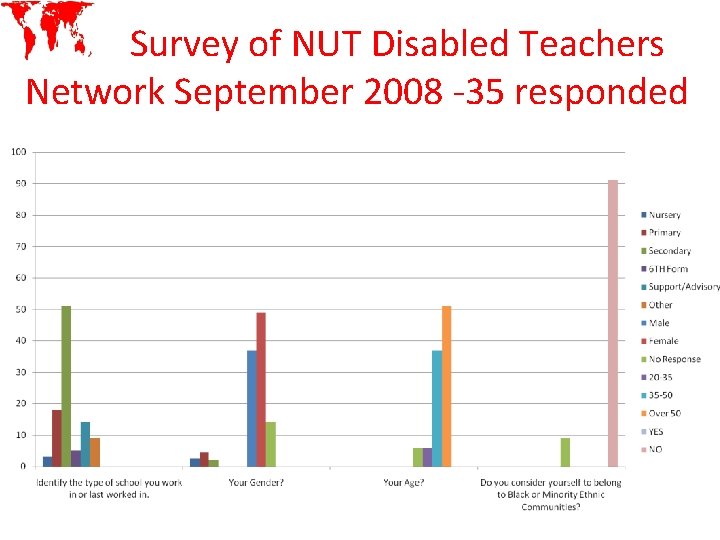
Survey of NUT Disabled Teachers Network September 2008 -35 responded
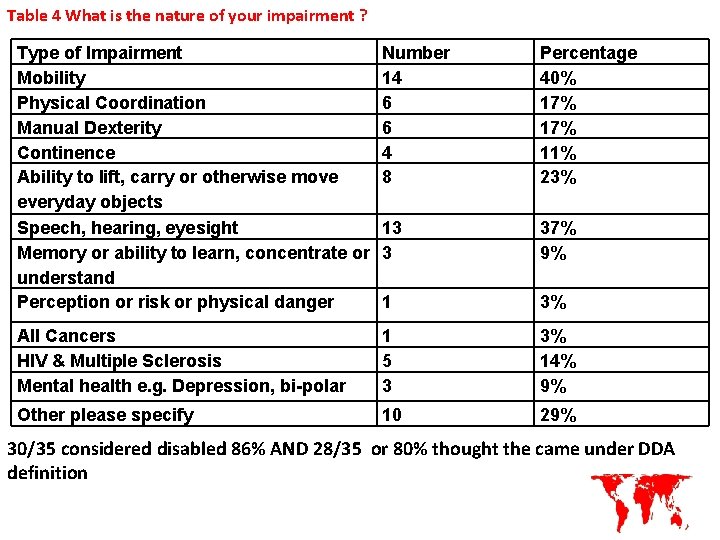
Table 4 What is the nature of your impairment ? Type of Impairment Mobility Physical Coordination Manual Dexterity Continence Ability to lift, carry or otherwise move everyday objects Speech, hearing, eyesight Memory or ability to learn, concentrate or understand Perception or risk or physical danger Number 14 6 6 4 8 Percentage 40% 17% 11% 23% 13 3 37% 9% 1 3% All Cancers HIV & Multiple Sclerosis Mental health e. g. Depression, bi-polar 1 5 3 3% 14% 9% Other please specify 10 29% 30/35 considered disabled 86% AND 28/35 or 80% thought the came under DDA definition
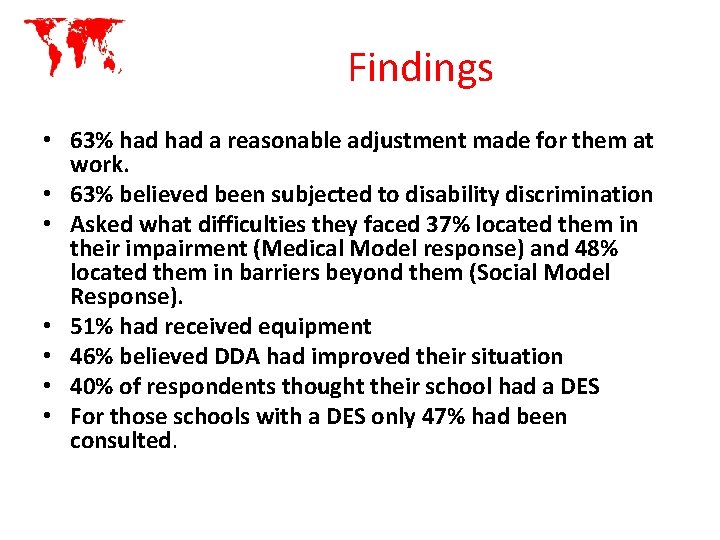
Findings • 63% had a reasonable adjustment made for them at work. • 63% believed been subjected to disability discrimination • Asked what difficulties they faced 37% located them in their impairment (Medical Model response) and 48% located them in barriers beyond them (Social Model Response). • 51% had received equipment • 46% believed DDA had improved their situation • 40% of respondents thought their school had a DES • For those schools with a DES only 47% had been consulted.
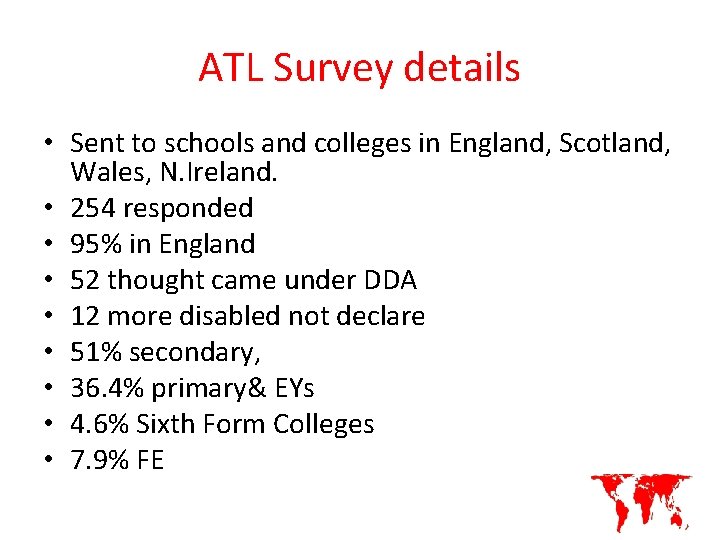
ATL Survey details • Sent to schools and colleges in England, Scotland, Wales, N. Ireland. • 254 responded • 95% in England • 52 thought came under DDA • 12 more disabled not declare • 51% secondary, • 36. 4% primary& EYs • 4. 6% Sixth Form Colleges • 7. 9% FE
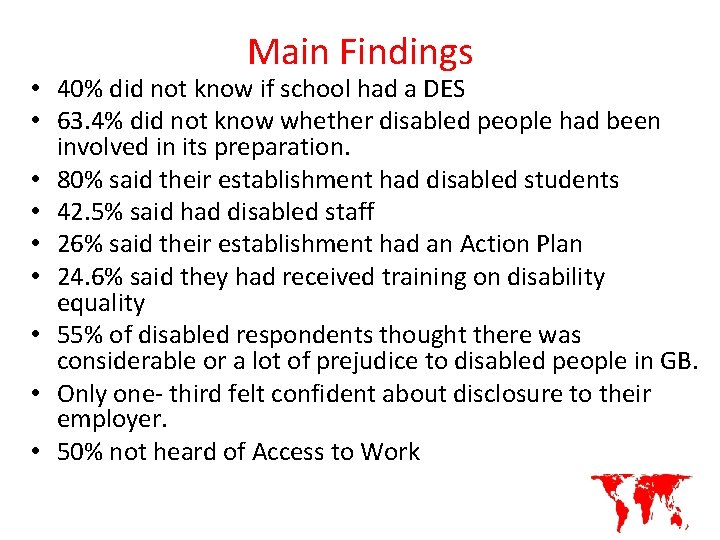
Main Findings • 40% did not know if school had a DES • 63. 4% did not know whether disabled people had been involved in its preparation. • 80% said their establishment had disabled students • 42. 5% said had disabled staff • 26% said their establishment had an Action Plan • 24. 6% said they had received training on disability equality • 55% of disabled respondents thought there was considerable or a lot of prejudice to disabled people in GB. • Only one- third felt confident about disclosure to their employer. • 50% not heard of Access to Work
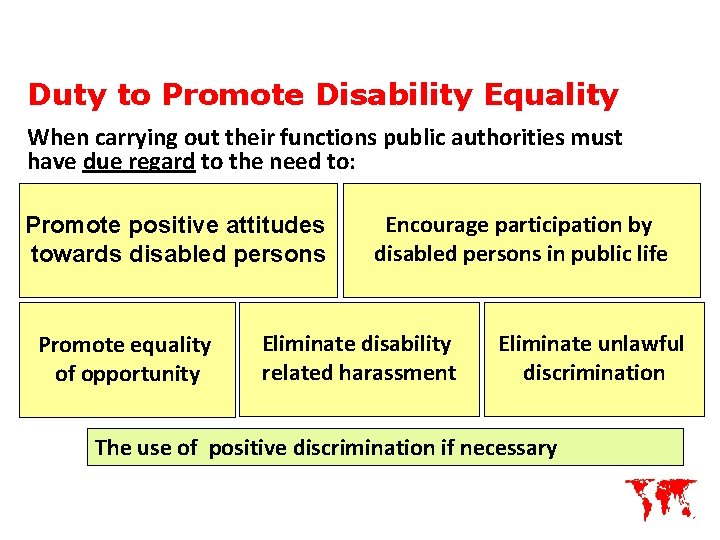
Duty to Promote Disability Equality When carrying out their functions public authorities must have due regard to the need to: Promote positive attitudes towards disabled persons Promote equality of opportunity Encourage participation by disabled persons in public life Eliminate disability related harassment Eliminate unlawful discrimination The use of positive discrimination if necessary
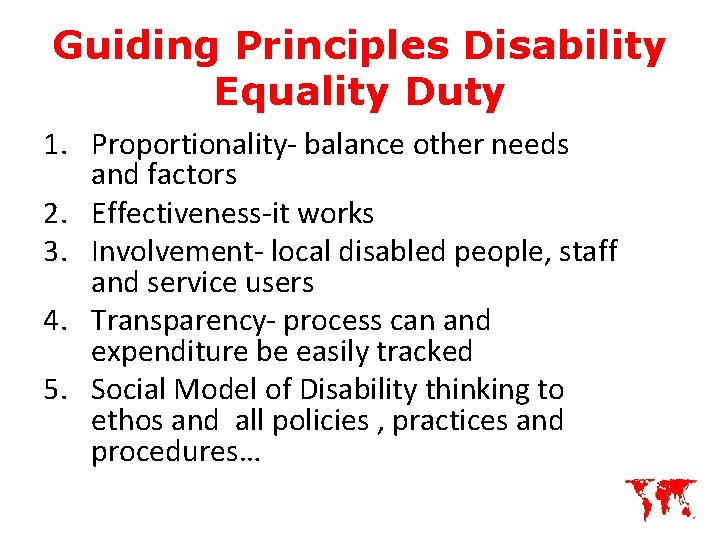
Guiding Principles Disability Equality Duty 1. Proportionality- balance other needs and factors 2. Effectiveness-it works 3. Involvement- local disabled people, staff and service users 4. Transparency- process can and expenditure be easily tracked 5. Social Model of Disability thinking to ethos and all policies , practices and procedures…
Disability Equality Scheme • How the school will implement General Duty? • Engagement with disabled people in production, setting targets and monitoring of the scheme. • How it meets with the strategic priorities of the school. ? • How the school will collect and analyse data e. g. : - achievement of disabled pupils, - exclusions, - staff recruitment and promotion? • Impact assess the policies, practices and procedures on disabled people. • Identify key outcomes
Disability Equality Scheme • How the school will implement General Duty? • Engagement with disabled people in production, setting targets and monitoring of the scheme. • How it meets with the strategic priorities of the school. ? • How the school will collect and analyse data e. g. : - achievement of disabled pupils, - exclusions, - staff recruitment and promotion? • Impact assess the policies, practices and procedures on disabled people. • Identify key outcomes
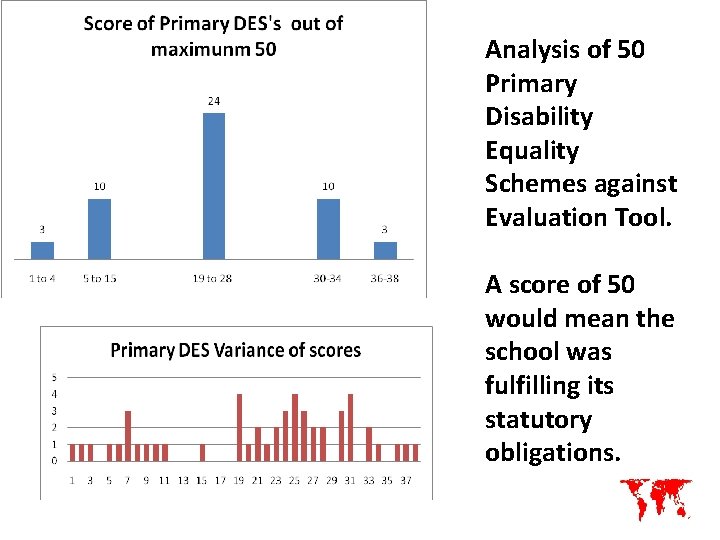
Analysis of 50 Primary Disability Equality Schemes against Evaluation Tool. A score of 50 would mean the school was fulfilling its statutory obligations.
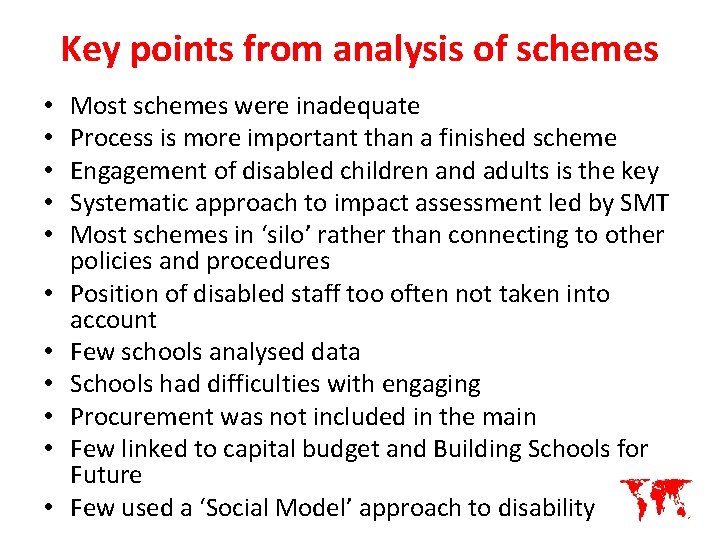
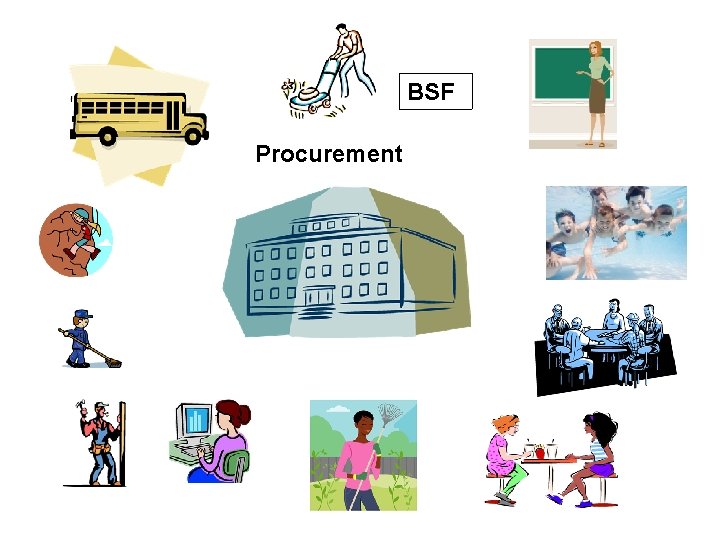
Key points from analysis of schemes • • • Most schemes were inadequate Process is more important than a finished scheme Engagement of disabled children and adults is the key Systematic approach to impact assessment led by SMT Most schemes in ‘silo’ rather than connecting to other policies and procedures Position of disabled staff too often not taken into account Few schools analysed data Schools had difficulties with engaging Procurement was not included in the main Few linked to capital budget and Building Schools for Future Few used a ‘Social Model’ approach to disability
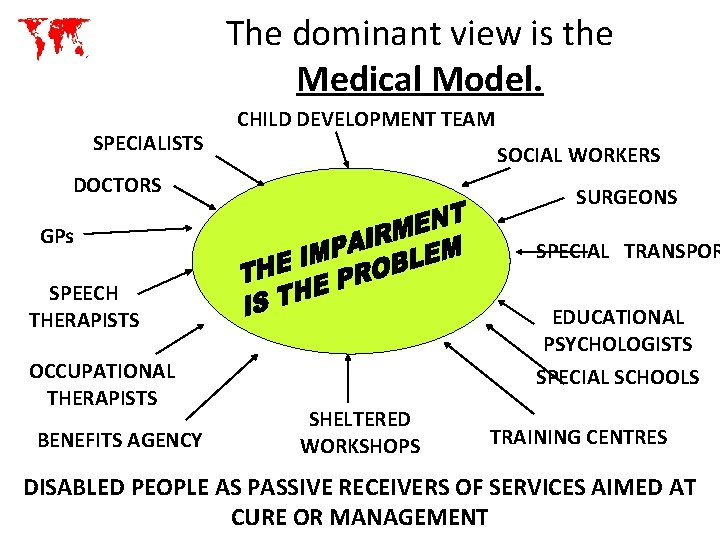
The dominant view is the Medical Model. SPECIALISTS CHILD DEVELOPMENT TEAM SOCIAL WORKERS DOCTORS SURGEONS GPs SPECIAL TRANSPOR SPEECH THERAPISTS OCCUPATIONAL THERAPISTS BENEFITS AGENCY EDUCATIONAL PSYCHOLOGISTS SPECIAL SCHOOLS SHELTERED WORKSHOPS TRAINING CENTRES DISABLED PEOPLE AS PASSIVE RECEIVERS OF SERVICES AIMED AT CURE OR MANAGEMENT
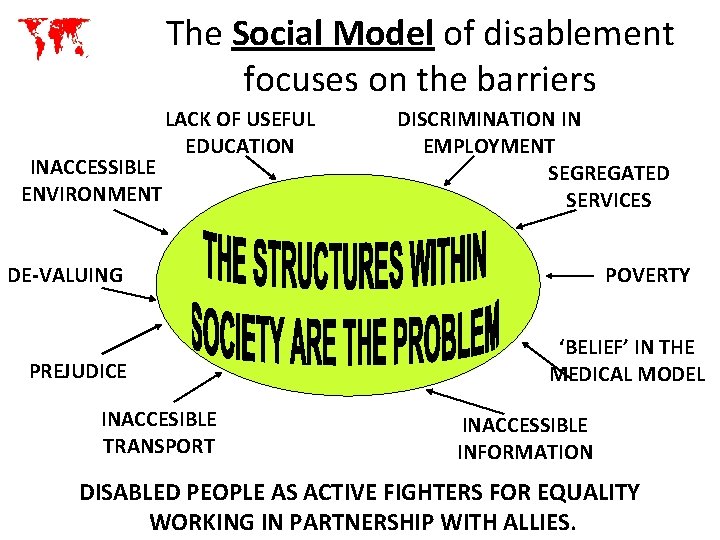
The Social Model of disablement focuses on the barriers INACCESSIBLE ENVIRONMENT LACK OF USEFUL EDUCATION DISCRIMINATION IN EMPLOYMENT SEGREGATED SERVICES DE-VALUING PREJUDICE INACCESIBLE TRANSPORT POVERTY ‘BELIEF’ IN THE MEDICAL MODEL INACCESSIBLE INFORMATION DISABLED PEOPLE AS ACTIVE FIGHTERS FOR EQUALITY WORKING IN PARTNERSHIP WITH ALLIES.
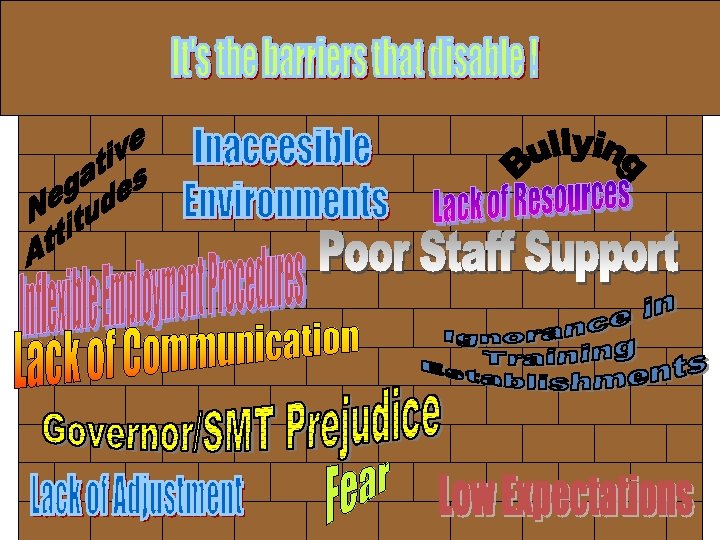
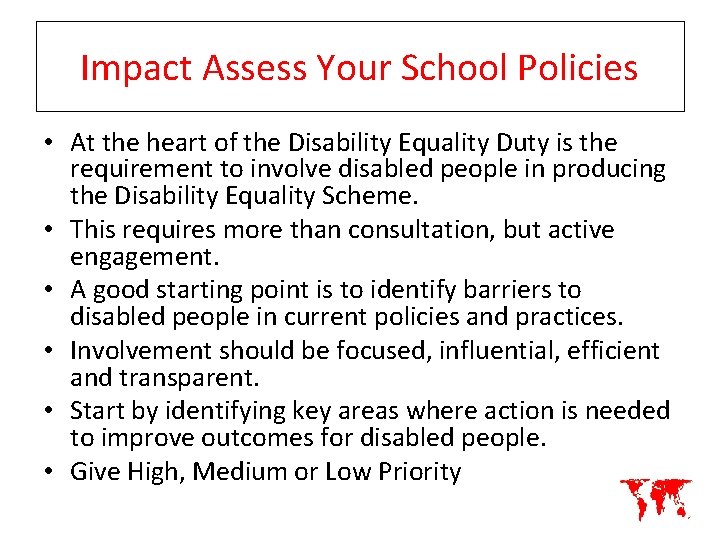
Impact Assess Your School Policies • At the heart of the Disability Equality Duty is the requirement to involve disabled people in producing the Disability Equality Scheme. • This requires more than consultation, but active engagement. • A good starting point is to identify barriers to disabled people in current policies and practices. • Involvement should be focused, influential, efficient and transparent. • Start by identifying key areas where action is needed to improve outcomes for disabled people. • Give High, Medium or Low Priority
Eliminating Unlawful Discrimination • Report did not ask enough about the Reasonable Adjustment Duty. Too many schools are in breach of the Duty. • SENDIST has found against schools on: • assumptions about disabled pupils • risk assessments • administration of medicines • school trips • behaviour related to disability • bullying and isolation from peers • access to the curriculum • admissions
School Trips School Policy- all entitled to go attend the trip Pre-visits by staff to check Access If not OK consider changing venue Check Transportation to Trip Exclusion from trip should not be used as a punishment • Provide the right support • Plan well ahead. • • •
Administering Medicines • School under a duty to provide routine medication • All staff doing this have to have training from state registered nurse or doctor • Staff without it in their contract can only be asked to volunteer • Good practice to provide training for all. Then ask who does not wish to do it • Royal College of Nurses provide a list of what non-medical people can do and cannot do.
Risk Assessment • Identifying Risks is only first step. • Under Reasonable Adjustment Duty must then see what reasonable adjustments can be made • Cannot have blanket policies • Each disabled person must be examined in the particular circumstances of the particular situation. • E. g. Manual lifting and fire evacuation of ambulant impaired. No fire resistant refuges in building
Elimination of Disability Related Harassment • The So. S Report says over 70% disabled young people report bullying compared to 30% of non-disabled. • [http: //209. 85. 229. 132/search? q=cache: th. Wy. Y 3 ryzc. J: www. dius. gov. uk/publications/documents/Corp orate/Equality%2520 and%2520 Diversity/D] • Bullying is, and is perceived to be, a significant barrier for disabled children and young people. DCSF guidance on reducing and responding to bullying of disabled children, published in 2008, has been widely welcomed. • [http: //www. teachernet. gov. uk/_doc/12626/7655 -dcfs -anti-bullying. pd]
Disabled Children and Bullying • Twice as likely as non-disabled children to be bullied. Children’s Commissioner Dec 2006 • 82% of children and young people with learning difficulty in UK are bullied-this is 280, 000 children. MENCAP-Don’t Stick It Stop It 2007 • Disabled Children are 9 times more likely to be excluded than non disabled children Df. ES 2004 • 62% of disabled pupils had been bullied, 19% daily or weekly and 38% at least once per month. DEE in work for DCSF in July 2008 • 70% of disabled pupils claim to have experienced bullying at school. DCSF Sec States Report Dec 2008
Case Study Bullying Attitudes Relationships Resilliance Jack is a 13 year old boy with autism. The pupils know he is easy to wind up and will react, sometimes violently, to being teased. Some of the pupils call him ‘spaka’ and other cruel words. Jack is nearly always left out of teams and groups when pupils are asked to work together. Some of the pupils say they don’t want to work with him because he is ‘weird’. He tells school staff nearly everyday that he is getting bullied; some staff have commented that they feel he ‘brings it on himself’. Reporting Friendship
Bullying and Disability What needs to be done! • Create a school culture that does not accept bullying. Respect • Monitor and record all incidents. • Develop an understanding of oppression and its impact historically. • Develop an understanding of what disabilist bullying leads to. • If an incident occurs stop the lesson to discuss it • Fully involve pupils-peer mediators, bully busters, Form and Year Councils • Staff to model the behaviour they expect • Share what you are doing with local community and parents.
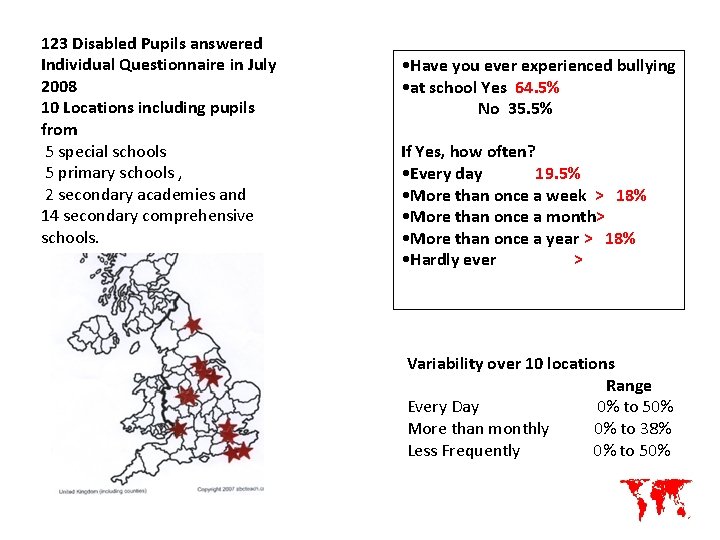
123 Disabled Pupils answered Individual Questionnaire in July 2008 10 Locations including pupils from 5 special schools 5 primary schools , 2 secondary academies and 14 secondary comprehensive schools. • Have you ever experienced bullying • at school Yes 64. 5% No 35. 5% If Yes, how often? • Every day 19. 5% • More than once a week > 18% • More than once a month> • More than once a year > 18% • Hardly ever > Variability over 10 locations Range Every Day 0% to 50% More than monthly 0% to 38% Less Frequently 0% to 50%
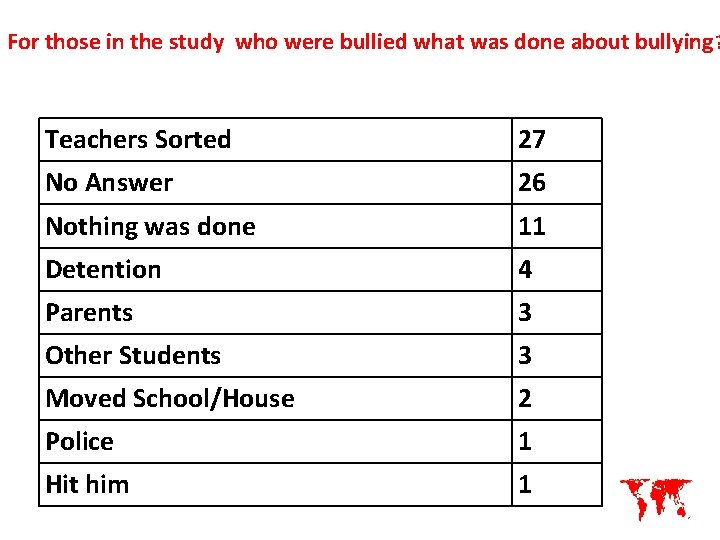
For those in the study who were bullied what was done about bullying ? Teachers Sorted 27 No Answer 26 Nothing was done 11 Detention 4 Parents 3 Other Students 3 Moved School/House 2 Police 1 Hit him 1
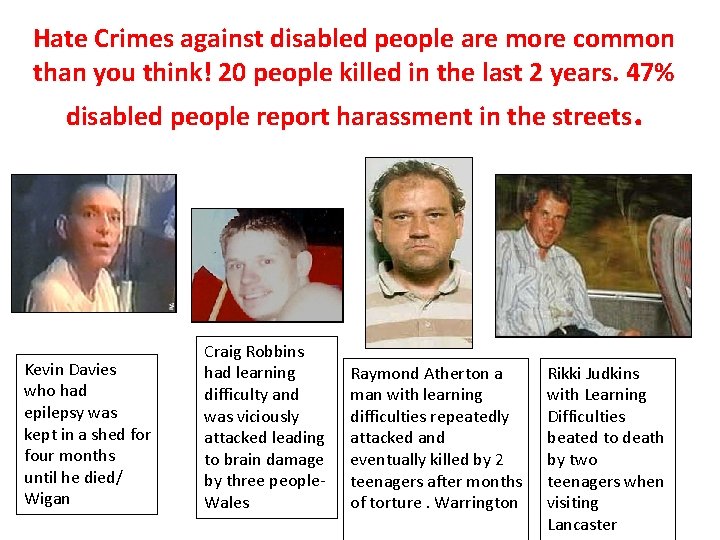
Hate Crimes against disabled people are more common than you think! 20 people killed in the last 2 years. 47% disabled people report harassment in the streets. Kevin Davies who had epilepsy was kept in a shed for four months until he died/ Wigan Craig Robbins had learning difficulty and was viciously attacked leading to brain damage by three people. Wales Raymond Atherton a man with learning difficulties repeatedly attacked and eventually killed by 2 teenagers after months of torture. Warrington Rikki Judkins with Learning Difficulties beated to death by two teenagers when visiting Lancaster
Promoting Equality of opportunity • Aiming High for Disabled Children will help coordination health, social services and education. Most money going into short breaks. • Key is to get all schools to develop their thinking about disability around the social model of disability-to implement the anticipatory nature of the duties and remove barriers. • Reminding schools of their duties, getting local authorities and OFSTED to monitor Disability Equality Schemes. Equalities will be grade limiting from September 2009 • Many schools have no DES. Push from DCSF and National Strategies
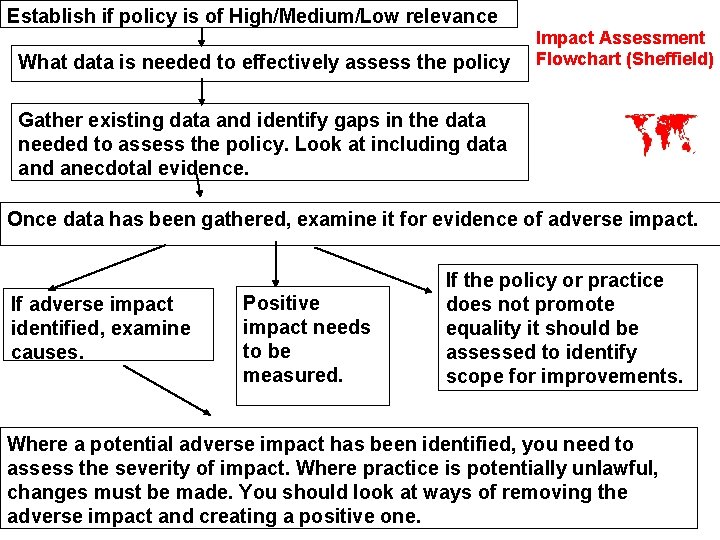
Establish if policy is of High/Medium/Low relevance What data is needed to effectively assess the policy Impact Assessment Flowchart (Sheffield) Gather existing data and identify gaps in the data needed to assess the policy. Look at including data and anecdotal evidence. Once data has been gathered, examine it for evidence of adverse impact. If adverse impact identified, examine causes. Positive impact needs to be measured. If the policy or practice does not promote equality it should be assessed to identify scope for improvements. Where a potential adverse impact has been identified, you need to assess the severity of impact. Where practice is potentially unlawful, changes must be made. You should look at ways of removing the adverse impact and creating a positive one.
BSF Procurement
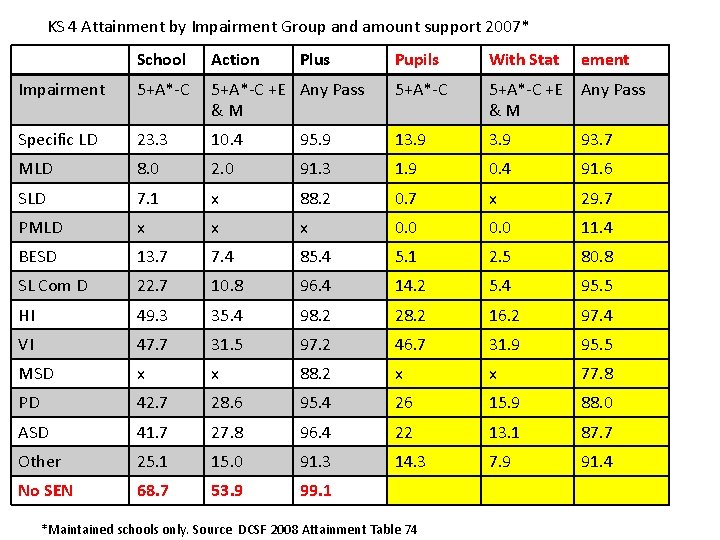
KS 4 Attainment by Impairment Group and amount support 2007* School Action Impairment 5+A*-C Specific LD Plus Pupils With Stat ement 5+A*-C +E Any Pass &M 5+A*-C +E &M Any Pass 23. 3 10. 4 95. 9 13. 9 93. 7 MLD 8. 0 2. 0 91. 3 1. 9 0. 4 91. 6 SLD 7. 1 x 88. 2 0. 7 x 29. 7 PMLD x x x 0. 0 11. 4 BESD 13. 7 7. 4 85. 4 5. 1 2. 5 80. 8 SL Com D 22. 7 10. 8 96. 4 14. 2 5. 4 95. 5 HI 49. 3 35. 4 98. 2 28. 2 16. 2 97. 4 VI 47. 7 31. 5 97. 2 46. 7 31. 9 95. 5 MSD x x 88. 2 x x 77. 8 PD 42. 7 28. 6 95. 4 26 15. 9 88. 0 ASD 41. 7 27. 8 96. 4 22 13. 1 87. 7 Other 25. 1 15. 0 91. 3 14. 3 7. 9 91. 4 No SEN 68. 7 53. 9 99. 1 *Maintained schools only. Source DCSF 2008 Attainment Table 74
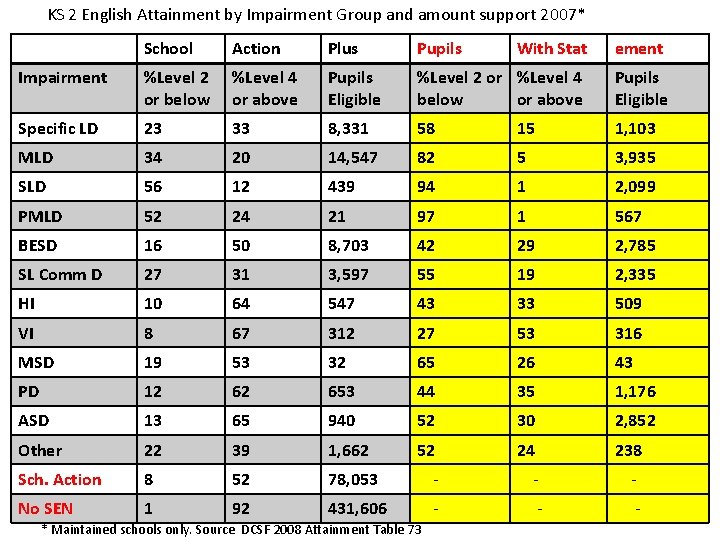
KS 2 English Attainment by Impairment Group and amount support 2007* School Action Plus Pupils With Stat ement Impairment %Level 2 or below %Level 4 or above Pupils Eligible %Level 2 or %Level 4 below or above Pupils Eligible Specific LD 23 33 8, 331 58 15 1, 103 MLD 34 20 14, 547 82 5 3, 935 SLD 56 12 439 94 1 2, 099 PMLD 52 24 21 97 1 567 BESD 16 50 8, 703 42 29 2, 785 SL Comm D 27 31 3, 597 55 19 2, 335 HI 10 64 547 43 33 509 VI 8 67 312 27 53 316 MSD 19 53 32 65 26 43 PD 12 62 653 44 35 1, 176 ASD 13 65 940 52 30 2, 852 Other 22 39 1, 662 52 24 238 Sch. Action 8 52 78, 053 - - - No SEN 1 92 431, 606 - - - * Maintained schools only. Source DCSF 2008 Attainment Table 73
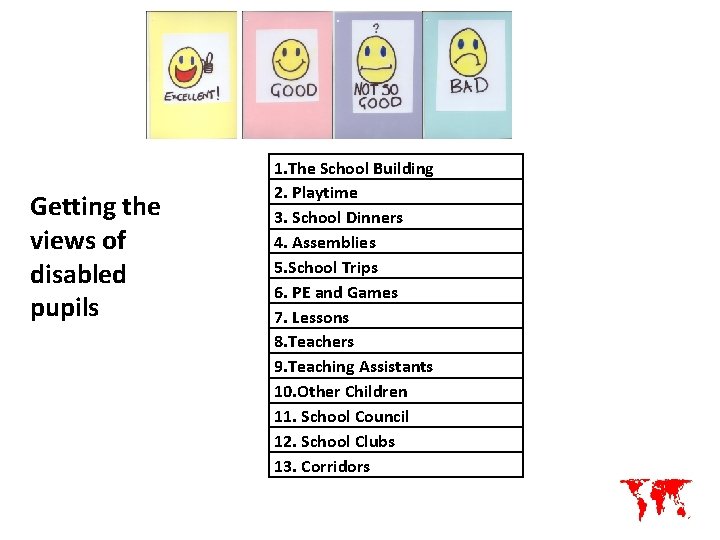
Getting the views of disabled pupils 1. The School Building 2. Playtime 3. School Dinners 4. Assemblies 5. School Trips 6. PE and Games 7. Lessons 8. Teachers 9. Teaching Assistants 10. Other Children 11. School Council 12. School Clubs 13. Corridors
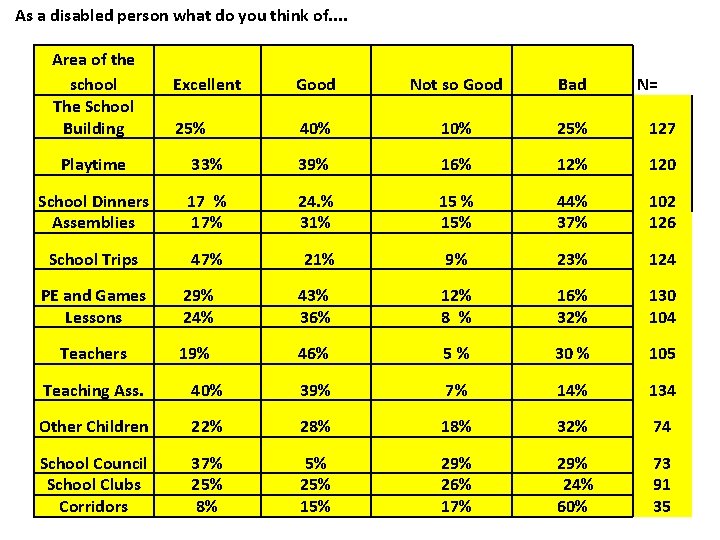
As a disabled person what do you think of. . Area of the school The School Building Excellent Good Not so Good Bad N= 25% 40% 10% 25% 127 Playtime 33% 39% 16% 120 School Dinners Assemblies 17 % 17% 24. % 31% 15% 44% 37% 102 126 School Trips 47% 21% 9% 23% 124 PE and Games Lessons 29% 24% 43% 36% 12% 8 % 16% 32% 130 104 Teachers 19% 46% 5% 30 % 105 Teaching Ass. 40% 39% 7% 14% 134 Other Children 22% 28% 18% 32% 74 School Council School Clubs Corridors 37% 25% 8% 5% 25% 15% 29% 26% 17% 29% 24% 60% 73 91 35
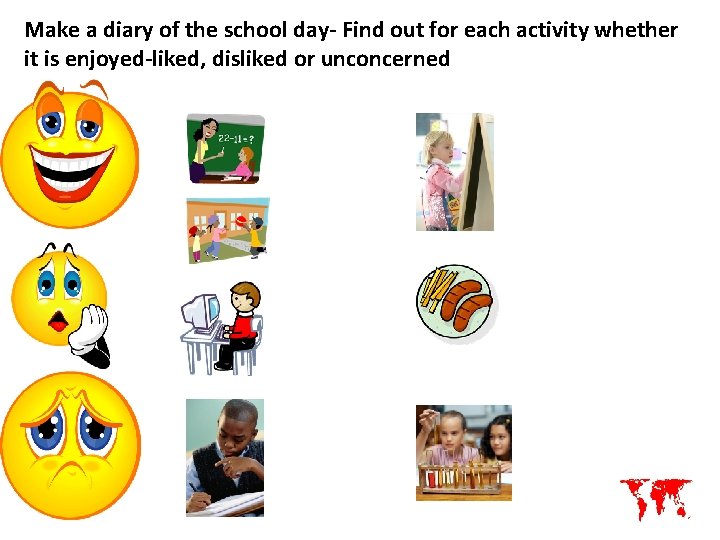
Make a diary of the school day- Find out for each activity whether it is enjoyed-liked, disliked or unconcerned
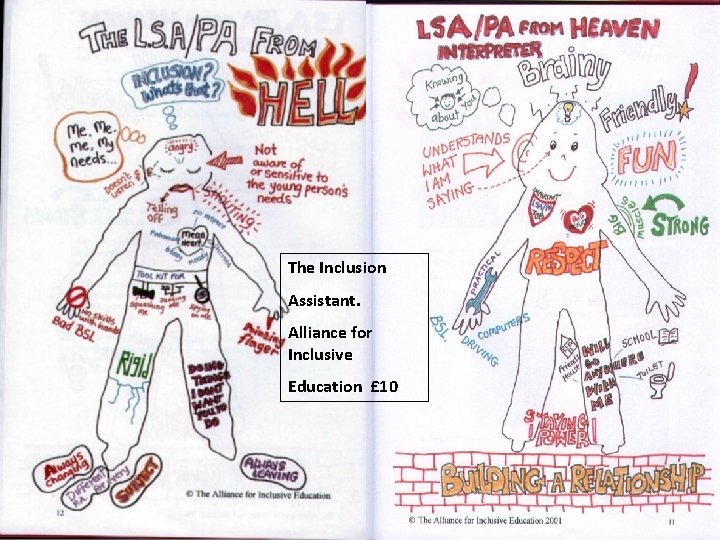
The Inclusion Assistant. Alliance for Inclusive Education £ 10
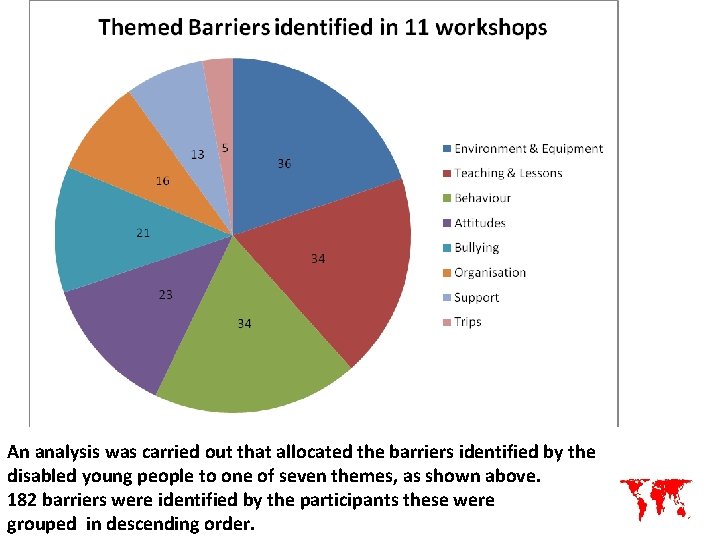
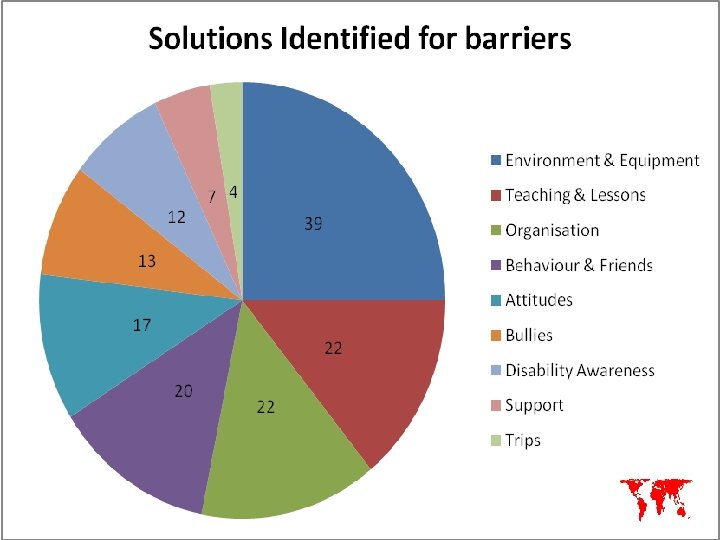
An analysis was carried out that allocated the barriers identified by the disabled young people to one of seven themes, as shown above. 182 barriers were identified by the participants these were grouped in descending order.
Promote positive attitudes towards disabled persons • Recommendation to QCA to bring social model and disability into the curriculum and consider having a disability week. Start yourselves now • Recent study from the Children’s Society show while covered in PHSE/Citizenship quite widely not in all curriculum areas. • All School staff need Disability Equality Training and pupils assemblies delivered by disabled people.
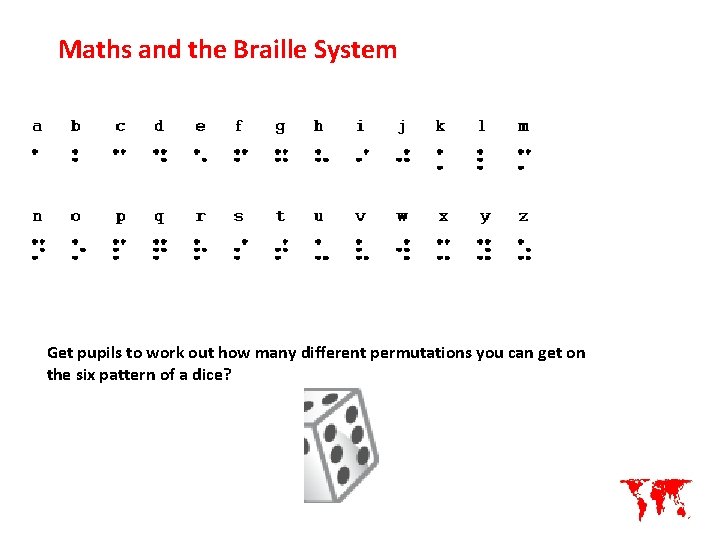
Maths and the Braille System Get pupils to work out how many different permutations you can get on the six pattern of a dice?
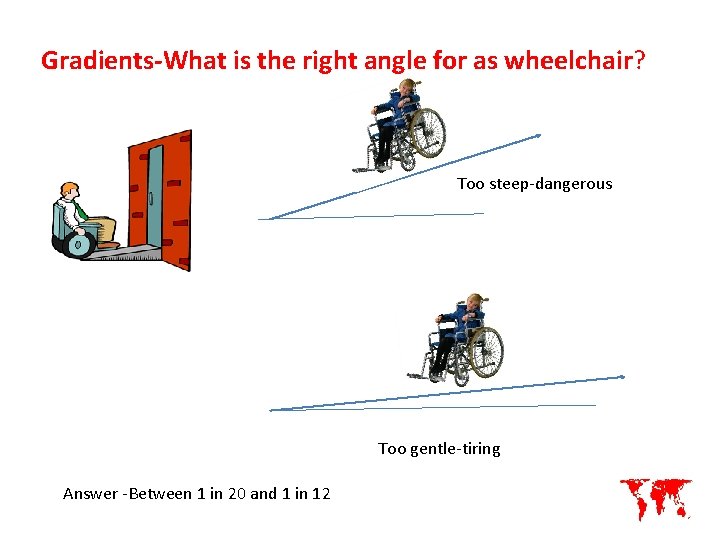
Gradients-What is the right angle for as wheelchair? Too steep-dangerous Too gentle-tiring Answer -Between 1 in 20 and 1 in 12
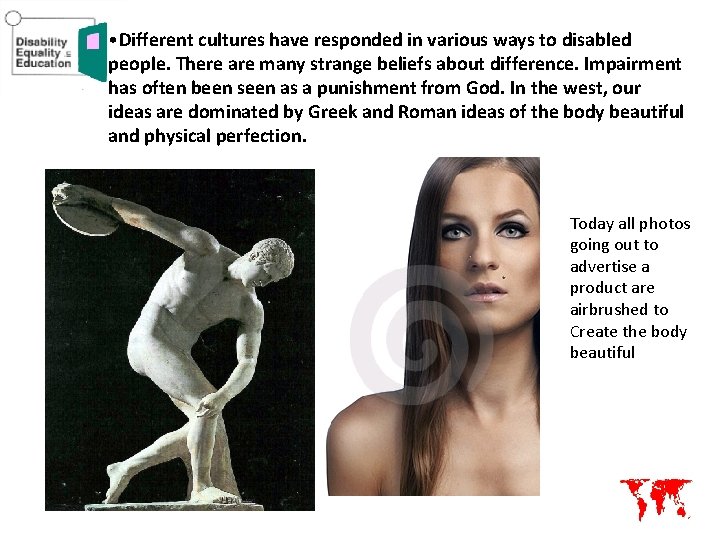
• Different cultures have responded in various ways to disabled people. There are many strange beliefs about difference. Impairment has often been seen as a punishment from God. In the west, our ideas are dominated by Greek and Roman ideas of the body beautiful and physical perfection. Today all photos going out to advertise a product are airbrushed to Create the body beautiful
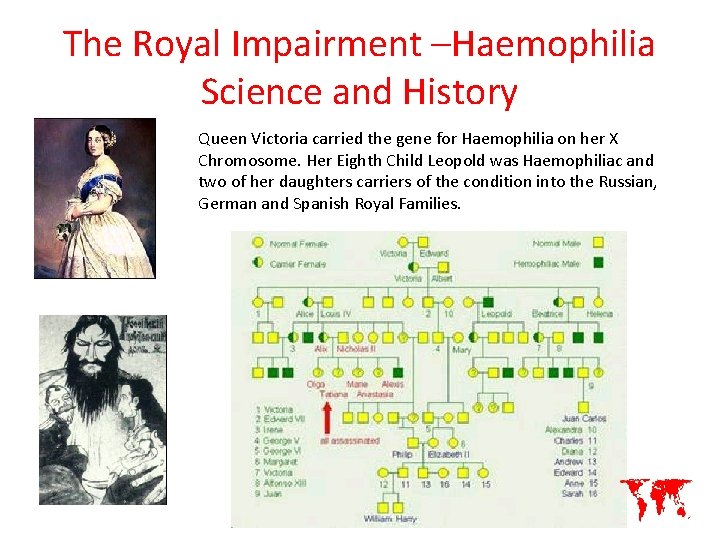
The Royal Impairment –Haemophilia Science and History Queen Victoria carried the gene for Haemophilia on her X Chromosome. Her Eighth Child Leopold was Haemophiliac and two of her daughters carriers of the condition into the Russian, German and Spanish Royal Families.
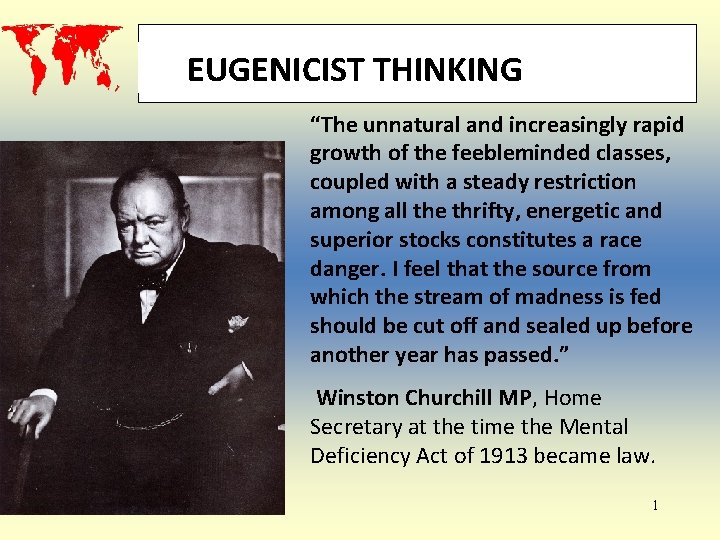
EUGENICIST THINKING “The unnatural and increasingly rapid growth of the feebleminded classes, coupled with a steady restriction among all the thrifty, energetic and superior stocks constitutes a race danger. I feel that the source from which the stream of madness is fed should be cut off and sealed up before another year has passed. ” Winston Churchill MP, Home Secretary at the time the Mental Deficiency Act of 1913 became law. 1

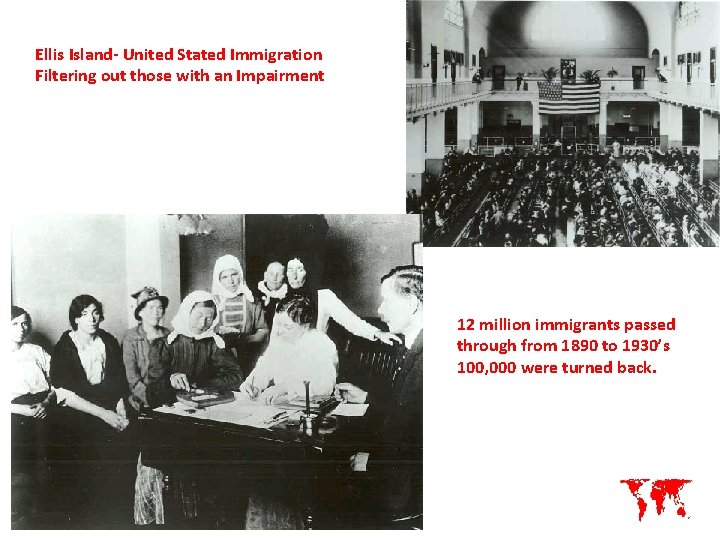
Ellis Island- United Stated Immigration Filtering out those with an Impairment 12 million immigrants passed through from 1890 to 1930’s 100, 000 were turned back.
Who would not have existed if we eliminate genetically and other carried impairments? • • • Julius Caesar Pope Milton Beethoven Goya Monet Van Gogh Evelyn Glennie Stevie Wonder Che Guevara Cerrie Burnell • • • Ray Charles Winston Churchill David Blunkett Gordon Brown Frida Kahlo Toulouse Lautrec Einstein Shrek or The Hulk Mr Magoo Howard Hughes Iris Murdoch
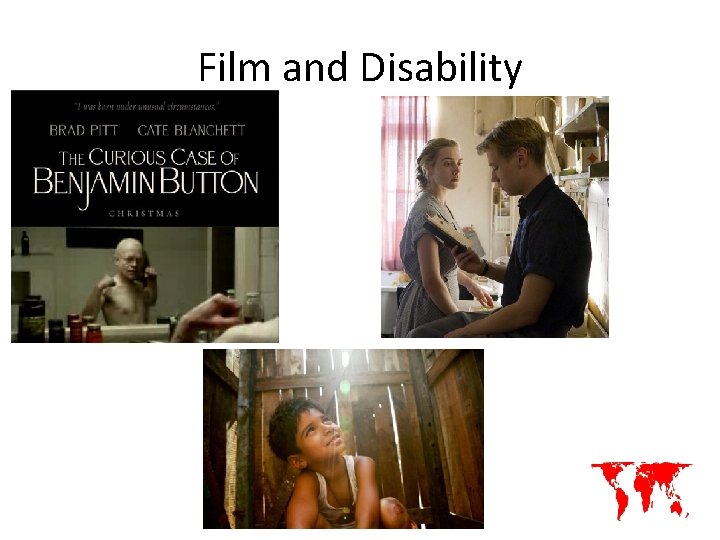
Film and Disability
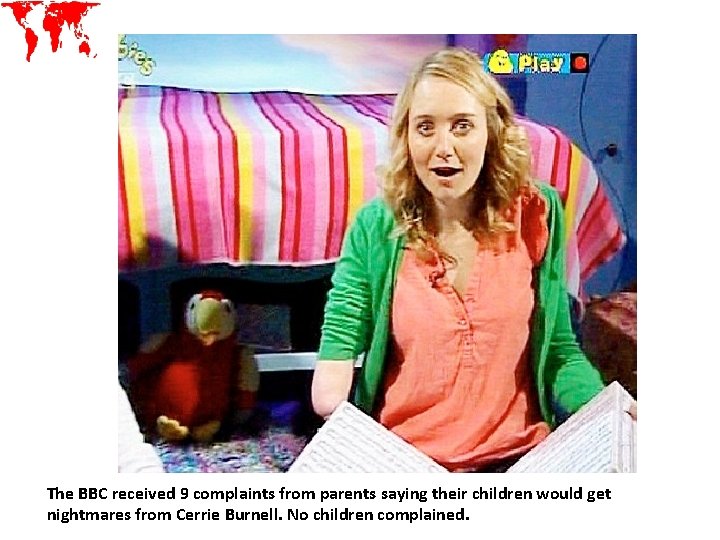
The BBC received 9 complaints from parents saying their children would get nightmares from Cerrie Burnell. No children complained.
Duty to Promote Disability Equality
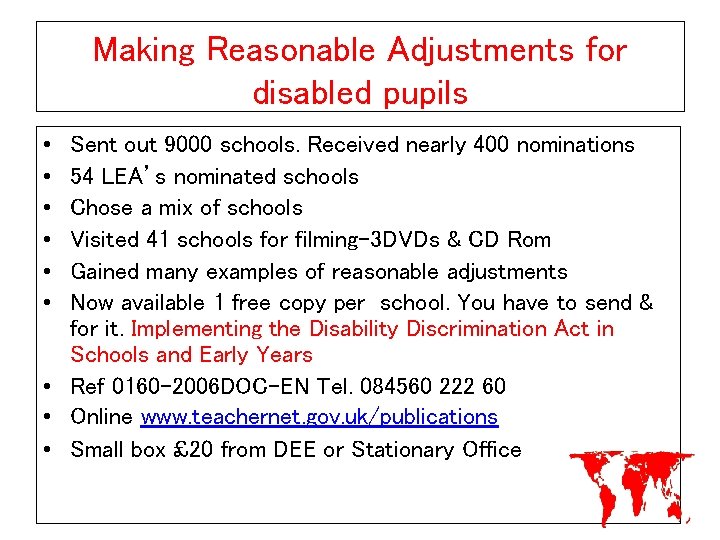
Making Reasonable Adjustments for disabled pupils • • • Sent out 9000 schools. Received nearly 400 nominations 54 LEA’s nominated schools Chose a mix of schools Visited 41 schools for filming-3 DVDs & CD Rom Gained many examples of reasonable adjustments Now available 1 free copy per school. You have to send & for it. Implementing the Disability Discrimination Act in Schools and Early Years • Ref 0160 -2006 DOC-EN Tel. 084560 222 60 • Online www. teachernet. gov. uk/publications • Small box £ 20 from DEE or Stationary Office
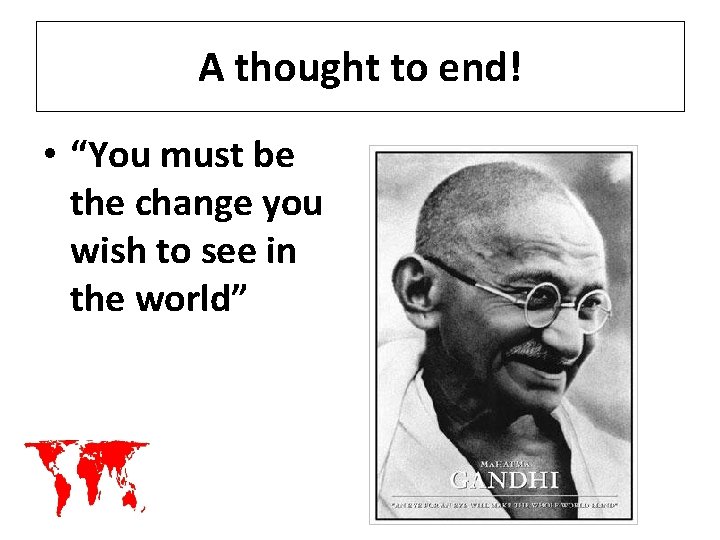
A thought to end! • “You must be the change you wish to see in the world”
- Slides: 60