
Lets Explore Electricity Unit 2 Chapter 1 Exploration





- Slides: 52
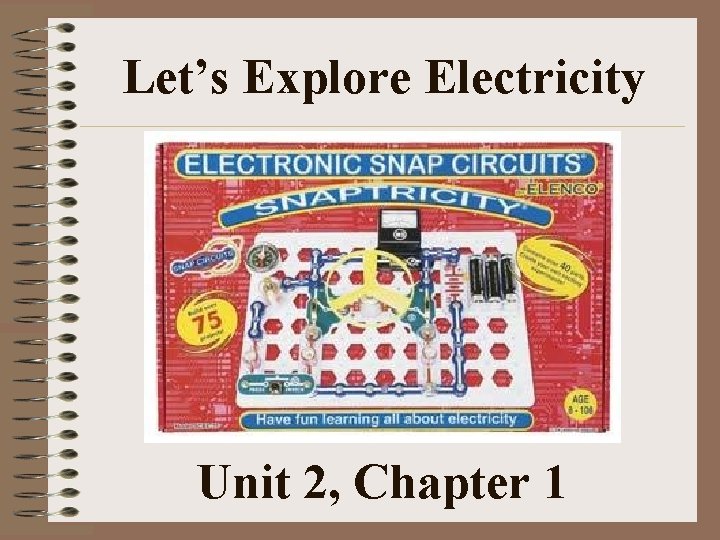
Let’s Explore Electricity Unit 2, Chapter 1
Exploration Activity 1. Working in groups of eight or less, let’s investigate electricity by assembling a circuit that has “lamps in series, ” page 26. I. Write down your own observations and thoughts. II. Ask a “Good” question. 2. Next, assemble a circuit that has “lamps in parallel, ” page 27. I. Write down your own observations and thoughts. II. Ask a “Good” question. 3. As a group, consider some of the advantages and disadvantages for each of these circuits? Where might you find an example of each of these circuits being used in your everyday life.
Tuesday’s Exit Slip Ask one “good” question about today’s activity.
Wednesday’s Bell Ringer When voltage increases and resistance remains constant what must happen to current? Current must increase.
AC/DC (The Rock Band) https: //www. youtube. com/watch? v=p. R 30 kn. Js 4 Xk Malcolm and Angus Young developed the idea for the band's name after their sister, Margaret Young, saw the initials "AC/DC" on a sewing machine. AC/DC is an abbreviation meaning alternating current/direct current electricity.
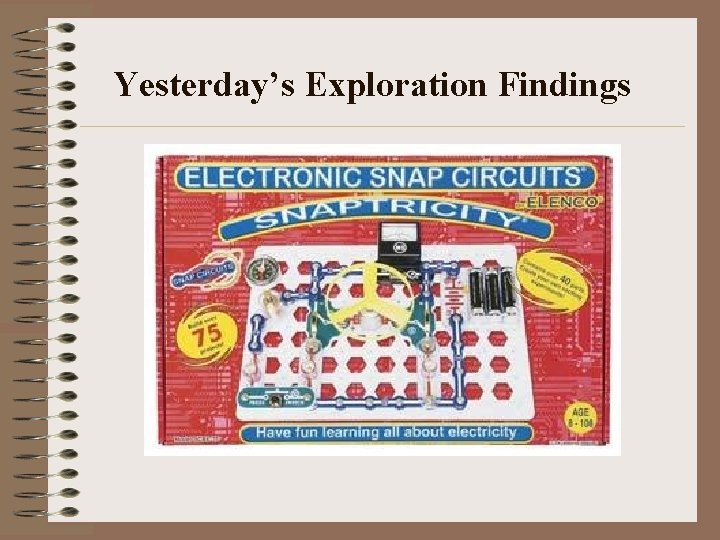
Yesterday’s Exploration Findings
Yesterday’s Exit Slip Ask one “good” question about today’s activity.
Electricity (Unit 2, Chapter 1)
Overview The focus of this week’s instruction will be on electricity. By way of observations and hands-on investigations, you will learn about Ohm’s Law and how it’s used to calculate the electrical energy used by a device, create series and parallel circuits, and learn the difference between alternating and direct currents.
Learning Targets You will use the following learning targets to selfassess your own learning as we move through the lesson: q I CAN define all the key vocabulary words/terms on the word wall. q I CAN create a model to illustrate/explain the conventional flow of current and the flow of electrons in a simple series and parallel circuit. q I CAN use Ohm’s Law to show the relationship between electric voltage, current, and resistance.
Weekly Agenda Monday: No School Tuesday: Exploration Activity Wednesday: Teacher’s Interactive Lecture Thursday: Hands-on, Minds-on Activity; Lesson Checkup Friday: Lesson Assessment
Upcoming Assignments/Assessments Thursday (02/22/2018): Checkup Friday (02/23/2018): Week 26 USA Test Prep Homework Assignment (3 Videos) & Lesson Quiz
Available Bonus Points • Week 26 - USA Bonus Assignments (Total of Three – Worth 2 Points Each – Due by 11: 59 on Friday) • Week 26 – Lesson Notes & Vocabulary Foldable (Worth 1 -Point – Due by Class time on Friday)
Reminder Be sure to take “good” notes. Remember, you can use your hand-written notes as a resource when you take the lesson check-ups and quizzes. This current grading window closes in about three weeks, during the week of March 4 -10. Be sure to make up all your missing work before the window closes.
Electric Power Electric power is the rate, per unit of time, at which electrical energy is transferred by an electric circuit.
Electrical Circuit An electrical circuit is a device that provides a path for electrical current to flow. By definition, a circuit is a circular journey or one beginning and ending at the same place.
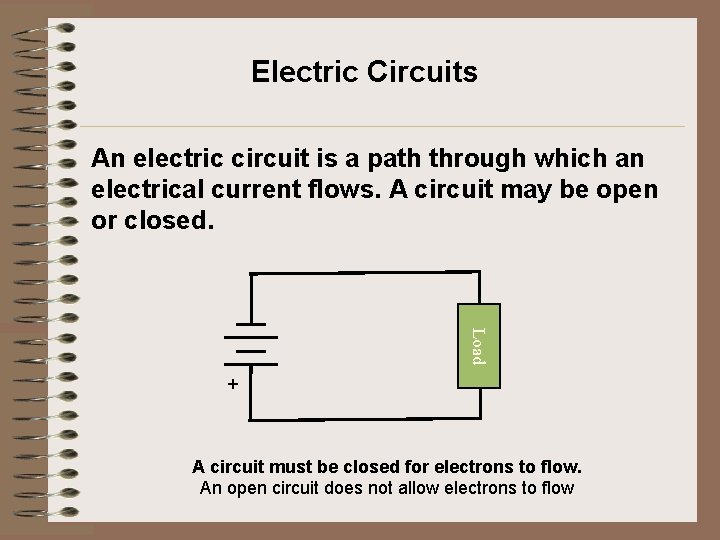
Electric Circuits An electric circuit is a path through which an electrical current flows. A circuit may be open or closed. Load + A circuit must be closed for electrons to flow. An open circuit does not allow electrons to flow
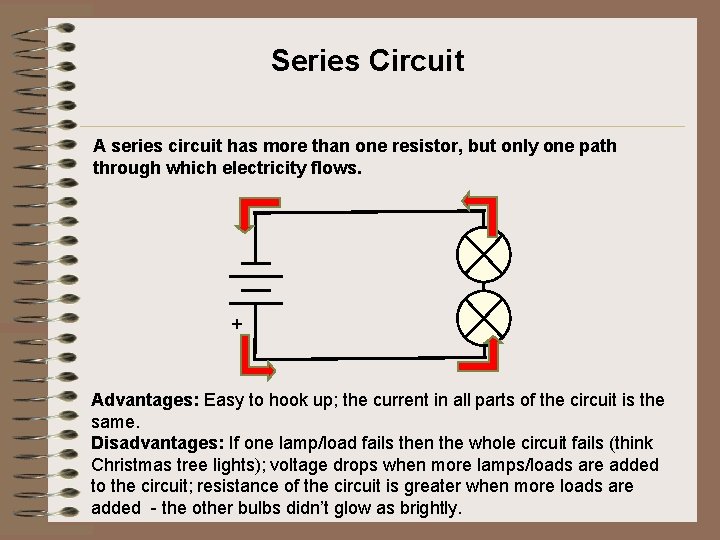
Series Circuit A series circuit has more than one resistor, but only one path through which electricity flows. + Advantages: Easy to hook up; the current in all parts of the circuit is the same. Disadvantages: If one lamp/load fails then the whole circuit fails (think Christmas tree lights); voltage drops when more lamps/loads are added to the circuit; resistance of the circuit is greater when more loads are added - the other bulbs didn’t glow as brightly.
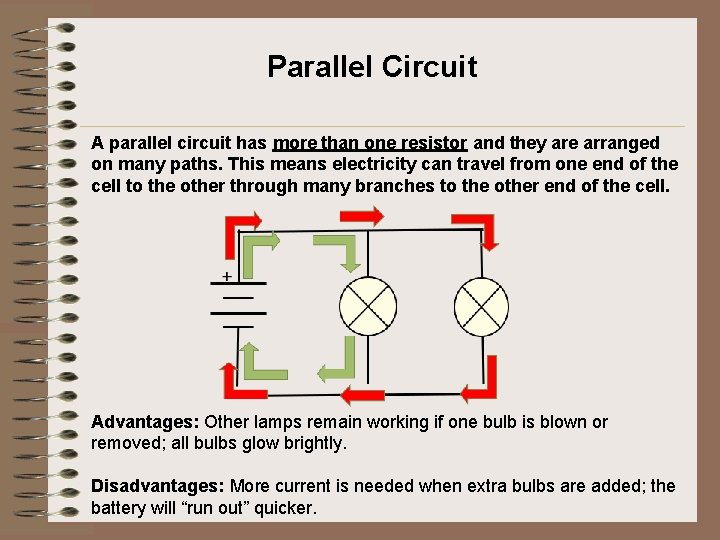
Parallel Circuit A parallel circuit has more than one resistor and they are arranged on many paths. This means electricity can travel from one end of the cell to the other through many branches to the other end of the cell. Advantages: Other lamps remain working if one bulb is blown or removed; all bulbs glow brightly. Disadvantages: More current is needed when extra bulbs are added; the battery will “run out” quicker.
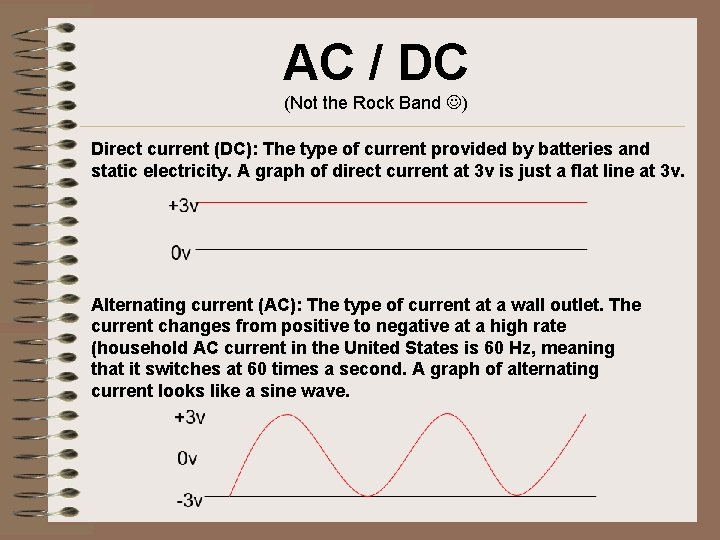
AC / DC (Not the Rock Band ) Direct current (DC): The type of current provided by batteries and static electricity. A graph of direct current at 3 v is just a flat line at 3 v. Alternating current (AC): The type of current at a wall outlet. The current changes from positive to negative at a high rate (household AC current in the United States is 60 Hz, meaning that it switches at 60 times a second. A graph of alternating current looks like a sine wave.
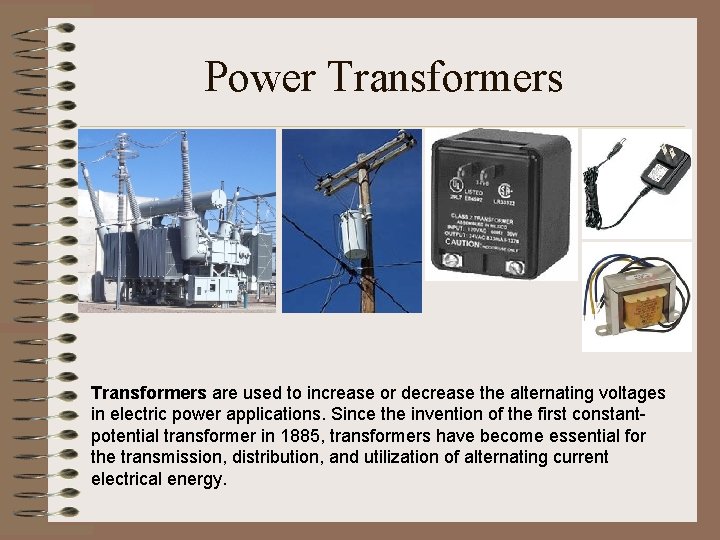
Power Transformers are used to increase or decrease the alternating voltages in electric power applications. Since the invention of the first constantpotential transformer in 1885, transformers have become essential for the transmission, distribution, and utilization of alternating current electrical energy.
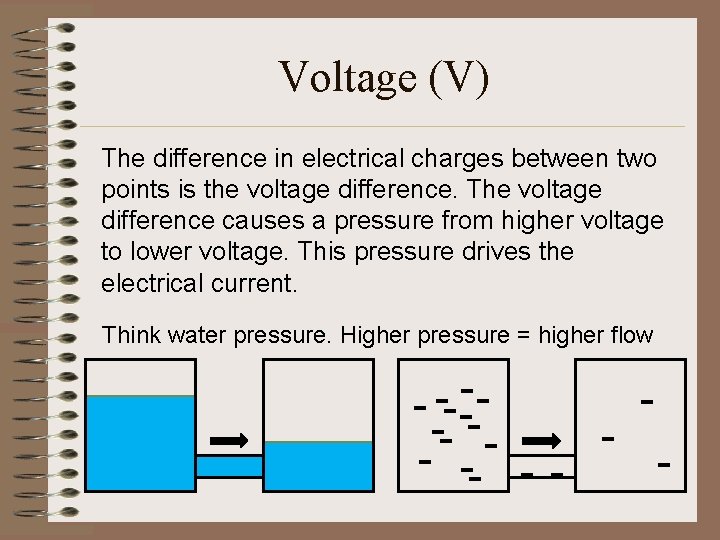
Voltage (V) The difference in electrical charges between two points is the voltage difference. The voltage difference causes a pressure from higher voltage to lower voltage. This pressure drives the electrical current. Think water pressure. Higher pressure = higher flow - - ---- - -
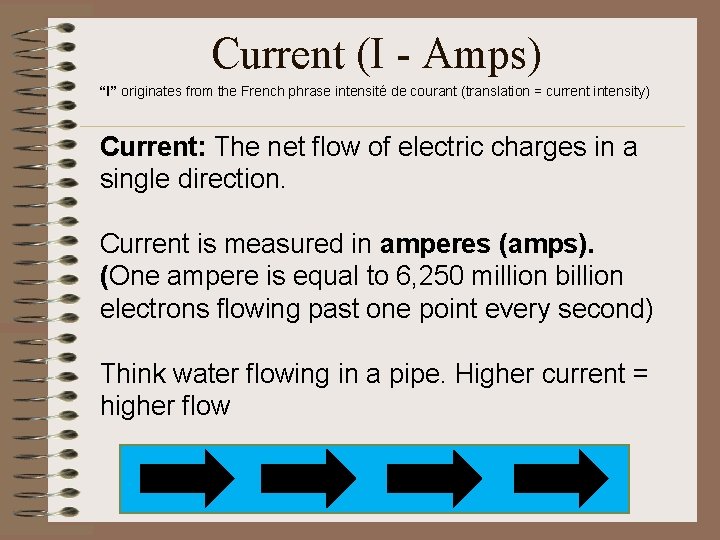
Current (I - Amps) “I” originates from the French phrase intensité de courant (translation = current intensity) Current: The net flow of electric charges in a single direction. Current is measured in amperes (amps). (One ampere is equal to 6, 250 million billion electrons flowing past one point every second) Think water flowing in a pipe. Higher current = higher flow
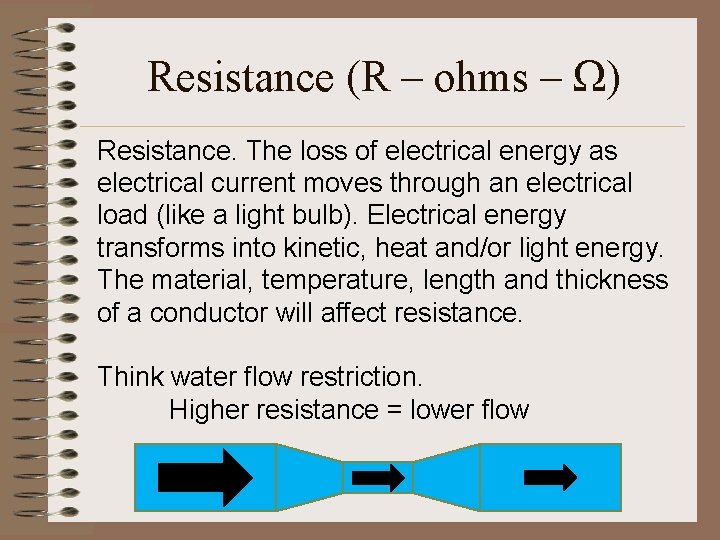
Resistance (R – ohms – Ω) Resistance. The loss of electrical energy as electrical current moves through an electrical load (like a light bulb). Electrical energy transforms into kinetic, heat and/or light energy. The material, temperature, length and thickness of a conductor will affect resistance. Think water flow restriction. Higher resistance = lower flow
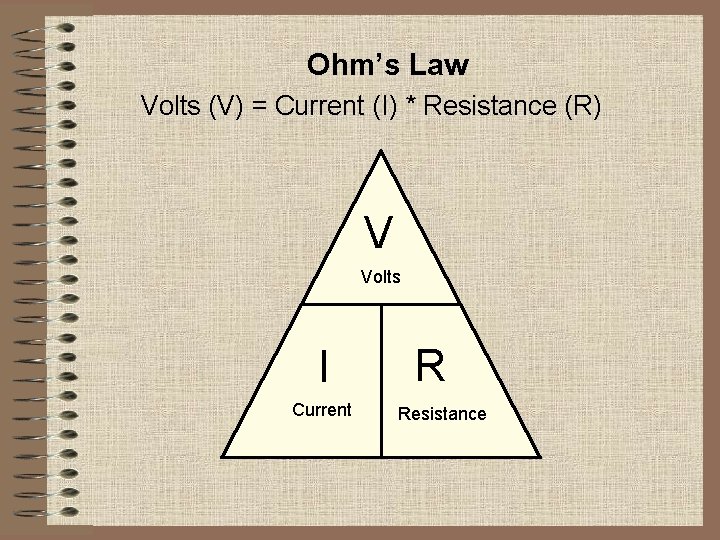
Ohm’s Law Volts (V) = Current (I) * Resistance (R) V Volts I Current R Resistance
Guess What?
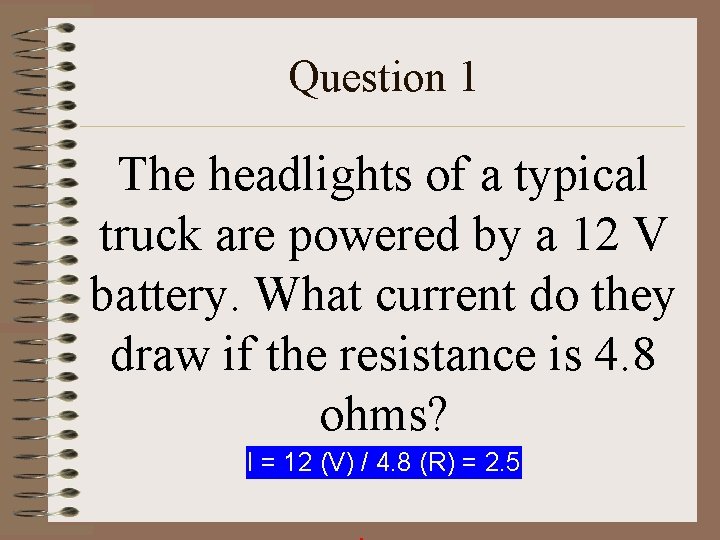
Question 1 The headlights of a typical truck are powered by a 12 V battery. What current do they draw if the resistance is 4. 8 ohms? I = 12 (V) / 4. 8 (R) = 2. 5
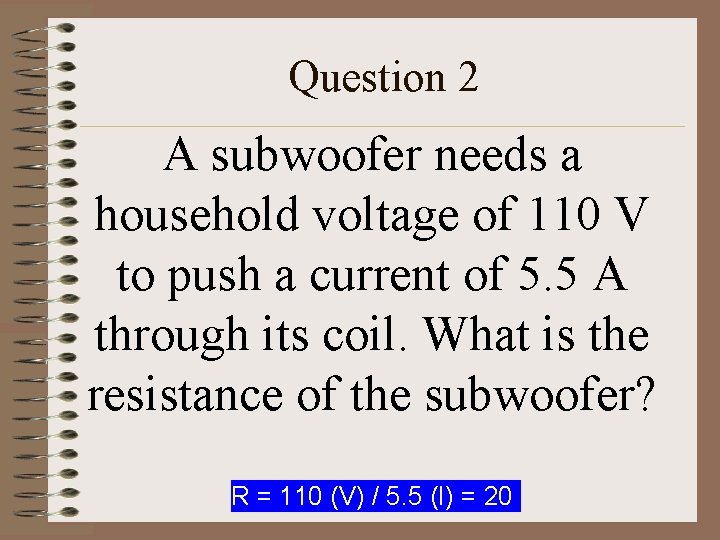
Question 2 A subwoofer needs a household voltage of 110 V to push a current of 5. 5 A through its coil. What is the resistance of the subwoofer? R = 110 (V) / 5. 5 (I) = 20
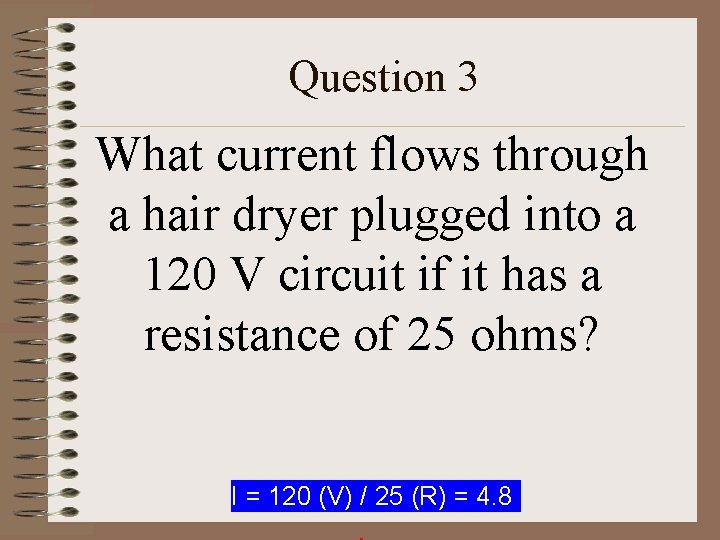
Question 3 What current flows through a hair dryer plugged into a 120 V circuit if it has a resistance of 25 ohms? I = 120 (V) / 25 (R) = 4. 8
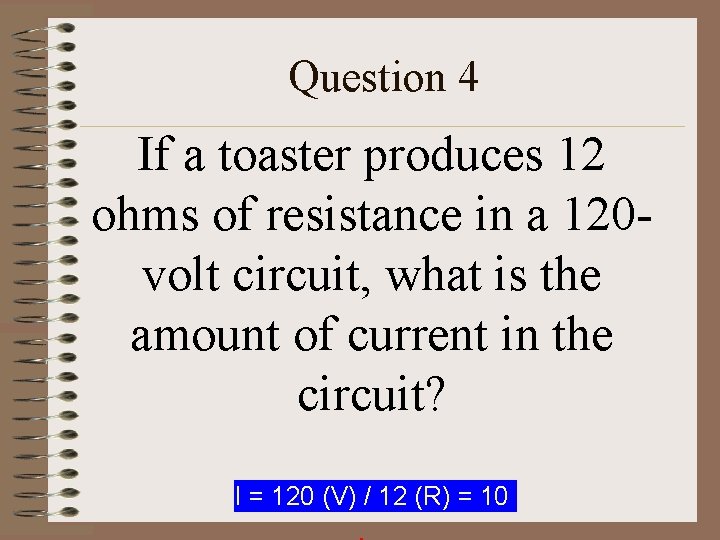
Question 4 If a toaster produces 12 ohms of resistance in a 120 volt circuit, what is the amount of current in the circuit? I = 120 (V) / 12 (R) = 10
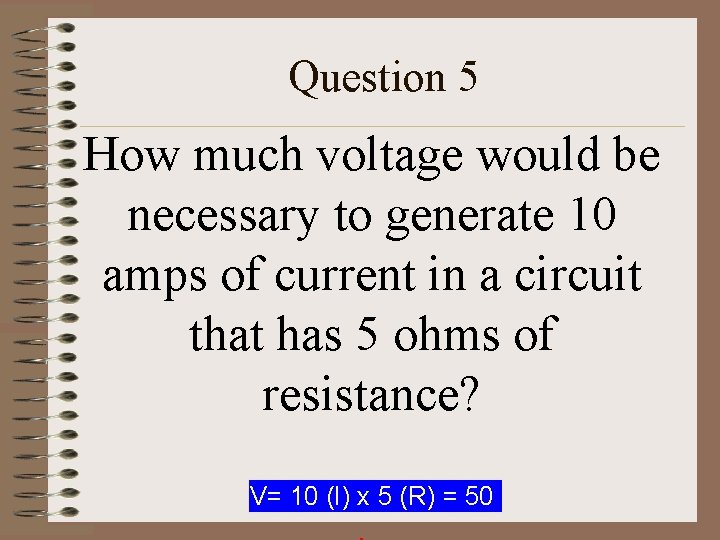
Question 5 How much voltage would be necessary to generate 10 amps of current in a circuit that has 5 ohms of resistance? V= 10 (I) x 5 (R) = 50
What questions do you have?
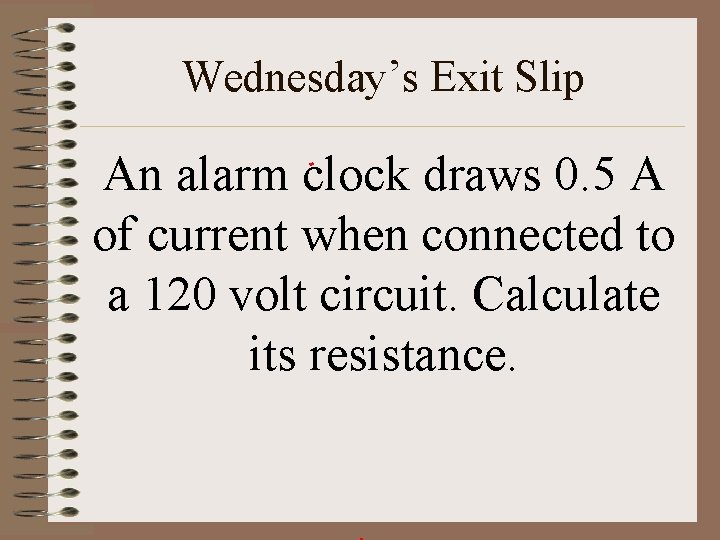
Wednesday’s Exit Slip An alarm clock draws 0. 5 A of current when connected to a 120 volt circuit. Calculate its resistance.
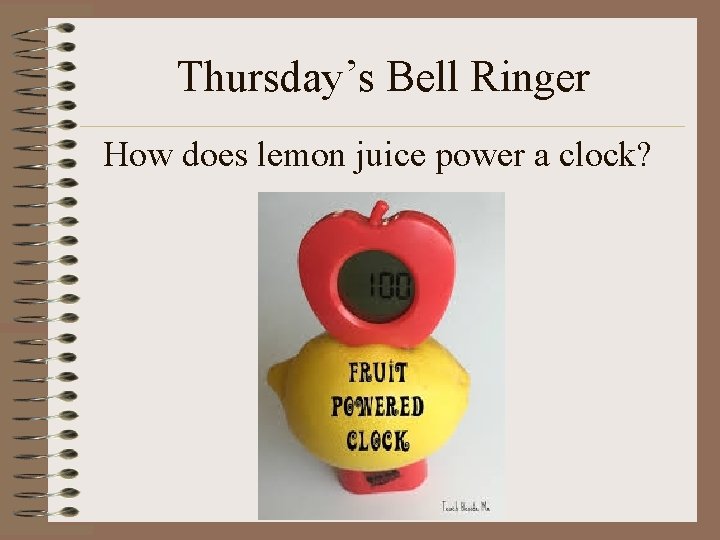
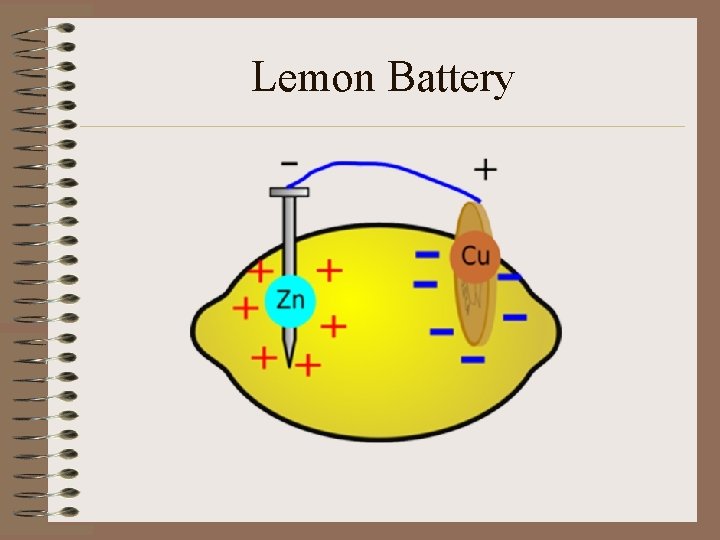
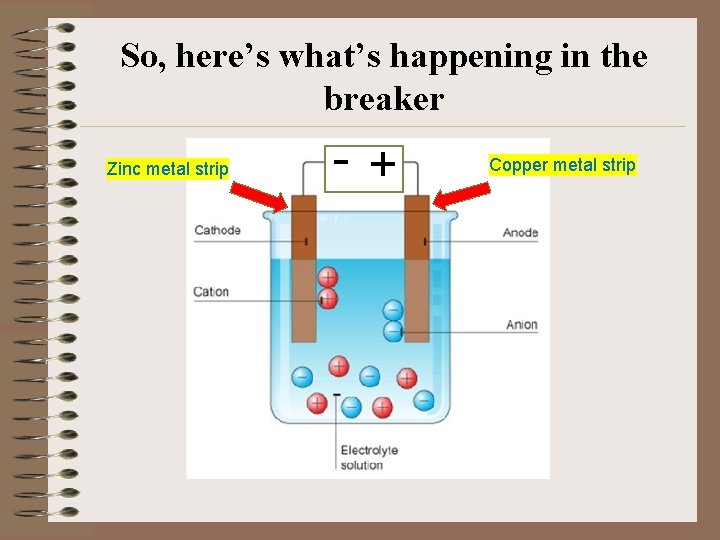
Thursday’s Bell Ringer How does lemon juice power a clock?
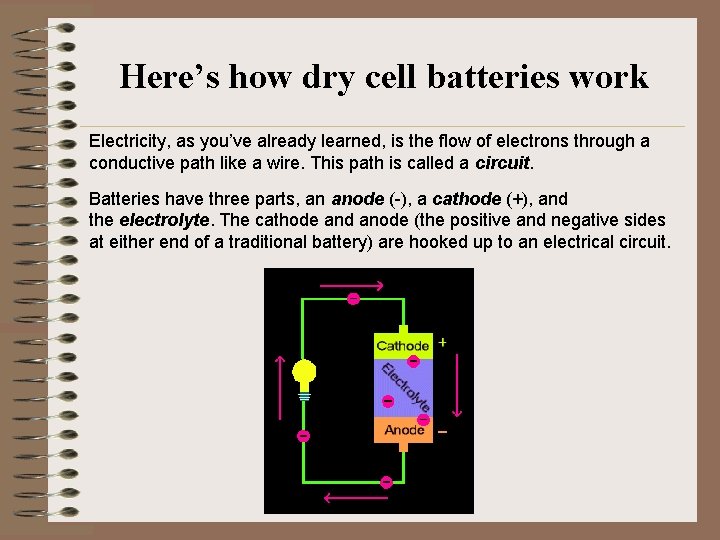
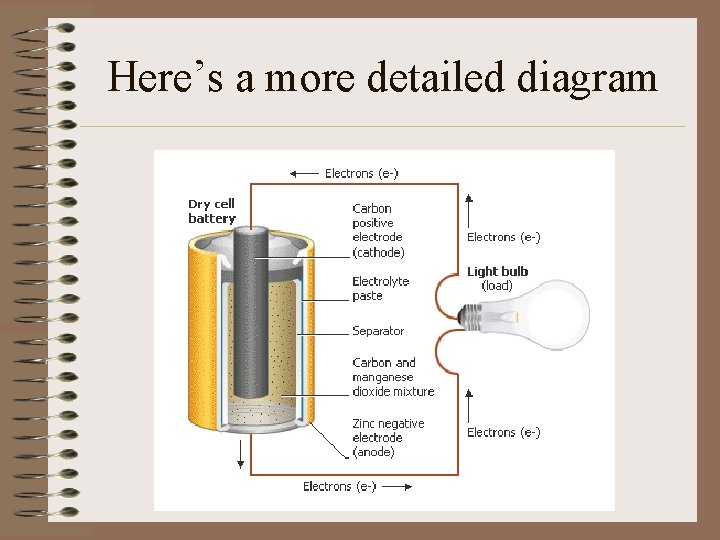
Here’s how dry cell batteries work Electricity, as you’ve already learned, is the flow of electrons through a conductive path like a wire. This path is called a circuit. Batteries have three parts, an anode (-), a cathode (+), and the electrolyte. The cathode and anode (the positive and negative sides at either end of a traditional battery) are hooked up to an electrical circuit.
Here’s a more detailed diagram
Lemon Battery
So, here’s what’s happening in the breaker Zinc metal strip -+ Copper metal strip
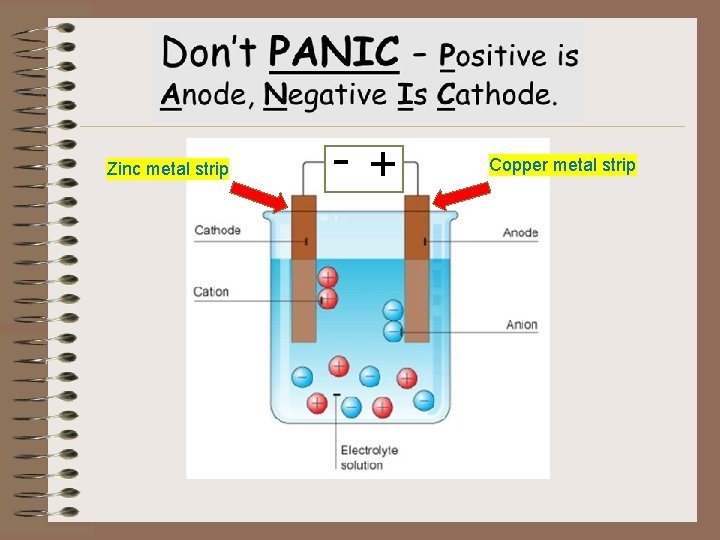
Zinc metal strip -+ Copper metal strip
Let’s take a moment to recap what we’ve learned so far. • What’s the difference between a series and a parallel circuit? • How might you identify one from the other? • What’s the difference between AC and DC currents? • Which is used most often in homes? AC or DC; series or parallel • Which is used most often in small portable appliances? AC or DC; series or parallel
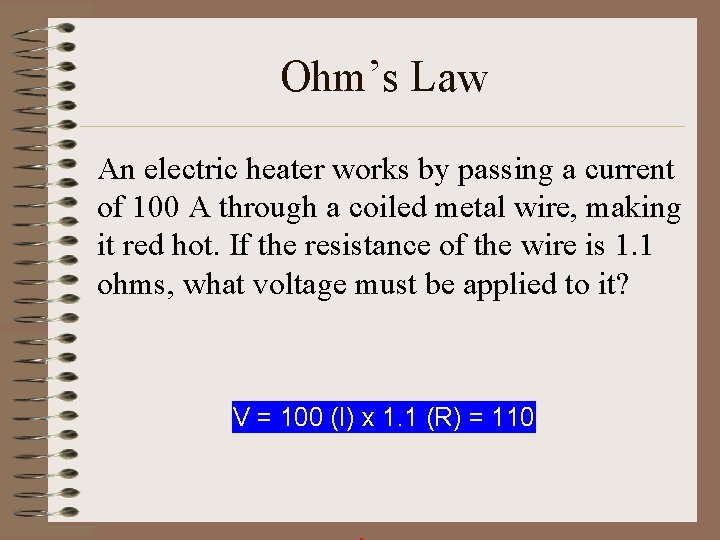
Ohm’s Law An electric heater works by passing a current of 100 A through a coiled metal wire, making it red hot. If the resistance of the wire is 1. 1 ohms, what voltage must be applied to it? V = 100 (I) x 1. 1 (R) = 110
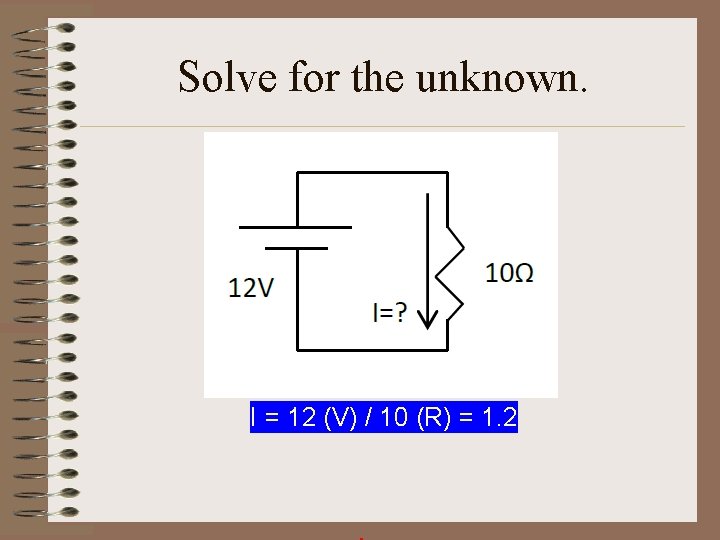
Solve for the unknown. I = 12 (V) / 10 (R) = 1. 2
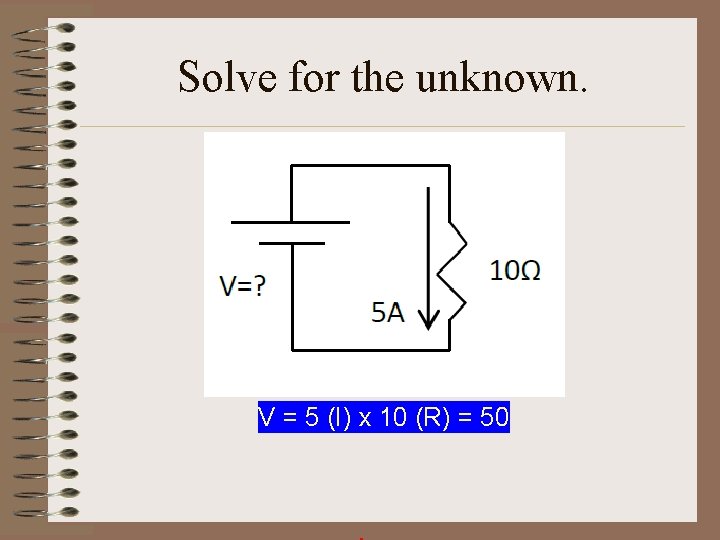
Solve for the unknown. V = 5 (I) x 10 (R) = 50
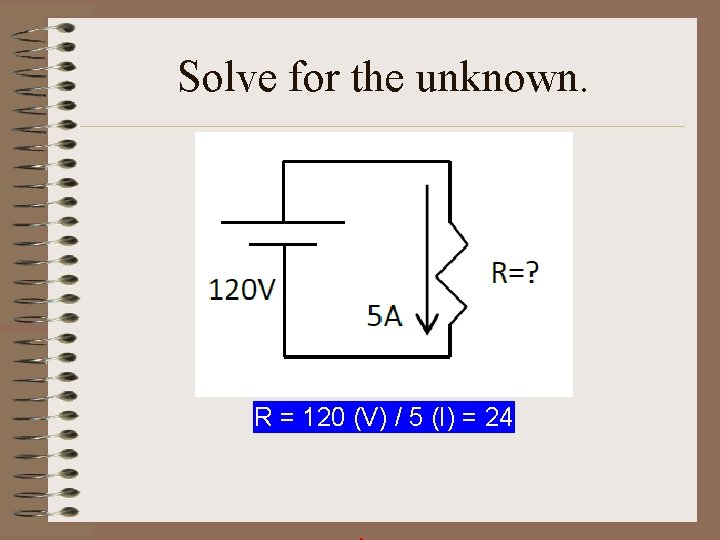
Solve for the unknown. R = 120 (V) / 5 (I) = 24
U 2 C 1 Checkup 1. With the materials provided, construct a series circuit and explain the advantages and disadvantages associated with this type of circuit. 2. With the materials provided, construct a parallel circuit and explain the advantages and disadvantages associated with this type of circuit.
Thursday’s Exit Slip A wall clock uses a 1. 5 V AA battery. How much resistance is in the circuit if it uses a current of 0. 01 A? R = 1. 5 (V) / 0. 01 (I) = 150
Friday’s Bell Ringer What is the voltage in a circuit if the current is 6. 2 A and the resistance is 18 ohms? V = 6. 2 (I) x 18 (R) = 111. 6
U 2 C 1 Quiz
Just a Reminder Your weekly homework and bonus assignments are due tonight, NLT 11: 59 PM The successful completion of both is the key to academic success in this class.
That’s all for today! The phone light is on!!!