
Lets calculate some paychecks 1 Math Reminder Gross

- Slides: 34
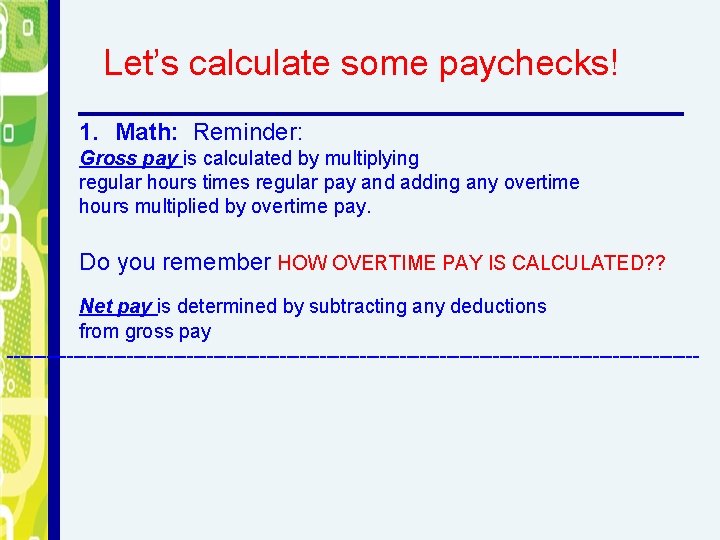
Let’s calculate some paychecks! 1. Math: Reminder: Gross pay is calculated by multiplying regular hours times regular pay and adding any overtime hours multiplied by overtime pay. Do you remember HOW OVERTIME PAY IS CALCULATED? ? Net pay is determined by subtracting any deductions from gross pay ----------------------------------------------------
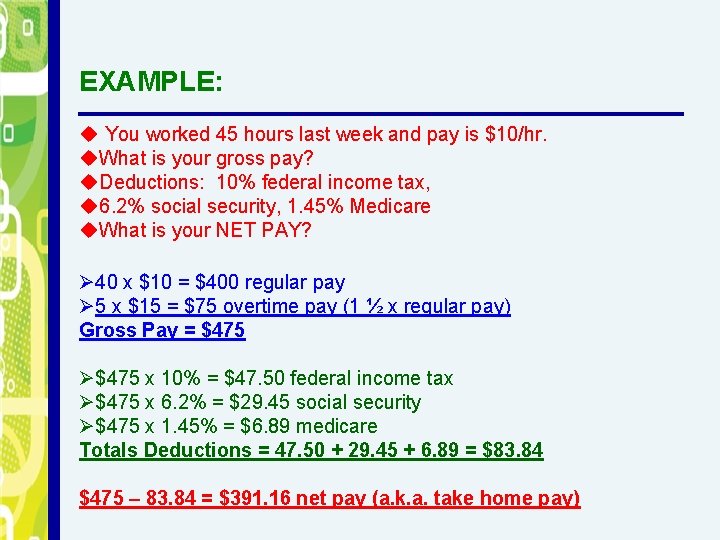
EXAMPLE: u You worked 45 hours last week and pay is $10/hr. u. What is your gross pay? u. Deductions: 10% federal income tax, u 6. 2% social security, 1. 45% Medicare u. What is your NET PAY? Ø 40 x $10 = $400 regular pay Ø 5 x $15 = $75 overtime pay (1 ½ x regular pay) Gross Pay = $475 Ø$475 x 10% = $47. 50 federal income tax Ø$475 x 6. 2% = $29. 45 social security Ø$475 x 1. 45% = $6. 89 medicare Totals Deductions = 47. 50 + 29. 45 + 6. 89 = $83. 84 $475 – 83. 84 = $391. 16 net pay (a. k. a. take home pay)
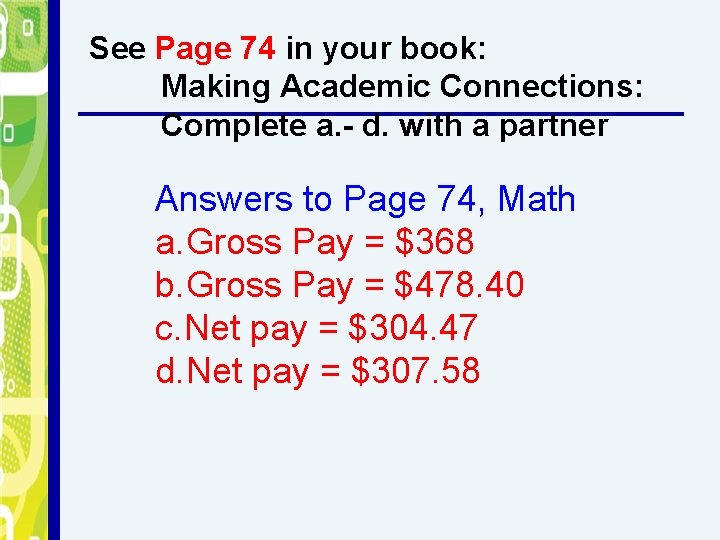
See Page 74 in your book: Making Academic Connections: Complete a. - d. with a partner Answers to Page 74, Math a. Gross Pay = $368 b. Gross Pay = $478. 40 c. Net pay = $304. 47 d. Net pay = $307. 58
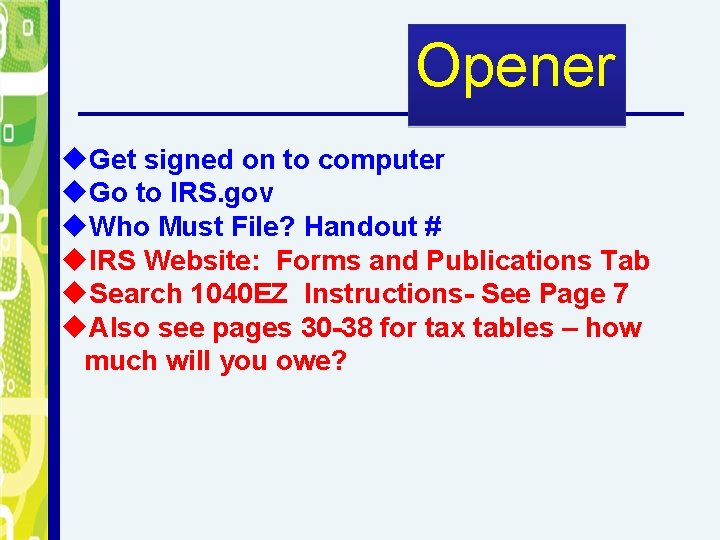
Opener u. Get signed on to computer u. Go to IRS. gov u. Who Must File? Handout # u. IRS Website: Forms and Publications Tab u. Search 1040 EZ Instructions- See Page 7 u. Also see pages 30 -38 for tax tables – how much will you owe?
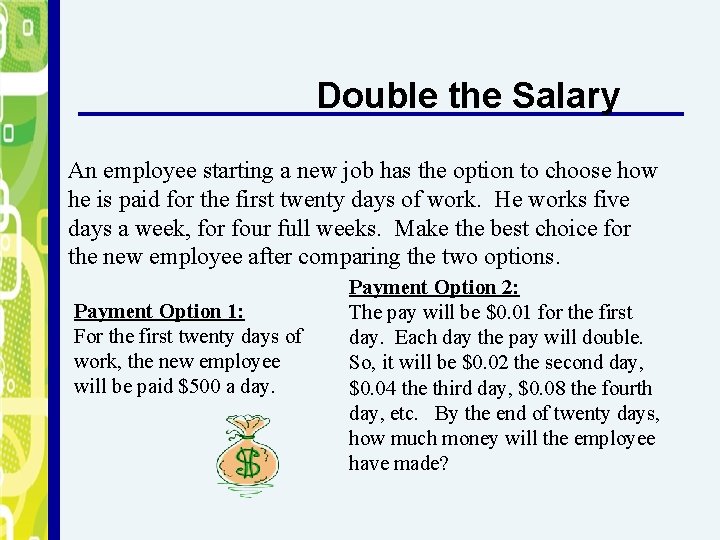
Double the Salary An employee starting a new job has the option to choose how he is paid for the first twenty days of work. He works five days a week, for four full weeks. Make the best choice for the new employee after comparing the two options. Payment Option 1: For the first twenty days of work, the new employee will be paid $500 a day. Payment Option 2: The pay will be $0. 01 for the first day. Each day the pay will double. So, it will be $0. 02 the second day, $0. 04 the third day, $0. 08 the fourth day, etc. By the end of twenty days, how much money will the employee have made?
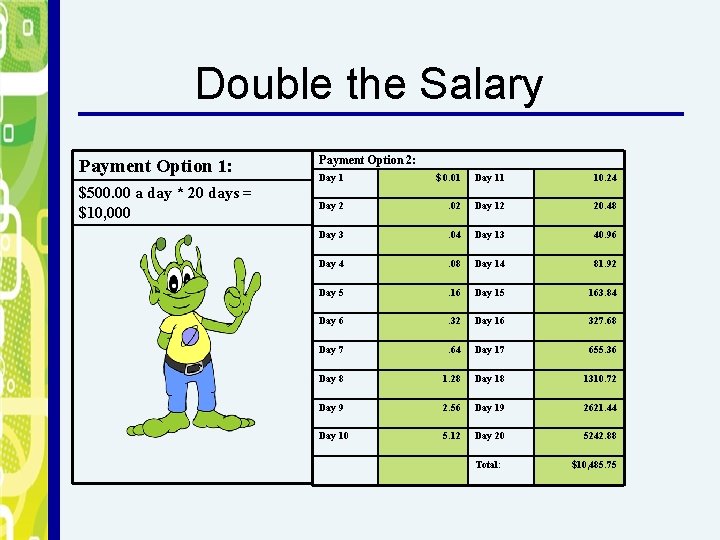
Double the Salary Payment Option 1: $500. 00 a day * 20 days = $10, 000 Payment Option 2: Day 1 $ 0. 01 Day 11 10. 24 Day 2 . 02 Day 12 20. 48 Day 3 . 04 Day 13 40. 96 Day 4 . 08 Day 14 81. 92 Day 5 . 16 Day 15 163. 84 Day 6 . 32 Day 16 327. 68 Day 7 . 64 Day 17 655. 36 Day 8 1. 28 Day 18 1310. 72 Day 9 2. 56 Day 19 2621. 44 Day 10 5. 12 Day 20 5242. 88 Total: $10, 485. 75
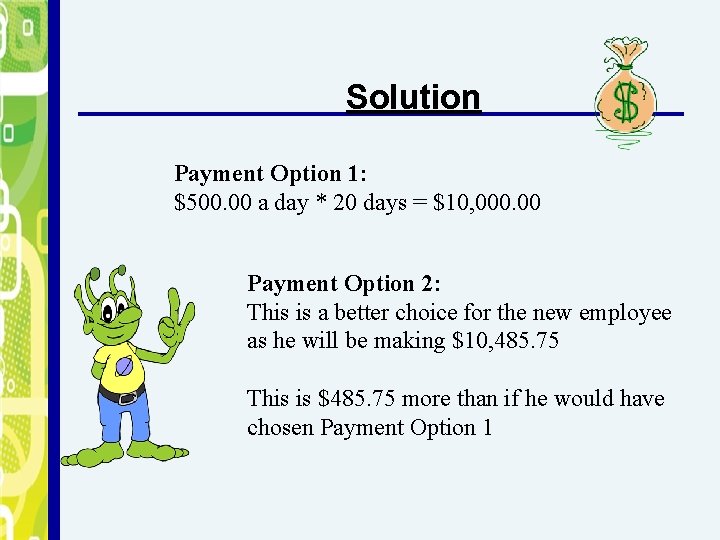
Solution Payment Option 1: $500. 00 a day * 20 days = $10, 000. 00 Payment Option 2: This is a better choice for the new employee as he will be making $10, 485. 75 This is $485. 75 more than if he would have chosen Payment Option 1
Chapter 2 Income, Benefits, and Taxes
Chapter 2 Objectives • List and discuss types of earned income and unearned income • Discuss types of self employment, advantages and disadvantages • Describe the types of taxes we pay and the benefits of paying taxes • Read a paycheck, noting required and optional deductions from gross pay • Discuss common federal tax forms Slide 9
What Are the Sources of Earned Income? • A wage is pay for each hour worked. o Minimum wage – lowest rate by state law o Overtime – 1½ times regular rate • A salary is pay for each month or year worked (no timecards used) • A tip is a gift of money for a service. • A commission is a set fee or percentage of a sale paid to the salesperson. 2 -1 Earned Income and Benefits Slide 10
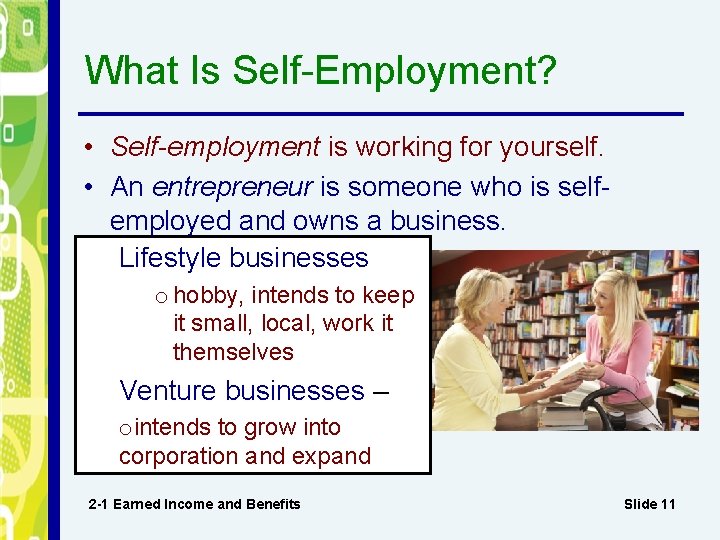
What Is Self-Employment? • Self-employment is working for yourself. • An entrepreneur is someone who is selfemployed and owns a business. Lifestyle businesses o hobby, intends to keep it small, local, work it themselves Venture businesses – ointends to grow into corporation and expand 2 -1 Earned Income and Benefits Slide 11
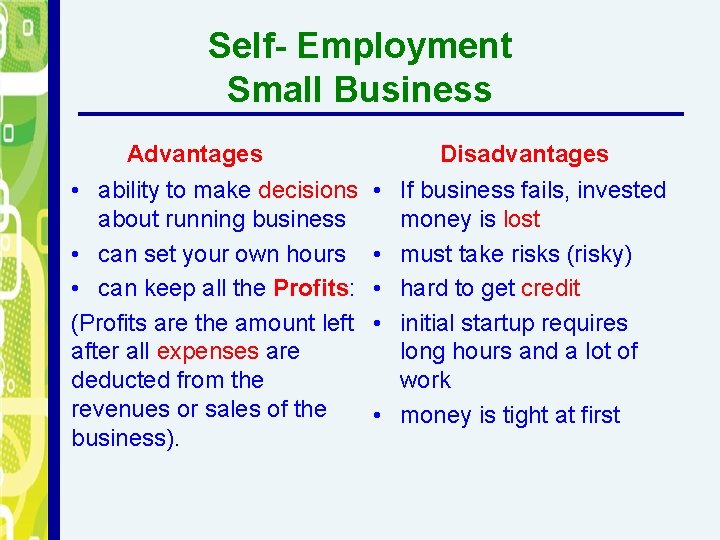
Self- Employment Small Business Advantages • ability to make decisions about running business • can set your own hours • can keep all the Profits: (Profits are the amount left after all expenses are deducted from the revenues or sales of the business). Disadvantages • If business fails, invested money is lost • must take risks (risky) • hard to get credit • initial startup requires long hours and a lot of work • money is tight at first
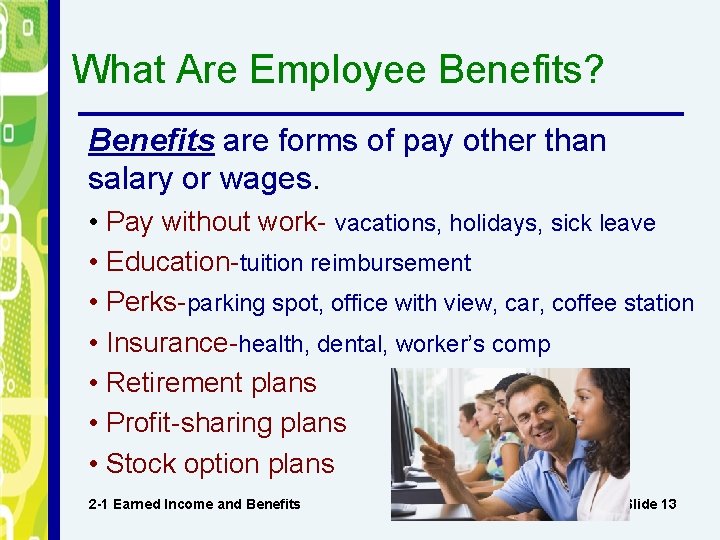
What Are Employee Benefits? Benefits are forms of pay other than salary or wages. • Pay without work- vacations, holidays, sick leave • Education-tuition reimbursement • Perks-parking spot, office with view, car, coffee station • Insurance-health, dental, worker’s comp • Retirement plans • Profit-sharing plans • Stock option plans 2 -1 Earned Income and Benefits Slide 13
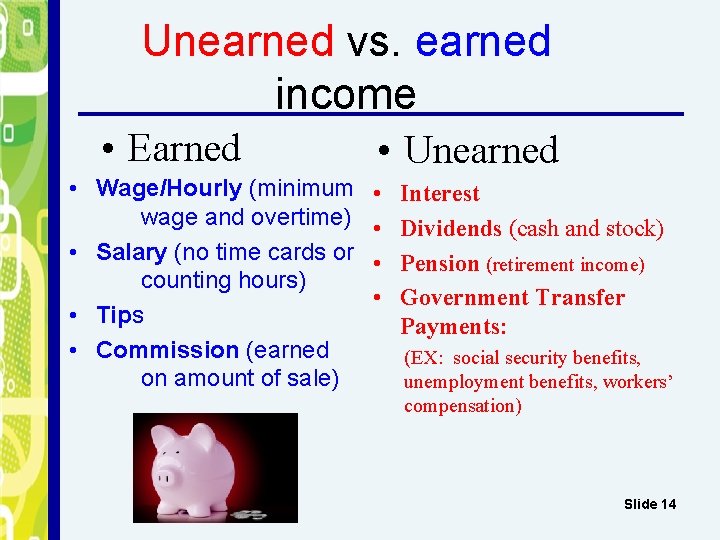
Unearned vs. earned income • Earned • Wage/Hourly (minimum wage and overtime) • Salary (no time cards or counting hours) • Tips • Commission (earned on amount of sale) • Unearned • • Interest Dividends (cash and stock) Pension (retirement income) Government Transfer Payments: (EX: social security benefits, unemployment benefits, workers’ compensation) Slide 14
What Type of Taxes Do You Pay? • Taxes are based on consumption, income, and wealth. • Direct taxes are paid directly to the government. o Examples: income and property taxes • Indirect taxes are charged on goods or services bought by the consumer. o Examples: use, excise, and sales taxes 2 -2 Unearned Income and Benefits Slide 15
What Types of Taxes Do You Pay? u CONSUMPTION TAXES u Use taxes – paid when is a Progressive tax – using certain good and the more you earn the services provided by more you pay in tax government. Ex: toll road (tax brackets) u Excise taxes – charged on the purchase of specific u. Property Tax goods. Ex: phone, utilities upaid by those who u Sales taxes – added to own real estate. purchase price of goods u. Income Tax:
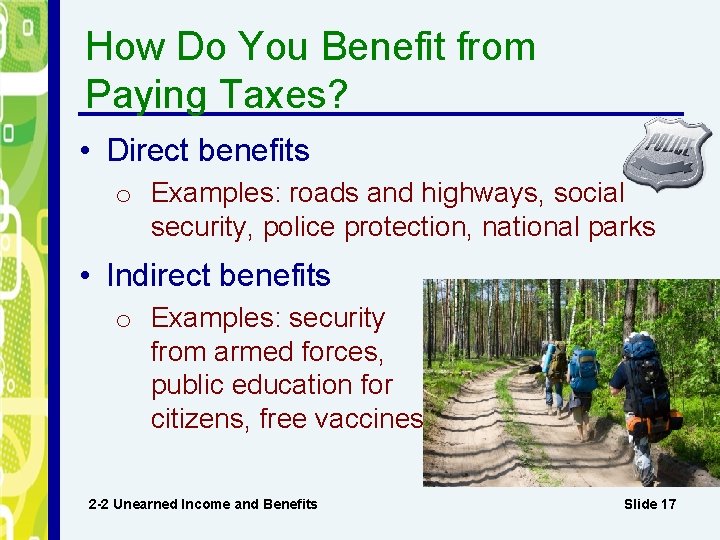
How Do You Benefit from Paying Taxes? • Direct benefits o Examples: roads and highways, social security, police protection, national parks • Indirect benefits o Examples: security from armed forces, public education for citizens, free vaccines 2 -2 Unearned Income and Benefits Slide 17
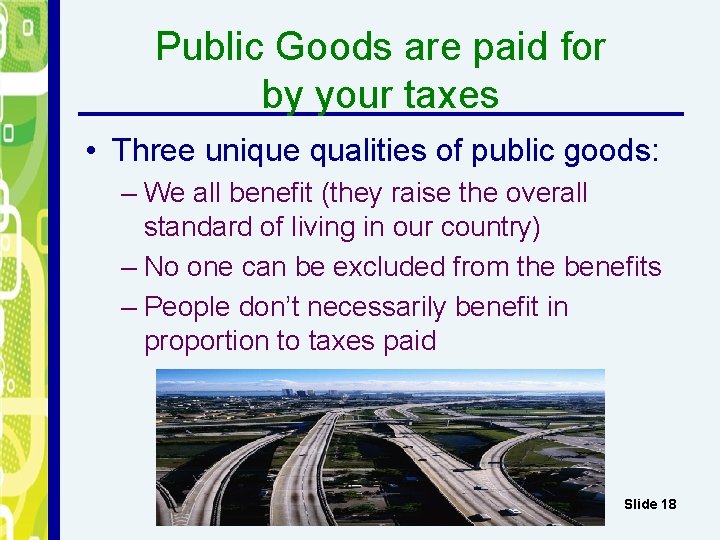
Public Goods are paid for by your taxes • Three unique qualities of public goods: – We all benefit (they raise the overall standard of living in our country) – No one can be excluded from the benefits – People don’t necessarily benefit in proportion to taxes paid Slide 18
Opener: Calculate and reflect the following: 1. Figure out weekly and yearly earned income if working a job at minimum wage ($7. 25/hr. ) for 40 hours a week for 1 year. W= Y= 2. Next figure out your weekly and yearly income if working a job at $12. 00/hr for 40 hours a week for a year. W= Y= 3. Now calculate the weekly and yearly income for a job with median starting pay for a Bachelor’s degree ($24/hr) for 40 hours a week for a year. W= Y= Sum up your thoughts about these results
Communication Skills – see pg. 53 Critical Listening • Evaluate the information you hear. • Consider only important or relevant information. • Make good decisions *Remember the example based on what is of the used car salesman accurate and useful. 2 -2 Unearned Income and Benefits Slide 20
Focus On. . . Social Security Benefits • Workers pay into the social security fund through payroll deductions. • A social security number is assigned to each person. • Employers match the payments. • Upon retirement, workers receive a monthly benefit check. 2 -2 Unearned Income and Benefits Slide 21
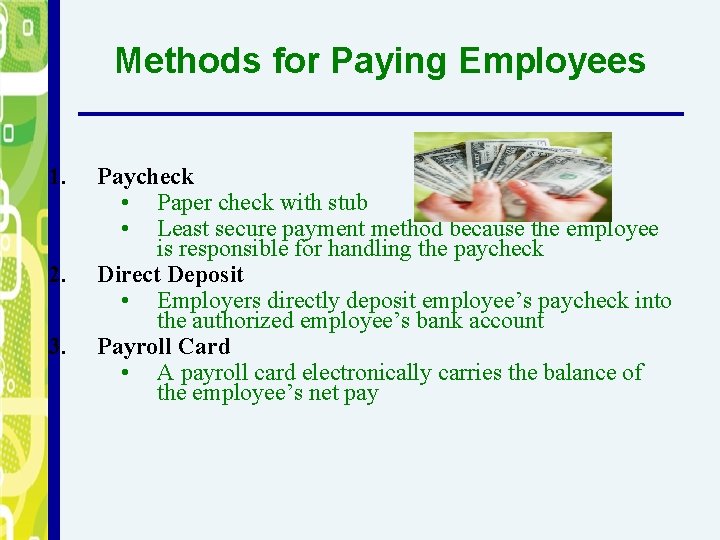
Methods for Paying Employees 1. 2. 3. Paycheck • Paper check with stub • Least secure payment method because the employee is responsible for handling the paycheck Direct Deposit • Employers directly deposit employee’s paycheck into the authorized employee’s bank account Payroll Card • A payroll card electronically carries the balance of the employee’s net pay
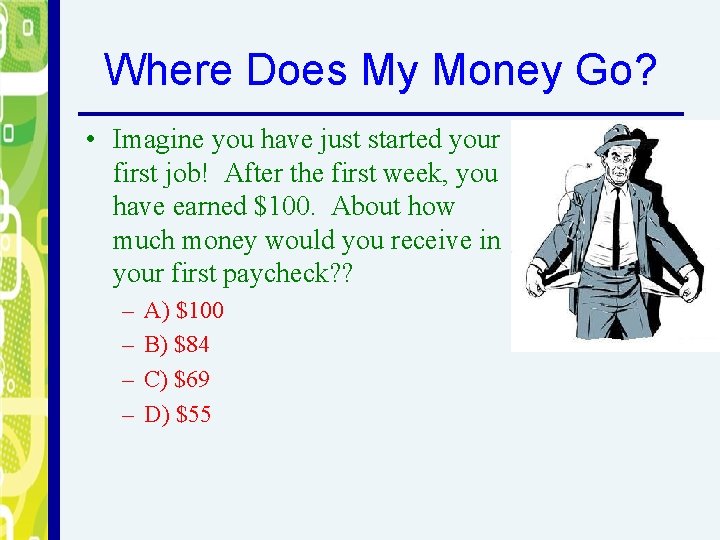
Where Does My Money Go? • Imagine you have just started your first job! After the first week, you have earned $100. About how much money would you receive in your first paycheck? ? – – A) $100 B) $84 C) $69 D) $55
Where Does My Money Go? • Up to 31% of an individual’s paycheck is deducted. Your net paycheck many only be about $69! • How do you get from $100 all the way down to $69? • Let’s take a look…
What Are Paycheck Deductions? • A deduction is money withheld from a paycheck. o Required deduction examples: income tax, social security tax, Medicare tax o Optional deduction examples: health insurance, life insurance, savings plan • Gross pay is total salary or wages. • Net pay is gross pay minus deductions. 2 -3 Taxes and Other Deductions Slide 25
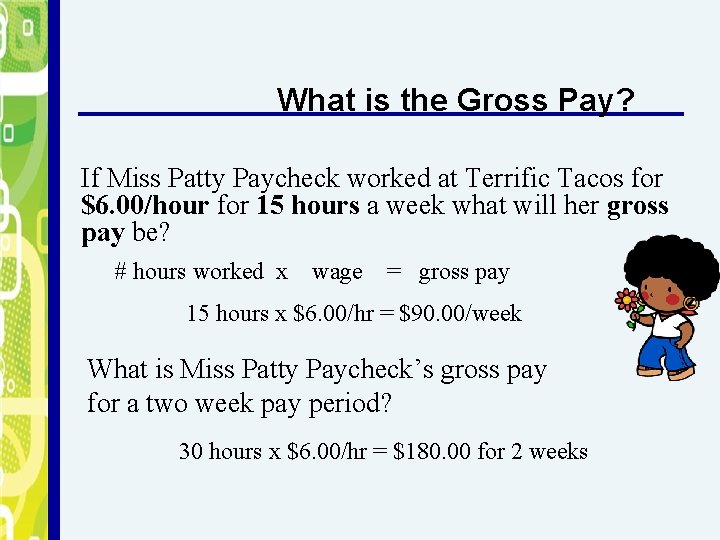
What is the Gross Pay? If Miss Patty Paycheck worked at Terrific Tacos for $6. 00/hour for 15 hours a week what will her gross pay be? # hours worked x wage = gross pay 15 hours x $6. 00/hr = $90. 00/week What is Miss Patty Paycheck’s gross pay for a two week pay period? 30 hours x $6. 00/hr = $180. 00 for 2 weeks
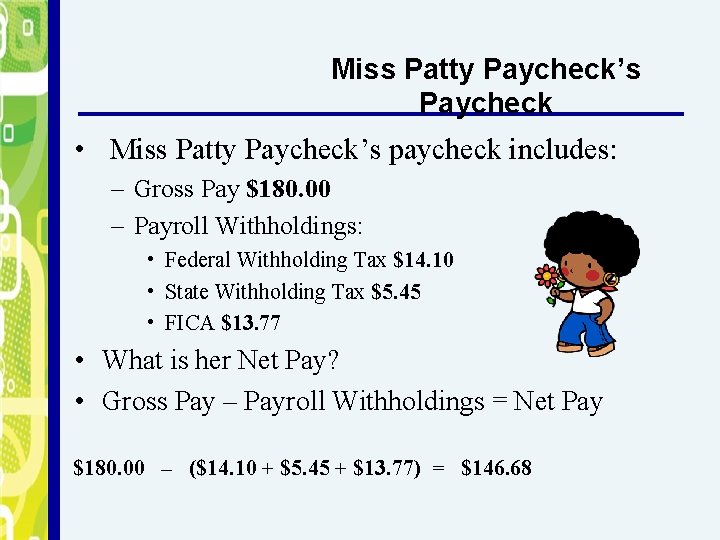
Miss Patty Paycheck’s Paycheck • Miss Patty Paycheck’s paycheck includes: – Gross Pay $180. 00 – Payroll Withholdings: • Federal Withholding Tax $14. 10 • State Withholding Tax $5. 45 • FICA $13. 77 • What is her Net Pay? • Gross Pay – Payroll Withholdings = Net Pay $180. 00 – ($14. 10 + $5. 45 + $13. 77) = $146. 68
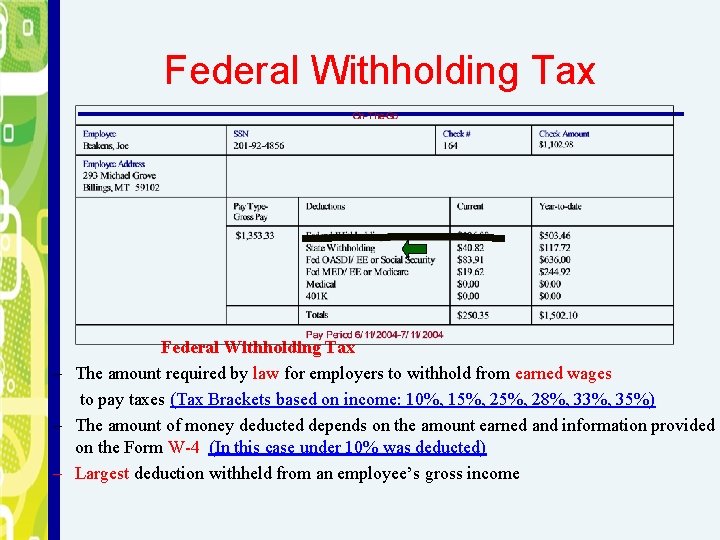
Federal Withholding Tax – The amount required by law for employers to withhold from earned wages to pay taxes (Tax Brackets based on income: 10%, 15%, 28%, 33%, 35%) – The amount of money deducted depends on the amount earned and information provided on the Form W-4 (In this case under 10% was deducted) – Largest deduction withheld from an employee’s gross income
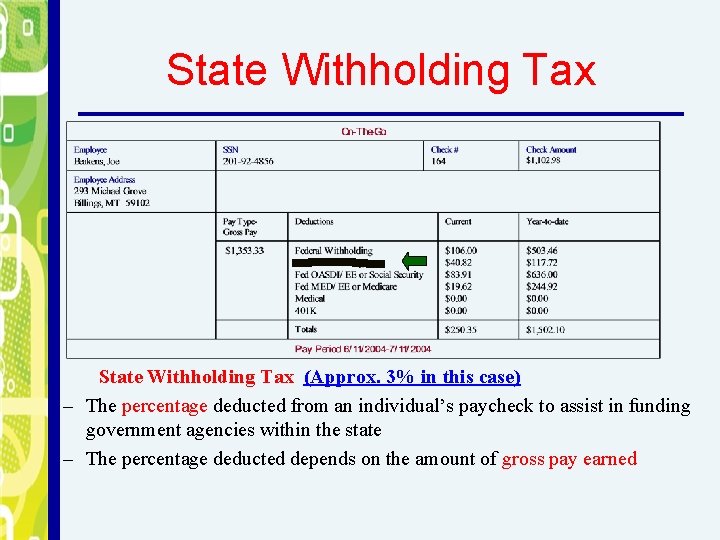
State Withholding Tax (Approx. 3% in this case) – The percentage deducted from an individual’s paycheck to assist in funding government agencies within the state – The percentage deducted depends on the amount of gross pay earned
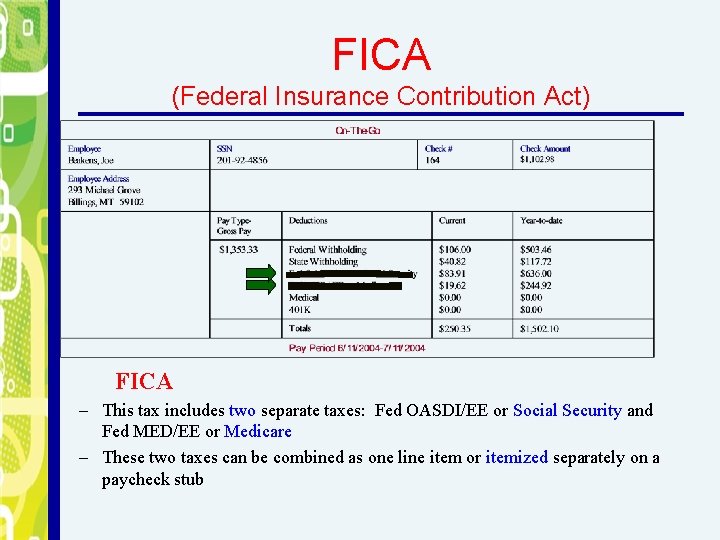
FICA (Federal Insurance Contribution Act) FICA – This tax includes two separate taxes: Fed OASDI/EE or Social Security and Fed MED/EE or Medicare – These two taxes can be combined as one line item or itemized separately on a paycheck stub
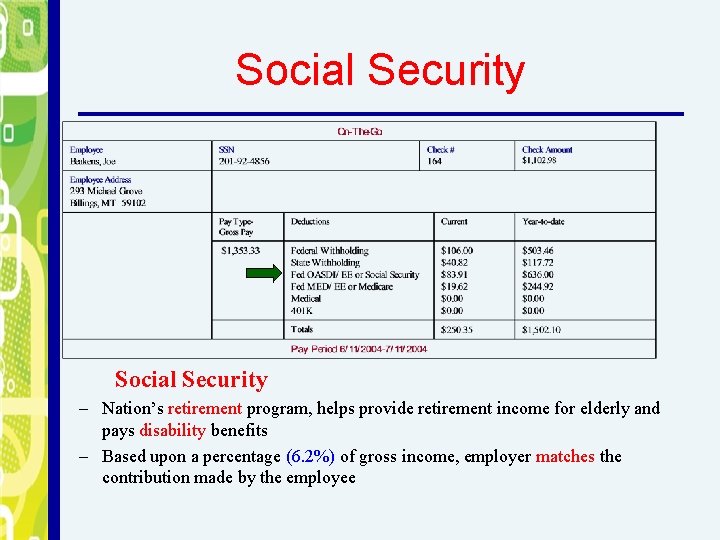
Social Security – Nation’s retirement program, helps provide retirement income for elderly and pays disability benefits – Based upon a percentage (6. 2%) of gross income, employer matches the contribution made by the employee
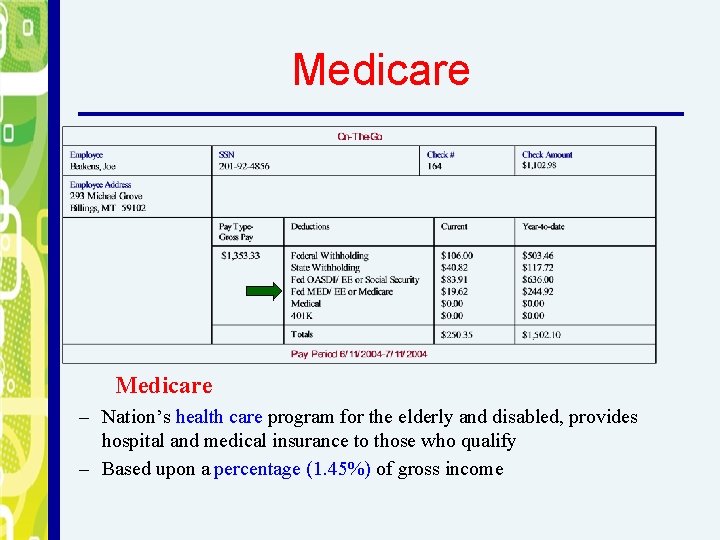
Medicare – Nation’s health care program for the elderly and disabled, provides hospital and medical insurance to those who qualify – Based upon a percentage (1. 45%) of gross income
Tax Forms – see pages 66 -68 • W-2 – reports a worker’s taxable income for the year • 1040 EZ – a tax return for filers with no dependents or itemized deductions • 1040 A – a tax return that allows more options for income and deductions • 1099 - – reports interest earned and selfemployment income (Ex: Landscaper, PT) 2 -3 Taxes and Other Deductions Slide 33
E-Filing – see page 66, 67 • It is a fast and safe way to file a tax return. • You can e-file yourself or hire an authorized e-file provider. • Those who meet adjusted gross income requirements can e-file free. • Refunds are often received much quicker. 2 -3 Taxes and Other Deductions Slide 34