
Let uu 1 u 2 un be a

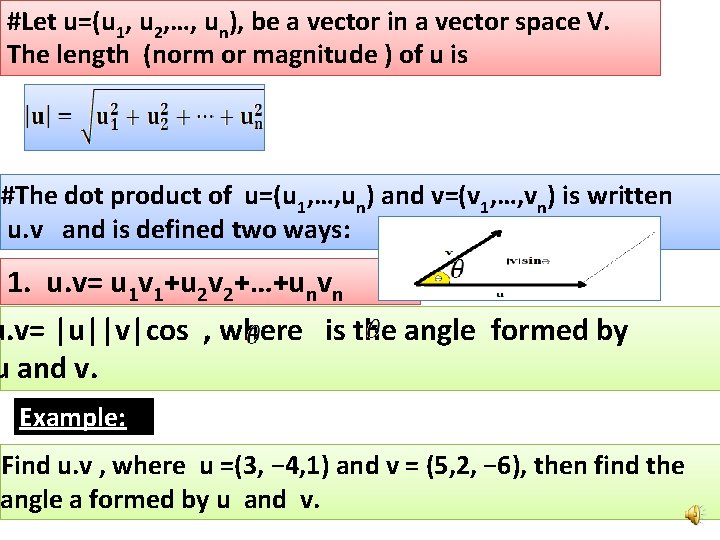
#Let u=(u 1, u 2, …, un), be a vector in a vector space V. The length (norm or magnitude ) of u is #The dot product of u=(u 1, …, un) and v=(v 1, …, vn) is written u. v and is defined two ways: 1. u. v= u 1 v 1+u 2 v 2+…+unvn u. v= |u||v|cos , where is the angle formed by u and v. Example: Find u. v , where u =(3, − 4, 1) and v = (5, 2, − 6), then find the angle a formed by u and v.
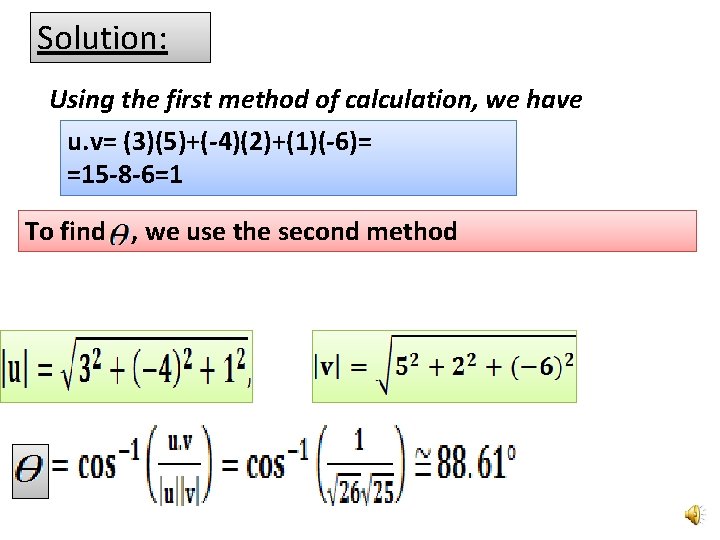
Solution: Using the first method of calculation, we have u. v= (3)(5)+(-4)(2)+(1)(-6)= =15 -8 -6=1 To find , we use the second method
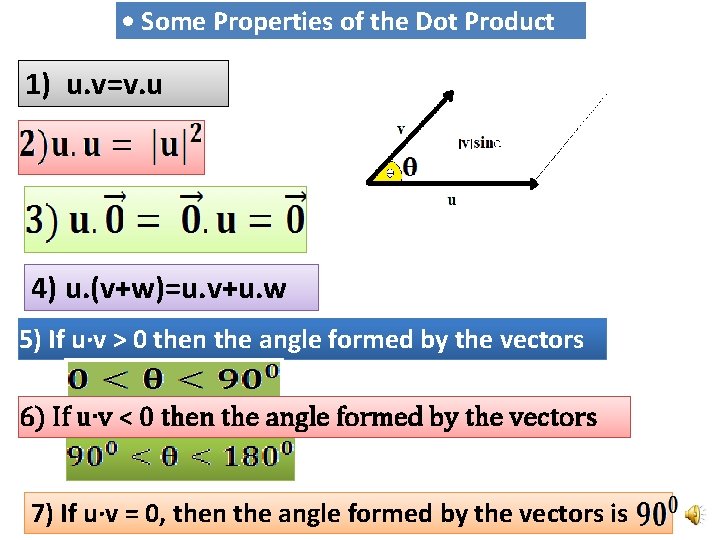
• Some Properties of the Dot Product 1) u. v=v. u 4) u. (v+w)=u. v+u. w 5) If u∙v > 0 then the angle formed by the vectors 6) If u∙v < 0 then the angle formed by the vectors 7) If u∙v = 0, then the angle formed by the vectors is
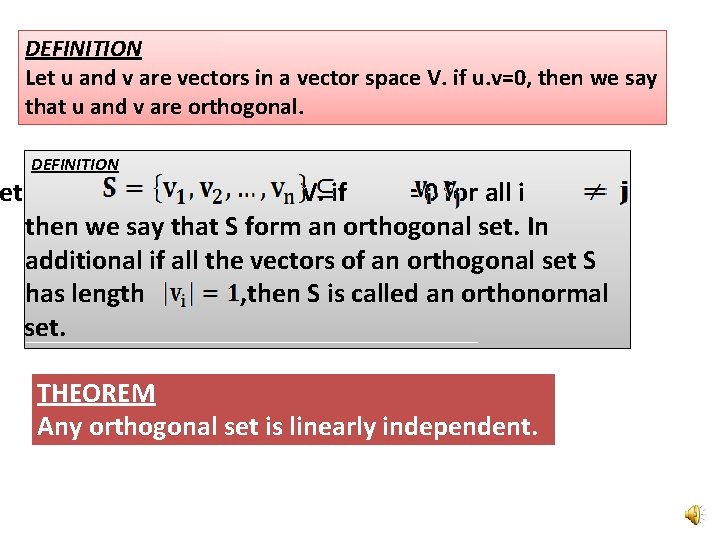
et DEFINITION Let u and v are vectors in a vector space V. if u. v=0, then we say that u and v are orthogonal. DEFINITION V. if =0 for all i then we say that S form an orthogonal set. In additional if all the vectors of an orthogonal set S has length , then S is called an orthonormal set. THEOREM Any orthogonal set is linearly independent.
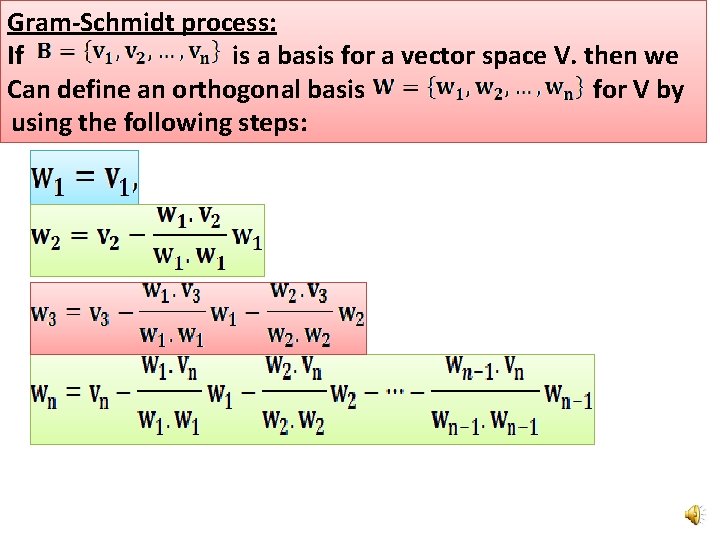
Gram-Schmidt process: If is a basis for a vector space V. then we Can define an orthogonal basis for V by using the following steps:

EXAMPLE Let be a basis for. We will use Gram-Schmidt process to find orthogonal and orthonormal bases for. =(1, 1, 0)
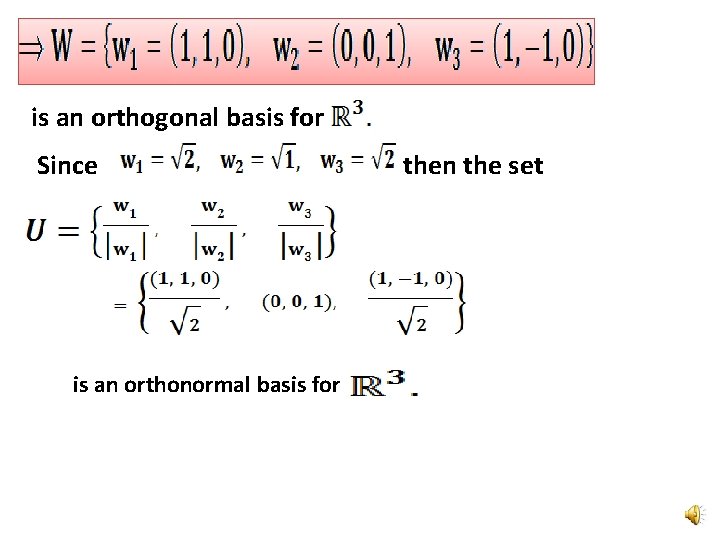
is an orthogonal basis for Since is an orthonormal basis for then the set
- Slides: 8