
Let there be Light The wave theory could
Let there be. . . Light
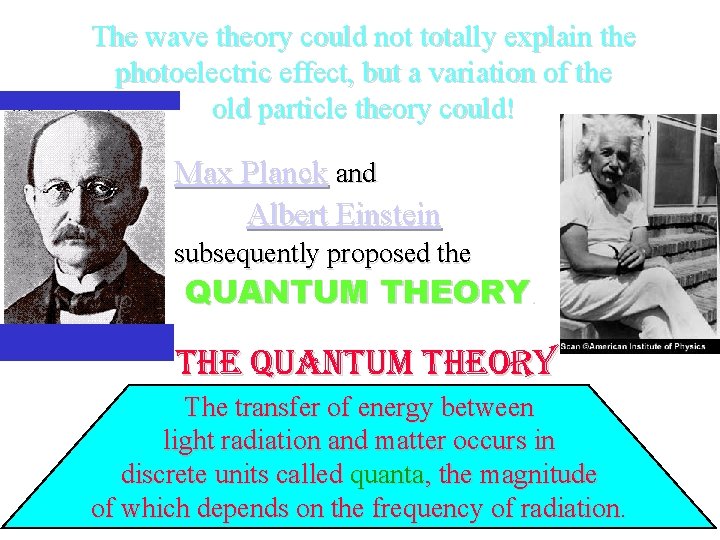
The wave theory could not totally explain the photoelectric effect, but a variation of the old particle theory could! Max Planck and Albert Einstein subsequently proposed the QUANTUM THEORY. the Quantum theory The transfer of energy between light radiation and matter occurs in discrete units called quanta, the magnitude of which depends on the frequency of radiation.
Although we still commonly characterize light as a wave, it is actually neither a wave nor a particle. It seems to have characteristics of both. The modern view of the nature of light recognizes the dual character: Light is radiant energy transported in photons that are guided along their path by a wave field.
This leads us to the Duality Principle: Principle Light is. . . • a wave when it acts like a wave • a particle when it acts like a particle
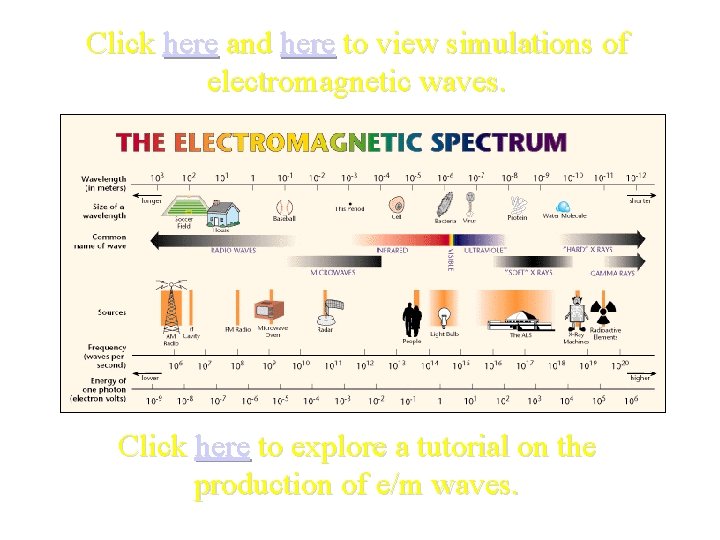
Click here and here to view simulations of electromagnetic waves. Click here to explore a tutorial on the production of e/m waves.

Visible light is that portion of the electromagnetic spectrum which stimulates the retina of the human eye. Visible spectrum wavelengths range from about 400 nm (violet) to 760 nm (red). Light travels at about 3 x 10⁸ m/s through empty space and slightly slower through air. Remember that for all waves, v = f.
Visible Light Wavelengths range from 400 nm to 700 nm n Longest wavelength = red n Shortest wavelength = violet n 1 nm = 1 x 10 -9 m n 7
Speed of Light does not require a medium n The speed of light depends on the medium n The more dense the material, the slower the light n Light travels fastest in a vacuum (no medium) n 8
Speed of Light Speed of light in a vacuum = 3. 00 x 108 m/s n Speed of light first calculated by Albert Michelson n The symbol, c, is used to represent the speed of light in a vacuum n 9
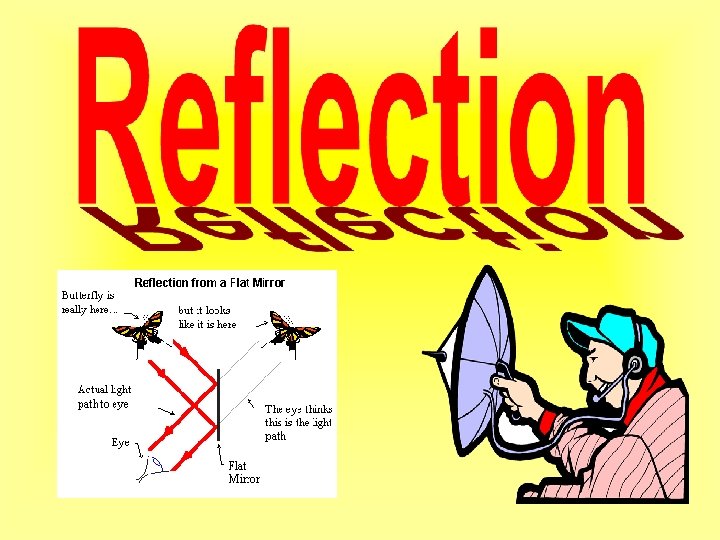
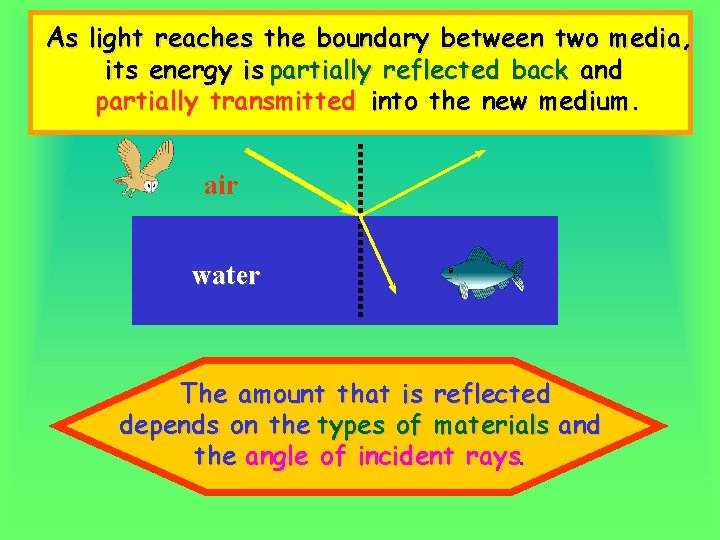
As light reaches the boundary between two media, its energy is partially reflected back and partially transmitted into the new medium. air water The amount that is reflected depends on the types of materials and the angle of incident rays.
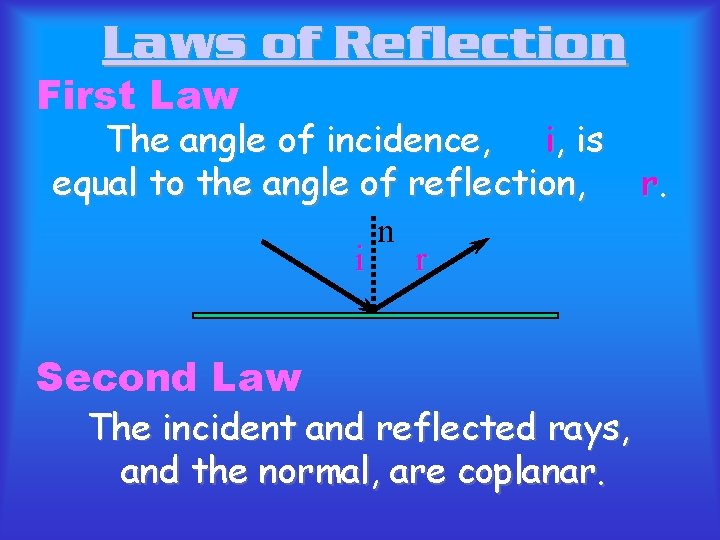
Laws of Reflection First Law The angle of incidence, i, is equal to the angle of reflection, r. n i r Second Law The incident and reflected rays, and the normal, are coplanar.
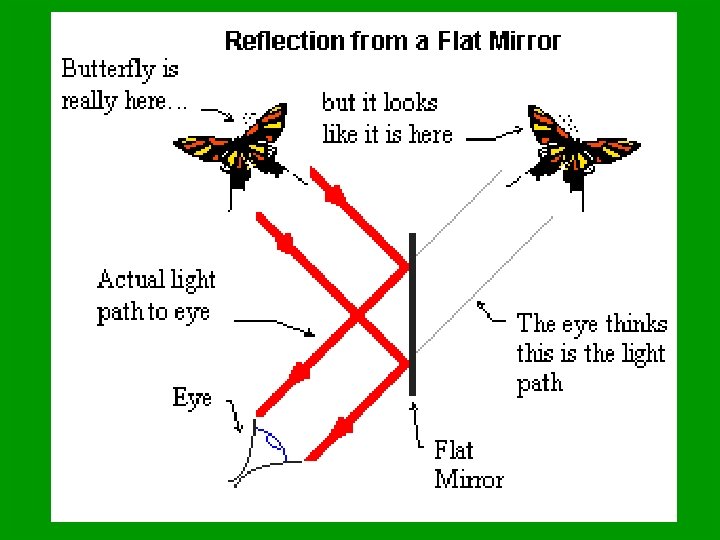
Images formed by mirrors and lenses may be classified as real or virtual. Real Image formed by actual rays of converging light Virtual Image not formed by actual rays of converging light, but from where the rays of light appear to come (diverging light rays)
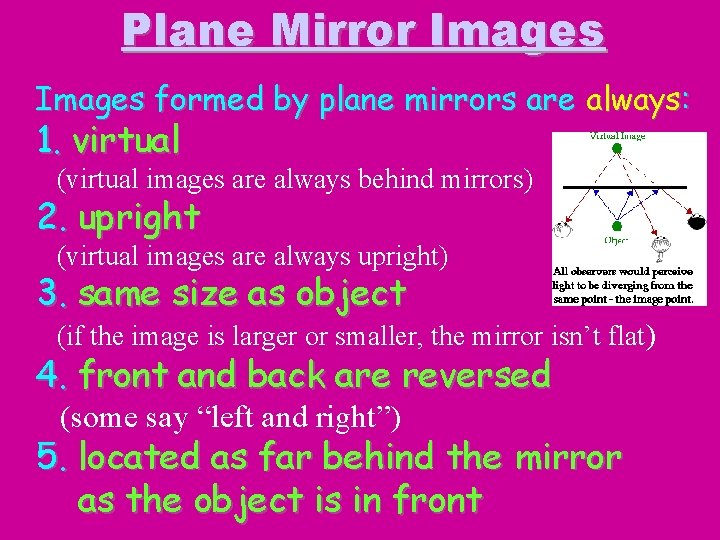
Plane Mirror Images formed by plane mirrors are always: 1. virtual (virtual images are always behind mirrors) 2. upright (virtual images are always upright) 3. same size as object (if the image is larger or smaller, the mirror isn’t flat) 4. front and back are reversed (some say “left and right”) 5. located as far behind the mirror as the object is in front
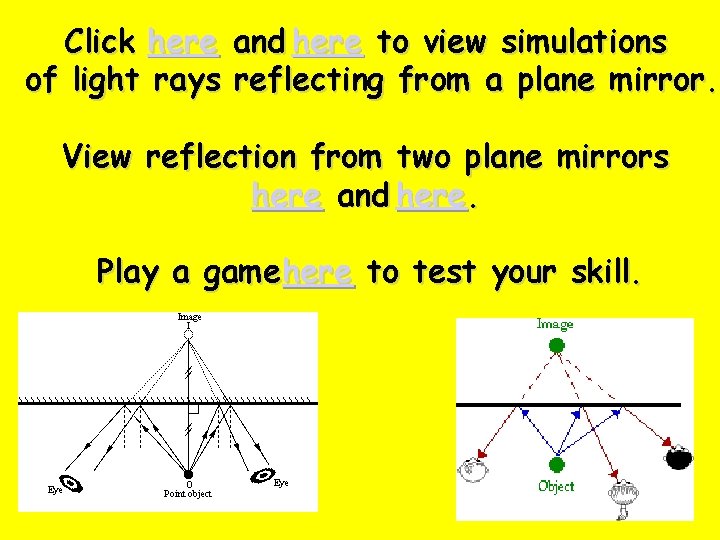
Click here and here to view simulations of light rays reflecting from a plane mirror. View reflection from two plane mirrors here and here. Play a gamehere to test your skill.
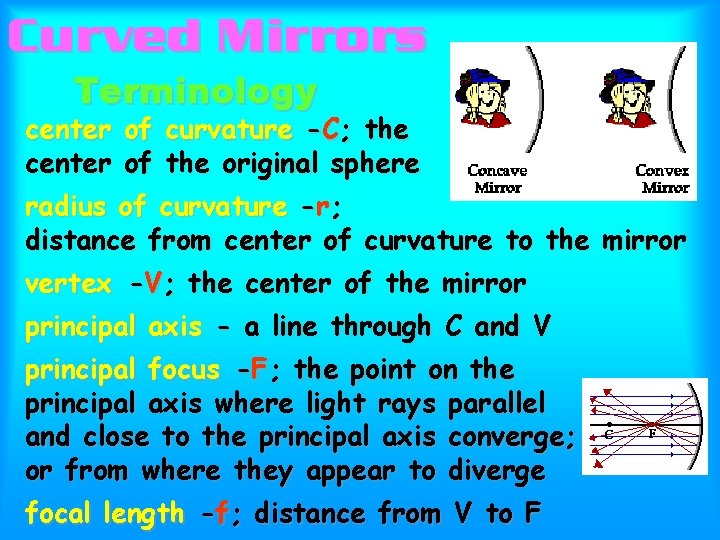
Curved Mirrors Terminology center of curvature -C; the center of the original sphere radius of curvature -r; distance from center of curvature to the mirror vertex -V; the center of the mirror principal axis - a line through C and V principal focus -F; the point on the principal axis where light rays parallel and close to the principal axis converge; or from where they appear to diverge focal length -f; distance from V to F
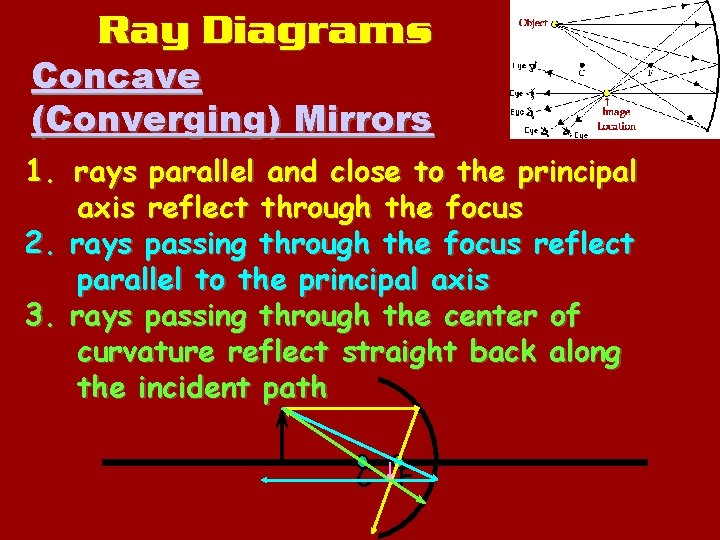
Ray Diagrams Concave (Converging) Mirrors 1. rays parallel and close to the principal axis reflect through the focus 2. rays passing through the focus reflect parallel to the principal axis 3. rays passing through the center of curvature reflect straight back along the incident path C F
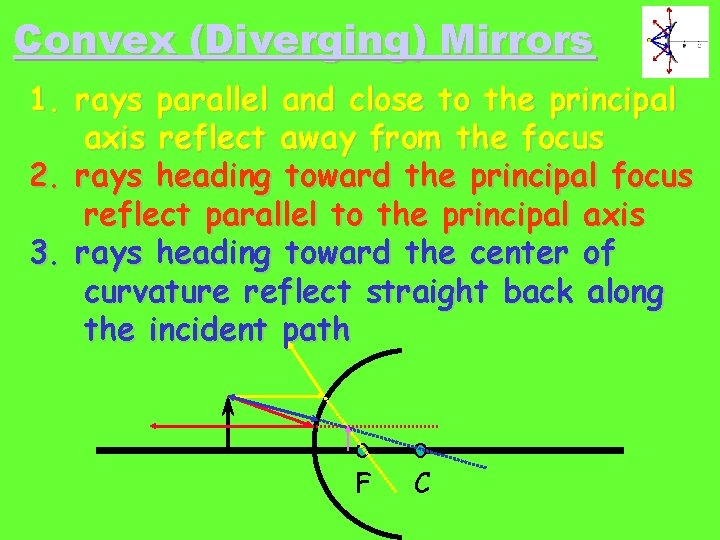
Convex (Diverging) Mirrors 1. rays parallel and close to the principal axis reflect away from the focus 2. rays heading toward the principal focus reflect parallel to the principal axis 3. rays heading toward the center of curvature reflect straight back along the incident path F C
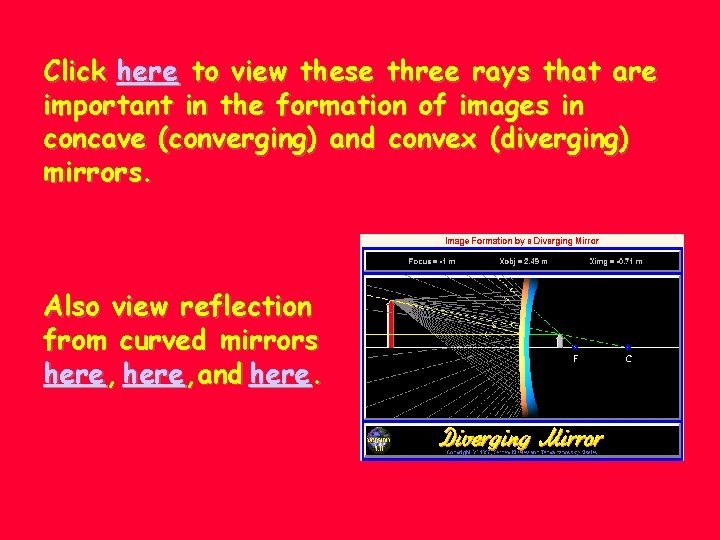
Click here to view these three rays that are important in the formation of images in concave (converging) and convex (diverging) mirrors. Also view reflection from curved mirrors here , and here.
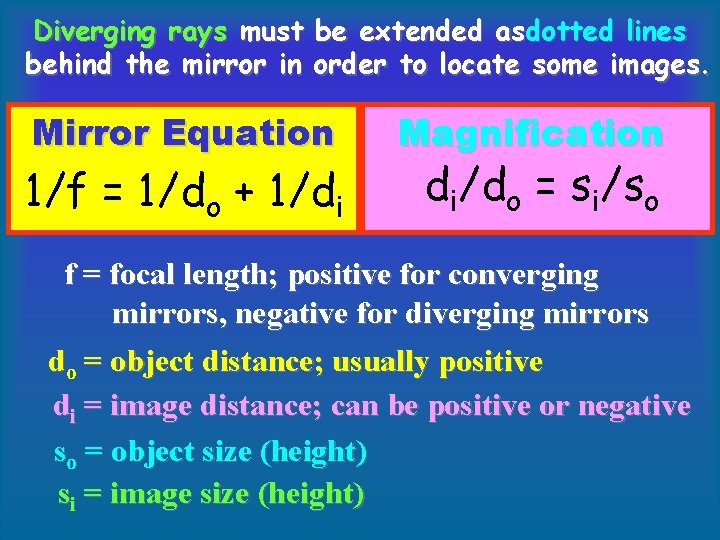
Diverging rays must be extended asdotted lines behind the mirror in order to locate some images. Mirror Equation 1/f = 1/do + 1/di Magnification di/do = si/so f = focal length; positive for converging mirrors, negative for diverging mirrors do = object distance; usually positive di = image distance; can be positive or negative so = object size (height) si = image size (height)
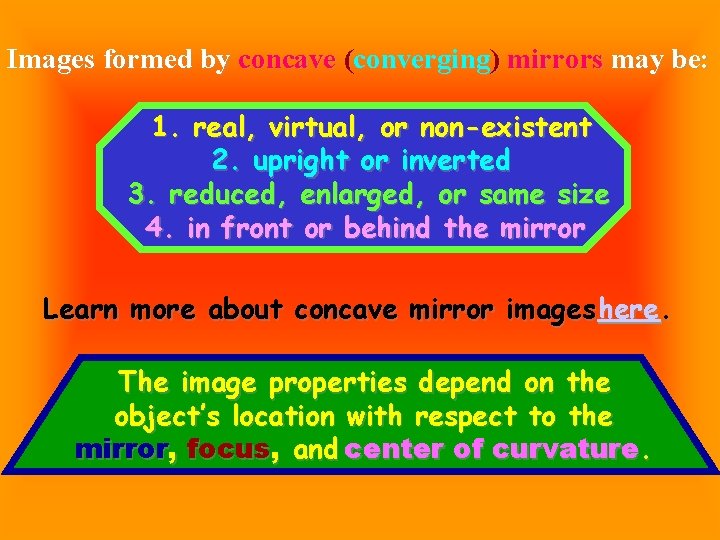
Images formed by concave (converging) mirrors may be: 1. real, virtual, or non-existent 2. upright or inverted 3. reduced, enlarged, or same size 4. in front or behind the mirror Learn more about concave mirror images here. The image properties depend on the object’s location with respect to the mirror, focus, and center of curvature.
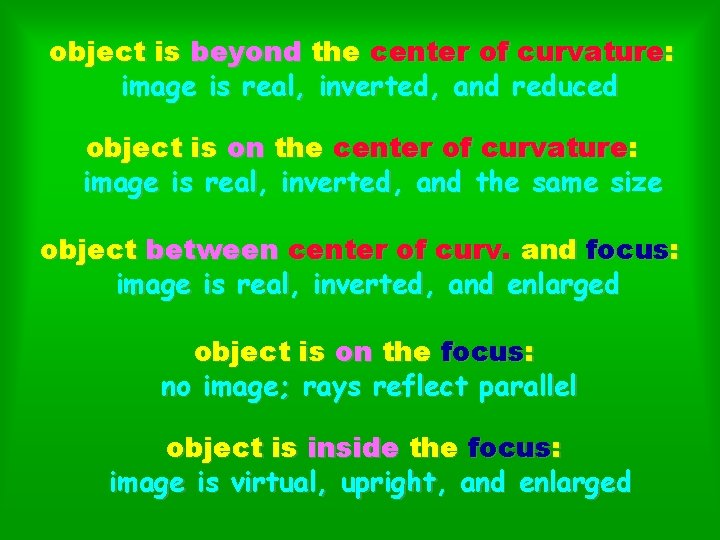
object is beyond the center of curvature: image is real, inverted, and reduced object is on the center of curvature: image is real, inverted, and the same size object between center of curv. and focus: image is real, inverted, and enlarged object is on the focus: no image; rays reflect parallel object is inside the focus: image is virtual, upright, and enlarged
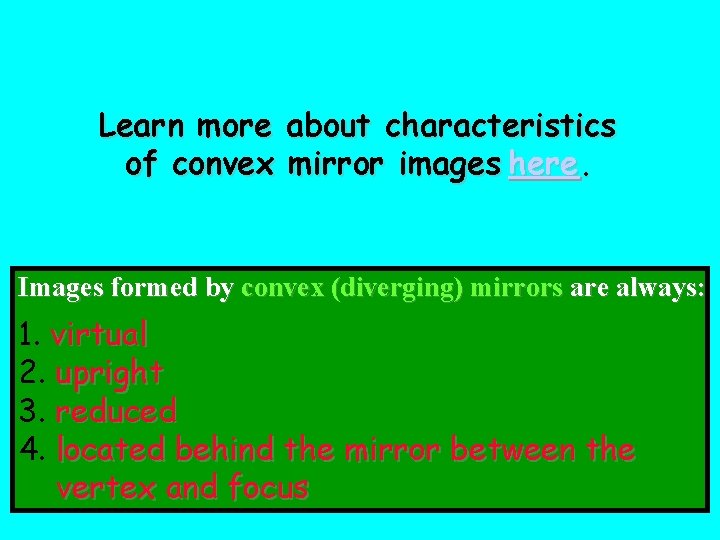
Learn more about characteristics of convex mirror images here. Images formed by convex (diverging) mirrors are always: 1. virtual 2. upright 3. reduced 4. located behind the mirror between the vertex and focus
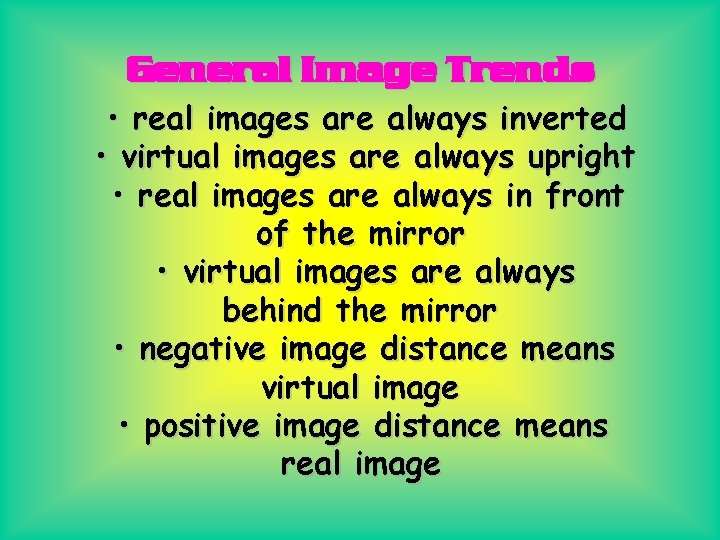
General Image Trends • real images are always inverted • virtual images are always upright • real images are always in front of the mirror • virtual images are always behind the mirror • negative image distance means virtual image • positive image distance means real image
- Slides: 25