
LET IT BEGINS WITH Blepharoptosis by Mohd Faiz

LET IT BEGINS WITH…

Blepharoptosis by Mohd Faiz Bin Mohd Azmi Muhd. Irfan Aqli Bin Abdullah Muhd. Syazwan Bin Mohd Nor
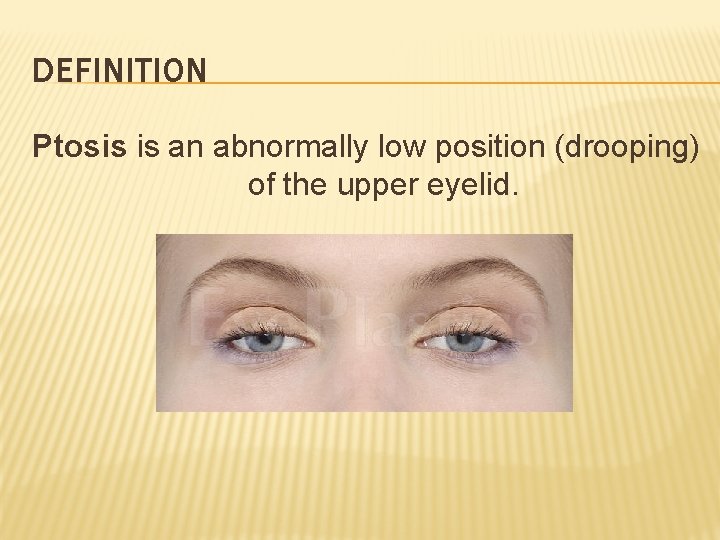
DEFINITION Ptosis is an abnormally low position (drooping) of the upper eyelid.
INTRODUCTION � Ptosis is also known as Blepharoptosis. It refers to an eyelid which is droopy. � This may cause a loss of vision, especially while reading, headaches, and eyebrow strain � It is a condition that may affect one or both eyes
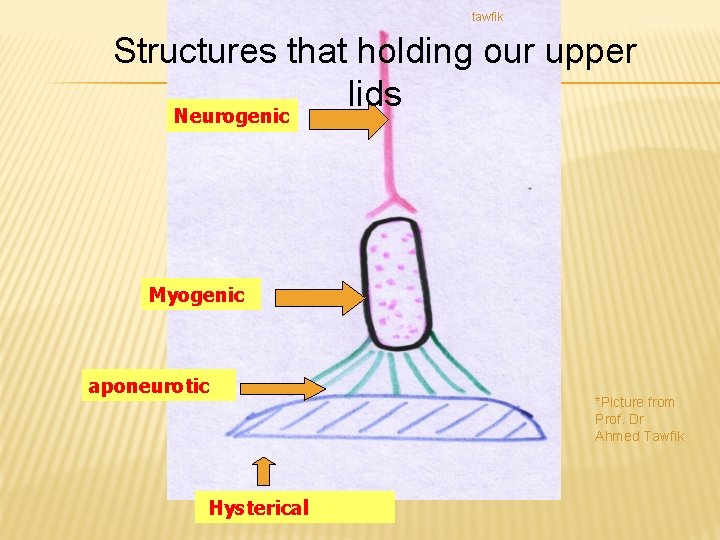
tawfik Structures that holding our upper lids Neurogenic Myogenic aponeurotic mechanical Hysterical *Picture from Prof. Dr Ahmed Tawfik
CLASSIFICATION � Can be classified according to its etiology into (A) Congenital (B) Acquired
(A) CONGENITAL PTOSIS Definition: Ptosis that is present since birth

WHAT IS THE PROBLEM IN THIS CONGENITAL PTOSIS? (CAUSE) a) Neurogenic b) Myogenic
A) NEUROGENIC CONGENITAL PTOSIS � occur when the innervation to the levator is interrupted through neurologic or neuromuscular junction dysfunction. � includes oculomotor nerve palsy, Horner's Syndrome, Marcus Gunn jaw winking syndrome, III rd cranial nerve misdirection. � Any other condition than include nerve manifestation may cause ptosis
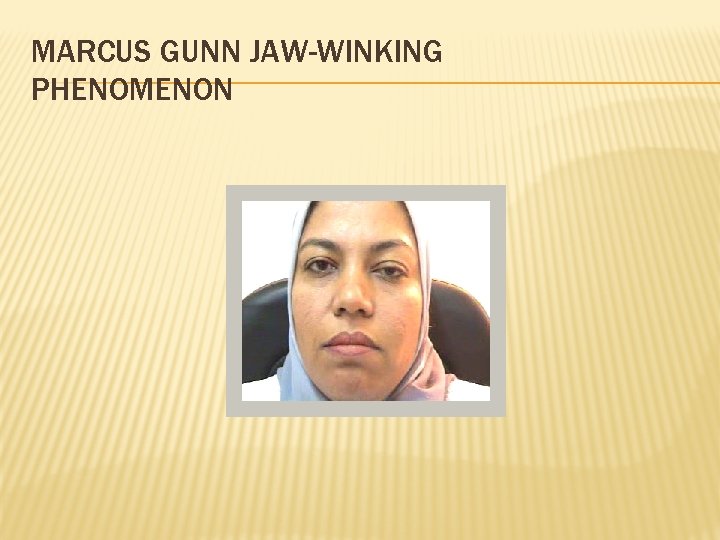
MARCUS GUNN JAW-WINKING PHENOMENON
B) MYOGENIC CONGENITAL PTOSIS � Rather than normal muscle fibers, fibrous and adipose tissues are present in the muscle belly, diminishing the ability of the levator to contract and relax. Therefore, the condition is commonly called congenital myogenic ptosis. � which includes myotonic dystrophy, ocular myopathy, simple congenital ptosis, blepharophimosis syndrome.
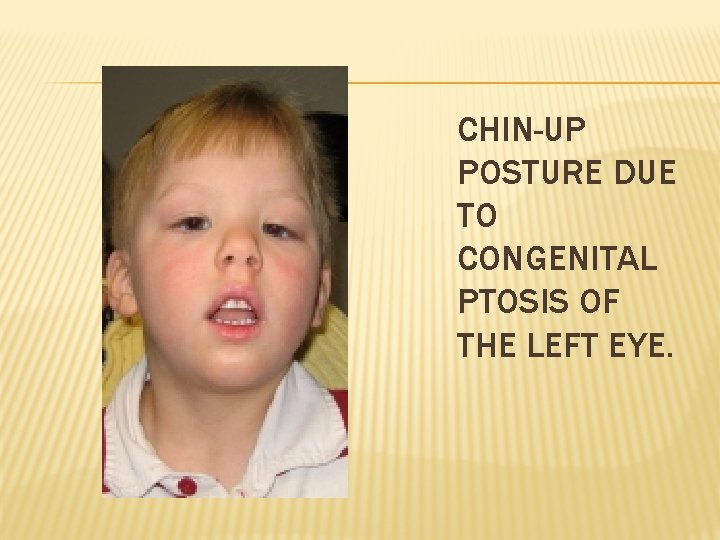
CHIN-UP POSTURE DUE TO CONGENITAL PTOSIS OF THE LEFT EYE.
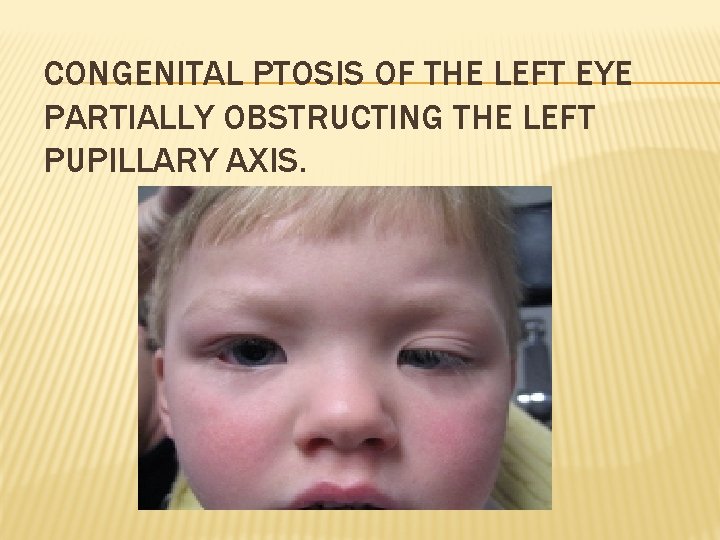
CONGENITAL PTOSIS OF THE LEFT EYE PARTIALLY OBSTRUCTING THE LEFT PUPILLARY AXIS.
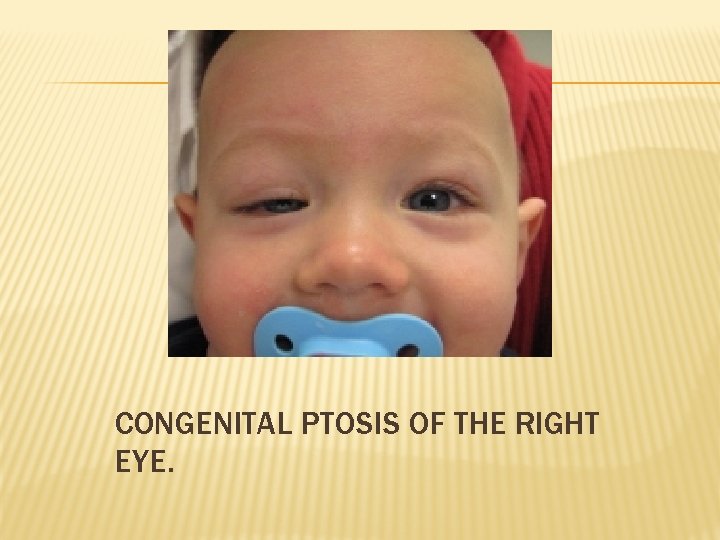
CONGENITAL PTOSIS OF THE RIGHT EYE.
SOMETHING WE SHOULD KNOW. . � In approximately 70 percent of cases, the condition affects only one eye. � If the drooping eyelid obscures part of the baby’s visual fields, surgery must be performed to correct the problem early in life to prevent permanent loss of vision.
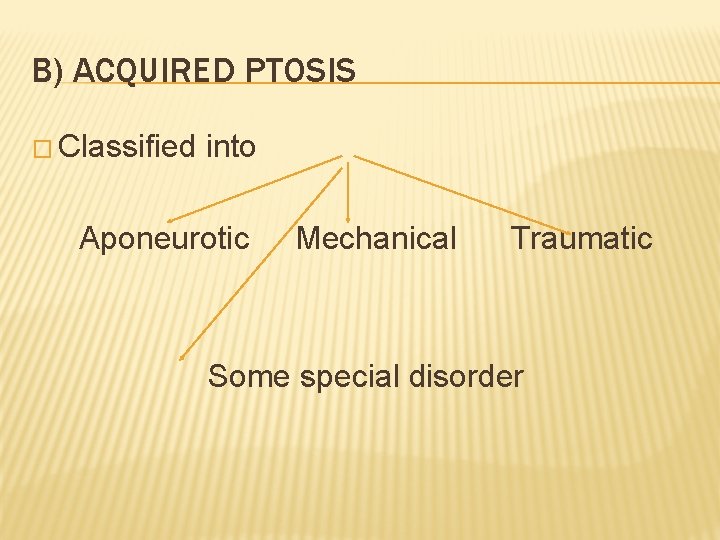
B) ACQUIRED PTOSIS � Classified into Aponeurotic Mechanical Traumatic Some special disorder
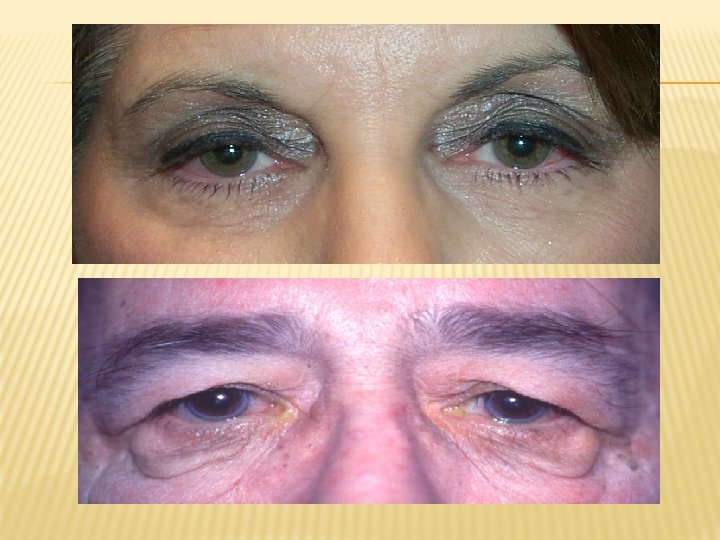
APONEUROTIC PTOSIS � senile or age-related ptosis— This is the most common cause of ptosis How it happens? � long-term effects of gravity and aging cause a stretching of a wide, tendon-like tissue; that helps the levator muscle lift the eyelid (aponeurosis)
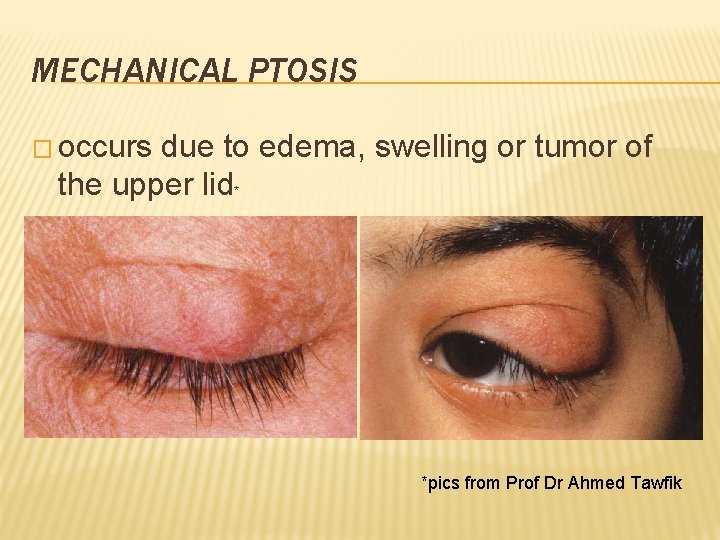
MECHANICAL PTOSIS � occurs due to edema, swelling or tumor of the upper lid * *pics from Prof Dr Ahmed Tawfik
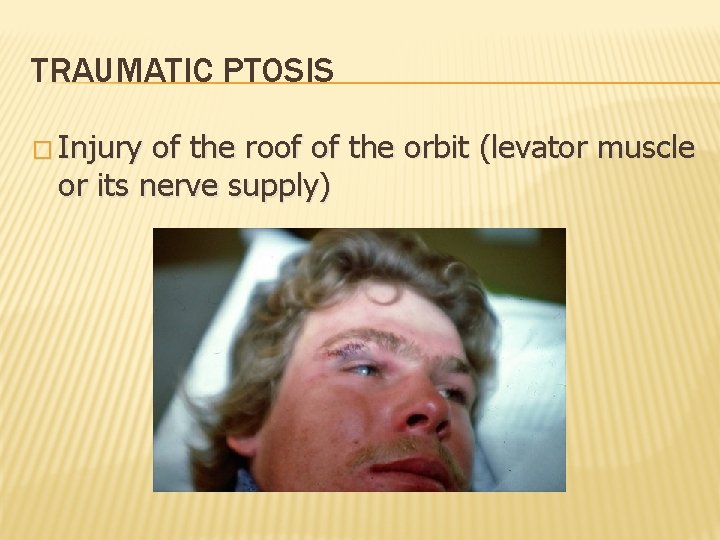
TRAUMATIC PTOSIS � Injury of the roof of the orbit (levator muscle or its nerve supply)
BLEPHAROPHIMOSIS � Inherited disorder � is a condition where the patient has bilateral ptosis with reduced lid size, vertically and horizontally. The nasal bridge is flat and there is hypoplastic orbital rim. � Both the vertical and horizontal palpebral fissures (eyelid opening) are shortened. Vignes (1889) probably first described this entity, a dysplasia of the eyelids
MYASTHENIA GRAVIS � Systemic disorder � a rare disorder that affects the ways muscles respond to nerves. � Myasthenia gravis can produce progressive muscle weakness, not only in the eyelids but also in the facial muscles, arms, legs and other parts of the body
PSEUDOPTOSIS It is appearance of ptosis but with false causes of its drooping of eyelid
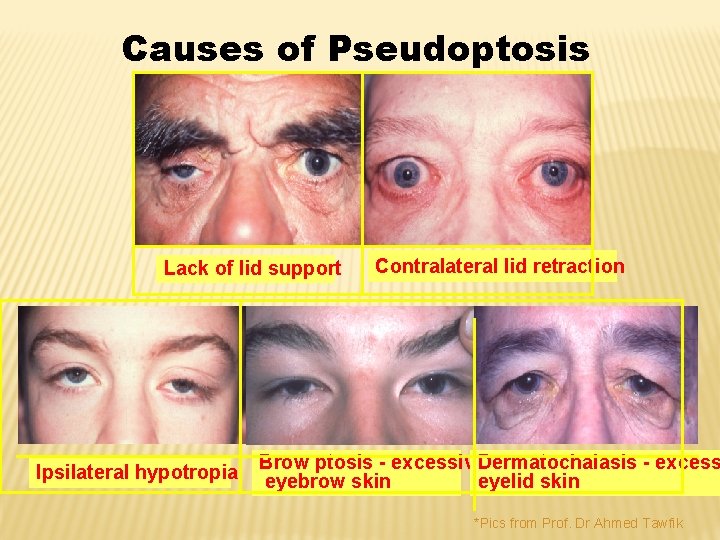
Causes of Pseudoptosis Lack of lid support Ipsilateral hypotropia Contralateral lid retraction Brow ptosis - excessive. Dermatochalasis - excess eyebrow skin eyelid skin *Pics from Prof. Dr Ahmed Tawfik
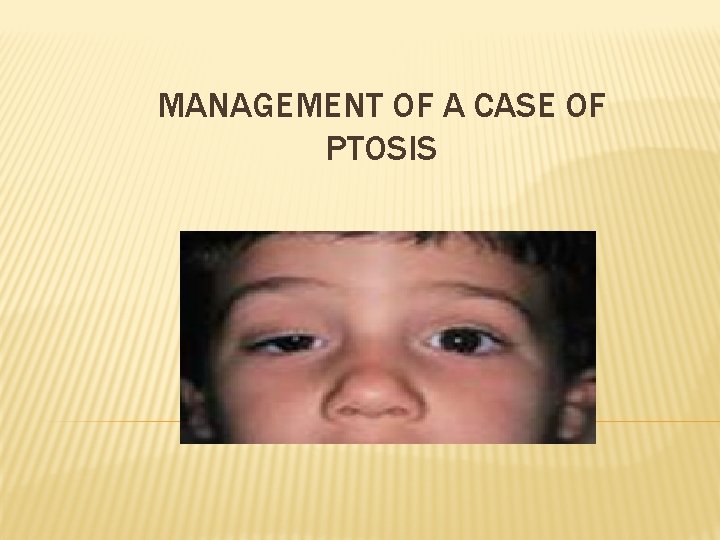
MANAGEMENT OF A CASE OF PTOSIS
HISTORY � Personal history � Age of onset � History of fever � Family history
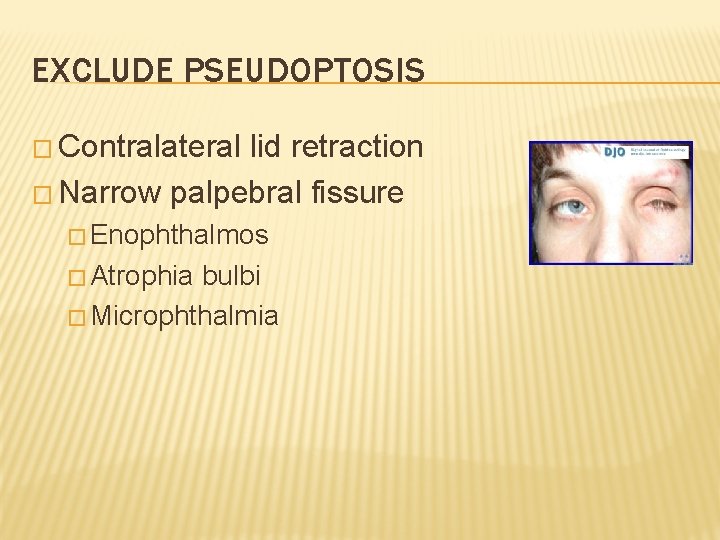
EXCLUDE PSEUDOPTOSIS � Contralateral lid retraction � Narrow palpebral fissure � Enophthalmos � Atrophia bulbi � Microphthalmia
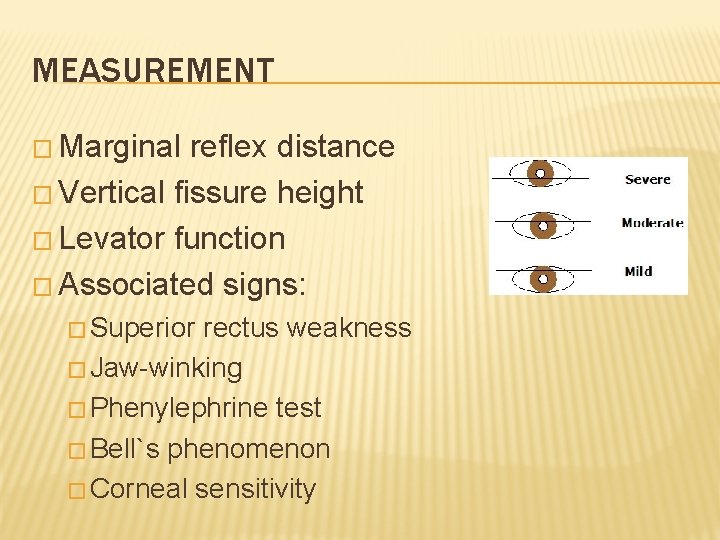
MEASUREMENT � Marginal reflex distance � Vertical fissure height � Levator function � Associated signs: � Superior rectus weakness � Jaw-winking � Phenylephrine test � Bell`s phenomenon � Corneal sensitivity
- Slides: 28