
LET Estimation of Heavy Ion Particles based on
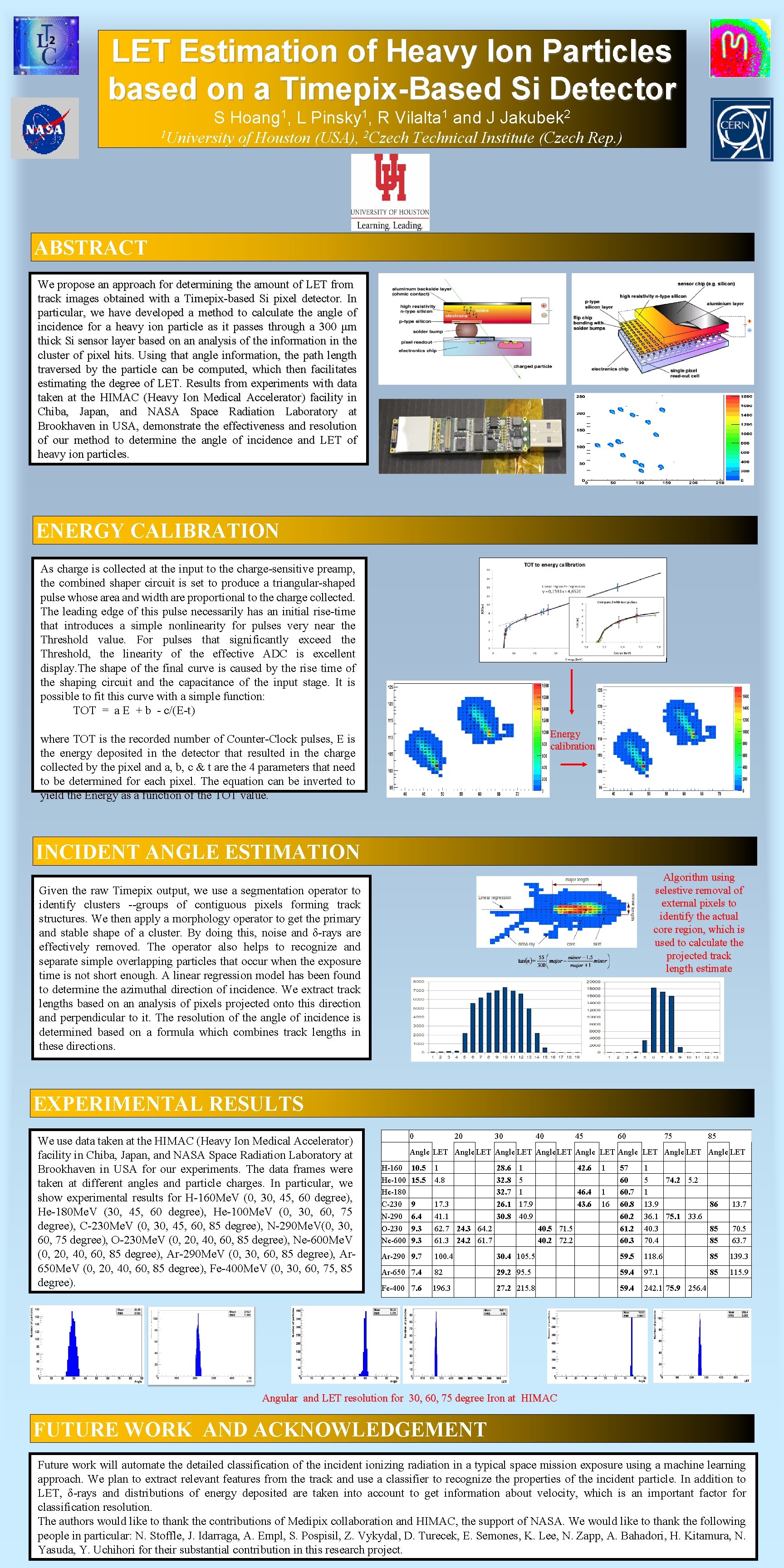
LET Estimation of Heavy Ion Particles based on a Timepix-Based Si Detector S Hoang 1, L Pinsky 1, R Vilalta 1 and J Jakubek 2 1 University of Houston (USA), 2 Czech Technical Institute (Czech Rep. ) ABSTRACT We propose an approach for determining the amount of LET from track images obtained with a Timepix-based Si pixel detector. In particular, we have developed a method to calculate the angle of incidence for a heavy ion particle as it passes through a 300 μm thick Si sensor layer based on an analysis of the information in the cluster of pixel hits. Using that angle information, the path length traversed by the particle can be computed, which then facilitates estimating the degree of LET. Results from experiments with data taken at the HIMAC (Heavy Ion Medical Accelerator) facility in Chiba, Japan, and NASA Space Radiation Laboratory at Brookhaven in USA, demonstrate the effectiveness and resolution of our method to determine the angle of incidence and LET of heavy ion particles. ENERGY CALIBRATION As charge is collected at the input to the charge-sensitive preamp, the combined shaper circuit is set to produce a triangular-shaped pulse whose area and width are proportional to the charge collected. The leading edge of this pulse necessarily has an initial rise-time that introduces a simple nonlinearity for pulses very near the Threshold value. For pulses that significantly exceed the Threshold, the linearity of the effective ADC is excellent display. The shape of the final curve is caused by the rise time of the shaping circuit and the capacitance of the input stage. It is possible to fit this curve with a simple function: TOT = a E + b - c/(E-t) Energy calibration where TOT is the recorded number of Counter-Clock pulses, E is the energy deposited in the detector that resulted in the charge collected by the pixel and a, b, c & t are the 4 parameters that need to be determined for each pixel. The equation can be inverted to yield the Energy as a function of the TOT value. INCIDENT ANGLE ESTIMATION Algorithm using selestive removal of external pixels to identify the actual core region, which is used to calculate the projected track length estimate Given the raw Timepix output, we use a segmentation operator to identify clusters --groups of contiguous pixels forming track structures. We then apply a morphology operator to get the primary and stable shape of a cluster. By doing this, noise and δ-rays are effectively removed. The operator also helps to recognize and separate simple overlapping particles that occur when the exposure time is not short enough. A linear regression model has been found to determine the azimuthal direction of incidence. We extract track lengths based on an analysis of pixels projected onto this direction and perpendicular to it. The resolution of the angle of incidence is determined based on a formula which combines track lengths in these directions. EXPERIMENTAL RESULTS We use data taken at the HIMAC (Heavy Ion Medical Accelerator) facility in Chiba, Japan, and NASA Space Radiation Laboratory at Brookhaven in USA for our experiments. The data frames were taken at different angles and particle charges. In particular, we show experimental results for H-160 Me. V (0, 30, 45, 60 degree), He-180 Me. V (30, 45, 60 degree), He-100 Me. V (0, 30, 60, 75 degree), C-230 Me. V (0, 30, 45, 60, 85 degree), N-290 Me. V(0, 30, 60, 75 degree), O-230 Me. V (0, 20, 40, 60, 85 degree), Ne-600 Me. V (0, 20, 40, 60, 85 degree), Ar-290 Me. V (0, 30, 60, 85 degree), Ar 650 Me. V (0, 20, 40, 60, 85 degree), Fe-400 Me. V (0, 30, 60, 75, 85 degree). 0 20 30 40 45 60 75 85 Angle LET Angle LET H-160 He-100 He-180 C-230 N-290 O-230 Ne-600 10. 5 15. 5 9 6. 4 9. 3 1 4. 8 17. 3 41. 1 62. 7 24. 3 64. 2 61. 3 24. 2 61. 7 28. 6 32. 8 32. 7 26. 1 30. 8 1 5 1 17. 9 40. 5 71. 5 40. 2 72. 2 42. 6 1 46. 4 43. 6 1 16 57 60 60. 7 60. 8 60. 2 61. 2 60. 3 1 5 74. 2 5. 2 1 13. 9 86 36. 1 75. 1 33. 6 40. 3 85 70. 4 85 13. 7 70. 5 63. 7 Ar-290 9. 7 100. 4 30. 4 105. 5 59. 5 118. 6 85 139. 3 Ar-650 7. 4 82 29. 2 95. 5 59. 4 97. 1 85 115. 9 Fe-400 7. 6 196. 3 27. 2 215. 8 59. 4 242. 1 75. 9 256. 4 Angular and LET resolution for 30, 60, 75 degree Iron at HIMAC FUTURE WORK AND ACKNOWLEDGEMENT Future work will automate the detailed classification of the incident ionizing radiation in a typical space mission exposure using a machine learning approach. We plan to extract relevant features from the track and use a classifier to recognize the properties of the incident particle. In addition to LET, δ-rays and distributions of energy deposited are taken into account to get information about velocity, which is an important factor for classification resolution. The authors would like to thank the contributions of Medipix collaboration and HIMAC, the support of NASA. We would like to thank the following people in particular: N. Stoffle, J. Idarraga, A. Empl, S. Pospisil, Z. Vykydal, D. Turecek, E. Semones, K. Lee, N. Zapp, A. Bahadori, H. Kitamura, N. Yasuda, Y. Uchihori for their substantial contribution in this research project.
- Slides: 1